Leak-Proof Food Packaging Guide for the United States
In the United States, choosing leak-proof food packaging is no longer a minor purchasing decision. It directly affects customer satisfaction, delivery ratings, food safety, waste reduction, brand image, and operating cost. For restaurants in New York, food trucks in Los Angeles, meal-prep brands in Chicago, seafood sellers in Seattle, and catering companies around Houston or Atlanta, the wrong container can lead to spills, soggy bags, refunds, and damaged reputations. The right container, by contrast, protects food texture, keeps sauces contained, supports compliance, and strengthens presentation from kitchen to customer doorstep.
This guide explains how buyers in the U.S. market can evaluate leak-resistant food packaging using practical criteria: material structure, coating systems, sealing performance, transport conditions, testing methods, industry requirements, and supplier capabilities. It also covers future directions through 2026, including compostability, PFAS scrutiny, stronger barrier engineering, and the shift toward packaging that balances performance with sustainability.
Quick Answer

If you need a fast answer, the best leak-proof food packaging choice depends on the food’s temperature, oil content, storage time, transport distance, and sustainability target. For soups, curries, ramen, chili, and saucy rice bowls, use containers with a reliable liquid barrier, tight lid fit, strong sidewall compression strength, and seam integrity tested under hot-fill and movement conditions. For greasy foods such as fried chicken, noodles, or loaded fries, oil resistance matters as much as liquid holdout. For cold salads, fruit, and deli items, moisture resistance and lid clarity may matter more than thermal stability.
In the United States, buyers should prioritize six checkpoints before placing an order:
- Match the packaging structure to the food application, not just the volume.
- Confirm barrier type: PE, PLA, water-based barrier, or alternative coating.
- Request test results for leaks, compression, stacking, and temperature performance.
- Check compliance with FDA food-contact requirements and any customer sustainability standards.
- Review lid fit, seam design, and handling performance in delivery situations.
- Choose a supplier that can provide samples, customization, and stable production quality.
For many U.S. foodservice buyers, paper-based containers with food-grade PE lining remain the most practical option for high-moisture and sauce-heavy applications because they offer a strong balance of cost, leak resistance, and broad operational compatibility. Compostable PLA-lined options are attractive for selected cold or moderate-heat uses where sustainability messaging matters and local waste programs support compostables. Specialty coatings and structural upgrades are increasingly valuable for brands seeking lower plastic content without sacrificing performance.
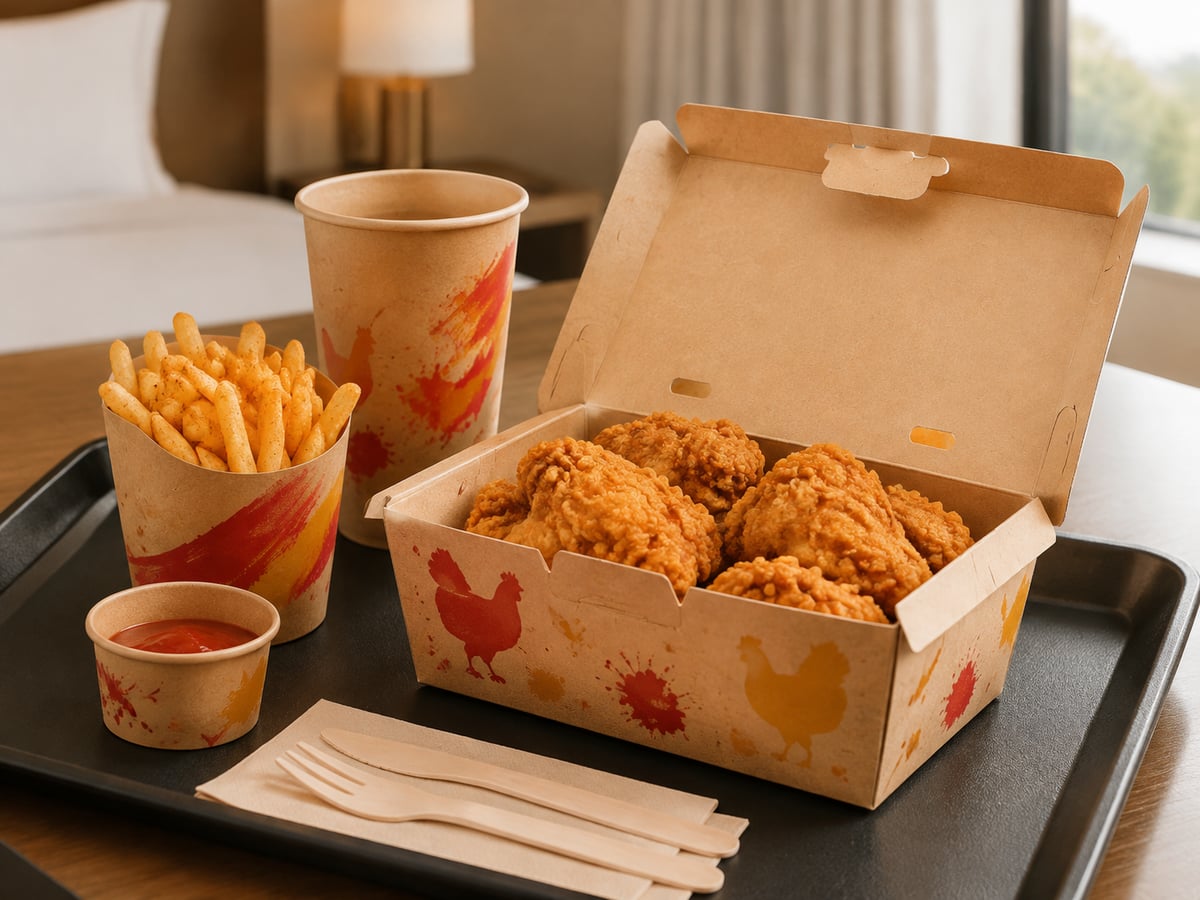
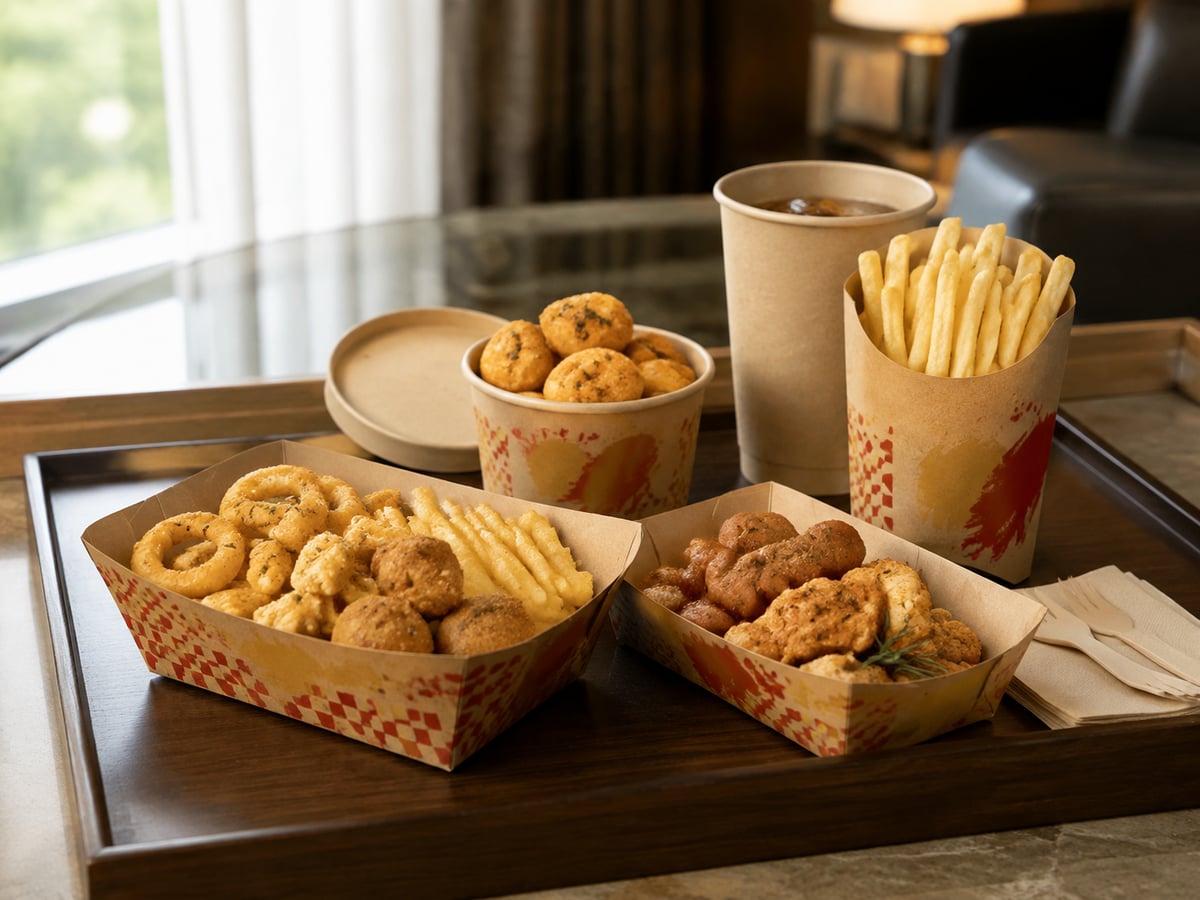
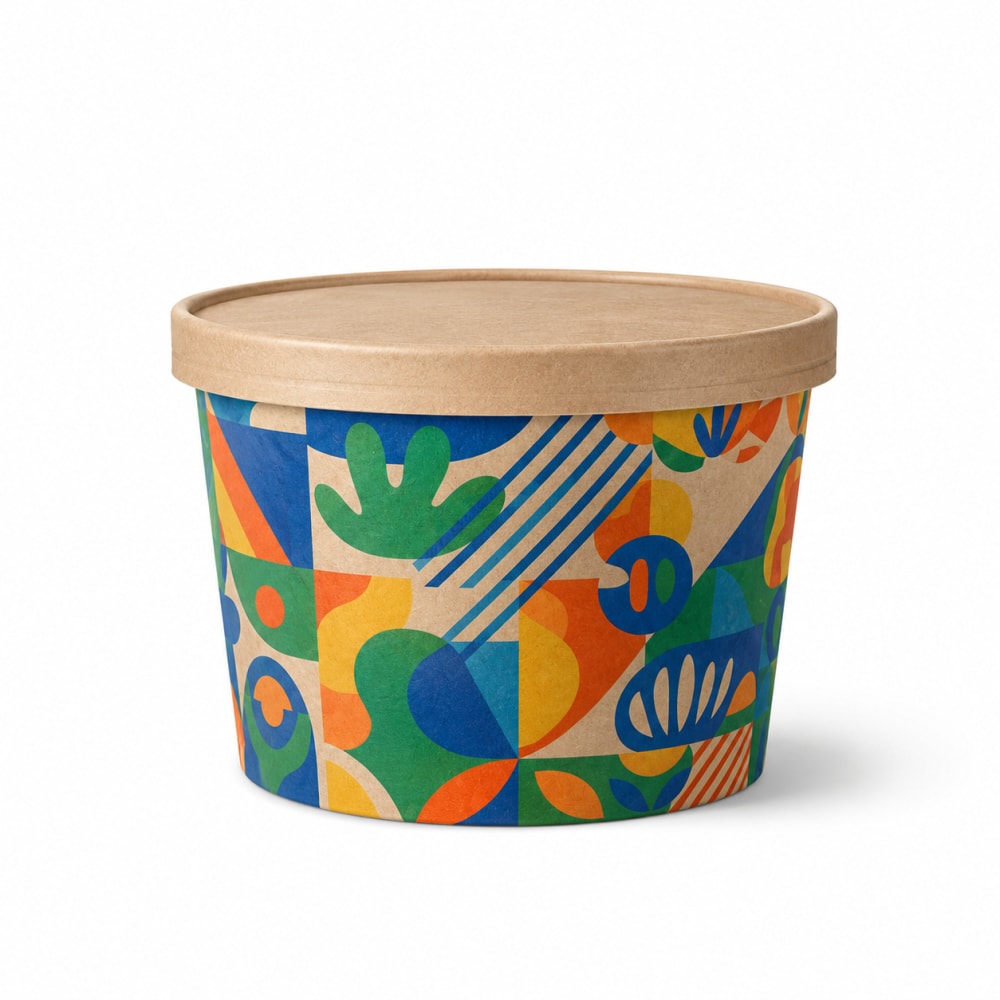
Common winning formats include kraft takeout boxes, coated paper bowls, compartment meal boxes, deli containers, and matching lids designed to reduce side leakage during transport. Buyers looking for category-specific options can review Custom Paper Food Container products, Custom Paper Bowl products, and Custom Paper Cup products when comparing structures for different foodservice channels.
| Food Type | Leak Risk | Best Container Style | Recommended Barrier | Lid Requirement | Primary Buying Focus |
|---|---|---|---|---|---|
| Soup and broth | Very high | Deep paper bowl or soup tub | PE or advanced water barrier | Snap-fit sealed lid | Heat resistance and seam integrity |
| Noodles with sauce | High | Tall bowl or noodle box | PE lining | Secure anti-shift lid | Oil plus liquid resistance |
| Curry and rice | High | Bento box or rigid food container | PE lining | Tight multi-point closure | Compartment stability |
| Salads with dressing | Medium | Salad bowl or deli box | PLA or moisture barrier | Clear locking lid | Condensation control |
| Fried foods | Medium | Fries cup or tray | Oil-resistant coating | Optional vented cover | Grease resistance |
| Desserts and fruit | Low to medium | Deli box or paper cup | Moisture-resistant barrier | PET or paper lid | Presentation and freshness |
The table above shows why one-size-fits-all packaging usually fails. A soup bowl that survives a 30-minute delivery in Boston may not be ideal for a chilled dessert cup in Miami. Leakage is always a combination of food chemistry, package design, and logistics conditions.
Understanding Leak-Proof Technologies Used in Modern Food Packaging

Leak-proof packaging is not created by a single feature. It is a system made up of substrate, coating, shape, seams, rim design, and closure. In modern food packaging, especially paper-based formats, the barrier layer prevents moisture and oil from migrating through fibers, while the structure helps the package resist buckling, panel flexing, and seam opening during transport.
The most common leak-prevention technologies used in U.S.-bound paper food packaging include laminated coatings, precision-formed side seams, rolled rims for lid retention, bottom-crimp optimization, nested wall structures, and matching lids built for vibration resistance. For hot foods, the container must also tolerate steam pressure and softening risk. For cold foods, it must control condensation and maintain rigidity in refrigerated handling.
Modern designs often include:
- Double-sided barrier engineering for inside liquid holdout and outside surface stability.
- Heat-sealed seams designed to resist capillary leakage.
- Reinforced corners in rectangular takeaway boxes.
- Wide-lip bowls that improve lid engagement.
- Multi-compartment designs that reduce cross-flow in mixed meals.
- Window-lid structures for display without excessive opening and reclosing.
Leak resistance is especially important in delivery-heavy U.S. metro markets such as San Francisco, Dallas, Phoenix, Philadelphia, and Washington, D.C., where food may travel by bike, car, or third-party courier over uneven roads, stairs, elevators, and weather exposure. Packaging must withstand shaking, tilting, and stacking rather than just static shelf placement.
Another major technology layer is fit between container and lid. Even an excellent barrier coating cannot compensate for a poorly designed closure. Containers for ramen, pho, chili, poke, oatmeal, and dessert applications need lids sized to hold under pressure changes and motion. Venting also matters; fully sealed hot containers can build internal pressure, while too much venting can reduce temperature retention and increase spill risk if tipped.
Across the U.S. market, there is increasing demand for packaging that combines leak resistance with sustainability positioning. This is driving innovation in reduced-plastic coatings, compostable linings, recyclable mono-material thinking, and optimized paper weights that preserve strength while lowering total material use.
The line chart illustrates a realistic growth pattern for leak-resistant packaging demand in the United States, driven by takeout, meal delivery, premium convenience foods, and the need to reduce complaints tied to spills and package failure.
Material Selection Criteria for Liquid and Sauce-Resistant Containers

Material selection should start with the food itself. Thin broth behaves differently from thick marinara, melted butter, salsa, salad dressing, or hot gravy. Acidity, salt content, fat level, and serving temperature all influence how the package performs over time. In many cases, the fiberboard grade and its grammage are just as important as the coating because weak paper can flex at the corners and seams, creating pathways for leakage.
For the U.S. market, common selection criteria include:
- Contact time: immediate consumption, 30-minute delivery, or several hours of hold time.
- Temperature profile: hot fill, refrigerated, frozen, or reheating exposure.
- Fat and oil load: higher oil can weaken poor barriers faster.
- Moisture migration: soups and stews require stronger internal holdout than dry snacks.
- Stacking pressure: commissaries, airports, campuses, and catering jobs often involve vertical loads.
- Branding and print needs: custom printing should not compromise performance.
- End-of-life goals: recyclability, compostability, or mixed operational needs.
Paperboard thickness should be considered alongside shape. Round bowls often manage internal liquid pressure better than low-grade rectangular boxes, while well-engineered rectangular meal containers can outperform bowls for divided meals if the walls and folds are reinforced correctly. For sauces, corners are critical failure points, so buyers should inspect fold geometry and seam finishing carefully.
Material choice also depends on the user segment. A stadium concession operator in Denver may need fast service and stackability. A ghost kitchen in Brooklyn may need bowls that survive 45 minutes in delivery bags. A supermarket deli in Orlando may prioritize shelf presentation, lid clarity, and anti-sweat behavior. A seafood brand near the Port of Los Angeles may need resistance to cold moisture and longer transport cycles.
| Selection Criterion | Why It Matters | Low Requirement Example | Medium Requirement Example | High Requirement Example | Buyer Question |
|---|---|---|---|---|---|
| Liquid hold time | Longer contact raises seepage risk | Dry bakery box | Salad with dressing cup | Soup container | How many minutes or hours must it hold liquid? |
| Oil resistance | Grease can penetrate weak barriers | Fruit cup | Pasta bowl | Fried chicken box | What is the oil content of the menu item? |
| Heat exposure | Heat affects rigidity and seals | Cold dessert | Warm rice bowl | Boiling-hot noodle soup | What is the filling temperature? |
| Structural strength | Weak walls can deform and leak | Single-serving snack tray | Deli box | Family-size meal container | Will it be stacked or transported far? |
| Lid retention | Loose lids cause side leaks | In-store serving | Short takeout trip | Third-party delivery | Will drivers carry multiple orders together? |
| Sustainability target | Impacts coating and disposal route | Standard PE | Reduced plastic barrier | Compostable PLA system | What do your customers and local rules expect? |
The best buying approach is to define your minimum performance threshold first, then compare materials within that requirement. Choosing a cheaper paper weight without validating actual transport performance often leads to a higher total cost through leakage claims and customer churn.
Coating Types for Liquid Resistance: PE, PLA, and Wax Alternatives
Coatings are the main reason paper containers can handle liquids and sauces. In practical terms, the coating creates a barrier between food and paper fibers. The three most commonly discussed categories are PE, PLA, and wax or wax-like alternatives, though water-based and dispersion coatings are increasingly relevant as the market evolves.
PE, or polyethylene, remains widely used because it performs reliably, seals well, and handles both hot and moist foods effectively. For many U.S. foodservice operations, PE-lined paper containers still offer the most balanced combination of leak resistance, cost efficiency, machinability, and broad product compatibility. This is especially true for soups, noodle bowls, rice dishes, and grease-heavy takeout formats.
PLA, or polylactic acid, is often chosen for compostable positioning. It can work well in cold or moderate applications and appeals to brands in eco-conscious urban markets such as Portland, Seattle, Austin, and parts of California. However, buyers should verify temperature limits, composting infrastructure, and actual use-case suitability rather than assume all compostable coatings perform the same.
Wax and wax-alternative barriers have traditionally been used in some applications, but they vary significantly in resistance, temperature tolerance, and disposal acceptance. They may suit selected dry-to-moist foods but are less universally favored for demanding sauce and soup uses. Newer water-based barriers are gaining attention because they can reduce plastic content while supporting specific recyclability goals, but performance depends heavily on formula and converting quality.
| Coating Type | Liquid Resistance | Heat Suitability | Compostability Position | Typical U.S. Uses | Main Trade-Off |
|---|---|---|---|---|---|
| PE | Excellent | Strong for hot foods | Limited compostability | Soup bowls, takeout boxes, cups | Plastic content concern |
| PLA | Good to very good | Best for cold or moderate heat | Good in industrial composting systems | Salad bowls, cold cups, deli uses | Heat limitations in some formats |
| Wax | Moderate | Variable | Application dependent | Bakery, light-moisture wraps | Less ideal for hot liquid transport |
| Wax alternative blend | Moderate to good | Variable | Depends on chemistry | Snacks, short-hold foods | Needs thorough validation |
| Water-based barrier | Good | Improving rapidly | Can support lower plastic goals | Premium eco lines | Performance varies by supplier |
| Dual-layer specialty barrier | Excellent | Excellent | Depends on structure | High-performance delivery packaging | Higher cost |
The table shows why coating selection is really about fit for use. A chain that sells hot ramen in winter across Minneapolis has different needs from a salad brand shipping chilled bowls in San Diego. Buyers should always request application-specific samples, not generic claims.
By 2026, the biggest trend will be coatings that narrow the gap between sustainability and heavy-duty leak performance. Expect stronger commercial adoption of lower-plastic barrier systems, better compostable heat tolerance, and more emphasis on proof of actual end-of-life outcomes rather than marketing language alone.
This area chart highlights a realistic market trend: PE remains dominant because of performance, but compostable and lower-plastic alternatives continue gaining share as policy and brand expectations evolve.
Testing Methods and International Standards for Leak-Proof Packaging
Testing is where marketing claims meet operational reality. A container can look sturdy in a catalog and still fail during a 25-minute delivery through rainy streets in Manhattan or a catering drop in suburban Atlanta. Buyers should not rely only on material descriptions; they should request documented tests and, when possible, run practical trials using their own menu items.
Core testing categories include static leak testing, hot-fill leak testing, drop and tilt simulation, compression strength, stack testing, seam inspection, lid retention, grease penetration, and environmental conditioning. Environmental conditioning matters because packaging can behave differently in humid Gulf Coast climates, refrigerated storage, or dry inland regions.
For food-contact packaging entering the U.S., FDA compliance is essential. Depending on buyer requirements, additional references may include EU EC 1935/2004 for broader export standards, ISO 9001 quality management practices, FSC for paper sourcing, and compostability certifications such as BPI or OK Compost where relevant. These certifications do not replace application tests, but they do help validate material management and regulatory alignment.
| Test or Standard | Purpose | What It Reveals | Best For | Typical Acceptance Focus | Buyer Action |
|---|---|---|---|---|---|
| Static liquid hold test | Measure basic seepage resistance | Barrier integrity over time | Soups, sauces, stews | No leakage during defined hold period | Ask for test duration and temperature |
| Hot-fill test | Check performance with hot food | Seal stability under heat | Noodles, chili, broth | No seam softening or lid failure | Match test temperature to your menu |
| Tilt and vibration test | Simulate delivery movement | Lid fit and side leakage risk | Third-party delivery orders | Minimal or no escape after repeated motion | Request video evidence if possible |
| Compression test | Measure stacking strength | Wall collapse risk | Catering, bulk transport | Holds set vertical load | Compare with your pallet or bag use |
| FDA food-contact compliance | Regulatory suitability | Material appropriateness for food use | All U.S. applications | Conformance documentation available | Verify latest declarations |
| BPI/OK Compost certification | Compostability claim support | End-of-life positioning | Eco-focused programs | Valid certificate scope | Check whether your local waste stream accepts it |
The most reliable buyers combine lab data with field testing. Fill ten containers with your actual menu item, hold them at service temperature, transport them under normal delivery conditions, then evaluate seam seepage, lid shift, outside surface feel, and customer presentation. This process often reveals issues that certificates alone cannot show.
By 2026, smart quality control will become more common, including digital batch traceability, tighter seam inspection, and data-based consistency monitoring. That matters because leak-proof performance is not only about design; it also depends on manufacturing repeatability from lot to lot.
Industry-Specific Requirements for Leak-Proof Food Packaging Solutions
Different industries within foodservice require different definitions of leak-proof. A coffee chain, a ramen shop, a grocer’s deli, and an airline caterer do not face the same transport patterns, customer expectations, or compliance pressures. The best procurement decisions come from aligning packaging specifications to the operational reality of each sector.
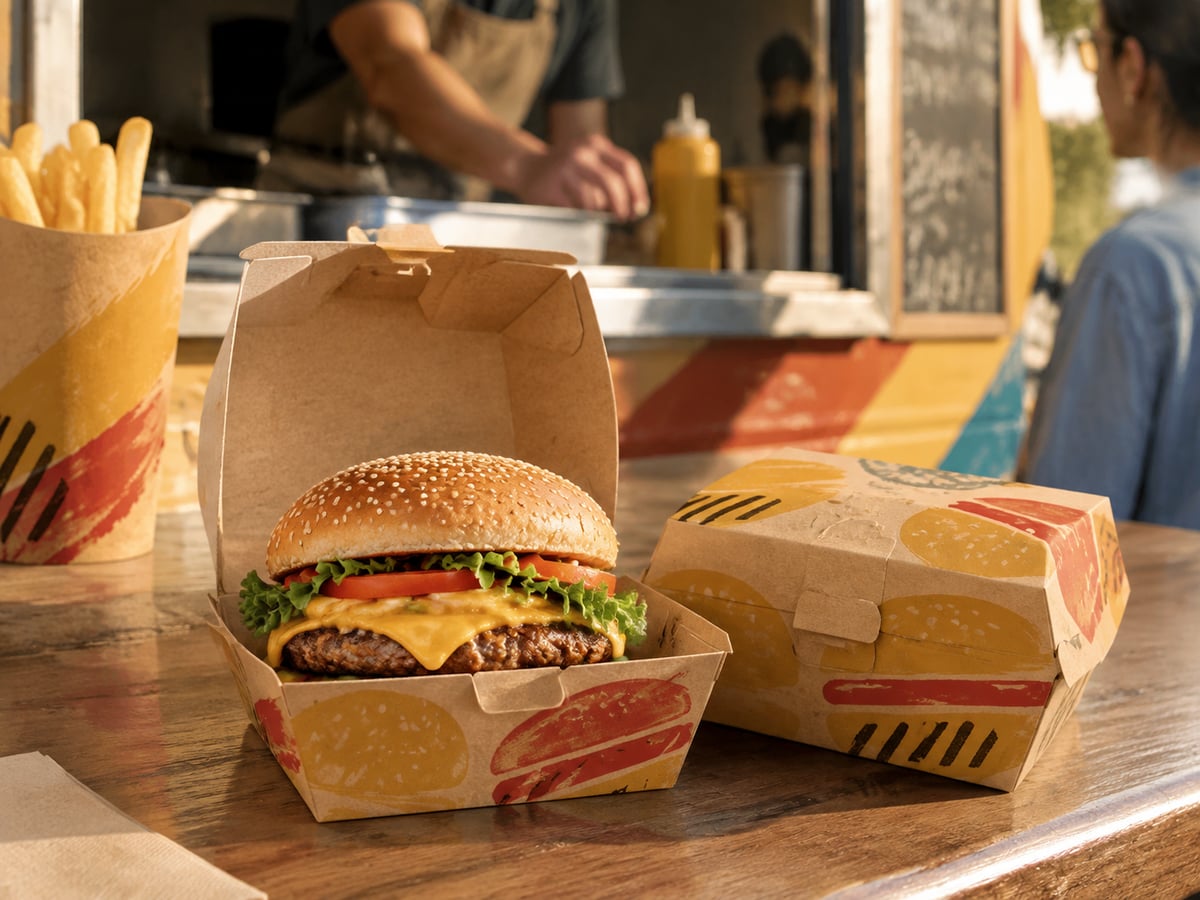
Restaurants and takeout kitchens need all-around performance: fast filling, stackability, low leakage, and good print presentation. Delivery-first brands need exceptional lid retention and vibration resistance. Grocery delis often need refrigerated shelf display and visible contents. Caterers need larger-volume packaging that handles holding time and batch transport. Food trucks need compact, hand-friendly structures that survive movement and outdoor service. Institutional buyers such as schools and hospitals often prioritize consistency, safety documentation, and controlled portioning.
Regional conditions also matter. In coastal cities such as Miami, New Orleans, and Seattle, humidity and condensation can affect paper packaging differently than in dry zones like Las Vegas or Phoenix. In colder states, hot soups and comfort foods put more pressure on thermal stability and sealing. Around major U.S. distribution hubs such as Los Angeles, Chicago, Savannah, and New York/New Jersey ports, importers and wholesalers also need packaging that holds quality through storage and inland transport before final use.
The bar chart shows how delivery-centric segments place the strongest demand on leak-resistant packaging because the container must perform beyond the point of sale, not just at the service counter.
Application examples include kraft bowls for grain and noodle concepts, compartment boxes for meal prep, deli boxes with windows for retail grab-and-go, and coated paper cups for beverages or dessert applications. Buyers serving multiple categories often benefit from a coordinated packaging family rather than sourcing unrelated items from different factories. This simplifies branding, freight planning, and quality control.
Companies evaluating category options often compare Custom Paper Food Container products for meals, Custom Paper Bowl products for soups and salads, and Custom Paper Cup products for hot, cold, and dessert service. The right mix depends on menu, delivery radius, and service model.
Cost vs Performance Analysis of Leak-Proof Packaging Technologies
In procurement, unit price is only one part of the total cost. A low-cost container that leaks 2% of orders can become far more expensive than a slightly higher-priced option with stable performance. Refunds, remakes, labor, customer complaints, replacement delivery, and lower app ratings all raise the true cost of failure. For U.S. operators competing on convenience and reviews, performance usually pays back quickly.
Cost should be evaluated across five layers: purchase price, fill efficiency, transport survival, branding value, and waste reduction. A better-fitting lid might cost slightly more but reduce order failures. A stronger bowl may increase unit cost but allow safer stacking, lower breakage, and fewer double-bagging needs. Custom printing may raise upfront cost but improve perceived quality and repeat orders.
| Technology Option | Typical Unit Cost Level | Leak Performance | Best Application | Operational Benefit | Possible Limitation |
|---|---|---|---|---|---|
| Standard PE-lined paper container | Low to medium | High | General hot takeout | Strong cost-performance balance | Lower eco appeal for some buyers |
| Heavy-duty PE-lined premium structure | Medium | Very high | Delivery and soups | Fewer complaints and stronger stacking | Higher unit cost |
| PLA-lined container | Medium to high | Good | Cold foods and eco programs | Supports compostable messaging | Needs correct temperature match |
| Water-based barrier paper | Medium to high | Good to very good | Selective eco-forward menus | Reduced plastic positioning | Supplier variation can be large |
| Low-grade unverified coated box | Low | Low to moderate | Short dry-food use only | Cheap initial spend | High risk of field failure |
| Multi-layer specialty leak-proof system | High | Excellent | Premium or long-distance delivery | Maximum protection | May exceed budget for basic use |
The table makes one point clear: the cheapest option is rarely the cheapest after field use. This is especially true in urban U.S. delivery markets where customer feedback is immediate and public.
Case examples are useful. A meal-prep company in Chicago may save money by shifting from a low-grade rectangular box to a stronger compartment container because it reduces sauce migration between sections and lowers replacement claims. A noodle concept in Seattle may improve retention and spill control by moving from generic bowls to a purpose-built bowl-and-lid system. A Texas caterer may justify heavier structures because better stacking reduces loss in transit to offices and events.
For wholesalers and chain buyers, the goal is not necessarily the highest specification across all SKUs. It is right-spec packaging: premium protection where needed, leaner formats where risk is lower. That approach protects both margin and service quality.
Supplier Evaluation Checklist for Leak-Proof Packaging Procurement
Choosing the right supplier is as important as choosing the right container. A strong design can still fail if manufacturing control is inconsistent. Buyers should assess not only product samples but also quality systems, production scale, communication speed, customization support, and logistics reliability.
A practical checklist begins with technical transparency. Can the supplier explain paper weight, coating type, seam construction, and test conditions clearly? Do they provide samples that match final production? Can they document food-contact compliance and, where relevant, compostability claims? Are lead times realistic? Can they support custom sizing, logo printing, and structural adjustments?
For U.S. importers and distributors, additional considerations include climate-controlled storage, carton durability, pallet planning, shipping coordination, and responsiveness during peak ordering periods. Suppliers serving East Coast and West Coast ports should understand transit realities, from New Jersey warehouse flows to Southern California distribution networks.
| Evaluation Item | What to Check | Warning Sign | Preferred Evidence | Why It Matters | Score Weight |
|---|---|---|---|---|---|
| Material clarity | Exact paper and coating details | Vague descriptions | Specification sheet | Prevents mismatch in use | High |
| Leak testing | Static and real-use validation | No test data | Lab report and sample trial | Confirms actual performance | High |
| Compliance documents | FDA and other relevant declarations | Expired or incomplete files | Current certificates | Supports legal and customer requirements | High |
| Customization capability | Size, print, lid, structure options | Only generic stock items | Artwork and sample support | Improves brand fit | Medium |
| Production capacity | Equipment, output, QC routines | Inconsistent lead times | Factory overview and schedule | Reduces supply disruption | High |
| Service responsiveness | Sampling, revisions, shipping updates | Slow communication | Named account process | Critical during launches | Medium |
When scoring suppliers, many U.S. buyers use a weighted matrix. Leak performance and compliance usually rank highest, followed by customization, lead time, and price. This helps procurement teams avoid the common mistake of selecting on cost alone.
The comparison chart reflects what many experienced buyers look for in a dependable packaging partner: strong documentation, proven production consistency, and service that continues after the order is placed.
Companies that need structured development, from custom sizing to artwork preparation and shipment planning, often prefer suppliers that can support Custom and Wholesale food Paper packaging rather than acting only as traders. That becomes especially important when the project includes brand printing, multiple product categories, or market testing before volume rollout.
Our Company
Shandong Fude Packaging Co., Ltd. serves foodservice buyers looking for practical, leak-resistant, and brand-ready paper packaging for the U.S. market. Rather than presenting packaging as a commodity, the company approaches it as a functional system that must protect food, support operations, and align with environmental goals.
From a technological capability standpoint, the company focuses on food-grade paper and plastic packaging with barrier options suited to takeaway, delivery, beverage, and retail food applications. Its product development experience spans kraft and white paper food containers, paper bowls for soups and salads, and cups for hot, cold, and dessert use. The technical team works with structures such as PE-lined interiors, compostable PLA options, grease-resistant formats, stackable geometry, and lid-compatible designs intended to reduce leakage and maintain presentation. This is valuable for U.S. buyers who need packaging that can handle sauces, oils, moisture, and transport stress without sacrificing print quality or shelf appeal.
On the manufacturing side, the company operates a modern factory in Shandong with automated production lines, flexographic printing, die-cutting, forming equipment, and in-house quality control processes. That production foundation supports both scale and repeatability, two factors that matter greatly for importers, chains, distributors, and restaurant groups. A strong manufacturing setup also allows broader SKU coordination across containers, bowls, and cups, helping buyers streamline sourcing. Those who want a closer look at product categories can explore Custom Paper Food Container products, Custom Paper Bowl products, and Custom Paper Cup products.
Service capability is equally important. The company supports packaging selection, artwork review, sample development, production planning, and delivery coordination. That approach helps U.S. buyers reduce mistakes before mass production, especially when launching custom-printed packaging or testing a new format for soups, meal boxes, deli items, or beverage programs. Flexible order planning and a structured review-sample-production workflow can be useful for both trial orders and ongoing wholesale programs. Buyers who want to understand the service process in more detail can review Custom and Wholesale food Paper packaging or visit our company profile.
For the United States market, the key value lies in combining factory-based production, category depth, customization support, and documented quality practices. That makes the company relevant not only to importers and distributors but also to restaurant groups, food delivery brands, deli operators, and emerging packaged-food businesses that need reliable packaging performance with brand flexibility.
FAQ
1. What is the best leak-proof food packaging for hot soup in the United States?
For hot soup, choose a deep paper bowl or soup container with a high-performance internal barrier, strong side seam construction, and a tightly fitting lid. PE-lined bowls remain one of the most dependable solutions for hot liquid applications, especially when delivery is involved.
2. Is paper packaging really leak-proof for sauces and oily foods?
Yes, if the paper structure, coating, and closure are engineered correctly. Leak resistance comes from the full system: paper quality, barrier type, seam design, rim shape, and lid fit. Poor-quality coated paper can still fail, so validation is essential.
3. Should I choose PE or PLA lining?
Choose PE when hot-fill durability, broad menu flexibility, and strong cost-performance are your top priorities. Choose PLA when compostable positioning matters and the application fits the coating’s temperature and disposal realities. Always test with your actual food.
4. How do I test packaging before buying in bulk?
Request production-like samples and run practical trials using your menu items. Test hold time, hot-fill conditions, lid fit, tilting, stacking, and delivery movement. Check for seam seepage, wall softening, and leaks around the lid edge.
5. What certifications should U.S. buyers ask for?
At minimum, request FDA food-contact compliance documentation. Depending on your program, you may also ask for EU EC 1935/2004, ISO 9001 quality management, FSC paper sourcing, and BPI or OK Compost certification for compostable claims.
6. Why do some containers leak only during delivery?
Because movement changes everything. Vibration, pressure from stacking, sudden braking, and container tilting can stress seams and lids in ways that static countertop tests do not. Delivery testing is essential for courier-based operations.
7. Are rectangular boxes more likely to leak than round bowls?
Not always, but corners and folds create more risk points. A well-designed rectangular meal box can perform very well, especially with reinforced folds and correct coating. Round bowls often distribute pressure more evenly, which helps in soup and noodle applications.
8. How important is paper weight?
Very important. Heavier or better-engineered paperboard usually provides stronger wall stability and better shape retention, reducing the chance of seam stress and flex-related leakage. Still, paper weight alone is not enough; coating and forming quality matter too.
9. Can eco-friendly packaging also be truly leak-proof?
Increasingly, yes. PLA-lined and newer water-based barrier systems are improving quickly. By 2026, expect more high-performing sustainable options, but buyers should still verify actual heat, oil, and transport performance instead of assuming all eco claims mean equal functionality.
10. How do I choose a supplier for leak-proof food packaging?
Compare technical transparency, test reports, certification support, customization ability, production capacity, lead time reliability, and service responsiveness. The best supplier is the one that consistently matches your application, not simply the one with the lowest quoted price.
Final takeaway: in the United States, leak-proof food packaging should be selected through performance-based purchasing, not guesswork. The best results come from matching food type, barrier technology, structural design, testing data, and supplier capability into one clear specification. With takeout, delivery, and sustainability standards continuing to rise through 2026, businesses that invest in the right packaging now will protect margins, strengthen customer trust, and build a more resilient brand.

About the Author
Fude Packaging is a professional flexible packaging manufacturer serving global food brands, wholesalers, and distributors. Our team shares practical insights on custom packaging, printing technology, food-safe materials, and industry trends to help businesses build better packaging solutions.
Share
Product Category
Start Your Project With Fude Today
Related Post
-

Canada Food Packaging Launch Workflow for Brand Owners
Food packaging launch planning works best when it is managed as a documented, cross-functional process rather than a series of informal email approvals. For Canadian brand owners, restaurant chains, retailers, meal-prep companies, and food distributors, the process should define the required inputs, accountable owners, decision gates, delivery thresholds, sample requirements, and records that must be retained before mass production begins.A reliable food packaging launch process starts with a commercial goal, translates that goal into measurable packaging specifications, verifies the design through samples, and records each approval before production is released. This approach reduces the risk of late samples, incomplete artwork, untested food-contact performance, mismatched lids, print errors, leakage complaints, customs-document gaps, and launch-date disruption.The most practical rule is simple: no packaging project should enter mass production until the approved specification, final artwork, production sample, acceptance criteria, commercial terms, and delivery plan are all complete. If any item is missing, the project remains at the appropriate approval gate. This is especially important for businesses serving cities such as Toronto, Vancouver, Montréal, Calgary, Ottawa, and Halifax, where promotional windows, retail planograms, food-service openings, and seasonal demand can create strict delivery requirements.Launch-Control ElementPurposePrimary OwnerEvidence to RetainBusiness objectiveDefines the commercial reason for the packaging projectBrand or commercial managerLaunch brief and sales forecastTechnical specificationSets dimensions, materials, coating, strength and food-use needsPackaging engineer or buyerApproved specification sheetArtwork approvalConfirms brand visuals, legal text and print layoutMarketing and compliance teamsSigned digital proofSample validationVerifies fit, leakage, heat resistance and usabilityQuality and operations teamsSample test report and approval recordProduction releaseAuthorizes manufacturing only after all gates are completeAuthorized approverPurchase order and release noticeShipment readinessConfirms inspection, packing and export documentationSupply-chain managerInspection report, packing list and shipping fileThe table shows why packaging launch management must include more than design approval. A paper cup may look correct in a digital proof but fail if the lid fit, coating, carton pack-out, cup rigidity, heat performance, or printed colour is not verified before volume production.Start by mapping the full path from product concept to arrival at the Canadian warehouse, co-packer, restaurant distribution centre, or retail location. A practical workflow has seven stages: brief, specification, quotation, sample validation, pre-production approval, mass production, and shipment acceptance. Each stage needs a named owner, deadline, output, and decision rule.For example, a Toronto coffee chain introducing a new 12 oz takeaway cup should not treat its project as “order printed cups.” The actual project includes cup capacity, paperboard grade, PE or alternative coating selection, lid compatibility, sleeve requirement, Pantone colour targets, case quantity, pallet pattern, food-contact documentation, sample lead time, production lead time, shipping route, and warehouse receiving date.The process should also distinguish between information that is fixed and information that remains open. Fixed information may include brand artwork, target capacity, food application, launch date, and destination. Open information may include the exact carton configuration, final print method, or shipping option. Open items should have owners and closure dates; they should never be hidden in informal messages.Canadian importers should work backwards from the required in-market date. Allow time for sample shipment by courier, approval cycles, production, quality inspection, sea freight, customs processing, inland transportation, and contingency. A shipment moving through Vancouver or Prince Rupert may have different scheduling considerations from cargo routed through Montréal, Halifax, or a United States cross-border warehouse.The business objective explains what the new packaging must achieve. It may support a restaurant opening, a new beverage launch, a limited-time menu, a retailer listing, an online food-delivery expansion, a sustainability initiative, or a cost-reduction program. The objective should be written in operational terms, not only creative language.Good success criteria are measurable. Instead of stating that a bowl must be “high quality,” define the required capacity, filling temperature, hold time, compression resistance, leak tolerance, lid engagement, stacking performance, print accuracy, and acceptable defect rate. Instead of saying that delivery must be “fast,” define the required delivery date, sample deadline, production completion date, and shipment booking date.Business ObjectiveExample Success MeasurePackaging ImpactApproval TeamLaunch a premium coffee lineAvailable in 180 stores by launch weekPrinted hot cups, lids and sleevesMarketing, operations, procurementReduce takeaway leakage claimsLess than 1% packaging-related complaintsLeak-resistant bowls and secure lidsQuality, culinary, supplierSupport a retail listingMeet retailer packaging and barcode requirementsPrinted cartons and tamper-evident packsSales, compliance, packagingImprove sustainability positioningSpecified fibre source and disposal guidanceFSC material or compostability optionsSustainability, legal, procurementControl total landed costMeet target landed cost per unitOptimized dimensions and case packFinance, supply chain, sourcingExpand meal-delivery serviceMaintain food integrity for 45 minutesInsulated, grease-resistant meal boxesOperations, quality, culinaryThis table helps teams align the packaging format with the business outcome. A packaging project can only be approved efficiently when marketing, quality, procurement, finance, and operations agree on what success means.var ctx = document.getElementById('lineChart').getContext('2d');new Chart(ctx, { type: 'line', data: { labels: ['2022', '2023', '2024', '2025', '2026', '2027'], datasets: [{ label: 'Indexed Canadian foodservice packaging demand', data: [100, 106, 112, 119, 126, 134], borderColor: 'rgb(32, 111, 87)', backgroundColor: 'rgba(32, 111, 87, 0.12)', borderWidth: 3, fill: false, tension: 0.25 }] }, options: { responsive: false, maintainAspectRatio: false, scales: { y: { beginAtZero: false, title: { display: true, text: 'Demand index (2022 = 100)' } } } }});The line chart is an illustrative planning index, not a market forecast. It shows why Canadian buyers should reserve sufficient time for packaging development: growing foodservice, convenience, and delivery demand can increase pressure on production slots, material availability, and freight capacity.Technical and commercial inputs should be collected in one controlled project brief. The technical section covers the food product, serving conditions, packaging dimensions, material preference, printing requirements, lid fit, performance criteria, and regulatory documentation. The commercial section covers order quantity, forecast, target price, delivery point, Incoterms, payment terms, shipment mode, and required launch date.For Canada, food-contact packaging decisions should be reviewed in relation to the intended food use, temperature, storage condition, and destination-market requirements. Brand owners should confirm whether packaging will be used for hot beverages, cold drinks, soups, salads, fried foods, bakery items, frozen meals, or prepared meals. Grease resistance, heat tolerance, condensation behaviour, stiffness, and lid fit can change significantly by application.Artwork inputs must include editable files, dielines, brand standards, approved colours, mandatory bilingual requirements where applicable, recycling or disposal instructions, barcode placement, and legal review. Québec projects may require particular attention to French-language requirements, while national programs often need packaging communication suitable for multiple Canadian provinces.Input CategoryRequired InformationTypical Risk if MissingValidation MethodFood applicationFood type, temperature and hold timeLeakage, softening or heat failureFunctional sample testDimensionsCapacity, diameter, height and lid sizeIncorrect fit or filling volumePhysical measurementMaterialPaperboard, coating, fibre source and barrier needPerformance or compliance mismatchMaterial declaration reviewArtworkFiles, Pantone references and mandatory textPrint error or delayed proofingDigital proof approvalCommercial volumeTrial quantity, annual forecast and order frequencyWrong production plan or cost modelPurchase forecast reviewLogisticsDestination, shipping method and receiving dateLate launch or excess freight costTransport schedule confirmationA complete input package shortens supplier response time and makes quotations comparable. Buyers can review available formats through Fude Packaging’s food packaging range, including cups, bowls, trays, burger boxes, lunch boxes, salad containers, noodle boxes, and multi-compartment meal packaging.Packaging launch projects fail when everyone is involved but nobody is accountable. Every task should have one owner, even if several departments contribute. The owner is responsible for collecting the required information, escalating risks, and obtaining a clear decision before the deadline.Approval authority should be separated from task ownership. A marketing manager may own artwork coordination, but a designated brand approver should release final artwork. A packaging engineer may manage testing, but a quality leader should approve whether the sample meets the acceptance criteria. Procurement may negotiate commercial terms, while finance approves payment exposure and operations confirms the delivery date.Use a RACI-style project record: Responsible, Accountable, Consulted, and Informed. This is particularly useful when a Canadian brand works with a local marketing agency, a co-packer in Ontario, a distribution partner in British Columbia, and an overseas manufacturer. Clear authority prevents contradictory instructions reaching the factory.Late samples and incomplete specifications are common causes of launch delay because they create hidden rework. The solution is to establish thresholds that trigger escalation before the launch date is threatened. A threshold is not a punishment; it is an early-warning mechanism.For instance, if the white sample is not approved by the agreed date, the project manager should assess whether the printed pre-production proof can still be produced, approved, and released without changing the shipment plan. If the answer is no, the commercial team must choose between changing the launch date, using an approved interim stock package, selecting expedited freight, or reducing the initial launch scope.Project TriggerSuggested ThresholdRequired ActionDecision AuthorityIncomplete specificationMore than 2 working days after brief deadlineFreeze quotation and issue missing-input listProject ownerArtwork not approvedWithin 10 working days of print slotEscalate launch-date riskMarketing leadSample feedback delayedMore than 3 working days after deliverySchedule approval meetingQuality leadMaterial change requestedAfter pre-production proof approvalReopen technical review and timelinePackaging authorityFreight schedule changesTransit buffer reduced below 7 daysReview alternate routing or shipment modeSupply-chain managerCritical defect foundAny failure against acceptance criteriaHold release and conduct corrective actionQuality directorThe thresholds in this table should be adapted to product complexity. A simple unprinted kraft tray may need fewer gates than a custom-printed multi-compartment meal box with a matching lid, special coating, bilingual artwork, and national restaurant-chain delivery schedule.The best way to build a launch framework is to test it on one real project. Select a project with meaningful complexity but manageable commercial risk, such as a branded paper bowl program for a regional salad chain or a new paper cup design for a café group. Run the project using the documented workflow, then record where decisions slowed down or information was unclear.A useful pilot project includes at least one physical sample stage. White samples verify shape, dimensions, lid fit, capacity, and user handling before print costs are committed. Printed samples or printed pre-production proofs verify colour, artwork placement, registration, and visual impact. Functional prototypes can be used to test hot liquids, sauces, oily foods, stacking, delivery movement, or microwave suitability where relevant.Brand owners should conduct testing under realistic conditions. A soup container should be filled with hot soup and held for the expected service period. A burger box should be checked for grease transfer and closure performance. A cold drink cup should be tested for condensation and lid security. A meal box should be tested after courier movement, not only while sitting on a table.var ctx = document.getElementById('barChart').getContext('2d');new Chart(ctx, { type: 'bar', data: { labels: ['Coffee shops', 'Quick-service restaurants', 'Meal delivery', 'Grocery prepared foods', 'Catering', 'Universities'], datasets: [{ label: 'Illustrative packaging launch demand score', data: [88, 94, 91, 78, 68, 72], backgroundColor: ['#3c8d6f', '#2f6f95', '#d18b47', '#8a6aa8', '#b65a5a', '#5f8f46'] }] }, options: { responsive: false, maintainAspectRatio: false, scales: { y: { beginAtZero: true, max: 100, title: { display: true, text: 'Demand score' } } } }});This bar chart illustrates where structured packaging launch control is especially valuable. Quick-service restaurants, coffee chains, and meal-delivery businesses often manage fast rollout schedules and high packaging volumes, making sample discipline and specification control essential.After the pilot launch, conduct a short post-launch review. Compare the planned timeline with the actual timeline, identify where the process was delayed, and determine whether the delay was caused by missing inputs, unclear ownership, supplier capacity, sample transit, late approvals, or incorrect assumptions.Do not limit the review to failures. Record what worked well, such as a sample approval form that prevented ambiguity, a shared artwork checklist that reduced revisions, or a pre-booked production slot that protected the launch schedule. Improvements should be incorporated into the next project version, with changed forms, revised thresholds, and clearer owner responsibilities.Retained evidence should include the project brief, quotation revision history, approved specification, digital proof, sample photos, functional test results, approval emails or signed forms, inspection record, shipping documents, and complaint data after launch. These records provide a repeatable basis for future packaging decisions and supplier performance reviews.Canada’s food packaging market includes national chains, independent restaurants, grocery prepared-food departments, convenience stores, institutional caterers, ghost kitchens, and growing delivery platforms. Demand differs across regions. Greater Toronto Area buyers may prioritize rapid replenishment and distribution-centre compatibility. Vancouver businesses may emphasize takeaway, sustainability messaging, and Pacific import logistics. Montréal and Québec City buyers may require careful review of bilingual packaging communication. Calgary, Edmonton, Winnipeg, and Atlantic Canada may place greater importance on long-distance distribution durability and practical case pack design.Canadian buyers should plan for climate and logistics realities. Cold weather can affect packaging handling and storage. Long transportation distances can increase compression risk. Warehouses may need pallet configurations that suit local racking systems. Products moving through the Port of Vancouver, Port of Montréal, Port of Halifax, or rail-linked inland hubs require realistic buffer time in the launch plan.var ctx = document.getElementById('areaChart').getContext('2d');new Chart(ctx, { type: 'line', data: { labels: ['2022', '2023', '2024', '2025', '2026', '2027'], datasets: [{ label: 'Share of projects requesting fibre-based or lower-plastic options', data: [38, 44, 51, 58, 65, 71], borderColor: 'rgb(88, 143, 70)', backgroundColor: 'rgba(88, 143, 70, 0.28)', borderWidth: 3, fill: true, tension: 0.3 }] }, options: { responsive: false, maintainAspectRatio: false, scales: { y: { beginAtZero: true, max: 100, title: { display: true, text: 'Share of projects (%)' } } } }});The area chart presents an illustrative trend shift toward fibre-based, recyclable, or compostability-oriented packaging discussions. For 2026 and beyond, brands should avoid unsupported environmental claims and instead select materials, disposal messages, and supporting documentation that match the product’s actual end-of-life pathway and market requirements.Packaging selection should follow the food application, not only visual preference. Paper cups are suited to hot and cold beverages when matched with the appropriate coating and lid. Paper bowls can support salads, noodles, rice dishes, soups, and prepared meals depending on the required barrier performance. Burger boxes, clamshells, food trays, and kraft lunch boxes are common for quick-service meals, bakery products, fried foods, and takeaway combinations.Packaging TypeCommon ApplicationKey Performance CheckTypical Sample NeededPaper hot cupCoffee, tea and hot chocolateHeat handling, seam integrity, lid fitWhite cup and printed proofCold drink cupIced coffee, juice and smoothiesCondensation resistance and lid securityFilled cold-drink testPaper bowlSalads, noodles, soup and grain bowlsLeak resistance and stackingFood-filled functional sampleBurger boxBurgers, sandwiches and fried foodsGrease resistance and closureGrease and transport testKraft lunch boxMeal combos and bakery productsLoad bearing and closure strengthFilled weight testMulti-compartment trayPrepared meals and institutional cateringCompartment separation and lid matchFull meal assembly testThe table demonstrates why the sample stage cannot be skipped. The same paperboard can perform differently when used in a high-temperature soup bowl, a greasy fried-food tray, or a cold beverage cup with condensation exposure.When sourcing food packaging, compare suppliers based on total project risk rather than unit price alone. Ask whether the supplier controls manufacturing directly, offers white and printed samples, supports functional testing, has an inspection process, understands export documentation, and can provide clear production scheduling. A low quotation can become expensive if it results in delayed launch dates, inconsistent print quality, leakage claims, rework, or emergency air freight.Request a quotation that identifies product dimensions, material structure, coating, print coverage, order quantity, carton pack, production lead time, sample lead time, quality standard, payment terms, shipping terms, and validity period. If any of these items are absent, the quotation may not be directly comparable with alternatives.For customized projects, buyers should check dielines carefully before artwork release. They should also confirm whether lids are included, compatible, or sourced separately. A common mistake is approving a cup or bowl design before confirming that the intended lid fits the final production dimensions and works with the actual food-service process.A documented packaging launch framework is useful across many industries. Coffee chains need cup programs that maintain visual consistency across hundreds of locations. Quick-service restaurants need burger boxes, meal boxes, fry trays, and drink containers that are easy to assemble during peak service. Grocery prepared-food departments need reliable containers for salads, deli meals, bakery products, and hot counter items. Meal-prep companies need stackable, delivery-ready formats with practical portion control.Hospitals, schools, universities, corporate cafeterias, event caterers, and airline or rail catering providers may need multi-compartment trays and portioned meal packaging. These sectors often require stronger documentation, consistent supply planning, and dependable batch traceability because purchasing is centralized and product use is standardized across many locations.A Canadian fast-casual restaurant group planned to launch a new rice-bowl menu in Ontario and British Columbia. The original packaging brief specified a printed bowl but did not define the lid, filling temperature, sauce volume, delivery hold time, or required artwork approval date. The supplier could produce a bowl sample quickly, but the project was at risk because the lid fit and food-performance criteria were incomplete.The team introduced a controlled approval process. Operations defined the serving temperature and delivery time. Culinary tested sauces and steam exposure. Marketing approved the artwork. Procurement confirmed the initial volume and replenishment forecast. Quality documented acceptance criteria: no leakage after 45 minutes, secure lid engagement, no visible print defect at normal viewing distance, and bowl stiffness acceptable after hot filling.The first white sample revealed that the proposed lid was not sufficiently secure for courier delivery. The team changed the lid before printed proof approval, avoiding a larger production delay. The final project launched with retained sample records, a signed specification, a printed pre-production approval, and a shipment timeline with contingency days. The lesson was clear: early sample validation is cheaper and faster than correcting a problem after a production run is complete.Canadian buyers can choose local converters, distributors, overseas manufacturers, or a combined sourcing model. Local supply may offer shorter domestic replenishment times and easier in-person communication. Overseas manufacturing may offer wider customization, consolidated product categories, direct factory control, and competitive production economics for planned-volume programs. The best option depends on demand stability, customization level, inventory strategy, and launch timing.var ctx = document.getElementById('comparisonChart').getContext('2d');new Chart(ctx, { type: 'bar', data: { labels: ['Customization range', 'Large-volume cost efficiency', 'Domestic replenishment speed', 'Sample flexibility', 'Multi-category consolidation', 'Export documentation support'], datasets: [ { label: 'Local stock-focused supplier', data: [55, 58, 90, 60, 50, 65], backgroundColor: 'rgba(47, 111, 149, 0.75)' }, { label: 'Direct manufacturing partner', data: [90, 88, 55, 85, 92, 88], backgroundColor: 'rgba(32, 111, 87, 0.75)' } ] }, options: { responsive: false, maintainAspectRatio: false, scales: { y: { beginAtZero: true, max: 100, title: { display: true, text: 'Illustrative capability score' } } } }});The comparison chart is illustrative. Many Canadian businesses use a dual approach: holding selected standard packaging locally while planning custom branded packaging through a direct manufacturer for scheduled launches and recurring volume. This can reduce supply risk while protecting brand consistency.Fude Packaging supports overseas B2B buyers with food packaging development and manufacturing for cups, bowls, boxes, trays, and multi-compartment meal packaging. The company’s technological capabilities include in-house quality and performance testing, material evaluation, artwork and dieline checking, Pantone colour matching, digital proofs, white samples, and printed pre-production proof options. These controls help buyers confirm practical performance before mass production.Its manufacturing capabilities are built on more than 20 years of packaging experience, a self-owned production base of approximately 30,000 m², automated output capacity of up to 120,000 units per day, and direct control over material selection, printing, die-cutting, forming, inspection, packing, and shipment preparation. Documentation and quality systems can support customer needs involving BRC, FSC, ISO 9001, LFGB, FDA-related requirements, batch traceability, and third-party inspection arrangements where applicable.Service capabilities include OEM and ODM support, rapid sampling, scheduled-order planning, export packing, commercial document support, sea freight and air freight coordination, and responsive communication for international customers. Canadian buyers can explore custom food packaging services, learn more about Fude Packaging’s manufacturing background, or contact the packaging team for a project review.For a Canadian launch project, the recommended first discussion includes product type, food application, serving temperature, capacity, artwork status, order quantity, target launch date, delivery city, desired shipping method, and documentation expectations. This information enables a practical recommendation instead of a generic quotation.By 2026, food packaging launch decisions will increasingly combine product performance, supply-chain resilience, automation compatibility, sustainability claims, and traceability. Brand owners are expected to request faster digital proofing, more structured sample records, better colour control, and data-supported approval workflows. Packaging teams will also place more emphasis on supplier contingency planning as freight availability, material pricing, and regulatory expectations continue to evolve.Sustainability will remain a major priority, but successful projects will focus on realistic and verified choices. Fibre sourcing, reduced material use, recyclability, compostability options, coating selection, and disposal communication should be evaluated together. The correct option depends on the food application, local collection infrastructure, customer expectations, and the evidence available to support environmental claims.Policy and compliance reviews will also become more important. Canadian brand owners should build legal and food-contact checks into the packaging brief instead of treating them as a final-stage task. Early review helps prevent costly artwork changes, relabelling, material substitution, and launch delays after production has already been scheduled.The purpose is to protect food, support safe and convenient use, communicate the brand, meet operational requirements, and ensure packaging is ready when the product reaches customers. A documented launch process reduces avoidable delays and quality risk.Most projects require marketing, procurement, quality, operations, finance, supply chain, and sometimes legal or sustainability teams. Essential inputs include food type, temperature, dimensions, material requirements, artwork, quantity, delivery date, target cost, and destination.Formal gates should be placed after the project brief, technical specification, digital artwork proof, white sample, printed pre-production proof, production inspection, and shipment readiness review. The exact number of gates depends on product complexity.It uses named owners, fixed due dates, escalation thresholds, and release rules. If a sample or specification is late, the project team assesses the impact immediately and decides whether to revise the timeline, use an interim option, change transport, or hold production.Retain the launch brief, approved specification, sample test reports, artwork approvals, quotation revisions, purchase order, inspection reports, shipment documents, complaint data, and post-launch review notes. These records improve repeatability and supplier accountability for future Canadian packaging programs. -
Global Market Guide to Oil-Resistant Fried-Food Packs
A reliable evaluation of oil-resistant packaging for fried foods requires a repeatable test method with controlled samples, a defined food or simulant, temperature, duration, loading condition, inspection criteria, and documented pass/fail limits. For Global Market buyers, the goal is not simply to confirm that a package “looks greaseproof” at the factory. The goal is to verify that the packaging continues to perform during real delivery, holding, stacking, customer handling, and waste disposal.Fried chicken, French fries, onion rings, tempura, spring rolls, fried seafood, potato wedges, and breaded snacks all release oil differently. A package that performs well with dry fries may fail when used with hot fried chicken, sauces, steam, and stacked delivery bags. Procurement teams should therefore approve packaging based on the highest-risk operating condition rather than on a basic room-temperature demonstration.An effective incoming inspection plan should define the approved material construction, basis weight or board grade, grease barrier, coating type, food-contact documentation, test temperature, sample quantity, test duration, acceptable oil staining, leakage threshold, and compression condition. This information should appear in the approved product specification, purchase order, supplier quality agreement, and batch inspection report.For buyers sourcing internationally through ports such as Rotterdam, Hamburg, Los Angeles, Dubai, Singapore, Sydney, Jebel Ali, and Durban, consistent documentation is especially important. A shipment may travel for weeks, be exposed to humidity changes, and then enter a high-volume food-service distribution network. Oil resistance must be controlled together with strength, stackability, print quality, odor, migration compliance, and carton protection.Evaluation ElementWhy It MattersRecommended Buyer ControlFood typeDifferent fried foods release different amounts of oil and moisture.Test with the actual menu item or a documented simulant.Serving temperatureHigher temperatures accelerate oil penetration.Record food and package temperature at test start.Holding durationDelivery and pickup periods can exceed restaurant counter service time.Use realistic intervals such as 15, 30, 45, and 60 minutes.Package loadOil can migrate faster when food weight presses against the board.Test at the maximum specified fill weight.Stacking pressureDelivery bags and cartons add pressure to containers.Apply a documented top load or stack simulation.Inspection standardVisual opinions can differ among inspectors.Use photos, rating grades, and defined acceptance limits.The table above gives procurement teams a practical framework. It turns a vague claim of “grease resistance” into an objective, auditable approval process. Buyers should also distinguish between an oil stain visible on the inside surface and oil breakthrough that reaches the exterior, weakens the paperboard, contaminates a delivery bag, or creates a consumer complaint.Oil resistance testing measures the risk that fats, frying oils, and food grease penetrate through the packaging structure. This risk is commercial as well as technical. A grease mark on a takeaway box can make a premium restaurant brand appear careless. A leaking fries cup can damage a customer’s car seat, delivery rider bag, retail shelf, or other packed products. If oil softens the base or sidewall, the container may lose rigidity and create a safety problem during handoff.The highest-risk categories are hot fried food with long dwell times, heavy portions, steam accumulation, sauces, and delivery operations. Quick-service restaurants, ghost kitchens, food courts, stadium concessions, travel hubs, supermarket hot-food counters, and meal-prep distributors should all assess oil resistance based on their actual service environment.Oil resistance is not the same as water resistance. A package may resist short-term water contact while still allowing hot oil to migrate into fibers. Likewise, a package with a strong grease barrier may still fail because the board is too light, the fold line is weak, the bottom seam is poorly formed, or the lid design traps excessive condensation.Failure ModeTypical CauseBusiness ImpactExterior grease stainInsufficient barrier or prolonged oil contact.Reduced brand appearance and customer confidence.Bottom seepageHeavy food load, weak base folding, or coating gaps.Bag contamination and delivery claims.Softened sidewallOil absorption combined with steam and heat.Lower handling strength and deformation.Grease at seamsIncomplete sealing or barrier disruption at folds.Localized leaks and inconsistent batch quality.Oil transfer to outer cartonContainers stacked before cooling or packed tightly.Transport damage and unusable retail inventory.Odor or material concernUnsuitable coating, ink, adhesive, or storage condition.Food-contact compliance and reputational risk.For global procurement, risk also varies by climate and operating model. In humid locations such as Singapore, Jakarta, Miami, and Lagos, packaging may absorb moisture more quickly during storage or service. In colder markets, hot food can generate strong condensation inside a closed container. Buyers should request validation under anticipated ambient conditions rather than relying only on a single laboratory test conducted under ideal conditions.var ctxMarketGrowth = document.getElementById('marketGrowthChart').getContext('2d');new Chart(ctxMarketGrowth, {type: 'line',data: {labels: ['2022', '2023', '2024', '2025', '2026', '2027'],datasets: [{label: 'Indexed Global Demand for Grease-Resistant Food Packaging',data: [100, 108, 117, 128, 140, 153],borderColor: 'rgb(52, 122, 89)',backgroundColor: 'rgba(52, 122, 89, 0.12)',borderWidth: 3,fill: false,tension: 0.25}]},options: {responsive: true,maintainAspectRatio: false,plugins: { legend: { display: true } },scales: { y: { beginAtZero: false, title: { display: true, text: 'Demand Index' } } }}});The line chart illustrates an indexed market trend rather than a guarantee of future sales. Growth is supported by delivery food, convenience retail, premium fried-snack concepts, and buyer demand for fiber-based alternatives that still provide dependable grease control.Sample selection is critical because oil resistance can vary between raw material lots, coating batches, print designs, forming conditions, and production shifts. A buyer should not approve a product only from one visually perfect prototype. Test samples should represent the final construction, including production-grade paperboard, coating, ink coverage, folds, glued areas, vents, lids, and any inner liner.For a practical qualification test, buyers can begin with at least 10 finished containers from a production-representative sample set: five for normal use and five for stress conditions. For higher-volume restaurant chains or distributors, a larger plan such as 20 to 32 units provides stronger evidence. If multiple sizes are ordered, each size should be assessed because a deep fried-chicken bucket, a shallow food tray, and a fries cup do not experience the same load distribution.Common product types include fries cups, chip cups, burger boxes, clamshell boxes, open food trays, kraft lunch boxes, noodle containers used for fried snacks, paper bowls, snack cartons, and multi-compartment meal boxes. Buyers can review oil-resistant kraft fries cups for fast-food service when comparing compact formats designed for chips, wedges, and fried snack portions.Packaging TypeTypical Fried-Food UseSuggested Sample QuantityMain Inspection ZoneFries cupFrench fries, wedges, chips10–20 unitsBase corners and lower sidewallBurger boxFried chicken burgers, breaded sandwiches10–20 unitsBase panel and fold linesOpen food trayFried snacks, seafood, wings15–25 unitsBottom surface and rimKraft lunch boxMixed meals with fried sides20–32 unitsBottom seam and closure foldsPaper bowl with lidFried chicken bites and sauced foods20–32 unitsSidewall, rim, and lid fit areaCompartment meal boxFried entrée with rice or sides20–32 unitsPartition joints and base panelsThis sample plan should be adapted to the consequences of failure. A small independent café may accept a simpler internal check, while a national delivery platform or supermarket chain should use a more formal lot-based plan with retained samples, batch traceability, and independent verification when needed.Testing equipment does not need to be overly complex, but it must be consistent. A reliable buyer or supplier laboratory should have calibrated scales, timers, thermometers, controlled test trays, compression weights, absorbent indicator sheets, cameras, rulers, and sample labels. More advanced facilities may use oil permeability instruments, Cobb-style absorption equipment, conditioning chambers, burst-strength testing, and controlled-temperature cabinets.A simple real-food test can use freshly prepared fried food placed into a finished container at a specified temperature. The sample is then held on a clean white absorbent sheet, with an optional fixed load placed on top to simulate stacking. Inspectors check the outside of the container and indicator sheet at scheduled intervals. The result should be recorded using a predefined rating system, not just a comment such as “acceptable.”For comparative development work, a standardized oil simulant can improve repeatability. However, real food remains important because steam, salt, surface texture, breading, sauce, and food geometry can influence results. The strongest approval program combines a controlled laboratory screening test with final confirmation using the buyer’s actual menu item.EquipmentPurposeControl RequirementDigital scaleControls food fill weight and applied load.Verify calibration routinely.Probe thermometerRecords food temperature at filling.Measure representative food portions.TimerControls holding intervals.Use the same timing points for every test.White absorbent sheetReveals oil transfer from the outer surface.Use identical sheet grade for comparison.Compression plate and weightsSimulates stacked delivery packaging.Document total load and contact area.Camera or inspection stationCreates objective visual evidence.Use standard lighting and image distance.To make results comparable between supplier and buyer, photographs should show the sample code, test time, product orientation, and indicator sheet. If a customer complaint occurs later, retained records allow both parties to distinguish a manufacturing issue from changes in food preparation, overfilling, delivery time, or storage.Test conditions should replicate the worst credible use case. A buyer selling fries for immediate counter collection may use a 15-minute hold period. A delivery-focused brand in London, Toronto, Dubai, São Paulo, or Melbourne may need 45 to 60 minutes, plus stacked-bag pressure. Products intended for airport concessions or convenience stores may need extended holding conditions because the food can remain in packaging longer before consumption.Start by defining food type, fill weight, food temperature, ambient temperature, container closure, hold duration, stacking load, and orientation. Include both normal and stressed conditions. For example, test fries at the nominal serving weight and then test a maximum portion with 20% additional oil exposure. Test chicken wings with and without sauce if both are served in the same format.Steam is an important factor. Closed packaging preserves heat but may create condensation that weakens paper fibers or causes oil and water to migrate together. Vented structures can improve crispness but may alter heat retention. Product development should therefore balance grease resistance, ventilation, structural rigidity, and consumer experience rather than optimizing only one property.var ctxIndustryDemand = document.getElementById('industryDemandChart').getContext('2d');new Chart(ctxIndustryDemand, {type: 'bar',data: {labels: ['Quick-Service Restaurants', 'Delivery Kitchens', 'Convenience Retail', 'Stadium Catering', 'Supermarkets', 'Travel Food Service'],datasets: [{label: 'Relative Demand for Oil-Resistant Packaging',data: [92, 88, 76, 68, 81, 73],backgroundColor: ['rgb(202, 126, 55)','rgb(230, 159, 70)','rgb(91, 141, 185)','rgb(110, 171, 112)','rgb(159, 122, 191)','rgb(215, 93, 93)']}]},options: {responsive: true,maintainAspectRatio: false,plugins: { legend: { display: true } },scales: { y: { beginAtZero: true, max: 100, title: { display: true, text: 'Demand Score' } } }}});The bar chart shows where oil-resistant packaging is particularly relevant. Quick-service restaurants and delivery kitchens typically place the highest value on consistent performance because volume, speed, and customer visibility amplify the cost of failure.Procurement teams should define pass/fail limits before testing begins. A result cannot be judged objectively if the criteria are created after a sample has failed. The best limit depends on product category, market position, delivery time, and food type. For most branded fried-food packaging, exterior oil breakthrough, visible oil transfer to the indicator sheet, structural collapse, and seam leakage should be classified as failures.A minor translucent mark on the inside surface may be acceptable if it does not reach the exterior, compromise strength, or affect food-contact safety. However, this allowance must be clearly described and agreed in writing. Premium retail and restaurant brands may set a zero-visible-stain external standard, while lower-risk short-service formats may permit a limited internal stain rating.Pass/fail limits should be reviewed during design approval. If a supplier proposes a lighter paperboard, alternative coating, new pulp source, reduced coating weight, or modified forming process, the buyer should treat the change as a new qualification event. Cost reduction should never silently reduce packaging performance.Inspection ItemSuggested Acceptance LimitFailure DefinitionExternal oil breakthroughNo visible oil penetration after specified hold time.Any clear external grease spot.Indicator sheet transferNo measurable or visible oil transfer.Oil staining on the sheet beneath sample.Base strengthContainer remains stable at full specified load.Soft base, sagging, or loss of shape.Seam and fold conditionNo leakage at joints, folds, or glued areas.Localized grease seepage or opening.Closure performanceLid or flap remains functional after holding.Closure disengages due to softening.Appearance ratingConsistent with approved golden sample.Visible degradation beyond agreed tolerance.The table provides a practical baseline, but buyers should tailor it to their business. A fries cup may need a 30-minute no-transfer standard, while a lunch box for fried chicken delivery may require a 60-minute standard under a specified stack load. The limit should be measurable, realistic, and commercially meaningful.A supplier test report should allow the buyer to understand what was tested, how it was tested, and whether the result relates to the supplied product. A report without sample identification, date, test conditions, and acceptance criteria has limited value. Buyers should request reports that connect the result to a specific product code, material specification, production date, batch number, and customer-approved artwork or dieline where relevant.Reports should state whether the test used actual food or simulant, the fill weight, food temperature, dwell time, ambient condition, compression load, number of samples, inspection intervals, and final result. Photographs are particularly useful for fried-food packaging because visible staining and structural changes can be compared against an approved reference sample.For large contracts, buyers can include a certificate of conformity and batch testing requirement in the purchase agreement. Incoming inspection can then verify selected cartons from each shipment. This is especially useful when goods are consolidated for export through Qingdao, Shanghai, Ningbo, Shenzhen, or other major manufacturing and logistics hubs before onward shipment to global destinations.Report SectionInformation RequiredBuyer BenefitProduct identificationProduct code, size, material, artwork revision.Confirms the tested item matches the order.Batch traceabilityProduction date, line, lot number, carton code.Supports investigation and recall control.Test sample detailsQuantity, conditioning, random selection process.Shows whether testing was representative.Test conditionsFood type, temperature, time, load, orientation.Makes supplier and buyer tests comparable.Acceptance criteriaApproved oil-stain and leakage limits.Prevents subjective interpretation.Evidence and conclusionPhotos, measurements, inspector sign-off.Creates a defensible quality record.Supplier reporting should be proportionate to risk. Standard stock items may need routine lot verification, while a new customized package for a restaurant chain should receive full first-article approval, functional testing, and retained samples before mass production begins.When an oil-resistance test fails, the first step is containment. Stop shipment release for affected stock, identify the production lot, isolate related cartons, and compare failed samples against approved retained samples. The second step is to define the failure precisely: exterior penetration, seam seepage, strength loss, lid failure, or unacceptable appearance. Broad statements such as “the packaging is weak” do not lead to effective correction.Root-cause analysis may include checking paperboard grade, barrier application, coating coverage, curing conditions, converting settings, fold pressure, glue placement, storage humidity, print coverage, and changes in raw material suppliers. It may also include reviewing whether the customer used the package outside the approved specification, such as filling above the maximum weight or holding food longer than the validated time.Corrective action should include a documented solution, verification test, preventive control, and communication timeline. Examples include increasing barrier performance, changing board weight, strengthening the base design, revising a fold pattern, improving forming-process controls, or modifying the package ventilation system. Buyers should require confirmation testing before releasing replacement production.var ctxTrendShift = document.getElementById('trendShiftChart').getContext('2d');new Chart(ctxTrendShift, {type: 'line',data: {labels: ['2022', '2023', '2024', '2025', '2026', '2027'],datasets: [{label: 'Conventional Barrier Solutions',data: [68, 64, 59, 54, 49, 44],borderColor: 'rgb(177, 92, 57)',backgroundColor: 'rgba(177, 92, 57, 0.20)',fill: true,tension: 0.25}, {label: 'Fiber-Based and Lower-Impact Barrier Solutions',data: [32, 36, 41, 46, 51, 56],borderColor: 'rgb(58, 135, 91)',backgroundColor: 'rgba(58, 135, 91, 0.22)',fill: true,tension: 0.25}]},options: {responsive: true,maintainAspectRatio: false,plugins: { legend: { display: true } },scales: { y: { beginAtZero: true, max: 100, stacked: false, title: { display: true, text: 'Relative Share Index' } } }}});The area chart reflects the expected shift toward packaging systems that balance functional grease resistance with fiber recovery, compostability objectives, recycling compatibility, and evolving regulations. Actual suitability depends on destination-market rules and available waste-management infrastructure.Fude Packaging supports overseas B2B buyers seeking practical oil-resistant packaging for fried foods, including fries cups, burger boxes, food trays, kraft lunch boxes, paper bowls, salad containers, noodle boxes, and compartment meal boxes. Buyers can explore the broader food-container range for takeaway and food-service packaging when building a consolidated packaging program.Technological capabilities: Fude Packaging uses in-house quality and performance testing to support material selection, grease-resistance evaluation, structural review, and prototype validation. Product development can consider food type, serving temperature, expected holding time, fill weight, coating requirements, lid compatibility, printing coverage, and destination-market requirements. White samples, printed samples, and functional prototypes help buyers validate a package before committing to mass production.Manufacturing capabilities: With more than 20 years of industry experience, a self-owned 30,000 m² factory in Shandong, automated production lines, and capacity reaching up to 120,000 units per day, Fude Packaging maintains direct control over paper selection, printing, die-cutting, forming, inspection, packing, and shipment preparation. This integrated approach helps customers maintain consistent specifications across several packaging categories rather than managing multiple fragmented suppliers.Service capabilities: The international team supports OEM and ODM projects with artwork review, dieline checks, Pantone matching, sampling, functional testing, export packing, and documentation support. Customers in Europe, North America, Southeast Asia, the Middle East, Oceania, Central Asia, and other regions can discuss food-contact requirements, FSC materials, ISO 9001 systems, FDA-related requirements, EC 1935/2004 considerations, and recognized compostability options where appropriate. Flexible shipment planning can support sea freight, air freight, full-container, less-than-container, and express samples.For French fries, snack portions, and takeaway chips, buyers may also review kraft paper fries cups for eco-focused food service. The right solution should be selected based on real food performance rather than material appearance alone.var ctxSupplierComparison = document.getElementById('supplierComparisonChart').getContext('2d');new Chart(ctxSupplierComparison, {type: 'bar',data: {labels: ['Customization', 'In-House Production Control', 'Functional Testing', 'Export Documentation', 'Multi-Category Supply', 'After-Sales Support'],datasets: [{label: 'Integrated Manufacturing Partner',data: [92, 90, 88, 86, 91, 85],backgroundColor: 'rgb(71, 115, 173)'}, {label: 'Basic Trading Model',data: [65, 48, 42, 58, 55, 50],backgroundColor: 'rgb(184, 184, 184)'}]},options: {responsive: true,maintainAspectRatio: false,plugins: { legend: { display: true } },scales: { y: { beginAtZero: true, max: 100, title: { display: true, text: 'Capability Score' } } }}});The comparison chart is a procurement decision framework, not a claim about every supplier. Buyers should assess each supplier using verified samples, factory information, inspection records, communication responsiveness, compliance documents, and performance history.It measures the risk that oil or grease penetrates through the package, stains the outside surface, transfers to bags or cartons, weakens the structure, leaks through seams, or harms the customer experience. It also helps buyers assess whether a package can maintain appearance and handling strength during the intended holding period.Use finished production-representative packaging, not only flat paper samples. Test with the actual fried food whenever possible, at the maximum stated fill weight and realistic serving temperature. Include the expected delivery or holding time, closure configuration, ambient conditions, and stacking pressure. For new products, combine normal-use and stress-condition testing.Use sample codes, calibrated timing, controlled food weights, temperature records, photos, a standardized white indicator sheet, and a written scoring system. Record the condition at each inspection point, such as 15, 30, 45, and 60 minutes. The report should identify the product, batch, conditions, acceptance criteria, result, and inspector.For most fried-food packaging, no visible external oil breakthrough, no transfer to the indicator sheet, no seam leakage, and no structural collapse at the approved load are sensible baseline limits. The precise hold time and loading condition should match the buyer’s actual operation. Premium delivery brands often require stricter limits than short-service counter applications.Repeat testing at initial approval, after any material or process change, when a new artwork or structure affects the package, after a significant complaint, and at planned intervals for regular supply. High-volume or high-risk programs may include routine batch verification and incoming inspection. Retained samples from approved production runs make future comparisons more reliable.Looking toward 2026 and beyond, Global Market buyers will increasingly evaluate oil-resistant packaging through three connected priorities: functional performance, regulatory readiness, and sustainability. New barrier technologies, lower-plastic material strategies, fiber-based designs, compostability programs, recycling guidance, and tighter food-contact expectations will continue to influence purchasing decisions. The most resilient procurement strategy is to define measurable performance requirements early, approve representative samples, document the test method, and work with a supplier capable of maintaining consistent production at scale. -
Delivery Food Packaging Selection Guide for Canada
Delivery food packaging should be selected around the actual conditions of transport: whether the food is hot, cold, dry, oily, sauced or liquid; how much it weighs; how long it will remain packed; how it is stacked; and how customers open, carry and reheat it. A container that performs well for a 15-minute urban delivery in downtown Toronto may fail during a 45-minute trip across the Greater Toronto Area, a winter delivery in Calgary, or a multi-order courier route in Vancouver.For Canadian delivery-first brands, the best approach is to start with the menu rather than the cheapest container. Define the serving temperature, fill weight, moisture level, sauce volume, delivery radius, sealing requirement and intended customer experience. Then test samples under realistic service conditions before approving a bulk purchase.Reliable delivery packaging usually requires a combination of the right material, structure and lid system. For example, dry fried foods may require ventilation; oily foods need grease resistance; sauced meals need secure seams and lids; and soups require reliable leak resistance plus secondary carrying support. A practical approval record should include approved dimensions, material details, print standard, lid fit, leakage threshold, stacking performance and production sample reference.Decision FactorWhat to ConfirmTypical Risk if IgnoredFood temperatureHot, chilled, frozen or mixed-temperature useSoftened board, condensation or unsafe handlingFood weightNet fill weight plus sauce and garnishBottom deformation or lid displacementOil contentLight oil, fried food, fatty protein or butter sauceGrease penetration and weak appearanceLiquid volumeSoup, broth, gravy, dressing or beverage amountLeakage during courier movementDelivery time15, 30, 45 or 60-minute holding periodLoss of heat, texture or container strengthCustomer handlingOpening, sharing, reheating and disposal needsMessy unboxing and negative reviewsThis checklist helps purchasing teams move from generic food containers to a measurable delivery food packaging specification. It also makes it easier to compare supplier samples fairly and reduce avoidable packaging complaints.Delivery food packaging is most effective when the container supports both food protection and brand presentation. In Canada, common applications include restaurant takeout, ghost kitchens, university food service, corporate catering, meal-prep subscriptions, grocery prepared foods, coffee shops and delivery-platform merchants.For restaurants in Montreal, Ottawa and Toronto, compact containers with strong stacking performance are useful where courier bags carry several orders at once. In Vancouver and Victoria, moisture management is important for seafood, rice bowls and fresh salads. In Prairie cities such as Edmonton, Winnipeg and Saskatoon, packaging should tolerate seasonal temperature swings during pickup and last-mile delivery.Quick-service restaurants serving burgers, fried chicken, wraps and sides. Asian cuisine brands serving noodles, rice bowls, dumplings, soups and curries. Meal-prep businesses supplying chilled weekly portions. Cafés and bakeries delivering beverages, breakfast items and desserts. Corporate caterers preparing multi-compartment lunch formats. Retail food counters supplying ready-to-eat meals through grocery channels. var ctxIndustryDemand = document.getElementById('industryDemandChart').getContext('2d');new Chart(ctxIndustryDemand, {type: 'bar',data: {labels: ['Quick Service', 'Asian Cuisine', 'Meal Prep', 'Cafés', 'Catering', 'Retail Prepared Food'],datasets: [{label: 'Estimated Delivery Packaging Demand Index in Canada',data: [92, 85, 76, 68, 61, 73],backgroundColor: ['#b85c38','#d88b4a','#6c8e6b','#8e6c88','#527f9b','#c5a253']}]},options: {responsive: true, maintainAspectRatio: false, scales: {y: {beginAtZero: true, max: 100}}}});The chart illustrates relative demand patterns for delivery-oriented food packaging categories. Quick-service and Asian cuisine operators often require the broadest mix of bowls, boxes, trays, cups and leak-resistant lids.Food condition is one of the most important selection variables. Dry foods, greasy foods, sauced dishes and liquids create different stresses on fibre packaging, coatings, folds, seams and closures. A single box format may not be suitable for every item on a menu.Food TypeRecommended FormatImportant Packaging FeatureFrench fries and fried chickenVentilated clamshell or fry boxAirflow to reduce trapped steamBurgers and sandwichesRigid folding burger boxGrease-resistant board and stable closurePasta and rice bowlsPaper bowl with fitted lidHeat resistance and secure lid engagementCurry and sauced entréesDeep bowl or food tray with lidLeak-resistant seams and splash controlSoup and broth noodlesRound soup container with tight lidLeak prevention and compression strengthSalads and cold dessertsClear-lid bowl or salad containerVisibility, cold stability and dressing separationDry foods need protection from crushing and excess condensation. For fries, onion rings and crispy chicken, a fully sealed container can trap steam and reduce texture quality. Strategic ventilation is often more valuable than maximum closure.Greasy foods need paperboard and coatings that resist visible oil migration. Grease marks can make a premium meal look poorly packed even when the food is safe. For burgers, poutine, pastries and fried snacks, test the package after holding food at the real serving temperature.Sauced meals need enough headspace to prevent spills when couriers turn corners, climb stairs or place orders in insulated delivery bags. Liquids require the highest test standard: fill the pack to the intended level, close it, tilt it, invert it briefly if suitable, and simulate vibration or stacking.A Canadian Korean fried chicken brand may use one vented box for dry wings, one grease-resistant bucket for glazed chicken, and separate sauce cups for dipping sauces. Using the same sealed bowl for all three items may create sogginess, leakage and an inconsistent customer experience.Delivery time changes packaging performance. A container suitable for a 10-minute pickup order may not be reliable after 45 minutes in a courier bag. Restaurants should establish a realistic hold-time range based on delivery zones, traffic, weather, courier availability and multi-stop dispatching.In central Toronto or downtown Vancouver, short-distance orders may arrive quickly, but elevator waits, apartment access and traffic congestion can still extend the actual hold time. In suburban areas around Mississauga, Brampton, Surrey or Laval, delivery routes may be longer and more variable. Winter conditions in Canada can add further stress when hot meals meet cold outdoor temperatures.Delivery ScenarioTypical Hold TimePriority Packaging RequirementCounter pickup5–10 minutesFast packing and basic structural protectionDense urban delivery15–25 minutesStacking strength and spill resistanceSuburban courier route25–40 minutesHeat retention and strong lid securityMulti-order batch delivery30–45 minutesCompression strength and clear order separationWinter delivery30–60 minutesInsulation support and condensation controlCatering or scheduled meal drop45–90 minutesLarge-format stability and tamper-evident handlingThe table shows why a delivery-first brand should test packaging at the longest normal delivery time, not only under ideal pickup conditions. The test should include real food, normal fill level, common courier bag conditions and actual stacking.var ctxMarketGrowth = document.getElementById('marketGrowthChart').getContext('2d');new Chart(ctxMarketGrowth, {type: 'line',data: {labels: ['2022', '2023', '2024', '2025', '2026', '2027'],datasets: [{label: 'Canadian Delivery-Ready Packaging Demand Index',data: [100, 108, 116, 124, 133, 142],borderColor: '#2f6f73',backgroundColor: 'rgba(47,111,115,0.12)',borderWidth: 3,fill: false,tension: 0.3}]},options: {responsive: true, maintainAspectRatio: false, scales: {y: {beginAtZero: false}}}});This planning trend line reflects continuing demand for packaging that protects food quality, supports branded delivery and helps operators standardize service across multiple locations.Packaging dimensions should match the order format. Single portions need portion control and easy handling. Combo meals need separation between components. Sharing formats need strength, stacking ability and convenient opening. Oversized packs can make food look underfilled, while undersized packs can compress toppings, damage presentation and increase leakage.Order FormatBest Container ApproachUseful Add-OnSingle rice or noodle bowlRound or rectangular bowl with lidSeparate sauce cupBurger mealBurger box plus side containerDrink carrier or cup trayTwo-person comboMultiple clearly sized containersTamper seal and bag organiserFamily mealLarge tray or compartment meal boxStrong external carry bagOffice lunch orderStackable individual meal boxesName label areaMeal-prep subscriptionRepeatable portioned tray systemReheating and storage instructionsFor combo meals, do not assume a multi-compartment box always improves the experience. Compartments are useful when food components must remain separated, such as rice, protein and vegetables. They are less suitable when a sauce needs to coat the full dish or when deep liquid content can move between sections.Customers judge quality before tasting the meal. A clean, well-fitted package can make a delivery order feel organized and premium. A greasy exterior, loose lid, collapsed box or oversized container can reduce perceived value even if the kitchen prepared the food correctly.Presentation details include the opening direction, food visibility, printed design, logo placement, insert cards, sauce organization and the absence of leakage. In competitive markets such as Toronto, Montreal and Vancouver, repeat customers often compare restaurants through delivery photos, unboxing videos and ratings. Packaging therefore supports both operations and marketing.For branded packaging projects, start with a functional white sample before moving to a printed proof. After verifying dimensions and performance, review the final print proof for logo scale, barcode area, colour consistency, readable food labels and safe margins around folds.var ctxPresentationTrend = document.getElementById('presentationTrendChart').getContext('2d');new Chart(ctxPresentationTrend, {type: 'line',data: {labels: ['2022', '2023', '2024', '2025', '2026', '2027'],datasets: [{label: 'Basic Unbranded Packaging',data: [66, 61, 56, 51, 47, 43],borderColor: '#9a6b4a',backgroundColor: 'rgba(154,107,74,0.22)',fill: true,tension: 0.3},{label: 'Branded Functional Packaging',data: [34, 39, 44, 49, 53, 57],borderColor: '#416f5b',backgroundColor: 'rgba(65,111,91,0.25)',fill: true,tension: 0.3}]},options: {responsive: true, maintainAspectRatio: false, scales: {y: {beginAtZero: true, max: 70}}}});The area chart shows a typical market shift toward packaging that combines functional performance with brand visibility. The trend is especially relevant for delivery brands that depend on online repeat orders.No packaging format is universal. A paper-based box should not be selected merely because it looks sustainable or costs less. The format must suit the menu and distribution process.A vented fried-food box should not be used for soups, broths or high-volume curries. A shallow tray should not be used for tall layered meals that may shift during transport. A standard paper bowl should not be used for extremely oily or acidic food without confirming the appropriate barrier material. A clear-lid cold-food container should not be assumed suitable for high-temperature foods. A large family tray should not be used for single portions where presentation and heat loss matter. A multi-compartment pack should not be used if liquids can overflow between compartments. When the food contains high levels of liquid, oil, steam or weight, ask the supplier to recommend a tested structure rather than choosing only by appearance. A pack should also be compatible with the intended lid, sealing method and courier bag orientation.The following table can be used as a starting point for menu engineering, procurement discussions and sample requests. Final selection should always be confirmed through service trials with the real recipe and delivery route.Menu ItemSuggested PackagingKey TestCanadian Delivery ConsiderationChicken shawarma plateCompartment meal boxOil resistance and divider strengthSeparate garlic sauce to avoid leakageRamen or phoDeep soup bowl with secure lidLeak and heat testPack noodles and broth separately for longer routesPoutineGrease-resistant bowlBottom strength after 30 minutesVentilation can reduce sogginessSushi platterLow-profile tray with clear lidLid fit and cold stabilityProtect presentation during courier stackingButter chicken with riceRound bowl or divided traySauce splash and lid sealAllow adequate headspace for hot sauceMeal-prep entréePortioned rectangular trayChilled storage and reheating suitabilityUse consistent portions for subscription ordersSalad with dressingSalad bowl with separate cupCondensation and lid clarityKeep crunchy toppings dry until openingUse this table to create a packaging matrix for every SKU. For each item, document container code, lid code, capacity, minimum board or material requirement, approved supplier, packing quantity and acceptance test result.Fude Packaging supports overseas B2B buyers seeking scalable paper food packaging for Canadian food-service, distribution and retail projects. The company offers packaging across cups, bowls, burger boxes, kraft lunch boxes, salad containers, noodle boxes, trays and multi-compartment meal packaging. Buyers can explore the available range through the food packaging product collection.Packaging performance depends on material selection, structural design, printing control and testing. Fude Packaging uses an in-house laboratory to support practical evaluation of leak resistance, grease resistance, structural strength, lid compatibility and food-contact performance. For customized projects, the team can assist with artwork review, dieline checking, Pantone colour matching, material recommendations and prototype development.For Canada-bound packaging programs, documentation and material selection can be aligned with applicable food-contact, quality and sustainability needs. Available support includes FDA-related food-contact documentation, FSC materials, ISO 9001 systems and selected compostability options where appropriate to the product and destination requirement.With more than 20 years of industry experience, a self-owned 30,000 m² production base and automated capacity of up to 120,000 units per day, Fude Packaging can support recurring orders, branded product launches and multi-category procurement. Direct control over printing, die-cutting, forming, inspection, packing and shipment helps improve consistency across repeat orders.The company has experience supporting buyers that need to consolidate multiple packaging types under one supplier. This can simplify container loading, artwork management, quality control and replenishment planning for distributors, restaurant groups and meal-service operators. Learn more about the company through the Fude Packaging company profile.Fude Packaging provides OEM and ODM support from early packaging selection to mass-production coordination. Buyers may request digital proofs, white samples, printed samples or pre-production proofs before approving full production. Full-batch traceability and defined inspection stages support a repeatable approval process.For Canadian importers, shipments may be planned through major logistics gateways such as the Port of Vancouver, Port of Montreal, Toronto-area distribution centres and cross-country warehouse networks. The team can support export packing, commercial documents, scheduled production and practical communication around delivery deadlines. View available support through custom packaging services.var ctxSupplierComparison = document.getElementById('supplierComparisonChart').getContext('2d');new Chart(ctxSupplierComparison, {type: 'bar',data: {labels: ['Customization', 'Production Scale', 'Sample Options', 'Quality Traceability', 'Multi-Category Supply', 'Export Support'],datasets: [{label: 'Fude Packaging Capability Score',data: [92, 90, 94, 91, 89, 88],backgroundColor: '#486c8d'},{label: 'Typical Single-Category Supplier Score',data: [62, 58, 65, 60, 52, 57],backgroundColor: '#b5a16b'}]},options: {responsive: true, maintainAspectRatio: false, scales: {y: {beginAtZero: true, max: 100}}}});This comparison chart is a procurement planning tool. Buyers should validate actual requirements, samples, documents, lead times and quality standards during supplier qualification.Canadian buyers may source from local distributors, regional converters or overseas manufacturers. Local suppliers can provide fast replenishment for standard inventory, while overseas manufacturing may offer stronger customization, broader product consolidation and more competitive pricing for planned volumes. The right model depends on demand predictability, storage capacity, lead time, order quantity and branding complexity.Supplier OptionBest ForBuying ConsiderationLocal cash-and-carry supplierUrgent standard stockLimited customization and higher unit costCanadian regional distributorRegular replenishmentCheck inventory depth and SKU consistencyLocal custom converterShort-run branded packagingConfirm capacity during peak seasonsOverseas direct manufacturerPlanned volume and customizationManage sampling, shipping and production scheduleMulti-supplier modelRisk diversificationMaintain consistent specifications across sourcesSingle-source packaging partnerMulti-category consolidationAudit quality systems and continuity plansBefore issuing a purchase order, request samples and define measurable acceptance criteria. Typical criteria include capacity tolerance, lid fit, leak performance, grease resistance, compression strength, print colour, odour, cleanliness, carton count and shipment marking. For a tailored quotation or sample discussion, contact the Fude Packaging export team.Pack the actual menu item at normal serving temperature and fill weight. Hold the packed food for the maximum expected delivery time. Place units in the same bags or crates used by couriers. Stack orders as they are handled during real service. Check leakage, grease marks, lid movement, temperature loss and food appearance. Ask staff and customers to assess opening convenience and perceived value. Record results with photos, date, food type, container code and corrective actions. By 2026 and beyond, Canadian delivery packaging decisions will increasingly be shaped by sustainability expectations, municipal waste policies, extended producer responsibility programs, food-service labour shortages and consumer demand for convenient but lower-waste packaging.One important trend is material optimization: using sufficient board strength and barrier performance without unnecessary material weight. Another is better separation of hot and cold items, including compartment systems and secondary carriers that reduce spills. Digital printing and shorter branded production runs are also becoming more useful for seasonal menus, promotions and regional campaigns.Technology will improve approval processes as well. Brands are likely to use digital dieline approvals, batch traceability, QR-enabled packaging information and standardized test records. Procurement teams will increasingly evaluate total landed cost rather than only unit price, including defect risk, freight efficiency, storage space, customer complaints and brand consistency.Yes, provided the format is selected for the actual food condition. Hot foods require heat and moisture management; oily foods need grease resistance; sauced foods need secure seams and lids; and liquids need robust leak testing. One packaging style should not be assumed suitable for every menu item.Test at the normal packing temperature and at the longest expected delivery duration. For many urban delivery brands, this means at least 30 to 45 minutes. Include seasonal conditions where relevant, especially Canadian winter routes and longer suburban deliveries.Pack food at the intended fill level, close the lid, hold it for the planned delivery time and simulate handling through stacking, tilting and movement. Inspect the seams, lid edge, bottom panel and outer surface for visible leaks, grease migration, softening or deformation.The best size matches the food volume, toppings, sauce level and desired presentation. Choose enough headspace to prevent splashing but avoid excessive empty space. Round bowls suit soups and sauced meals; rectangular trays suit meal prep; boxes suit burgers, fried foods and dry combinations.A real-service trial should include the actual recipe, expected serving temperature, normal portion size, common delivery bag, courier-style stacking, maximum delivery time and customer opening review. Record results in a repeatable approval file before placing a full production order.