-
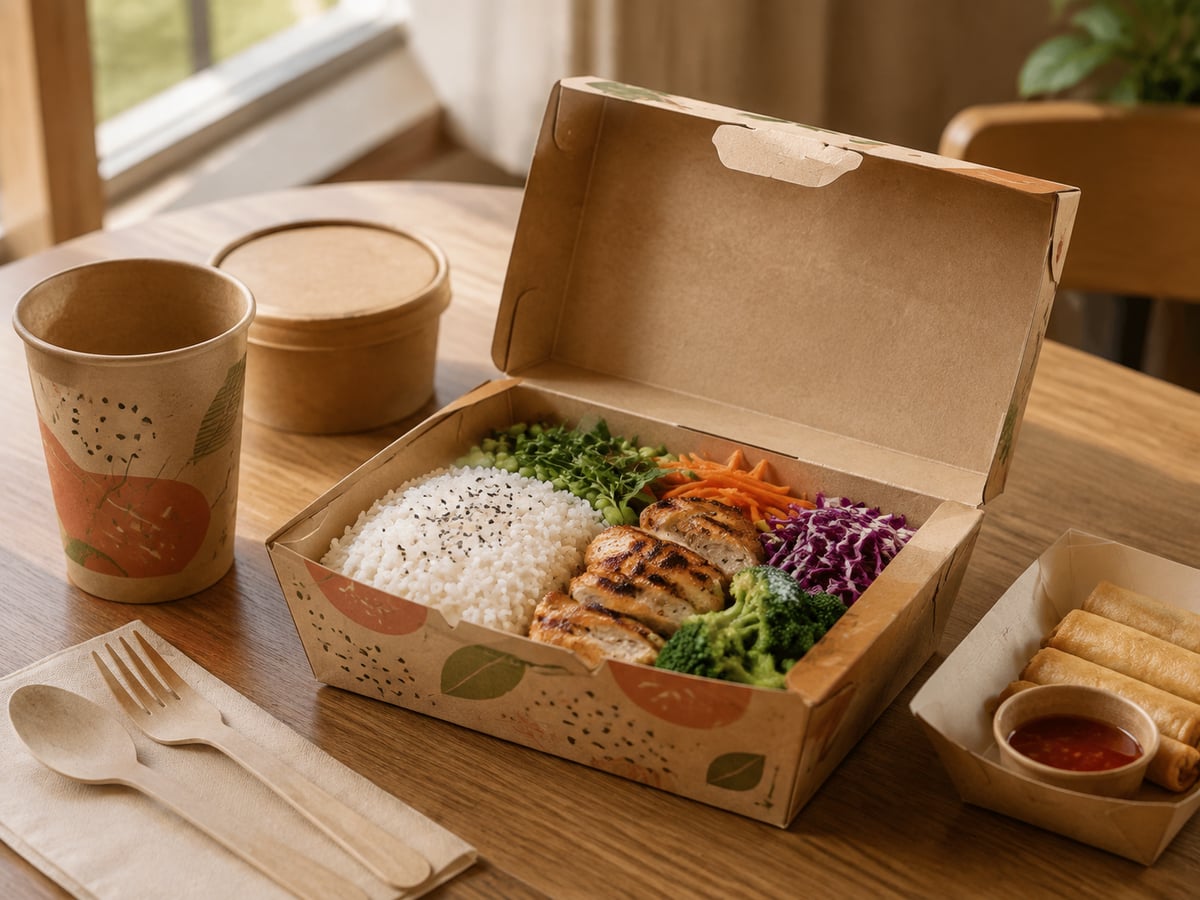
Canada Guide to Sizing Right 3-Compartment Meal Boxes
The correct 750–1300 ml three-compartment meal box is not simply the box with the highest nominal capacity. For Canadian caterers, meal-prep brands, institutional kitchens and delivery operators, the best specification is the smallest format that safely holds the intended main dish and two side portions without compressing food, allowing sauce to migrate, creating excessive empty space or causing the lid to touch the meal.In practice, a 750–900 ml box often suits lighter meals such as grilled chicken with vegetables and rice, salads with protein, breakfast sets, children’s meals and smaller corporate lunches. A 900–1100 ml format is usually the most versatile range for standard Canadian takeaway meals, including rice bowls, pasta with vegetables, chicken dishes and balanced meal-prep menus. A 1100–1300 ml three-section meal box is more appropriate for generous portions, higher-protein menus, meals with bulky sides, hot comfort food, or delivery orders where larger servings are part of the brand promise.Capacity should be approved using real food, not water alone. Water confirms a container’s nominal volume, but it does not show how rice piles, how roasted vegetables stack, whether fried foods lose their shape, or whether sauces cross the divider during transport. The final decision should consider portion weight, food density, fill height, lid clearance, total filled weight, stacking strength and movement during delivery.For reliable procurement, establish a simple approval record with menu details, target weights, accepted fill line, lid fit, leak test result, transport result, artwork version and inspection standard. This turns a subjective packaging choice into a repeatable purchasing specification.Typical Menu FormatRecommended Total CapacityMain Compartment UseSide CompartmentsBest FitBreakfast set with eggs and fruit750–850 mlEggs, pancakes or breakfast proteinFruit, potatoes or pastryCafés and hotel breakfast serviceLight lunch bowl800–900 mlSalad, grain bowl or wrap piecesFruit and snack sideOffice lunch programsStandard balanced meal900–1050 mlProtein with rice, pasta or grainsVegetables and sauce-controlled sideMeal-prep subscriptionsHot entrée with two cooked sides1000–1150 mlChicken, beef, fish or pasta entréeVegetables and starchTakeaway restaurantsHigh-protein fitness meal1050–1200 mlProtein and carbohydrate baseVegetables and extra sideGyms and nutrition brandsGenerous family-style single serving1150–1300 mlLarge hot main dishTwo substantial sidesDelivery kitchens and caterersThe table is a starting point rather than a substitute for testing. A 950 ml meal box can outperform a 1100 ml box if its compartment layout better matches the food. Buyers should compare usable compartment volume, divider height and internal footprint rather than purchasing only by the total capacity printed on a catalogue.Three-compartment meal boxes normally divide the internal area into one large entrée section and two smaller side sections. The correct layout depends on whether the meal is led by a protein, starch, salad or sauced dish. In Canadian quick-service operations, the main compartment typically needs to hold 50–65% of the usable volume. The remaining capacity should be divided between sides according to the menu: equal sections for rice and vegetables, or one medium and one small section for a sauce cup, fruit portion, dessert, coleslaw or bread.For example, a Toronto meal-prep business serving 140 g grilled chicken, 180 g rice and 120 g roasted vegetables may find that a 1000 ml box with a 600 ml main section and two 200 ml side sections provides a clean presentation. However, a Vancouver poke-style meal with loose grains, raw vegetables and a sauce cup may need a broader, shallower 1050 ml format to prevent tall ingredients from touching the lid. A Montréal caterer serving lasagna, mixed vegetables and salad may choose a deeper 1150 ml box because the entrée is dense and hot while the side dishes need separation.Do not assume that equal-volume compartments are automatically better. Equal sections are suitable for menus where all items have comparable portion sizes, such as a school lunch with pasta, vegetables and fruit. They are less suitable for restaurant meals where the entrée is clearly larger. For Canadian institutional catering, a large-main layout is usually more operationally efficient because food staff can portion the central item quickly and use the smaller areas for consistent sides.Total Box CapacitySuggested Main SectionSuggested Side Section 1Suggested Side Section 2Suitable Food Profile750 ml400–450 ml150–175 ml150–175 mlBreakfast, children’s meals, light lunches850 ml450–525 ml160–200 ml160–200 mlSalads, sandwiches with sides, compact meals950 ml525–600 ml175–215 ml175–215 mlStandard lunch service1050 ml575–650 ml200–240 ml200–240 mlRice, pasta and protein meals1150 ml650–725 ml210–250 ml210–250 mlHot entrées and larger portions1300 ml725–825 ml230–290 ml230–290 mlPremium delivery and hearty mealsThese ratios should be verified against the actual internal dimensions. A box with thick rolled edges, tall dividers or a strongly domed lid may have less usable food space than its nominal capacity suggests. Ask suppliers for internal length, width, depth and compartment capacity measurements. When sourcing from overseas, request a physical sample before confirming a high-volume order.Portion weight gives a more dependable basis for selecting meal packaging because food density varies widely. A 200 g serving of steamed rice occupies much less space than 200 g of leafy salad. Mashed potatoes settle differently than roasted potato wedges, and a 150 g portion of sauced curry can spread across a compartment more readily than a 150 g grilled chicken breast.Build a menu-to-packaging worksheet for every major meal program. Record the target serving weight of each food item, the cooked state, serving temperature, sauce volume, garnish allowance and intended compartment. This worksheet helps purchasing, culinary and operations teams agree on a packaging format before branded stock is ordered.For a Canadian delivery business operating in Calgary, Edmonton or Winnipeg, filled weight is especially important during winter conditions. A heavy meal packed in a weak box can flex as customers carry it from a vehicle to an office or home. For delivery programs, test the gross meal weight, not only the food portion weight. Include the box, lid, sauce cups, utensils, napkins and any secondary bagging.Food ItemTypical Portion WeightApproximate Space RequirementPackaging ConsiderationRecommended Box RangeGrilled chicken breast with sauce140–190 gModerate, irregular shapeNeeds lid clearance and grease resistance900–1100 mlCooked rice or quinoa150–220 gCompact, settles easilyLeave room for scooping variation850–1050 mlRoasted vegetables100–160 gBulky and unevenRequires broader compartment footprint950–1150 mlMixed leafy salad80–140 gHigh volume, low densityUse a shallow, wide design950–1200 mlPasta with sauce220–320 gDense but mound-formingCheck heat, steam and sauce control1000–1300 mlFresh fruit side80–130 gVariable shape and moistureSeparate from hot foods where possible750–1050 mlThe purpose of this table is to illustrate why the same total meal weight can need different box sizes. A 500 g meal consisting mainly of rice and chicken may fit securely in a 950 ml format, while a 500 g meal containing salad, roasted vegetables and bread may need a 1150 ml shallow box.Headspace is the distance between the highest point of the food and the inside of the closed lid. It protects the presentation of the meal, reduces pressure on sauces and allows hot food to release steam without immediately contacting the cover. For most three-compartment food boxes, allow approximately 8–15 mm of working headspace. Foods with tall or fragile components, such as broccoli florets, crispy chicken, sushi-style ingredients or piled salads, may need 15–20 mm.Headspace should be measured with the actual lid or closure method in place. A flat lid may require a lower fill line than a domed lid. If using a fold-over paper lid, check whether the hinge line enters the food area after closing. If the meal box has a separate lid, verify that repeated opening and closing does not weaken the rim or cause the lid to release.For hot foods, overly tight packing creates condensation. Moisture can soften crispy foods, dampen paperboard surfaces and make customers feel that the portion is overcrowded. Conversely, too much empty space can make a meal look undersized and allow food to slide during delivery. The aim is controlled headspace, not maximum empty volume.var ctx=document.getElementById('lineChart').getContext('2d');new Chart(ctx,{type:'line',data:{labels:['2022','2023','2024','2025','2026','2027'],datasets:[{label:'Canadian demand index for compartment meal packaging',data:[100,108,117,126,136,147],borderColor:'rgb(37,99,235)',backgroundColor:'rgba(37,99,235,0.12)',borderWidth:3,fill:false,tension:0.3}]},options:{responsive:true,maintainAspectRatio:false,scales:{y:{beginAtZero:false,title:{display:true,text:'Demand index (2022 = 100)'}},x:{title:{display:true,text:'Year'}}}}});The chart shows an illustrative planning index for demand growth in Canadian compartment meal packaging. Demand is supported by meal-prep subscriptions, workplace catering, campus dining, grocery prepared foods and third-party delivery. Buyers should plan packaging capacity in advance of seasonal increases, particularly around back-to-school periods, winter delivery peaks and corporate event seasons.A real-food fit test is the most useful final check before standardizing a three-compartment meal box. The test should use production-intended foods at normal serving temperatures. Water testing alone cannot replicate oils, acidic sauces, gravy, melted cheese, food particles or pressure from a stacked delivery bag.Start by filling each compartment to the proposed operating line. Close the lid using the normal staff method. Then complete a controlled movement test: hold the box level for one minute, tilt it 30 degrees in each direction, stack it under normal delivery weight, and simulate 10–15 minutes of vehicle movement. For institutional orders, document the test with photographs and pass/fail criteria.Sauce migration may result from a low divider, poor lid engagement, a distorted rim, excess headspace or a menu that uses too much liquid. If a curry, gravy or salad dressing regularly crosses the divider, consider a deeper divider, a revised portion size, a separate sauce cup or a different compartment layout. Do not rely on staff being unusually careful; packaging must accommodate real operating conditions.Test StepMethodPass CriterionCommon Failure SignalCorrective ActionInitial closure checkClose 10 filled samplesAll lids seat evenlyCorner gaps or rim bucklingReview lid fit or board stiffnessHot-fill checkPack food at service temperatureNo softening or deformationSteam collapse or warpingAdjust material or venting30-degree tilt testTilt each side for 10 secondsNo cross-compartment leakageSauce travels over dividerIncrease divider height or reduce sauceStacking testStack loaded boxes for 20 minutesBase remains stableCompression or lid releaseImprove structure or stacking limitDelivery vibration testTransport in insulated bagFood remains in assigned sectionMixed sides or shifted entréeReduce empty space or revise layoutCustomer opening testOpen after delivery intervalMeal looks clean and appetizingCondensation, spills or crushed foodChange fill line, lid or menu assemblyThis test protocol can be used by restaurants in Ottawa, hospital food-service teams in Toronto, university kitchens in Halifax and national meal-prep programs distributing through Vancouver. A simple repeatable method is more valuable than approving a sample based only on appearance.Oversizing is not harmless. A box that is too large can encourage over-portioning, use more paperboard than necessary, consume more storage space and reduce the number of units that fit into cartons, pallets and shipping containers. For importers bringing packaging through the Port of Vancouver, Port of Montréal or Port of Halifax, inefficient carton dimensions can affect total landed cost even when the unit price appears competitive.Large empty areas also create a poor delivery experience. Food shifts more easily when there is unused space, sauces can spread, and a customer may perceive the meal as smaller than expected. In a premium meal-prep program, this can lead to complaints despite the correct food weight being served.The right objective is usable capacity. An efficient box supports the menu with minimal unused space while leaving necessary headspace. Review carton pack counts, nesting height, pallet pattern and container loading when comparing formats. A slightly more expensive box with better nesting can be less costly after warehousing and freight are included.var ctx=document.getElementById('barChart').getContext('2d');new Chart(ctx,{type:'bar',data:{labels:['Meal prep','QSR takeaway','Corporate catering','Healthcare','University dining','Retail prepared food'],datasets:[{label:'Estimated Canadian demand share (%)',data:[26,23,16,12,10,13],backgroundColor:['#2563eb','#16a34a','#f59e0b','#9333ea','#dc2626','#0891b2']}]},options:{responsive:true,maintainAspectRatio:false,plugins:{legend:{display:false}},scales:{y:{beginAtZero:true,max:30,title:{display:true,text:'Estimated demand share (%)'}}}}});The bar chart provides an illustrative view of where three-compartment meal packaging demand is concentrated. Meal-prep brands and quick-service takeaway operators typically need the broadest range of sizes, while healthcare and education buyers often value portion consistency, simple handling and documented food-contact compliance.Many growing food brands purchase too many packaging sizes too early. Multiple formats can improve menu fit, but they also increase inventory complexity, minimum order quantities, artwork versions, warehouse space and staff mistakes. For most Canadian brands with a focused menu, two standard sizes are enough at launch: one compact 800–900 ml format and one regular 1000–1150 ml format.A third 1200–1300 ml size becomes useful when the business offers premium portions, family-oriented single meals, high-calorie fitness meals or seasonal comfort-food menus. A fourth format should only be added when there is clear sales volume, a repeated product-fit problem or an operational need that cannot be solved through portion adjustment.Brands serving multiple cities should also consider whether one format can work across channels. A box that works for counter pickup may not be ideal for 35-minute delivery. Test for the longest normal delivery route, especially in Greater Toronto, Metro Vancouver and Montréal where traffic can extend travel time.Business StageRecommended Number of SizesSuggested Capacity MixPrimary GoalInventory RiskNew local concept1–2 sizes850 ml and 1050 mlSimple menu executionLowSingle-city meal-prep brand2 sizes900 ml and 1100 mlCover standard and premium mealsLow to moderateMulti-location restaurant group2–3 sizes850 ml, 1050 ml, 1250 mlSupport varied daypartsModerateCorporate catering operator2–3 sizes800 ml, 1000 ml, 1200 mlPortion-controlled serviceModerateInstitutional food service1–2 sizes850 ml and 1050 mlFast assembly and consistencyLowNational food brand3–4 sizes750 ml to 1300 ml rangeChannel and menu optimizationHigher; needs forecast controlThe table demonstrates that more sizes do not automatically create a better packaging system. A smaller, disciplined range can improve purchasing leverage, reduce obsolete stock and make employee training easier. Add a format only after collecting sales, food-cost and delivery-performance data.Before bulk production, convert sample feedback into measurable acceptance standards. State the total nominal capacity, internal compartment dimensions, board material, coating or barrier requirement, lid style, food temperature range, maximum filled weight, permitted headspace, packing quantity and artwork approval version.For Canada-bound packaging, buyers should also clarify documentation needed for the intended food-contact application and environmental positioning. Requirements may vary by customer, province, end-use claim and material selection. If compostability, recyclable-fibre content or FSC-related sourcing is part of the sales message, make sure the relevant wording and supporting documentation are reviewed before printing.For custom printed meal boxes, approve digital artwork first, then a white structural sample, then a printed pre-production proof where appropriate. This sequence helps identify issues with logo placement, fold lines, colour alignment and readability before full production. See Fude Packaging’s custom packaging services for support with dielines, material recommendations, sampling and production preparation.var ctx=document.getElementById('areaChart').getContext('2d');new Chart(ctx,{type:'line',data:{labels:['2022','2023','2024','2025','2026','2027'],datasets:[{label:'Share of buyers prioritizing fibre-based packaging (%)',data:[38,44,51,58,64,70],borderColor:'rgb(22,163,74)',backgroundColor:'rgba(22,163,74,0.24)',borderWidth:3,fill:true,tension:0.35}]},options:{responsive:true,maintainAspectRatio:false,scales:{y:{beginAtZero:true,max:80,title:{display:true,text:'Buyer priority share (%)'}}}}});The area chart illustrates the continuing shift toward fibre-based and sustainability-focused food packaging selection. By 2026 and beyond, Canadian buyers are expected to examine not only capacity and price, but also material efficiency, responsible fibre sourcing, barrier performance, end-of-life communication and packaging reduction opportunities.Fude Packaging supports overseas buyers with in-house production of food packaging including cups, bowls, trays, paper food containers and multi-compartment meal boxes. For Canadian importers, the main advantage is direct coordination between structural development, material selection, printing, forming, inspection and export packing rather than fragmented sourcing through multiple suppliers.Technological capabilities: The company uses automated production processes and an in-house laboratory to evaluate practical performance factors such as box formation, material consistency, grease resistance, leak prevention, heat suitability, lid compatibility and print quality. This matters when a 750–1300 ml compartment meal box must carry hot rice, oily proteins, salads or sauces without compromising its structure. Buyers can request white samples, printed samples and functional prototypes to verify dimensions before committing to large-scale supply.Manufacturing capabilities: With more than 20 years of packaging experience, a self-owned 30,000 m² production base in Shandong and automated capacity of up to 120,000 units per day, Fude Packaging is positioned to support regular purchasing programs and scheduled orders. Full-batch traceability, incoming material inspection, production monitoring and final checks help improve consistency for buyers supplying restaurant chains, distributors, caterers and retail food programs. Explore available food container options when comparing compartment layouts and serving capacities.Service capabilities: Fude Packaging provides OEM and ODM support covering size selection, structural development, artwork review, Pantone-oriented colour matching, prototypes, export packing and international shipping coordination. The team can assist Canadian customers with documentation requests, inspection arrangements, sample delivery and order scheduling. Learn more about Fude Packaging’s manufacturing background or contact the packaging team to request samples for meal-box testing.Supplier Evaluation PointWhat Canadian Buyers Should VerifyWhy It MattersFude Packaging SupportCapacity accuracyNominal and usable compartment volumePrevents poor menu fitSample-based dimensional confirmationMaterial performanceHeat, grease and moisture suitabilityProtects food presentationMaterial and coating recommendationsPrint approvalArtwork, colours and fold-line placementReduces branding errorsDigital proof and pre-production optionsBatch consistencyFormation quality and rim uniformitySupports lid fit and service speedProduction monitoring and inspectionCompliance documentsFood-contact and fibre-related documentationSupports procurement reviewAvailable documentation guidanceExport readinessCartons, palletization and shipping documentsReduces landed-cost riskInternational order coordinationThis supplier comparison framework is intended to help buyers evaluate total procurement value rather than focusing only on the lowest container price. A reliable meal box program requires stable quality, correct dimensions, efficient logistics and responsive problem handling after shipment.Three trends will shape meal-box selection in Canada through 2026 and beyond. First, packaging design will become more data-driven. Larger caterers and delivery operators are increasingly recording menu weights, waste levels, delivery complaints and packaging usage by location. This information makes it easier to match a box size to real portions and reduce oversizing.Second, sustainability requirements will continue to influence material decisions. Buyers are likely to favour right-sized packaging, responsible fibre sourcing, lighter structures that maintain performance and clearer end-of-life communication. The best sustainability improvement is often avoiding unnecessary material in the first place, while still maintaining safe containment and food quality.Third, delivery resilience will become more important. Longer delivery routes, multi-order stacking and seasonal weather conditions require meal containers that maintain shape and separation. Packaging specifications will increasingly include vibration testing, temperature exposure, stack load limits and defined acceptance criteria.var ctx=document.getElementById('comparisonChart').getContext('2d');new Chart(ctx,{type:'bar',data:{labels:['Menu fit','Freight efficiency','Delivery stability','Branding flexibility','Approval traceability'],datasets:[{label:'Standard untested format',data:[55,58,54,45,40],backgroundColor:'rgba(148,163,184,0.85)'},{label:'Sample-approved right-sized format',data:[90,82,88,86,92],backgroundColor:'rgba(147,51,234,0.82)'}]},options:{responsive:true,maintainAspectRatio:false,scales:{y:{beginAtZero:true,max:100,title:{display:true,text:'Performance score out of 100'}}}}});The comparison chart highlights the operational advantage of a right-sized, sample-approved meal box. While values are illustrative, the decision pattern is practical: testing before bulk production usually improves menu fit, transport stability, branding confidence and purchasing control.Start with the actual cooked portion weight of the main dish and both sides. Pack the food into samples at the normal serving temperature, close the lid and check for clean presentation, sufficient headspace and no divider overflow. Record total filled weight and usable compartment space. Select the smallest box that passes the test consistently.Most meals need around 8–15 mm between the food and lid. Use more space, usually 15–20 mm, for tall salads, crispy foods, bulky vegetables or fragile garnishes. The correct amount depends on the lid shape, delivery distance and whether the food releases steam.Yes. Many brands can standardize around one 850–900 ml box for lighter meals and one 1000–1150 ml box for regular meals. Group menu items by physical volume and food shape, not only by price or weight. Test the largest, sauciest and tallest meal in each group before standardizing.A custom size is justified when a standard format repeatedly causes food compression, wasted space, poor delivery performance, inefficient pallet loading or inconsistent presentation. It can also be worthwhile for national restaurant chains that need a distinctive compartment layout or branded structure at significant volume.The best confirmation is a real-food test combining hot-fill evaluation, lid closure, 30-degree tilt testing, stack testing and simulated delivery movement. Use at least 10 samples and document the results. The final approved sample should become the reference for future production inspections.For Canadian buyers, the best 750–1300 ml three-compartment meal box is the one that protects the meal from kitchen assembly through final delivery. Test real portions, define measurable acceptance criteria and select a supply partner that can reproduce the approved specification consistently. -

Global Market Guide to Qualifying Food Packaging Factories
When sourcing from a China custom food packaging manufacturer for the Global market, buyers should qualify the factory against the exact product, food application, destination regulations, order volume, printing requirement and delivery schedule involved. A factory that makes simple dry-food cartons may not be suitable for hot soup bowls, grease-resistant burger boxes, double-wall coffee cups or leak-resistant takeaway containers.The most reliable qualification approach is evidence-based. Request machinery lists, production-flow records, raw-material specifications, food-contact declarations, inspection reports, batch traceability examples, product-specific samples, capacity schedules and corrective-action records. Then turn the agreement into measurable acceptance standards covering dimensions, material weight, print color, leakage, lid fit, odor, grease resistance, carton packing and delivery timing.For overseas buyers, qualification should also include export readiness. A factory should be able to support commercial invoices, packing lists, shipping marks, inspection records, relevant food-contact documents and destination-market paperwork. Buyers shipping through Qingdao Port, Shanghai Port, Ningbo-Zhoushan Port, Shenzhen or Guangzhou should confirm lead times based on both factory production and port booking conditions.Qualification AreaWhat Buyers Should VerifyPractical EvidenceTypical Risk if MissingProduct suitabilityFactory experience with the required food type and container structureProduct samples, customer references, production photosLeakage, deformation or poor food performanceFood-contact controlMaterial declarations, coating information and compliance testingSupplier declarations, test reports, batch recordsCustoms or regulatory rejectionEquipment capabilityPrinting, die-cutting, forming, sealing and inspection equipmentMachine list, videos, maintenance recordsInconsistent quality or restricted customizationTraceabilityAbility to link finished goods to raw materials and production datesLot codes, inspection sheets, warehouse recordsSlow recall or unresolved quality claimsCapacityAvailable output during ordinary and peak seasonsProduction plan, shift records, confirmed booking slotsDelayed launches and stock shortagesCorrective actionHow the factory investigates and closes defectsCAPA reports, root-cause analysis, reinspection resultsRepeated defects across later shipmentsThis table should be used as a starting point rather than a substitute for product testing. A supplier may have valid documents but still produce a cup that loses stiffness when filled with hot beverages, a bowl that does not match the selected lid, or a printed carton with unacceptable color variation. The approval decision should be based on documents, samples and measurable performance together.Demand in the Global market is being shaped by takeaway meals, delivery platforms, coffee chains, convenience retail, meal-prep businesses and branded restaurant groups. Buyers increasingly need packaging that balances cost, transport efficiency, food safety, sustainability claims and visual consistency across countries. The chart below shows an illustrative indexed growth pattern for food-service paper packaging demand, with 2023 set as the baseline year.var ctxMarketGrowth = document.getElementById('marketGrowthChart').getContext('2d');new Chart(ctxMarketGrowth, { type: 'line', data: { labels: ['2023', '2024', '2025', '2026', '2027', '2028'], datasets: [{ label: 'Global food-service paper packaging demand index', data: [100, 107, 115, 124, 134, 145], borderColor: 'rgb(34, 115, 82)', backgroundColor: 'rgba(34, 115, 82, 0.12)', borderWidth: 3, tension: 0.3, fill: false }] }, options: { responsive: true, maintainAspectRatio: false, scales: { y: { beginAtZero: false } } }});Product scope should be the first factory-screening question. Buyers should identify whether the supplier manufactures the required product internally or sources it from another plant. A factory with in-house converting and forming generally gives better control over dimensions, printing, consistency, lead time and corrective action than a trading company coordinating multiple unidentified producers.Common food-service products include paper cups, ripple-wall cups, double-wall cups, paper bowls, salad bowls, soup containers, noodle boxes, burger boxes, kraft lunch boxes, food trays, multi-compartment meal boxes and takeaway containers. Buyers can review relevant custom paper cup options, paper bowl formats and broader food container solutions while defining the intended use.Each application should specify food temperature, holding time, sauce or oil content, microwave or refrigeration exposure, delivery distance, stacking requirement, lid type and disposal expectation. A salad bowl for chilled foods does not have the same barrier requirement as a noodle bowl carrying hot broth. A burger box must resist grease and compression, while a coffee cup must provide suitable insulation, rim comfort and lid compatibility.Packaging ProductTypical ApplicationCritical Performance CheckRecommended Sample TestSingle-wall paper cupCold drinks, short-service beveragesSeam integrity and print registrationCold-water hold test and lid fit checkDouble-wall coffee cupHot coffee, tea and specialty drinksHeat insulation and rim strengthHot-fill test at operating temperaturePaper bowlRice, salad, soup and noodlesLeak resistance and bowl rigidityTimed liquid and compression testKraft lunch boxFried foods, bakery items and mealsGrease resistance and fold strengthOil exposure and stacking testBurger boxBurgers, sandwiches and snacksGrease barrier and closure retentionHot-food holding and transport testMulti-compartment trayMeal preparation and institutional cateringPartition stability and portion separationFilled-container handling trialThe purpose of this product matrix is to prevent generic approvals. The approved sample should match the final specification as closely as possible: same board grade, coating type, size, artwork, forming method, lid, packing configuration and intended food use. Where a buyer changes the coating, cup size, print coverage or food temperature, the supplier should repeat relevant validation.Equipment verification should focus on capability, condition and relevance. Ask for a current machine list showing machine type, quantity, operating status, date of installation, rated output and product category. A remote factory audit can include live video of material storage, printing, die-cutting, forming, packing and finished-goods warehousing. Buyers should request that the factory demonstrate the specific line intended for their order.For paper food packaging, relevant equipment may include flexographic or offset printing units, die-cutting machines, paper cup forming machines, bowl-forming machines, carton folding and gluing lines, ultrasonic or heat-sealing equipment, automated counting systems, metal detection where applicable, compression testers, leak testers, color-control tools and laboratory instruments.Equipment alone does not guarantee good output. Buyers should also inspect preventive maintenance records, spare-parts planning, operator training, first-piece approval procedures and changeover controls. These records indicate whether a supplier can sustain quality across production runs rather than merely produce a good sample.Fude Packaging operates from a self-owned 30,000 m² manufacturing facility in Shandong, a region connected to China’s established paper and packaging supply chain. Its production process covers material selection, printing, die-cutting, forming, inspection, packing and shipment coordination. In-house laboratory testing supports checks for key functional requirements such as leak resistance, strength, print quality, dimensions and food-application performance.For branded packaging programs, useful technical support includes Pantone color matching, artwork review, dieline confirmation, coating recommendations, structural adjustment and prototype evaluation. This is especially important for international restaurant chains that need the same visual identity across distributors, stores and delivery channels in different countries.Minimum order quantity is not simply a sales policy. It is affected by board purchasing, printing setup, ink consumption, die-cutting setup, forming efficiency, coating requirements, lid compatibility, packing method and export carton utilization. Small orders may carry higher unit costs because fixed preparation time is spread over fewer finished pieces.Buyers should compare total landed cost rather than only ex-works price. A lower unit price can be offset by weak cartons, poor pallet planning, low container utilization, rework, product failure, delayed shipment or fragmented purchasing from multiple suppliers. The most economical option often combines compatible sizes, efficient carton dimensions, consolidated product categories and a realistic reorder plan.Price DriverEffect on CostBuyer DecisionControl MethodPaperboard weightHigher grammage raises material costMatch strength to actual food loadApprove grammage toleranceCoating or barrierSpecial barriers increase conversion costSelect by food temperature and grease levelConfirm food-contact documentationPrinting coverageMore colors and coverage raise setup demandStandardize brand artwork where possibleApprove color targets and proofsCustom sizeNew tooling may add one-time costUse proven sizes when suitableConfirm tooling ownership termsOrder quantityHigher quantities improve fixed-cost absorptionForecast reorder volume realisticallyAgree price tiers in advanceExport packingStronger cartons and pallets affect total costBalance protection with container utilizationApprove carton dimensions and loading planThe table clarifies why a quote should show more than one final figure. Request a price breakdown by product, size, material, printing, quantity, packing, Incoterm and delivery point. For shipments to Rotterdam, Los Angeles, Dubai, Sydney or Singapore, buyers should also model freight volatility, port charges, customs duties and local warehousing costs.A product-specific sample trial is the bridge between sourcing claims and commercial approval. It should include a white sample for size and structure, a printed sample for artwork and color, and a functional sample for food testing. When a project is technically demanding, buyers should run the sample through the same conditions expected in restaurants, cafés, delivery vehicles or retail distribution.Quality limits should be written into the purchase order or quality agreement. Define acceptable and unacceptable defects before production starts. Examples include print shade tolerance, misregistration, glue marks, odor, pinholes, incorrect dimensions, weak seams, crushed rims, coating defects, carton damage and incorrect piece counts.Sample Trial ItemAcceptance CriterionTest ConditionResult RecordDimensionsWithin approved toleranceMeasure rim, height, base and fold pointsInspection report with sample quantityCapacityMeets stated fill volumeFill to designated line or brim standardVolume test recordLeak resistanceNo visible seepage or seam failureHot or cold liquid hold for agreed timeTimed leak-test logGrease resistanceNo unacceptable oil strike-throughFood or oil exposure simulationVisual assessment recordPrint qualityApproved color, position and readabilityCompare with signed proof or Pantone targetColor and visual approval sheetLid compatibilitySecure fit without distortion or leakageRepeated opening, closing and transport trialFit-test and handling reportFor large launch programs, it is prudent to retain signed golden samples at both buyer and factory locations. These samples should be labeled with product code, revision number, date, approved material and artwork version. Any later change in board source, coating, tooling, printing plate or production method should trigger a controlled reapproval process.Compliance documentation should match the material, product and destination market. Buyers importing into the European Union may assess food-contact suitability against applicable requirements such as EC 1935/2004. Buyers serving the United States commonly request relevant FDA-related food-contact information. FSC documentation may be requested for responsibly sourced paper claims, while compostability claims should be supported by the applicable certification route and correct labeling rules.Documents must be current, product-relevant and traceable. A generic certificate from an unrelated material or a report that does not identify the actual product construction should not be accepted as sufficient evidence. Ask the factory to explain what the document covers, the test method, issue date, material reference and connection to the supplied batch.By 2026, food packaging buyers will face stronger scrutiny of environmental claims, extended producer responsibility obligations, recycled-content policies, fluorinated-substance restrictions in some jurisdictions, clearer compostability labeling rules and increased demand for material transparency. Packaging decisions will increasingly involve a trade-off between recyclability, compostability, barrier performance, food safety and local waste-management infrastructure.Technology will also change supplier qualification. More buyers will request digital batch records, automated vision inspection, QR-enabled traceability, production dashboards, color-management data and real-time shipment visibility. The most resilient China packaging factories will combine automation with documented human inspection and controlled corrective-action systems.var ctxSustainability = document.getElementById('sustainabilityTrendChart').getContext('2d');new Chart(ctxSustainability, { type: 'line', data: { labels: ['2023', '2024', '2025', '2026', '2027', '2028'], datasets: [{ label: 'Demand for verified sustainable packaging solutions (%)', data: [38, 45, 53, 62, 69, 76], borderColor: 'rgb(35, 99, 181)', backgroundColor: 'rgba(35, 99, 181, 0.22)', borderWidth: 3, tension: 0.35, fill: true }] }, options: { responsive: true, maintainAspectRatio: false, scales: { y: { beginAtZero: true, max: 100 } } }});Real capacity is not the same as a factory’s theoretical machine output. Buyers should ask how many units can be produced on the relevant line after allowing for changeovers, maintenance, sampling, quality checks, other booked orders, worker shifts and peak-season demand. A practical capacity review should identify available production windows for the buyer’s specific item.Before seasonal peaks such as Ramadan, summer beverage demand, Black Friday promotions, Christmas, Lunar New Year or major restaurant launches, buyers should reserve capacity early. They should confirm raw-material availability, production slot dates, inspection timing, carton availability and shipping cut-off dates. A 7–15 day standard production window can be achievable for many orders, but actual timing depends on product complexity, quantity, approved artwork, material availability and current scheduling.Lead-Time StageTypical Buyer CheckEvidence to RequestRisk Reduction ValueArtwork approvalConfirm final revision and colorsSigned artwork and dielinePrevents incorrect printingRaw-material bookingConfirm board and coating availabilityMaterial purchase or stock recordReduces material delaysSample confirmationApprove functional and printed sampleSigned sample approval sheetPrevents production disputesProduction bookingReserve line and shift timeFactory schedule extractProtects peak-season capacityInspection and packingConfirm final quality and carton standardsFinal inspection reportReduces shipment claimsPort and freight bookingCoordinate cargo-ready date with forwarderBooking confirmation and loading planImproves delivery reliabilityThe following industry-demand chart illustrates how packaging demand typically differs by application. Coffee and beverage businesses often require frequent replenishment, while institutional food service may have larger but less frequent production cycles. Buyers should align supplier capacity with their demand profile rather than choosing based on headline daily output alone.var ctxIndustryDemand = document.getElementById('industryDemandChart').getContext('2d');new Chart(ctxIndustryDemand, { type: 'bar', data: { labels: ['Coffee Chains', 'Quick-Service Restaurants', 'Delivery Kitchens', 'Retail Meal Prep', 'Catering', 'Convenience Stores'], datasets: [{ label: 'Illustrative annual packaging demand index', data: [86, 94, 90, 71, 62, 78], backgroundColor: [ 'rgb(152, 94, 52)', 'rgb(220, 95, 74)', 'rgb(67, 132, 191)', 'rgb(112, 163, 94)', 'rgb(179, 138, 63)', 'rgb(135, 105, 177)' ] }] }, options: { responsive: true, maintainAspectRatio: false, scales: { y: { beginAtZero: true, max: 100 } } }});A supplier scorecard turns factory approval into an ongoing management process. Initial qualification is important, but supplier performance must be monitored after every shipment. A strong supplier relationship relies on transparent KPIs, regular reviews and an agreed escalation process when results fall below target.KPISuggested MeasurementReview FrequencyWhy It MattersOn-time deliveryOrders shipped by confirmed cargo-ready dateEvery shipmentProtects inventory and promotionsDefect rateDefective units or cartons per inspected quantityEvery shipmentMeasures manufacturing consistencyClaim closure timeDays from claim notice to approved corrective actionMonthly or quarterlyShows responsiveness and accountabilityPrint conformityLots meeting signed artwork and color standardEvery printed orderProtects brand presentationDocument accuracyCorrect invoices, packing lists and certificatesEvery shipmentSupports customs clearanceCapacity adherenceConfirmed quantity produced within reserved periodPeak-season reviewReduces supply interruption riskSupplier evaluations should include both quality and commercial performance. For example, a low-cost manufacturer with frequent artwork errors may create more total cost than a slightly higher-priced supplier with stronger inspection, faster communication and stable export documentation. Use weighted scoring to reflect what matters most to the business.var ctxSupplierComparison = document.getElementById('supplierComparisonChart').getContext('2d');new Chart(ctxSupplierComparison, { type: 'bar', data: { labels: ['Quality Control', 'Capacity Proof', 'Compliance Support', 'Customization', 'Export Service', 'Corrective Action'], datasets: [ { label: 'Qualified factory benchmark', data: [90, 88, 91, 89, 87, 90], backgroundColor: 'rgb(44, 125, 91)' }, { label: 'Basic supplier benchmark', data: [68, 62, 65, 70, 60, 58], backgroundColor: 'rgb(184, 112, 75)' } ] }, options: { responsive: true, maintainAspectRatio: false, scales: { y: { beginAtZero: true, max: 100 } } }});A practical audit should follow the material flow: incoming paperboard and coatings, storage conditions, printing preparation, die-cutting, forming, in-process inspection, finished-goods packing, warehouse control and shipment release. Buyers can conduct the audit in person, appoint an independent inspection company or combine video verification with third-party testing.For example, a European salad-chain buyer may need FSC-related material documentation, printed bowl consistency, leak resistance for dressings and secure lid fit during bicycle delivery. A Middle East restaurant distributor may prioritize grease resistance, heat performance, Arabic and English print accuracy, high-volume carton loading and delivery through Jebel Ali. A North American coffee chain may focus on cup insulation, lid fit, beverage temperature testing, print color and replenishment planning around regional promotions.Local suppliers can be useful for emergency replenishment, short domestic runs or market-specific warehousing. However, China-based manufacturers may offer stronger customization economics, broader product consolidation and scalable production for global programs. The right decision depends on total landed cost, compliance needs, delivery speed, product complexity and the buyer’s ability to plan inventory.Fude Packaging supports overseas B2B buyers seeking a controlled and scalable custom packaging factory in China. With more than 20 years of industry experience, the company serves importers, distributors, food brands, restaurant groups, coffee businesses, takeaway platforms and retailers across more than 50 countries and six continents.Its manufacturing capability is built around a self-owned Shandong factory with automated production lines capable of producing up to 120,000 units per day. Product categories include paper cups, paper bowls, food containers, burger boxes, kraft lunch boxes, salad containers, noodle boxes, food trays and multi-compartment meal boxes. This allows buyers to consolidate multiple paper food-packaging categories under one supplier while maintaining coordinated quality and brand presentation.Fude Packaging’s service capability includes OEM and ODM support, material selection guidance, structural development, artwork and dieline checks, Pantone matching, white samples, printed samples, functional prototypes, export-ready packing and coordinated shipment documentation. Customers can also arrange independent third-party inspection or laboratory testing before shipment when their internal procurement policy requires it.For Global market buyers, the practical value lies in combining factory-level production control with international project communication. The team can clarify food type, serving temperature, quantity, destination-market requirements, packaging objective, shipping preference and launch deadline before recommending a suitable solution. Standard orders may be completed in approximately 7–15 days depending on the final specification and production schedule.Verify the supplier through a combination of legal business information, factory address confirmation, live or in-person audit, machinery records, food-contact documents, product-specific samples, third-party inspection options, production schedules and export references. Do not rely only on catalog photographs, generic certificates or low quotations.Useful records include machinery lists, maintenance logs, production schedules, shift plans, first-piece approval forms, in-process inspection sheets, final inspection reports, warehouse inventory records, batch codes, raw-material purchase records and corrective-action reports. These documents should relate to the product category being sourced.The trial should include dimensional checks, capacity verification, hot or cold liquid testing, leak testing, grease testing where relevant, lid-fit testing, print approval, odor review, transport simulation and packing evaluation. The final trial should use the same material and process intended for mass production whenever possible.Ask the supplier to provide a production-window confirmation for the required product line, material availability status, current order loading, planned shifts, expected completion date, inspection timing and shipping readiness date. Reserve capacity with a formal purchase order or agreed forecast instead of relying on verbal assurances.Track on-time delivery, defect rate, claim frequency, claim closure time, print conformity, document accuracy, response speed, production adherence and corrective-action effectiveness. Review performance after each shipment and conduct a more detailed supplier review at least quarterly for strategic packaging programs. -

United States Meal Prep Paper Box Supplier Guide 2026
The United States market for meal prep paper boxes is expanding quickly as restaurants, delivery kitchens, grocers, caterers, and healthy food brands move away from foam and standard plastic packs toward stronger paper-based packaging. A reliable meal prep paper boxes supplier should offer leak resistance, stable compartment designs, food-contact compliance, printing options, and dependable export logistics into major U.S. gateways such as Los Angeles, Long Beach, New York/New Jersey, Savannah, Houston, and Seattle. For buyers serving cities such as New York, Chicago, Dallas, Miami, Atlanta, San Francisco, and Los Angeles, the best supplier is not just the cheapest factory. It is the partner that can balance material performance, certification, lead time, container loading efficiency, and consistent branding at scale.For U.S. importers and food-service operators, compartment meal boxes are especially valuable because they help separate proteins, grains, vegetables, sauces, and side dishes in one pack. This supports portion control, cleaner presentation, and better delivery performance. If you are sourcing from overseas, you should assess coating choice, paper weight, sealing quality, microwave suitability, available dimensions, custom printing accuracy, and after-sales responsiveness before placing a wholesale order. If you want to review a broader packaging lineup beyond meal prep trays, you can browse the full product catalog for related bowls, trays, lunch boxes, and takeaway containers.A good meal prep paper boxes supplier for the United States should provide compartment food boxes in multiple capacities, food-grade paperboard, PE or PLA lining choices, FDA-compliant materials, reliable leakage performance, and practical MOQ options for both trial and container orders. In the current U.S. market, demand is strongest from meal prep brands, delivery-focused restaurants, school lunch programs, grocery ready-meal counters, and corporate catering providers. Buyers usually favor 2-compartment and 3-compartment paper boxes in kraft or white board formats because they work well for rice bowls, grilled chicken sets, pasta meals, salads, and mixed hot entrees.The most important buying criteria are straightforward. First, confirm that the structure is strong enough for hot and oily foods. Second, match the coating to your disposal and branding goals. Third, check that the supplier can maintain printing consistency and lead times during seasonal spikes. Fourth, verify documents for food contact and compostability if required by your customers or local regulation. Fifth, make sure the factory has real production scale instead of acting only as a trader.For U.S. distributors and chains, sourcing directly from a manufacturer can improve cost control, especially when shipping to high-volume distribution corridors such as Southern California, the Midwest, and the Northeast. It also helps when you need custom lid shapes, special compartment ratios, or private-label packaging. A dependable meal prep paper box manufacturer should be able to support artwork review, samples, production scheduling, and loading plans that fit both full-container and mixed-SKU orders.Buying FactorWhy It Matters in the U.S.What to Ask the SupplierCompartment LayoutSupports portion control for fitness meals and combo dishesDo you offer 1, 2, and 3-compartment options?Leak ResistanceCritical for delivery and refrigerated transportWhat coating and paper weight are used?Food ComplianceNeeded for import confidence and B2B salesCan you provide FDA-related food-contact documents?CustomizationImportant for chains, meal brands, and wholesalersWhat are the print colors, finish, and OEM options?MOQ FlexibilityHelps new brands test the marketDo you support pilot orders and mixed sizes?Lead TimeReduces stockout risk in busy metro marketsWhat is the production time after artwork approval?Export CapabilityImportant for shipments to U.S. ports and warehousesHow do you manage packing, loading, and delivery support?The table above summarizes what most U.S. buyers should verify first. Many sourcing problems come from overlooking box structure, coating, or documentation during early negotiations. When these points are clear from the beginning, price comparison becomes much more meaningful.The United States meal prep packaging market is being driven by several converging trends: growth in food delivery, healthier eating habits, expansion of grab-and-go refrigerated meals, and rising consumer expectations around sustainable packaging. By 2026, demand for paper-based meal prep containers is expected to remain strong, especially in dense metro areas where off-premise dining dominates. New York City, Los Angeles, Chicago, Dallas, Houston, Atlanta, Seattle, and Miami continue to generate substantial packaging consumption through restaurant chains, cloud kitchens, airport catering, hospitals, universities, and grocery prepared-food departments.Demand is also widening beyond traditional takeout. Fitness meal subscription companies need sturdy compartment containers that preserve presentation during distribution. Corporate caterers want cleaner branding and better stackability. Supermarkets want shelves that look less plastic-heavy while still protecting food quality. School and institutional procurement teams increasingly favor packs that can align with sustainability targets without sacrificing service efficiency. This is why a meal prep paper boxes supplier today must think beyond basic lunch boxes and offer a portfolio suitable for hot foods, cold meals, refrigerated display, and same-day delivery.Policy and sustainability trends matter as well. Several U.S. states and municipalities continue to restrict or discourage certain single-use plastics and foam products. Even where laws are not fully uniform, many brands are proactively moving toward paper-based packaging because it aligns with customer expectations and retail positioning. At the same time, buyers are becoming more informed. They ask whether the coating is PE or PLA, whether the paper is responsibly sourced, and whether the pack is commercially compostable in regions where infrastructure exists.var ctxLine = document.getElementById('lineMarketGrowth').getContext('2d');var lineMarketGrowth = new Chart(ctxLine, { type: 'line', data: { labels: ['2022', '2023', '2024', '2025', '2026'], datasets: [{ label: 'Estimated U.S. Demand Index for Meal Prep Paper Boxes', data: [78, 89, 101, 114, 129], borderColor: 'rgb(54, 162, 235)', backgroundColor: 'rgba(54, 162, 235, 0.15)', fill: false, tension: 0.3 }] }, options: { responsive: true, maintainAspectRatio: false }});The line chart shows a realistic demand index trend rather than a formal market valuation. It reflects how order volume can rise as delivery, ready-to-eat retail meals, and sustainability-focused procurement continue to expand through 2026.U.S. Demand SegmentPrimary Use2026 Demand OutlookMeal prep subscription brandsPortion-controlled weekly meal packsVery strongQuick-service restaurantsRice bowls, combo meals, sidesStrongGrocery prepared foodsFresh deli and refrigerated mealsVery strongCorporate cateringIndividual boxed lunchesStable to strongSchools and institutionsPortioned meal serviceStableHospitality and travel cateringTakeaway and event mealsModerate growthFood delivery platformsThird-party fulfillment packagingStrongThis table highlights where growth is coming from. The strongest momentum is not only from restaurants but also from retail foodservice and structured meal programs.var ctxBar = document.getElementById('barIndustryDemand').getContext('2d');var barIndustryDemand = new Chart(ctxBar, { type: 'bar', data: { labels: ['Meal Prep Brands', 'QSR Chains', 'Grocery Deli', 'Catering', 'Schools', 'Delivery Kitchens'], datasets: [{ label: 'Estimated 2026 Purchasing Volume Index', data: [92, 86, 95, 70, 58, 81], backgroundColor: [ 'rgb(255, 99, 132)', 'rgb(54, 162, 235)', 'rgb(255, 206, 86)', 'rgb(75, 192, 192)', 'rgb(153, 102, 255)', 'rgb(255, 159, 64)' ] }] }, options: { responsive: true, maintainAspectRatio: false }});In practice, a supplier serving the United States should be able to adjust case pack formats and volume planning around these demand centers. Grocery deli programs often prefer predictable replenishment and refined presentation. Delivery kitchens care more about stackability, sealing, and transport stability.Product range is one of the clearest ways to distinguish an experienced meal prep paper boxes supplier from a limited converter. U.S. buyers commonly request clamshell lunch boxes, rectangular meal trays, window-lid deli boxes, and bento-style compartment packs. Sizes vary according to cuisine, calorie portioning, and whether the food is eaten immediately or stored chilled for later use.Popular capacities in the United States include compact 500 ml and 650 ml boxes for light lunches, 750 ml and 900 ml formats for standard meal prep service, and 1000 ml to 1200 ml boxes for large entrees, family portions, or mixed combo dishes. Compartment ratios also matter. A balanced meal prep brand may need a larger protein bay with two smaller side sections, while an Asian takeout operator may want a wide rice section and a separated sauce or vegetable section. Lid style is another differentiator. Some customers want integrated fold-over paper lids, while others prefer separate transparent lids for retail visibility.For applications such as salad bars, cold protein bowls, or premium deli offerings in places like Boston, San Diego, and Washington, D.C., presentation can be just as important as performance. A well-designed compartment box keeps ingredients visually separated, reduces sogginess, and supports shelf appeal. This is especially valuable in refrigerated supermarket cases.Box TypeTypical CapacityCommon U.S. UsesSingle-compartment lunch box500-1000 mlPasta, fried rice, salads, noodlesTwo-compartment meal box700-1100 mlProtein plus side, sandwiches with saladThree-compartment bento box800-1200 mlMeal prep sets, school meals, combo platesWindow-lid deli box500-1000 mlRetail refrigerated meals, bakery lunch kitsBoat tray style boxSmall to mediumStreet food, fries, snacks, appetizersDeep rectangular tray900-1400 mlLarge entrees, family portionsMicrowave-ready paper bowl format650-1300 mlHot meal bowls, grain bowls, stewsThe ranges above are typical, but dimensions should always be checked against your exact menu. A box that works for grilled chicken and rice may fail with saucy pasta or a high-moisture vegetable mix. That is why sampling is essential before final approval.When comparing suppliers, ask whether they can customize paper thickness, crease design, box depth, corner sealing, and stacking geometry. Those details affect warehouse efficiency and customer experience. If you need multiple formats from one source, a factory with a wider line of food containers can simplify procurement and reduce coordination time.The PE versus PLA decision is one of the most important technical choices in paper food packaging. Both options can improve moisture and grease resistance, but they are not identical in cost, disposal pathway, and heat profile. U.S. buyers often start with PE because it is familiar, economical, and dependable for hot and oily foods. PLA is selected more often when a brand specifically wants a compostable positioning and when local disposal systems or customer expectations support that claim.PE, or polyethylene, is widely used as a food-safe inner barrier. It offers solid leak resistance, performs well for many hot applications, and is usually more cost-effective. For many restaurant and delivery programs, PE-lined meal prep paper boxes remain the practical standard because they balance strength and affordability. PLA, or polylactic acid, is a plant-based coating frequently chosen for compostable packaging programs. However, buyers should understand that compostability is meaningful only where industrial composting systems or accepted waste streams are available.Heat, oil, storage time, and logistics all influence the right choice. A buyer shipping chilled meal kits across state lines may prioritize different characteristics than a restaurant sending hot lunch combos across Manhattan or downtown Chicago. The best supplier should clearly explain coating behavior, not simply present PLA as universally better. A smart sourcing decision matches the material to real use conditions and disposal expectations.FactorPE CoatingPLA CoatingBarrier performanceStrong for grease and moistureGood, depends on structure and useCost levelUsually lowerUsually higherCommon applicationHot takeaway and delivery mealsEco-positioned foodservice packagingCompostable positioningNoYes, with relevant certification and system supportMicrowave practicalityCommonly used for many meal boxesNeeds product-specific confirmationU.S. market fitBroad mainstream demandGrowing in premium and sustainability-focused segmentsBuyer profileWholesalers, QSR, delivery brandsNatural food brands, green procurement programsThe comparison above shows why both materials remain relevant. PE often wins on budget and broad performance. PLA can support environmental positioning when backed by the right documentation and end-of-life messaging.var ctxArea = document.getElementById('areaTrendShift').getContext('2d');var areaTrendShift = new Chart(ctxArea, { type: 'line', data: { labels: ['2021', '2022', '2023', '2024', '2025', '2026'], datasets: [{ label: 'Share of U.S. Buyers Requesting Compostable-Labeled Options', data: [18, 23, 29, 36, 42, 49], borderColor: 'rgb(75, 192, 192)', backgroundColor: 'rgba(75, 192, 192, 0.25)', fill: true, tension: 0.3 }] }, options: { responsive: true, maintainAspectRatio: false }});This area chart illustrates a realistic trend shift rather than a full conversion of the market. Even by 2026, many U.S. buyers will continue purchasing PE-lined boxes, but requests for compostable options are likely to increase steadily, especially in coastal cities and premium retail channels.Large-scale production of meal prep paper boxes combines paper conversion, printing, die-cutting, forming, quality control, and organized warehouse handling. A capable manufacturer should manage these steps in-house or under tightly controlled systems so that dimensions remain consistent from sample stage to bulk order. For U.S. buyers, process control matters because even small deviations in fold accuracy or coating quality can create leakage, unstable stacking, or machine packing problems downstream.At industrial scale, the process typically begins with food-grade paperboard selection, followed by coating or lamination based on the target application. Next comes flexographic or other printing, especially for custom branding. The printed sheets are die-cut to precise patterns and then moved to forming lines where folds, locks, and compartment shapes are created. After forming, quality teams inspect sealing integrity, compression strength, print accuracy, and cleanliness. The finished boxes are then packed in export cartons and staged in warehousing conditions designed to preserve shape and hygiene.Shandong Fude Packaging Co., Ltd. is a good example of how technology should support U.S. sourcing needs. The company operates from a modern 30,000 square meter manufacturing base with automated lines, printing, die-cutting, forming, laboratory testing, and managed storage systems. That matters because a meal prep paper boxes supplier serving North America must do more than produce boxes. It must maintain consistency over repeated orders, especially for chain accounts and distributors supplying multiple states.From a technological capability perspective, integrated printing and converting reduce mismatch risk between artwork approval and final production. Controlled forming equipment helps maintain compartment shape and lid closure performance. Quality labs help verify food-contact safety, resistance performance, and batch stability. These systems are particularly useful when shipping long distances to U.S. warehouses in Inland Empire logistics zones, New Jersey distribution centers, or Texas fulfillment networks.Production StageMain PurposeImpact on U.S. BuyersPaperboard selectionSets stiffness and food-contact baseAffects structure and safety confidenceCoating applicationAdds grease and moisture barrierDetermines leak resistance and use caseFlexo printingApplies branding and legal design elementsSupports retail presentation and chain identityDie-cuttingCreates accurate box patternsImproves fold precision and machine compatibilityForming and lockingBuilds final box structureInfluences sealing, stacking, and user handlingLab and visual inspectionChecks dimensions and performanceReduces defect rates in imported shipmentsClimate-managed storageProtects finished inventoryHelps maintain print and shape quality before exportThe manufacturing sequence above explains why scale alone is not enough. The real value is controlled scale. If you want to learn more about factory background and production systems, you can visit about our factory for a closer look at capabilities and export experience.One practical example comes from a North America-focused prepared-meal distributor that served fitness kitchens and refrigerated retail accounts across the East Coast. The buyer needed a 3-compartment paper box that could hold a hot protein, grain base, and vegetable side without leaking during transport or collapsing during stacking. They also wanted cleaner shelf presentation than black plastic trays and needed reliable repeat supply into New York/New Jersey distribution channels.The initial challenge was that the previous packaging source provided inconsistent fold quality and weak corner performance, which caused sauce seepage and damaged branding in transit. The buyer tested multiple structures before selecting a reinforced rectangular format with a food-grade barrier and a custom print layout. By working directly with an experienced meal prep paper boxes supplier instead of a general trader, they were able to adjust the compartment ratio, improve the board feel, and optimize carton loading for ocean freight.After sample confirmation, the program moved into bulk production. The result was a measurable reduction in transit complaints, better visual consistency for retail placement, and improved customer response because meals looked more organized and premium. The distributor also benefited from a clearer reorder process and more predictable lead times. This kind of case shows that performance gains often come from small technical decisions such as fold geometry, board weight, and coating fit rather than from dramatic design changes.Another common success pattern in the U.S. market involves regional wholesalers who supply independent restaurants in cities like Houston, Phoenix, and Orlando. These buyers want practical, fast-moving SKUs with strong price discipline. When they switch from fragmented local sourcing to a specialized export manufacturer, they often gain better carton consistency, more reliable print quality, and access to broader product families under one vendor.var ctxComp = document.getElementById('comparisonSupplierProduct').getContext('2d');var comparisonSupplierProduct = new Chart(ctxComp, { type: 'bar', data: { labels: ['Structure Consistency', 'Print Accuracy', 'Leak Resistance', 'MOQ Flexibility', 'Lead Time Reliability', 'Customization Depth'], datasets: [{ label: 'Specialized Manufacturer Score', data: [92, 90, 94, 78, 88, 91], backgroundColor: 'rgb(153, 102, 255)' },{ label: 'General Trading Source Score', data: [70, 68, 72, 75, 64, 58], backgroundColor: 'rgb(201, 203, 207)' }] }, options: { responsive: true, maintainAspectRatio: false }});The comparison chart reflects the typical advantage of buying from a specialized manufacturer when product performance and consistency matter. Trading companies may still fit some projects, but direct factories are often stronger for long-term private-label and chain programs.Documentation is a major part of B2B purchasing in the United States. Importers, distributors, restaurant groups, and institutional buyers increasingly request evidence that packaging materials meet food-contact expectations and, when applicable, sustainability claims. For a meal prep paper boxes supplier, relevant files may include FDA-related food-contact statements, test reports, FSC documentation for responsible paper sourcing, ISO quality system records, and compostability certifications such as BPI or OK Compost where the product specification supports them.Buyers should understand that not every certificate applies to every box style or coating. A supplier should be transparent about which document belongs to which item. If you are selling into natural grocery chains, universities, or corporate campuses with environmental procurement rules, that clarity becomes even more important. Mislabeling a PE-lined product as compostable can create compliance and reputation risks.Shandong Fude Packaging serves international markets with a quality-driven approach that aligns well with U.S. importer expectations. Instead of treating certification as a sales brochure item, a serious manufacturer should connect each document to the actual material and production batch logic. This reduces confusion during customs review, distributor audits, and customer onboarding.Document or StandardWhat It SupportsWhy U.S. Buyers CareFDA food-contact compliance materialsFood safety suitabilityHelps validate packaging for edible productsEU EC 1935/2004International food-contact benchmarkSignals broader regulatory disciplineISO 9001Quality management systemIndicates process control and repeatabilityFSCResponsible paper sourcingSupports sustainability narratives and procurement goalsBPI certificationCompostability claim in relevant contextsUseful for U.S. commercial compost programsOK CompostRecognized compostability standardValuable for global and premium eco buyersProduct-specific test reportsPerformance and material verificationSupports buyer due diligence and auditsThe table makes clear that certification is not a one-line answer. Each document serves a different purpose. For large U.S. accounts, a supplier should be able to provide a document package that matches the exact SKUs under discussion.MOQ and pricing vary by size, board type, coating, printing complexity, and whether the order uses a standard die or a custom mold. In the United States, buyers range from startup meal-prep brands that need one or two pallets to established distributors that order full containers. A flexible meal prep paper boxes supplier should be able to support both entry-level programs and larger wholesale volumes, although pricing naturally improves as order quantity rises and carton utilization becomes more efficient.Standard kraft or white compartment boxes with simple printing usually deliver the best cost position. Custom dimensions, extra-thick paper, transparent window features, or compostable coatings can raise unit cost. Freight is also a major factor. Ocean rates into Los Angeles/Long Beach, New York/New Jersey, Savannah, and Houston can shift landed cost substantially. Buyers should compare not only unit price but also carton count per container, storage footprint, and damage risk.From a service capability perspective, what matters is not only the quoted MOQ but also whether the supplier can guide you toward an economical mixed-SKU plan. A mature factory partner should help you choose the right assortment, carton format, and reorder rhythm rather than simply pushing a large volume that may strain your warehouse or cash flow. For project discussion or specification review, you can explore custom packaging service options that cover sampling, artwork preparation, and production planning.Order TypeTypical MOQ PatternPrice PositionSample runLow volume, often with standard sizesHighest per unitStartup trial orderOne or a few SKUs with moderate quantityHigh but manageableStandard wholesale orderMultiple cartons per SKUBalancedDistributor replenishmentRegular recurring volumeBetter pricing stabilityFull container orderHigh volume, optimized loadingBest unit economicsCustom printed chain orderDedicated artwork and stable forecastCompetitive over timeCompostable premium programDepends on material and certificationAbove standard PE product costThis table should be read as a buying framework rather than a fixed quotation sheet. Final pricing depends on exact dimensions, coating choice, print design, packing method, and shipping terms.Lead time is equally important. Many reliable factories can handle standard orders within roughly one to two weeks after approval, though custom projects may require longer. For U.S. buyers with strong seasonality, especially those supplying summer event catering or holiday retail meals, forecast communication is critical.Shandong Fude Packaging Co., Ltd. has been focused on disposable food-grade paper and plastic packaging since 2004, serving foodservice customers in more than 35 countries. For U.S. buyers looking for a meal prep paper boxes supplier, the company stands out as a factory-based partner with experience in export manufacturing, private-label development, and eco-oriented packaging design. Rather than offering a narrow container list, the company supports a broad packaging family that includes lunch boxes, paper bowls, trays, cups, deli formats, and specialty takeaway items.Its manufacturing capability is built around a modern 30,000 square meter production site in Shandong, with automated lines, integrated converting processes, and warehouse support designed for stable bulk output. That scale matters when customers need repeated shipments, coordinated packaging sets, or consistent box quality across multiple purchase cycles. In real sourcing terms, it means better control over die-cutting accuracy, forming quality, and export packing readiness.Its technological capability supports custom work as well. Flexographic printing, die development, forming systems, and internal quality checks help translate buyer specifications into repeatable production. This is especially useful for U.S. restaurant groups and wholesalers that want their own logo, specific structure, or differentiated finish. Products can be configured in kraft or white board, with leak-resistant barrier options, OEM/private label support, and application-specific sizing.Its service capability is equally important for international buyers. The company supports packaging selection, artwork preparation, sample confirmation, delivery coordination, and customization development through a simple step-by-step process. Typical production timing often falls within roughly 7 to 15 days depending on project complexity, which is attractive for distributors and food brands that need responsive replenishment. If you would like to start a project discussion, request samples, or confirm export details, you can contact our export team directly.For U.S. customers, the practical value is not just factory scale. It is the combination of product breadth, quality discipline, and export-minded service that helps reduce sourcing friction. That is particularly useful when distributing into regional hubs such as Southern California, Chicago-area warehouses, Atlanta fulfillment centers, or East Coast wholesale networks.1. What is the best box style for meal prep businesses in the United States?For most meal prep brands, 2-compartment and 3-compartment paper boxes work best because they separate proteins, carbs, and vegetables while keeping the meal organized. The exact best choice depends on menu moisture, portion size, and whether the food is sold hot, chilled, or frozen.2. Are paper meal prep boxes strong enough for oily or saucy foods?Yes, if the paperboard weight and inner coating are properly matched to the food. PE-lined boxes are especially common for hot, oily, or sauce-heavy meals. Always request samples and test them with your actual menu.3. Which is better for the U.S. market, PE or PLA?Neither is universally better. PE is usually more cost-effective and widely used. PLA is attractive for compostable positioning but should be selected only when your customers and disposal system can support that claim.4. What certifications should I request from a supplier?Ask for food-contact documentation, quality system records, and any sustainability certificates relevant to the exact product. Common examples include FDA-related documentation, FSC, ISO 9001, and compostability certificates where applicable.5. Can I order custom printed meal prep paper boxes?Yes. Many manufacturers support OEM and private label projects with custom logos, colors, dimensions, and structures. Printing setup and MOQ will depend on your artwork and volume.6. What is a reasonable MOQ for first-time buyers?For standard sizes, many suppliers can offer manageable trial quantities, while custom sizes or printed projects usually require higher MOQs. It is often more efficient to start with a standard structure and then customize after validating sales.7. How long does production usually take?Lead time depends on product complexity, season, and artwork approval. Standard projects can often be completed in about 7 to 15 days, while custom developments may take longer.8. How should U.S. buyers compare suppliers?Look beyond unit price. Compare documentation, compartment design quality, coating options, print consistency, communication speed, sampling support, and export reliability into your preferred U.S. port or warehouse location.9. Are these boxes suitable for supermarkets and refrigerated meal display?Yes, many are. Window-lid deli boxes and clean-finish compartment formats are particularly suitable for retail meal displays. However, shelf-life conditions and condensation behavior should be tested before launch.10. What trends will shape the market through 2026?Three major trends stand out: stronger demand for sustainable packaging, greater interest in custom branded meal programs, and wider use of structured paper containers in grocery prepared foods. Technology will also improve forming accuracy, barrier efficiency, and printing consistency, while policy pressure around single-use plastics will continue pushing paper alternatives forward.In summary, the best meal prep paper boxes supplier for the United States is one that can combine performance, certification, customization, and responsive service. As 2026 approaches, buyers should expect continued growth in paper-based meal packaging, stronger interest in compostable or responsibly sourced materials, and higher standards for product consistency across restaurant, retail, and delivery channels. Careful supplier selection today can improve packaging reliability, brand image, and long-term cost control. -

Specify 800–3000 ml Paper Lunch Boxes for Canada
For Canadian caterers, meal-prep operators, restaurant chains, distributors, and delivery kitchens, an 800–3000 ml paper lunch box should never be selected by kraft colour or paper appearance alone. Its real performance depends on the full construction: food-contact board grade, board weight, coating type, fold geometry, glue-line quality, lid design, filled food weight, serving temperature, delivery distance, stacking load, and expected hold time.A box that performs well for a dry 800 ml sandwich meal may fail with a 1,500 ml hot curry, a 2,000 ml rice-and-protein meal, or a 3,000 ml family platter. The main risks are usually stacking deformation, grease migration, softened corners, bottom-panel sagging, lid opening, and leakage during delivery. Canadian buyers should define measurable acceptance criteria before mass production, then confirm the specification through samples, practical filled-product testing, supplier documentation, and retained approval records.For most hot-meal applications, begin with food-grade kraft or white paperboard, select a coating according to grease and moisture exposure, and match the board weight to the actual filled product rather than nominal capacity. A reliable specification also identifies the minimum stacking performance, permitted grease staining, transport test method, print requirements, batch traceability, and destination-market food-contact documentation.CapacityTypical Canadian Menu UseTypical Filled Weight RangePrimary Failure RiskStarting Construction Direction800 mlSalad, sandwich combo, light rice bowl350–650 gCorner softening and lid fitMedium board with moisture-resistant lining1,000 mlNoodles, grain bowls, lunch portions500–850 gGrease staining at foldsMedium-to-heavy board with grease barrier1,200 mlHot entrée with sides650–1,000 gBottom deflection during deliveryHeavy board and reinforced base geometry1,500 mlMeal prep, pasta, curry, protein meals800–1,250 gSidewall compression when stackedHeavy board with heat and oil-resistant coating2,000 mlFamily meals, large salads, shared meals1,100–1,700 gBase sagging and lid openingPremium board with structural reinforcement3,000 mlCatering trays, platters, party portions1,600–2,600 gStacking deformation and seam stressPremium heavy-duty construction and validation testingThe table is a starting point, not a substitute for product validation. A 1,000 ml box filled with dry roasted vegetables can need less protection than an 800 ml box containing hot poutine, sauced wings, butter chicken, or oily noodles. The food composition and transport conditions determine the final material specification.A complete purchase specification should be written as an operational document, not as a short request for “kraft food boxes.” This is especially important for businesses serving Toronto, Vancouver, Montréal, Calgary, Edmonton, Ottawa, Halifax, Winnipeg, and other Canadian delivery markets where order volumes, weather conditions, and delivery durations vary widely.Start by documenting the menu category: dry food, fried food, sauced food, oily food, chilled meal prep, frozen meal preparation, hot prepared food, or mixed meal. Record the filling temperature, maximum hold time, normal delivery duration, average number of boxes per delivery bag, warehouse storage conditions, and whether boxes will be stacked in restaurant kitchens or on catering carts.Then define the structure: capacity, internal dimensions, top-opening or side-opening format, fold arrangement, lid tab type, venting requirement, compartment configuration, and whether a separate lid is used. For printed boxes, also specify artwork version, ink coverage, finish, pantone target where applicable, barcode location, and carton labelling.Specification ItemWhat Canadian Buyers Should StateWhy It MattersFood typeDry, sauced, oily, acidic, chilled, or hot mealDetermines paper and coating selectionServing temperatureFor example, chilled, ambient, 60°C, 80°C, or hotterAffects barrier performance and structural softeningMaximum hold timeKitchen-to-customer time, including waiting periodIdentifies moisture and grease exposure durationFilled product weightAverage and maximum fill weight in gramsSupports board-weight and stacking decisionsStacking conditionNumber of filled boxes stacked and durationPrevents crushing, lid opening, and base deformationAcceptance criteriaLeakage, staining, deflection, print, odour, and fit limitsMakes sample approval repeatable for each orderCompliance documentsFood-contact declarations and relevant certification recordsSupports import, retail, and customer audit requirementsSpecification discipline reduces costly misunderstandings. For example, “heavy-duty kraft box” is subjective, while “1,500 ml folded lunch box, tested with 1.15 kg hot sauced food at 75°C, stacked five high for 45 minutes without seam opening, visible oil breakthrough, or base collapse” is a testable requirement.var ctx = document.getElementById('marketGrowthChart').getContext('2d');new Chart(ctx, {type: 'line',data: {labels: ['2022', '2023', '2024', '2025', '2026', '2027'],datasets: [{label: 'Canadian demand index for paper meal packaging',data: [100, 108, 117, 125, 135, 146],borderColor: 'rgb(65, 120, 90)',backgroundColor: 'rgba(65, 120, 90, 0.12)',fill: false,tension: 0.3}]},options: {responsive: true,maintainAspectRatio: false,plugins: {legend: {display: true}},scales: {y: {beginAtZero: false, title: {display: true, text: 'Demand index'}}}}});This market-growth illustration reflects the continued shift toward delivery-ready, fibre-based food packaging in Canada. Growth is supported by restaurant delivery, prepared-food retailing, office catering, university food service, and consumers seeking convenient meal solutions. Actual purchasing volumes vary by province, municipal waste-management systems, menu trends, and chain expansion plans.Kraft appearance is popular because it communicates a natural, practical presentation, but a brown surface does not automatically indicate high strength, safe food-contact performance, or compostability. Buyers should choose the paperboard construction first and the visual finish second.Common options include natural kraft board, white kraft board, solid bleached sulphate board, duplex board, coated paperboard, and laminated paperboard constructions. Natural kraft is often selected for casual restaurants, cafés, healthy meal brands, bakery counters, and sustainable-looking takeaway programs. White board can support sharper branding and stronger colour contrast. However, the right choice must also account for stiffness, fold endurance, surface print quality, food-contact requirements, and barrier compatibility.For delivery operations in wet Canadian winters, the outside surface matters as much as the inside. Condensation from hot food, snow exposure during courier handoff, and humid delivery bags can weaken untreated outer paper fibres. A well-designed construction should preserve practical stiffness through the intended delivery cycle.Paper TypeAdvantagesLimitationsSuitable ApplicationsNatural kraft boardNatural appearance, good fibre strength, practical print surfaceColour variation can occur; requires suitable barrier for oily foodSalads, bakery meals, bowls, casual takeawayWhite kraft boardCleaner branding surface and good stiffnessUsually higher material cost than basic kraftPremium meal prep, retail-ready food packagingSolid bleached boardExcellent print quality and smooth surfaceMust be paired with proper barrier for heavy grease exposureBranded chain packaging and promotional launchesDuplex boardCost-effective for selected dry-food usesNot ideal for demanding hot, oily delivery meals without validationLight bakery items and dry snack packagingPE-coated boardStrong moisture and leak resistanceEnd-of-life treatment depends on local recycling systemsSauced meals, soups, oily food, long hold timesWater-based barrier boardPotentially supports fibre-forward packaging objectivesMust be tested carefully for food and hold-time conditionsSelected dry-to-medium moisture food applicationsPLA-coated boardPlant-based coating option for suitable programsComposting outcomes depend on local collection and processingSpecified compostable packaging programsPaper grade should be supported by supplier material records and performance samples. Buyers working with grocery programs, national restaurant groups, or institutional food-service contracts should avoid approving a lunch box only by visual inspection. The box should be tested with the real meal, at the expected temperature, for the longest practical delivery and holding period.Coating selection is a functional decision. It controls how the inside surface responds to water, oil, steam, sauces, salt, acidity, and heat. The coating must also work with the forming process and remain properly bonded at creases, corners, and glue areas.For a short-service dry sandwich box, a basic barrier may be sufficient. For a 90-minute delivery route from a commercial kitchen in Mississauga to central Toronto, or from Richmond to downtown Vancouver, a more robust grease and moisture barrier may be required. Hot food can release steam that condenses inside the box, while oily sauces may migrate through folds before they penetrate the flat sidewall. Therefore, testing must inspect corners, seam edges, bottom folds, and closure tabs.Food ConditionRecommended Barrier DirectionValidation FocusDry bakery productsLight moisture-resistant surface where neededPrint rub, fold quality, lid closureFresh saladsModerate moisture barrierCondensation, dressing separation, bottom stiffnessFried foodsGrease-resistant treatment or coatingOil staining, venting, crispness retentionHot rice and noodle mealsHeat-tolerant moisture and grease barrierSteam softening, seam integrity, base deflectionSauced curries and pastaEnhanced leak and oil barrierCorner leakage, coating continuity, lid engagementChilled meal prepModerate moisture resistance with suitable stiffnessRefrigerated condensation and stackingFamily plattersPremium barrier with reinforced structureLong hold time, heavy fill, transport vibrationCanadian packaging specifications should also distinguish between a material claim and an actual waste-management outcome. Terms such as recyclable, compostable, biodegradable, PFAS-free, or plastic-free should only be used when they are accurate for the exact construction, intended market, and applicable program. Municipal collection practices differ among Toronto, Vancouver, Calgary, Montréal, and smaller communities. The practical question is not merely whether a material has an environmental attribute; it is whether the product and claim are appropriate, documented, and usable in the buyer’s local system.Higher GSM does not automatically mean better lunch-box quality. Board weight must be balanced with fibre quality, caliper, coating, fold design, box footprint, height, and product load. An excessively heavy board can increase cost and make folds less consistent. An under-specified board may look acceptable empty but soften or buckle after filling.The best approach is to establish the maximum filled product weight for every SKU. Restaurants often know portion volume but not actual meal weight. A 1,500 ml container can carry 800 g of salad or more than 1.2 kg of dense rice, meat, sauce, and vegetables. The filled weight, not nominal millilitres alone, should guide structural decisions.var ctx = document.getElementById('industryDemandChart').getContext('2d');new Chart(ctx, {type: 'bar',data: {labels: ['Restaurant delivery', 'Meal prep', 'Catering', 'Retail prepared food', 'Universities', 'Healthcare food service'],datasets: [{label: 'Relative demand for large paper lunch boxes',data: [86, 78, 72, 67, 54, 48],backgroundColor: ['#6f9f78', '#8db58b', '#5c8065', '#b0cfae', '#789e87', '#9ab39d']}]},options: {responsive: true,maintainAspectRatio: false,plugins: {legend: {display: true}},scales: {y: {beginAtZero: true, max: 100, title: {display: true, text: 'Demand index'}}}}});The chart shows why a single board specification is rarely ideal across every customer segment. Meal-prep operators may prioritize refrigeration performance and repeatable stacking. Caterers may prioritize a large footprint, firm lid closure, and transport stability. Restaurant delivery kitchens often need grease resistance, steam management, and fast packing-line handling.Laboratory data is useful, but practical simulation is essential. The final test should reproduce the restaurant or catering environment as closely as possible. Fill the lunch box with the real food or a realistic substitute at the expected maximum temperature and weight. Close it normally, place it in the same delivery bag or carton used by the customer, stack it under the expected load, and hold it for the maximum operational period.Inspect every key failure point: bottom-panel bending, box sidewall bowing, lid tab release, wetting at corners, oil stains on the outer surface, coating cracking at folds, glue separation, odour transfer, print scuffing, and compression damage after stacking. When possible, include a transport vibration or vehicle simulation step, especially for large 2,000 ml and 3,000 ml boxes used for catering or family meals.TestSuggested MethodAcceptance ExampleHot-fill hold testFill with hot food at target temperature and holdNo leakage, collapse, or lid release after defined timeGrease migration testUse oily food or representative oil exposureNo visible oil breakthrough beyond agreed limitStacking testStack filled boxes at operational heightNo unacceptable deformation after specified durationCompression testApply controlled top load to a filled boxBox remains closed and base remains functionalTransport simulationCarry or vibrate packed boxes in delivery configurationNo seam failure, product escape, or major shiftingCold-condensation testStore chilled packed meals under refrigerationNo bottom softening or surface delaminationPrint rub testRub finished box surfaces under controlled pressureNo significant ink transfer or branding lossEvery test should include a written outcome. A simple approval form should record the date, box code, board grade, coating, production lot, meal used, food temperature, fill weight, stack height, hold time, result, photographs, and approver name. This creates a repeatable reference when the business reorders, changes a menu, opens new locations, or investigates a complaint.Standard and premium constructions are not simply low-cost versus high-cost choices. They are different risk-control options. A standard construction may be efficient for dry, light, short-hold meals. A premium construction is often justified for hot, oily, heavy, high-value, or long-delivery meals where a packaging failure can damage customer confidence and increase refund costs.FeatureStandard ConstructionPremium ConstructionBest FitBoard stiffnessSuitable for normal portionsHigher stiffness and better load tolerancePremium for dense or heavy mealsBarrier protectionBasic moisture or grease resistanceEnhanced protection for oil, sauce, and steamPremium for sauced foodFold reinforcementStandard crease geometryOptimized folds and stronger stress pointsPremium for delivery and stackingPrint finishFunctional brand presentationHigher consistency and enhanced appearance optionsPremium for chain brandingSample validationBasic dimensional and visual reviewFilled-food and performance validationPremium for high-risk applicationsBatch controlsStandard lot checksExpanded traceability and retained recordsPremium for retail and institutional programsTypical useShort-hold dry or moderate-moisture mealsHeavy, hot, oily, catering, and meal-prep applicationsChoose by risk, not appearancevar ctx = document.getElementById('trendShiftChart').getContext('2d');new Chart(ctx, {type: 'line',data: {labels: ['2022', '2023', '2024', '2025', '2026', '2027'],datasets: [{label: 'Basic visual specification',data: [62, 57, 51, 46, 40, 35],borderColor: 'rgb(190, 130, 75)',backgroundColor: 'rgba(190, 130, 75, 0.20)',fill: true,tension: 0.3}, {label: 'Performance-based specification',data: [38, 43, 49, 54, 60, 65],borderColor: 'rgb(55, 115, 85)',backgroundColor: 'rgba(55, 115, 85, 0.20)',fill: true,tension: 0.3}]},options: {responsive: true,maintainAspectRatio: false,plugins: {legend: {display: true}},scales: {y: {beginAtZero: true, max: 70, title: {display: true, text: 'Share of buying approach (%)'}}}}});The trend shift illustrates a practical change in B2B purchasing. More buyers are moving away from selecting packaging based primarily on appearance and unit price. They are using filled-food samples, supplier audits, compliance records, traceable production lots, and measurable service-performance requirements. This direction is expected to strengthen through 2026 as food-service operators seek fewer delivery complaints and more defensible sustainability claims.Documentation should correspond to the product construction and the buyer’s sales channel. Canadian importers and distributors may need food-contact declarations, material composition information, production-lot records, supplier quality documents, and certifications requested by retail, restaurant-chain, or institutional customers. Businesses should confirm current regulatory and customer-specific requirements with qualified local advisors before import or market launch.At minimum, request a product specification sheet, food-contact compliance statement relevant to the target market, coating information, material traceability details, and final inspection records. For certified fibre claims, request supporting chain-of-custody documentation where applicable. For compostability claims, request documentation specific to the material and claim being made, rather than assuming every paper-coated product is suitable for every composting stream.Fude Packaging supports full-batch traceability through incoming-material inspection, production monitoring, final inspection, and batch verification. Its in-house laboratory can support practical material and performance checks, while buyers may also arrange independent pre-shipment inspection or third-party laboratory testing for high-volume programs. This approach is useful for distributors importing through the Port of Vancouver, Port of Montréal, Port of Halifax, or Toronto-area logistics hubs.Fude Packaging combines more than 20 years of packaging experience with a 30,000 m² self-owned production base in Shandong. Its technical capability begins with material selection, board and coating recommendations, structural development, printing control, die-cutting accuracy, forming stability, and practical testing for leak resistance, heat exposure, grease resistance, strength, lid fit, and print quality. This makes it possible to develop lunch-box specifications around actual food-service conditions rather than generic catalogue descriptions.Its manufacturing capability includes automated production lines with capacity of up to 120,000 units per day, allowing buyers to coordinate paper lunch boxes with related food containers, cups, bowls, trays, and multi-compartment meal packaging. Consolidating categories can help Canadian importers reduce supplier fragmentation, improve container utilization, and maintain more consistent brand presentation across restaurant, retail, and catering programs. Learn more about available food container solutions for takeaway and prepared-food applications.For service capability, Fude Packaging provides OEM and ODM support that can include artwork checking, dieline review, Pantone matching, white samples, printed samples, functional prototypes, and printed pre-production proofs. Scheduled-order support is available for customers managing repeat purchases, seasonal promotions, and multi-location replenishment. Standard orders can often be completed in approximately 7–15 days depending on construction, print requirements, and volume. Buyers can review the company’s custom packaging services when planning a Canadian launch or packaging conversion.The company has served more than 500 business customers across international markets and maintains documentation systems that may include BRC, FSC, ISO 9001, LFGB, and FDA-related records depending on the product and requested program. Canadian buyers should identify their food-contact, environmental, customer-audit, and destination-market requirements early so the correct documentation can be prepared with the order specification. More information about the factory and international experience is available on the Fude Packaging company profile.var ctx = document.getElementById('supplierComparisonChart').getContext('2d');new Chart(ctx, {type: 'bar',data: {labels: ['Material options', 'Batch traceability', 'Custom sampling', 'Production capacity', 'Export coordination', 'In-house testing'],datasets: [{label: 'Fude Packaging capability index',data: [92, 90, 94, 95, 88, 91],backgroundColor: 'rgba(66, 132, 100, 0.75)'}, {label: 'Typical basic supplier index',data: [62, 48, 55, 60, 58, 45],backgroundColor: 'rgba(150, 150, 150, 0.60)'}]},options: {responsive: true,maintainAspectRatio: false,plugins: {legend: {display: true}},scales: {y: {beginAtZero: true, max: 100, title: {display: true, text: 'Capability index'}}}}});This comparison is an illustrative procurement framework rather than an industry ranking. Buyers should assess suppliers using their own priorities: product performance, compliance documents, sampling speed, communication quality, production controls, logistics experience, and ability to provide consistent repeat orders.For hot meals and delivery, select food-grade board that has sufficient stiffness for the maximum filled weight and a coating suitable for moisture, steam, oil, and sauces. Natural kraft, white kraft, and other food-grade boards can all be suitable when matched with the correct barrier and structure. Request filled-food samples rather than relying only on empty-box appearance.Specify coating by food type, maximum serving temperature, expected hold time, grease level, moisture exposure, and environmental claim requirements. Include practical test conditions, such as a 75°C hot-fill test for 60 minutes, a defined grease migration limit, and a stacking requirement. Verify whether coating claims are appropriate for the intended Canadian market and waste stream.No. Higher GSM can improve stiffness, but quality also depends on fibre composition, board thickness, fold design, coating adhesion, glue quality, box footprint, and filled weight. A properly engineered medium-weight construction may outperform an unnecessarily heavy but poorly folded box. Performance testing should decide the final specification.Request the product specification sheet, food-contact declaration relevant to the destination market, material and coating information, production-lot details, final inspection record, and any requested certification documents. For larger programs, add hot-fill, grease migration, stack compression, transport, and print-rub test records. Retain approved samples and a signed acceptance checklist.Often, yes. A supplier may upgrade board weight, fibre grade, coating, or print finish while maintaining the same die-cut structure. However, any material change can influence folding, lid engagement, box dimensions, and forming efficiency. The revised construction should be sampled and tested before approval for bulk production.Confirm capacity, internal dimensions, food compatibility, filled weight, coating, stack strength, lid closure, printing, cartons per case, pallet configuration, delivery lead time, documentation, and shipping route. For import programs, confirm whether the goods will move through Vancouver, Montréal, Halifax, or another logistics route and allow sufficient time for production, freight, clearance, and warehouse receiving.For a practical quotation, sample plan, or material recommendation for 800–3000 ml paper lunch boxes, Canadian buyers can contact Fude Packaging with their menu type, capacity range, monthly volume, artwork, target delivery schedule, and required documentation. -
Canada Guide to 500/750/1000ml Kraft Deli Boxes
For Canadian deli counters, cafés, grocery retailers, meal-prep brands and grab-and-go operators, 500ml, 750ml and 1000ml compact deli boxes should be purchased as a complete packaging system rather than as “kraft boxes with windows.” A reliable specification combines the paperboard grade, barrier coating, folding design, adhesive performance, PET window clarity, lid-lock geometry, stacking strength and intended food application.A common starting point is a 350g kraft paper base paired with a clear PET window lid. That construction can work well for cold salads, pasta sides, sandwiches, wraps, bakery items and chilled prepared meals. However, it must be adjusted when foods contain dressing, oil, condensation, acidic sauces, high moisture vegetables, warm proteins or long chilled-display holding periods. The main risks are usually not visible at delivery: window fogging, soft sidewalls, grease strike-through, loose lid fit, warped corners and box compression during shelf stacking.Before placing a bulk order, Canadian buyers should approve physical samples using measurable criteria: fill capacity, lid engagement, leakage after a defined hold time, stacking performance, grease resistance, window visibility and food-contact documentation. For import programs moving through Vancouver, Toronto, Montréal, Calgary or Halifax, a repeatable approval record also helps prevent specification drift between batches.Box CapacityTypical Food LoadRecommended Starting ConstructionPrimary RiskSample Test Priority500mlFruit, snacks, side salads350g kraft with food-safe barrierLid loosenessDrop and closure test500mlCold pasta or grain side350g kraft with enhanced moisture barrierBase softening4-hour chilled hold750mlMain salad350g kraft with clear PET window lidWindow foggingCondensation visibility test750mlSandwich and side combinationRigid folded kraft boardCorner openingClosure cycling test1000mlPrepared chilled meal350g+ kraft with reinforced locking tabsShelf stackingTop-load compression test1000mlLarge salad or sharing sideHigh-barrier coated kraft baseGrease migrationOil contact and leak testThe table provides a practical starting point, not a universal rule. A 500ml box filled with dry bakery products can perform very differently from the same nominal size filled with dressed coleslaw. Food temperature, headspace, dressing quantity, transport distance and retail refrigeration conditions must be confirmed before final approval.A compact kraft deli box generally includes a paperboard base, food-contact barrier layer, folded sidewalls, locking tabs or a fitted lid, transparent PET window material, adhesive or heat-sealed bonding areas, and printed outer surfaces. The materials must work together. Strong paper alone cannot compensate for a poorly cut lid edge; a clear PET window does not guarantee a fog-free display; and a thick coating cannot correct weak corner folds.For salads and chilled meals, the structure should be evaluated from inside to outside. The food-contact surface requires a suitable barrier against moisture and oils. The paperboard needs enough bending stiffness to keep its shape when handled with one hand. The window should remain securely bonded, visually clear and resistant to cracking. The lid should engage around the rim consistently without requiring excessive force from store staff.Canadian buyers should distinguish between an integrated windowed lid and a separate PET lid. An integrated window design can support branding and reduce loose components, but it requires controlled gluing and accurate die-cutting. A separate clear lid can improve visibility and closure consistency, yet it may increase material complexity and warehouse handling requirements.ComponentTypical MaterialFunctionWhat to InspectCommon FailureBase boardKraft paperboardProvides shape and carrying strengthGSM, caliper, fold qualitySoft walls or crushed panelsFood-contact layerPE, water-based, PLA or other barrierResists moisture and greaseCoverage and food compatibilityStaining or leakageWindowClear PETDisplays food insideClarity, bond line, thicknessFogging or detachmentLid lockFolded board tabs or fitted rimKeeps pack closedEngagement consistencyPopping open in transitCorner foldsDie-cut kraft boardMaintains box geometryCrease accuracy and adhesiveGaps or food seepagePrinting layerFood-safe inks and varnishBrand communicationColour, rub resistance, registrationScuffing or misprintThis component-level review helps purchasing teams compare quotations fairly. Two suppliers may both offer “350g kraft,” while one uses a better fibre structure, cleaner die-cutting, more consistent folding creases and a more appropriate barrier layer. The practical result can be substantially different on a refrigerated retail shelf.A 350g kraft base is widely used because it offers a useful balance of natural presentation, printability, foldability and structural support for compact food packaging. In many cold-food applications, it gives better shape retention than lighter grades while avoiding unnecessary material cost. For 750ml and 1000ml formats, however, buyers should confirm whether the board stiffness and lock design remain sufficient after exposure to cold condensation or oily ingredients.The clear PET window lid is valuable for merchandising. Consumers can see salad colour, fresh produce, sandwich layers or meal components without opening the package. This supports fast purchase decisions in convenience stores, university cafés, airport food outlets and urban grocery locations. Yet a visible window magnifies presentation problems. Condensation, grease droplets, scratches, poor glue lines and trapped dust are immediately noticeable.For Canadian chilled retail programs, test the window after refrigeration rather than only at room temperature. A sample that looks excellent in a supplier showroom may fog after a cold salad is packed, held in a display case, then moved through a warmer delivery environment. For high-moisture meals, consider venting strategy, product cooling procedures and filling temperature in addition to window material.var ctxMarket = document.getElementById('marketGrowthChart').getContext('2d');new Chart(ctxMarket, { type: 'line', data: { labels: ['2022', '2023', '2024', '2025', '2026', '2027'], datasets: [{ label: 'Indexed Canadian demand for windowed deli boxes', data: [100, 108, 117, 126, 137, 149], borderColor: 'rgb(60, 118, 75)', backgroundColor: 'rgba(60, 118, 75, 0.12)', borderWidth: 3, fill: false, tension: 0.25 }] }, options: { responsive: false, maintainAspectRatio: false, plugins: { title: { display: true, text: 'Illustrative Growth in Canadian Grab-and-Go Packaging Demand' } }, scales: { y: { beginAtZero: false, title: { display: true, text: 'Demand index, 2022 = 100' } } } }});The chart is an illustrative purchasing-planning index rather than a market forecast. It reflects the continuing shift toward chilled prepared foods, retail meal solutions and convenience-oriented foodservice formats. Buyers should base volumes on their own store count, menu cycle, sell-through data and seasonal demand.GSM describes basis weight, but it does not completely define stiffness, compression strength or wet performance. A heavier board may feel substantial before filling but lose strength faster if fibre composition, coating, creasing or construction is weak. Conversely, a carefully selected board at the same nominal GSM can offer better folding behaviour and more reliable locking performance.Real stiffness is influenced by board caliper, fibre quality, moisture content, grain direction, crease design, box dimensions and the shape of the filled food. A tall 1000ml box carrying a dense chilled meal is more demanding than a shallow 1000ml salad box because load distribution changes. Products packed close to the rim can also place continuous pressure on a PET-window lid.Ask suppliers to identify the board grade, nominal GSM tolerance, thickness range and grain direction where relevant. During sample approval, fill units to the intended net weight, refrigerate them for the planned holding period, stack them as they will be displayed, and inspect sidewall deflection and closure performance.Assessment FactorWhy It MattersSimple Receiving CheckMore Reliable ValidationAcceptance ExampleNominal GSMSets a baseline material weightReview specification sheetLab basis-weight measurementWithin agreed toleranceCaliperAffects bending resistanceCompare sample feelMicrometer measurementConsistent across sheetsWet stiffnessProtects form under condensationChilled sample observationTimed moisture exposure testNo collapse at hold timeCrease qualityControls accurate foldingHand-fold several samplesProduction-run fold auditNo fibre crackingLock strengthPrevents opening during handlingOpen-close manuallyRepeated closure-cycle testSecure after stated cyclesStack resistanceProtects retail display appearanceStack five filled boxesDefined compression testNo lid distortion or failureThe table shows why a purchase order should not simply state “350g kraft.” A usable specification should include performance expectations. This reduces disputes when a product meets a paper-weight claim but fails in real foodservice use.The barrier layer is selected according to food type, contact duration, temperature and environmental objectives. Cold, dry sandwiches may need modest moisture protection. Salads with dressing, marinated proteins, roasted vegetables, creamy pasta or oily sides can require higher resistance. The supplier should understand whether sauce is packed separately, mixed into the food, or likely to migrate during transport.For the Canada market, buyers should request relevant food-contact documentation for the supplied construction and discuss destination-specific requirements with their compliance team. A claim such as “food grade” is not enough on its own. The requested documentation should match the paperboard, coating, PET window, adhesive and printing components used in the approved design.Water-based barrier technologies and compostability-oriented solutions may support sustainability goals, but they must be validated against the actual menu. A low-plastic material choice is not beneficial if it produces soggy boxes, waste, food leakage or product returns. Material sustainability and functional performance should be assessed together.var ctxDemand = document.getElementById('industryDemandChart').getContext('2d');new Chart(ctxDemand, { type: 'bar', data: { labels: ['Grocery deli', 'Cafés', 'Meal prep', 'Universities', 'Hospitals', 'Travel foodservice'], datasets: [{ label: 'Relative demand for compact deli boxes', data: [92, 76, 84, 68, 61, 73], backgroundColor: ['#496f55','#6f9b70','#8ab17d','#b7c98a','#d4a373','#7b8f8a'] }] }, options: { responsive: false, maintainAspectRatio: false, plugins: { title: { display: true, text: 'Illustrative Demand Intensity by Canadian Foodservice Segment' } }, scales: { y: { beginAtZero: true, max: 100, title: { display: true, text: 'Relative demand score' } } } }});Grocery deli departments and meal-preparation businesses often require the most disciplined testing because their packages can be refrigerated, stacked, handled by staff, placed in shopping bags and held for extended periods. Café programs may prioritize fast packing and attractive product display, while institutional programs may place greater emphasis on portion control, secure closures and dependable replenishment.Even when food is sold chilled, temperature changes still matter. Food may be packed warm before cooling, moved from a preparation room to a refrigerator, handled during delivery, or exposed to ambient air while consumers shop. Every transition can create condensation. Window fogging is especially likely when warm moisture is trapped beneath a clear lid and then cooled.Salads create moisture through washed greens, tomatoes, cucumbers, fruit and dressings. Sides such as macaroni salad, potato salad and marinated vegetables can challenge barriers with oils, acids and sauces. Sandwiches may appear dry but can transfer moisture from tomato, pickles, condiments and warm proteins. Chilled ready meals can stress both the base and lid because of higher fill weight.Define the expected hold time precisely: for example, two hours for café pickup, eight hours for a catering program, or 24 to 48 hours for chilled grocery merchandising. A package approved for one service model may not suit another. Avoid describing a product merely as “salad-safe”; identify the actual food, fill temperature, dressing condition, maximum net weight and required display life.Food ApplicationTypical Packaging StressRecommended Test ConditionMain Visual CheckMain Structural CheckLeafy saladCondensation and dressingRefrigerated 8-hour holdWindow clarityBase remains firmPasta sideOil and sauce contact4-hour filled holdNo grease strike-throughCorner integritySandwichCompression and moistureBag transport simulationClean food displayLid remains closedGrain bowlDense weight and steam residueCold hold after fillingLimited foggingSidewall stiffnessChilled mealWeight, sauce and stacking24-hour refrigerated stackLabel and print conditionNo panel deformationBakery snack boxCrumb migration and handlingRetail display trialScratch-free PET windowAccurate closure fitThese checks should be carried out using actual ingredients, not water alone. Water testing can reveal obvious leaks, but it cannot duplicate oil migration, acidic dressing, food weight or the way a filled package is handled in real retail operations.The best upgrades are those that address an identified risk. For example, if the product will be stacked in refrigerated grocery displays, reinforced sidewalls, stronger locking tabs or improved board stiffness may provide more value than premium exterior printing. If product visibility drives sales, a clearer PET window, stronger window bonding and better condensation management may be the priority.Useful upgrades can include enhanced grease-resistant coating, more rigid board, improved crease control, stronger adhesive for the window, anti-scuff exterior finishing, tighter die-cut tolerances, deeper lid engagement or customized ventilation features where appropriate. Each change should be tested against food performance and packing-line speed.Do not automatically upgrade all materials. Overengineering can raise unit cost, affect recyclability discussions, increase lead time and make folding more difficult. The objective is a fit-for-purpose box that remains attractive and functional throughout its intended Canadian distribution cycle.var ctxTrend = document.getElementById('trendShiftChart').getContext('2d');new Chart(ctxTrend, { type: 'line', data: { labels: ['2022', '2023', '2024', '2025', '2026', '2027'], datasets: [ { label: 'Standard kraft construction', data: [68, 63, 58, 53, 48, 43], borderColor: 'rgb(154, 111, 66)', backgroundColor: 'rgba(154, 111, 66, 0.20)', fill: true, tension: 0.25 }, { label: 'Performance-specified barrier construction', data: [32, 37, 42, 47, 52, 57], borderColor: 'rgb(48, 117, 104)', backgroundColor: 'rgba(48, 117, 104, 0.18)', fill: true, tension: 0.25 } ] }, options: { responsive: false, maintainAspectRatio: false, plugins: { title: { display: true, text: 'Illustrative Shift Toward Performance-Specified Deli Packaging' } }, scales: { y: { beginAtZero: true, max: 80, title: { display: true, text: 'Share of buying focus (%)' } } } }});Looking toward 2026 and beyond, buyers are expected to place greater emphasis on traceable materials, lower-waste pack designs, packaging that supports prepared-food freshness and documentation that can be shared across procurement, sustainability and quality teams. Digital proofing, batch-level traceability and testing records will become increasingly useful for multi-location programs.A clear specification converts a visual concept into an order that can be produced repeatedly. It should state the capacity, internal dimensions, board grade, coating type, PET window construction, colour requirements, printing standard, food application, temperature range, expected hold time, packing quantity, inspection method and acceptance criteria.Rather than requesting “high-quality kraft boxes,” write measurable requirements such as: 750ml nominal capacity; 350g kraft board; clear PET window lid; intended for dressed cold salads; maximum fill weight 550g; refrigerated display up to 24 hours; no visible oil stain on exterior; closure must remain engaged after three opening cycles; six filled boxes stacked for 12 hours without lid collapse; approved sample retained by both parties.For a national Canadian rollout, identify packaging labels, bilingual requirements where applicable, carton markings, pallet pattern and port routing in advance. Importers receiving through the Port of Vancouver may need a different carton configuration from regional distributors supplying Toronto and Montréal warehouses. Better specifications reduce last-minute repacking, underutilized container space and avoidable freight cost.Specification FieldWhat to StateExample RequirementEvidence to KeepApproval OwnerCapacityNominal and usable fill volume750ml compact deli boxDimension drawingProduct managerBoardGrade, GSM and tolerance350g kraft boardMaterial declarationQuality teamBarrierCoating and intended food contactSuitable for dressed cold saladCompliance documentsRegulatory teamWindowMaterial, clarity and bond methodClear PET, no haze or liftingApproved sample photosBrand teamClosureFit, lock and opening forceSecure after three cyclesTest recordOperations teamStackingLoad and durationSix filled boxes for 12 hoursStack-test reportQuality teamKeep the signed sample, product drawing, print proof, test report and approved production reference together. This repeatable approval record is particularly important when orders are scheduled over multiple months, when artwork changes, or when several food-container sizes are sourced at the same time.Fude Packaging supports overseas B2B buyers with integrated technology, manufacturing and service capabilities for paper food packaging. On the technology side, the team can assess material selection, barrier requirements, lid compatibility, structural behaviour, print layout and food-application risk before production begins. In-house laboratory and production inspection processes support practical checks for dimensions, forming quality, appearance and batch consistency.From a manufacturing perspective, Fude Packaging has more than 20 years of packaging experience, a self-owned 30,000 m² production base in Shandong and automated capacity of up to 120,000 units per day. This scale helps buyers consolidate products such as cups, bowls, boxes, trays and multi-compartment meal packaging with one manufacturing partner. The factory’s production control covers material selection, printing, die-cutting, forming, inspection, packing and export preparation.For service capability, Fude Packaging offers digital proofs, white samples and printed pre-production proofs so buyers can evaluate capacity, fit, print accuracy and functional performance before committing to mass production. Documentation support can include applicable BRC, FSC, ISO 9001, LFGB and FDA-related materials, depending on the product and destination-market requirements. Full-batch traceability, scheduled-order support and third-party inspection coordination can further reduce purchasing risk for Canadian importers.Explore suitable food container solutions when comparing box formats, review available custom packaging services for OEM and ODM programs, learn more about Fude Packaging’s manufacturing background, or contact the packaging team to request samples for a Canada-focused project.var ctxComparison = document.getElementById('comparisonChart').getContext('2d');new Chart(ctxComparison, { type: 'bar', data: { labels: ['Sample control', 'Custom options', 'Batch traceability', 'Container consolidation', 'Export support', 'Production scale'], datasets: [ { label: 'Integrated manufacturer program', data: [92, 90, 88, 91, 86, 94], backgroundColor: 'rgba(48, 117, 104, 0.78)' }, { label: 'Basic trading-only program', data: [60, 58, 52, 49, 63, 55], backgroundColor: 'rgba(194, 139, 78, 0.72)' } ] }, options: { responsive: false, maintainAspectRatio: false, plugins: { title: { display: true, text: 'Illustrative Comparison of Supply-Program Capabilities' } }, scales: { y: { beginAtZero: true, max: 100, title: { display: true, text: 'Capability score' } } } }});This comparison is a general framework for evaluating suppliers, not a claim about every manufacturer or distributor. Buyers should score suppliers using their own requirements for product testing, documentation, lead time, minimum order quantity, delivery terms and after-sales responsiveness.1. Which paper grade is suitable for salads, sides, sandwiches and chilled meals?For many compact cold-food applications, 350g kraft board is a practical starting point. The final grade should be chosen based on fill weight, moisture level, grease exposure, storage time, box geometry and stacking requirements. Larger or denser 1000ml meals may need better stiffness or reinforcement than dry sandwich applications.2. How should coating be specified?State the food type, contact condition, dressing or oil exposure, fill temperature, storage temperature and maximum hold time. Specify the desired barrier performance rather than using vague terms such as “waterproof.” Ask the supplier to confirm that the selected coating, paperboard, window and adhesive are suitable for the intended food-contact application.3. Does higher GSM always mean better quality?No. GSM is only one factor. Fibre quality, caliper, crease pattern, barrier layer, die-cut precision, locking design and wet stiffness determine real performance. A higher-GSM box can still fail if its folds are inaccurate or if its barrier layer is unsuitable for the food.4. Which test reports should be requested?Request material and food-contact documentation relevant to the construction, plus sample-based records for capacity, closure fit, leakage, grease resistance, window bonding, print appearance and stacking. For critical programs, retain independently inspected pre-shipment samples and define the test conditions in the purchase order.5. Can the material be upgraded without changing the structure?Often, yes. Buyers may improve the board grade, barrier layer, PET window thickness, adhesive, print protection or die-cut tolerance while keeping the same external box format. However, every upgrade should be sampled because it can influence folding, lid fit, unit cost, sustainability positioning and production lead time.6. How many samples should be tested before a container order?Test enough units to represent packing, refrigeration, transport and merchandising conditions. For a new product launch, assess several filled samples from each relevant size and run at least one realistic shelf-stack and transport trial. Retain the approved samples as a physical reference for production inspection.7. What are the most important acceptance criteria for clear-window deli boxes?Prioritize secure closure, no visible window lifting, acceptable clarity after chilled holding, no exterior grease staining, no softened base, accurate print, clean die-cut edges and stable stacking performance. Criteria should be documented with photos, timing, food load and pass-or-fail limits. -
China Paper Food Packaging: Global Factory Buyer Guide
When sourcing from a China paper food packaging manufacturer for the global market, buyers should qualify the factory against the exact product, material, food application, destination country, and expected order volume. A supplier that produces standard paper cups may not necessarily be capable of producing leak-resistant soup bowls, grease-resistant burger boxes, freezer-safe food trays, or custom printed meal boxes at the same performance level.The most reliable qualification process combines document review, live factory verification, product-specific sampling, measurable acceptance criteria, and a controlled first production order. Buyers should request evidence of food-contact material controls, incoming paper inspection, coating specifications, printing controls, traceability records, equipment lists, production schedules, quality reports, and corrective-action procedures. Claims should be verified through records rather than accepted from certificates or marketing brochures alone.For importers, restaurant chains, distributors, retailers, and takeaway brands, the essential question is not simply whether a factory can make paper packaging. It is whether it can repeatedly make the approved packaging with the correct dimensions, strength, print quality, food-contact compliance, packing method, and delivery performance. This is particularly important when shipping through Qingdao, Shanghai, Ningbo-Zhoushan, Shenzhen, Xiamen, or Tianjin during peak food-service seasons.Qualification AreaBuyer Verification MethodEvidence to RequestPractical Acceptance StandardProduct suitabilityReview the exact product specificationDieline, material specification, weight, coating informationSample matches approved dimensions and intended food useFood-contact controlsCheck material and compliance recordsDeclarations, test reports, supplier material recordsDocuments apply to the actual construction and destination marketEquipment capabilityVerify production line and process flowMachine list, production video, maintenance recordsEquipment supports required forming, printing and packing processQuality assuranceAudit inspection pointsInspection reports, defect logs, work instructionsDefined sampling plan and traceable final inspectionCapacityCompare bookings with output recordsMonthly plan, shift records, shipment historyAvailable capacity covers forecast plus contingencyCorrective actionReview a real previous nonconformance caseCAPA report, root-cause analysis, closure evidenceCause, corrective action and prevention are documentedThis table provides a practical starting point because it turns broad factory claims into verifiable checkpoints. A capable supplier should be able to provide most records promptly, explain how they relate to the product being sourced, and identify any limitations before an order is confirmed.China’s paper food packaging industry covers a wide range of disposable and branded food-service products. The main categories include single-wall and double-wall paper cups, cold drink cups, soup cups, paper bowls, salad bowls, noodle boxes, burger boxes, kraft lunch boxes, bakery boxes, food trays, French fry holders, multi-compartment meal boxes, paper lids, and related custom packaging components.Product scope should be defined by function rather than appearance. For example, a bowl intended for hot ramen requires heat resistance, seam integrity, lid compatibility, and liquid holding performance. A kraft burger box must manage grease, stacking pressure, closure performance, and print accuracy. A salad container may require resistance to chilled moisture, dressing contact, and refrigerated storage. Buyers should specify the food type, fill temperature, holding time, oil content, sauce content, transport distance, and disposal requirement.Fude Packaging manufactures core food-service categories in-house, including paper cups, bowls, burger boxes, kraft lunch boxes, salad containers, noodle boxes, food trays, and compartment meal boxes. For buyers consolidating several packaging categories, this can reduce the number of supplier approvals, simplify color consistency management, and improve container loading efficiency.Explore suitable paper food containers when comparing lunch boxes, takeaway trays, salad packaging, and meal box formats for different serving occasions.Product TypeTypical Food ApplicationCritical Performance CheckCommon Customization OptionsPaper cupCoffee, tea, juice, cold beveragesLeak resistance, rim quality, lid fitSize, wall type, print, coatingPaper bowlSoup, noodles, rice, saladBottom seal, heat performance, lid fitCapacity, paper grade, coating, printBurger boxBurgers, sandwiches, fried foodGrease resistance and closure strengthKraft or white board, dieline, printingKraft lunch boxRice meals, bakery items, takeaway setsStacking strength and moisture resistanceWindow, compartments, handles, logoNoodle boxAsian noodles, pasta, fried riceFold integrity and sauce resistanceCapacity, shape, print, inner barrierFood traySnacks, fries, desserts, street foodRigidity and grease controlSize, shape, branding, paperboard gradeCompartment meal boxSchool meals, airline meals, delivery mealsDivider strength and heat retentionCompartment layout, lid, printUse this product matrix during supplier discussions. It helps buyers identify where a factory’s standard range ends and where tooling, material development, or additional testing may be necessary. A product-specific approach avoids approving a supplier based only on visually similar packaging.Equipment verification is one of the fastest ways to distinguish a true manufacturer from a trading company or a factory with limited process control. Buyers should ask for a machine list linked to the product being purchased. The list should show the type of equipment, quantity, production function, approximate output, and whether the machine is owned or subcontracted.A complete production route may include paperboard cutting, flexographic or offset printing, die-cutting, creasing, cup forming, bowl forming, heat sealing, window patching, gluing, inspection, counting, polybag packing, carton packing, and palletizing. Not every product requires each operation, but the supplier should clearly explain where each critical process occurs.For cups and bowls, verify forming machines, rim curling capability, bottom sealing control, leak-testing procedures, and lid compatibility checks. For paper boxes, inspect die-cutting accuracy, folding and gluing equipment, crease quality, glue application, and stacking controls. For custom printed packaging, review color management, artwork approval, print registration, and batch-to-batch color checks.Fude Packaging operates from a self-owned 30,000 m² facility in Shandong, a region connected to China’s established paper and packaging supply network. Its automated lines support output of up to 120,000 units per day, while in-house laboratory testing supports performance checks before and during production. Buyers should still confirm which lines and tests apply to their exact package design.var ctx = document.getElementById('lineChart').getContext('2d');var chart = new Chart(ctx, {type: 'line',data: {labels: ['2022', '2023', '2024', '2025', '2026 Forecast', '2027 Forecast'],datasets: [{label: 'Indexed Global Demand for Paper Food Packaging',data: [100, 108, 117, 126, 136, 148],borderColor: 'rgb(32, 120, 91)',backgroundColor: 'rgba(32, 120, 91, 0.12)',borderWidth: 3,fill: false,tension: 0.3}]},options: {responsive: true, maintainAspectRatio: false}});The line chart illustrates an indexed demand outlook rather than a guarantee of market performance. Growing restrictions on certain single-use plastics, expansion of delivery platforms, coffee consumption, convenience retail, and branded takeaway programs continue to support demand for qualified paper-based food packaging in many regions.MOQ and unit pricing depend on the product structure, material, print method, order quantity, packing configuration, and logistics terms. Buyers should avoid comparing quotations that use different paper weights, coating systems, print coverage, carton quantities, or quality assumptions. A lower quoted price may reflect thinner board, fewer inspections, simplified packing, or an unsuitable barrier for the intended food application.Custom printing often introduces plate charges, setup loss, color-control requirements, and higher minimum quantities. Special shapes may require new cutting dies. Compostable or recyclable material options can change both cost and available production lead time. High-volume orders usually reduce conversion cost per unit, but buyers should compare total landed cost, not only ex-works price.Price DriverImpact on CostBuyer QuestionRisk if UnspecifiedPaperboard grade and weightHigher weight usually increases material costWhat GSM and source grade are quoted?Weak walls, poor stacking or deformationBarrier coatingVaries by grease, heat and moisture needsWhich coating is used and for what food?Leakage or unsuitable end-of-life claimsPrinting coverageMore colors and coverage increase setup and ink useHow many colors and what print standard apply?Color variation or unexpected surchargesCustom toolingNew dies add one-time development costWho owns the die and how is it stored?Repeat-order delays or tooling disputesOrder quantityHigher volume lowers setup cost per unitWhat are price breaks by volume?MOQ unsuitable for inventory planPacking formatInner bag, carton and pallet choices affect costHow many units per sleeve and carton?Transit damage or warehouse inefficiencyFreight routingPort, container use and season affect landed costWhich Incoterm and loading plan are proposed?Unplanned logistics expenseThis comparison shows why buyers should issue a clear request for quotation. Include annual forecast, trial order quantity, delivery destination, packaging artwork, target launch date, and product application. A supplier can then recommend an economical MOQ without compromising performance.A sample should be a controlled decision tool, not only a visual approval item. Buyers should request white samples for dimensional and structural review, printed samples for artwork and color review, and functional samples for actual food testing. The final pre-production sample should reflect the approved material, coating, print, construction, packing method, and production process as closely as possible.Functional trials should simulate real use. Fill a soup bowl with the intended hot product and hold it for the expected service period. Pack a burger with sauce and assess grease migration, closure retention, and box compression. Use cups with the selected lids and test filling, carrying, drinking, and stacking. For delivery applications, perform vibration and compression checks that reflect last-mile transport.Quality limits should be measurable. Common criteria include capacity tolerance, height and diameter tolerance, seam position, leakage allowance, print registration, Pantone variation, odor, board cleanliness, folding accuracy, carton count, and acceptable defect rate. Buyers should define critical, major, and minor defects before mass production.Inspection ItemSuggested Test MethodExample Acceptance RequirementDefect ClassificationDimensionsCaliper, ruler or gauge measurementWithin agreed drawing toleranceMajorCapacityMeasured water-fill testMeets stated nominal capacity rangeMajorLeak resistanceFill and hold under intended temperatureNo visible leakage during agreed holding timeCriticalPrint registrationVisual check against approved artworkLogo and text aligned within agreed toleranceMajorColor consistencyApproved reference or instrument checkWithin agreed print-color toleranceMinor or majorOdor and cleanlinessVisual and sensory checkNo abnormal odor, stains or foreign matterCriticalCarton quantityCount verificationMatches approved packing specificationMajorThe table should be converted into a signed quality specification. It creates a common basis for factory inspection, third-party pre-shipment inspection, and post-delivery claim handling. Sampling plans can be agreed using an AQL approach or another buyer-approved system, provided critical food-safety and leakage failures are handled with stricter controls.Compliance documentation should match the market where the packaging will be sold and the product’s construction. Paper, ink, adhesive, coating, and finished product declarations may all be relevant. Buyers importing into the European Union may review documentation connected to EC 1935/2004 and applicable good manufacturing practice expectations. Buyers selling in the United States may request documentation relevant to FDA food-contact requirements. Other markets may require local declarations, migration testing, labeling reviews, or environmental claims substantiation.FSC documentation may support responsible fiber sourcing where applicable. ISO 9001 can demonstrate a quality-management framework, but it does not itself confirm food-contact compliance for a specific item. Compostability claims require particular caution: a product may be described as compostable only where its full material construction, certification basis, and local waste infrastructure support that claim. Buyers should request applicable BPI or OK Compost documentation when those claims are needed.Documentation should be checked for product identification, material reference, issue date, testing laboratory, regulatory scope, and validity. Generic certificates that do not identify the actual material or finished product should not be treated as conclusive evidence.Real capacity is the output available after existing customer commitments, maintenance time, labor shifts, material lead times, and quality holds are considered. A factory’s theoretical machine output is not the same as available capacity for a new customer. Buyers should ask for the production schedule covering the proposed order period and should check whether custom artwork, tooling, material procurement, and sample approval are included in the lead-time calculation.Standard production orders at Fude Packaging can typically be completed in approximately 7–15 days, subject to product complexity, order quantity, artwork approval, material availability, and production scheduling. Export delivery requires additional time for packing, booking, customs documentation, port delivery, and ocean or air transit. Buyers shipping from Qingdao may choose full-container loads for stable high-volume programs or less-than-container shipments for mixed SKU replenishment.var ctx = document.getElementById('barChart').getContext('2d');var chart = new Chart(ctx, {type: 'bar',data: {labels: ['Coffee Shops', 'QSR Chains', 'Delivery Kitchens', 'Retail Food', 'Catering', 'Hotels'],datasets: [{label: 'Relative Paper Packaging Demand Index',data: [88, 96, 91, 72, 68, 61],backgroundColor: ['#3d8b68', '#4aa978', '#72b88b', '#a5c994', '#d3b66f', '#7ca6b8']}]},options: {responsive: true, maintainAspectRatio: false}});The bar chart highlights demand concentration in industries where packaging performance and supply continuity matter most. Quick-service restaurants, coffee chains, and delivery kitchens frequently require recurring orders, exact print control, and responsive replenishment planning.Order StageTypical ActivityBuyer Control PointPotential Delay FactorSpecification reviewConfirm size, material, food use and artworkApprove a complete specification sheetIncomplete technical informationSamplingDevelop white, printed or functional samplesTest under real food-service conditionsArtwork changes or tooling revisionMaterial preparationReserve paper, coating and print materialsConfirm approved material referencesSpecial material availabilityMass productionPrint, convert, form and inspect goodsMonitor against approved samplePeak-season schedulingFinal inspectionVerify quantity, packing and qualityApprove inspection releaseNonconformance reworkExport dispatchBook shipment and prepare documentsConfirm port and Incoterm instructionsSpace constraints or port congestionThis lead-time map helps buyers plan backwards from a launch date. Before peak periods such as year-end promotions, Ramadan food-service demand, summer beverage campaigns, or major retail resets, buyers should reserve production windows and confirm contingency capacity in writing.A supplier scorecard turns qualification into an ongoing management system. After approval, buyers should monitor performance by SKU and production batch. The most useful KPIs are not limited to price; they measure delivery reliability, defect performance, response speed, documentation accuracy, corrective-action closure, and consistency across repeat orders.var ctx = document.getElementById('areaChart').getContext('2d');var chart = new Chart(ctx, {type: 'line',data: {labels: ['2022', '2023', '2024', '2025', '2026 Forecast', '2027 Forecast'],datasets: [{label: 'Share of Demand Prioritizing Recyclable or Compostable Options (%)',data: [38, 44, 51, 58, 64, 69],borderColor: 'rgb(27, 120, 151)',backgroundColor: 'rgba(27, 120, 151, 0.28)',borderWidth: 3,fill: true,tension: 0.35}]},options: {responsive: true, maintainAspectRatio: false}});The area chart shows the continuing shift toward material transparency and sustainability-driven procurement. By 2026 and beyond, buyers are likely to demand clearer information about fiber source, coatings, recyclability pathways, compostability claims, reduced-plastic designs, and country-specific packaging rules. Procurement teams should balance environmental objectives with actual food performance and locally available recovery systems.KPIHow to MeasureSuggested Review FrequencyWhy It MattersOn-time deliveryOrders shipped on or before confirmed dateMonthlyProtects promotions and store replenishmentIncoming defect rateDefective units divided by units inspectedEach deliveryMeasures usable product consistencyLeakage failure rateFailed units in agreed functional testEach relevant batchProtects consumer safety and brand reputationColor complianceApproved print reference versus production outputEach printed batchMaintains brand consistencyDocument accuracyCorrect shipment and compliance documents issuedEach shipmentReduces customs and receiving delaysCAPA closure timeDays from claim to verified corrective actionQuarterlyShows problem-solving disciplineResponse timeTime to acknowledge technical or quality inquiryMonthlySupports fast operational decisionsAssign weighted scores according to your risk profile. For a coffee chain, lid fit, cup leakage, print consistency, and lead-time reliability may carry the highest weight. For a distributor managing multiple markets, document quality, packing accuracy, container utilization, and SKU consolidation may deserve greater attention.Fude Packaging supports overseas B2B buyers seeking a China paper packaging manufacturer with integrated manufacturing, customization, and export coordination. Its strengths can be evaluated across technology, manufacturing, and service capabilities rather than through price alone.Technological capabilities: Fude Packaging combines automated converting and forming equipment with in-house laboratory testing. The technical team can advise on paper selection, coating choices, structural performance, dielines, Pantone matching, print artwork checks, and product application requirements. This is useful for projects involving hot drinks, cold beverages, oily foods, saucy meals, salads, noodles, and delivery packaging. Buyers can review white samples, printed samples, and functional prototypes before mass production.Manufacturing capabilities: The company’s 30,000 m² self-owned factory in Shandong supports production from material selection and printing through die-cutting, forming, inspection, packing, and shipment preparation. With capacity of up to 120,000 units per day on applicable automated lines, the operation can support standard and customized programs for food brands, distributors, restaurant chains, and retailers. The company has experience serving more than 500 international customers across over 50 countries and six continents.Service capabilities: Fude Packaging provides OEM and ODM support, including product recommendation, custom sizes, structural development, artwork review, rapid sampling, production scheduling, export packing, and documentation assistance. Its international team can coordinate T/T and L/C payment options, sea freight, air freight, full-container shipping, less-than-container shipping, and express sample delivery. Buyers may also appoint independent inspection companies or third-party laboratories before shipment.For beverage programs, review the available custom paper cup options and confirm cup wall construction, coating, lid fit, beverage temperature, and print requirements. For soup, noodle, grain, and salad concepts, compare paper bowl solutions based on capacity, lid matching, liquid holding time, and stacking needs.var ctx = document.getElementById('comparisonChart').getContext('2d');var chart = new Chart(ctx, {type: 'bar',data: {labels: ['Equipment Control', 'Customization', 'Quality Testing', 'Export Support', 'Multi-SKU Supply', 'Traceability'],datasets: [{label: 'Integrated Manufacturer Model',data: [92, 90, 88, 87, 91, 86],backgroundColor: 'rgb(43, 121, 94)'},{label: 'Basic Trading Model',data: [55, 62, 48, 68, 58, 50],backgroundColor: 'rgb(178, 150, 92)'}]},options: {responsive: true, maintainAspectRatio: false}});The comparison chart is an illustrative supplier-evaluation framework, not a rating of every factory or trading company. A trading partner can offer value in sourcing coordination, while an integrated manufacturer can offer stronger direct control over the production stages it owns. Buyers should select the model that best fits their product complexity, compliance exposure, and supply-chain strategy.Verify the supplier through a structured process: confirm legal business identity, review product-specific equipment, inspect food-contact documentation, request samples, test the product with real food, review capacity records, and use a controlled first order with defined inspection criteria. Video audits are useful, but an on-site audit or independent third-party inspection provides stronger verification for high-volume or high-risk programs.Request a product-related machine list, factory layout, production flow chart, shift schedule, maintenance records, monthly output reports, current order booking schedule, material inventory records, first-piece approval records, in-process inspection sheets, final inspection reports, and shipment history. The most useful records are recent, traceable, and connected to the same product family being quoted.A proper trial should include dimension and capacity checks, visual review, print comparison, odor and cleanliness review, lid-fit testing where relevant, fill-and-hold testing, grease testing, stacking, compression, and delivery simulation. The trial should use the actual food or a realistic substitute at the expected temperature and holding time. Record results in a signed sample approval sheet.Ask the supplier to show available capacity after committed orders, not only maximum theoretical output. Review the production calendar, line allocation, raw-material reservation plan, labor shifts, maintenance schedule, and contingency options. Reserve the production slot in writing and agree on the latest artwork approval date, inspection date, and shipment booking deadline.Track on-time delivery, incoming quality performance, leakage failures, print consistency, correct carton count, document accuracy, response time, and corrective-action closure. For recurring orders, compare results by SKU and shipment month. A supplier that handles an issue transparently, identifies root cause, and prevents recurrence can be more valuable than one offering a slightly lower unit price without reliable after-sales support.For the global market, a successful China paper packaging sourcing program is built on clear specifications, evidence-based factory qualification, realistic demand planning, and ongoing supplier measurement. The strongest purchasing decision combines cost efficiency with food-contact readiness, repeatable quality, scalable capacity, and responsible corrective-action support. -
United States Guide to Custom Kraft Fries Cup Sourcing
For snack brands, quick-service restaurants, food trucks, stadium vendors, and distributors in the United States, custom kraft paper fries cups are no longer a minor packaging detail. They shape portion control, grease resistance, delivery performance, shelf appeal, sustainability claims, and brand recall. In cities such as New York, Los Angeles, Chicago, Houston, Atlanta, and Miami, buyers increasingly want fry cups that work both on the serving line and in social media photos. That makes the right supplier, print method, coating choice, and development path critical.This guide explains the business case, sourcing models, product development process, launch timing, branding choices, quality and IP controls, minimum order quantities, and cost planning for custom kraft paper fries cups in the United States market. It also shows how a factory-direct partner can support distributors, restaurant groups, and emerging snack brands with reliable production and practical customization. If you are comparing suppliers or preparing your next launch, you can also review broader packaging categories through food packaging product options.Custom kraft paper fries cups are a strong opportunity in the United States because they combine practical performance with visible branding and sustainability positioning. They are used for French fries, sweet potato fries, loaded fries, chicken bites, onion rings, churros, waffle fries, and grab-and-go snacks. For most buyers, the best approach is to choose OEM when you already have clear size, print, and structural requirements, and choose ODM when you want a faster path using existing proven cup formats with branded adjustments.In 2026, demand is expected to rise as more U.S. operators upgrade disposable packaging to meet consumer expectations around eco-conscious presentation, grease control, and delivery readiness. A good custom kraft fry cup should match the food type, portion size, heat retention target, grease load, and serving environment. It should also be built around compliance, print accuracy, logistics timing, and total landed cost rather than unit price alone.For United States buyers, the most successful sourcing projects usually include six steps: defining use case, selecting material and coating, confirming dimensions and artwork, approving samples, locking quality terms, and planning shipping around launch dates and seasonal demand. Importers moving through ports such as Los Angeles, Long Beach, New York and New Jersey, Savannah, and Houston often gain better schedule control when sampling and production are started early.Buying GoalRecommended ChoiceWhy It MattersBest ForFast market entryODM with custom printUses established cup structures and shortens development timeStartups, promotions, pilot launchesFull brand differentiationOEMAllows custom dimensions, rim shape, wall angle, and graphicsChains, premium snack brandsLower risk on performanceStandard kraft cup platformReduces structural trial and errorDistributors and wholesalersPremium visual impactHigh-definition flexo print with kraft baseCreates shelf and counter visibilityRetail snack conceptsSustainability positioningFSC paper and compostable material optionsSupports brand messaging and procurement goalsEco-focused operatorsCost controlRight-size cup and shared export planningPrevents overspecification and freight wasteMulti-location buyersThe table above shows a simple rule: the right fry cup is not just the cheapest cup. It is the one that protects food quality, supports service speed, reflects the brand, and arrives on time at the right landed cost.The United States market opportunity for custom kraft paper fries cups in 2026 is tied to three overlapping changes. First, snacking continues to expand across quick-service restaurants, mall kiosks, ghost kitchens, food halls, sports venues, cinemas, university dining, and convenience retail. Second, operators want packaging that looks more natural and premium than plain white paperboard or generic plastic containers. Third, procurement teams are facing more pressure to document material choices, recycling potential, certified fiber sourcing, and food-contact safety.Fries remain one of the most profitable add-on items in U.S. food service. That means even small packaging upgrades can produce visible returns through stronger branding, easier upselling, and better customer perception. In dense urban markets such as Seattle, Boston, San Francisco, and Washington, D.C., many snack operators use the packaging itself as a brand touchpoint because customer interaction time is short. A kraft fries cup with bold printing can do the work of a mini billboard.Another driver is menu diversification. Traditional French fries are now joined by seasoned wedges, tater tots, loaded fries with cheese and sauces, plant-based snack bites, and hybrid street food concepts. These products often require different cup depths, openings, grease barriers, and wall stiffness. As menu formats diversify, custom cups become more useful than one-size-fits-all stock packaging.Policy and sustainability will also influence 2026 buying. While packaging regulation differs by state and city, buyers across California, New York, Washington, Oregon, and parts of the Northeast increasingly ask about renewable materials, compostable options, and reduced plastic use. Not every operation needs a compostable cup, but many need a credible sustainability pathway. Brands that prepare now can avoid rushed packaging changes later.var ctx1 = document.getElementById('marketGrowthChart').getContext('2d');var marketGrowthChart = new Chart(ctx1, { type: 'line', data: { labels: ['2022', '2023', '2024', '2025', '2026', '2027'], datasets: [{ label: 'Estimated U.S. Demand Index', data: [78, 84, 91, 99, 110, 118], borderColor: 'rgb(75, 192, 192)', backgroundColor: 'rgba(75, 192, 192, 0.15)', fill: false, tension: 0.3 }] }, options: { responsive: true, maintainAspectRatio: false }});The line chart suggests a healthy upward demand pattern, driven by takeout growth, snack innovation, and replacement of plain unbranded packaging. While exact demand varies by region, the direction is clear: custom fry cups are becoming a mainstream packaging category rather than a niche promotional item.2026 Market DriverImpact on U.S. BuyersTypical Packaging ResponsePriority LevelGrowth in snack-led menusMore demand for portioned fry packagingMore sizes and shapesHighDelivery and takeout expansionNeed for stronger walls and grease controlImproved paper and coatingsHighEco-conscious consumersPressure to show material responsibilityFSC kraft, PLA, compostable claims where suitableHighRegional packaging rulesNeed for compliant sourcing and documentationSupplier certifications and test reportsHighBrand competition on social mediaPackaging becomes part of visual identityCustom printing and stronger artworkMediumLabor efficiency in food serviceOperators want packaging that is easy to stack and dispenseConsistent dimensions and forming qualityMediumImport cost volatilityNeed to balance MOQ and freight planningSmarter order batchingHighIn practical terms, 2026 will reward buyers who plan ahead, specify clearly, and work with a supplier that can combine material expertise, print consistency, and production capacity. Those relying on generic stock cups may find themselves losing visual differentiation in a crowded market.United States buyers often ask whether OEM or ODM is the better path. The answer depends on speed, cost, risk tolerance, and how unique the packaging must be.OEM means the supplier manufactures to your exact specification. You can define opening width, height, taper angle, paper gram weight, coating type, logo layout, and even special structures for loaded fries or mixed snacks. OEM is ideal when a chain wants packaging that is unique and consistent across multiple locations.ODM means you start from an existing supplier design and customize selected details such as artwork, paper tone, coating, and size range. ODM usually saves time because the structure has already been tested in production. It is a strong choice for brands launching quickly or buyers who want proven function with lower development cost.For U.S. importers serving wholesalers in New Jersey, Illinois, Texas, or California, ODM can also simplify inventory planning because the supplier already understands nesting efficiency, carton dimensions, and forming behavior. OEM becomes more valuable when your brand strategy requires stronger visual distinction or when your menu format creates unusual performance needs.FactorOEMODMBest Choice WhenDevelopment speedModerateFastODM for urgent launchesDesign freedomVery highModerateOEM for unique brandingTooling and setupMay require moreUsually lowerODM for lower startup costPerformance certaintyDepends on validationHigh on proven structuresODM for reduced technical riskMOQ flexibilityCan be higherOften more flexibleODM for trial ordersBrand exclusivityStrongLimited to customization scopeOEM for large chainsFit for distributorsGood for private label programsExcellent for standard resale linesDepends on portfolio strategyThe table above shows that neither model is universally better. The real question is whether you value uniqueness or speed more. Many successful U.S. buyers start with ODM for a regional test, then move to OEM once volume is proven.When evaluating a factory partner, ask about design support, print file review, forming tolerances, and how the supplier handles revisions after sample approval. A supplier with integrated printing, die-cutting, forming, and quality checks can usually move more smoothly from concept to shipment. If you want to understand how a supplier supports custom projects end to end, review custom packaging services.The design phase often decides whether a fry cup will succeed in real operations. A beautiful cup that collapses under hot fries or leaks grease after ten minutes is not a winning design. Good development starts with food behavior, not just graphics.Most United States brands begin with a rough sketch, reference image, or existing cup sample. From there, the development process normally covers cup dimensions, target food weight, desired fill line, paper grade, lining type, outer finish, artwork placement, and carton packing. For example, a food truck in Austin serving skin-on fries may want a compact cup with easy one-hand holding, while a stadium concession stand in Philadelphia may prioritize fast dispensing and bold logo visibility from a distance.Key structural points include opening width for easy filling, wall angle for stacking efficiency, base stability, and edge comfort for customers. Material selection is equally important. Kraft paper delivers a natural, eco-forward appearance, but buyers must still choose between different paper weights and barrier solutions depending on grease level and service time.For printing, many brands underestimate the importance of layout adaptation to the cup shape. Flat artwork can distort once wrapped into a tapered form. A capable supplier should adjust the design for print registration and visual balance.Design StepMain DecisionCommon U.S. Buyer ConcernRecommended PracticeUse-case definitionFries only or mixed snacksOne cup for several menu itemsSet a primary and secondary usage scenarioPortion sizingSmall, medium, largeControlling food costMatch cup volume to target serving weightPaper selectionKraft shade and stiffnessBalancing cost and feelTest with actual hot productBarrier choicePE, PLA, or other grease protectionGrease seepage over timeChoose by hold time and policy needsArtwork fitLogo placement and print coverageDistortion on tapered wallsUse cup-specific dielinesPrototype reviewVisual and functional sampleUnexpected handling issuesRun kitchen and front-counter trialsPack-out planningCarton count and storageBack-of-house space limitsConfirm carton dimensions before final approvalThe most effective sample review combines three tests: kitchen test, customer handling test, and logistics test. Kitchen staff should confirm fill speed and stacking. Brand teams should verify logo appearance, kraft color tone, and premium feel. Warehouse or distributor teams should check master carton condition and pallet efficiency.Technological capability matters here. A manufacturer with in-house flexo printing, die-cutting, forming equipment, and lab-based quality checks can refine the cup more efficiently than a trader outsourcing every step. This reduces the chance of artwork mismatch, weak seams, or unstable dimensions during scale-up.For snack brands that need matching product families, many buyers also coordinate fry cups with trays, bowls, lunch boxes, or sauce containers so the entire packaging system looks unified. That matters for chains and delivery-first brands that want a recognizable identity across menu categories.Consider a mid-sized United States snack brand preparing a spring rollout for loaded fries across 40 stores in California, Nevada, and Arizona. The team wants a natural kraft look, black-and-red logo print, grease resistance for a 20-minute hold time, and a medium cup that can support sauces and toppings. They plan to import through the Port of Los Angeles and distribute from a Southern California warehouse.Week 1 starts with requirement review: target dimensions, expected order volume, coating choice, artwork files, and compliance documents. Week 2 focuses on dieline adaptation and print-ready revisions. Weeks 3 and 4 cover physical samples and internal food testing. In Week 5, the buyer confirms revisions and signs off on a pre-production sample. Mass production starts in Week 6 or 7. After production, packing inspection and shipment preparation follow. Ocean transit, customs handling, drayage, and inland delivery add the final stage.If the same project waited too long, the biggest risk would not be production itself but the combined delay across sampling, artwork revision, and logistics coordination. This is why experienced buyers work backward from launch date and add a buffer.Project StageTypical DurationMain OutputRisk if DelayedRequirement briefing2 to 4 daysConfirmed size, coating, artwork scopeMisaligned sample directionDieline and artwork review3 to 5 daysPrint-ready layoutMultiple revision loopsSample production5 to 7 daysPhysical cup samplesLate functional testingBuyer testing and approval4 to 10 daysFinal sign-offLaunch date compressionMass production7 to 15 daysCompleted orderMissed vessel booking windowInspection and packing2 to 4 daysShipment-ready goodsCarton or label errorsFreight and deliveryVaries by routeArrival at U.S. warehouseStock-out at launchThe timeline table shows why planning matters. A project can move quickly, but only when approvals are prompt and specifications are complete. Delays often come from unfinished artwork, unclear serving size targets, or late legal review of packaging claims.One practical lesson from real launches is to separate visual approval from operational approval. Marketing teams may love a large printed logo, but kitchen teams may need a slightly different shape for better filling speed. Both views should be resolved before production. Another lesson is to budget for trial quantities before a full national rollout.For buyers working across multiple U.S. regions, a phased launch often works best: sample test, limited regional order, then full-volume rollout. This reduces waste and allows refinements based on real consumer use.var ctx2 = document.getElementById('trendShiftAreaChart').getContext('2d');var trendShiftAreaChart = new Chart(ctx2, { type: 'line', data: { labels: ['2022', '2023', '2024', '2025', '2026', '2027'], datasets: [{ label: 'Shift Toward Custom and Eco-Focused Fry Cups', data: [32, 38, 46, 55, 66, 74], borderColor: 'rgb(255, 159, 64)', backgroundColor: 'rgba(255, 159, 64, 0.25)', fill: true, tension: 0.35 }] }, options: { responsive: true, maintainAspectRatio: false }});The area chart reflects how the market is shifting away from generic stock packaging toward branded and sustainability-aware formats. This shift is especially visible in urban food markets and regional chain expansion.Printing and branding are often the main reason brands move from stock cups to custom kraft paper fries cups. In the United States, packaging needs to work at the counter, in delivery bags, on event tables, and in customer photos. Good print does not simply decorate the cup; it communicates quality and identity in seconds.Common branding choices include single-color logos for a minimalist natural look, two- or three-color systems for stronger recognition, and full-wrap designs for premium campaigns. The kraft base itself contributes to perception by signaling warmth, craft, and a less industrial feel. That is why many burger chains, artisanal snack brands, and food truck concepts prefer kraft over bright white stock paper.Print design should consider cup orientation, hand placement, and food visibility. If the logo sits too low, it may be hidden in a cup holder or behind a customer’s grip. If the upper edge is too crowded, the design can feel messy when fries extend above the rim. Buyers should also consider whether they want a unified system across fry cups, trays, and takeaway boxes.From a technical standpoint, flexographic printing is a common choice for large-scale paper food packaging because it supports efficient production with reliable color control. Strong prepress support matters, especially when brand guidelines need adaptation to kraft paper tones.Branding OptionVisual EffectCost ImpactBest UseSingle-color logoClean and understatedLowBudget-conscious private labelTwo-color printBalanced branding and valueModerateRegional chainsThree-color printStronger recognitionModerate to higherGrowing snack brandsFull-wrap graphicsMaximum shelf and social media impactHigherPremium launches and campaignsSeasonal limited editionFresh and promotionalVariableHoliday or sports eventsQR code integrationConnects packaging to offers or storyLow to moderateLoyalty and digital marketingMinimal ink coverage on kraftNatural, eco-forward messageLow to moderateSustainability-led conceptsThe table highlights a key tradeoff: more print impact usually means more design management and sometimes higher costs, but strong visual branding can improve perceived value and repeat recognition. This is especially useful in crowded local markets such as Brooklyn, Dallas, Las Vegas, and Orlando, where many food concepts compete for attention.Branding also extends to carton labeling, barcodes, and warehouse identification. Distributors and multi-store operators often save time by standardizing item codes and print references early. A supplier with good artwork control and production discipline can help avoid mixed cartons or color inconsistency between batches.Industry demand for custom fry cups is not uniform. Fast food, casual dining, event catering, and delivery-native brands each value different features.var ctx3 = document.getElementById('industryDemandBarChart').getContext('2d');var industryDemandBarChart = new Chart(ctx3, { type: 'bar', data: { labels: ['QSR Chains', 'Food Trucks', 'Stadiums', 'Cafes', 'Delivery Brands', 'Wholesalers'], datasets: [{ label: 'Estimated U.S. Demand by Segment', data: [92, 68, 74, 49, 81, 77], backgroundColor: [ 'rgb(54, 162, 235)', 'rgb(255, 99, 132)', 'rgb(255, 206, 86)', 'rgb(75, 192, 192)', 'rgb(153, 102, 255)', 'rgb(255, 159, 64)' ] }] }, options: { responsive: true, maintainAspectRatio: false }});The bar chart shows that quick-service chains, delivery-first brands, and wholesalers are likely to remain the strongest demand centers, while food trucks and stadiums continue to provide strong project-based and seasonal opportunities.For United States buyers, quality control and intellectual property protection are just as important as price. A custom fry cup usually contains proprietary artwork, menu positioning, and operational details that should not be copied or released without permission. It also needs to meet food-contact and performance expectations consistently across every shipment.IP protection starts with practical documents: artwork ownership confirmation, approved-use boundaries, sample sign-off records, and confidentiality terms where appropriate. Buyers with unique structures or launch-sensitive branding should clearly define who owns artwork files, dies, and production adaptations.Quality agreements should be equally specific. Instead of asking for “good quality,” define measurable criteria such as paper weight tolerance, print registration, seam integrity, odor control, grease resistance, carton labeling, and acceptable defect rate. Include sample references and photos when possible.For U.S. importers, compliance documentation is also part of quality management. Food-grade declarations, certification records, and relevant test reports should be reviewed before ordering, not after the goods are on the water. This is especially important for buyers supplying chains or institutional accounts that require vendor qualification.Manufacturing discipline is critical here. A factory with organized warehousing, process control, and routine inspections can better maintain consistency over repeat orders. Climate-aware storage and structured lot tracking also support cleaner shipment execution, especially during long export cycles.Agreement AreaWhat to DefineWhy It MattersBuyer TipArtwork ownershipWho controls logo and design filesPrevents unauthorized reuseKeep dated file approvalsTooling and dielinesWho owns custom dies or structure drawingsProtects custom development workList tooling references in POMaterial standardPaper grade and barrier typePrevents substitution riskReference approved samplePrint qualityColor tolerance and registrationProtects brand consistencyApprove printed sample, not just PDFStructural qualitySeams, rim shape, cup stabilityReduces service failuresSet handling and fill testsCarton and labelingShipping marks, quantities, SKU codesAvoids warehouse confusionStandardize labels for U.S. receivingCorrective action processHow issues are documented and resolvedSpeeds post-shipment responseAgree on evidence and timeline rulesThe table shows that the strongest quality agreements are operational, not generic. They define what will be made, how it will be checked, and how disputes will be handled. This is especially useful for repeat programs with wholesalers or chain accounts.MOQ and cost are where many custom projects either become practical or stall. In the United States market, buyers should evaluate three cost layers: ex-factory product cost, freight and import cost, and operational cost after arrival. A lower cup price is not a true saving if the cup uses too much storage space, fails during service, or forces rush reorders.MOQ depends on structure complexity, print coverage, material choice, and whether the project uses OEM or ODM. Standardized cup styles with simple custom print often allow more flexible entry volumes. Fully custom designs, special coatings, or complex graphics usually require higher volume to spread setup cost.Price also moves with paper market conditions, ink use, carton packing density, and order consolidation. Buyers importing to Chicago through East Coast ports or to Southern California through West Coast ports may see different freight economics depending on season and destination. That is why landed-cost planning matters more than unit-price comparison alone.Another important point is right-sizing. Overly large cups waste material and may distort portion perception. Undersized cups can cause overfilling and inconsistent serving. The best cost control often comes from matching cup dimensions to exact menu economics.Cost FactorWhat Increases CostWhat Controls CostBuyer GuidanceCustom structureNew tooling or complex shapeUse proven format where possibleReserve OEM for real value-added changesPrint coverageMultiple colors and large ink areaSimpler artwork on kraft basePrioritize visible logo placementMaterial specificationHeavier paper or specialty barrierFit spec to actual grease loadAvoid overspecifying low-grease applicationsMOQ levelVery small custom runsBatch orders or phased forecastsPlan quarterly demand when possiblePacking efficiencyLoose nesting or inefficient cartonsOptimized case countsReview carton dimensions before orderFreight timingPeak season shippingEarlier bookings and consolidated loadsBuild buffer before promotional periodsInventory carryingOverbuying slow-moving designsBalanced forecast and reorder planUse pilot volume before national scaleThe table shows that cost management is a design and planning exercise, not only a negotiation exercise. U.S. buyers who share realistic forecasts and launch timing usually receive better recommendations on MOQ and production strategy.var ctx4 = document.getElementById('comparisonSupplierChart').getContext('2d');var comparisonSupplierChart = new Chart(ctx4, { type: 'bar', data: { labels: ['Customization', 'Lead Time', 'Print Control', 'MOQ Flexibility', 'Quality Consistency', 'Service Support'], datasets: [{ label: 'Integrated Factory Model', data: [92, 84, 90, 78, 91, 88], backgroundColor: 'rgba(75, 192, 192, 0.8)' },{ label: 'Fragmented Trading Model', data: [66, 61, 64, 72, 59, 57], backgroundColor: 'rgba(153, 102, 255, 0.8)' }] }, options: { responsive: true, maintainAspectRatio: false }});The comparison chart highlights why many buyers prefer an integrated factory partner for custom food packaging. Control over printing, forming, quality checks, and production scheduling often creates better outcomes than fragmented sourcing where multiple subcontractors handle different stages.For U.S. buyers building a full program, it is smart to ask for cost breakdown logic rather than only one final price. Understanding how print colors, coating choice, size variation, and volume affect price makes later optimization easier.Shandong Fude Packaging Co., Ltd. serves international food-service buyers looking for practical, brand-ready disposable packaging with a strong focus on responsible materials and dependable execution. For the United States market, the company is best understood through three capabilities: technology, manufacturing, and service.On the technology side, Fude has built a modern production system around food-grade paper packaging development, supported by flexographic printing, die-cutting, forming processes, and quality testing. This matters for custom kraft paper fries cups because small details in print registration, cut accuracy, and cup forming directly affect appearance and performance. Buyers looking for consistent branding across cups, trays, bowls, and takeaway containers benefit from a supplier that can coordinate these steps inside one organized production environment.On the manufacturing side, the company operates a large modern factory in Shandong and has experience serving clients across multiple global markets. Its production organization supports high daily output, structured quality inspection, and warehousing conditions designed to protect packaging before export. For U.S. importers, that scale is useful when balancing trial orders with repeat volume growth, especially for distributors or restaurant groups that may start regionally and expand later. The company’s product range also extends beyond fry cups into food containers, noodle and salad bowls, lunch boxes, trays, deli boxes, and paper cups, which can support unified sourcing strategies. Buyers can learn more through the company overview.On the service side, Fude supports a practical workflow: requirement review, artwork and sample confirmation, then production and delivery coordination. This is important for United States customers who need not only manufacturing, but also clear communication on material options, lead times, MOQ planning, sample approvals, and shipment scheduling. Flexible order handling and custom development can help both wholesalers and emerging brands move from concept to launch with less friction. If you are preparing a project, you can contact the packaging team for specification discussion.In short, the company is positioned as a one-stop partner for food packaging buyers who want more than generic supply. The value is strongest when customers need coordinated customization, stable quality, and a packaging system that supports both operations and branding in the United States market.1. What sizes are most popular in the United States?Small and medium sizes are common for standard fries, while taller or wider cups are often used for loaded fries, chicken bites, and mixed snacks. The right size should match your target serving weight and upsell strategy.2. Are kraft fries cups suitable for greasy foods?Yes, when the correct paper and barrier system are chosen. Grease resistance depends on the food type, hold time, and whether sauces or toppings are added.3. Should I choose PE lining or compostable options?That depends on your operational needs and local market expectations. PE-lined cups are widely used for dependable performance, while compostable options may fit sustainability-driven programs where the end-use system supports that claim.4. How long does custom development usually take?A typical project can move from requirement review to production in a matter of weeks, but final timing depends on artwork readiness, sample revisions, and shipping arrangements to the United States.5. What is better for a startup: OEM or ODM?ODM is usually better for speed and budget control. OEM becomes more attractive once volumes justify a unique structure or stronger exclusivity.6. Can I print a full brand story on the cup?Yes, but keep readability in mind. Because fry cups are tapered and often held by hand, concise messaging, clear logo placement, and strong contrast usually work better than dense text.7. How do I lower total cost without hurting quality?Match the size closely to the serving, keep print efficient, use proven structures where possible, and plan order timing early enough to avoid emergency freight decisions.8. What certifications or documents should U.S. buyers review?Review food-contact compliance information, quality management records, and sustainability-related certifications that are relevant to your procurement and customer requirements.9. Can custom fry cups be paired with other branded packaging?Yes. Many brands build coordinated sets including trays, paper bowls, lunch boxes, and beverage cups so the customer experience stays visually consistent across the menu.10. What is the main 2026 trend to watch?The biggest trend is the combination of custom branding with practical sustainability. Buyers increasingly want packaging that looks natural, performs well under hot and greasy foods, and fits evolving policy and consumer expectations.For snack brands and food-service buyers in the United States, custom kraft paper fries cups are a strategic packaging category. They influence food presentation, operational efficiency, sustainability messaging, and customer memory. The best sourcing decisions come from combining market awareness, a suitable OEM or ODM path, disciplined sample review, strong quality agreements, and realistic landed-cost planning. When those pieces are aligned, a fry cup becomes more than a disposable item. It becomes part of the brand experience. -
Canada Paper Lunch Box Pricing: 800–3000 ml Guide
Pricing for 800–3000 ml paper lunch boxes in Canada is determined by far more than the quoted unit price. Paperboard grade, basis weight, food-contact coating, capacity, folding structure, printing coverage, order quantity, carton configuration, pallet density and freight volume all influence the landed cost. For Canadian caterers, restaurant groups, meal-prep brands, distributors and grocery suppliers, the most useful approach is to compare quotes against one fixed specification rather than selecting the lowest number on a spreadsheet.A low-price quotation may exclude plates, mould adjustments, sample charges, printing setup, export cartons, palletizing, testing, inland delivery, customs-related documentation or replacement allowances for defects. It may also use lighter board, reduced coating performance, less rigid corners or a smaller actual capacity than the requested container. These details become expensive when lunch boxes soften under hot food, deform during stacking, leak grease onto delivery bags or arrive with inconsistent printing.For Canada-bound purchases, buyers should request a written specification covering usable capacity, dimensions, paperboard type, GSM, coating type, lid style, grease resistance, temperature range, print artwork, carton count, pallet dimensions and inspection criteria. Before mass production, approve a white sample and, where branding is involved, a printed pre-production sample. This creates a repeatable record that protects both the buyer and supplier.Cost ComponentWhat It CoversTypical Pricing ImpactBuyer Risk If UnclearPaperboardKraft, white board, virgin fibre or recycled-content boardHighWeak walls, odour, poor print surfaceCoatingPE, water-based barrier or compostable coatingHighGrease migration or moisture softeningForming StructureFold lines, locking tabs, glued corners and compartmentsMedium to highPoor stacking and opening failuresPrintingColour count, Pantone matching, coverage and varnishMediumBrand inconsistency or colour variationMOQMinimum order quantity and production changeoverHigh at low volumesInflated unit cost or hidden setup feesLogisticsCarton cube, pallet density, ocean freight and warehousingMedium to highUnexpected landed-cost increaseThe table shows why the lowest factory price is not always the lowest procurement cost. A lunch box that saves one or two cents per unit but causes leakage, product returns or food-delivery complaints can cost a Canadian food-service business substantially more than a better-specified alternative.Canadian demand for paper takeaway packaging continues to be shaped by delivery platforms, workplace catering, meal subscriptions, university food halls, grocery prepared-food counters and restaurant chains. In Toronto, Vancouver, Montréal, Calgary and Ottawa, operators increasingly need containers that can travel reliably from kitchen to customer without sacrificing presentation.The 800–3000 ml range covers many practical food-service applications. Smaller formats are suitable for rice bowls, salads, noodle dishes and individual meal kits. Mid-sized formats support hot entrées, family-style meals and combination menus. Large 2000–3000 ml paper lunch boxes are often selected for sharing meals, party trays, catering portions, rotisserie sides and meal-prep bundles.var ctxMarketGrowth = document.getElementById('marketGrowthChart').getContext('2d');new Chart(ctxMarketGrowth, {type: 'line',data: {labels: ['2022', '2023', '2024', '2025', '2026 Forecast', '2027 Forecast'],datasets: [{label: 'Canadian demand index for paper food containers',data: [100, 109, 118, 126, 135, 144],borderColor: 'rgb(42, 122, 89)',backgroundColor: 'rgba(42, 122, 89, 0.12)',fill: false,tension: 0.3}]},options: {responsive: true, maintainAspectRatio: false}});The market-growth chart is an indicative procurement-demand index rather than a guarantee of market volume. It illustrates the continuing shift toward delivery-ready, branded and more sustainable food packaging. Buyers planning annual programs should consider forward ordering, seasonal stock levels and port timing, especially for shipments entering through Vancouver, Prince Rupert, Montréal or Halifax.Lunch Box CapacityCommon Food ApplicationTypical StructureProcurement Consideration800 mlSalads, rice bowls, pasta portionsSingle-compartment folded boxConfirm sauce and condensation resistance1000 mlStandard takeaway mealsRectangular tuck-top boxCheck lid closure during delivery1200 mlNoodles, curries and protein mealsDeep wall lunch boxVerify hot-food and oil resistance1500 mlLarge meals and combo ordersWide-base folded containerAssess stacking compression strength2000 mlFamily meals and catering sidesReinforced locking boxReview carton cube and pallet load3000 mlSharing platters and meal-prep bundlesLarge tray or handled boxTest lifting strength and bottom rigidityCapacity should never be evaluated in isolation. A nominal 1000 ml box may hold less usable food when the lid line, internal taper or safe filling height are considered. Request internal dimensions and an actual fill test using the food type sold by your business.Before comparing suppliers, create one specification sheet that all vendors must quote against. This is especially important where Canadian buyers are comparing domestic distributors, importers and direct factories. A factory may quote a lower number because it is using a 280 GSM board while another quote is based on 350 GSM; both may appear to describe the same 1200 ml lunch box.A complete specification should include capacity, top length and width, bottom dimensions, height, board composition, GSM tolerance, coating technology, colour, print coverage, food temperature, required holding time, maximum stack count, carton pack, master-carton burst strength and target delivery date. If the product is intended for hot curries, poutine, fried chicken, sauced noodles or oily proteins, identify that use clearly.Specification ItemWhat to DefineMeasurable Acceptance StandardWhy It MattersCapacityNominal and usable fill volumeFill test to stated line or closure levelPrevents undersized containersBoard WeightGSM and board gradeMaterial certificate and sample verificationSupports rigidity and stackabilityBarrier CoatingCoating type and application sideNo oil strike-through after agreed testProtects against grease migrationClosureTuck lock, tab lock or separate lidBox remains closed during handling testReduces delivery failuresPrint QualityColours, Pantone references and coverageApproved digital proof or printed sampleMaintains brand consistencyCarton PackPieces per carton and carton dimensionsConfirmed packing list and pallet planControls storage and freight costsA written approval record is useful when the same design is reordered across multiple seasons or regions. It should include final artwork, dieline version, sample photos, approved physical sample number, carton label format, inspection level and shipping marks. This is particularly valuable for chains operating across provinces where consistent packaging is needed in British Columbia, Ontario, Québec and Alberta.The base price of a paper lunch box starts with paper yield. Larger boxes do not simply cost more because they hold more food; they require more cut area, more board strength, more fold complexity and often more coating. A deep 1500 ml or 3000 ml container can also create higher production waste because its dieline has more cut-outs, locking features and score lines.Paperboard selection affects both performance and price. Natural kraft board can provide a rustic appearance and strong visual association with sustainable packaging. White food-grade board provides a cleaner printing surface and more consistent colour reproduction. Virgin-fibre board may be selected for appearance, stiffness or specific food-contact requirements, while recycled-content options require careful review for application suitability, odour control and regulatory documentation.Coatings also require careful comparison. Conventional PE-coated board is widely used for liquid and grease resistance. Water-based dispersion barriers and compostability-oriented coatings can support sustainability objectives, but performance must be tested against actual foods, temperatures and holding times. A coating that works for a dry sandwich may not be suitable for hot butter chicken or gravy-heavy fries.var ctxIndustryDemand = document.getElementById('industryDemandChart').getContext('2d');new Chart(ctxIndustryDemand, {type: 'bar',data: {labels: ['Quick Service Restaurants', 'Meal Prep', 'Catering', 'Grocery Prepared Foods', 'Universities', 'Delivery Kitchens'],datasets: [{label: 'Estimated Canadian demand index',data: [88, 74, 69, 77, 56, 82],backgroundColor: ['#2a7a59', '#4da87a', '#6ec197', '#92d6b4', '#b8e6d1', '#1c5a41']}]},options: {responsive: true, maintainAspectRatio: false}});The bar chart demonstrates why specifications must be tied to industry use. Quick-service restaurants may prioritize fast assembly and strong closure. Meal-prep brands may need reliable freezer-to-refrigerator handling. Caterers often prioritize high capacity and stack strength. Grocery prepared-food departments may place greater value on shelf appearance, labelling space and tamper-evident presentation.Printing can significantly change the cost of bulk paper lunch boxes. The main cost variables include the number of colours, solid coverage area, white ink requirements on kraft material, Pantone colour matching, metallic effects, varnish, inside printing and the number of artwork versions. A one-colour logo on a kraft box is generally less complex than a full-coverage multi-colour brand design with photographic graphics.For Canadian food brands, printed packaging often works as an extension of the storefront. Delivery orders can reach customers who never visit the restaurant, so the lunch box may carry the primary brand experience. However, procurement teams should avoid paying for detail that does not remain visible after folding, stacking or condensation exposure.To control cost, use one shared dieline across several menu formats where practical, reduce unnecessary colour variations, keep critical branding on visible panels and approve colour standards before production. Artwork should be checked for Canadian labelling requirements when applicable, including bilingual presentation where products are distributed in Québec or sold through retail channels.Printing OptionCost LevelBest UseKey Approval PointUnprinted kraftLowestGeneric catering and back-of-house useBoard colour consistencyOne-colour logoLowRestaurants and cafésLogo placement after foldingTwo-colour designLow to mediumRegional chainsColour registrationFour-colour process printMediumRetail-ready branded packagingImage clarity and colour variationFull-coverage printMedium to highHigh-visibility delivery brandsScuff resistance and ink coverageSpecial finishHighPremium launches and promotionsFood-contact suitability and durabilityThe table indicates relative complexity, not fixed pricing. Request a quote that separates plate charges, print setup, per-unit printing cost and any artwork revision fees. This enables a buyer to compare a launch order with future reorder costs more accurately.Freight cube is a major part of the landed cost of paper food packaging. Paper lunch boxes are lightweight but bulky, especially when larger formats are shipped partially assembled or packed in low-density cartons. A buyer importing into Canada should compare not only price per 1,000 units but also cartons per pallet, units per cubic metre, container utilization and local warehouse cost.For example, a slightly more expensive folded-flat lunch box may reduce warehouse space and improve container loading compared with a pre-formed alternative. On the other hand, a complex flat-packed structure may increase labour time in a busy kitchen. The right decision depends on whether cost pressure is concentrated in freight, storage, labour or customer-experience risk.var ctxTrendShift = document.getElementById('trendShiftChart').getContext('2d');new Chart(ctxTrendShift, {type: 'line',data: {labels: ['2022', '2023', '2024', '2025', '2026 Forecast', '2027 Forecast'],datasets: [{label: 'Demand for standard PE-coated formats',data: [72, 69, 66, 62, 58, 54],borderColor: '#8d6e63',backgroundColor: 'rgba(141, 110, 99, 0.18)',fill: true,tension: 0.3}, {label: 'Demand for fibre-focused and advanced barrier formats',data: [28, 35, 42, 49, 57, 65],borderColor: '#2a7a59',backgroundColor: 'rgba(42, 122, 89, 0.18)',fill: true,tension: 0.3}]},options: {responsive: true, maintainAspectRatio: false}});The area chart reflects an expected shift toward fibre-focused packaging, improved barriers and more documented sustainability claims. Actual procurement decisions should still be based on functional testing, local waste-management conditions and product-specific compliance needs. A compostability claim is only useful when the material, coating, certification pathway and local disposal environment are properly understood.Logistics MetricWhat to RequestEffect on Landed CostUseful Canadian Planning QuestionUnits per cartonExact packed quantityControls handling efficiencyHow many service days does one carton cover?Carton dimensionsLength, width and heightDetermines freight cubeWill it fit existing warehouse racking?Gross carton weightProduct plus packaging weightInfluences LCL and courier chargesIs handling safe for staff?Pallet configurationCartons per layer and layers per palletAffects storage densityDoes it meet receiving requirements?Container loadingEstimated units per 20 ft or 40 ft containerSupports freight allocationShould orders be consolidated?Lead timeProduction and transit scheduleInfluences safety-stock costCan inventory cover port delays?For direct import programs, buyers should plan for production time, export booking, ocean transit, customs clearance and inland movement from a Canadian port to the final warehouse. Businesses serving Ontario may route through Montréal or Vancouver depending on the broader shipping plan; Western Canadian importers often evaluate Vancouver and Prince Rupert options. The best route depends on volume, destination, seasonal congestion and carrier availability.A lower quote is not automatically a problem, but it should trigger a structured review. The supplier may have achieved a legitimate saving through efficient automation, stronger paper sourcing, better container loading or lower operating overhead. However, the quotation may also omit requirements that another supplier has included.Common warning signs include vague descriptions such as “kraft lunch box,” no stated GSM, no coating information, no usable dimensions, no carton details, unclear printing method, no sample process and no quality tolerance. The risk is highest where the product will be used with hot, oily or liquid-rich food.Canadian buyers should also ask whether the supplier can provide applicable food-contact documentation and whether lot traceability is maintained. These records are important for restaurant chains, distributors and retail programs that need to investigate a quality issue quickly.Low-Quote Warning SignPossible Missing ItemPotential Operational ConsequenceBuyer ActionPrice far below comparable offersLighter board or lower coating weightSoftening and deformationRequest GSM and barrier detailsNo tooling informationPlate, mould or die-cut chargesUnexpected invoice additionsAsk for itemized setup feesCapacity only stated broadlyActual internal dimensionsFood portions do not fitApprove physical fill testNo carton dataPack quantity and shipping cubeHigher freight and storage expenseRequest pallet and container planNo sample commitmentPre-production verificationBrand or functional mismatchRequire signed sample approvalNo inspection standardDefect tolerance and claim procedureDisputes after deliveryDefine quality acceptance criteriaWhen comparing local suppliers, importers and overseas factories, the right question is not “Who has the lowest quote?” It is “Which option gives the lowest verified cost for an equivalent lunch box delivered to the required location and performance standard?” Local inventory can be valuable for urgent replenishment, while direct factory sourcing can offer greater customization and volume efficiency for scheduled programs.A professional quote review should include product performance, commercial terms, logistics and service capability. Procurement teams should involve kitchen operators, marketing teams, warehouse managers and finance staff where appropriate. Kitchen staff can identify closure or assembly problems that procurement teams may not see. Warehouse teams can identify carton and pallet restrictions. Marketing teams can confirm that the visible print panels match brand standards.Confirm capacity with water or food-based testing, not nominal volume alone. Specify paperboard type, GSM, coating and food-contact requirements. Request white samples before committing to custom printing. Approve a printed pre-production proof for branded orders. Compare unit price, setup fees, carton cost, freight cube and duty-related documentation. Define acceptable defects, including printing variation, glue failure, crushing and contamination. Review stack strength with the maximum intended food weight and delivery configuration. Plan replenishment volumes according to warehouse space and seasonal menu demand. var ctxSupplierComparison = document.getElementById('supplierComparisonChart').getContext('2d');new Chart(ctxSupplierComparison, {type: 'bar',data: {labels: ['Customization', 'Traceability', 'Bulk Cost Efficiency', 'Rapid Local Refill', 'Compliance Documents', 'Multi-Category Supply'],datasets: [{label: 'Direct manufacturing program',data: [92, 90, 88, 62, 89, 94],backgroundColor: '#2a7a59'}, {label: 'Typical local stock supplier',data: [48, 58, 63, 91, 66, 52],backgroundColor: '#8bbfa4'}]},options: {responsive: true, maintainAspectRatio: false}});The comparison chart is a general sourcing framework. A direct manufacturing program may be stronger for customization, standardization and consolidated purchasing, while a local stock supplier may be stronger for emergency replenishment. Many Canadian buyers use a blended strategy: scheduled imported orders for core demand and local stock for short-notice coverage.Fude Packaging supports overseas buyers with a manufacturing model designed for repeatable food-service packaging programs. Our technological capabilities include automated printing, die-cutting, forming and inspection processes, supported by an in-house laboratory for practical product-performance checks. This enables structured evaluation of issues such as compression resistance, fold accuracy, grease resistance, leakage risk, print alignment and carton packing consistency.Our manufacturing capabilities are supported by a self-owned 30,000 m² production base in Shandong and automated daily output capacity of up to 120,000 units. Rather than offering only one product type, Fude Packaging produces food containers across cups, bowls, trays, lunch boxes and multi-compartment meal packaging. Canadian importers and restaurant groups can therefore review opportunities to consolidate compatible packaging categories through one production partner.For buyers evaluating product options, our food container range provides a useful starting point for comparing lunch boxes, bowls, trays and related takeaway packaging structures. The selection process can then be narrowed according to food type, capacity, temperature, grease exposure, branding needs and order volume.Service capability is equally important in an international program. Fude Packaging can support digital proofs, white samples and printed pre-production proofs so customers can verify dimensions, structure and appearance before mass production. We also support full-batch traceability, scheduled-order planning, export packing coordination and documentation discussions related to FDA, FSC, ISO 9001, LFGB and other applicable requirements. Buyers can learn more about our custom packaging services when planning OEM or ODM lunch box projects.For Canadian businesses with recurring demand, scheduled orders can help balance factory efficiency with warehouse capacity. A restaurant chain may forecast quarterly requirements while releasing shipments according to sales patterns, promotional calendars and regional warehouse availability. This approach reduces the pressure to purchase excessive inventory while protecting against supply interruptions.The main cost structure includes paperboard, coating, die-cutting, forming, glue or locking construction, printing, quality inspection, packing, tooling, freight cube and warehousing. For custom orders, plates and sample development may be separate one-time charges. Large containers normally use more material and can require stronger construction, increasing the base cost.Board GSM, coating type, box size, structural complexity, printing coverage and MOQ generally have the greatest impact. Moving from unprinted kraft to full-colour printed packaging can change both setup and per-unit costs. Increasing board strength for heavy meals may raise the unit price but reduce failure rates during delivery and stacking.A higher MOQ spreads setup, machine changeover and print preparation across more units. This usually lowers the price per lunch box. However, the right MOQ should account for Canadian warehouse space, cash flow, menu stability and expiry risk for printed branding. A lower unit price is not beneficial if cartons remain unused after a rebrand or menu change.Common exclusions include printing plates, custom mould changes, sampling, design revisions, export cartons, palletizing, freight, insurance, duties, local delivery, third-party inspection and special documentation. Ask for an itemized quotation and confirm Incoterms so there is no confusion over responsibilities between the factory, freight forwarder and importer.Buyers can reduce costs by standardizing sizes, simplifying artwork, consolidating product categories, improving carton density, scheduling orders early and selecting the appropriate board instead of automatically choosing the heaviest option. Functional testing remains essential. The goal is to use the lowest-cost specification that reliably performs with the intended food and delivery conditions.For a tailored quotation, sample plan or container-loading review for the Canada market, buyers can contact Fude Packaging with the required capacity, food type, monthly volume, artwork, destination city and target delivery date. To review our manufacturing background and quality approach, visit about Fude Packaging. -
Canada Guide to Compact Kraft Deli Box Pricing
For Canadian deli counters, cafés, meal-prep brands and grab-and-go retailers, the quoted price of a 500ml, 750ml or 1000ml compact deli box is only one part of the purchasing decision. Paper grade, board weight, grease-resistant coating, window material, folding structure, print coverage, order quantity, carton dimensions and delivery route all influence the true landed cost.A low unit quote can become expensive if boxes collapse under hot food, windows fog during display, lids open during delivery, cartons waste container space or printed batches vary from the approved colour. The most reliable buying process is to define the food application first, confirm measurable quality criteria, test samples with actual menu items, compare suppliers on a normalized basis and maintain a repeatable approval record for future reorders.For Canada, buyers should also account for freight through Vancouver, Prince Rupert, Montréal, Halifax or Toronto-area distribution networks; seasonal demand peaks; bilingual packaging needs where applicable; food-contact documentation; storage space; and provincial waste-reduction or compostability policies. A practical budget includes product cost, customization cost, freight cube, customs-related documentation, inspection, sample validation and a contingency for replacement or rework.Cost ElementTypical Effect on PriceWhy It MattersBuyer CheckPaperboard gradeHighControls stiffness, appearance and moisture resistanceConfirm virgin, recycled or FSC-certified specificationBoard weightHighHeavier paper may improve stacking strengthRequest GSM and toleranceBarrier coatingHighReduces grease penetration and leakage riskTest with hot, oily and acidic foodsPrinting coverageMedium to highIncreases ink, setup and plate requirementsConfirm colours, Pantone targets and coverage areaMOQ and run lengthHighSpreads setup costs across more unitsCompare price at several quantitiesCarton densityMediumChanges freight cube and warehouse useRequest carton dimensions and gross weightThe table shows why a box with the same stated capacity may have a very different real cost. Capacity alone does not define durability, presentation, leak resistance or logistics efficiency. Canadian buyers should request an itemized quotation instead of comparing only a single price per piece.Compact kraft deli boxes are generally used for salads, sandwiches, pastries, rice bowls, pasta, fried snacks, bakery products, side dishes and chilled prepared foods. Their price is driven by the interaction of material, structure and production scale. A 500ml box may use less paper than a 1000ml format, but a smaller box with a difficult locking mechanism or a large clear window can still require substantial converting work.Material pricing starts with the paperboard type. Natural kraft paper communicates a rustic or sustainability-oriented brand image, while white kraft, SBS-style board or coated food-grade board can provide cleaner print reproduction. A grease-resistant or moisture-resistant layer may be necessary for butter chicken, poutine toppings, sauced noodles, fried chicken, grilled vegetables or deli salads with dressing. The correct solution depends on product temperature, hold time and food oil content.Forming complexity also matters. A simple tuck-top box generally costs less than a format with reinforced corners, integrated locking tabs, a separate lid, a PET window, a compartment divider or a tamper-evident closure. Buyers should not specify unnecessary complexity, but they should not remove structural features that prevent spills, lid opening or poor shelf appearance.Specification FactorLower-Cost OptionHigher-Performance OptionRecommended UsePaper appearanceStandard brown kraftWhite kraft or premium food boardChoose based on brand visibility and print needsBoard weightLightweight boardHigher GSM boardUse higher weight for stacked or hot mealsGrease barrierBasic treatmentEnhanced grease and moisture barrierRecommended for oily and sauced foodsWindowNo windowClear PET or alternative windowUseful for bakery, salads and retail displayClosureSimple tuck closureLocking or tamper-evident closureUseful for delivery and takeawayStructureStandard die-cut profileCustom shape or reinforced baseUse only when product handling requires itThis comparison highlights a central buying rule: optimize the box for actual food performance rather than selecting the thickest material or the most elaborate structure by default. For example, a 500ml bakery box may need a clear window and clean printing but not heavy grease resistance. A 1000ml hot meal box may require stronger board, reliable lid interlock and a coating suited to moisture exposure.Paper weight is usually expressed in GSM, although suppliers may use local board descriptions. GSM should never be treated as the only quality indicator. Fibre composition, stiffness, surface treatment, moisture content and converting accuracy also affect how a deli box performs. Two papers with similar GSM can fold, stack and resist grease differently.For Canadian foodservice operators, actual-use testing is essential. Fill samples with the hottest and heaviest menu item, close them as staff would during a busy service period, stack them, hold them for the expected delivery duration and inspect the base, corners and lid. For refrigerated foods, evaluate condensation and window fogging after display in a chilled case. For bakery foods, check whether the window gives a clear presentation after several hours.Coating selection should match the food contact requirement and environmental target. Some applications require a strong moisture barrier; others prioritize fibre-based packaging, compostability pathways or reduced plastic use. Buyers should clarify whether a claimed material feature applies to the complete package, the paper component only or a specific disposal stream. Regional collection and processing availability in Canada may differ by province and municipality.Forming complexity affects both direct cost and quality risk. Extra folds, glued areas and locking tabs create more variables in die-cutting and forming. A well-designed custom structure can improve user experience, but poor tooling or inadequate process control can result in loose lids, uneven corners or inconsistent dimensions. Approval samples should include flat blanks and finished formed boxes.Plain kraft deli boxes are usually the fastest and lowest-risk route for a first purchase, particularly for distributors, seasonal food vendors and operators still validating their menu. Custom printing adds brand value, helps retailers build recognition and can communicate ingredients, recycling instructions, QR codes or handling information. However, printed orders require artwork preparation, proofing, colour approval, setup and sometimes printing plates.The cost impact depends on the number of colours, print coverage, design precision and production volume. A single-colour logo on one panel costs less than full-coverage multi-colour artwork across the entire box. Large dark ink areas may also influence scuff resistance and visual consistency. Buyers using brand colours should provide Pantone references, artwork files and a clear statement of acceptable colour variation.For Canada, bilingual requirements may apply depending on product category, retail channel and destination market. Québec-focused retail programs often require especially careful review of French-language labelling and claims. A packaging supplier can print approved artwork, but the importer, brand owner or retailer should remain responsible for confirming market-specific label content and legal requirements.Print ChoiceSetup CostUnit Cost EffectBest FitPlain kraftVery lowLowestStartups, distributors and generic foodservice stockOne-colour logoLowLowCafés and small restaurant groupsTwo-colour brandingModerateModerateRegional chains and event caterersMulti-colour spot printModerate to highModerateRetail-ready food brandsFull-coverage artworkHighHighHigh-volume branded programsSeasonal or limited artworkHigh per unitHigh at low volumePromotions with proven sell-throughThe table does not mean custom printing is automatically costly. At an appropriate run length, branded packaging can be commercially efficient. The key is to prevent plate, artwork and setup charges from being hidden inside a unit price that cannot be compared fairly against other quotes.MOQ, or minimum order quantity, affects both the supplier’s manufacturing efficiency and the buyer’s inventory exposure. A short run must absorb setup time, printing preparation, material changeover, die-cutting adjustments, quality checks and packing preparation across fewer units. A longer run can reduce the unit price, but it may tie up capital and warehouse space.Canadian importers should compare several volume breaks, such as a trial quantity, one pallet equivalent, a partial-container quantity and a full-container quantity. The lowest factory unit price may not create the best total outcome if a business must store slow-moving stock for many months. Seasonal restaurant traffic, university-area demand, summer festivals and holiday catering should all be considered before committing to a large run.A useful approach is to establish a standard unprinted stock box, then use branded sleeves, stickers or stamps during early-stage market testing. Once volume is stable, custom printing can be moved into the next scheduled production run. This approach lowers first-order risk while preserving a branded customer experience.var ctxMarketGrowth = document.getElementById('marketGrowthChart').getContext('2d');new Chart(ctxMarketGrowth, {type: 'line',data: {labels: ['2022', '2023', '2024', '2025', '2026', '2027'],datasets: [{label: 'Indexed Canadian demand for compact food boxes',data: [100, 108, 117, 126, 137, 149],borderColor: 'rgb(70, 125, 88)',backgroundColor: 'rgba(70, 125, 88, 0.12)',borderWidth: 3,fill: false,tension: 0.3}]},options: {responsive: true, maintainAspectRatio: false}});The line chart is an illustrative demand index, not a market forecast. It shows why buyers may benefit from planning repeat orders and capacity windows instead of treating every purchase as an urgent standalone transaction. A scheduled-order program can help stabilize supply, consolidate production and reduce last-minute air-freight exposure.Freight cube is often overlooked when buyers compare compact deli box quotations. Lightweight paper packaging is typically charged by volume during ocean, rail or domestic warehouse transport, especially when cartons contain significant air space. A factory quote with a lower unit price can lose its advantage if carton design is inefficient or if formed boxes cannot nest compactly.Ask for the number of pieces per inner pack, pieces per master carton, carton dimensions, gross weight, net weight and estimated container loading quantity. Compare the cost per delivered usable box rather than the factory piece price alone. This is especially important for shipments moving through Vancouver and onward to Calgary, Edmonton or Toronto, or through Montréal and Halifax for eastern Canadian distribution.Carton strength matters too. Under-specified export cartons can crush during stacking, leading to distorted boxes and unusable inventory. Conversely, excessively heavy cartons can add cost without improving outcomes. Buyers should agree on maximum stacking height, moisture protection, palletization needs and carton marking before production.Logistics MeasureWhy It Changes CostWhat to RequestRisk if IgnoredPieces per cartonDetermines handling efficiencyInner pack and master carton countUnclear inventory reconciliationCarton dimensionsDetermines freight volumeLength, width and height in centimetresUnexpected freight chargesGross weightAffects handling and transport planningWeight per carton and palletWarehouse safety issuesContainer loadingShows space efficiencyEstimated 20GP and 40HQ quantitiesPoor container utilizationPallet patternSupports warehouse receivingCartons per pallet and pallet heightReceiving delays and damageCarton compressionProtects boxed products in transitCarton grade and stacking guidanceCrushed corners and lid-fit failureFor an importer serving multiple provinces, it can be more economical to use standardized carton sizes across the 500ml, 750ml and 1000ml range. This supports simpler storage, picking and replenishment. However, carton standardization should not force a weak product pack or excessive empty space.A normalized quote places every supplier on the same specification, currency, Incoterm, packaging basis and quality expectation. Without normalization, a comparison can be misleading. One supplier may quote 300 GSM board with a grease barrier and 500 pieces per carton, while another may quote lighter paper, a different coating and 400 pieces per carton. The lower number may not represent the same product.Create a quote sheet that lists capacity, internal dimensions, board type, GSM, coating, window material, printing colours, finish, forming method, tolerance, packing, MOQ, lead time, Incoterm, sample cost, plate cost, mould or die cost, payment terms and documentation. Add delivery destination, such as Vancouver, Mississauga, Montréal or a third-party logistics warehouse, so freight assumptions remain consistent.Quality acceptance criteria should be measurable. Examples include no visible oil penetration after a defined hold time; no lid opening after a standard shake test; acceptable capacity tolerance; consistent window placement; legible barcode or QR code; maximum allowable print variation; and carton survival after agreed stacking conditions. The approval record should identify the signed sample, artwork revision, production date and inspection method.Quote FieldSupplier ASupplier BHow to NormalizeCapacity750ml nominal750ml nominalConfirm usable fill volume and internal dimensionsPaperboardKraft boardFood-grade kraft boardRequest GSM, fibre type and certificatesCoatingGrease resistantPE coatedCompare actual food performance, not wordingPrintingTwo coloursTwo colours plus larger coverageCompare print area and Pantone requirementPackaging400 pieces/carton500 pieces/cartonCalculate cube and delivered price per pieceCommercial termsFOB QingdaoEXW factoryConvert to the same Incoterm and destinationNormalization helps purchasing teams avoid a common failure: approving a low-cost offer that later requires added freight, additional testing, rework, expedited replacement or customer-service compensation. The best quote is the one that meets the required specification at the lowest defensible total cost.A first order should be budgeted as a validation project, not merely as inventory. Include a sample phase, potential artwork revision, print setup, inspection, shipping, customs-related paperwork, warehouse receiving and an allowance for initial learning. The first production batch often reveals practical details that cannot be fully predicted from a drawing, such as how quickly staff can close the box or how it fits into a delivery bag.A realistic budget range should separate recurring from non-recurring expenses. Recurring expenses include the product, standard packaging and freight. Non-recurring expenses may include plates, dies, new structure development, sample courier charges, digital proof preparation and third-party inspection. Some tooling can be reused for repeat orders if the design remains unchanged; buyers should confirm ownership, storage conditions and expected tooling life.For a new Canadian food brand, it may be prudent to begin with one size, such as 750ml, before adding 500ml and 1000ml formats. This concentrates volume, reduces setup complexity and helps determine actual customer usage. A multi-size launch is appropriate when menu portions are already established and demand is predictable.var ctxIndustryDemand = document.getElementById('industryDemandChart').getContext('2d');new Chart(ctxIndustryDemand, {type: 'bar',data: {labels: ['Cafés', 'Delis', 'Meal Prep', 'Supermarkets', 'Catering', 'University Foodservice'],datasets: [{label: 'Relative demand index for compact deli boxes',data: [68, 84, 92, 79, 61, 73],backgroundColor: ['#8a6f45', '#6d8a55', '#537b99', '#b27a53', '#9c6b83', '#687c8c']}]},options: {responsive: true, maintainAspectRatio: false}});The bar chart provides an illustrative view of demand concentration by end-use sector. Meal-prep operators and delis often require dependable portion control and leak resistance, while supermarkets may prioritize display, barcode space, stacking and window clarity. Understanding the industry application helps prevent over-specification and under-specification.Canada’s foodservice packaging market includes independent cafés, national restaurant groups, grocery prepared-food departments, ghost kitchens, campus dining, hospital foodservice, caterers and meal-subscription brands. Demand differs by region. Greater Toronto Area operations may require frequent replenishment and dense warehouse storage. Vancouver and Lower Mainland businesses may focus on imported inventory timing through Pacific ports. Montréal and Québec City retailers may need additional attention to French-language packaging communication. Prairie markets may prioritize durable cases that tolerate longer domestic transportation distances.The 500ml format is commonly suited to sides, bakery items, snacks, small salads and desserts. The 750ml format often works as a versatile core SKU for salads, grain bowls, pasta and lunch portions. The 1000ml option is usually selected for larger meals, family-style side dishes, loaded salads, hot entrées and combination meals. Product selection should follow the actual fill volume rather than a menu description alone.Before purchasing, measure the product height, width, weight, sauce level and lid clearance. A compact-looking box can have less usable space than expected due to tapered walls, folds or lid geometry. Test whether a fork, sauce cup, napkin or topping compartment must fit inside. Also consider whether the box must fit common delivery bags, retail shelves or refrigerated display trays.var ctxTrendShift = document.getElementById('trendShiftChart').getContext('2d');new Chart(ctxTrendShift, {type: 'line',data: {labels: ['2022', '2023', '2024', '2025', '2026', '2027'],datasets: [{label: 'Demand for plain standard packaging',data: [72, 69, 65, 61, 57, 53],borderColor: 'rgb(130, 104, 75)',backgroundColor: 'rgba(130, 104, 75, 0.22)',fill: true,tension: 0.3}, {label: 'Demand for verified performance and branded packaging',data: [38, 45, 53, 62, 71, 80],borderColor: 'rgb(66, 128, 100)',backgroundColor: 'rgba(66, 128, 100, 0.20)',fill: true,tension: 0.3}]},options: {responsive: true, maintainAspectRatio: false}});The area chart illustrates an important purchasing shift: buyers increasingly evaluate packaging by total operational performance, not simply by low unit price. In 2026 and beyond, technology trends are likely to include more traceable production records, digital artwork approval, improved barrier solutions, streamlined fibre-based structures, QR-enabled consumer information and more data-driven replenishment planning.Compact deli boxes can serve many industries when specified correctly. In cafés, they may hold pastries, sandwiches or lunch bowls. In grocery stores, they can support prepared salads and ready-to-eat meals. In catering, they can provide compact service for individual portions. In meal-prep programs, they may be used for repeatable portion sizes and delivery-friendly packing.Consider a Toronto meal-prep company delivering hot rice bowls. Its key concerns may be base rigidity, steam management, lid security and carton efficiency for a third-party logistics facility. A suitable 1000ml box may need a stronger board and a grease-resistant coating, but a large window may be unnecessary if condensation interferes with presentation.Consider a Vancouver bakery selling chilled desserts and sandwiches through retail display. The priority may be a clear window, stable stacking, premium printing and a compact footprint for refrigerated shelves. In this case, a 500ml or 750ml windowed format with controlled window placement may deliver more value than a heavier hot-food specification.Consider a Montréal delicatessen offering take-home salads and pasta. It may need 750ml and 1000ml boxes with bilingual brand information, reliable closure and a surface that accepts labels. The buyer should validate label adhesion under refrigeration and check whether moisture changes the appearance of the kraft surface.Canadian buyers can source compact deli boxes from local distributors, regional converters, North American manufacturers and overseas factories. Local suppliers can be valuable for urgent replenishment, small volumes and simple standard products. Imported factory-direct purchasing can be attractive when order volume is sufficient, customization is important or a buyer needs consistent supply across several packaging categories.The right sourcing model depends on total cost, not geography alone. A distributor may provide speed and local inventory but may offer fewer customization choices. A direct manufacturer may offer more control over paper, structure, printing and packing but requires longer planning, import coordination and order consolidation. Many established buyers use both: local stock for emergencies and scheduled imported production for core branded packaging.When evaluating an overseas supplier, ask about factory ownership, production capacity, in-house testing, food-contact documentation, artwork control, traceability, production lead time, export packing and claim handling. A supplier should be able to discuss the specific food application instead of providing a generic price list.var ctxSupplierComparison = document.getElementById('supplierComparisonChart').getContext('2d');new Chart(ctxSupplierComparison, {type: 'bar',data: {labels: ['Customization', 'Volume Efficiency', 'Urgent Availability', 'Documentation', 'Multi-SKU Consolidation', 'Sample Control'],datasets: [{label: 'Local stock supplier',data: [55, 58, 92, 75, 52, 67],backgroundColor: 'rgba(95, 130, 180, 0.75)'}, {label: 'Factory-direct planned supplier',data: [88, 91, 48, 86, 93, 90],backgroundColor: 'rgba(92, 153, 104, 0.75)'}]},options: {responsive: true, maintainAspectRatio: false}});The comparison chart is illustrative. It demonstrates why local and imported supply models can complement each other. The strongest sourcing strategy is often one that aligns routine production with forecasted demand while retaining a backup plan for urgent requirements.Fude Packaging supports overseas B2B buyers seeking a planned, factory-direct packaging program. Its manufacturing capability includes more than 20 years of packaging experience, a self-owned 30,000 m² production base in Shandong and automated capacity of up to 120,000 units per day. This scale can support scheduled production for compact deli boxes as well as cups, bowls, trays, meal boxes and related food container categories.From a technology and quality perspective, Fude Packaging uses in-house laboratory testing and process controls covering material selection, printing, die-cutting, forming, inspection, packing and shipment. Buyers can request digital proofs, white samples, printed samples or pre-production proofs to verify capacity, dimensions, closure function, print quality and food-application performance before mass production. Full-batch traceability helps create a more controlled approval process for repeat orders.For manufacturing capability, the company can support custom sizes, paper and coating recommendations, structural development, artwork and dieline checking, Pantone colour matching and export-ready carton planning. Documentation options may include FSC, ISO 9001, FDA-related food-contact information, LFGB and other records appropriate to the requested market and product configuration. Buyers should confirm the precise documentation needed for their Canadian program before finalizing production.For service capability, Fude Packaging works with importers, distributors, restaurant chains, retailers and food brands in international markets. The team can discuss food type, serving temperature, required capacity, branding, destination, timeline and shipping preference before preparing a recommendation. Standard orders may be completed in approximately 7–15 days depending on specification and volume. Buyers can explore the company’s food container range, review available custom packaging services, learn more about Fude Packaging or contact the team for a Canada-focused quotation.From 2026 onward, Canadian packaging buyers are likely to see stronger demand for documented food-contact compliance, material transparency, fibre-based packaging development, lower-plastic structures, better recycling or compostability communication and data-supported inventory planning. Policy direction will continue to vary across federal, provincial and municipal systems, so packaging claims should be specific, supportable and appropriate to the intended market.Digital tools will also affect purchasing. Digital proofs, controlled artwork versions, batch traceability, production photography, remote inspections and replenishment forecasts can reduce avoidable errors. Brands with multiple locations may increasingly use standardized approval records so that a box supplied to a Calgary store performs consistently with one supplied to Ottawa, Winnipeg or Victoria.Sustainability should be evaluated as a complete system. A lighter box that fails and causes food waste is not necessarily a better environmental choice than a properly specified, reliable box. Likewise, a material claim should be considered alongside local disposal infrastructure, consumer instructions, product protection and transportation efficiency.The main recurring costs are paperboard, coating, converting, printing, packing and freight. Non-recurring costs may include printing plates, dies, structural development, samples and inspection. The total landed cost should also include warehousing, domestic distribution and the financial impact of product failures.Paper grade, GSM, barrier coating, window material, custom structure, printing coverage and MOQ usually have the strongest effect. Higher capacity can increase material usage, but a smaller complex box can sometimes cost more than a larger standard format.A higher MOQ normally lowers the unit cost because setup and production preparation are distributed across more pieces. However, buyers should balance this saving against storage cost, working capital, shelf life of printed branding and demand uncertainty.Common exclusions include printing plates, tooling, samples, courier charges, inspection, export documentation, freight, insurance, customs-related charges, palletization and local delivery. Always ask for an itemized quotation and clarify the Incoterm.Use standard dimensions where possible, simplify printing, consolidate sizes, improve carton density, forecast repeat orders, avoid unnecessary windows or structural features and validate the right paper/coating combination through food testing. Do not reduce material weight or barrier performance before confirming that the box still works with real menu items.Include product code, capacity, dimensions, paper specification, coating, artwork version, approved colour reference, carton configuration, test results, signed sample date, inspection criteria and photographs of the accepted product. This record makes future reorders more consistent.