-
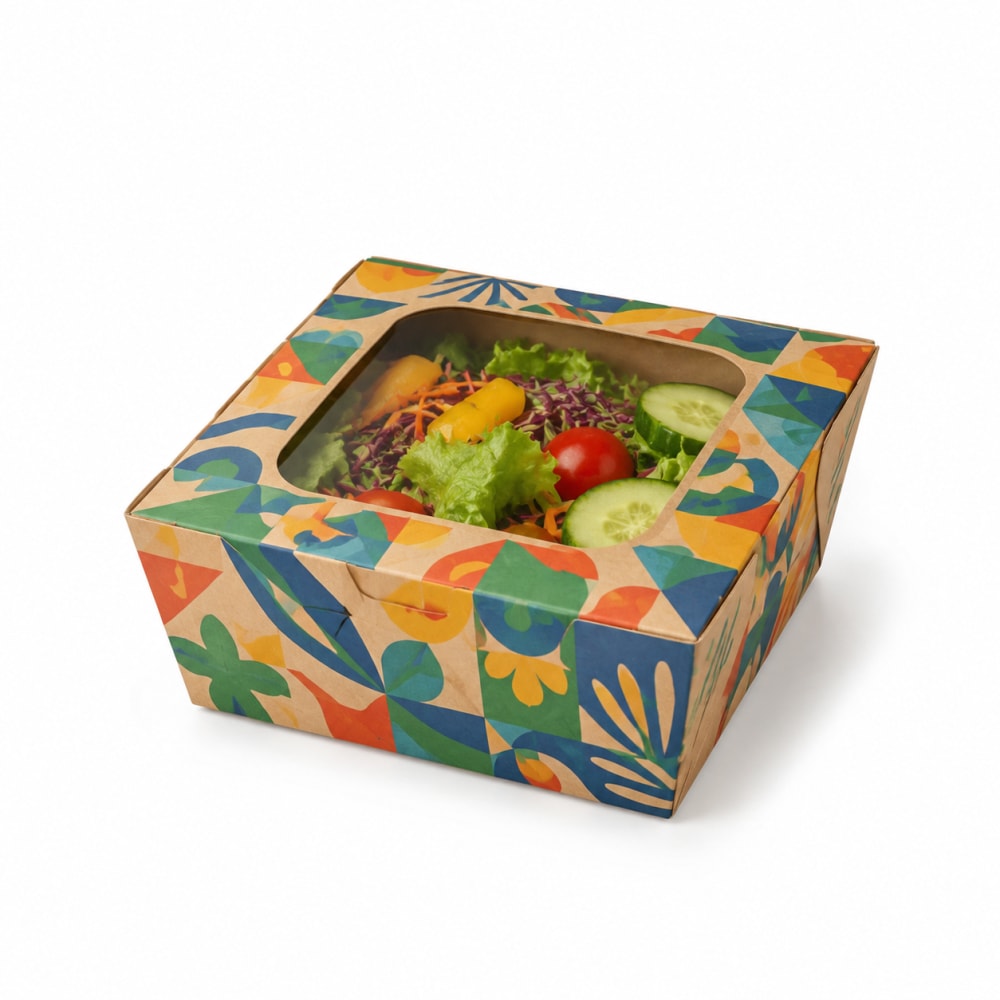
Square Salad Box OEM Supplier for United States Brands
Meal brands in the United States are moving fast toward cleaner presentation, stronger delivery performance, and better sustainability stories. For salads, grain bowls, fruit mixes, cold pasta, poke, deli meals, and ready-to-eat lunch programs, square paper salad boxes have become a practical format because they stack well, hold toppings neatly, present ingredients attractively, and work across dine-in, takeaway, and delivery channels. Choosing the right OEM square salad boxes supplier is not only about unit price. It is about speed to market, food safety, print quality, leak resistance, freight planning, and brand consistency across every store and shipment.This guide is written for restaurant groups, ghost kitchens, distributors, wholesalers, private-label food companies, and emerging meal brands selling in New York, Los Angeles, Chicago, Houston, Miami, Seattle, Dallas, Atlanta, and other major U.S. markets. It covers direct buying advice, 2026 market opportunity, OEM versus ODM strategy, packaging design development, branding, intellectual property protection, quality control, minimum order quantities, cost structure, and practical launch planning.If you are looking for an OEM square salad boxes supplier for the United States, the best partner is usually a factory that can customize size, paper grade, coating, lid fit, print layout, and carton configuration while also meeting food-contact compliance, timeline, and freight needs. For most meal brands, OEM is the better route when you already know your size, serving style, and brand identity. ODM works better when you want a faster launch using existing molds and standard structures.The strongest suppliers usually offer:Food-grade kraft or white paper options with PE or PLA barrier layers Square formats from single-serve lunch boxes to premium salad meal containers Matching lids in PET, PP, or paperboard Grease resistance and leak control for dressings, grains, and protein toppings Flexo or custom branding support for logos, colors, and campaign artwork Clear documentation for FDA-relevant food-contact requirements and export quality checks Reasonable MOQs for trial runs and scalable production for chain rollouts For U.S. buyers importing through Los Angeles, Long Beach, New York/New Jersey, Savannah, Houston, Oakland, and Seattle-Tacoma, a dependable supplier should also support carton optimization, pallet planning, and production scheduling around seasonal volume spikes. If you want to review customization options and related food packaging lines, you can explore custom food packaging products for a broader view of available structures and materials.In short: choose a supplier that can protect your brand, hit your target landed cost, and deliver repeatable quality at scale.The U.S. market opportunity for square salad boxes is expanding because salad is no longer a niche category. It is now part of mainstream meal occasions: office lunch, airport grab-and-go, meal prep subscriptions, school dining, hospital food service, convenience retail, and premium grocery prepared foods. By 2026, three forces are expected to shape demand most strongly: healthier eating patterns, stricter sustainability expectations, and growth in omnichannel food distribution.Square containers are especially attractive for operators because they use shelf and delivery bag space efficiently. They also make ingredients look organized, which matters in social-media-driven food presentation. For chains selling composed salads with proteins, toppings, and dressing cups, square boxes make portion control easier and improve stackability in refrigeration and dispatch zones.Across the United States, demand is strongest in metropolitan areas with dense office, university, travel, and delivery ecosystems. New York City and Jersey City drive high volumes in premium lunch delivery. Los Angeles and Orange County push healthy lifestyle formats and influencer-friendly presentation. Chicago and Dallas support chain restaurant expansion and corporate catering. Miami favors fresh fruit, seafood, and Latin-inspired cold meal applications. Seattle, Boston, San Francisco, and Washington, D.C. continue to support premium sustainable packaging adoption.By 2026, policy and buyer expectations will likely increase demand for better material choices. More food operators are requesting recyclable fiber-based packaging, responsibly sourced paper, compostable options where infrastructure exists, and reduced plastic use without sacrificing performance. At the same time, rising labor costs make packaging that is easy to assemble, fill, and close more valuable operationally.Market DriverWhy It MattersImpact on Square Salad BoxesU.S. Hotspots2026 OutlookBuyer ActionHealthy meal demandMore consumers choose lighter lunch optionsHigher demand for salad and grain bowl packagingLos Angeles, Seattle, BostonStrong growthSecure scalable supply earlyGrab-and-go retailConvenience stores and groceries expand prepared foodNeed stackable display-ready containersChicago, Atlanta, DallasVery strongPrioritize shelf presentationDelivery platformsCold meals travel across more channelsLeak resistance and lid security become essentialNew York, Miami, HoustonStrong growthTest transit performanceSustainability pressureBrands need better packaging storiesFiber formats gain share over rigid plastic-only packsCalifornia, Pacific Northwest, NortheastAcceleratingAssess kraft, FSC, PLA optionsPremium food photographyVisual appeal drives online conversionSquare geometry improves plating lookLos Angeles, Austin, San FranciscoStable growthInvest in print and lid clarityLabor efficiencyFaster pack-out saves cost in busy kitchensEasy-fold structures and stable stacking matterNationwideIncreasing importanceRequest assembly trialsThe table above shows why square salad boxes are not just a packaging trend. They support practical food service economics. The most successful U.S. buyers in 2026 will likely be those that treat packaging as a performance system rather than a commodity purchase.var ctx1 = document.getElementById('marketGrowthChart').getContext('2d');var marketGrowthChart = new Chart(ctx1, { type: 'line', data: { labels: ['2022', '2023', '2024', '2025', '2026', '2027'], datasets: [{ label: 'Estimated U.S. Demand Index for Square Salad Boxes', data: [82, 89, 97, 108, 121, 132], borderColor: 'rgb(46, 125, 50)', backgroundColor: 'rgba(46, 125, 50, 0.1)', fill: false, tension: 0.3 }] }, options: { responsive: true, maintainAspectRatio: false }});The growth curve reflects a realistic pattern for the U.S. market: steady expansion rather than sudden spikes. For importers and chain buyers, this means long-term supply relationships are more valuable than one-off spot buying.Many U.S. buyers use the terms OEM and ODM interchangeably, but the commercial implications are different. OEM means the factory manufactures a product based on your brand requirements, which may include custom size, board thickness, coating, fold structure, print design, and pack configuration. ODM means the factory offers an existing product design that you can brand and adapt with limited changes.For a regional meal brand launching a new salad line in Phoenix or Philadelphia, ODM can reduce development time and tooling risk. For a national chain that wants a unique square format, optimized lid fit, or a signature premium look, OEM is usually the stronger strategic choice.FactorOEMODMBest ForMain RiskRecommendationDesign ownershipBuyer-led specificationsFactory-led base designBrands with packaging strategyMisaligned spec if brief is weakUse OEM for brand differentiationLaunch speedModerateFastUrgent pilot programsLess uniquenessUse ODM for quick market testingTooling flexibilityHighLow to mediumCustom sizes and shapesAdded setup costChoose OEM for long-term volumesBranding depthFull artwork integrationLimited by existing layoutPremium visual identityPrint compromiseOEM supports stronger shelf impactMOQ structureCan be higher for unique SKUsOften lowerSmaller first ordersUnit cost may stay higherMix ODM start with later OEM upgradeCost efficiency over timeBetter at scaleGood for short runsChains and distributorsOver-customizationModel 12-month volume before decidingThe table makes the trade-off clear. OEM usually wins on brand value and operational fit. ODM usually wins on speed and simplicity. A common U.S. buying strategy is hybrid: begin with an ODM shell for a regional test in places such as Denver, Nashville, or Charlotte, then transition to a custom OEM specification after sales data validates the concept.Good suppliers can support both paths. They should ask about fill weight, temperature range, dressing use, shelf life, store count, freight destination, and printing goals before recommending a route. If a supplier quotes too quickly without learning your application, that is often a sign that the packaging may not be optimized for actual use.The design path from concept to approved sample is where many packaging projects either gain momentum or lose weeks. A disciplined OEM process reduces errors and protects launch timing. For square salad boxes, development usually starts with product fit: portion size, ingredient height, topping separation, and intended lid type. Then it moves to structure, material, branding, and packing details.A strong development workflow for U.S. buyers normally follows these steps:Requirement review: serving size, use case, hot or cold fill, dressing inclusion, transport distance, refrigeration needs. Structural proposal: box dimensions, paper gsm, fold style, edge strength, and lid compatibility. Artwork review: logo placement, color usage, nutritional or legal print needs, QR codes, and bilingual copy if required. Prototype or plain sample: physical confirmation of shape and capacity. Printed sample or pilot run: check print registration, color expectation, and actual use performance. Production approval: finalize packaging specification, carton marks, and shipment schedule. In practical terms, square salad boxes for the U.S. market often fall into a few popular styles: kraft natural-look boxes for clean-label positioning, bright white boxes for premium print contrast, window-lid formats for retail display, and matching transparent lids for ingredient visibility. Some buyers need deeper boxes for mixed salads with chicken or salmon. Others need shallow premium bowls with strong visual layering for upscale cafes in Manhattan or Santa Monica.Design ElementOptionsOperational BenefitBrand BenefitCommon U.S. UseWhat to ConfirmBox size500 ml, 750 ml, 1000 ml, customBetter portion controlConsistent menu positioningLunch sets, deli, meal prepNet fill and topping heightPaper colorKraft, whiteDifferent merchandising styleNatural or premium visual effectHealthy brands, corporate cateringInk contrast and grease show-throughBarrier layerPE, PLA, specialized coatingLeak and moisture resistanceSupports sustainability messagingSalads, pasta, fruit mixesCold use and disposal routeLid typePET, PP, paperboardProduct protection and visibilityEnhances shelf appealGrab-and-go retailSnap fit and transport testPrint coverage1 color to full designSKU identificationHigher brand recallChains and franchisesColor consistency across runsCarton packingNested, bagged, retail-readyWarehouse efficiencyCleaner receiving processDistributors and chainsCase count and pallet densityThe table above shows why packaging design is never only about appearance. Every design choice affects kitchen speed, transport safety, consumer experience, and landed cost. For U.S. buyers, the smartest move is to evaluate samples in actual store conditions: refrigerated holding, dressing contact, third-party delivery, and final customer handoff.If you need support from concept review to pre-production sample approval, it is helpful to work with a packaging partner that offers a structured customization flow. You can review packaging development services to understand how requirement review, artwork preparation, sampling, and production coordination can be managed efficiently.Consider a realistic U.S. launch case. A fast-growing meal brand based in Chicago planned to launch a new line of premium chopped salads and grain bowls across Illinois, Indiana, and Wisconsin, followed by expansion into Minneapolis and St. Louis. The company wanted a square paper box that looked modern, photographed well for app orders, and stayed stable in refrigerated dispatch.The original challenge was that the brand had been using a generic round bowl with a standard clear lid. The bowl worked for in-store sales but took up more shelf space, made ingredient layering less attractive, and increased carton volume during inbound warehousing. The procurement team needed a better format before the spring healthy menu campaign.The project timeline looked like this:Week 1: Buyer brief, capacity targets, artwork review, delivery route conditions, and price target. Week 2: Structural recommendation for a square kraft box with a clear lid and optimized wall height. Week 3: Plain samples sent for fill testing and stack checks. Week 4: Printed sample approval after logo adjustment and side-panel message edits. Week 5 to 6: Production run and quality checks. Week 7 to 8: Ocean freight booking, customs preparation, and U.S. receiving schedule. The result was a successful launch timed for a major digital campaign. The brand improved visual presentation, reduced cold-shelf footprint, and increased average order value for add-on proteins because the packaging showcased layered ingredients more clearly. The company also reduced warehouse inefficiency because square cartons stacked better and used space more effectively.For chains planning launches around key periods like January health campaigns, summer travel season, or back-to-school lunch demand, the lesson is simple: start packaging development earlier than menu marketing. A one-month delay in sample approval can disrupt an entire launch calendar.var ctx2 = document.getElementById('trendShiftChart').getContext('2d');var trendShiftChart = new Chart(ctx2, { type: 'line', data: { labels: ['2022', '2023', '2024', '2025', '2026', '2027'], datasets: [{ label: 'Standard Generic Packaging', data: [68, 64, 59, 53, 47, 41], borderColor: 'rgb(120, 144, 156)', backgroundColor: 'rgba(120, 144, 156, 0.2)', fill: true, tension: 0.3 },{ label: 'Custom Branded Square Salad Boxes', data: [32, 36, 41, 47, 53, 59], borderColor: 'rgb(255, 112, 67)', backgroundColor: 'rgba(255, 112, 67, 0.2)', fill: true, tension: 0.3 }] }, options: { responsive: true, maintainAspectRatio: false }});The area chart illustrates a broad industry shift: food brands are gradually moving away from generic packaging and toward custom branded formats that support loyalty, product presentation, and sustainability positioning.Printing matters more than many food operators expect. On a crowded deli shelf in Brooklyn, a branded square salad box can communicate freshness, quality, ingredient trust, and premium price positioning in a few seconds. On a delivery app, the packaging indirectly supports the perception of menu quality. In office catering, custom printed boxes can make a regional brand look like a national player.For square salad boxes, the most common branding goals are:Clear logo visibility from top and side angles Color consistency across repeat purchase cycles Clean typography for ingredient or dietary claims Seasonal promotions or QR code engagement Natural-looking graphics for eco-friendly positioning Retail differentiation in refrigerated display cases Not every application needs full-surface print. Some U.S. brands use simple one-color kraft packaging to convey minimalism and sustainability. Others in higher-end urban retail choose stronger visual identity with larger logos, graphic bands, or matte white backgrounds. The right choice depends on your customer, shelf context, and budget.Branding ChoiceAppearanceCost EffectBest ApplicationOperational NoteStrategic ValueSingle-color logoClean and simpleLowest print costSmall brands, test launchesEasy repeat runsGood basic recognitionTwo-color designBalanced visual identityModerateRegional chainsBetter shelf visibilityImproves recallFull wrap printHigh-impact presentationHigherPremium retail and chainsRequires tighter print controlStrong brand storytellingKraft base with dark inkNatural and eco-forwardEfficientHealthy meal brandsWorks well with earthy colorsSupports sustainable imageWhite base with bright colorsModern and boldModerate to highUrban cafes, youth brandsHigh contrast for photographyPremium visual appealQR code integrationFunctional brandingLow added costLoyalty and digital programsNeeds print clarity testAdds measurable engagementThe table shows that printing strategy should match business stage. Early-stage brands often overinvest in graphics before they confirm reorder velocity. Meanwhile, larger chains sometimes underinvest and miss a simple way to strengthen consistency across markets like Houston, Orlando, and Sacramento.A reliable supplier should also discuss practical print limitations, not just visual ambition. Color on kraft paper will look different from color on white paper. Tiny text may blur on lower-cost runs. QR codes need proper quiet zones. Artwork should account for fold lines, side seams, and lid overlap. These details are where packaging performance and branding quality meet.When you build a custom salad box program, your artwork, dimensions, dielines, and commercial terms have value. That means intellectual property and quality agreements should be handled early, not after a purchase order is placed. U.S. buyers often focus heavily on price but overlook the importance of version control, approval records, and defect definitions.Good supplier agreements for custom square salad boxes usually cover:Artwork confidentiality and restrictions on reuse Dieline and structure ownership terms Approved material specification and tolerance range Print color acceptance criteria Lid fit, leak resistance, and forming consistency standards Inspection methods before shipment Claims handling, replacement rules, and evidence requirements For imported food packaging entering the United States, the supplier should be comfortable discussing food-contact compliance and supporting documentation. That does not mean every buyer needs the same paperwork package, but it does mean the factory should be organized, traceable, and able to answer technical questions quickly.Agreement AreaWhat to DefineWhy It Protects the BuyerTypical U.S. ConcernFactory ResponsibilityBest PracticeArtwork confidentialityLogo and design use limitsPrevents unauthorized duplicationBrand misuseStore files securelyUse written NDA termsSpecification controlMaterial, size, coating, lid fitReduces production driftInconsistent runsLock approved BOMIssue signed spec sheetQuality standardAQL or inspection criteriaClarifies defect thresholdsPrint and forming defectsRun pre-shipment checksDefine critical defects clearlyCompliance documentsFood-contact and material recordsSupports import confidenceCustomer auditsProvide current documentationReview before bulk orderClaims processEvidence, timeline, remedySpeeds issue resolutionDelayed credits or replacementsRespond within agreed windowDocument with photos and batch codeIP around molds or toolingOwnership and reuse termsProtects custom development valueCopied format riskRespect contract scopeClarify at quotation stageThis table highlights a simple truth: a lower quoted price can become expensive if specifications are vague. Strong agreements create consistency, which matters even more when you scale from a pilot in one city to a multi-state rollout.From a capability standpoint, it helps to work with a supplier that has internal quality procedures, testing routines, and documented production controls rather than relying only on final visual checks. Buyers can learn more about a manufacturer’s operating background by reviewing the company profile and factory overview before moving into detailed negotiations.Minimum order quantity and total cost are shaped by more than box dimensions. They depend on printing complexity, material type, lid choice, carton configuration, and whether the order uses an existing structure or a new custom setup. U.S. buyers should focus on total landed cost and practical reorder economics, not just the quoted ex-factory unit price.The main cost components usually include:Paper material and barrier coating Printing setup and production complexity Forming and finishing Lid cost if supplied as a matching set Packing method and carton density Sample and development costs where applicable Ocean freight, customs, and domestic transfer to final warehouse MOQ often becomes a strategic decision. For a single-SKU launch in a regional chain, a moderate MOQ may be acceptable because throughput is predictable. For a startup testing three menu formats, a too-high MOQ can tie up cash and warehouse space. The smartest buying approach is to align MOQ with 8 to 12 weeks of realistic usage where possible, while preserving the option to reorder in time.Order ScenarioTypical MOQ TendencyUnit Cost TrendBest ForMain Trade-OffBuyer AdviceStandard size, no printLowerLowestWholesalers, food service distributorsWeak differentiationUse for commodity channelsStandard size, simple logoLow to moderateEfficientRegional restaurant groupsLimited branding depthBest starter formatCustom size, single-color printModerateMid-rangePrivate-label meal brandsLonger setupWorth it if volume is stableCustom size with matched lidModerate to higherHigherRetail-ready salad programsMore components to manageConfirm lid inventory planningFull custom print programHigherHigher at launch, better at scaleChains and premium conceptsArtwork discipline neededStandardize across storesMulti-SKU seasonal campaignVariableCan be highPromotional launchesInventory complexityLimit SKU count earlyThe cost logic in the table is important. The cheapest format is not always the most profitable one. If custom square salad boxes improve display conversion, reduce leakage, or strengthen repeat orders, the total business return can outweigh a modest packaging premium.var ctx3 = document.getElementById('industryDemandChart').getContext('2d');var industryDemandChart = new Chart(ctx3, { type: 'bar', data: { labels: ['Quick-Service Chains', 'Meal Prep Brands', 'Grocery Deli', 'Corporate Catering', 'Universities', 'Airports'], datasets: [{ label: 'Estimated 2026 U.S. Demand Index', data: [88, 94, 91, 76, 69, 73], backgroundColor: [ 'rgb(66, 133, 244)', 'rgb(15, 157, 88)', 'rgb(244, 180, 0)', 'rgb(219, 68, 55)', 'rgb(171, 71, 188)', 'rgb(0, 172, 193)' ] }] }, options: { responsive: true, maintainAspectRatio: false }});The demand comparison shows where 2026 growth is likely to be most visible. Meal prep, grocery deli, and quick-service healthy concepts are expected to remain the most active buyers of square salad box programs.Shandong Fude Packaging Co., Ltd. works with food service and packaging buyers who need reliable disposable food-grade paper and plastic packaging for practical commercial use. For U.S. customers looking for a dependable OEM square salad boxes supplier, the company’s value is best understood through three areas: technological capability, manufacturing capability, and service capability.On the technical side, the company has built its packaging business around material research, structure development, and process control for food-contact packaging. Its product work covers kraft and white paper food containers, bowls, trays, cups, deli formats, and multi-compartment solutions designed for leak resistance, grease resistance, stackability, and branded presentation. This technical base is useful for salad box development because the same engineering questions appear repeatedly: wall strength, coating choice, moisture control, lid fit, and print stability.The operation supports flexographic printing, die-cutting, forming, and quality testing workflows that help translate artwork and structural concepts into repeatable production. For U.S. brands that care about consistency across locations, this matters. Good technical control means the box that arrives in a Dallas distribution center should perform like the one shipped later to New Jersey or Southern California.From a manufacturing perspective, the company operates a modern 30,000 square meter factory in Shandong with automated production systems, organized warehousing, and export experience serving buyers across multiple continents. Its packaging production is designed to support both trial-scale and larger-volume wholesale programs. That is important for U.S. customers because some launches start with pilot volumes before rolling out nationally.With more than 20 years in packaging and a broad product portfolio for catering and takeaway channels, the company understands how to manufacture for restaurants, chains, distributors, and private-label buyers. Its output systems and internal handling procedures are built to support production continuity, repeat orders, and shipment preparation for overseas markets. That makes it suitable for customers receiving through major U.S. entry points such as Long Beach, Savannah, Newark, or Houston.On the service side, the company supports requirement review, packaging selection advice, artwork preparation, sample confirmation, and coordinated delivery planning. This is often where a supplier becomes a real partner rather than just a manufacturer. U.S. buyers frequently need guidance on balancing material performance, print ambition, MOQ, and launch timing. A service-driven supplier should be able to identify those trade-offs early.The company’s normal process follows a practical sequence: understand needs, confirm design and samples, then move into production and delivery. This structure helps shorten communication loops and reduces the chance of rework. Buyers wanting to discuss a project directly can use the contact page for custom packaging inquiries to start specification review and quotation.Overall, the company is positioned as a one-stop packaging partner for buyers who want custom food packaging with export-ready manufacturing, flexible development support, and a sustainability-oriented product mindset.var ctx4 = document.getElementById('supplierCompareChart').getContext('2d');var supplierCompareChart = new Chart(ctx4, { type: 'bar', data: { labels: ['Customization', 'Quality Control', 'Lead Time Stability', 'Export Experience', 'Branding Support', 'Product Range'], datasets: [{ label: 'Advanced OEM Supplier Benchmark', data: [93, 95, 88, 96, 91, 94], backgroundColor: 'rgb(123, 97, 255)' },{ label: 'Basic Trading-Only Supplier Benchmark', data: [62, 58, 64, 61, 55, 49], backgroundColor: 'rgb(255, 159, 64)' }] }, options: { responsive: true, maintainAspectRatio: false }});This comparison highlights why many U.S. buyers prefer working directly with capable manufacturers or with sourcing partners that have true factory integration. The advantage is not just price. It is usually better control, better documentation, and a clearer path from concept to delivery.For most cold salad and grain bowl applications, food-grade kraft or white paperboard with a suitable moisture-resistant barrier layer works well. The right choice depends on your disposal goals, branding style, lid format, and the amount of dressing or wet ingredients inside.Kraft often supports a natural, eco-forward brand image and works well for healthy meal concepts. White paper gives stronger color contrast and a more premium print result. If your brand depends heavily on vivid graphics, white may be better. If your brand values a minimal natural look, kraft is often the stronger fit.Major users include quick-service healthy chains, grocery deli programs, meal prep companies, university dining, airport food service, office catering, convenience retail, and independent cafes. They are also popular with food delivery brands that need efficient stacking and reliable presentation.Yes. They are commonly used for grain bowls, fruit mixes, poke, pasta salads, wraps with sides, cold noodles, snack assortments, deli meals, and premium takeaway lunches. The format is flexible as long as size and coating match the application.Local suppliers may offer shorter replenishment cycles and easier meetings, but they may have less customization depth or higher costs depending on the product. Overseas OEM factories often provide stronger manufacturing flexibility and better economics at scale. The right decision depends on your volume, timeline, and tolerance for planning inventory ahead.Ask about material options, food-contact compliance support, lid compatibility, print method, sample timeline, production lead time, carton count, pallet configuration, shipping experience to the United States, claim handling, and how they define acceptable quality levels.A straightforward project using an existing structure with custom print can move relatively quickly once artwork is ready and samples are approved. A fully custom project with size changes, lid matching, and detailed testing takes longer. Build in extra time if your launch aligns with peak freight periods or holiday schedules.Expect stronger demand for sustainable material choices, reduced excess packaging, better digital printing and design workflows, tighter food-contact documentation, and more packaging engineered for omnichannel use. Buyers will increasingly want a single format that looks good on shelf, survives delivery, and supports brand sustainability claims.By 2026, the most successful U.S. brands will likely choose square salad box suppliers based on a wider set of criteria: speed, compliance readiness, structural performance, sustainability fit, and ability to support scale across regions. Whether your brand serves offices in Manhattan, airports in Atlanta, campuses in Austin, or grocery deli counters in Los Angeles, the right OEM supplier can turn packaging into an operational and branding advantage instead of just a cost line. -

Canada Guide to 800–3000ml Paper Lunch Boxes
The best 800–3000ml paper lunch box for Canada is not necessarily the lowest-priced option. The practical choice depends on serving temperature, sauce level, oil content, portion weight, holding time, stacking pressure, delivery distance, available warehouse space and branding objectives. A dry sandwich lunch may perform well in a light kraft box, while a 2,000ml hot rice bowl with curry, gravy or fried food usually needs a stronger board grade, a reliable grease-and-moisture barrier and a lid that remains secure during transport.For caterers, meal-prep operators, restaurant chains and distributors, the safest decision is a weighted comparison rather than a visual comparison. Test actual menu items at realistic temperatures, stack filled boxes, simulate delivery vibration and assess grease migration after 30, 60 and 90 minutes. In Canadian markets such as Toronto, Vancouver, Montréal, Calgary and Halifax, winter conditions, long delivery routes and multi-location replenishment can change packaging performance significantly.A useful starting point is: choose 800–1,200ml boxes for individual lunches and side dishes; 1,300–1,800ml for standard hot entrées; 1,900–2,400ml for generous meal-prep portions, family-style meals and sauced dishes; and 2,500–3,000ml for catering, sharing meals, trays and multi-item food sets. Confirm every specification through samples, documented acceptance criteria and a repeatable approval record before production.CapacityTypical Canadian UseRecommended Food TypeBarrier NeedSuggested Holding TimePrimary Buying Risk800mlOffice lunch, salad, snack mealDry rice, wraps, saladsStandard grease resistanceUp to 30 minutesOverfilling1,000mlSingle restaurant entréeNoodles, rice bowls, pastaMedium moisture barrier30–45 minutesSteam softening1,200mlLunch comboMain dish with sidesMedium grease barrierUp to 45 minutesLid movement1,500mlMeal-prep and takeawayProtein, grains and vegetablesEnhanced moisture barrier45–60 minutesCorner deformation2,000mlPremium entrée or two-person mealCurry, stir-fry, pastaHigh grease and moisture resistance60–90 minutesBase sagging2,500mlFamily meal or cateringLarge hot portionsHigh-performance barrier60–90 minutesStack compression3,000mlEvents, catering and sharingPlatters, mixed mealsHigh-performance barrierUp to 90 minutesFreight volumeThis capacity guide should be treated as a menu-planning tool, not a substitute for trials. A 1,500ml box can fail with a heavy, oily meal while a 2,000ml version succeeds with a lighter dish, depending on paperboard basis weight, fold design, coating, lid construction and food temperature.Canadian buyers generally compare kraft folded lunch boxes, rectangular paper food containers with separate lids, windowed meal boxes, compartment meal boxes and heavy-duty catering boxes. Their differences are structural as well as visual. Folded clamshell-style boxes use score lines and locking tabs, offering fast packing and a compact shipped form. Separate-lid containers can provide a cleaner presentation and stronger closure, particularly for meal-prep operations. Multi-compartment formats improve food separation but require tighter dimensional control during forming.For a high-volume delivery program in downtown Toronto or Vancouver, closure security is often more important than shelf appearance. For a corporate lunch caterer in Ottawa, a wide opening and simple stacking may save more labour than a complex premium structure. For retailers and meal-prep brands, clear windows can improve product visibility, but they must be assessed for condensation and sealing performance.Box OptionStructureBest StrengthKey LimitationIdeal BuyerTypical Capacity RangeKraft folded boxOne-piece folded bodyFast assembly and low storage volumeMay soften with very wet foodsQuick-service restaurants800–1,800mlRectangular lid containerRigid base with separate lidStable stacking and premium appearanceMore components to manageMeal-prep brands1,000–2,500mlWindow lunch boxFolded box with display windowStrong retail presentationCondensation can reduce visibilityBakeries and retailers800–1,500mlCompartment meal boxDivided internal layoutSeparates proteins and sidesMore complex toolingSchools and caterers1,200–2,500mlDeep meal containerTall sidewall, fitted lidHandles high-volume servingsRequires stable base designAsian cuisine and delivery1,500–3,000mlCatering tray boxWide, reinforced formatLarge serving surfaceHigher freight cubeEvents and institutions2,000–3,000mlThe table shows why “paper lunch box” should never be treated as a single product category. Buyers should compare the whole food-service system: container, lid, liner or coating, secondary bag, tamper label and delivery stacking method.Performance starts with the substrate. Paperboard thickness, fibre quality, food-contact coating, folding accuracy and adhesive selection influence whether a lunch box retains its shape. Grease resistance and moisture resistance are related but not identical. Fried chicken may challenge the grease barrier, while a steaming curry challenges both moisture resistance and structural stiffness. A box for cold salads may require a different solution from a box for reheated meal-prep food.Canadian buyers should request food-contact documentation appropriate for their intended market, along with material descriptions, test records and batch traceability. For environmentally focused programs, it is important to distinguish between recycled content claims, FSC-certified paper sourcing, compostability claims and actual local acceptance. Municipal collection rules differ across Canada, so a packaging claim should be aligned with the customer’s waste-management pathway rather than selected only for marketing value.Construction FeatureOperational EffectBest forFailure if UnderspecifiedTrial MethodApproval MeasureHigher board stiffnessImproves sidewall stabilityHeavy rice and protein mealsWall bulgingFill to rated loadNo visible collapseGrease-resistant treatmentLimits oil migrationFried and roasted foodsExternal staining60-minute hot holdNo oil seepageMoisture barrierSlows softening from saucesCurry, pasta and stewsBase weakening90-minute holdBase remains firmReinforced fold linesImproves closure strengthDelivery and stacked ordersTab releaseOpen-close cycle testClosure remains lockedVent designReduces condensationFried foods and hot bakery itemsSoggy productSteam retention testControlled moisture releaseFitted lid geometryImproves transport securityMeal-prep and deliveryLid shiftingVibration simulationNo opening or leakageCompartment wallsSeparate menu componentsBalanced meal programsFood migrationTilt and stack testSeparation maintainedThese construction details should appear in a buyer specification sheet. Instead of asking for “good quality,” define board range, dimensions, capacity tolerance, coating type, print tolerance, lid fit, stack test load, grease test time and acceptable defect rate. Clear specifications protect both buyer and manufacturer.Food application determines the right format. A light 800ml kraft box is efficient for sandwiches, wraps, pastries and dry grain bowls. A 1,000–1,200ml container is often suited to individual pasta, noodles, poke-style bowls or rice meals. Meal-prep companies frequently benefit from 1,500–2,000ml rectangular containers because they offer a more consistent portion presentation and can be packed in refrigerated fulfilment lines.For hot delivery, especially in dense urban areas where drivers may make multiple stops, choose a format that supports predictable stacking. Restaurants in Montréal and Toronto often need packaging that can tolerate movement in insulated delivery bags, while operators serving suburban routes around Mississauga, Surrey or Laval may need stronger protection for longer travel times. For catering, 2,500–3,000ml boxes should be assessed for carrying comfort, stacking strength and ease of opening at the service point.var ctx=document.getElementById('canadaLunchBoxGrowth').getContext('2d');new Chart(ctx,{type:'line',data:{labels:['2022','2023','2024','2025','2026','2027'],datasets:[{label:'Indexed Canadian demand for paper meal packaging',data:[100,108,117,126,136,147],borderColor:'rgb(46,125,50)',backgroundColor:'rgba(46,125,50,0.12)',fill:false,tension:0.3}]},options:{responsive:false,maintainAspectRatio:false,plugins:{legend:{display:true}},scales:{y:{beginAtZero:false}}}});The line chart is an indexed planning illustration rather than a market forecast. It shows the direction many food-service buyers are planning for: increased demand for delivery-ready, branded and lower-risk paper food packaging as meal-prep, takeaway and institutional food programs expand.Stacking deformation and grease migration are two of the most expensive hidden risks in paper lunch box procurement. A box can look acceptable when empty, then fail after being filled with hot food and placed under six other orders. Sidewalls may flare, base panels may soften, lids may shift and grease may travel through score lines. These failures can damage bags, contaminate other orders and create refund or replacement costs far above a small unit-price saving.Test under real conditions. Use the hottest menu item, the heaviest portion and the longest realistic delivery window. Fill boxes to normal operational weight, close them at production-line speed, stack them in the same pattern used by staff and inspect them after transport. Include a cold-weather test if the product will travel through Canadian winter conditions, because condensation behaviour and handling characteristics can change between kitchen and destination.Risk ScenarioCommon CauseHigh-Risk MenuRecommended PreventionTest DurationPass CriterionBase saggingInsufficient moisture resistanceStew and curryUpgrade barrier and board stiffness90 minutesNo base leakageCorner openingWeak folding or tab lockHeavy mixed mealReinforce locking geometry20 transport cyclesClosure intactGrease stainingLow oil resistanceFried chicken and poutineUse stronger grease barrier60 minutesNo outer oil marksLid displacementPoor fit toleranceNoodles and pastaConfirm lid-body matchingVibration testNo openingStack collapseLow compression strengthLarge catering mealsUse reinforced structureFive-box stackNo deformationSteam softeningExcess trapped condensationHot fried foodsAdd suitable venting45 minutesWalls remain firmFood migrationLow internal partition heightMeal with sauce and sidesIncrease divider designTilt testSections stay separateThe strongest procurement practice is to convert these pass criteria into a signed approval record. Record sample date, materials, dimensions, test food, temperature, fill weight, holding time, stack configuration, evaluator and result. This record gives purchasing teams a repeatable reference for future reorder batches.Customization affects minimum order quantity, cost, sampling time and inventory exposure. Stock kraft boxes normally offer the fastest route for new food businesses, seasonal projects and short promotional runs. Custom printing supports brand recognition and can improve perceived value, particularly for premium meal-prep, retail-ready lunches and chain restaurants. However, buyers should consider design complexity, ink coverage, colour consistency, tooling requirements and the time needed for artwork approval.Fude Packaging supports digital proofs, white samples and printed pre-production samples so buyers can verify sizing, graphic placement, readability and functional performance before mass production. For businesses launching across multiple Canadian provinces, a staged approval process can reduce risk: approve structure first, then print, then final food application. This is especially useful when packaging is ordered overseas and distributed through Vancouver, Prince Rupert, Montréal or Halifax.var ctx=document.getElementById('industryDemandChart').getContext('2d');new Chart(ctx,{type:'bar',data:{labels:['Quick service','Meal prep','Corporate catering','Grocery prepared food','Schools','Hospitals'],datasets:[{label:'Relative demand for 800–3000ml paper lunch boxes',data:[88,82,69,75,58,63],backgroundColor:['#2e7d32','#388e3c','#43a047','#66bb6a','#81c784','#a5d6a7']}]},options:{responsive:false,maintainAspectRatio:false,plugins:{legend:{display:true}},scales:{y:{beginAtZero:true,max:100}}}});The bar chart compares typical demand intensity by buying sector. Quick-service restaurants and meal-prep businesses often require the broadest mix of capacities, while institutions may prioritize approved specifications, consistency and scheduled supply over extensive graphic customization.Freight and warehouse cost should be measured per usable meal packed, not only per carton. Large 2,500–3,000ml boxes can be economical for food portions but occupy more warehouse volume. Flat-packed folded boxes usually provide better container utilization than fully formed rigid formats. Buyers importing through the Port of Vancouver, Port of Montréal or Halifax should discuss carton dimensions, nesting efficiency, pallet pattern and moisture protection before confirming a purchase order.For distributors, standardizing several menu lines around compatible carton sizes can simplify warehouse slots and improve pick speed. For chains, scheduled orders can reduce the need to hold months of printed stock. Inventory planning should account for seasonal peaks, promotions, school terms, holiday catering and the lead time needed for custom print approval.Logistics FactorLow-Volume BuyerDistributorRestaurant ChainRecommended ActionCost ImpactFlat-pack efficiencyModerate priorityHigh priorityHigh priorityCompare cartons per palletLower storage costPrinted inventoryHigher riskModerate riskManageable with planningUse phased releasesLess obsolete stockContainer utilizationOften shared shipmentCriticalCriticalOptimize mixed product loadsLower freight per unitCarton durabilityImportantEssentialEssentialSpecify export carton strengthFewer transit damagesWarehouse assembly timeLabour-sensitiveHigh-volume sensitiveProcess-sensitiveTest ease of foldingFaster packingReorder schedulingFlexibleForecast-basedCalendar-basedSet replenishment windowsLower stockout riskPort routingDestination dependentNetwork dependentNational dependentPlan inland delivery earlyBetter lead-time controlFreight decisions should also include packaging protection. Hygienic inner bags, moisture-resistant export cartons and clear carton labels help protect product condition throughout ocean freight, inland trucking and warehouse handling.Different buyers need different buying strategies. A new café should usually begin with stock sizes and a proven material combination. A meal-prep company should focus on lid fit, stacking strength, food temperature performance and portion consistency. A distributor should prioritize a balanced capacity range, carton efficiency, documentation and stable replenishment. A national chain should build a controlled specification with defined colour standards, approved samples and batch traceability.var ctx=document.getElementById('trendShiftChart').getContext('2d');new Chart(ctx,{type:'line',data:{labels:['2022','2023','2024','2025','2026','2027'],datasets:[{label:'Standard stock packaging share',data:[72,68,63,59,55,51],borderColor:'#8d6e63',backgroundColor:'rgba(141,110,99,0.18)',fill:true,tension:0.3},{label:'Customized delivery-ready packaging share',data:[28,32,37,41,45,49],borderColor:'#1565c0',backgroundColor:'rgba(21,101,192,0.18)',fill:true,tension:0.3}]},options:{responsive:false,maintainAspectRatio:false,plugins:{legend:{display:true}},scales:{y:{beginAtZero:true,max:80}}}});The area chart illustrates a continuing shift toward customized, delivery-ready food packaging. In Canada, this trend is supported by branded online ordering, meal subscription services, food retail expansion and increasing attention to packaging recovery, fibre sourcing and waste-reduction programs.Fude Packaging combines manufacturing scale with practical project support for overseas B2B buyers. Its 30,000 m² self-owned production base in Shandong and automated capacity of up to 120,000 units per day support projects ranging from stock food containers to customized lunch boxes, bowls, trays, cups and multi-compartment meal packaging. This enables Canadian importers and food-service operators to consolidate categories under one manufacturing partner.Technological capability is built around material selection, printing, die-cutting, forming and in-house performance testing. The company can recommend structures based on food temperature, oil content, delivery time and capacity requirements, then help buyers verify dimensions, barrier performance, lid compatibility and print placement through samples. In-house laboratory testing supports more consistent review of strength, grease resistance, leak prevention and functional food application.Manufacturing capability includes full-batch traceability, production monitoring, final inspection and export-oriented packing. Fude Packaging can provide documentation relevant to food-contact and quality-management needs, including FSC, ISO 9001, LFGB and FDA-related documentation where applicable to the product and destination-market requirement. Buyers can also arrange independent inspection or third-party testing before shipment.Service capability includes digital proofs, white samples, printed pre-production proofs, artwork and dieline checks, Pantone colour matching, rapid sampling and scheduled-order support. With more than 20 years of packaging experience and service history across more than 500 business clients, Fude Packaging helps buyers manage practical issues such as MOQ, artwork approval, delivery timing, mixed-container loading and repeat orders. Explore the available paper food container range when comparing capacities and structures for Canadian menus.var ctx=document.getElementById('supplierComparisonChart').getContext('2d');new Chart(ctx,{type:'bar',data:{labels:['Customization','Traceability','Testing support','Product range','Scheduled supply','Export support'],datasets:[{label:'Fude Packaging capability score',data:[92,90,88,94,86,91],backgroundColor:'#5e35b1'},{label:'Typical single-category supplier score',data:[65,54,57,48,52,60],backgroundColor:'#b39ddb'}]},options:{responsive:false,maintainAspectRatio:false,plugins:{legend:{display:true}},scales:{y:{beginAtZero:true,max:100}}}});The comparison chart is a qualitative procurement framework. It highlights why buyers should evaluate total capability rather than compare unit pricing alone. For large programs, the ability to manage documentation, samples, colour consistency, quality checks and coordinated delivery can reduce operational risk.By 2026, Canadian packaging buyers are expected to place greater emphasis on material transparency, waste reduction, fibre sourcing and practical end-of-life communication. The strongest suppliers will not simply offer a generic “eco” claim; they will help buyers understand barrier trade-offs, local collection limitations and the documentation behind product claims. Food-service businesses should avoid using environmental language that cannot be supported by material evidence or accepted disposal pathways.Technology will also influence purchasing. Digital artwork workflows, barcode-based batch traceability, automated visual inspection and more precise forming controls can improve repeatability for custom lunch boxes. Brands will increasingly request QR codes, multilingual instructions, promotional printing and standardized packaging systems that work across storefront, catering and delivery channels.For Canadian operators, future-ready packaging should balance sustainability with food protection. A package that reduces material weight but fails during delivery creates food waste, customer dissatisfaction and extra transport emissions. The best solution is usually the lightest structure that consistently protects the meal through its real service journey.A fair trial should compare candidate boxes using the same food, fill weight and service conditions. Test at least three units per format, then repeat the test on different production days if the purchase volume is significant. Include staff feedback because packing speed, closure convenience and labelling space affect real operating cost.Start with a written checklist: capacity, dimensions, food-contact requirements, hot-fill temperature, holding time, grease resistance, moisture resistance, closure security, stack load, printing needs, carton count, pallet layout and delivery deadline. Fude Packaging can support product selection and sample development through its custom packaging services, helping buyers move from a general concept to a measurable, production-ready specification.Trial StageWhat to TestResponsible TeamSuggested Sample SizeDecision EvidenceNext StepDesktop reviewDimensions and menu fitPurchasing and operations2–3 formatsSpecification comparisonSelect samplesWhite sample testFold, fill and lid fitKitchen team10 units eachStaff feedbackAdjust structureHot-food testSteam and moisture resistanceQuality team10 units eachTimed inspection recordApprove barrierDelivery simulationStacking and vibrationDelivery team12 filled unitsDamage countApprove closurePrinted proof reviewColour and artwork placementMarketing team1 proof setSigned artworkRelease productionPre-shipment checkCartons and batch qualityBuyer or inspectorAgreed inspection levelInspection reportAuthorize shipmentFirst delivery reviewWarehouse and store useOperations teamInitial shipmentPerformance reportPlan reorderDocumented trials are especially valuable for chain rollouts. They prevent different branches from using different assumptions about filling, closure and storage, and they provide a clear benchmark if a later batch needs investigation.Which option is best for hot meals, meal prep and delivery?For hot meals with sauces, select a 1,200–2,000ml structure with sufficient moisture and grease resistance, secure closure and confirmed stacking strength. Meal-prep brands often benefit from rectangular containers with fitted lids. Delivery programs should prioritize transport testing over appearance alone.Which choice costs less in real operation?The lowest unit price is not always the lowest operating cost. Consider food leakage, refunds, bag contamination, packing speed, storage volume, product damage and reordering frequency. A slightly stronger box can reduce overall cost if it prevents failure during delivery.How do storage and freight differ?Flat-packed folded lunch boxes usually use warehouse and container space efficiently. Larger, deep or rigid structures may provide stronger food protection but use more freight cube. Compare packed carton dimensions, units per carton, pallet pattern and total delivered cost.Which option offers better branding?Custom printed containers provide the strongest brand visibility, particularly for meal subscriptions, restaurant chains and retail-ready food. Kraft printing, white board printing, windows and custom-shaped formats each create different visual effects. Confirm artwork with a printed pre-production proof before mass production.How should a buyer run a fair trial?Use actual food, realistic portion weights, real service temperatures and the longest expected delivery period. Test stacking, grease migration, condensation, closure reliability and carton handling. Record results in a signed approval sheet before placing a large order.For a supplier discussion tailored to your menu, destination port and purchasing volume, visit about Fude Packaging or contact the packaging team to request samples, specifications or a customized quotation. -

Compact Kraft Deli Boxes for Canadian Food Service
For Canadian deli counters, cafés, grocery grab-and-go departments and meal-prep brands, 500ml, 750ml and 1000ml compact kraft deli boxes should be selected around the actual menu item rather than capacity alone. Food weight, product temperature, sauce level, oil migration, moisture release, shelf time, delivery distance and customer opening behaviour all affect whether a box performs reliably.As a practical starting point, 500ml compact deli boxes generally suit smaller salads, desserts, side dishes, snack boxes and half-sandwich combinations. A 750ml format is often the most flexible option for standard deli salads, pasta portions, sandwich-and-side meals and chilled lunch offerings. A 1000ml kraft deli box is usually better for substantial salads, protein bowls, family-style sides, large sandwiches, prepared meals and higher-volume chilled foods.Before placing a bulk order, use physical samples and define measurable approval criteria: no visible grease penetration, no liquid leakage, acceptable window clarity, secure lid closure, stable stacking, easy filling, and no product damage after simulated delivery. This approach is especially important for Canadian operators serving dense urban markets such as Toronto, Vancouver, Montréal, Calgary and Ottawa, where food may move from a central kitchen through refrigerated display, third-party delivery and customer transport.Box CapacityTypical Food WeightBest Menu UsesRecommended HoldMain Risk to Test500ml180–350gSmall salads, sides, desserts2–12 hours chilledOverfilling and lid strain500ml200–320gFruit, slaw, grain sides4–24 hours chilledMoisture softening750ml300–500gStandard salads, pasta, lunch boxes2–24 hours chilledWindow fogging750ml350–550gSandwich with side dish2–8 hours displayClosure security1000ml450–750gLarge salads, meal bowls2–24 hours chilledBase strength1000ml500–850gPrepared meals and large sides1–12 hours displayGrease and leakageThe table is a planning guide, not a substitute for testing. A 500ml box filled with dense potato salad may weigh more than a larger box containing leafy greens. Measure both gross weight and fill height before approving a structure.Start with the menu architecture. Leafy salads need headspace to protect volume and visual appeal. Dense pasta, rice, grains and protein ingredients need stronger bases and dependable closing flaps. Sandwiches need width and opening geometry that prevents compression of bread, fillings and toppings. Chilled prepared meals may need a grease-resistant lining and enough internal room to separate components.For Canadian retail environments, it is useful to classify menu items by product behaviour. A dry quinoa salad and a dressing-heavy Mediterranean salad may use the same nominal volume, but they create very different packaging demands. Similarly, a turkey sandwich with lettuce and tomato needs better moisture management than a dry baked focaccia sandwich.Menu CategorySuggested CapacityPreferred ShapeKey Packaging FeatureRetail ExampleLeafy side salad500mlSquare or shallow rectangleClear viewing area and headspaceDowntown Toronto caféPasta salad500–750mlRectangleGrease-resistant boardOffice lunch counterGrain and protein salad750–1000mlWide rectangleRigid base and secure tuckVancouver meal-prep brandSandwich with side750mlLong rectangular boxWide opening and crush protectionAirport grab-and-go outletPrepared chilled meal1000mlDeep rectangleLeak control and stacking strengthMontréal grocery deliFamily-style side dish1000mlDeep square or rectangleHigh sidewall strengthCalgary catering counterOperators should also consider whether sauces are packed inside the deli box or separately. A sealed sauce cup can reduce moisture exposure, protect crisp ingredients and improve shelf appearance. However, it reduces usable capacity, so the container should be tested with the complete serving configuration.Capacity in millilitres indicates internal volume, not guaranteed carrying performance. The most reliable specification combines volume, maximum food weight, serving temperature, hold time and food chemistry. Chilled food may create condensation; oily foods may challenge the inner barrier; acidic dressings can remain in contact with the package for many hours.For cold-menu programs, test the product at the temperature it will enter the pack, not only at room temperature. A salad packed at 4°C and displayed in a refrigerated case can behave differently from a salad packed at 10°C during a busy lunch rush. If food is packed warm and then chilled, test the cooling process because steam can fog windows and soften paperboard.Food ConditionTest TemperatureSuggested Hold TimeInspection PointAcceptance ExampleCold leafy salad2–5°C12–24 hoursWindow clarity and base moistureNo pooling or severe foggingPasta with dressing2–5°C24 hoursOil migrationNo visible exterior stainingProtein grain bowl2–5°C12–24 hoursBottom panel strengthNo sagging during liftingWarm packed then chilled food35–60°C start4–12 hoursSteam and closure stabilityLid remains lockedSandwich with tomato2–8°C4–8 hoursBread contact moistureNo package collapseOily roasted vegetables2–5°C12–24 hoursGrease resistanceNo seepage through boardFor any box intended for refrigerated distribution from a commissary to stores across the Greater Toronto Area, Metro Vancouver or the Montréal region, include transport conditions in the trial. A product can pass a stationary shelf test but fail after vibration, loading and unloading.var ctxMarketGrowth = document.getElementById('marketGrowthChart').getContext('2d');new Chart(ctxMarketGrowth, { type: 'line', data: { labels: ['2022', '2023', '2024', '2025', '2026 Forecast', '2027 Forecast'], datasets: [{ label: 'Canadian Chilled Grab-and-Go Packaging Demand Index', data: [100, 108, 117, 126, 136, 147], borderColor: 'rgb(44, 122, 89)', backgroundColor: 'rgba(44, 122, 89, 0.12)', fill: false, tension: 0.3 }] }, options: { responsive: true, maintainAspectRatio: false, plugins: { title: { display: true, text: 'Estimated Growth Trend for Chilled Food-Service Packaging' } }, scales: { y: { beginAtZero: false } } }});This directional market chart illustrates why more Canadian food-service buyers are prioritizing repeatable performance testing. Growth in prepared foods, workplace lunch programs, grocery convenience formats and delivery-friendly menu concepts increases the cost of packaging failure.Shape affects presentation, filling speed, stacking and customer experience. Square boxes can suit compact salads and bowls. Long rectangular boxes are often stronger for sandwiches, wraps and meal combinations. Wide, shallow boxes help display leafy ingredients, while deeper boxes provide more vertical capacity for grain bowls and prepared meals.Opening style matters just as much. A front tuck closure may be fast for staff, but it must remain secure during courier handling. A top-opening box can improve product access, while a windowed lid can support retail merchandising. Test whether the lid can be opened and reclosed without tearing, particularly for customers who eat part of a meal and transport the remainder.StructureBest UseAdvantagesPotential LimitationTrial RequirementSquare top-openingSide saladsCompact shelf footprintLimited sandwich lengthCheck top-panel rigidityLong rectangleSandwiches and wrapsProtects product lengthCan flex if overloadedTest carrying from one endWide shallow boxLeafy saladsStrong visual displayUses more shelf areaCheck stacking clearanceDeep rectanglePrepared mealsHigher food capacityMay hide food presentationTest base loadingWindowed lid boxRetail chilled displayImproves visibilityCondensation riskTest refrigerated foggingCompartment-compatible boxMeal combinationsSeparates componentsMay reduce usable volumeTest movement between sectionsWhen customising a kraft deli box, confirm external dimensions as well as volume. Canadian retailers often have fixed display shelves, cooler trays and delivery totes. A box that fits the product but wastes shelf space can increase operating cost.Window fogging is a common issue for chilled deli foods, especially when a product moves through temperature changes. The risk increases when warm components are packed before cooling, when leafy greens release moisture, or when refrigeration cycles fluctuate. Window size, film type, headspace, ventilation strategy and food temperature all influence visibility.Lid fit should be assessed under realistic loading. The lid must close consistently even when portions vary slightly between staff members. A closure that appears secure on an empty sample can release when a box contains 600g of pasta salad, a sauce cup and a fork. Shelf stacking requires a stable top surface, sufficient compression strength and dimensions compatible with display plans.var ctxDemandBar = document.getElementById('demandBarChart').getContext('2d');new Chart(ctxDemandBar, { type: 'bar', data: { labels: ['Grocery Delis', 'Cafés', 'Meal Prep', 'Corporate Catering', 'Universities', 'Travel Food Service'], datasets: [{ label: 'Relative Demand for Compact Deli Boxes', data: [88, 74, 82, 63, 71, 69], backgroundColor: ['#6b8e23', '#8fbc8f', '#556b2f', '#bdb76b', '#2e8b57', '#708090'] }] }, options: { responsive: true, maintainAspectRatio: false, plugins: { title: { display: true, text: 'Relative Demand by Canadian Food-Service Segment' } }, scales: { y: { beginAtZero: true, max: 100 } } }});The demand comparison shows why buyers should avoid a one-size-fits-all approach. Grocery delis may prioritize shelf appearance and overnight hold performance, while cafés may value rapid assembly. Meal-prep brands often require consistent portion capacity and strength for multi-unit delivery.A good deli box must work at service speed. During busy periods in Toronto’s Financial District, Vancouver transit hubs or Montréal university areas, staff need to fill, close, label and stock containers quickly without damaging the box. Evaluate whether the box opens flat, holds its shape during filling and closes without repeated adjustment.Run timed trials with normal staff rather than only managers or suppliers. Measure average filling time, closure success on the first attempt, number of re-closures, label placement time and rejected units. A slightly lower-cost box can become expensive if staff spend extra seconds correcting closure tabs or handling weak structures.Operational CheckHow to MeasureSuggested Sample SizeTarget ResultCommon Corrective ActionBox erectionSeconds per unit30 unitsConsistent fast openingAdjust crease or structureFood fillingSpillage count30 portionsMinimal product lossUse wider openingLid closingFirst-pass closure rate50 unitsAt least 95%Refine tuck geometryLabel applicationPlacement accuracy30 unitsReadable and flatReserve label panelStackingStable stack height6 filled unitsNo sliding or crushingIncrease board strengthCustomer reopeningSuccessful reclosure20 unitsFunctional after openingModify locking tabDocument the results in a simple approval record. This creates a consistent reference for future orders, seasonal menu changes and communication between purchasing, kitchen operations and quality teams.Delivery testing should simulate the actual route and handling sequence. This may include loading into insulated bags, stacking in courier totes, vehicle vibration, short outdoor exposure in winter, transfer to a condominium lobby and final customer handling. Canada’s climate makes temperature and moisture management especially important: a package may move from a refrigerated store through a warm vehicle or from a heated kitchen into cold outdoor conditions.For display tests, place filled boxes in the same refrigerated case used by the store. Check product visibility, window fogging, label readability, stacking and shelf recovery after customers remove units. For customer handling, ask testers to carry the pack, open it without tools, eat from it if applicable and transport leftovers.var ctxTrendArea = document.getElementById('trendAreaChart').getContext('2d');new Chart(ctxTrendArea, { type: 'line', data: { labels: ['2022', '2023', '2024', '2025', '2026 Forecast', '2027 Forecast'], datasets: [{ label: 'Share of Buyers Prioritising Recyclable or Fibre-Based Formats (%)', data: [41, 48, 56, 63, 69, 74], borderColor: 'rgb(30, 136, 229)', backgroundColor: 'rgba(30, 136, 229, 0.25)', fill: true, tension: 0.35 }] }, options: { responsive: true, maintainAspectRatio: false, plugins: { title: { display: true, text: 'Shift Toward Fibre-Based Chilled Food Packaging' } }, scales: { y: { beginAtZero: true, max: 100 } } }});By 2026, Canadian buyers are expected to place greater emphasis on material transparency, fibre sourcing, reduced unnecessary plastic, improved recyclability communication and packaging designs that reduce food waste. Sustainability claims should be matched to the specific material, coating, local collection infrastructure and destination-market requirements.A real-service trial is the strongest way to approve 500ml, 750ml and 1000ml compact deli boxes. Use production-representative samples whenever possible. Test the selected food, normal portion, actual staff workflow, real cold storage, intended display time and typical delivery conditions.Create pass/fail criteria before the trial begins. This prevents decisions based only on appearance. Approval should include capacity confirmation, food-contact documentation, print review, closure performance, grease resistance, leak resistance, stacking strength and shipping-pack compatibility.Trial StageWhat to TestResponsible TeamEvidence to KeepApproval DecisionSample reviewDimensions and print layoutPurchasing and marketingSigned sample photosProceed or reviseKitchen testFilling and closureOperations teamTiming sheetPass or modifyCold-display testFogging and shelf appearanceStore teamTimed inspection logPass or revise windowLeak testDressings, oil and moistureQuality teamPhotos and observationsPass or change materialDelivery testVibration and compressionLogistics teamDelivery checklistPass or reinforce designFinal approvalAll agreed requirementsBuyer and supplierApproved specification fileRelease bulk orderFude Packaging supports overseas B2B purchasers with a product range that includes paper cups, bowls, kraft lunch boxes, food trays, salad containers, burger boxes and multi-compartment meal packaging. Buyers sourcing for Canada can explore the available food-container range when comparing deli packaging structures for chilled menus.Technological capabilities: Fude Packaging uses in-house quality and performance testing to support material selection, food-contact suitability, structural assessment, print checking and functional sample evaluation. For custom projects, customers can review digital proofs, white samples and printed pre-production proofs before mass production. This helps verify capacity, lid compatibility, grease resistance, leak performance and brand presentation.Manufacturing capabilities: With more than 20 years of packaging experience, a 30,000 m² self-owned production base in Shandong and automated output capacity of up to 120,000 units per day, Fude Packaging provides scalable supply for distributors, restaurant chains and retail programs. Manufacturing control covers material sourcing, printing, die-cutting, forming, inspection, packing and export preparation. Batch traceability and documented quality processes help buyers manage repeat orders more confidently.Service capabilities: Canadian importers and food-service buyers can access OEM and ODM support for sizing, material recommendations, artwork checks, Pantone matching, structural development and sampling. The custom packaging service is designed to help buyers move from food application requirements to a practical specification. Fude Packaging also supports export documentation, flexible production scheduling and international shipping coordination for routes through Vancouver, Prince Rupert, Montréal and Halifax.To understand the manufacturer’s background and compliance approach, visit about Fude Packaging. For sample requests, project specifications or bulk-order planning, buyers can contact the packaging team with food type, volume, temperature, target quantity, branding needs and Canadian destination.var ctxSupplierComparison = document.getElementById('supplierComparisonChart').getContext('2d');new Chart(ctxSupplierComparison, { type: 'bar', data: { labels: ['Sampling Options', 'Customisation', 'Batch Traceability', 'Export Support', 'Product Range', 'Capacity Scalability'], datasets: [ { label: 'Fude Packaging Capability Score', data: [92, 94, 88, 90, 95, 93], backgroundColor: 'rgb(117, 82, 155)' }, { label: 'Typical Single-Category Supplier Score', data: [65, 60, 58, 62, 45, 67], backgroundColor: 'rgb(156, 175, 136)' } ] }, options: { responsive: true, maintainAspectRatio: false, plugins: { title: { display: true, text: 'Packaging Supplier Capability Comparison' } }, scales: { y: { beginAtZero: true, max: 100 } } }});This comparison is an operational purchasing framework rather than a universal supplier ranking. Buyers should compare suppliers using their own priorities, such as documentation, delivery schedule, sample quality, communication speed, packaging range and repeat-order consistency.Compact deli boxes are used across Canadian food-service sectors: supermarket delis, independent cafés, meal-prep companies, corporate food programs, universities, hospitals, airport concessions, convenience retailers and catering businesses. Each channel has different priorities. Grocery buyers often need display consistency and overnight performance. Caterers may prioritize stacking and transport. Café operators may need fast assembly and visual merchandising.Local suppliers can provide fast replenishment for standard stock items, but may offer limited customization, fewer sizes or less control over print and structure. Importing directly can improve access to custom formats and consolidated product categories, particularly for distributors and multi-location brands, but requires planning for lead times, freight, customs documentation and warehouse inventory.A practical case example is a Vancouver meal-prep operator using a 1000ml compact deli box for chilled protein bowls. Initial samples looked acceptable, but a delivery trial showed that sauce movement softened one side panel after eight hours. The solution was a revised material specification, slightly increased headspace and separate sauce packing. In a second example, a Montréal café selected a 750ml long rectangular deli box for sandwiches with seasonal salads after finding that a square format compressed brioche buns during stacked display.1. Are 500ml, 750ml and 1000ml compact deli boxes suitable for salads, sides, sandwiches and chilled meals?Yes. The correct size depends on portion weight, food height, moisture level, sauces, presentation needs and service model. A sample trial with actual menu items is essential.2. Which temperature and hold time should be tested?Test the real packing temperature, refrigerated display temperature and maximum expected holding period. For many chilled menus, this includes 2–5°C storage for 12–24 hours, plus delivery simulation where applicable.3. How is leakage or grease resistance checked?Fill samples with the actual food, dressing or oil level. Hold them on absorbent paper, inspect exterior panels, check seams and closures, then repeat after stacking and delivery vibration.4. Which size and shape work best?500ml suits smaller servings, 750ml is a versatile lunch format, and 1000ml suits larger salads and meals. Choose long rectangles for sandwiches, shallow shapes for leafy salads and deeper formats for dense prepared foods.5. What should a real-service trial include?Include staff filling, lid closing, labelling, cold display, stacking, courier handling, customer opening and a documented final inspection. Keep approved samples, dimensions, artwork and acceptance criteria for repeat purchasing. -
United States Guide to Wholesale Paper Fruit Boxes
The United States produce industry is moving quickly toward stronger, cleaner, and more brand-ready packaging. For growers, importers, distributors, retailers, meal kit brands, farm stands, and fresh-cut fruit sellers, custom paper fruit boxes wholesale programs offer a practical way to protect fruit, improve shelf appearance, support sustainability goals, and reduce packaging costs at scale. Whether the fruit is shipped through Los Angeles, Savannah, Houston, Newark, Seattle, or inland produce hubs such as Chicago, Dallas, Atlanta, and Philadelphia, the right box design can influence freight efficiency, product freshness, and retail conversion.This guide explains how buyers in the United States can source custom paper fruit boxes wholesale successfully, compare OEM and ODM routes, estimate MOQs and unit pricing, manage printing and branding, protect intellectual property, and build a launch timeline from sketch to approved production sample. It also shows where Shandong Fude Packaging Co., Ltd. fits as a factory partner for fruit packaging projects requiring food-safe materials, flexible customization, and export-ready quality systems.Yes, custom paper fruit boxes wholesale is a strong buying option for the United States market in 2026 because paper-based produce packaging aligns with retailer sustainability targets, e-commerce produce delivery growth, and consumer demand for cleaner presentation. Buyers should choose packaging based on fruit weight, ventilation needs, moisture exposure, stacking pressure, cold-chain handling, and print objectives. For most wholesale programs, the best results come from factory-direct development that combines structural design, material testing, custom printing, and shipping planning before the first production run.For U.S. buyers, the fastest path is usually this: define fruit type and pack weight, confirm dimensions and load requirements, choose kraft or white board with appropriate coating, review dieline and branding, approve a pre-production sample, and then move into a trial MOQ before scaling. This approach is especially useful for berries, cherries, grapes, citrus gift packs, cut fruit, and premium orchard brands.Common use cases include:Retail-ready fruit boxes for supermarket shelves Carry boxes for farmers markets and roadside stands Window boxes for premium fruit gifting Delivery-safe cartons for online fresh produce sales Display trays for club stores and wholesale produce terminals Private-label fruit packaging for distributors and importers When buyers need a factory partner with integrated production and export experience, they often look for a supplier that can manage packaging development from concept to delivery. On the service side, custom packaging support and sampling coordination matter as much as the box itself, especially when a brand is preparing for a launch across multiple U.S. states.Buying GoalRecommended Box TypeMaterial DirectionBest ForTypical Lead TimeKey Risk to CheckLow-cost produce distributionStandard folded fruit cartonKraft paperboardDistributors and wholesalers7-15 days after approvalCompression strengthPremium shelf presentationWindow fruit boxWhite board or premium kraftRetail brands and gift sets10-18 daysWindow film foggingCold-chain deliveriesMoisture-resistant lidded boxCoated boardE-grocery and fresh-cut fruit10-20 daysCondensation resistanceFarm market convenienceHandle-top carry boxKraft boardOrchards and small farms7-12 daysHandle tear strengthStacked wholesale palletsReinforced tray-style boxHeavy gsm boardProduce importers12-20 daysPallet crush performanceSeasonal private labelPrinted custom size fruit boxKraft or bleached boardRetail promotions10-18 daysColor consistencyThe table above shows that the right packaging choice depends less on appearance alone and more on logistics, weight, handling conditions, and sales channel. A fruit box that works in a local market may fail in a humid warehouse or in long-haul transport from a port to a Midwest distribution center.The market outlook for custom paper fruit boxes wholesale in the United States remains favorable through 2026. Three forces are driving demand. First, retailers are under pressure to reduce visible plastic in produce aisles. Second, regional and direct-to-consumer fruit shipping is expanding. Third, brand owners want packaging that functions as both protection and marketing.States with large produce distribution activity such as California, Florida, Texas, Washington, Georgia, and New Jersey are especially important. Import hubs including the Port of Los Angeles, Port of Long Beach, PortMiami, Port of Savannah, Port Newark-Elizabeth, and Port Houston move large volumes of fresh produce that later enter wholesale markets and retail chains. In these environments, packaging decisions are tied to pallet efficiency, shelf differentiation, and sustainability reporting.By 2026, buyers should expect three major trends:More retailer requests for FSC-sourced paper and lower-plastic packaging formats Broader use of moisture-resistant coatings that balance performance with sustainability goals Greater demand for short-run custom branding for seasonal fruit campaigns, regional orchards, and promotional launches Policy and buyer expectations are also changing. In the United States, corporate procurement teams increasingly review recyclability, packaging weight reduction, and source traceability. While regulations vary by state, many brands now prepare packaging standards with future compliance in mind rather than waiting for mandates. That gives paper fruit boxes an advantage when designed well.var ctx1 = document.getElementById('lineChartMarket').getContext('2d');var lineChartMarket = new Chart(ctx1, {type: 'line',data: {labels: ['2022', '2023', '2024', '2025', '2026', '2027'],datasets: [{label: 'Estimated U.S. Demand Index for Custom Paper Fruit Boxes',data: [68, 74, 81, 89, 98, 108],borderColor: 'rgb(75, 192, 192)',backgroundColor: 'rgba(75, 192, 192, 0.15)',fill: false,tension: 0.3}]},options: {responsive: true,maintainAspectRatio: false}});The line chart suggests a realistic upward trajectory rather than a sudden spike. That is how this packaging segment usually grows: through gradual adoption by chains, food service distributors, fresh produce brands, and online grocery channels.2026 Market DriverWhy It Matters in the United StatesImpact on Box DesignPriority LevelBuyer Type Most AffectedAction StepSustainability targetsRetailers want lower-plastic presentationShift toward recyclable paper formatsHighSupermarketsSpecify fiber source and recyclabilityDirect-to-consumer produceMore fruit sold through online channelsNeed stronger transit-safe structuresHighE-commerce brandsTest stacking and drop resistancePremium brandingPackaging influences purchase decisionsCustom printing and windows increase appealMediumGift and premium fruit sellersDevelop shelf-ready artworkCold-chain complexityCondensation can weaken packagingMoisture-resistant coating neededHighFresh-cut fruit suppliersRun humidity simulation testsRegional seasonalityFruit programs change by harvestFlexible SKUs and quick reorders helpMediumOrchards and cooperativesPlan reorder windows earlyPrivate-label expansionMore distributors launch house brandsCustom sizes and branded cartons requiredHighWholesalers and importersSecure print approval processThe key takeaway from the table is that 2026 demand is not based on a single trend. It is built from the overlap of sustainability, e-commerce handling, retail branding, and practical logistics.One of the first decisions in a wholesale fruit box project is whether to use OEM or ODM development.OEM means you provide the concept, dimensions, artwork, and performance targets, and the factory manufactures according to your specification. This is ideal for buyers with a defined brand system, exact pallet plan, or retailer compliance requirements. ODM means the factory starts from an existing or semi-developed structure and adapts it to your needs. This is often faster and more cost-efficient for buyers entering the market or testing a product line.For United States importers, OEM is usually better when the packaging must match a retailer program in New York, Los Angeles, Miami, or Dallas with strict shelf dimensions or visual guidelines. ODM works well when speed matters more than building a completely unique structure.FactorOEMODMBest ForMain AdvantageMain LimitationDesign ownershipBuyer-ledFactory-led base designBrands with unique needsGreater customizationLonger development timeSpeed to marketModerateFastSeasonal launchesShorter sampling cycleLess structural originalityTooling changesOften requiredUsually minimalLarge-volume projectsPrecision fitHigher upfront costBrand alignmentExcellentGoodPrivate-label retailersExact visual controlMore buyer input neededMOQ efficiencyDepends on complexityUsually betterTrial ordersLower development frictionMay limit format choicesIP sensitivityHigherModerateNovel structuresUnique market positionRequires stronger documentationThe explanation is simple: OEM gives you control, ODM gives you speed. Many successful U.S. buyers actually use a hybrid path. They begin with an ODM-inspired structure to validate market fit, then shift to a more refined OEM version after first-season sales data comes in.When comparing suppliers, review how they handle design files, sample revisions, and structure testing. This is especially important if the box must support premium produce displays in stores or withstand container transport before distribution across the United States.Good fruit packaging starts with structure, not printing. A box may look attractive on screen but still fail if ventilation is weak, locking tabs loosen under humidity, or stacking walls collapse during handling. The design process should move through clear stages: brief, sketch, dieline, white sample, printed sample, performance adjustment, and approval.A standard brief should include fruit type, single-unit weight, total pack weight, intended temperature range, whether fruit touches the paper directly, whether a window is needed, warehouse storage conditions, stacking height, and point-of-sale environment. Apples, peaches, berries, grapes, dragon fruit, citrus, and mixed fruit packs all behave differently.Ventilation is especially important. Too little airflow increases moisture build-up. Too much open area can reduce strength. For U.S. buyers shipping to colder northern states or humid southern regions, climate variation must be considered early in the design stage.On the technological capabilities side, a supplier should be able to support structural development with flexographic printing, die-cutting precision, forming control, and quality lab checks. Buyers evaluating factory partners can review a supplier’s background through pages such as company capabilities and export experience to understand whether the design process is backed by real production infrastructure.The sketch-to-sample cycle generally looks like this:Requirement review and dimension confirmation Preliminary structure sketch or reference selection Dieline drawing and artwork placement planning White sample for size, folding, and fit check Printed sample for color and finish validation Compression, moisture, and assembly review Final approval for mass production var ctx2 = document.getElementById('areaChartTrend').getContext('2d');var areaChartTrend = new Chart(ctx2, {type: 'line',data: {labels: ['Plastic-heavy', 'Hybrid packs', 'Kraft cartons', 'Window paper boxes', 'Coated eco paper', 'Smart branded paper'],datasets: [{label: 'Shift in Packaging Preference Index',data: [82, 76, 84, 91, 97, 103],borderColor: 'rgb(54, 162, 235)',backgroundColor: 'rgba(54, 162, 235, 0.25)',fill: true,tension: 0.35}]},options: {responsive: true,maintainAspectRatio: false}});The area chart shows the transition from older plastic-forward solutions toward functional paper-based formats with branding and performance improvements. The shift is not purely aesthetic; it reflects actual procurement change in produce packaging.Design StageWhat HappensBuyer Input NeededTypical OutputCommon ProblemBest PracticeInitial briefDefine fruit, size, and channelWeight and use caseProject specificationMissing logistics detailsInclude pallet and climate dataSketch phaseStructure ideas are outlinedVisual preferencesConcept drawingDesign too decorativePrioritize function firstDieline developmentAccurate fold and cut lines createdDimension approvalTechnical layoutIncorrect tolerancesCheck fruit fit and filling speedWhite sampleUnprinted box is madePhysical reviewSample for fit testWeak lock tabsTest manual assemblyPrinted sampleArtwork is appliedBrand confirmationColor mockupColor driftApprove Pantone or reference valuesFinal adjustmentPerformance changes madeSign-offProduction-ready sampleRushed approvalRun carton test before mass orderThis table makes it clear that sample development is not a formality. It is the most important risk-reduction stage in the buying process.Consider a realistic United States case. A regional produce brand serving California and Arizona wants to launch a premium citrus and grape mixed fruit gift box before the holiday season. It plans to sell through supermarkets, a direct website, and specialty stores in Phoenix, San Diego, Los Angeles, and Las Vegas.The buyer starts in late August with a concept: kraft exterior, fruit-safe interior, carry handle, seasonal print, and a partial window. The first week is used to finalize dimensions and load requirements. In week two, the factory prepares dielines and a white sample. Week three covers revision of the handle and ventilation slots. Week four includes a printed sample and barcode placement check. The buyer then confirms outer carton configuration and shipping marks. Mass production starts in early September, and goods are container-loaded in time for port handling and inland delivery to U.S. fulfillment points.This timeline works because the buyer avoids the most common delays: incomplete artwork, undefined pack weight, and late structural changes. When factories offer an integrated service process, product development moves faster and with fewer surprises.On the manufacturing capabilities side, strong partners combine automated lines, die-cutting, forming, inspection, and warehousing to support repeatability at scale. Buyers needing volume production can explore a factory’s broader packaging range through pages such as food-grade paper packaging products to gauge whether the producer can scale from sample stage to repeat wholesale orders.WeekProject StepOwnerDeliverableRisk PointHow to Avoid DelayWeek 1Requirement lockBuyerDimension and weight sheetIncomplete specificationsConfirm use case and shipping routeWeek 2Structure designFactoryDieline and white sampleFit mismatchProvide actual fruit size rangeWeek 3Revision cycleBothUpdated sampleToo many editsLimit changes to critical itemsWeek 4Artwork proofingBuyerPrint-approved fileBarcode or legal text errorsUse final retail checklistWeek 5Pilot productionFactoryPre-production batchColor inconsistencyApprove control sampleWeek 6Mass production and shipmentFactory and forwarderExport-ready goodsBooking congestionReserve freight earlyThe lesson from the case study is straightforward: the launch timeline is manageable if decision points are organized and approvals happen quickly.Fruit packaging is often the first brand touchpoint in produce aisles. A plain carton can protect the product, but a well-printed custom paper fruit box also communicates freshness, origin, quality tier, and sustainability values. In the United States, this is especially important for premium orchard brands, organic fruit programs, club store displays, and seasonal gift packaging.Printing decisions should reflect sales channel. For wholesale distribution, simple one-color or two-color flexo printing may be enough. For retail display and premium positioning, higher contrast layouts, stronger logo treatment, fruit photography-style graphics, or crafted illustration themes may be worth the added cost. White board often produces brighter graphics, while kraft supports a more natural brand image.Important branding elements include:Brand logo and variety name Origin messaging such as farm, region, or grower story Net weight and handling instructions Barcode and retailer-required identifiers Recyclability and material claims Seasonal or promotional artwork Design for visibility also matters. In a refrigerated produce section in Chicago or Boston, low light and condensation can weaken subtle print choices. Strong contrast, clear typography, and uncluttered front panels usually work best.Color control should be discussed before production. If the fruit box is part of a wider brand system used on labels, pouches, trays, or cups, color matching becomes more important. A competent supplier should explain print tolerance, substrate impact, and what changes can happen between kraft and white materials.var ctx3 = document.getElementById('barChartDemand').getContext('2d');var barChartDemand = new Chart(ctx3, {type: 'bar',data: {labels: ['Supermarkets', 'Importers', 'Farm Brands', 'E-Grocery', 'Gift Fruit', 'Food Service'],datasets: [{label: 'Estimated 2026 U.S. Demand by Buyer Segment',data: [92, 78, 69, 84, 57, 63],backgroundColor: ['rgb(255, 99, 132)','rgb(255, 159, 64)','rgb(255, 205, 86)','rgb(75, 192, 192)','rgb(54, 162, 235)','rgb(153, 102, 255)']}]},options: {responsive: true,maintainAspectRatio: false}});The bar chart indicates that supermarkets and e-grocery channels are likely to remain major demand centers for branded fruit paper boxes, while importers and farm brands also represent steady volume opportunities.Packaging development involves more than artwork. It also involves commercial control. U.S. buyers should document intellectual property, quality expectations, inspection rules, and claim procedures before placing production orders. This is particularly important when the packaging has a proprietary structure, unique locking system, or signature visual layout.At minimum, buyers should include the following in their supplier package agreement:Approved dieline version and revision date Artwork ownership and permitted use terms Material specification, gsm, and coating details Color standard or print reference Sampling sign-off criteria AQL or inspection standard Carton packing method and shipping marks Complaint response window and replacement terms Quality control for fruit boxes should include dimension checks, board consistency, die-cut accuracy, fold performance, print registration, bonding or locking strength, odor control, and moisture resistance. For food-related packaging, regulatory compliance documentation should be available where relevant.Shandong Fude Packaging Co., Ltd. brings value here through established quality systems and export familiarity in food-grade packaging. Its production and lab processes support buyers who need consistency, traceable materials, and clear sample-to-mass-production control. For final procurement discussions, U.S. buyers can move from specification review to supplier communication through direct contact for project consultation.For brands with multiple SKU launches, it is also smart to create a master quality file that includes approved photos, board references, dimensions, print placements, and carton packing diagrams. This reduces error when repeat orders happen months later.MOQ and unit cost depend on structure, material, print complexity, and order concentration. There is no single price that fits every fruit packaging project. A simple kraft fruit carton with one-color print and a standard size will usually be far cheaper than a custom window box with reinforced handles, heavier board, and multi-color branding.For United States buyers, total landed cost should include more than the factory unit price. It should include sampling, tooling adjustments if needed, export packing, freight, customs-related charges, inland delivery, and possible warehouse handling at the destination. A box that appears inexpensive at the factory level may not be the most efficient after freight and storage are considered.Cost FactorLow Complexity BoxMid Complexity BoxHigh Complexity BoxWhat Increases CostHow to Control CostMaterialStandard kraft boardHeavier kraft or white boardPremium coated boardHigher gsm and specialty coatingsMatch board only to real load needPrinting1 color2-3 colorsFull branding with refined graphicsMore ink stations and tighter toleranceSimplify artwork zonesStructureBasic fold cartonHandle or vent featuresWindow and reinforced designComplex die-cuttingReuse standard formats where possibleMOQ impactBetter unit cost at scaleModerateHigh sensitivityShort runs spread setup costCombine seasonal SKUs strategicallySamplingMinimalModerateHigherMultiple revisionsApprove structure earlyFreight efficiencyStrongDepends on pack-flat ratioCan weakenBulky finished formUse flat-packed export configurationThe table explains why MOQ cannot be separated from design choices. Complex customization can still be cost-effective when it improves retail conversion or reduces product damage, but it should be justified by the sales channel.Typical buying advice for MOQ planning:Use a test MOQ for new product launches Consolidate artwork versions when possible Separate structural customization from minor print updates Forecast peak seasons early, especially citrus and holiday gift fruit Ask for unit cost breaks at multiple quantity levels Many experienced U.S. importers buy in phases: pilot order, first commercial order, then annual volume commitment. This reduces risk while preserving room to optimize packaging after initial market feedback.Shandong Fude Packaging Co., Ltd. serves international food and produce packaging buyers seeking a dependable factory source for custom paper-based solutions. Founded in 2004 in Shandong, China, the company has developed into a modern packaging manufacturer serving clients across North America, Europe, Southeast Asia, the Middle East, Oceania, and other regions.Its value to U.S. fruit box buyers can be understood across three areas.Fude supports custom packaging development with integrated printing and converting capabilities, including flexographic printing, die-cutting, forming processes, and quality testing workflows. This matters when a fruit box project requires accurate folds, stable print registration, and practical performance under moisture and stacking pressure. The company’s product engineering experience with food-grade packaging helps buyers translate rough concepts into production-ready formats.The company operates a large modern factory with automated production lines, organized quality control routines, and climate-aware warehousing support. That foundation is useful for wholesale programs where consistency matters across repeated orders. In produce packaging, reliable mass production is critical because even a small variance in fold or board behavior can affect assembly speed and shelf presentation. Buyers looking for a direct manufacturing partner can review more about the company through Fude’s factory background.Fude’s service model is built around requirement review, design coordination, sample confirmation, production, and delivery follow-up. For United States customers, that end-to-end support helps simplify communication on artwork, sampling, lead time, and order execution. This is especially useful for distributors, restaurant supply groups, produce marketers, and private-label brands that need both flexibility and scale.Beyond fruit boxes, the company produces a broad range of food-grade paper packaging such as bowls, trays, lunch boxes, cups, deli boxes, and related custom items. That wider experience is helpful when buyers want to build a coordinated packaging line rather than sourcing one SKU at a time.1. What fruits work best with paper fruit boxes?Apples, citrus, grapes, cherries, peaches, pears, berries in secondary pack formats, and mixed gift fruit packs all work well. The exact board and coating should be matched to moisture level and load.2. Are custom paper fruit boxes suitable for refrigerated distribution?Yes, if the structure and coating are selected properly. Moisture resistance, ventilation, and stacking strength need to be tested before mass production.3. What is the difference between kraft and white board fruit boxes?Kraft supports a natural and eco-forward brand image, while white board usually provides brighter print results and a more premium graphic finish.4. Can I order custom sizes for a U.S. retail chain?Yes. Custom sizing is common, especially for private-label retail programs and seasonal produce promotions. Be sure to provide shelf dimensions, fill weights, and barcode requirements.5. What MOQ should I expect?MOQ depends on box complexity, print setup, and whether the design is standard or highly customized. Trial orders are often possible, but unit cost improves with larger runs.6. How long does development usually take?Many projects move from specification to production within a few weeks if artwork and dimensions are clear. Sample revisions can extend the schedule.7. Is OEM better than ODM for produce packaging?OEM is better when you need full control and a unique structure. ODM is better when you want faster launch and lower development friction.8. What quality checks are most important?Dimensions, compression strength, fold accuracy, print registration, material consistency, moisture resistance, and packing method are the main checks.9. How can I lower total cost without hurting quality?Simplify artwork, use standard structural elements where possible, choose the right board instead of the heaviest board, and consolidate order volumes across SKUs.10. Are these boxes good for branding?Yes. Custom fruit cartons can carry logos, farm stories, handling instructions, seasonal graphics, and sustainability messaging that support shelf recognition.11. What industries buy custom paper fruit boxes wholesale in the United States?Fresh produce distributors, importers, orchards, co-ops, supermarket suppliers, e-grocery brands, subscription fruit companies, gift basket businesses, and specialty retailers all use them.12. What should be included in my first inquiry?Share fruit type, dimensions, estimated weight, target market, print design, coating preference, expected MOQ, destination port or city, and timeline. That allows the supplier to recommend a realistic packaging solution quickly.var ctx4 = document.getElementById('comparisonChartSuppliers').getContext('2d');var comparisonChartSuppliers = new Chart(ctx4, {type: 'bar',data: {labels: ['Customization', 'Lead Time', 'Print Flexibility', 'Scale Capacity', 'Quality Control', 'Service Support'],datasets: [{label: 'Factory-Direct Specialist',data: [92, 85, 90, 94, 91, 93],backgroundColor: 'rgba(153, 102, 255, 0.8)'},{label: 'Generic Trading Source',data: [68, 74, 66, 70, 64, 72],backgroundColor: 'rgba(201, 203, 207, 0.8)'}]},options: {responsive: true,maintainAspectRatio: false}});The comparison chart illustrates a common sourcing reality in the United States market: factory-direct specialists usually provide better control over customization, quality consistency, and service coordination than generic trading-only sources, especially for structured packaging projects.In conclusion, custom paper fruit boxes wholesale is not simply a packaging purchase. It is a logistics, branding, and compliance decision that can influence damage rates, merchandising quality, and customer perception. For U.S. buyers preparing for 2026, the best strategy is to combine clear specifications, practical sample testing, and a supplier capable of supporting design, production, and repeat execution. That is how produce brands move from ordinary cartons to packaging that protects fruit, supports sustainability goals, and strengthens market presence. -

Canada Kraft Takeout Container Quality Control Guide
For Canadian restaurant groups, meal-prep brands, distributors, and delivery kitchens, quality for 800–3000 ml kraft takeaway containers should never be defined only by appearance. A container can look clean and well printed in a warehouse but fail after being filled with hot noodles, curry, rice bowls, poutine, salad dressing, fried chicken, or complete meals during a 25-minute delivery run.A reliable purchasing specification should define measurable requirements for dimensions, capacity, paperboard basis weight, coating coverage, seam strength, corner integrity, lid fit, print registration, odour, migration documentation, carton packing, and practical food-use testing. The approved reference sample, inspection level, defect classification, and corrective-action process should be signed off before mass production begins.The most effective quality program for kraft food containers combines three controls: a physical specification, a real-food validation test, and a repeatable batch inspection record. This creates a common standard for the importer, factory, quality inspector, restaurant operator, and delivery team.For Canada, buyers should also align the packaging specification with provincial waste-reduction expectations, food-contact requirements, bilingual labelling needs where applicable, and local transport conditions. A container delivered in downtown Toronto, Montréal, Vancouver, Calgary, Halifax, or Winnipeg may face cold outdoor temperatures, condensation inside insulated delivery bags, long-distance courier handling, and high-moisture menu items.Quality ItemRecommended StandardHow to MeasureWhy It Matters in ServiceNominal capacityWithin ±5% of declared volumeFill with water to usable fill linePrevents under-portioned meals and lid overflowLength and widthWithin ±1.5 mm unless otherwise agreedDigital caliper measurementMaintains packing consistency and lid compatibilityContainer heightWithin ±2.0 mmMeasure at four cornersReduces closure gaps and stacking instabilityPaperboard weightDeclared basis weight with controlled toleranceSample cutting and weighingSupports stiffness during hot and wet food serviceCoating coverageContinuous food-contact barrier with no exposed pinholesVisual check and soak testLimits soak-through from sauces, oils, and steamLid engagementSecure closure without excessive forceOpen-close and shake testReduces spills during courier transportThe table above should be treated as a starting point rather than a universal legal standard. Actual limits depend on container format, paper grade, coating type, food temperature, intended holding time, and delivery distance. A 1,000 ml noodle container and a 3,000 ml family meal box need different stiffness, closure, and load-bearing requirements.Failures usually happen when packaging is evaluated under warehouse conditions rather than kitchen and delivery conditions. The container may pass a dry visual inspection but perform poorly after exposure to hot food, steam, grease, acidic sauces, condensation, stacking pressure, or repeated handling.In Canada, delivery performance can become more demanding during winter. A hot meal packed in a warm kitchen and carried outdoors through Ottawa, Edmonton, Québec City, or Winnipeg may experience fast temperature changes. Steam condenses under the lid, moisture concentrates at folded corners, and paper fibres can soften if the barrier layer or structural design is insufficient.Common failure patterns include corner leaks, opening flaps, loose lids, oil staining, bottom sagging, uneven printing, crushed rims, and inconsistent nesting. These are not always isolated factory defects. They can result from a mismatch between the container design and the customer’s menu, operational process, or delivery route.The following chart presents planning-level demand indicators for larger kraft meal containers across food-service channels. It is intended to illustrate why delivery-ready packaging quality has become a larger purchasing issue for Canadian buyers.var ctx = document.getElementById('lineChart').getContext('2d');var chart = new Chart(ctx, {type: 'line',data: {labels: ['2022', '2023', '2024', '2025', '2026', '2027'],datasets: [{label: 'Indexed Canadian demand for large takeaway containers',data: [100, 109, 118, 128, 139, 151],borderColor: 'rgb(75, 120, 80)',backgroundColor: 'rgba(75, 120, 80, 0.12)',fill: false,tension: 0.25,borderWidth: 3}]},options: {responsive: false,maintainAspectRatio: false,plugins: { legend: { display: true } },scales: { y: { beginAtZero: false, title: { display: true, text: 'Demand index (2022 = 100)' } } }}});Growth in meal delivery, office catering, family portions, ghost kitchens, and prepared-food retail has increased demand for 800–3000 ml food containers. The operational consequence is clear: buyers need a stronger approval process than a simple visual sample review.Corner leakage is one of the most serious defects because it can damage food bags, customer vehicles, delivery equipment, and brand reputation. On folded kraft boxes, the highest-risk zones are usually lower corners, glue overlaps, fold intersections, and the lid engagement area. A tiny channel at a folded seam can become a leak path once hot sauce reaches it under pressure.Closure failure often appears as a lid that looks closed but releases when the container is lifted from one side, compressed in a bag, or exposed to steam. Large-capacity containers are particularly vulnerable because the food load creates outward pressure against side walls and lid tabs.Critical causes include insufficient adhesive coverage, poor fold geometry, coating cracking at creases, overly stiff paperboard, inaccurate die-cutting, weak locking tabs, and container dimensions that no longer match the lid profile. A supplier should examine the entire conversion process rather than merely add more adhesive.Failure SymptomLikely Root CauseProduction CheckRecommended RemedyLeak at lower cornerIncomplete glue line or open fold channelInspect glue pattern and fold compressionIncrease adhesive control and verify folding jigLid opens in delivery bagLocking tab too short or slot too wideMeasure tab and slot dimensionsRevise die-line tolerance or lid structureLeak after hot fillingBarrier cracks along scored foldHot-water fold stress testAdjust score depth and coating selectionOil stain at bottomInsufficient grease resistanceOil contact test at serving temperatureUpgrade paperboard or barrier layerContainer opens when liftedWeak front flap engagementLift test at rated food loadStrengthen locking geometryRandom leaking cartonsInconsistent forming pressure or glue applicationTrace defects by production time and machineCalibrate equipment and isolate affected batchFor a practical acceptance rule, any active leakage from a filled container during the specified test period should normally be classified as a critical defect. A closure that opens during a standard lifting or shake test should also be treated as critical when the product is sold for delivery, sauced meals, or high-liquid foods.Paperboard and barrier variation can create inconsistent performance even when boxes are formed on the same machine. Kraft paper may vary in fibre composition, thickness, moisture content, stiffness, surface smoothness, and coating adhesion. If incoming paperboard is not checked by lot, one production batch can perform differently from the next.For 800–3000 ml kraft takeaway containers, paperboard selection should reflect the meal profile. Dry bakery products and cold salads may tolerate lighter structures, while saucy rice dishes, ramen, curry, braised meat, poutine, and family-size meals need a stronger board and more dependable moisture or grease barrier.Buyers should request a clearly defined material description rather than accepting vague terms such as “food-grade kraft paper.” The written standard should state whether the product uses virgin kraft paperboard, recycled-content board where permitted, PE coating, water-based barrier coating, PLA-based coating, or another agreed structure. Environmental claims should be supported by suitable documentation for the actual material and end-of-life pathway.Canadian food-service buyers are increasingly balancing leak resistance, recyclability, compostability objectives, fibre sourcing, and practical cost. The chart below illustrates the expected shift toward performance-plus-sustainability specifications rather than single-factor purchasing.var ctx = document.getElementById('areaChart').getContext('2d');var chart = new Chart(ctx, {type: 'line',data: {labels: ['2022', '2023', '2024', '2025', '2026', '2027'],datasets: [{label: 'Buyers prioritizing verified barrier performance',data: [42, 48, 55, 63, 70, 74],fill: true,backgroundColor: 'rgba(75, 192, 192, 0.25)',borderColor: 'rgb(40, 140, 140)',tension: 0.25,borderWidth: 3},{label: 'Buyers prioritizing documented fibre and end-of-life options',data: [35, 43, 51, 60, 68, 73],fill: true,backgroundColor: 'rgba(153, 102, 255, 0.18)',borderColor: 'rgb(120, 75, 190)',tension: 0.25,borderWidth: 3}]},options: {responsive: false,maintainAspectRatio: false,scales: { y: { beginAtZero: true, max: 100, title: { display: true, text: 'Share of purchasing priorities (%)' } } }}});For 2026 and beyond, purchasing teams should expect more requests for verified food-contact documentation, fibre-source declarations, reduced-plastic structures, practical compostability guidance, and packaging designs that remain functional in real delivery conditions. Sustainability claims should never replace performance testing. A container that leaks or collapses creates food waste and operational waste, regardless of its environmental positioning.Forming and lid tolerance defects are often subtle. If the body width is only slightly oversized, the lid may require excessive force and tear the rim. If the body is undersized, the lid may appear to fit but release after steam softens the paper. Uneven score lines can create asymmetrical walls, and inaccurate die-cutting can cause one corner to close differently from another.For multi-part packaging systems, the buyer should approve the container and lid together. It is not enough to approve a paper base and a separate lid sample from different production periods. Each approved configuration should identify the container size, lid code, paper specification, coating specification, artwork version, forming machine setting where relevant, and test record.Container FormatTypical Food UsePrimary Performance RiskSuggested Validation Test800 ml square kraft boxRice bowls, salads, side dishesLid release and dressing leakage30-minute filled shake test1,000 ml noodle containerRamen, chow mein, pastaSteam softening and corner leakageHot-fill hold test at 70–85°C1,200 ml clamshell meal boxChicken meals, burgers, friesGrease staining and flap openingOil contact and lifting test1,500 ml rectangular boxMixed grill, curry, family portionsBottom deflection under weightRated-load carry test2,000 ml salad or catering boxLarge salads, prepared foodsWall bowing and lid mismatchCold-fill stack compression test3,000 ml family meal containerShared meals, catering traysHandle-free lifting collapseFull-load transport simulationThe table demonstrates why a single inspection method cannot cover every format. Larger containers require more than a simple water test because food weight, temperature, oil content, and handling all affect performance. A 3,000 ml container loaded with a complete meal can experience several kilograms of force when lifted, stacked, or moved through a delivery bag.A kitchen validation test is one of the fastest ways to identify weak batches before they are distributed across restaurants. The test should use actual menu items whenever possible. If real food is not available, use a realistic substitute that combines hot water, cooking oil, salt, starch, and weight to simulate liquid and greasy meals.A practical protocol is to sample containers from several cartons, fill them to the agreed usable level, close them with the approved lid, and hold them at the expected service temperature. After the holding period, inspect corners, seams, bottom panels, coating integrity, lid engagement, and external staining. Then place the containers in the same bags used by drivers and conduct a controlled carry, tilt, and stack test.Select samples from the beginning, middle, and end of the production lot. Record container code, carton number, production date, and inspection time. Fill with the approved food type or a documented test mixture. Hold for 30, 45, or 60 minutes based on the restaurant’s service model. Perform controlled lifting, tilting, and bag transport simulation. Check for leakage, lid opening, softening, staining, deformation, and print transfer. Photograph failures and keep retained samples for comparison. The bar chart below shows relative demand intensity for larger kraft meal containers across common Canadian buying channels. It can help buyers prioritize the testing conditions that match their own business model.var ctx = document.getElementById('barChart').getContext('2d');var chart = new Chart(ctx, {type: 'bar',data: {labels: ['Meal Delivery', 'Quick-Service Restaurants', 'Ghost Kitchens', 'Catering', 'Grocery Prepared Foods', 'Universities'],datasets: [{label: 'Relative demand for 800–3000 ml containers',data: [92, 84, 78, 72, 68, 55],backgroundColor: ['rgb(84, 130, 93)','rgb(111, 160, 116)','rgb(143, 180, 116)','rgb(203, 163, 77)','rgb(106, 143, 182)','rgb(159, 117, 174)']}]},options: {responsive: false,maintainAspectRatio: false,scales: { y: { beginAtZero: true, max: 100, title: { display: true, text: 'Demand intensity index' } } }}});Delivery-focused brands should make the transport simulation mandatory. Quick-service restaurants may prioritize rapid assembly, nesting consistency, and lid-closing speed. Caterers should focus on stacking compression, larger load stability, and carton-to-carton consistency. Grocery prepared-food programs may need additional attention to shelf display, cold-food condensation, tamper evidence, and barcode or label placement.A credible factory response should be based on containment, root-cause analysis, correction, verification, and prevention. Simply sending replacement cartons without identifying the cause can allow the same defect to return in the next order.After a failure report, the supplier should first identify the affected lot through batch codes, production records, raw-material records, and packing information. The factory should quarantine related inventory where reasonable, compare failed samples with retained samples, and reproduce the issue under controlled conditions. The customer should receive a clear corrective-action report that explains the problem, immediate remedy, process change, verification result, and future prevention measure.Examples of useful factory changes include adjusting fold pressure, recalibrating glue application, revising scoring depth, changing paperboard basis weight, improving coating inspection, tightening die-cut tolerances, adding lid-fit gauges, increasing in-process sampling, or updating carton protection. The corrective action should be connected directly to the observed failure.Failure CategoryImmediate ContainmentCorrective ActionVerification MethodActive leakageHold related inventory and trace lot numbersRepair glue, fold, or barrier controlRepeat hot-fill and tilt testingLid incompatibilityStop mixed-lot packingCorrect die-cut or lid dimensionsGauge test and repeated close-open cyclesLow stiffnessSeparate paperboard lotsAdjust board grade or basis weightLoad-bearing and stack testOil soak-throughBlock shipment of affected materialImprove barrier specificationGrease test at service temperaturePrint mismatchHold printed stock for reviewCorrect artwork, plates, or colour controlsApproved proof comparisonCarton damageReview warehouse and loading conditionStrengthen outer packaging and pallet protectionDrop, compression, and shipment reviewFor Canadian importers receiving shipments through Vancouver, Prince Rupert, Montréal, Halifax, Toronto-area warehouses, or inland distribution centres, packaging protection matters as much as product forming. Long ocean transit, container humidity, pallet movement, and winter unloading conditions can affect carton condition. Export packaging should include sensible palletization, moisture protection where needed, carton strength, and traceable outer markings.A written quality standard turns a verbal expectation into an auditable purchasing tool. It should be issued before the first bulk order and updated whenever the design, material, lid, artwork, menu application, or production location changes. The document should be linked to a signed approval sample and an approved digital artwork file.For restaurant chains and delivery brands, the standard should define critical, major, and minor defects. Critical defects may include active leakage, food-contact contamination, wrong material, unsafe odour, serious lid failure, or incorrect printed food-contact information. Major defects may include deformation, exposed barrier gaps, severe print misregistration, inconsistent size, or visible oil staining. Minor defects may include small cosmetic marks that do not affect functionality or branding.Specification SectionWhat to StateAcceptance DecisionRecord to KeepProduct identitySize, shape, container code, lid codeMust match approved itemProduct specification sheetMaterialPaperboard, barrier, food-contact declarationNo unapproved substitutionMaterial declaration and batch recordDimensionsNominal dimensions and tolerancesMeasured sample within limitsInspection reportFunctional performanceFood type, temperature, hold time, test methodNo critical failureKitchen test recordPrintingArtwork version, colour reference, registration toleranceMatches signed proofPre-production proof approvalDefect remedyReplacement, credit, rework, or claim procedureAgreed before shipmentQuality agreement and claim logInspection quantity should reflect order size, risk level, and product complexity. For a new supplier, new print design, new coating, or high-risk food application, buyers should use a stricter inspection level. For repeat orders with proven consistency, the program can be optimized while maintaining traceability. Independent pre-shipment inspection may be appropriate for high-value or first-time import orders.Buyers can review available formats through Fude Packaging’s food container range and build the quality standard around the actual structure rather than a generic kraft-box description.Fude Packaging supports overseas B2B buyers with manufacturing, technical, and service capabilities that can be applied to Canadian kraft takeaway container programs. Rather than treating a food box as a simple commodity, the team can help match container structure, paperboard, coating, capacity, lid configuration, printing, and packing method to the buyer’s menu and delivery model.Technical control begins with material selection, structural development, artwork checking, and functional validation. Fude Packaging operates an in-house laboratory and can support performance checks for dimensions, capacity, stiffness, leak resistance, heat resistance, grease resistance, lid fit, and print quality. Digital proofs, white samples, and printed pre-production proofs give Canadian buyers several stages to verify a product before a bulk run.For a custom program, the supplier can review dielines, branding placement, Pantone colour targets, fold directions, label areas, and food-use conditions. This is especially helpful for multi-location operators that need consistent presentation in cities such as Toronto, Vancouver, Montréal, Calgary, and Mississauga.With more than 20 years of packaging experience, a self-owned 30,000 m² production base, automated capacity of up to 120,000 units per day, and direct control across printing, die-cutting, forming, inspection, packing, and shipment preparation, Fude Packaging can support both standard and customized food packaging programs. Its product range includes cups, bowls, boxes, trays, salad containers, noodle containers, and multi-compartment meal packaging, helping buyers consolidate categories under one supplier.Batch traceability is particularly valuable for large Canadian distributors and restaurant groups. When an issue is reported, production and material records can help identify the relevant lot instead of treating every shipment as an unrelated order. Learn more about the company’s background through Fude Packaging’s manufacturing profile.Fude Packaging provides OEM and ODM support for product selection, custom sizes, material recommendations, structural development, printing, sampling, inspection coordination, export packing, and replenishment planning. Standard production timing may be approximately 7–15 days depending on specifications and volume. The team can also assist with export documents, commercial invoices, packing lists, certificates, and shipment coordination for sea freight, air freight, full-container, less-than-container, and express sample orders.For buyers requiring documentation support, Fude Packaging can provide relevant available records for systems and material requirements, including BRC, FSC, ISO 9001, LFGB, FDA-related food-contact documentation, and destination-market discussions. Buyers should confirm the exact documentation needed for their Canadian application before production. Details of customization and project support are available through Fude Packaging’s packaging services.var ctx = document.getElementById('comparisonChart').getContext('2d');var chart = new Chart(ctx, {type: 'bar',data: {labels: ['Customization', 'Batch Traceability', 'Functional Testing', 'Export Documentation', 'Multi-Category Supply', 'Production Scale'],datasets: [{label: 'Fude Packaging capability index',data: [92, 90, 88, 87, 94, 91],backgroundColor: 'rgb(113, 85, 170)'},{label: 'Typical single-product supplier index',data: [65, 55, 52, 60, 42, 58],backgroundColor: 'rgb(170, 170, 170)'}]},options: {responsive: false,maintainAspectRatio: false,scales: { y: { beginAtZero: true, max: 100, title: { display: true, text: 'Capability comparison index' } } }}});This comparison is a practical purchasing framework, not a substitute for supplier audits or product testing. Canadian buyers should compare suppliers on measurable performance, approval discipline, batch consistency, communication speed, export experience, and corrective-action capacity—not only unit price.To discuss a specific 800–3000 ml kraft container requirement, including samples, inspection plans, and Canadian delivery needs, buyers can contact the Fude Packaging team.Critical defects generally include active leakage, food-contact contamination, incorrect material, strong abnormal odour, missing or unsafe closure performance, serious structural collapse, and any defect that could cause food loss during normal handling. For delivery applications, a lid that opens during the agreed transport simulation should normally be treated as critical.The quantity depends on order size, product risk, production history, and customer requirements. For first orders, new structures, new printing, or high-liquid food applications, inspect samples from multiple pallets and multiple cartons throughout the shipment. Sampling should include cartons from different production times rather than only top cartons near the loading door.Use the foods most likely to challenge the container: hot noodles with broth, curry, rice with sauce, salad with dressing, fried foods with oil, poutine, pasta, braised dishes, and complete meal combinations. Test at actual fill weight, serving temperature, holding time, and delivery-bag conditions. Water alone is useful for basic leakage checks but does not fully simulate grease, starch, steam, or load stress.The approved sample should have a unique product code and be linked to the material specification, lid code, artwork version, dimensional drawing, colour reference, test method, and acceptance criteria. Both buyer and supplier should retain a signed or digitally approved record. Any material, coating, structural, or artwork change should require renewed approval.The quality agreement should define the remedy before shipment. Depending on the defect and evidence, remedies may include replacement, credit, rework, sorting, return handling, or a future-order adjustment. The supplier should also provide a documented corrective-action plan that identifies the root cause and verification result. The goal is not only to settle one claim but to prevent recurrence in the next production run.No. Kraft appearance alone does not determine end-of-life suitability. The paperboard, coating, ink, local collection infrastructure, provincial requirements, and food contamination all influence the outcome. Buyers should request accurate material information and avoid unsupported environmental claims. A practical sustainability program should evaluate both disposal pathways and real-service durability. -

Canada Paper Noodle Box Quality: Tests, Specs and Approval
For Canadian restaurants, distributors and food brands, quality for 12–32 oz deep paper noodle boxes should never be judged only by appearance. A box can look clean, print well and still fail after being filled with hot ramen broth, curry, pho, soup or sauced noodles. A reliable specification must define measurable dimensions, paperboard basis weight, coating coverage, seam strength, lid fit, print tolerances, packing requirements and practical food-service tests.The most effective approach is to approve a physical reference sample before bulk production and link it to a written quality standard. That record should identify the box size, nominal capacity, paper grade, coating type, acceptable dimensional variation, approved Pantone colours, seam location, lid model, carton packing configuration and inspection method. It should also establish what happens if a shipment fails inspection: sorting, replacement, credit, rework where feasible, or a mutually agreed claim process.For broth-heavy noodles and soup delivery in Toronto, Vancouver, Montréal, Calgary and other Canadian food-service markets, test conditions should reflect real service. Use actual hot food, realistic filling levels, delivery-style holding times and stacked transport conditions. A deep noodle box that holds water for ten minutes may still fail after 35 minutes with 85°C broth, oily toppings and condensation under a fitted lid.Control ItemSuggested RequirementInspection MethodWhy It Matters in CanadaCapacity12, 16, 20, 26 or 32 oz nominal volumeWater-fill verificationSupports menu portion consistencyPaperboard weightSpecified GSM with agreed toleranceMaterial certificate and sample weighingHelps prevent soft sidewallsCoating continuityNo exposed fibre or pinholesVisual check and hot-liquid hold testCritical for broth and currySide seamNo opening, channel or adhesive gapFill, invert and pressure observationPrevents leaking in delivery bagsLid fitSecure engagement without excessive forceFit test with approved lidReduces spills during courier transportPrint qualityColour, register and legibility within approval limitsCompare with signed production proofProtects brand presentationCarton packingDry, clean, labelled and crush-resistantFinal packing inspectionProtects stock during ocean and inland freightThe table above provides a practical starting point. Final limits should be confirmed based on food type, filling temperature, sauce oil content, lid design, expected delivery time and the storage environment. Winter delivery in Edmonton or Winnipeg can create additional condensation cycles, while warm commercial kitchens may expose cartons and containers to higher humidity.Most failures happen because the container is tested as a dry paper item rather than as part of a food-delivery system. Deep noodle boxes experience multiple stresses at once: high liquid weight, heat, steam, oil, sauce acidity, utensil contact, lid pressure, stacking and movement in a delivery bag. When specifications are incomplete, suppliers may use materials or forming conditions that are technically acceptable on paper but unsuitable for real service.Canadian takeaway demand has increased the importance of robust paper food packaging. Restaurants in downtown Toronto may need boxes that tolerate a 20- to 40-minute courier trip; operators in Greater Vancouver may require moisture resistance during rainy weather; and distributors shipping through Montréal, Halifax or Vancouver ports need cartons that remain stable through container transit, warehouse handling and final delivery.Common operational symptoms include moisture marks around the bottom corners, visible darkening of the paperboard, softened walls, lid release, seam drips, distorted box shape and print scuffing. These are not merely cosmetic defects. They can lead to customer complaints, delivery-platform refunds, food contamination concerns, wasted meals and reputational damage for restaurant chains.var ctx = document.getElementById('lineChart').getContext('2d');new Chart(ctx, { type: 'line', data: { labels: ['2022', '2023', '2024', '2025', '2026 Forecast', '2027 Forecast'], datasets: [{ label: 'Indexed demand for deep takeaway noodle packaging in Canada', data: [100, 109, 119, 128, 139, 150], borderColor: 'rgb(28, 104, 168)', backgroundColor: 'rgba(28, 104, 168, 0.12)', borderWidth: 3, tension: 0.3, fill: false }] }, options: { responsive: true, maintainAspectRatio: false, plugins: { legend: { display: true } }, scales: { y: { beginAtZero: false, title: { display: true, text: 'Demand index (2022 = 100)' } } } }});The chart illustrates a planning trend rather than a guarantee of market performance. As demand grows, buyers should place more emphasis on batch repeatability, not simply sourcing the lowest-priced noodle container.Hot-liquid leakage is usually caused by insufficient barrier performance, weak seam formation, poor bottom sealing or a mismatch between the chosen material and the intended food. A 12 oz box for dry chow mein does not necessarily need the same material structure as a 32 oz soup noodle box filled with hot broth. The latter carries greater hydrostatic pressure and transfers more heat into the paperboard.Sidewall softening often begins when moisture reaches the paper fibres through an incomplete coating, seam edge, crease area or microscopic pinhole. Once fibre absorption starts, the board can lose rigidity. A container may then bulge, deform under handling or release its lid. Oily curry and spicy soup can worsen the problem because hot oil and food residues may challenge the coating differently from plain water.Service FailureLikely Root CauseImmediate CheckCorrective ActionDrip at side seamWeak sealing pressure or adhesive channelFill and hold upright for 30 minutesAdjust forming and seam settingsWet bottom cornerIncomplete fold sealingInspect corner under lightReview bottom-forming toolingSoft sidewallLow board weight or poor coating coverageCompare GSM and barrier samplesUpgrade material specificationOil stain through paperInadequate grease barrierRun curry or chili oil testUse suitable food-contact coatingLid loosens after fillingBox rim deformation from heat and moistureMeasure rim after hold timeStrengthen rim and improve forming controlBase bulges in deliveryLoad exceeds structure designStacked hot-food transport testModify board, geometry or filling limitThis table separates symptoms from corrective actions. It helps purchasing teams avoid a common mistake: requesting “better quality” without defining the physical failure that must be prevented. A factory needs a measurable target, such as “no visible leakage after 45 minutes at 80°C with 90% fill volume,” rather than a general request for “leakproof boxes.”Paper and coating variation can occur between mills, material lots, coating runs and production shifts. Even when two sheets have similar visual appearance, their stiffness, fibre structure, moisture content, barrier properties and forming behaviour may differ. If incoming material control is weak, a factory may produce boxes with inconsistent performance from one batch to another.For Canadian importers, material consistency matters because long-distance freight can expose cartons to temperature and humidity changes. Containers shipped through the Port of Vancouver or Port of Montréal may then be stored in distribution facilities before reaching restaurants. Packaging should arrive dry, clean, odour-free and structurally stable, with traceable lot information available if a complaint occurs.Buyers should specify whether the requirement is for conventional PE-coated board, water-based barrier options, PLA-based structures or other available food-contact materials. The best choice depends on the intended application, disposal pathway, municipal requirements, product temperature and desired environmental positioning. Sustainability claims should be supported by appropriate documentation for the selected material and destination market.var ctx = document.getElementById('barChart').getContext('2d');new Chart(ctx, { type: 'bar', data: { labels: ['Ramen Shops', 'Pho Restaurants', 'Curry Takeaway', 'Meal Prep', 'Food Courts', 'Catering'], datasets: [{ label: 'Relative need for high-barrier deep boxes', data: [92, 95, 89, 68, 74, 62], backgroundColor: [ 'rgb(31, 119, 180)', 'rgb(44, 160, 44)', 'rgb(255, 127, 14)', 'rgb(148, 103, 189)', 'rgb(214, 39, 40)', 'rgb(140, 86, 75)' ] }] }, options: { responsive: true, maintainAspectRatio: false, plugins: { legend: { display: true } }, scales: { y: { beginAtZero: true, max: 100, title: { display: true, text: 'Performance priority score' } } } }});The bar chart demonstrates why food application must guide purchasing. Pho and ramen operations generally place the highest demand on barrier integrity because of hot liquid volume, extended holding time and heavy toppings. Meal-prep businesses may prioritise stack strength and microwave suitability, while catering operators may focus on packing efficiency and lid security.Good raw material alone cannot guarantee a dependable noodle box. Die-cut accuracy, folding geometry, forming pressure, heat settings, sealing time and lid tolerance all affect final performance. Slight deviation in the top rim can create poor lid engagement. A misaligned side seam can leave an open channel. Excessive forming force can weaken folds, while insufficient force can produce incomplete seals.Dimensions should be measured at defined points on the box: top opening length and width, bottom dimensions, height, rim profile, seam overlap and lid engagement depth. The approved sample should show the exact lid and box combination that passed testing. If the lid source changes, the compatibility test should be repeated before a production release.Measurement PointTypical Control ObjectiveRecommended ToolFailure Risk if Out of ToleranceTop opening lengthMatches approved lid profileDigital caliperLid gap or loose fitTop opening widthUniform across all cornersDigital caliperUneven closureOverall heightWithin agreed drawing toleranceHeight gaugeIncorrect capacity or stackingBottom panel sizeFlat and consistently foldedTemplate gaugeBulging or bottom leakageSeam overlapContinuous and fully bondedVisual and peel reviewSidewall seepageRim profileStable, even and undamagedVisual fixture inspectionPoor lid engagementLid retention forceSecure during normal handlingPractical lift and shake testSpill during transportThe measurements in this table should be recorded on an inspection sheet rather than checked informally. For custom packaging, Fude Packaging can support dieline review, prototype confirmation, white samples, digital proofs and printed pre-production samples. Buyers can explore suitable paper food container options before selecting a final structure and size.A practical kitchen test is one of the fastest ways to identify weak batches before they reach customers. It should use food that resembles actual menu conditions, not only room-temperature water. For example, a ramen business can test hot broth with noodles, protein, vegetables and chili oil at the normal serving volume. A curry operator can use hot sauce with rice or noodles to evaluate grease resistance and wall stability.Test at least three boxes per selected carton and include cartons taken from the beginning, middle and end of the production lot where possible. Record box code, carton number, fill temperature, fill volume, lid type, hold time and result. Photograph any leakage, distortion or delamination. If the sample fails, quarantine the related lot until further inspection is complete.Test StepRecommended ConditionPass CriterionWhat It RevealsInitial visual reviewDry, unfolded and well-litNo stain, crack, odour or print defectSurface and forming qualityHot-fill test75–90°C food or brothNo immediate seepageInitial seam integrityThirty-minute holdFilled to normal service levelNo wetting or wall collapseBarrier and stiffnessForty-five-minute delivery holdLidded and baggedNo drip or lid releaseRealistic delivery performanceStack testThree filled boxes, normal orientationNo base deformationCompression resistanceTransport motion testControlled hand-carry movementNo splash leak or seam openingLid and seam securityPost-cooling reviewAfter product coolsNo delamination or severe softeningCondensation resistanceThe test matrix above is intentionally simple enough for a restaurant kitchen in Mississauga, Richmond, Markham or Burnaby. It does not replace formal laboratory verification where required, but it gives food-service teams a repeatable acceptance method that reflects customer experience.After a confirmed failure, the correct response is not simply to send more boxes. The factory should identify the failure mode, isolate affected stock, review traceability records and conduct a corrective and preventive action process. Root-cause analysis should examine incoming paperboard, coating lot, machine settings, operator records, forming tools, sealing conditions, lid compatibility and final-inspection samples.For a leakage complaint, the factory may need to increase barrier consistency, revise the paperboard specification, recalibrate sealing pressure, replace worn tooling or adjust seam overlap. For lid failures, the box rim and lid tolerances should be checked together. For print defects, the digital proof, colour target, artwork version and inline inspection records should be reviewed.A meaningful corrective action report should contain the complaint description, lot number, sample evidence, root cause, containment action, permanent corrective action, verification result and responsibility date. The buyer should receive a clear summary, especially when products are held at a Canadian warehouse or already distributed to multiple restaurant locations.var ctx = document.getElementById('areaChart').getContext('2d');new Chart(ctx, { type: 'line', data: { labels: ['2022', '2023', '2024', '2025', '2026 Forecast', '2027 Forecast'], datasets: [{ label: 'Share of buyers prioritising documented testing and traceability', data: [38, 46, 55, 63, 71, 77], borderColor: 'rgb(46, 125, 50)', backgroundColor: 'rgba(76, 175, 80, 0.28)', borderWidth: 3, fill: true, tension: 0.3 }] }, options: { responsive: true, maintainAspectRatio: false, plugins: { legend: { display: true } }, scales: { y: { beginAtZero: true, max: 100, title: { display: true, text: 'Buyer priority share (%)' } } } }});The area chart highlights a broader procurement shift: buyers increasingly value documented controls, traceable production and verifiable performance. This is particularly relevant as food-service businesses manage online reviews, third-party delivery platforms, sustainability expectations and stricter supplier accountability.A written quality standard turns subjective opinions into repeatable controls. It should be shared with purchasing, operations, the factory, the freight team and any third-party inspection provider. The document should be version-controlled so that changes to size, artwork, coating, lid or testing conditions are recorded and approved before the next production run.For large restaurant groups or distributors, the specification can include an AQL-style inspection plan, carton sampling method, defect classification and remedies. Critical defects typically include leakage, food-contact contamination, incorrect material, unsafe odour, severe sealing failure and major lid incompatibility. Major defects may include damaged box structure, substantial print error, capacity deviation or carton damage. Minor defects may include limited cosmetic variation that does not affect use.Defect LevelExamplesSuggested Buyer ResponseProduction DecisionCriticalLeakage, contamination, wrong materialImmediate notification and evidence reviewHold or reject affected batchCriticalUnsafe odour or visible foreign matterQuarantine inventoryStop shipment pending investigationMajorWeak lid fit or structural collapseExpand sampling and verify scopeSort, rework or replace as agreedMajorMaterially incorrect print artworkCompare against approved proofHold branded inventoryMinorSmall colour shift within acceptable useDocument inspection resultAccept if within agreed limitMinorLimited scuffing on outer cartonCheck internal product conditionAccept or claim freight damage as applicableThis written standard should also describe the remedy process. A failed batch may require replacement stock, credit, sorting at origin, sorting in Canada, a proportionate refund or another negotiated solution based on evidence and commercial impact. Clear terms reduce disputes and encourage faster containment.Canada’s noodle, soup, curry and Asian food-service segments are diverse. Vancouver and Richmond have strong demand for ramen, pho, Korean soups and pan-Asian takeaway. Toronto, Markham, Scarborough and Mississauga support high-volume delivery kitchens, food courts and multi-unit restaurant groups. Montréal, Ottawa, Calgary and Edmonton also present opportunities for soup-focused concepts, meal-prep brands and catering businesses.Product selection should start with the menu. A 12 oz deep noodle box may suit side dishes, smaller soup portions or children’s meals. A 16–20 oz box can serve standard noodles or rice bowls with sauce. A 26–32 oz format is better suited to substantial pho, ramen, curry noodles, soup meals and combination portions. Larger boxes should normally receive more demanding structural and liquid-resistance testing because they carry greater weight.Buyers should compare total procurement cost, not only unit price. Consider container nesting efficiency, carton dimensions, container loading, customs documentation, freight routing, warehouse handling, defect risk, printing consistency and supplier response time. A slightly stronger box can reduce customer refunds and food waste enough to justify its cost.var ctx = document.getElementById('comparisonChart').getContext('2d');new Chart(ctx, { type: 'bar', data: { labels: ['Material Traceability', 'Hot-Broth Testing', 'Custom Print Control', 'Lid Compatibility', 'Batch Documentation', 'Export Support'], datasets: [ { label: 'Basic unverified supply option', data: [35, 28, 45, 40, 25, 38], backgroundColor: 'rgba(158, 158, 158, 0.75)' }, { label: 'Documented quality-controlled supply option', data: [90, 88, 89, 86, 92, 87], backgroundColor: 'rgba(25, 118, 210, 0.75)' } ] }, options: { responsive: true, maintainAspectRatio: false, plugins: { legend: { display: true } }, scales: { y: { beginAtZero: true, max: 100, title: { display: true, text: 'Capability score' } } } }});The comparison chart illustrates the practical difference between a price-only purchase and a documented supply program. A supplier should be able to explain how material, forming, inspection and shipment controls reduce risk for the specific food application.Deep noodle boxes are used beyond traditional noodle restaurants. They support ghost kitchens, university food courts, hospital meal programmes, event caterers, meal-kit brands, supermarket hot-food counters and airport concession operators. The right design depends on whether food is eaten immediately, carried by hand, delivered by bicycle, transported by car or held in a heated display environment.For example, a Toronto ramen brand may require a 32 oz high-barrier box with a dependable lid for broth delivery. A Calgary meal-prep company may select a 20 oz box for sauced noodles and focus on stackability in refrigerated dispatch. A Vancouver food-court operator may prefer a 16 oz box with clear branding and fast filling speed. A Montréal catering company may need carton packing that supports high-volume event preparation.Before importing, buyers should request samples and conduct application testing with their own recipes. Fude Packaging can provide tailored packaging development through its custom packaging services, including material recommendations, artwork checks, sampling and functional assessment for food-service use.Fude Packaging combines manufacturing, technical and service capabilities for overseas buyers seeking paper food packaging for Canada. With more than 20 years of packaging experience and a self-owned production base of approximately 30,000 m² in Shandong, the company supports scalable production for paper cups, bowls, boxes, trays and multi-compartment meal packaging.From a technological perspective, Fude Packaging uses automated production lines and in-house quality testing to monitor material selection, printing, die-cutting, forming and final inspection. The company can support digital proofs, white samples and printed pre-production proofs, helping buyers confirm artwork, dimensions, capacity, structural performance and food-service suitability before bulk production. Material and documentation options can be discussed according to food-contact, FSC, ISO 9001, FDA-related, LFGB or other destination-market requirements.From a manufacturing perspective, automated capacity can reach approximately 120,000 units per day, depending on product structure and specification. Production controls include incoming material checks, process monitoring, final inspection and batch traceability. These controls are important for Canadian customers managing repeat orders, multi-location restaurants or distribution programmes across provinces.From a service perspective, Fude Packaging supports OEM and ODM projects, scheduled orders, export-ready packing, sample shipments, sea freight coordination, air freight and documentation support. The company has served more than 500 business customers and can work with buyers who require custom sizing, Pantone colour matching, independent inspection coordination or repeatable approval records. Learn more about the manufacturer through Fude Packaging’s company profile, or contact the packaging team to discuss a Canada-specific noodle box requirement.By 2026 and beyond, Canadian packaging buyers are expected to place greater focus on source reduction, fibre-based packaging, better barrier technologies, documented food-contact compliance and more accurate sustainability communication. The practical challenge is to improve environmental performance without reducing hot-food reliability. A compostable or fibre-forward package that leaks during delivery does not create a successful sustainability outcome because it can increase food waste and replacement consumption.Technology trends include water-based barrier development, improved mould and forming control, digital colour management, camera-assisted defect detection, lot-level traceability and data-driven production scheduling. Buyers are also likely to request stronger evidence for recycled-content, compostability, fibre sourcing and disposal claims. Requirements may differ by province, municipality and customer segment, so product claims should be verified for the specific Canadian sales channel.For restaurant groups, future-ready sourcing means establishing approved specifications now. This includes maintaining retained samples, food-test records, print approvals, batch codes and documented corrective actions. These controls make it easier to change volume, expand to new cities or add a second warehouse without losing packaging consistency.1. Which defects are critical for 12–32 oz deep noodle boxes?Critical defects include hot-liquid leakage, exposed or contaminated food-contact surfaces, wrong material structure, severe odour, major seam failure and lid incompatibility that can cause spills. These defects should trigger immediate batch review or quarantine.2. How many cartons should be inspected?The number depends on order size, risk level and the agreed inspection plan. For new suppliers, custom structures or broth-heavy applications, inspect more cartons and select samples from different production periods. For repeat orders, maintain a defined sampling plan and increase inspection whenever a defect trend appears.3. Which real-food tests should be used?Use the actual menu food whenever possible: hot broth for ramen or pho, oily curry for sauced dishes, and normal topping weight. Test normal fill volume, holding time, lid closure, stacking and delivery-style movement. Record temperature, time and observed defects.4. How is the approved sample linked to production?The approved sample should be assigned a revision number and retained by both buyer and supplier. The production order, artwork proof, material specification, dimensional drawing and inspection sheet should reference the same revision. Any change in material, printing, lid or structure requires reapproval.5. What remedy should apply to a failed batch?The remedy should be agreed before ordering. Depending on defect severity and location of inventory, options may include replacement, credit, sorting, rework where appropriate, return handling or another documented commercial settlement. Evidence, lot traceability and timely notification are essential.For Canadian buyers, the strongest purchasing strategy is straightforward: test the exact 12–32 oz deep noodle box with real food, approve a reference sample, document acceptance limits and require batch-level accountability. This approach protects the restaurant, the distributor, the end customer and the packaging supply relationship. -
Canada Pricing Guide for 1000/1300ml Grain Bowl Boxes
For Canadian buyers, the price of 1000/1300ml large grain bowl boxes is not determined by capacity alone. Paperboard grade, coating type, bowl geometry, wall and base strength, lid compatibility, printing coverage, order volume, packing method, freight cube, and quality-control requirements all affect the final landed cost. A low unit quote can become expensive if bowls deform under a 600–900g meal, leak during delivery, require oversized cartons, or create high replacement rates.For poke restaurants, salad chains, meal-prep businesses, university food-service operators, grocery ready-meal programs, and health-food brands in Canada, the best buying method is to compare total cost per served meal. This means separating the product price from tooling, sample charges, inland handling, ocean or rail freight, customs documentation, warehousing, and product-failure risk. Before approving a production order, confirm the specification with physical samples, measurable acceptance criteria, and a repeatable signed approval record.A practical quotation request should state: capacity, top diameter, bottom diameter, height, paperboard GSM, coating or barrier material, food temperature, oil content, lid requirement, print colours, annual forecast, carton limits, delivery city, and expected meal weight. Buyers shipping into Vancouver, Toronto, Montreal, Calgary, Edmonton, or Halifax should also compare the freight cube and warehouse handling implications of each carton configuration.Canadian demand for larger paper food containers is being supported by delivery meals, fast-casual dining, prepared-food retail, workplace catering, and health-oriented menu formats. Grain bowls commonly include rice, quinoa, vegetables, sauces, proteins, and hot toppings, so the package must resist moisture, grease, compression, and bottom deflection. The 1000ml format is often suitable for standard bowls, while 1300ml bowls are frequently used for premium protein portions, family-style salads, large poke bowls, and meal-prep combinations.var ctx=document.getElementById('canadaMarketGrowthChart').getContext('2d');new Chart(ctx,{type:'line',data:{labels:['2022','2023','2024','2025','2026','2027'],datasets:[{label:'Indexed Canadian demand for large paper meal bowls',data:[100,108,117,126,136,147],borderColor:'rgb(41,128,185)',backgroundColor:'rgba(41,128,185,0.12)',borderWidth:3,fill:false,tension:0.3}]},options:{responsive:true,maintainAspectRatio:false,plugins:{legend:{display:true}},scales:{y:{beginAtZero:false,title:{display:true,text:'Demand index'}}}}});The chart illustrates an indicative demand index rather than a guaranteed market forecast. Its purpose is to show why many Canadian importers are moving from occasional spot buying to scheduled orders. Predictable purchasing improves production planning, reduces stockout risk, and can lower the effective unit cost when a supplier can consolidate materials, printing, forming, and shipping preparation.A usable quote must allow an apples-to-apples comparison. Ask suppliers to identify whether the price is EXW, FOB, CIF, DDP, or delivered warehouse price. For imported food packaging, an FOB quote from China may exclude ocean freight, insurance, Canadian customs brokerage, destination charges, inland rail or trucking, and local warehouse receiving. A supplier that provides a higher product price may still deliver a lower landed cost if its carton density, nesting efficiency, and export packing are better.Quote itemWhat it coversWhy it matters in CanadaUnit product pricePaperboard, coating, converting and standard packingMust be compared at the same specification and incotermPrinting chargeInk, plates, print setup and colour coverageFull-coverage artwork can increase cost and lead timeTooling or mould costNew die-cut, forming or embossing developmentOften spread across forecast volume rather than first order onlySample costWhite sample, digital proof or printed prototypeUseful for approving fit, appearance and meal performanceExport carton costMaster cartons, inner sleeves and pallet protectionAffects freight cube, damage rate and warehouse handlingFreight and destination chargesSea, rail, trucking, customs and deliveryCan vary significantly between Vancouver, Toronto and MontrealQuality inspectionBatch checks, laboratory testing or third-party inspectionReduces the cost of nonconforming imports and claimsThe table shows why a single “price per bowl” does not tell the full procurement story. A quotation should also identify minimum order quantity, production lead time, units per carton, cartons per pallet, net weight, gross weight, pallet dimensions, and the supplier’s quality standard. If the supplier cannot describe these items clearly, the buyer may have difficulty calculating the delivered cost.For each supplier, create a worksheet with the same requested variables. Include 1000ml and 1300ml options, material construction, lid type, logo artwork, estimated shipment frequency, and destination postal code. Evaluate the landed cost at least at three annual volumes: trial quantity, regular replenishment quantity, and forecast annual quantity. This makes volume discounts visible and prevents a buyer from committing to a low price that only applies at an unrealistic quantity.Custom grain bowl packaging may require one-time charges, particularly when a buyer requests a new diameter, unique locking structure, special embossing, unusual lid fit, or a new printed design. These charges should not be hidden within a vague unit price. Separating recurring and non-recurring costs helps buyers decide whether to use an existing stock structure, adapt a standard shape, or invest in a fully custom bowl.Cost categoryRecurring or one-timeBuyer actionPaperboard and barrier coatingRecurringConfirm GSM, fibre source and food-contact suitabilityForming labour and machine timeRecurringCompare only when bowl dimensions are equalPrinting platesUsually one-timeConfirm plate ownership, storage and replacement termsDie-cut toolingUsually one-timeAsk whether an existing dieline can be usedForming mouldOne-time or amortizedClarify cavity count, expected life and maintenance responsibilityWhite sampleOne-time development costUse it to confirm dimensions, assembly and lid fitPrinted pre-production proofOne-time approval costApprove colour, barcode placement and artwork orientationThe correct decision is not always to eliminate tooling. A custom structure can reduce leakage, improve stacking, support a premium brand presentation, or decrease secondary packaging needs. However, if a Canadian buyer is launching only a small number of locations, an existing 1000ml or 1300ml bowl format with custom printing may offer a better balance between investment and flexibility.Use a written approval sheet for every sample. Record bowl capacity, rim diameter, bottom diameter, height, paperboard thickness, coating description, lid SKU, print file version, Pantone references where applicable, acceptable colour variation, carton count, and test results. Add photographs of the approved sample and retain a physical control sample. This record is valuable when reorders are placed months later or when multiple distribution centres are receiving the same product.Two bowls may look almost identical in product photographs while performing very differently in real service. A bowl made with lighter paperboard may be suitable for dry salad but not for a hot rice bowl with curry sauce. A low-cost coating may resist short-term moisture but lose stiffness after 30 to 45 minutes. A bowl with an attractive wide profile may require more material, consume more carton volume, and show greater base deflection under a heavy meal.Specification factorLower-cost approachHigher-performance approachPaperboard gradeLighter or less rigid boardStronger food-grade board matched to meal weightBarrier systemBasic moisture resistanceCoating selected for hot, oily or acidic foodsBase geometryShallower reinforcementStable formed base with better load distributionRim constructionSimple rolled edgeReinforced rim designed for secure lid engagementPrinting coverageSingle colour or limited logo areaMulti-colour, full-wrap or special visual effectsCarton densityLoose pack or inefficient nestingOptimized nesting and compression-resistant cartonsInspection levelBasic final checkDefined sampling, batch records and functional testingThe table does not mean that every application needs the highest-cost specification. It means that each feature should be tied to an actual service condition. For example, a cold grain salad sold and consumed within 15 minutes may need a different bowl from a hot meal-prep bowl transported through winter conditions in Winnipeg or delivered to condominium customers in downtown Toronto.Large grain bowl packaging can be supplied as round paper bowls, kraft-look bowls, white printed bowls, rectangular meal boxes, octagonal bowls, wide-rim salad containers, or multi-compartment meal packaging. Round formats are common for poke and rice bowls; wider bowls suit salad-heavy meals; compartment structures help separate protein, grains, and sauces. Lid selection may include paper lids, PET lids, PP lids, rPET lids, or other suitable configurations depending on food temperature, visibility requirements, and Canadian waste-management goals.var ctx=document.getElementById('industryDemandChart').getContext('2d');new Chart(ctx,{type:'bar',data:{labels:['Poke concepts','Meal prep','Fast-casual bowls','Grocery ready meals','University dining','Corporate catering'],datasets:[{label:'Indicative demand share for large bowl packaging (%)',data:[24,21,19,15,11,10],backgroundColor:['#1f77b4','#2ca02c','#ff7f0e','#9467bd','#17becf','#bcbd22']}]},options:{responsive:true,maintainAspectRatio:false,plugins:{legend:{display:true}},scales:{y:{beginAtZero:true,max:30,title:{display:true,text:'Indicative share (%)'}}}}});This demand comparison is intended as a buying-planning view. Poke and meal-prep programs tend to require stronger performance because meals are often packed earlier, transported longer, and filled with moist ingredients. Grocery programs may place greater emphasis on shelf presentation, barcode placement, pallet stability, and consistent carton labelling.MOQ changes price because production setup, printing preparation, material purchasing, machine scheduling, inspection, and export packing are spread over more units. However, buyers should not order excessive inventory just to obtain a marginal unit-price reduction. Bulky food containers occupy warehouse space and may become obsolete if branding, menu portions, lid styles, or municipal packaging requirements change.Order rangeTypical commercial effectRecommended buyer strategySample quantityHighest cost per unit; freight dominatesTest food performance before commercial commitment5,000–20,000 unitsLimited setup absorptionUse existing structures and restrained print coverage20,000–50,000 unitsBetter material and production efficiencySuitable for regional restaurants or launch programs50,000–100,000 unitsMore competitive converting costConsider consolidated container orders100,000–300,000 unitsTooling amortization becomes more practicalNegotiate scheduled releases and stable material specifications300,000+ unitsStrong purchasing and automation efficiencyUse forecast commitments with inspection and reorder controlsMixed-SKU container loadFreight utilization can improveCombine bowls, cups, trays and meal boxes where practicalFor Canadian importers, a mixed-SKU strategy can be particularly useful. A distributor may combine grain bowls with paper cups, food trays, burger boxes, or salad containers to improve container utilization. Buyers can review food container options from Fude Packaging when building a consolidated packaging plan instead of sourcing every category separately.Base deflection is the visible bending, softening, or instability that can occur when a bowl carries a heavy meal. A 1000ml or 1300ml grain bowl may contain rice, beans, vegetables, sauce, chicken, salmon, tofu, and toppings. Depending on recipe and portioning, the filled weight can reach 600–900g. If the base weakens, the customer may experience spills, lid separation, difficult handling, poor food presentation, and reduced confidence in the brand.The failure cost is broader than replacing one bowl. Staff time, refund requests, delivery-platform credits, wasted food, customer complaints, brand damage, and disposal can quickly exceed the initial savings gained by choosing a lighter material. Testing should simulate real conditions: fill the bowl to intended weight, include hot and cold ingredients, apply the selected lid, hold for the expected service period, stack where relevant, and assess base shape, leakage, rim integrity, and print scuffing.Test pointSuggested methodAcceptance focusCapacity verificationMeasure filled volume with waterMatches specified 1000ml or 1300ml capacity rangeStatic loadHold 600g, 750g and 900g fill weightsNo unacceptable base deflection or collapseHot-fill holdingFill with hot food simulation and holdMaintains rigidity during expected consumption windowGrease resistanceUse oily protein or sauce simulationNo visible oil strike-through or loss of structureLid-fit testApply and remove lid repeatedlySecure fit without rim tearing or distortionTransport testCarry and tilt packed bowlNo leakage at seams, rim or lid interfaceCarton compressionStack export cartons under planned conditionsBowls arrive usable and round after transitThese criteria should be adjusted for the menu, delivery time, and route conditions. A hot bowl delivered in Vancouver rain, a frozen or chilled meal distributed from Montreal, and a meal-prep kit transported across Alberta may require different tests. The important point is that both supplier and buyer use the same measurable standard before mass production begins.Cost per meal is a stronger purchasing metric than unit price alone. Calculate it by adding landed packaging cost, expected failure cost, labour impact, storage cost, and any secondary packaging requirement. A bowl costing one cent more may reduce leakage claims, eliminate the need for double bagging, improve delivery handling, and protect a meal worth far more than the package itself.var ctx=document.getElementById('costTrendAreaChart').getContext('2d');new Chart(ctx,{type:'line',data:{labels:['Basic bowl','Improved board','Better barrier','Optimized lid fit','Approved final specification'],datasets:[{label:'Unit packaging cost (¢)',data:[18,20,22,23,24],borderColor:'rgb(230,126,34)',backgroundColor:'rgba(230,126,34,0.25)',fill:true,tension:0.3},{label:'Estimated total cost per served meal (¢)',data:[33,29,26,24,23],borderColor:'rgb(39,174,96)',backgroundColor:'rgba(39,174,96,0.12)',fill:true,tension:0.3}]},options:{responsive:true,maintainAspectRatio:false,plugins:{legend:{display:true}},scales:{y:{beginAtZero:true,title:{display:true,text:'Canadian cents'}}}}});The area chart demonstrates a common procurement pattern: a modest increase in packaging cost can lower total meal cost when it reduces failures. Buyers should use their own meal value, refund data, delivery-channel costs, and warehouse expenses rather than relying on generic assumptions.A growing meal-prep operator serving the Greater Toronto Area initially selected a low-cost 1300ml bowl based on unit price. After delivery complaints involving soft bases and lid movement, the company reviewed its menu and found that several rice-and-protein meals exceeded 800g. The revised specification used stronger board, a more suitable barrier, and a confirmed lid fit. The unit price increased, but the brand reduced packaging-related credits and avoided costly double packing. The final decision was based on cost per meal rather than the cheapest bowl.Effective negotiations focus on reducing avoidable cost rather than stripping away essential performance. Canadian buyers can often save money by standardizing diameters across multiple menu sizes, simplifying artwork, using fewer print colours, consolidating SKUs, accepting scheduled production, improving demand forecasts, selecting an existing bowl platform, optimizing carton counts, and combining product categories in one shipment.Do not negotiate away paperboard strength, coating suitability, reliable forming, food-contact documentation, lid compatibility, or inspection requirements without verifying the consequences. These specifications protect the meal and the customer experience. A supplier should be able to explain which changes reduce cost and which changes create performance risk.var ctx=document.getElementById('supplierComparisonChart').getContext('2d');new Chart(ctx,{type:'bar',data:{labels:['Food-contact documentation','Customization support','Load-test capability','Batch traceability','Export packing','Scheduled orders'],datasets:[{label:'Basic spot supplier',data:[55,50,40,35,55,45],backgroundColor:'rgba(149,165,166,0.75)'},{label:'Integrated manufacturing partner',data:[90,88,92,90,88,85],backgroundColor:'rgba(52,152,219,0.75)'}]},options:{responsive:true,maintainAspectRatio:false,plugins:{legend:{display:true}},scales:{y:{beginAtZero:true,max:100,title:{display:true,text:'Capability comparison index'}}}}});The comparison chart is a supplier-evaluation framework, not a scorecard for every company. Buyers should request evidence, sample results, documentation, and production records before assigning scores. The goal is to choose a partner that can protect quality while supporting practical cost control.Fude Packaging supports overseas B2B buyers with large food-container programs for restaurants, distributors, retail food businesses, and meal-prep brands. Its technological capabilities include automated production systems, in-house quality testing, artwork and dieline checking, Pantone colour matching support, sample development, functional prototypes, and batch-level quality verification. These controls help buyers confirm dimensions, print quality, strength, lid fit, grease resistance, leak prevention, and intended food-use performance before shipment.From a manufacturing perspective, Fude Packaging has more than 20 years of packaging experience, a self-owned 30,000 m² production base in Shandong, and automated capacity of up to 120,000 units per day. In-house production covers multiple food-packaging categories, allowing Canadian customers to source bowls, cups, trays, meal boxes, and related paper packaging through one coordinated manufacturer. The company’s material and production systems can support applicable food-contact and quality documentation, including FSC, ISO 9001, FDA-related requirements, LFGB, and other market-specific documentation where appropriate.Its service capabilities include digital proofs, white samples, printed pre-production proofs, export-ready packing, scheduling support, third-party inspection coordination, and assistance with commercial shipping documents. Fude Packaging has served more than 500 business customers and supports practical communication around order forecasts, destination requirements, freight planning, and replenishment schedules. Buyers can explore custom packaging services when a standard bowl requires branding, structural adjustment, or application testing.For importers supplying Canadian cities from Vancouver and Surrey to Toronto, Ottawa, Montreal, Quebec City, Calgary, and Halifax, supplier reliability matters as much as manufacturing cost. Learn more about Fude Packaging’s production background or request a project quotation and sample plan for a specific grain bowl application.Canadian buyers may choose between local distributors, domestic converters, and overseas manufacturers. Local suppliers can offer quick replenishment and lower initial purchasing complexity, especially for stock designs. Overseas manufacturers may provide stronger customization, broader product consolidation, and more competitive unit economics at larger volumes. The best approach depends on annual demand, warehouse capacity, lead-time tolerance, custom-print requirements, and the ability to forecast inventory.Import planning should consider the arrival port and final distribution route. Vancouver is often relevant for Pacific import flows and Western Canada distribution. Montreal and Halifax can support Eastern Canada logistics, while Toronto-area warehouses may serve as central inventory hubs for Ontario and nearby provinces. Confirm whether quoted freight includes port handling, customs clearance, rail movement, chassis charges, pallet delivery, and warehouse appointments.In 2026, Canadian food-service packaging buyers are likely to place greater emphasis on recyclable, fibre-based, compostable, and lower-plastic packaging solutions, while also demanding evidence that sustainability claims match actual material construction and local waste-stream realities. Regulatory expectations, retailer requirements, municipal policies, and consumer preferences will continue to influence coating selection, labelling, and product design.Technology trends will include more digital proofing, faster artwork approval, improved traceability, automated inspection, data-supported demand planning, and more precise nesting and carton optimization. Buyers will increasingly request packaging that works across dine-in, takeaway, delivery, and retail channels without changing the visual identity of the brand. The strongest suppliers will combine cost discipline with measurable performance testing and transparent documentation.The cost normally includes paperboard, coating, printing, die-cutting, forming, packing, inspection, and export preparation. Additional items may include printing plates, moulds, samples, freight, insurance, customs clearance, inland delivery, and storage. Always ask whether the quote is EXW, FOB, CIF, DDP, or delivered to your Canadian warehouse.Paper grade, board weight, coating type, bowl dimensions, forming complexity, print coverage, lid compatibility, carton density, and MOQ usually have the greatest impact. High-performance requirements for hot, oily, acidic, or heavy meals can also increase cost, but they may reduce claims and product loss.Higher volumes spread setup, tooling, printing preparation, and production scheduling costs across more units. However, the lowest unit cost is not always the best choice if it creates excess inventory, warehouse costs, or obsolete branded packaging. Use forecast-based scheduled orders when possible.Common exclusions include mould charges, printing plates, sample freight, third-party inspection, ocean freight, destination port charges, customs brokerage, duties, inland trucking, palletization, storage, and special testing. Require each item to be listed separately.Standardize bowl sizes, use existing structures, limit print colours, improve forecast accuracy, optimize carton quantities, combine multiple packaging categories, and negotiate scheduled production. Do not reduce strength, barrier performance, lid fit, food-contact compliance, or quality inspection without validating the impact through samples and tests.Test capacity, filled weight, hot-fill holding, grease resistance, leakage, base deflection, lid fit, stacking, delivery handling, print accuracy, carton compression, and food-contact documentation. Keep an approved reference sample and written acceptance record for repeat orders. -
Canada Deep Noodle Box Pricing: A Buyer’s Cost Guide
Pricing for 12–32 oz deep paper noodle boxes in Canada is shaped by much more than the quoted unit price. The largest cost drivers are paperboard grade and basis weight, grease- and liquid-resistant coating, box dimensions, fold and forming complexity, artwork coverage, order volume, carton density, freight routing, and the level of quality verification required before shipment.For restaurants serving noodles, ramen, pho, curry, rice bowls, soup, pasta, and saucy takeaway meals, a low-cost box can become expensive if it leaks, loses stiffness, opens during delivery, or creates a poor customer experience. Buyers should compare the complete landed cost: product price, printing plates, sampling, tooling where required, export packing, freight cube, customs-related handling, warehouse space, local delivery, and the expected cost of product failures.In practical terms, Canadian importers should request a specification-based quotation rather than asking only for “the best price.” The specification should state capacity, top and bottom dimensions, unfolded size, board weight, coating type, print colours, packing count, acceptable leakage performance, food-contact documentation, and destination city. A shipment routed through Vancouver, Toronto, Montréal, Halifax, or Calgary will have different freight and inland-delivery economics.Cost ComponentTypical Influence on CostWhy It Matters for Canadian BuyersPaperboard gradeHighHigher-quality virgin or food-contact board improves stiffness and print appearance.Coating selectionHighPE, water-based, and compostable coatings have different hot-liquid and grease performance.Box capacityMedium to high32 oz boxes use more material and often require stronger structural support than 12 oz boxes.Printing coverageMediumFull-colour branding, large ink coverage, and special finishes increase setup and run cost.MOQ and run lengthHighShort production runs spread fixed setup cost over fewer pieces.Carton cubeMediumBulky formed boxes can consume valuable container and warehouse space.Quality testingLow to mediumSampling and inspection reduce the risk of costly leakage, print, or quantity claims.The table shows why a per-piece quote should never be considered in isolation. A box that costs a fraction less but requires more cartons, carries a higher leakage risk, or creates greater storage pressure in a Toronto distributor warehouse may not be the lower-cost option.var ctx = document.getElementById('lineChart').getContext('2d');new Chart(ctx, { type: 'line', data: { labels: ['2022', '2023', '2024', '2025', '2026', '2027'], datasets: [{ label: 'Estimated Canadian demand index for paper takeaway containers', data: [100, 107, 115, 123, 132, 142], borderColor: 'rgb(44, 122, 80)', backgroundColor: 'rgba(44, 122, 80, 0.10)', fill: false, tension: 0.3, borderWidth: 3 }] }, options: { responsive: true, maintainAspectRatio: false, plugins: { legend: { display: true } }, scales: { y: { beginAtZero: false } } }});This market-growth view is directional rather than a quoted price index. Continued growth in delivery, meal-kit, quick-service, campus dining, and Asian cuisine is increasing demand for durable paper food containers across major Canadian metropolitan areas.Deep noodle boxes are structurally different from shallow fry cartons or simple paper trays. Their taller sidewalls, locking folds, broad bottom panels, and liquid-holding requirements make material and forming accuracy important. A 12 oz noodle carton designed for dry chow mein can use a lighter specification than a 32 oz soup-ready box intended for ramen broth or butter chicken.Paperboard is generally the largest direct material expense. Higher board weight improves crush resistance and reduces sidewall softening, but it also increases material consumption. The correct choice depends on food temperature, holding time, sauce volume, delivery distance, stacking conditions, and whether the container will be carried in an insulated delivery bag.Canadian operators should also consider climate and operations. In winter, condensation and temperature changes can affect packaging performance during courier delivery in Edmonton, Winnipeg, Ottawa, and Québec City. In humid kitchen environments, boxes may be exposed to steam before they leave the restaurant. A laboratory-tested specification is preferable to an assumption based only on a product photo.Specification FactorLower-Cost DirectionHigher-Performance DirectionBest Use CaseBoard weightLighter food-grade boardHeavier, stiffer boardHeavy noodles, soup, curry, stacked delivery ordersInternal coatingBasic moisture barrierEnhanced liquid and grease barrierRamen, pho, broth, oily saucesExternal finishNatural kraft or plain whiteHigh-white, coated print surfacePremium retail and branded restaurant programsFold patternStandard formed shapeReinforced seams or complex locking designLong delivery radius and high-fill applicationsClosureIntegrated top flapsSecure fold lock or compatible lid systemSoup and high-movement courier deliveryPrint methodPlain or one-colour printMulti-colour custom graphicsChain restaurant branding and promotionsThe important buying decision is not simply “heavy versus light.” It is selecting the lowest-cost construction that consistently passes the actual food application. A 20-minute hot-fill and delivery test may reveal that a medium-weight board with a suitable coating performs better than a heavier board with an unsuitable barrier treatment.Board weight, coating, and forming complexity interact. Increasing paper weight can improve rigidity, but it does not automatically guarantee seam integrity. Likewise, a premium coating can resist oil and moisture, yet poor folding alignment can still cause leaks at the base or corners. The most reliable approach is to evaluate the full converting system: material, print, die-cutting, scoring, folding, gluing or heat sealing, final forming, and packing.For noodle and soup applications, buyers may evaluate conventional polyethylene-lined paperboard, water-based barrier paper, or certified compostable material options where suitable. The optimal material should be selected according to the food-contact requirement, performance target, regional waste-management context, and customer sustainability policy. Claims should be supported by relevant documentation rather than broad marketing language.Forming complexity may include deep sidewalls, wide top openings, narrow bottoms, multiple fold locks, reinforced corners, and fitted lid compatibility. Custom dimensions can improve portion control and food presentation but may involve a new die-cutting layout or tool cost. Standard sizes usually provide a better starting point for first orders, especially when a buyer is still validating menu fit and sales volume.Box SizeCommon Food ApplicationSuggested Performance FocusPricing Sensitivity12 ozSide noodles, snacks, small rice portionsDry-food resistance and fold securityLower material use; printing may dominate small orders16 ozSingle noodle portion, pasta, stir-fryGrease resistance and sidewall stiffnessCommon volume with efficient carton packing20 ozRice bowls, curry, medium ramen portionsHot-fill stability and base integrityModerate board and freight requirement24 ozLarge noodles, saucy entréesLeak resistance and closure reliabilityHigher material consumption and cube26 ozGenerous takeaway mealsStacking strength and moisture controlMay need reinforced format depending on food32 ozRamen, pho, soup, family-size curryBroth resistance, heat retention, safe handlingHighest material, carton cube, and testing needThis table helps buyers align box size with food weight and operating conditions. For example, a 32 oz box filled with broth should not be evaluated with a dry pasta test. The fill temperature, headspace, delivery time, shaking, and stacking conditions should reflect the restaurant’s real service process.Plain noodle boxes are generally the simplest route for pilot orders, seasonal demand, distributors, and businesses needing rapid replenishment. They avoid print plate or cylinder costs, artwork approval delays, colour-control requirements, and potential write-offs if branding changes. White and natural kraft options can also work well with labels, stamps, sleeves, or tamper seals added locally in Canada.Custom printing adds visible brand value but introduces fixed costs and approval steps. Cost increases depend on the number of colours, print coverage, ink density, use of Pantone colours, varnish requirements, artwork complexity, and the production quantity. A simple one-colour logo on one panel is very different from a full-coverage design printed across all visible surfaces.For a multi-location restaurant group in Vancouver or Greater Toronto, custom printing can be economical when annual demand is sufficient and the artwork is stable. For a startup food truck, catering company, or short promotional run, plain stock packaging with branded labels may preserve cash and reduce obsolescence risk.var ctx = document.getElementById('barChart').getContext('2d');new Chart(ctx, { type: 'bar', data: { labels: ['Ramen & Pho', 'Asian Quick Service', 'Meal Prep', 'Campus Dining', 'Catering', 'Grocery Hot Food'], datasets: [{ label: 'Relative demand for deep noodle boxes', data: [92, 88, 66, 58, 49, 63], backgroundColor: [ 'rgb(44, 122, 80)', 'rgb(75, 144, 104)', 'rgb(103, 163, 126)', 'rgb(132, 182, 149)', 'rgb(162, 201, 172)', 'rgb(91, 149, 113)' ] }] }, options: { responsive: true, maintainAspectRatio: false, plugins: { legend: { display: true } }, scales: { y: { beginAtZero: true, max: 100 } } }});The bar chart illustrates typical demand intensity by food-service segment. Ramen, pho, Asian quick-service restaurants, and grocery hot-food counters are often the strongest users because they need deep containers that support moist, hot, and substantial menu items.Minimum order quantity, commonly called MOQ, affects nearly every element of a custom noodle box quotation. Before production begins, a manufacturer may need to prepare artwork files, make printing plates, set up die-cutting, calibrate printing, establish forming settings, and prepare packing instructions. These costs are relatively fixed, so they have a much larger effect on a small run.A larger production run can reduce the unit price, but only if the buyer can use and store the goods efficiently. Canadian importers should avoid ordering more than they can rotate before packaging specifications, branding, menu formats, or regulatory requirements change. The correct order size balances manufacturing efficiency with warehouse carrying cost and demand risk.When comparing suppliers, ask whether MOQ is based on a single size, a single print design, one material specification, or a combined family of related products. It may be possible to use the same artwork style across 16 oz, 24 oz, and 32 oz containers, but each size may still require separate die-lines or printing setups.Order ScenarioUnit Price TendencyFixed-Cost ImpactRecommended Buyer StrategySample quantityHighestVery high per unitUse for fit, leakage, print, and delivery testing only.Small pilot orderHighHighChoose standard sizes and limited print coverage.One pallet equivalentModerateModerateSuitable for regional restaurant groups and distributors.Partial-container orderModerate to lowerBetter fixed-cost absorptionConsolidate complementary packaging where possible.Full-container orderLowerLower per unitConfirm forecast, warehouse capacity, and product rotation.Scheduled annual programMost stableLowest setup burden over timeUse call-off schedules and agreed production windows.For buyers who need several food-packaging categories, consolidation can improve order economics. In addition to noodle boxes, compatible cups, bowls, trays, burger boxes, and compartment meal containers may be sourced through the food container range to improve purchasing efficiency and container utilization.Deep formed noodle boxes are light, but they are not always freight-efficient. Their shape creates air space inside master cartons, and inefficient carton dimensions can increase ocean freight, domestic drayage, warehouse racking needs, and last-mile delivery costs. This is especially important for importers shipping into inland markets such as Calgary, Edmonton, Saskatoon, Winnipeg, or southern Ontario distribution centres.Freight cube should be evaluated alongside gross weight. Two products with the same unit price can have different landed cost if one packs more efficiently. Buyers should request carton dimensions, gross and net weight, pieces per carton, cartons per pallet where relevant, and estimated container loading quantity. These details make it possible to compare cost per 1,000 usable boxes rather than cost per box alone.For ocean shipments, Vancouver and Prince Rupert can be logical gateways for western Canada, while Montréal and Halifax can support eastern supply routes. Toronto-bound freight may move through several port and rail combinations depending on service availability, season, and container type. Freight planning should be confirmed with a qualified forwarder before finalizing a purchasing decision.Freight-Cube QuestionInformation to RequestCost Risk if IgnoredCarton dimensionsLength, width, height in centimetresInaccurate ocean and warehouse cost calculationsPieces per cartonInner pack and master-carton quantityDifficulty planning restaurant replenishmentCarton gross weightWeight including product and export cartonHandling and courier cost surprisesContainer loading estimate20-foot and 40-foot loading quantitiesIncorrect full-container purchasing decisionsPallet configurationCartons per pallet and pallet heightWarehouse incompatibility or unstable storageCarton compression protectionBoard strength and stacking guidanceCrushed boxes and unusable inventoryThe table demonstrates why packing data belongs in every formal quotation. It is not a logistics detail to be checked after purchase; it is a core component of the landed-cost calculation.A fair supplier comparison requires one master specification. Without it, a quotation with a lower price may be based on lighter board, a different coating, fewer pieces per carton, less print coverage, or a different delivery term. Buyers should ask every supplier to quote the same capacity, dimensions, board specification, coating, artwork, packing configuration, testing expectation, and trade term.A normalized quotation should show whether prices are EXW, FOB, CIF, or delivered to a Canadian destination. It should identify the currency, validity period, MOQ, payment terms, sampling cost, tooling or plate cost, production lead time, packing details, and documentation included. It should also clarify whether the quoted product is plain, custom printed, or a pre-production approved version.For high-volume food-service programs, establish measurable acceptance criteria. Examples include capacity tolerance, box dimensions, print-colour tolerance, coating integrity, leakage after a defined hot-liquid hold, grease resistance, fold alignment, carton count accuracy, and acceptable defect rate. These criteria create a repeatable approval record for future production.var ctx = document.getElementById('areaChart').getContext('2d');new Chart(ctx, { type: 'line', data: { labels: ['2022', '2023', '2024', '2025', '2026', '2027'], datasets: [{ label: 'Share of buyer requests emphasizing lower-plastic barrier options', data: [24, 31, 39, 47, 56, 64], borderColor: 'rgb(36, 99, 146)', backgroundColor: 'rgba(36, 99, 146, 0.25)', fill: true, tension: 0.35, borderWidth: 3 }] }, options: { responsive: true, maintainAspectRatio: false, plugins: { legend: { display: true } }, scales: { y: { beginAtZero: true, max: 100 } } }});The area chart reflects an ongoing shift toward packaging specifications that consider fibre sourcing, coating composition, recyclability or compostability pathways, and reduced-plastic goals. The appropriate solution must still pass performance testing for hot and oily foods.A first-order budget should include more than factory pricing. The starting point is the product cost for the required quantity, followed by artwork development, printing plates where applicable, sampling, quality inspection, export cartons, freight, marine insurance if used, customs brokerage, duties and taxes where applicable, local transport, warehouse receiving, and storage. Buyers should also include contingency for product trials and approval adjustments.For a first custom noodle box order, it is often prudent to set aside a budget for three physical checkpoints: a white sample to verify dimensions and folding, a functional sample for food testing, and a printed pre-production proof to verify artwork, colour, and finishing. Skipping these stages can appear cheaper but raises the risk of receiving inventory that does not match the intended use.Restaurant chains and distributors can reduce budget uncertainty by preparing a demand forecast by size. Instead of buying only one deep box format for every menu item, they may use a 16 oz option for dry noodles, a 24 oz option for standard meals, and a 32 oz reinforced option for broth-heavy servings. This can lower material spend while preserving performance where it matters most.First-Order Budget LineInclude It?Planning NoteProduct unit priceYesCalculate at the confirmed MOQ and specification.Printing plates or setupYes for custom printConfirm whether it is one-time, reusable, or charged again for reorders.White and printed samplesYesUse samples to approve dimensions, colour, and forming quality.Freight and insuranceYesEstimate based on carton cube, route, and shipping method.Customs and local deliveryYesInclude brokerage and transportation to the final warehouse.Inspection and contingencyRecommendedProtect against quality uncertainty in a first production order.A useful formula is: landed cost per 1,000 usable boxes = total product, setup, sample, shipping, customs, handling, storage, and expected failure costs divided by usable units received. This calculation makes differences in freight efficiency and defect prevention visible.Fude Packaging supports overseas buyers with an integrated approach to deep noodle boxes and related food-service packaging. Its manufacturing capability includes more than 20 years of packaging experience, a self-owned 30,000 m² production base in Shandong, automated capacity of up to 120,000 units per day, and in-house control of material selection, printing, die-cutting, forming, inspection, packing, and export preparation.From a technological capability perspective, the company can support material and coating recommendations, artwork and dieline review, custom-size development, Pantone colour matching, white samples, digital proofs, printed pre-production proofs, and functional testing. An in-house laboratory helps verify practical factors such as strength, leakage resistance, grease resistance, dimensional consistency, and food-application suitability before mass production.From a manufacturing capability perspective, Fude Packaging provides batch traceability and controlled production for cups, bowls, boxes, trays, and multi-compartment meal packaging. This can help Canadian distributors consolidate categories under a single supplier while maintaining more consistent print quality, packing standards, and purchasing coordination. Relevant documentation may include FSC, ISO 9001, FDA-related food-contact support, LFGB, and other records according to the destination-market and material requirement.From a service capability perspective, the team can assist with scheduled orders, samples, inspection coordination, export documents, and shipment planning for sea freight, air freight, full-container, less-than-container, and express sample deliveries. Learn more about available custom packaging services, review the company background on the Fude Packaging profile page, or request a specification review through the Canadian buyer contact channel.var ctx = document.getElementById('comparisonChart').getContext('2d');new Chart(ctx, { type: 'bar', data: { labels: ['Specification Control', 'Sampling Support', 'Production Capacity', 'Traceability', 'Export Documentation', 'Multi-Category Supply'], datasets: [ { label: 'Integrated manufacturer approach', data: [92, 88, 95, 90, 86, 91], backgroundColor: 'rgb(44, 122, 80)' }, { label: 'Basic spot-buying approach', data: [61, 45, 52, 48, 56, 39], backgroundColor: 'rgb(170, 170, 170)' } ] }, options: { responsive: true, maintainAspectRatio: false, plugins: { legend: { display: true } }, scales: { y: { beginAtZero: true, max: 100 } } }});The comparison chart is a planning illustration of the operational advantages buyers often seek from an integrated packaging manufacturer compared with sourcing only on spot price. The right supplier should be assessed through actual samples, documentation, communication speed, and repeat-order consistency.The cost structure normally includes paperboard, barrier coating, printing, die-cutting, forming, labour, quality control, export packing, sampling, setup charges, and logistics. For imported goods, Canadian buyers should add freight, insurance where used, customs handling, domestic delivery, and storage. Larger boxes usually cost more because they use more board and occupy more freight cube.The largest changes usually come from board weight, coating type, capacity, special dimensions, complex folding structure, full-colour printing, print coverage, MOQ, and carton efficiency. Functional requirements such as hot-liquid leakage resistance can also increase cost because they may require upgraded material or more careful manufacturing control.MOQ affects how fixed costs are distributed. A small custom order carries a higher unit price because artwork preparation, printing setup, die-cutting preparation, and machine setup are spread across fewer boxes. Larger runs generally reduce unit cost, but buyers should not overbuy inventory that may become obsolete or costly to store.Common exclusions include printing plates, custom tooling, samples, third-party inspection, freight, insurance, customs clearance, taxes, local transportation, warehousing, and special documentation. Ask suppliers to list inclusions and exclusions in writing so that quotation comparisons are meaningful.Use standard dimensions where possible, limit print colours and coverage, consolidate compatible packaging items, optimize carton packing, use realistic MOQ planning, and match box performance to the actual food application. The safest savings usually come from eliminating unnecessary features, not from reducing critical barrier or structural performance.Test capacity, dimensions, folding, sidewall strength, hot-food handling, grease resistance, leakage after a defined holding period, closure security, stacking, courier-bag movement, print quality, and carton count. For soup and curry, test with the real menu item at the restaurant’s normal fill temperature and delivery duration.Future purchasing decisions will increasingly involve sustainability claims, fibre sourcing, lower-plastic barrier technologies, food-contact documentation, traceability, efficient freight cube, digital artwork approval, and demand forecasting. Buyers will also place greater value on packaging that performs reliably in delivery applications while supporting responsible material choices and evolving municipal waste-management expectations.For Canadian noodle, soup, curry, and Asian takeaway businesses, the strongest buying process is straightforward: define the food application, document the specification, test a sample, compare normalized quotes, calculate landed cost, and approve a repeatable standard before mass production. This approach protects brand presentation, customer satisfaction, and long-term procurement cost. -
Canada Guide to 1000/1300ml Large Grain Bowl Boxes
For Canadian poke shops, salad bars, meal-prep brands and health-food operators, 1000/1300ml large grain bowl boxes should be selected according to the finished meal rather than capacity alone. A bowl that looks suitable on a product sheet may fail when filled with warm grains, marinated protein, roasted vegetables, sauces, avocado, crispy toppings and cold ingredients in the same order.The most dependable buying method is to test samples with actual menu items, real serving temperatures, expected hold times, delivery movement and customer handling. A 1000ml bowl is commonly suitable for standard grain bowls with moderate toppings, while a 1300ml bowl gives more headspace for loaded portions, layered meals, extra protein, double bases or catering-style servings. The correct choice depends on fill weight, lid clearance, moisture exposure and the required customer presentation.For Canadian businesses operating in Toronto, Vancouver, Calgary, Montréal, Ottawa or Halifax, packaging should also be assessed against local delivery conditions. Winter temperatures, humid kitchens, multi-stop courier routes and longer suburban delivery distances can affect lid fit, condensation and the strength of paper-based containers. Before placing a bulk order, define measurable acceptance criteria for leakage, grease resistance, stackability, closure strength, print quality and delivered appearance.Fude Packaging supports food businesses sourcing food containers for takeaway and delivery with sample evaluation, material recommendations and repeatable approval records. The objective is not simply to buy a bowl; it is to build a packaging system that protects the meal, supports the brand and reduces service complaints.Canada’s demand for grain bowl packaging continues to be supported by healthy eating, office lunch delivery, university food service, urban convenience retail and subscription meal-prep programs. Grain bowls appeal to customers because they combine familiar ingredients with flexible dietary options, including plant-based proteins, halal choices, gluten-aware menus and high-protein meals.The following planning chart illustrates a realistic directional growth pattern for demand for premium takeaway bowl formats in major Canadian food-service markets. It should be used as a purchasing-planning indicator, not as a substitute for a company’s own sales history.var ctxMarketGrowth = document.getElementById('marketGrowthChart').getContext('2d');new Chart(ctxMarketGrowth, { type: 'line', data: { labels: ['2022', '2023', '2024', '2025', '2026', '2027'], datasets: [{ label: 'Indexed Canadian demand for premium grain bowl packaging', data: [100, 109, 121, 134, 148, 163], borderColor: 'rgb(40, 117, 92)', backgroundColor: 'rgba(40, 117, 92, 0.12)', borderWidth: 3, fill: false, tension: 0.3 }] }, options: { responsive: false, maintainAspectRatio: false, scales: { y: { beginAtZero: false } } }});A packaging program should include more than one container type. The standard 1000ml and 1300ml bowl boxes are usually the main service units, but lids, inserts, sauce cups, outer bags and tamper-evident labels may be equally important to delivery performance. A coordinated range simplifies purchasing, reduces packing errors and improves the visual consistency of every order.Packaging formatTypical useBest menu conditionKey selection point1000ml round grain bowlStandard lunch bowlRice, greens, protein and light toppingsCheck headspace under the lid1300ml large grain bowlLoaded meal or premium bowlDouble protein, layered vegetables and saucesConfirm stable stacking when filledClear fitted lidVisual merchandisingCold poke, salad and chilled meal prepTest seal around the full rimPaper or fibre lidHot or mixed-temperature menuWarm grain bowls and roasted mealsAssess moisture and steam behaviourDivider insertIngredient separationCrispy toppings, fruit or saucesVerify fit without reducing usable volumeSecondary carry bagDelivery and takeout transportMulti-bowl family or office ordersCheck handle strength and bowl stabilityThis table shows why a bowl should not be purchased as an isolated SKU. A 1300ml bowl paired with an incompatible lid, weak bag or poorly sized sauce cup can still create leakage, food mixing and customer dissatisfaction. The right system is determined by how all pieces work together during service.Start with the menu architecture. Map every bowl recipe by finished weight, ingredient height, sauce quantity, serving temperature and expected delivery time. In most operations, the 1000ml bowl serves the standard menu item and the 1300ml bowl serves upgrades, larger appetites, extra toppings and premium combinations.Canadian operators should avoid oversizing every menu item. Excessively large bowls can make portions look small, increase packaging cost and allow ingredients to move during transportation. Undersized bowls create lid pressure, messy edges and poor presentation. The best result is a small number of carefully chosen sizes matched to actual menu demand.Menu profileSuggested bowl sizeTypical filled weightRecommended headspaceOperational noteLight salad bowl750–1000ml350–500g20–30mmUse secure lid for leafy ingredientsStandard grain bowl1000ml500–700g15–25mmSuitable for most lunch occasionsPoke bowl with toppings1000–1300ml550–750g20–30mmProtect raw fish and garnish appearanceHigh-protein fitness bowl1300ml700–900g20–35mmAllow extra protein and dense grainsWarm roasted vegetable bowl1300ml650–850g25–35mmTest steam and coating performanceMeal-prep family portion1300ml or compartment tray800–1100g25–40mmMay require stronger outer packingThe filled-weight ranges are practical planning ranges rather than universal limits. Density differs considerably between quinoa, rice, roasted vegetables, legumes, tofu, chicken, salmon and sauce-heavy ingredients. Always confirm capacity using the business’s own recipes and serving utensils.Choose core sizes by reviewing sales data over at least four weeks, including weekday lunch peaks, weekend orders, delivery-platform promotions and seasonal menu changes. A growing bowl brand may begin with a standard 1000ml container and a 1300ml premium option, then add only specialized sizes where sales volume justifies the complexity.In dense downtown areas such as Toronto’s Financial District, Vancouver’s Yaletown or Montréal’s business core, customers often prioritize quick lunch portions, clean presentation and secure delivery. In suburban meal-prep markets around Mississauga, Surrey, Markham and Laval, larger bowl formats can be more common because customers buy multiple meals or seek higher-protein portions.Decision factor1000ml bowl priority1300ml bowl priorityHow to testPortion volumeStandard single mealLoaded or upgraded mealFill with normal production portionsIngredient heightLow to moderate topping profileHigh topping profileClose lid without compressing foodDelivery stabilityGood for single ordersCheck larger footprint in bagsStack and transport for 30 minutesFood temperatureCold, ambient or warm menuWarm and mixed-temperature mealHold at expected service temperatureBrand appearanceCompact and efficientPremium and generousPhotograph after delivery trialCost controlLower material use per mealHigher value for larger ticket sizeCompare total packaging cost per orderRound bowls are usually effective for visually layered meals and efficient filling lines. Rectangular formats may work better for meal-prep subscriptions, refrigerated displays and side-by-side stacking. The correct shape is the one that supports filling speed, lid compatibility, courier handling and the way customers eat the meal.Lid compatibility is one of the most important specifications in a grain bowl project. A lid should be tested with the exact bowl rim, not simply described as “compatible.” Small differences in rim geometry, material thickness and production tolerance can affect closure performance. This is especially important for sauces, hot grains and meals delivered through bike, car or scooter couriers.For poke and health-food brands, transparent lids can strengthen merchandising by displaying colourful ingredients. For warm meal-prep lines, fibre or paper-based lids may align better with a natural brand image, provided the lid remains stable in steam and moisture conditions. Inserts can keep crunchy toppings, sauces or fruit separate until consumption, but they must not create loose movement or complicate the packing line.Test scenarioTest conditionAcceptance targetWhy it mattersHot fill testWarm grains and vegetablesNo softening, distortion or lid releaseChecks heat and steam resistanceSauce leak testOil-based dressing or tahiniNo visible seepage at rim or baseProtects bags and customer confidenceStack testThree to five filled bowlsNo collapse or lid displacementSupports busy kitchen operationsDelivery vibration testVehicle or simulated movementFood remains contained and presentableReplicates courier handlingCold hold testRefrigerated meal-prep storageNo loss of rigidity or odour transferValidates advance-prepared mealsCustomer opening testNormal hand openingEasy to open without sudden spillsImproves end-user experienceEach test should be documented with date, sample code, food type, fill weight, temperature, hold time, result and approval decision. This simple record prevents repeated disputes when reorder specifications are discussed months later.Material standardization reduces procurement risk. When bowls, lids, trays and outer packs share compatible materials, colours and performance requirements, teams can train staff more quickly and reduce storage complexity. Standardization also helps restaurant groups maintain a consistent customer experience across locations in Canada.Common options include paperboard with suitable food-contact coatings, kraft-look exterior finishes, fibre-based formats and selected compostable material options. The appropriate construction depends on the meal, temperature, Canadian destination requirements and the waste-management systems available to customers. Environmental claims should be precise and supported by relevant documentation; a package should not be described as compostable or recyclable without confirming the applicable material and local collection pathway.From 2026 onward, Canadian buyers are expected to place more emphasis on packaging traceability, responsible fibre sourcing, reduced unnecessary plastic, clearer end-of-life labelling and more accurate environmental communication. At the same time, performance will remain non-negotiable. A package that uses less material but leaks during delivery creates food waste, refunds and reputational damage.var ctxTrendShift = document.getElementById('trendShiftChart').getContext('2d');new Chart(ctxTrendShift, { type: 'line', data: { labels: ['2023', '2024', '2025', '2026', '2027', '2028'], datasets: [{ label: 'Orders requesting fibre-focused or lower-plastic packaging (%)', data: [32, 39, 47, 56, 64, 70], borderColor: 'rgb(165, 107, 45)', backgroundColor: 'rgba(165, 107, 45, 0.28)', fill: true, borderWidth: 3, tension: 0.35 }] }, options: { responsive: false, maintainAspectRatio: false, scales: { y: { beginAtZero: true, max: 100 } } }});The area chart demonstrates the expected shift toward more sustainability-focused sourcing requests. For buyers, the practical response is to request material specifications, food-contact documentation, responsible sourcing information and clear use limitations before launch.Real-service testing is the strongest approval method because it reveals issues that laboratory-style checks may miss. Test during the busiest service window, using regular staff, normal assembly speed and actual delivery routines. Include at least one high-sauce item, one hot meal, one cold bowl, one heavily loaded bowl and one order packed with multiple containers.For operations near Port of Vancouver, Port of Montréal or the Greater Toronto Area distribution network, imported packaging may pass through extended warehousing and domestic transportation before reaching stores. Buyers should inspect incoming stock after shipment and again during live service, especially when weather changes significantly between seasons.var ctxIndustryDemand = document.getElementById('industryDemandChart').getContext('2d');new Chart(ctxIndustryDemand, { type: 'bar', data: { labels: ['Poke Shops', 'Meal Prep', 'Healthy QSR', 'Campus Food Service', 'Corporate Catering', 'Grocery Ready Meals'], datasets: [{ label: 'Estimated annual bowl-format purchasing demand index', data: [88, 94, 81, 63, 58, 72], backgroundColor: [ 'rgb(46, 134, 171)', 'rgb(38, 142, 111)', 'rgb(242, 153, 74)', 'rgb(142, 68, 173)', 'rgb(192, 57, 43)', 'rgb(241, 196, 15)' ] }] }, options: { responsive: false, maintainAspectRatio: false, scales: { y: { beginAtZero: true } } }});Meal-prep and poke operators are often the strongest users of 1000ml and 1300ml grain bowl boxes because their menus combine multiple ingredients and require dependable presentation after transportation. Healthy quick-service restaurants, university catering teams and grocery ready-meal programs can also benefit when formats are standardized around repeatable portions.Branding should follow functional approval, not replace it. Once the bowl, lid and secondary pack pass real-service tests, the business can move into print development. A well-designed bowl can reinforce a brand’s quality through clean colour matching, readable messaging, ingredient stories, recycling guidance and premium visual consistency.For Canadian brands, consider bilingual labelling requirements where applicable, especially for products distributed in Québec or across national retail channels. Artwork should be checked for logo placement, colour contrast, nutrition or handling messages, print alignment and legibility on curved surfaces. Avoid placing critical information too close to folds, seams or the bowl base.Fude Packaging can provide digital proofs, plain white samples and printed pre-production samples for custom projects. Through its custom packaging support service, buyers can review artwork, structure, material recommendations and prototype performance before bulk production begins.Reliable customization requires more than adding a logo. It depends on artwork checking, die-line control, printing accuracy, coating selection, forming consistency and quality verification. Fude Packaging combines in-house product development support with sample options that help buyers confirm dimensions, capacity, lid fit, grease resistance and printed appearance before a full production commitment.For food businesses with multiple locations, digital approval files and signed sample records are valuable controls. They help prevent colour variation, incorrect bowl dimensions or mismatched lid orders when purchasing teams change or new locations open.The lowest unit price is not always the lowest operating cost. A slightly stronger container may reduce refunds, bag replacement, food waste and delivery-platform complaints. Review the complete cost per served meal: bowl, lid, insert, sauce cup, label, bag, labour time, storage space and expected failure rate.Track customer complaints by category. Common issues include loose lids, greasy bases, crushed bowls, condensation, mixed ingredients, unclear disposal guidance and portions appearing too small. Review complaints monthly during the first three months of launch, then quarterly when the program becomes stable.var ctxSupplierComparison = document.getElementById('supplierComparisonChart').getContext('2d');new Chart(ctxSupplierComparison, { type: 'bar', data: { labels: ['Sample Support', 'Batch Traceability', 'Customization', 'Production Scale', 'Documentation', 'Delivery Testing'], datasets: [{ label: 'Fude Packaging planning score', data: [92, 94, 91, 96, 90, 88], backgroundColor: 'rgba(40, 117, 92, 0.78)' }, { label: 'Typical basic supplier planning score', data: [58, 52, 60, 55, 57, 48], backgroundColor: 'rgba(120, 120, 120, 0.62)' }] }, options: { responsive: false, maintainAspectRatio: false, scales: { y: { beginAtZero: true, max: 100 } } }});This comparison chart is a supplier-evaluation framework rather than an independent market ranking. Buyers should score every prospective supplier against their own priorities, including order volume, documentation needs, packaging performance, lead time and destination logistics.Fude Packaging has more than 20 years of packaging experience and operates a self-owned 30,000 m² production base in Shandong. Automated capacity can reach approximately 120,000 units per day, supporting businesses that need dependable replenishment for restaurant chains, distributors and multi-location food brands.In-house production control covers key stages from material selection and printing through forming, inspection, packing and shipment. An internal laboratory supports performance evaluation, while full-batch traceability helps buyers manage quality assurance. Relevant documentation can be prepared according to product and market needs, including food-contact, quality-management and responsible-fibre requirements.For Canadian importers and food-service operators, the most useful supplier relationship combines manufacturing capacity with practical project support. Fude Packaging serves buyers requiring paper cups, bowls, meal boxes, trays, burger boxes, salad containers and multi-compartment packaging, enabling sourcing teams to consolidate related SKUs through one packaging partner.Businesses importing through Vancouver, Prince Rupert, Montréal or Halifax can benefit from coordinated packing specifications, scheduled orders and export-ready documentation. Larger buyers may also reduce logistics complexity by aligning carton dimensions, product ranges and container-loading plans across multiple packaging formats.Fude Packaging supports OEM and ODM projects with product selection, custom sizing, structural development, artwork review, Pantone-oriented colour matching, sample development, functional testing and mass-production coordination. Buyers can also arrange independent inspection or third-party testing where required before shipment.The international service process begins by clarifying food type, serving temperature, order volume, branding requirements, destination market, delivery deadline and shipping preference. Standard production timing can be approximately 7–15 days depending on specification and volume. For project discussions, sample requests or Canadian delivery planning, buyers can contact the Fude Packaging team directly.Learn more about the company’s manufacturing background and quality approach on the Fude Packaging company profile. This is particularly useful for distributors and chain operators assessing long-term capacity, documentation control and multi-category packaging supply.Yes. A 1000ml bowl is commonly suitable for standard grain bowls, poke bowls and balanced lunch portions. A 1300ml bowl is better for loaded meals, double-protein options, larger portions, layered ingredients and menus with substantial toppings. The final choice should be confirmed using the actual finished meal, including sauce and lid clearance.Test the highest realistic serving temperature, the normal delivery duration and the longest expected holding condition. Many businesses should test at least 30, 45 and 60 minutes after packing. Meal-prep brands should also test chilled storage over their intended shelf-life period. Include hot grains, oily sauces and cold ingredients where relevant.Fill samples with the most demanding menu items, including dressing, oily protein, soup-like sauces or marinated vegetables. Hold the bowls upright, stack them, tilt them gently and transport them in the normal delivery bag. Check the rim, base, sidewall, lid seal and outer bag for seepage, staining or softening.The best format depends on portion weight, topping height, delivery method and storage system. Round bowls are effective for layered bowls and quick filling, while rectangular meal containers may be better for refrigerated meal-prep programs. Test the preferred format with lids, bags and delivery handling before final approval.A real-service trial should include normal kitchen staff, peak-hour assembly, actual recipes, production portions, delivery stacking, courier movement, customer opening and complaint review. Record fill weight, food temperature, hold time, lid performance, leakage, bowl strength and final appearance. Approval should be based on defined pass-or-fail criteria rather than informal opinion.Request product specifications, material details, relevant food-contact documentation, quality-control information, sample approval records and packing details. If sustainability claims are important to your brand, request supporting information for fibre sourcing, compostability or other environmental claims applicable to the selected product and intended market.