-
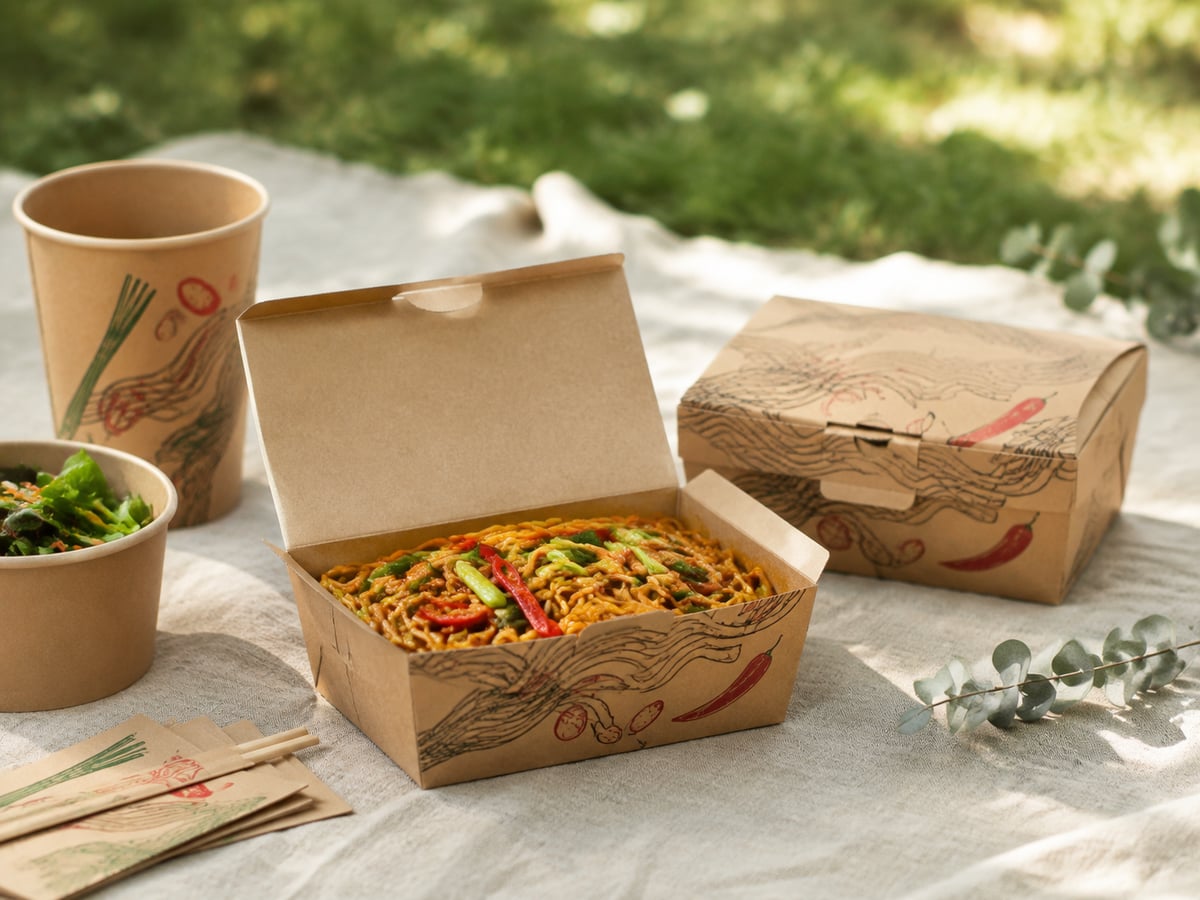
Canada Deep Noodle Box Pricing: A Buyer’s Cost Guide
Pricing for 12–32 oz deep paper noodle boxes in Canada is shaped by much more than the quoted unit price. The largest cost drivers are paperboard grade and basis weight, grease- and liquid-resistant coating, box dimensions, fold and forming complexity, artwork coverage, order volume, carton density, freight routing, and the level of quality verification required before shipment.For restaurants serving noodles, ramen, pho, curry, rice bowls, soup, pasta, and saucy takeaway meals, a low-cost box can become expensive if it leaks, loses stiffness, opens during delivery, or creates a poor customer experience. Buyers should compare the complete landed cost: product price, printing plates, sampling, tooling where required, export packing, freight cube, customs-related handling, warehouse space, local delivery, and the expected cost of product failures.In practical terms, Canadian importers should request a specification-based quotation rather than asking only for “the best price.” The specification should state capacity, top and bottom dimensions, unfolded size, board weight, coating type, print colours, packing count, acceptable leakage performance, food-contact documentation, and destination city. A shipment routed through Vancouver, Toronto, Montréal, Halifax, or Calgary will have different freight and inland-delivery economics.Cost ComponentTypical Influence on CostWhy It Matters for Canadian BuyersPaperboard gradeHighHigher-quality virgin or food-contact board improves stiffness and print appearance.Coating selectionHighPE, water-based, and compostable coatings have different hot-liquid and grease performance.Box capacityMedium to high32 oz boxes use more material and often require stronger structural support than 12 oz boxes.Printing coverageMediumFull-colour branding, large ink coverage, and special finishes increase setup and run cost.MOQ and run lengthHighShort production runs spread fixed setup cost over fewer pieces.Carton cubeMediumBulky formed boxes can consume valuable container and warehouse space.Quality testingLow to mediumSampling and inspection reduce the risk of costly leakage, print, or quantity claims.The table shows why a per-piece quote should never be considered in isolation. A box that costs a fraction less but requires more cartons, carries a higher leakage risk, or creates greater storage pressure in a Toronto distributor warehouse may not be the lower-cost option.var ctx = document.getElementById('lineChart').getContext('2d');new Chart(ctx, { type: 'line', data: { labels: ['2022', '2023', '2024', '2025', '2026', '2027'], datasets: [{ label: 'Estimated Canadian demand index for paper takeaway containers', data: [100, 107, 115, 123, 132, 142], borderColor: 'rgb(44, 122, 80)', backgroundColor: 'rgba(44, 122, 80, 0.10)', fill: false, tension: 0.3, borderWidth: 3 }] }, options: { responsive: true, maintainAspectRatio: false, plugins: { legend: { display: true } }, scales: { y: { beginAtZero: false } } }});This market-growth view is directional rather than a quoted price index. Continued growth in delivery, meal-kit, quick-service, campus dining, and Asian cuisine is increasing demand for durable paper food containers across major Canadian metropolitan areas.Deep noodle boxes are structurally different from shallow fry cartons or simple paper trays. Their taller sidewalls, locking folds, broad bottom panels, and liquid-holding requirements make material and forming accuracy important. A 12 oz noodle carton designed for dry chow mein can use a lighter specification than a 32 oz soup-ready box intended for ramen broth or butter chicken.Paperboard is generally the largest direct material expense. Higher board weight improves crush resistance and reduces sidewall softening, but it also increases material consumption. The correct choice depends on food temperature, holding time, sauce volume, delivery distance, stacking conditions, and whether the container will be carried in an insulated delivery bag.Canadian operators should also consider climate and operations. In winter, condensation and temperature changes can affect packaging performance during courier delivery in Edmonton, Winnipeg, Ottawa, and Québec City. In humid kitchen environments, boxes may be exposed to steam before they leave the restaurant. A laboratory-tested specification is preferable to an assumption based only on a product photo.Specification FactorLower-Cost DirectionHigher-Performance DirectionBest Use CaseBoard weightLighter food-grade boardHeavier, stiffer boardHeavy noodles, soup, curry, stacked delivery ordersInternal coatingBasic moisture barrierEnhanced liquid and grease barrierRamen, pho, broth, oily saucesExternal finishNatural kraft or plain whiteHigh-white, coated print surfacePremium retail and branded restaurant programsFold patternStandard formed shapeReinforced seams or complex locking designLong delivery radius and high-fill applicationsClosureIntegrated top flapsSecure fold lock or compatible lid systemSoup and high-movement courier deliveryPrint methodPlain or one-colour printMulti-colour custom graphicsChain restaurant branding and promotionsThe important buying decision is not simply “heavy versus light.” It is selecting the lowest-cost construction that consistently passes the actual food application. A 20-minute hot-fill and delivery test may reveal that a medium-weight board with a suitable coating performs better than a heavier board with an unsuitable barrier treatment.Board weight, coating, and forming complexity interact. Increasing paper weight can improve rigidity, but it does not automatically guarantee seam integrity. Likewise, a premium coating can resist oil and moisture, yet poor folding alignment can still cause leaks at the base or corners. The most reliable approach is to evaluate the full converting system: material, print, die-cutting, scoring, folding, gluing or heat sealing, final forming, and packing.For noodle and soup applications, buyers may evaluate conventional polyethylene-lined paperboard, water-based barrier paper, or certified compostable material options where suitable. The optimal material should be selected according to the food-contact requirement, performance target, regional waste-management context, and customer sustainability policy. Claims should be supported by relevant documentation rather than broad marketing language.Forming complexity may include deep sidewalls, wide top openings, narrow bottoms, multiple fold locks, reinforced corners, and fitted lid compatibility. Custom dimensions can improve portion control and food presentation but may involve a new die-cutting layout or tool cost. Standard sizes usually provide a better starting point for first orders, especially when a buyer is still validating menu fit and sales volume.Box SizeCommon Food ApplicationSuggested Performance FocusPricing Sensitivity12 ozSide noodles, snacks, small rice portionsDry-food resistance and fold securityLower material use; printing may dominate small orders16 ozSingle noodle portion, pasta, stir-fryGrease resistance and sidewall stiffnessCommon volume with efficient carton packing20 ozRice bowls, curry, medium ramen portionsHot-fill stability and base integrityModerate board and freight requirement24 ozLarge noodles, saucy entréesLeak resistance and closure reliabilityHigher material consumption and cube26 ozGenerous takeaway mealsStacking strength and moisture controlMay need reinforced format depending on food32 ozRamen, pho, soup, family-size curryBroth resistance, heat retention, safe handlingHighest material, carton cube, and testing needThis table helps buyers align box size with food weight and operating conditions. For example, a 32 oz box filled with broth should not be evaluated with a dry pasta test. The fill temperature, headspace, delivery time, shaking, and stacking conditions should reflect the restaurant’s real service process.Plain noodle boxes are generally the simplest route for pilot orders, seasonal demand, distributors, and businesses needing rapid replenishment. They avoid print plate or cylinder costs, artwork approval delays, colour-control requirements, and potential write-offs if branding changes. White and natural kraft options can also work well with labels, stamps, sleeves, or tamper seals added locally in Canada.Custom printing adds visible brand value but introduces fixed costs and approval steps. Cost increases depend on the number of colours, print coverage, ink density, use of Pantone colours, varnish requirements, artwork complexity, and the production quantity. A simple one-colour logo on one panel is very different from a full-coverage design printed across all visible surfaces.For a multi-location restaurant group in Vancouver or Greater Toronto, custom printing can be economical when annual demand is sufficient and the artwork is stable. For a startup food truck, catering company, or short promotional run, plain stock packaging with branded labels may preserve cash and reduce obsolescence risk.var ctx = document.getElementById('barChart').getContext('2d');new Chart(ctx, { type: 'bar', data: { labels: ['Ramen & Pho', 'Asian Quick Service', 'Meal Prep', 'Campus Dining', 'Catering', 'Grocery Hot Food'], datasets: [{ label: 'Relative demand for deep noodle boxes', data: [92, 88, 66, 58, 49, 63], backgroundColor: [ 'rgb(44, 122, 80)', 'rgb(75, 144, 104)', 'rgb(103, 163, 126)', 'rgb(132, 182, 149)', 'rgb(162, 201, 172)', 'rgb(91, 149, 113)' ] }] }, options: { responsive: true, maintainAspectRatio: false, plugins: { legend: { display: true } }, scales: { y: { beginAtZero: true, max: 100 } } }});The bar chart illustrates typical demand intensity by food-service segment. Ramen, pho, Asian quick-service restaurants, and grocery hot-food counters are often the strongest users because they need deep containers that support moist, hot, and substantial menu items.Minimum order quantity, commonly called MOQ, affects nearly every element of a custom noodle box quotation. Before production begins, a manufacturer may need to prepare artwork files, make printing plates, set up die-cutting, calibrate printing, establish forming settings, and prepare packing instructions. These costs are relatively fixed, so they have a much larger effect on a small run.A larger production run can reduce the unit price, but only if the buyer can use and store the goods efficiently. Canadian importers should avoid ordering more than they can rotate before packaging specifications, branding, menu formats, or regulatory requirements change. The correct order size balances manufacturing efficiency with warehouse carrying cost and demand risk.When comparing suppliers, ask whether MOQ is based on a single size, a single print design, one material specification, or a combined family of related products. It may be possible to use the same artwork style across 16 oz, 24 oz, and 32 oz containers, but each size may still require separate die-lines or printing setups.Order ScenarioUnit Price TendencyFixed-Cost ImpactRecommended Buyer StrategySample quantityHighestVery high per unitUse for fit, leakage, print, and delivery testing only.Small pilot orderHighHighChoose standard sizes and limited print coverage.One pallet equivalentModerateModerateSuitable for regional restaurant groups and distributors.Partial-container orderModerate to lowerBetter fixed-cost absorptionConsolidate complementary packaging where possible.Full-container orderLowerLower per unitConfirm forecast, warehouse capacity, and product rotation.Scheduled annual programMost stableLowest setup burden over timeUse call-off schedules and agreed production windows.For buyers who need several food-packaging categories, consolidation can improve order economics. In addition to noodle boxes, compatible cups, bowls, trays, burger boxes, and compartment meal containers may be sourced through the food container range to improve purchasing efficiency and container utilization.Deep formed noodle boxes are light, but they are not always freight-efficient. Their shape creates air space inside master cartons, and inefficient carton dimensions can increase ocean freight, domestic drayage, warehouse racking needs, and last-mile delivery costs. This is especially important for importers shipping into inland markets such as Calgary, Edmonton, Saskatoon, Winnipeg, or southern Ontario distribution centres.Freight cube should be evaluated alongside gross weight. Two products with the same unit price can have different landed cost if one packs more efficiently. Buyers should request carton dimensions, gross and net weight, pieces per carton, cartons per pallet where relevant, and estimated container loading quantity. These details make it possible to compare cost per 1,000 usable boxes rather than cost per box alone.For ocean shipments, Vancouver and Prince Rupert can be logical gateways for western Canada, while Montréal and Halifax can support eastern supply routes. Toronto-bound freight may move through several port and rail combinations depending on service availability, season, and container type. Freight planning should be confirmed with a qualified forwarder before finalizing a purchasing decision.Freight-Cube QuestionInformation to RequestCost Risk if IgnoredCarton dimensionsLength, width, height in centimetresInaccurate ocean and warehouse cost calculationsPieces per cartonInner pack and master-carton quantityDifficulty planning restaurant replenishmentCarton gross weightWeight including product and export cartonHandling and courier cost surprisesContainer loading estimate20-foot and 40-foot loading quantitiesIncorrect full-container purchasing decisionsPallet configurationCartons per pallet and pallet heightWarehouse incompatibility or unstable storageCarton compression protectionBoard strength and stacking guidanceCrushed boxes and unusable inventoryThe table demonstrates why packing data belongs in every formal quotation. It is not a logistics detail to be checked after purchase; it is a core component of the landed-cost calculation.A fair supplier comparison requires one master specification. Without it, a quotation with a lower price may be based on lighter board, a different coating, fewer pieces per carton, less print coverage, or a different delivery term. Buyers should ask every supplier to quote the same capacity, dimensions, board specification, coating, artwork, packing configuration, testing expectation, and trade term.A normalized quotation should show whether prices are EXW, FOB, CIF, or delivered to a Canadian destination. It should identify the currency, validity period, MOQ, payment terms, sampling cost, tooling or plate cost, production lead time, packing details, and documentation included. It should also clarify whether the quoted product is plain, custom printed, or a pre-production approved version.For high-volume food-service programs, establish measurable acceptance criteria. Examples include capacity tolerance, box dimensions, print-colour tolerance, coating integrity, leakage after a defined hot-liquid hold, grease resistance, fold alignment, carton count accuracy, and acceptable defect rate. These criteria create a repeatable approval record for future production.var ctx = document.getElementById('areaChart').getContext('2d');new Chart(ctx, { type: 'line', data: { labels: ['2022', '2023', '2024', '2025', '2026', '2027'], datasets: [{ label: 'Share of buyer requests emphasizing lower-plastic barrier options', data: [24, 31, 39, 47, 56, 64], borderColor: 'rgb(36, 99, 146)', backgroundColor: 'rgba(36, 99, 146, 0.25)', fill: true, tension: 0.35, borderWidth: 3 }] }, options: { responsive: true, maintainAspectRatio: false, plugins: { legend: { display: true } }, scales: { y: { beginAtZero: true, max: 100 } } }});The area chart reflects an ongoing shift toward packaging specifications that consider fibre sourcing, coating composition, recyclability or compostability pathways, and reduced-plastic goals. The appropriate solution must still pass performance testing for hot and oily foods.A first-order budget should include more than factory pricing. The starting point is the product cost for the required quantity, followed by artwork development, printing plates where applicable, sampling, quality inspection, export cartons, freight, marine insurance if used, customs brokerage, duties and taxes where applicable, local transport, warehouse receiving, and storage. Buyers should also include contingency for product trials and approval adjustments.For a first custom noodle box order, it is often prudent to set aside a budget for three physical checkpoints: a white sample to verify dimensions and folding, a functional sample for food testing, and a printed pre-production proof to verify artwork, colour, and finishing. Skipping these stages can appear cheaper but raises the risk of receiving inventory that does not match the intended use.Restaurant chains and distributors can reduce budget uncertainty by preparing a demand forecast by size. Instead of buying only one deep box format for every menu item, they may use a 16 oz option for dry noodles, a 24 oz option for standard meals, and a 32 oz reinforced option for broth-heavy servings. This can lower material spend while preserving performance where it matters most.First-Order Budget LineInclude It?Planning NoteProduct unit priceYesCalculate at the confirmed MOQ and specification.Printing plates or setupYes for custom printConfirm whether it is one-time, reusable, or charged again for reorders.White and printed samplesYesUse samples to approve dimensions, colour, and forming quality.Freight and insuranceYesEstimate based on carton cube, route, and shipping method.Customs and local deliveryYesInclude brokerage and transportation to the final warehouse.Inspection and contingencyRecommendedProtect against quality uncertainty in a first production order.A useful formula is: landed cost per 1,000 usable boxes = total product, setup, sample, shipping, customs, handling, storage, and expected failure costs divided by usable units received. This calculation makes differences in freight efficiency and defect prevention visible.Fude Packaging supports overseas buyers with an integrated approach to deep noodle boxes and related food-service packaging. Its manufacturing capability includes more than 20 years of packaging experience, a self-owned 30,000 m² production base in Shandong, automated capacity of up to 120,000 units per day, and in-house control of material selection, printing, die-cutting, forming, inspection, packing, and export preparation.From a technological capability perspective, the company can support material and coating recommendations, artwork and dieline review, custom-size development, Pantone colour matching, white samples, digital proofs, printed pre-production proofs, and functional testing. An in-house laboratory helps verify practical factors such as strength, leakage resistance, grease resistance, dimensional consistency, and food-application suitability before mass production.From a manufacturing capability perspective, Fude Packaging provides batch traceability and controlled production for cups, bowls, boxes, trays, and multi-compartment meal packaging. This can help Canadian distributors consolidate categories under a single supplier while maintaining more consistent print quality, packing standards, and purchasing coordination. Relevant documentation may include FSC, ISO 9001, FDA-related food-contact support, LFGB, and other records according to the destination-market and material requirement.From a service capability perspective, the team can assist with scheduled orders, samples, inspection coordination, export documents, and shipment planning for sea freight, air freight, full-container, less-than-container, and express sample deliveries. Learn more about available custom packaging services, review the company background on the Fude Packaging profile page, or request a specification review through the Canadian buyer contact channel.var ctx = document.getElementById('comparisonChart').getContext('2d');new Chart(ctx, { type: 'bar', data: { labels: ['Specification Control', 'Sampling Support', 'Production Capacity', 'Traceability', 'Export Documentation', 'Multi-Category Supply'], datasets: [ { label: 'Integrated manufacturer approach', data: [92, 88, 95, 90, 86, 91], backgroundColor: 'rgb(44, 122, 80)' }, { label: 'Basic spot-buying approach', data: [61, 45, 52, 48, 56, 39], backgroundColor: 'rgb(170, 170, 170)' } ] }, options: { responsive: true, maintainAspectRatio: false, plugins: { legend: { display: true } }, scales: { y: { beginAtZero: true, max: 100 } } }});The comparison chart is a planning illustration of the operational advantages buyers often seek from an integrated packaging manufacturer compared with sourcing only on spot price. The right supplier should be assessed through actual samples, documentation, communication speed, and repeat-order consistency.The cost structure normally includes paperboard, barrier coating, printing, die-cutting, forming, labour, quality control, export packing, sampling, setup charges, and logistics. For imported goods, Canadian buyers should add freight, insurance where used, customs handling, domestic delivery, and storage. Larger boxes usually cost more because they use more board and occupy more freight cube.The largest changes usually come from board weight, coating type, capacity, special dimensions, complex folding structure, full-colour printing, print coverage, MOQ, and carton efficiency. Functional requirements such as hot-liquid leakage resistance can also increase cost because they may require upgraded material or more careful manufacturing control.MOQ affects how fixed costs are distributed. A small custom order carries a higher unit price because artwork preparation, printing setup, die-cutting preparation, and machine setup are spread across fewer boxes. Larger runs generally reduce unit cost, but buyers should not overbuy inventory that may become obsolete or costly to store.Common exclusions include printing plates, custom tooling, samples, third-party inspection, freight, insurance, customs clearance, taxes, local transportation, warehousing, and special documentation. Ask suppliers to list inclusions and exclusions in writing so that quotation comparisons are meaningful.Use standard dimensions where possible, limit print colours and coverage, consolidate compatible packaging items, optimize carton packing, use realistic MOQ planning, and match box performance to the actual food application. The safest savings usually come from eliminating unnecessary features, not from reducing critical barrier or structural performance.Test capacity, dimensions, folding, sidewall strength, hot-food handling, grease resistance, leakage after a defined holding period, closure security, stacking, courier-bag movement, print quality, and carton count. For soup and curry, test with the real menu item at the restaurant’s normal fill temperature and delivery duration.Future purchasing decisions will increasingly involve sustainability claims, fibre sourcing, lower-plastic barrier technologies, food-contact documentation, traceability, efficient freight cube, digital artwork approval, and demand forecasting. Buyers will also place greater value on packaging that performs reliably in delivery applications while supporting responsible material choices and evolving municipal waste-management expectations.For Canadian noodle, soup, curry, and Asian takeaway businesses, the strongest buying process is straightforward: define the food application, document the specification, test a sample, compare normalized quotes, calculate landed cost, and approve a repeatable standard before mass production. This approach protects brand presentation, customer satisfaction, and long-term procurement cost. -

Canada Guide to 1000/1300ml Large Grain Bowl Boxes
For Canadian poke shops, salad bars, meal-prep brands and health-food operators, 1000/1300ml large grain bowl boxes should be selected according to the finished meal rather than capacity alone. A bowl that looks suitable on a product sheet may fail when filled with warm grains, marinated protein, roasted vegetables, sauces, avocado, crispy toppings and cold ingredients in the same order.The most dependable buying method is to test samples with actual menu items, real serving temperatures, expected hold times, delivery movement and customer handling. A 1000ml bowl is commonly suitable for standard grain bowls with moderate toppings, while a 1300ml bowl gives more headspace for loaded portions, layered meals, extra protein, double bases or catering-style servings. The correct choice depends on fill weight, lid clearance, moisture exposure and the required customer presentation.For Canadian businesses operating in Toronto, Vancouver, Calgary, Montréal, Ottawa or Halifax, packaging should also be assessed against local delivery conditions. Winter temperatures, humid kitchens, multi-stop courier routes and longer suburban delivery distances can affect lid fit, condensation and the strength of paper-based containers. Before placing a bulk order, define measurable acceptance criteria for leakage, grease resistance, stackability, closure strength, print quality and delivered appearance.Fude Packaging supports food businesses sourcing food containers for takeaway and delivery with sample evaluation, material recommendations and repeatable approval records. The objective is not simply to buy a bowl; it is to build a packaging system that protects the meal, supports the brand and reduces service complaints.Canada’s demand for grain bowl packaging continues to be supported by healthy eating, office lunch delivery, university food service, urban convenience retail and subscription meal-prep programs. Grain bowls appeal to customers because they combine familiar ingredients with flexible dietary options, including plant-based proteins, halal choices, gluten-aware menus and high-protein meals.The following planning chart illustrates a realistic directional growth pattern for demand for premium takeaway bowl formats in major Canadian food-service markets. It should be used as a purchasing-planning indicator, not as a substitute for a company’s own sales history.var ctxMarketGrowth = document.getElementById('marketGrowthChart').getContext('2d');new Chart(ctxMarketGrowth, { type: 'line', data: { labels: ['2022', '2023', '2024', '2025', '2026', '2027'], datasets: [{ label: 'Indexed Canadian demand for premium grain bowl packaging', data: [100, 109, 121, 134, 148, 163], borderColor: 'rgb(40, 117, 92)', backgroundColor: 'rgba(40, 117, 92, 0.12)', borderWidth: 3, fill: false, tension: 0.3 }] }, options: { responsive: false, maintainAspectRatio: false, scales: { y: { beginAtZero: false } } }});A packaging program should include more than one container type. The standard 1000ml and 1300ml bowl boxes are usually the main service units, but lids, inserts, sauce cups, outer bags and tamper-evident labels may be equally important to delivery performance. A coordinated range simplifies purchasing, reduces packing errors and improves the visual consistency of every order.Packaging formatTypical useBest menu conditionKey selection point1000ml round grain bowlStandard lunch bowlRice, greens, protein and light toppingsCheck headspace under the lid1300ml large grain bowlLoaded meal or premium bowlDouble protein, layered vegetables and saucesConfirm stable stacking when filledClear fitted lidVisual merchandisingCold poke, salad and chilled meal prepTest seal around the full rimPaper or fibre lidHot or mixed-temperature menuWarm grain bowls and roasted mealsAssess moisture and steam behaviourDivider insertIngredient separationCrispy toppings, fruit or saucesVerify fit without reducing usable volumeSecondary carry bagDelivery and takeout transportMulti-bowl family or office ordersCheck handle strength and bowl stabilityThis table shows why a bowl should not be purchased as an isolated SKU. A 1300ml bowl paired with an incompatible lid, weak bag or poorly sized sauce cup can still create leakage, food mixing and customer dissatisfaction. The right system is determined by how all pieces work together during service.Start with the menu architecture. Map every bowl recipe by finished weight, ingredient height, sauce quantity, serving temperature and expected delivery time. In most operations, the 1000ml bowl serves the standard menu item and the 1300ml bowl serves upgrades, larger appetites, extra toppings and premium combinations.Canadian operators should avoid oversizing every menu item. Excessively large bowls can make portions look small, increase packaging cost and allow ingredients to move during transportation. Undersized bowls create lid pressure, messy edges and poor presentation. The best result is a small number of carefully chosen sizes matched to actual menu demand.Menu profileSuggested bowl sizeTypical filled weightRecommended headspaceOperational noteLight salad bowl750–1000ml350–500g20–30mmUse secure lid for leafy ingredientsStandard grain bowl1000ml500–700g15–25mmSuitable for most lunch occasionsPoke bowl with toppings1000–1300ml550–750g20–30mmProtect raw fish and garnish appearanceHigh-protein fitness bowl1300ml700–900g20–35mmAllow extra protein and dense grainsWarm roasted vegetable bowl1300ml650–850g25–35mmTest steam and coating performanceMeal-prep family portion1300ml or compartment tray800–1100g25–40mmMay require stronger outer packingThe filled-weight ranges are practical planning ranges rather than universal limits. Density differs considerably between quinoa, rice, roasted vegetables, legumes, tofu, chicken, salmon and sauce-heavy ingredients. Always confirm capacity using the business’s own recipes and serving utensils.Choose core sizes by reviewing sales data over at least four weeks, including weekday lunch peaks, weekend orders, delivery-platform promotions and seasonal menu changes. A growing bowl brand may begin with a standard 1000ml container and a 1300ml premium option, then add only specialized sizes where sales volume justifies the complexity.In dense downtown areas such as Toronto’s Financial District, Vancouver’s Yaletown or Montréal’s business core, customers often prioritize quick lunch portions, clean presentation and secure delivery. In suburban meal-prep markets around Mississauga, Surrey, Markham and Laval, larger bowl formats can be more common because customers buy multiple meals or seek higher-protein portions.Decision factor1000ml bowl priority1300ml bowl priorityHow to testPortion volumeStandard single mealLoaded or upgraded mealFill with normal production portionsIngredient heightLow to moderate topping profileHigh topping profileClose lid without compressing foodDelivery stabilityGood for single ordersCheck larger footprint in bagsStack and transport for 30 minutesFood temperatureCold, ambient or warm menuWarm and mixed-temperature mealHold at expected service temperatureBrand appearanceCompact and efficientPremium and generousPhotograph after delivery trialCost controlLower material use per mealHigher value for larger ticket sizeCompare total packaging cost per orderRound bowls are usually effective for visually layered meals and efficient filling lines. Rectangular formats may work better for meal-prep subscriptions, refrigerated displays and side-by-side stacking. The correct shape is the one that supports filling speed, lid compatibility, courier handling and the way customers eat the meal.Lid compatibility is one of the most important specifications in a grain bowl project. A lid should be tested with the exact bowl rim, not simply described as “compatible.” Small differences in rim geometry, material thickness and production tolerance can affect closure performance. This is especially important for sauces, hot grains and meals delivered through bike, car or scooter couriers.For poke and health-food brands, transparent lids can strengthen merchandising by displaying colourful ingredients. For warm meal-prep lines, fibre or paper-based lids may align better with a natural brand image, provided the lid remains stable in steam and moisture conditions. Inserts can keep crunchy toppings, sauces or fruit separate until consumption, but they must not create loose movement or complicate the packing line.Test scenarioTest conditionAcceptance targetWhy it mattersHot fill testWarm grains and vegetablesNo softening, distortion or lid releaseChecks heat and steam resistanceSauce leak testOil-based dressing or tahiniNo visible seepage at rim or baseProtects bags and customer confidenceStack testThree to five filled bowlsNo collapse or lid displacementSupports busy kitchen operationsDelivery vibration testVehicle or simulated movementFood remains contained and presentableReplicates courier handlingCold hold testRefrigerated meal-prep storageNo loss of rigidity or odour transferValidates advance-prepared mealsCustomer opening testNormal hand openingEasy to open without sudden spillsImproves end-user experienceEach test should be documented with date, sample code, food type, fill weight, temperature, hold time, result and approval decision. This simple record prevents repeated disputes when reorder specifications are discussed months later.Material standardization reduces procurement risk. When bowls, lids, trays and outer packs share compatible materials, colours and performance requirements, teams can train staff more quickly and reduce storage complexity. Standardization also helps restaurant groups maintain a consistent customer experience across locations in Canada.Common options include paperboard with suitable food-contact coatings, kraft-look exterior finishes, fibre-based formats and selected compostable material options. The appropriate construction depends on the meal, temperature, Canadian destination requirements and the waste-management systems available to customers. Environmental claims should be precise and supported by relevant documentation; a package should not be described as compostable or recyclable without confirming the applicable material and local collection pathway.From 2026 onward, Canadian buyers are expected to place more emphasis on packaging traceability, responsible fibre sourcing, reduced unnecessary plastic, clearer end-of-life labelling and more accurate environmental communication. At the same time, performance will remain non-negotiable. A package that uses less material but leaks during delivery creates food waste, refunds and reputational damage.var ctxTrendShift = document.getElementById('trendShiftChart').getContext('2d');new Chart(ctxTrendShift, { type: 'line', data: { labels: ['2023', '2024', '2025', '2026', '2027', '2028'], datasets: [{ label: 'Orders requesting fibre-focused or lower-plastic packaging (%)', data: [32, 39, 47, 56, 64, 70], borderColor: 'rgb(165, 107, 45)', backgroundColor: 'rgba(165, 107, 45, 0.28)', fill: true, borderWidth: 3, tension: 0.35 }] }, options: { responsive: false, maintainAspectRatio: false, scales: { y: { beginAtZero: true, max: 100 } } }});The area chart demonstrates the expected shift toward more sustainability-focused sourcing requests. For buyers, the practical response is to request material specifications, food-contact documentation, responsible sourcing information and clear use limitations before launch.Real-service testing is the strongest approval method because it reveals issues that laboratory-style checks may miss. Test during the busiest service window, using regular staff, normal assembly speed and actual delivery routines. Include at least one high-sauce item, one hot meal, one cold bowl, one heavily loaded bowl and one order packed with multiple containers.For operations near Port of Vancouver, Port of Montréal or the Greater Toronto Area distribution network, imported packaging may pass through extended warehousing and domestic transportation before reaching stores. Buyers should inspect incoming stock after shipment and again during live service, especially when weather changes significantly between seasons.var ctxIndustryDemand = document.getElementById('industryDemandChart').getContext('2d');new Chart(ctxIndustryDemand, { type: 'bar', data: { labels: ['Poke Shops', 'Meal Prep', 'Healthy QSR', 'Campus Food Service', 'Corporate Catering', 'Grocery Ready Meals'], datasets: [{ label: 'Estimated annual bowl-format purchasing demand index', data: [88, 94, 81, 63, 58, 72], backgroundColor: [ 'rgb(46, 134, 171)', 'rgb(38, 142, 111)', 'rgb(242, 153, 74)', 'rgb(142, 68, 173)', 'rgb(192, 57, 43)', 'rgb(241, 196, 15)' ] }] }, options: { responsive: false, maintainAspectRatio: false, scales: { y: { beginAtZero: true } } }});Meal-prep and poke operators are often the strongest users of 1000ml and 1300ml grain bowl boxes because their menus combine multiple ingredients and require dependable presentation after transportation. Healthy quick-service restaurants, university catering teams and grocery ready-meal programs can also benefit when formats are standardized around repeatable portions.Branding should follow functional approval, not replace it. Once the bowl, lid and secondary pack pass real-service tests, the business can move into print development. A well-designed bowl can reinforce a brand’s quality through clean colour matching, readable messaging, ingredient stories, recycling guidance and premium visual consistency.For Canadian brands, consider bilingual labelling requirements where applicable, especially for products distributed in Québec or across national retail channels. Artwork should be checked for logo placement, colour contrast, nutrition or handling messages, print alignment and legibility on curved surfaces. Avoid placing critical information too close to folds, seams or the bowl base.Fude Packaging can provide digital proofs, plain white samples and printed pre-production samples for custom projects. Through its custom packaging support service, buyers can review artwork, structure, material recommendations and prototype performance before bulk production begins.Reliable customization requires more than adding a logo. It depends on artwork checking, die-line control, printing accuracy, coating selection, forming consistency and quality verification. Fude Packaging combines in-house product development support with sample options that help buyers confirm dimensions, capacity, lid fit, grease resistance and printed appearance before a full production commitment.For food businesses with multiple locations, digital approval files and signed sample records are valuable controls. They help prevent colour variation, incorrect bowl dimensions or mismatched lid orders when purchasing teams change or new locations open.The lowest unit price is not always the lowest operating cost. A slightly stronger container may reduce refunds, bag replacement, food waste and delivery-platform complaints. Review the complete cost per served meal: bowl, lid, insert, sauce cup, label, bag, labour time, storage space and expected failure rate.Track customer complaints by category. Common issues include loose lids, greasy bases, crushed bowls, condensation, mixed ingredients, unclear disposal guidance and portions appearing too small. Review complaints monthly during the first three months of launch, then quarterly when the program becomes stable.var ctxSupplierComparison = document.getElementById('supplierComparisonChart').getContext('2d');new Chart(ctxSupplierComparison, { type: 'bar', data: { labels: ['Sample Support', 'Batch Traceability', 'Customization', 'Production Scale', 'Documentation', 'Delivery Testing'], datasets: [{ label: 'Fude Packaging planning score', data: [92, 94, 91, 96, 90, 88], backgroundColor: 'rgba(40, 117, 92, 0.78)' }, { label: 'Typical basic supplier planning score', data: [58, 52, 60, 55, 57, 48], backgroundColor: 'rgba(120, 120, 120, 0.62)' }] }, options: { responsive: false, maintainAspectRatio: false, scales: { y: { beginAtZero: true, max: 100 } } }});This comparison chart is a supplier-evaluation framework rather than an independent market ranking. Buyers should score every prospective supplier against their own priorities, including order volume, documentation needs, packaging performance, lead time and destination logistics.Fude Packaging has more than 20 years of packaging experience and operates a self-owned 30,000 m² production base in Shandong. Automated capacity can reach approximately 120,000 units per day, supporting businesses that need dependable replenishment for restaurant chains, distributors and multi-location food brands.In-house production control covers key stages from material selection and printing through forming, inspection, packing and shipment. An internal laboratory supports performance evaluation, while full-batch traceability helps buyers manage quality assurance. Relevant documentation can be prepared according to product and market needs, including food-contact, quality-management and responsible-fibre requirements.For Canadian importers and food-service operators, the most useful supplier relationship combines manufacturing capacity with practical project support. Fude Packaging serves buyers requiring paper cups, bowls, meal boxes, trays, burger boxes, salad containers and multi-compartment packaging, enabling sourcing teams to consolidate related SKUs through one packaging partner.Businesses importing through Vancouver, Prince Rupert, Montréal or Halifax can benefit from coordinated packing specifications, scheduled orders and export-ready documentation. Larger buyers may also reduce logistics complexity by aligning carton dimensions, product ranges and container-loading plans across multiple packaging formats.Fude Packaging supports OEM and ODM projects with product selection, custom sizing, structural development, artwork review, Pantone-oriented colour matching, sample development, functional testing and mass-production coordination. Buyers can also arrange independent inspection or third-party testing where required before shipment.The international service process begins by clarifying food type, serving temperature, order volume, branding requirements, destination market, delivery deadline and shipping preference. Standard production timing can be approximately 7–15 days depending on specification and volume. For project discussions, sample requests or Canadian delivery planning, buyers can contact the Fude Packaging team directly.Learn more about the company’s manufacturing background and quality approach on the Fude Packaging company profile. This is particularly useful for distributors and chain operators assessing long-term capacity, documentation control and multi-category packaging supply.Yes. A 1000ml bowl is commonly suitable for standard grain bowls, poke bowls and balanced lunch portions. A 1300ml bowl is better for loaded meals, double-protein options, larger portions, layered ingredients and menus with substantial toppings. The final choice should be confirmed using the actual finished meal, including sauce and lid clearance.Test the highest realistic serving temperature, the normal delivery duration and the longest expected holding condition. Many businesses should test at least 30, 45 and 60 minutes after packing. Meal-prep brands should also test chilled storage over their intended shelf-life period. Include hot grains, oily sauces and cold ingredients where relevant.Fill samples with the most demanding menu items, including dressing, oily protein, soup-like sauces or marinated vegetables. Hold the bowls upright, stack them, tilt them gently and transport them in the normal delivery bag. Check the rim, base, sidewall, lid seal and outer bag for seepage, staining or softening.The best format depends on portion weight, topping height, delivery method and storage system. Round bowls are effective for layered bowls and quick filling, while rectangular meal containers may be better for refrigerated meal-prep programs. Test the preferred format with lids, bags and delivery handling before final approval.A real-service trial should include normal kitchen staff, peak-hour assembly, actual recipes, production portions, delivery stacking, courier movement, customer opening and complaint review. Record fill weight, food temperature, hold time, lid performance, leakage, bowl strength and final appearance. Approval should be based on defined pass-or-fail criteria rather than informal opinion.Request product specifications, material details, relevant food-contact documentation, quality-control information, sample approval records and packing details. If sustainability claims are important to your brand, request supporting information for fibre sourcing, compostability or other environmental claims applicable to the selected product and intended market. -

Canada’s Deep Noodle Box Guide for Foodservice Buyers
The best 12–32 oz deep noodle box for a Canadian food business depends on what is served, how long it travels, how hot it is filled, how much liquid it contains, and whether the brand needs custom printing. A lightweight kraft paper box may work well for dry chow mein or fried noodles served quickly, while hot ramen, pho-style dishes, curry noodles and sauce-heavy meals usually need a stronger paperboard structure, dependable fold-lock construction and a tested grease- and moisture-resistant barrier.For buyers in Toronto, Vancouver, Montréal, Calgary, Edmonton and other Canadian delivery markets, the lowest unit price is rarely the lowest operational cost. One leak, softened sidewall or lid failure can create refund costs, delivery-platform complaints, damaged bags and lost repeat business. The practical approach is to compare packaging using a weighted scorecard covering liquid resistance, heat performance, stacking strength, capacity accuracy, printing requirements, freight efficiency and minimum order quantity.For broth-heavy noodle meals, select a deep container with a robust liquid barrier, secure closure and sufficient headspace. For dry noodles or short-distance takeaway, a standard folded noodle box can be more economical. Before approving any specification, test white samples and printed prototypes with the actual menu item, at the expected fill temperature and delivery duration. Canadian buyers should also confirm food-contact documentation and packaging requirements for their destination province, retailer or foodservice customer.Canada’s foodservice packaging market is shaped by urban delivery demand, winter temperature variation, long delivery distances and increasingly visible sustainability expectations. Downtown Toronto and Vancouver may require fast handoff performance for dense delivery zones, while suburban Ontario, Alberta and British Columbia routes can keep hot meals in delivery bags for longer. A noodle box that performs for a five-minute pickup may fail after 35 minutes in a heated courier bag followed by exposure to cold outdoor air.Import planning also matters. Buyers receiving freight through the Port of Vancouver, Port of Montréal, Prince Rupert, Halifax or inland intermodal hubs near Toronto should calculate cubic volume, pallet configuration, warehouse racking and seasonal safety stock before choosing a large-format packaging programme. Explore Fude’s food container range when consolidating noodle packaging with bowls, trays, meal boxes and other takeaway formats.var ctx1 = document.getElementById('canadaNoodleMarketGrowth').getContext('2d');new Chart(ctx1, { type: 'line', data: { labels: ['2022', '2023', '2024', '2025', '2026 Forecast', '2027 Forecast'], datasets: [{ label: 'Canadian demand index for deep takeaway food containers', data: [100, 108, 116, 124, 133, 142], borderColor: 'rgb(30, 105, 155)', backgroundColor: 'rgba(30, 105, 155, 0.12)', borderWidth: 3, tension: 0.3, fill: false }] }, options: { responsive: true, maintainAspectRatio: false, scales: { y: { beginAtZero: false, title: { display: true, text: 'Demand index (2022 = 100)' } } } }});The chart is an indicative purchasing-planning index rather than a measure of national sales. It illustrates why restaurant chains, distributors and importers increasingly assess deep noodle boxes as a performance category rather than as a generic paper product. Growth is supported by noodle bars, Asian quick-service restaurants, meal-prep brands, campus catering and delivery kitchens.Deep noodle boxes are available in several practical constructions. The visible shape may appear similar, but the board grade, coating, seams, fold design, base width and closure geometry can create significant differences in actual food performance. Buyers should compare the complete pack system, including any lid, sealing label, carry bag and delivery-bag conditions.OptionTypical CapacityCore StrengthBest Food ConditionMain LimitationCanadian Buyer UseStandard folded kraft box12–26 ozCompact, recognizable takeaway formatDry noodles, rice and stir-fryLimited margin for high broth volumeFood courts and counter serviceDeep folded noodle box16–32 ozExtra vertical capacity and headspaceSauced noodles and curry mealsMust be tested for seam resistanceDelivery-oriented restaurantsPE-lined paperboard box12–32 ozStrong moisture and oil resistanceHot, wet and greasy foodsEnd-of-life options vary by local systemHigh-volume QSR operationsWater-based or dispersion-barrier box12–32 ozReduced plastic-content positioningModerate moisture foodsPerformance depends on formulationSustainability-led brandsPLA-lined paper box12–32 ozCompostability programme compatibilityWarm foods with controlled hold timeRequires suitable waste-stream accessCampuses and green procurementPaper bowl with fitted lid24–32 ozBetter option for high broth volumeRamen, soup and pho-style mealsMore components and storage spaceLong-distance deliveryThis comparison shows why a 32 oz paper bowl with a fitted lid can be safer than a folded noodle box for a full broth serving, even if both are marketed as “noodle packaging.” A folded box is often excellent for stir-fry noodles and moderate sauce levels, while a bowl-and-lid system may provide more reliable security for soup-oriented menus. The right choice should follow actual fill weight and free-liquid volume, not only nominal ounces.The strongest demand comes from ramen shops, Chinese takeaway outlets, Thai restaurants, Vietnamese restaurants, Korean casual dining, Japanese fast-casual concepts, university food halls, hospital cafeterias, meal-kit kitchens, corporate caterers and supermarket prepared-food departments. In Canada, a single distributor may supply independent restaurants in Mississauga, Richmond, Burnaby, Markham and Laval while also serving national chains. That mix makes consistent dimensions and repeatable batch performance important.var ctx2 = document.getElementById('industryDemandChart').getContext('2d');new Chart(ctx2, { type: 'bar', data: { labels: ['Asian QSR', 'Delivery Kitchens', 'Campus Dining', 'Supermarkets', 'Catering', 'Meal Preparation'], datasets: [{ label: 'Estimated deep noodle box demand score', data: [92, 86, 71, 66, 58, 63], backgroundColor: ['#1f6d8c', '#3d91b4', '#6aaed0', '#91c5dd', '#d19a45', '#b56b49'] }] }, options: { responsive: true, maintainAspectRatio: false, scales: { y: { beginAtZero: true, max: 100, title: { display: true, text: 'Demand score out of 100' } } } }});The bar chart highlights where leak resistance, rapid packing and reliable customization have the greatest commercial value. Asian quick-service restaurants and delivery kitchens are especially sensitive to container failure because their menus often combine heat, starch, oil, sauce and travel time.Paper noodle boxes are engineered products. Their performance comes from the interaction between paperboard caliper, fibre quality, barrier coating, adhesive selection, creasing accuracy, base locking and manufacturing consistency. A visually attractive kraft surface does not automatically mean the box is appropriate for hot broth.For Canadian food businesses, the primary technical questions are: What is the filling temperature? How much free liquid will remain in the container? What is the maximum expected holding time? Will the package be stacked? Will it sit inside a delivery bag? Does the menu contain oil, coconut milk, cheese sauce, acidic ingredients or high-salt broth? These variables should be written into the purchase specification.Construction FeatureWhat It ControlsSuitable Food ExamplesTest MethodAcceptance StandardRisk if IgnoredPaperboard basis weightRigidity and stacking strengthLarge noodle portionsFilled stack testNo visible collapse after 30 minutesCrushed sidewallsInternal liquid barrierWater penetration resistanceRamen and curry noodlesHot-liquid hold testNo seepage at target hold timeLeaking base or seamsGrease-resistant treatmentOil migration controlChili oil noodlesOil-contact testNo outer stainingBag contaminationFold-lock geometryClosure securityDelivery takeawayInversion and shake testClosure remains engagedSpills during transportCrease qualityRepeatable folding performanceFast counter serviceAssembly trialQuick folding without crackingSlow packing and rejectsPrint and varnish systemBrand clarity and rub resistancePremium branded mealsRub and visual inspectionArtwork remains legiblePoor shelf presentationThe table should become part of the buyer’s approval record. Instead of approving a box based only on a photograph or empty sample, document the food type, fill mass, fill temperature, closure method, test duration and pass/fail result. This makes repeat orders easier to manage and helps resolve any quality discussion objectively.A 12 oz format generally suits side dishes, children’s portions, snack noodles and small rice-based meals. A 16–20 oz deep noodle box is widely used for standard single servings of chow mein, pad thai, yakisoba, lo mein or curry noodles. A 24–26 oz format can accommodate larger meals with toppings, while 32 oz formats are better suited to large noodles, combination meals or high-volume soup applications when supported by the correct structure.For meals with broth, do not fill to the nominal rim capacity. Maintain practical headspace to reduce splash during courier handling. For example, a 32 oz container may be nominally sized at 946 mL, but an operating fill level can be lower depending on noodles, protein, vegetables and liquid. A container must hold the food safely, not merely contain it at the moment of packing.Menu ApplicationRecommended SizeRecommended FormatLiquid LevelDelivery SuitabilityBuyer NoteDry chow mein16–20 ozStandard or deep folded boxLowHighPrioritize speed and print areaPad thai20–26 ozDeep folded boxLow to mediumHighTest for oil resistanceJapanese yakisoba16–24 ozKraft folded boxLowHighGood for food-court serviceCurry noodles24–32 ozHeavy-duty deep box or bowlMedium to highMediumConfirm barrier performanceRamen with broth26–32 ozPaper bowl with secure lidHighHighSeparate broth where neededMeal-prep noodle bowl24–32 ozBowl or rigid deep containerMediumHighConsider refrigeration requirementsFor a ramen shop in Vancouver or a pho concept in Toronto, using a separate broth container may reduce delivery risk and preserve noodle texture. For a lunch counter in Winnipeg serving sauced noodles consumed within minutes, a deep folded box may deliver a better balance of cost, appearance and operating speed.Hot-liquid leakage is usually not caused by one factor alone. It may result from excessive fill volume, insufficient barrier performance, a weak bottom fold, rough courier handling, prolonged holding time or stacking pressure. Sidewall softening often occurs when steam condenses on the inside wall, especially with hot soup or sauced noodles. As the board absorbs moisture or loses stiffness, the customer may find the container difficult to hold.Buyers should run trials that replicate real use: hot fill, normal portion weight, actual sauce or broth, closure, packing into a carry bag, a 20–45 minute hold and short transport agitation. Tests should include several samples from different carton positions, not a single hand-selected unit. Restaurants serving colder winter markets such as Ottawa, Québec City, Saskatoon or Regina should also consider the effect of temperature cycling between kitchen, vehicle and customer doorstep.var ctx3 = document.getElementById('packagingTrendShiftChart').getContext('2d');new Chart(ctx3, { type: 'line', data: { labels: ['2022', '2023', '2024', '2025', '2026 Forecast', '2027 Forecast'], datasets: [{ label: 'Standard unprinted box preference', data: [58, 53, 48, 43, 38, 34], borderColor: '#8a8a8a', backgroundColor: 'rgba(138, 138, 138, 0.18)', fill: true, tension: 0.25 }, { label: 'Performance-tested custom packaging preference', data: [42, 47, 52, 57, 62, 66], borderColor: '#2f8f68', backgroundColor: 'rgba(47, 143, 104, 0.22)', fill: true, tension: 0.25 }] }, options: { responsive: true, maintainAspectRatio: false, scales: { y: { beginAtZero: true, max: 70, title: { display: true, text: 'Buyer preference share (%)' } } } }});This trend shift reflects the growing value of functional packaging decisions. Canadian food operators increasingly link packaging performance to online reviews, delivery-platform ratings, food quality perception and waste-reduction goals. A stronger, more appropriate container can reduce product loss even if it costs slightly more per piece.Define the maximum food and liquid fill weight in grams. Record the normal filling temperature and maximum holding time. Specify the acceptable leakage threshold: ideally no visible seepage. Test stacked containers with the actual bag and courier handling conditions. Check closure security after steam exposure and vigorous movement. Inspect outer surfaces for grease staining, print rub and sidewall softening. Approve the final production sample, not only the unprinted white sample. Customization affects minimum order quantity, lead time, print setup, proofing and inventory management. A plain stock noodle box is usually suitable for buyers needing immediate replenishment or small pilot quantities. A custom printed box creates stronger brand recognition but requires artwork review, colour confirmation, production scheduling and a realistic forecast.For a multi-location restaurant group in the Greater Toronto Area, custom printing can provide a consistent guest experience across locations. For a distributor supplying many independent restaurants, neutral kraft stock may move faster and reduce inventory risk. A hybrid strategy is also practical: use a high-performance unprinted container and apply branded tamper labels, sleeves or stickers for smaller programmes.Buying ModelMOQ TendencyBranding LevelLead-Time TendencyInventory RiskBest Buyer TypePlain stock boxLowerMinimalShorterLowStart-ups and local restaurantsSingle-colour custom printModerateClear logo visibilityModerateModerateGrowing regional chainsFull-colour custom printHigherHigh visual impactLongerHigherEstablished branded conceptsSeasonal artworkModerate to highCampaign-focusedRequires advance planningHigher after campaignPromotional food brandsPrivate-label distributor packHigherDistributor identityForecast drivenShared across customer baseImporters and wholesalersNeutral box plus labelLowerFlexibleShorterLow to moderateTesting and smaller operatorsBefore confirming a custom programme, request a digital proof, a white structural sample and a printed pre-production proof where appropriate. Fude Packaging can support artwork checking, dieline review, prototype options and manufacturing recommendations through its custom packaging services. This process helps reduce costly print errors, incorrect capacity selection and performance mismatches before full production begins.Deep noodle boxes are light, but they occupy volume. Canadian importers should assess landed cost using carton dimensions, pieces per master carton, pallet height, warehouse cube, container utilization and domestic transport to final distribution points. Freight planning is especially important for businesses shipping from Vancouver to Alberta, from Montréal to Ontario, or from a central warehouse to multiple franchise locations.Nested bowls may be efficient in some configurations, while folded boxes can ship flat and save warehouse space before assembly. However, a flat-folded product may require more labour at the restaurant if staff must form it during peak service. The saving in freight should be weighed against speed of assembly, training needs and service errors.Logistics FactorFlat-Folded Deep BoxPre-Formed BowlOperational MeaningWarehouse EffectDecision PriorityInbound cubic volumeUsually lowerUsually higherInfluences ocean and domestic freightLess space for flat stockHighRestaurant assembly timeHigherLowerInfluences peak-hour speedNo major differenceHighDamage during storageLower before formingCan deform if stacked poorlyAffects usable yieldRequires protective stackingMediumContainer utilizationGenerally efficientDepends on nesting ratioAffects landed costPlan by carton dimensionsHighStaff training requirementModerateLowAffects consistent assemblyNoneMediumMulti-location replenishmentEfficient for bulk distributionConvenient for ready useDepends on store labour modelEvaluate store backroom spaceHighThe freight comparison should include more than container price. Add estimated assembly labour, damage allowance, inventory carrying cost and the cost of delivery failures. A practical procurement team will compare “cost per successfully delivered meal,” not simply cost per empty box.Independent restaurants should begin with a controlled sample trial and choose a stock or low-complexity format that fits their core menu. Small chains should standardize one or two capacities across locations to simplify ordering, staff training and brand presentation. Distributors should select formats with stable broad-market demand, reliable carton labelling and manageable warehouse cube. National foodservice brands should define performance standards, artwork controls, batch traceability and scheduled replenishment programmes.var ctx4 = document.getElementById('supplierComparisonChart').getContext('2d');new Chart(ctx4, { type: 'bar', data: { labels: ['Leak-Test Support', 'Custom Print', 'Production Scale', 'Traceability', 'Multi-Category Supply', 'Export Support'], datasets: [{ label: 'Fude Packaging capability score', data: [92, 90, 95, 88, 94, 91], backgroundColor: '#3569a8' }, { label: 'Typical basic trading option', data: [58, 62, 55, 48, 51, 60], backgroundColor: '#b7b7b7' }] }, options: { responsive: true, maintainAspectRatio: false, scales: { y: { beginAtZero: true, max: 100, title: { display: true, text: 'Capability score out of 100' } } } }});This supplier comparison is a planning framework, not a substitute for supplier qualification. Buyers should verify samples, factory controls, documentation, production capacity, inspection arrangements and export experience before awarding business. The most suitable supplier is the one that can repeatedly meet the approved specification, not merely provide a competitive quotation.A regional delivery-focused noodle operator serving the Greater Vancouver area was experiencing customer complaints linked to sauce seepage and softened sidewalls. The business had selected a low-cost 20 oz box based on appearance and initial price. During review, the actual food weight, sauce content and 30-minute delivery period were documented. The operator moved to a deeper, stronger specification with a tested internal barrier and reduced its fill level slightly to preserve headspace. The result was a more stable package, fewer delivery-related complaints and improved presentation on arrival.An Ontario distributor supplying restaurants around Markham, Scarborough, Mississauga and Brampton needed a product range suitable for diverse Asian takeaway menus. Instead of stocking many similar formats, the distributor standardized a practical selection of 16 oz, 26 oz and 32 oz options. Product trials categorized menus by dry, sauced and broth-heavy applications. This approach simplified sales training, warehouse management and customer recommendations while offering a clearer upgrade path for restaurants moving into delivery.Fude Packaging supports overseas B2B buyers with manufacturing, technical and service capabilities designed for repeat foodservice purchasing. The company operates a self-owned production base of approximately 30,000 m² in Shandong and has more than 20 years of packaging experience. Automated production capacity can reach approximately 120,000 units per day, supporting both standard packaging programmes and structured custom projects.Technical support begins with material and structure selection. Fude Packaging can recommend paperboard, barrier approaches, capacity options, printing methods and packing configurations according to food type, serving temperature, grease exposure, destination-market expectations and sustainability objectives. In-house quality and performance testing supports evaluation of dimensions, forming quality, strength, leakage resistance, lid compatibility and print presentation. Documentation options can include food-contact and management-system materials relevant to buyer requirements, including FDA-related food-contact support, FSC, ISO 9001, LFGB and other applicable project documentation.With direct control over printing, die-cutting, forming, inspection, packing and shipment coordination, the factory can support consistency across paper cups, bowls, food boxes, trays, salad containers and multi-compartment meal packaging. This allows Canadian buyers to consolidate categories and maintain a consistent visual identity across different packaging formats. Full-batch traceability, incoming-material checks, production monitoring and final inspection help create a more controlled supply programme.For Canada-bound projects, Fude Packaging can provide digital proofs, white samples, printed samples and pre-production approvals. The international team can assist with product selection, artwork review, Pantone colour matching, order scheduling, export packing and shipping documentation. Buyers can also arrange third-party inspection when required. Learn more about the company’s export experience on the Fude Packaging profile page, or request project-specific guidance through the contact team.For broth-heavy ramen, soup and pho-style meals, a paper bowl with a secure fitted lid is generally the safest option. If using a deep folded noodle box for sauced food, select a heavy-duty structure with a proven moisture barrier and test it at normal filling temperature and delivery time. For very high liquid volume, consider separating broth from noodles and toppings.The lowest unit-price option is not always the least expensive in operation. Include leak-related refunds, food loss, delivery complaints, bag damage, assembly labour, storage, freight and customer retention in the calculation. A slightly stronger box may lower total cost by preventing failures.Flat-folded noodle boxes generally use less warehouse and freight volume than pre-formed bowls, but they require restaurant staff to assemble them. Pre-formed bowls are faster to use but can occupy more space. Compare carton dimensions, pieces per carton, assembly time and location-level storage limits before making a decision.Deep folded noodle boxes often provide large, visible printable panels and a strong takeaway appearance. Full-colour printing can support premium positioning, while a neutral kraft box plus branded label offers lower-order flexibility. The best branding choice depends on forecast volume, artwork complexity and the desired customer experience.Test at least several samples using actual food, sauce or broth; actual fill weight; normal filling temperature; normal closure method; realistic delivery duration; and stacking inside the intended carry bag. Record leakage, softening, closure performance, handling comfort and print quality. Approve the results in writing before mass production and retain the approved sample as a reference.In 2026 and beyond, Canadian packaging buyers are expected to place greater emphasis on measurable performance, material transparency, packaging reduction and local waste-stream compatibility. Sustainability claims should be supported by the actual material structure and the disposal options available in the city or province where the packaging is used. A compostable material may still require access to a suitable collection system, while recyclable or fibre-based claims should be communicated carefully and accurately.Technology trends will also influence purchasing. Digital artwork approvals, batch traceability, automated inspection, improved water-based barriers and smarter demand forecasting can reduce supply risk. Food businesses will increasingly select deep noodle packaging using menu-specific test data rather than visual comparison alone. For Canadian buyers, the strongest long-term strategy is to combine reliable food performance, practical logistics, compliance readiness, credible sustainability communication and consistent brand execution. -
U.S. Paper Noodle Box Factory Guide for 2026 Buyers
The United States takeaway market is expanding, and paper noodle boxes are now standard packaging for Asian restaurants, fast-casual chains, meal-prep brands, ghost kitchens, food trucks, campus dining, and third-party delivery. For U.S. buyers, working with a real paper noodle box factory instead of a trading company can improve consistency, shorten development cycles, reduce packaging costs, and support compliance with food-contact and sustainability requirements. This guide explains the 2026 U.S. market outlook, how factory production works, what capacity matters most, which certifications to verify, and how OEM and private label programs help brands grow. It also shows how Shandong Fude Packaging Co., Ltd. supports American importers, distributors, and restaurant groups with factory-direct supply.If you are sourcing takeout packaging in the United States, a qualified paper noodle box factory should offer more than box production. It should provide stable raw material sourcing, flexographic printing, die-cutting, forming, leak-resistance engineering, quality inspection, food-contact compliance, and dependable export service. For buyers in Los Angeles, New York, Chicago, Houston, Miami, Seattle, and New Jersey distribution hubs, the most important factors are product consistency, lead time reliability, freight planning, customization support, and certification transparency.In practical terms, a strong paper noodle box factory is different from a reseller because it controls tooling, production scheduling, print quality, coatings, carton packing, and pre-shipment inspection. That means fewer surprises during scale-up. For U.S. restaurant chains and wholesalers, that matters when seasonal demand spikes before summer events, year-end holidays, college semesters, or delivery platform promotions.Paper noodle boxes are used for chow mein, lo mein, fried rice, pasta, stir-fry meals, snacks, and side dishes. Common U.S. buying priorities include:Leak and grease resistance for sauces and oils Secure folding structure for delivery and takeout Custom print for brand recognition Kraft or white board options for different brand positioning Compatibility with microwave reheating in selected use cases Supply continuity for multi-location operations Compliance with FDA-related food-contact expectations and sustainable sourcing requests For buyers comparing suppliers, the shortest answer is this: choose a factory partner with proven export experience, visible production assets, in-house testing, flexible customization, and service support from sample development to shipment coordination. You can review available packaging categories first, then assess whether the supplier matches your volume, artwork, and certification needs.Buyer GoalWhat to CheckWhy It Matters in the U.S.Typical Risk if IgnoredBest PracticeRecommended VerificationLower landed costFactory-direct pricing structureMargins are tight in foodserviceExtra intermediary markupsRequest ex-works and FOB quotesCompare 3 suppliers line by lineConsistent qualityIn-house forming and QCChain stores need uniform packagingGlue failure or uneven foldsAsk for batch photos and specsPre-shipment inspection reportBrand visibilityPrint capability and color controlPackaging acts as mobile advertisingFaded or misaligned logosApprove print proofsProduction sample sign-offFood safetyMaterial declarations and certificationsCompliance pressure is risingImport disputes or client rejectionVerify paper, coating, and testingCertificate review and sample testingFast launchSampling and lead time managementRestaurant launches are time-sensitiveMissed opening dateSet milestone calendarWritten production scheduleSustainability claimsFSC, compostable options where applicableConsumers increasingly compare claimsGreenwashing concernsUse documented materialsCertification copies and label rulesThe table above shows that a U.S. buyer is not just purchasing a box. The buyer is purchasing supply stability, compliance confidence, and brand protection. That is why factory capability matters more than list price alone.The U.S. market for paper takeout packaging continues to benefit from three connected shifts: delivery-led dining habits, sustainability-driven packaging replacement, and menu diversification beyond traditional Asian cuisine. Paper noodle boxes are no longer limited to Chinese takeout. They are used by poke shops, salad concepts, gourmet sides programs, event caterers, and meal kits. Demand is especially strong in urban and suburban markets where convenience and presentation both matter.In 2026, U.S. buyers are expected to place more emphasis on packaging that performs well under transportation stress. That includes stacked delivery runs, steam retention, lid closure integrity, and resistance to oil migration. At the same time, state-level policy pressure in places such as California, Washington, New York, and parts of the Northeast is encouraging foodservice operators to reduce dependence on conventional plastic-heavy formats.Import demand is likely to remain centered around major entry points such as the Port of Los Angeles, Port of Long Beach, Port of New York and New Jersey, Port of Savannah, Port of Houston, and Port of Seattle-Tacoma. These trade gateways influence landed cost, replenishment timing, and inventory strategy for U.S. distributors.U.S. Segment2024 Estimated Demand Index2025 Estimated Demand Index2026 Estimated Demand IndexMain DriverTypical Packaging NeedAsian quick-service restaurants100108117Stable takeout trafficClassic folded noodle boxesFood delivery platforms and ghost kitchens92104116Off-premise meal growthLeak-resistant branded boxesUniversity and corporate dining788796Reusable-adjacent paper shiftPortion-controlled containersMeal-prep and ready-to-eat brands708295Retail convenience demandMicrowave-friendly formatsCatering and events657484Recovery of gatheringsPremium printed packagingWholesale and cash-and-carry distribution8897106Regional restockingBulk-packed standard sizesThe table suggests broad-based growth rather than a single-category spike. This is important for U.S. buyers because it means demand diversification. A supplier that only understands one food format may struggle to support evolving applications.var ctxLine = document.getElementById('lineChartMarket').getContext('2d');var chartLine = new Chart(ctxLine, { type: 'line', data: { labels: ['2022', '2023', '2024', '2025', '2026'], datasets: [{ label: 'U.S. Paper Noodle Box Demand Index', data: [72, 81, 89, 99, 110], borderColor: 'rgb(54, 162, 235)', backgroundColor: 'rgba(54, 162, 235, 0.15)', fill: false, tension: 0.3 }] }, options: { responsive: true, maintainAspectRatio: false }});The line chart above reflects a realistic upward pattern tied to delivery growth and paper substitution. While growth may not be identical in every state, the overall U.S. trajectory remains positive.2026 demand is also being shaped by procurement behavior. Restaurant groups increasingly want vendors that can support both standard stock SKUs and customized runs. Distributors want suppliers that can provide container families, not only a single noodle box size. That means product range matters: noodle boxes, paper bowls, deli boxes, trays, lunch boxes, and matching lids all strengthen supplier value.Another clear trend is the shift from pure price buying to total-cost buying. Importers are calculating waste rates, complaint rates, reprint costs, warehousing efficiency, and customer retention impact. A slightly lower unit price is no longer automatically the best deal if print registration is unstable or if the boxes collapse under hot food loads.More requests for responsibly sourced paper and documented chain-of-custody claims Higher acceptance of compostable or lower-impact coating alternatives where commercially practical Greater demand for custom-printed small and medium runs from emerging brands Increased use of packaging as a delivery-era branding tool More procurement scrutiny on food safety, migration testing, and supplier traceability Technology adoption in factories for tighter color control, defect reduction, and automated counting var ctxArea = document.getElementById('areaChartTrend').getContext('2d');var chartArea = new Chart(ctxArea, { type: 'line', data: { labels: ['2022', '2023', '2024', '2025', '2026'], datasets: [{ label: 'Share of Buyers Prioritizing Sustainability and Compliance', data: [34, 41, 49, 58, 66], borderColor: 'rgb(75, 192, 192)', backgroundColor: 'rgba(75, 192, 192, 0.25)', fill: true, tension: 0.25 }] }, options: { responsive: true, maintainAspectRatio: false }});This trend shift is especially important in metro areas such as San Francisco, Seattle, Boston, and New York, where operators often face stronger customer scrutiny around packaging choices. For that reason, 2026 procurement discussions are expected to include not only cost and dimensions, but also source transparency and environmental positioning.Many U.S. buyers first encounter suppliers through trade platforms, where factories and traders can look similar on the surface. The difference becomes clear during development, scale-up, and problem resolution. A trader may coordinate with multiple workshops, but a true paper noodle box factory usually controls core production steps, quality routines, and production planning.When a U.S. importer works with a factory, communication about board thickness, PE or PLA lining, print color, crease strength, carton packing, and sampling tends to be more precise. Tool adjustments can be made faster. If you want a custom lock structure, updated logo placement, or revised carton labeling for a warehouse in Dallas or Newark, the factory can often respond directly rather than relaying the request through several layers.Point of ComparisonFactoryTraderBenefit to U.S. BuyerCommon Limitation with TradersHow to VerifyProduction controlDirect control of machinery and scheduleDepends on outsourced workshopsMore reliable delivery planningLess visibility on delaysAsk for production line photos/videosCustomizationCan adjust tooling and specsLimited by subcontractor networkFaster OEM developmentLonger revision cyclesRequest custom sample timelineQuality managementIn-house inspection standardsOften checks finished goods onlyLower defect riskIssues found lateReview QC checkpointsTechnical adviceMaterial and forming knowledgeSales-led knowledgeBetter application fitGeneric recommendationsAsk material-specific questionsCost structureFewer middle layersAdditional margin addedMore competitive factory pricingHigher landed costCompare quote detailProblem solvingCan trace root cause internallyMust coordinate with othersQuicker corrective actionSlower claims resolutionAsk for CAPA exampleFor U.S. distributors and restaurant groups, the practical difference appears in six moments: sampling, print proofing, first order timing, repeat order consistency, complaint handling, and scaling capacity. If a supplier cannot answer detailed production questions, that is often a warning sign.Another point is product range integration. A true factory partner can often help you build a coordinated packaging line. Instead of buying noodle boxes from one source, bowls from another, and cups from a third, many buyers prefer one qualified manufacturer with related foodservice packaging capability. This improves print consistency and simplifies vendor management. You can explore broader packaging support services when evaluating whether a supplier can function as a longer-term partner rather than a one-order vendor.That said, not every trader is unsuitable. Traders can be useful for mixed sourcing or low-volume testing. But if your U.S. business requires repeatability, controlled branding, and clear quality accountability, a factory relationship is usually the stronger model.Factory scale matters because capacity influences lead time, consistency, MOQ flexibility, and the ability to handle seasonal surges. In the United States, demand often peaks around school openings, holiday catering, sports events, and expansion cycles in franchise and regional restaurant groups. A supplier with insufficient scale may quote attractively but struggle once volumes rise.Capacity is not only about how many boxes can be formed each day. Buyers should also consider printing throughput, die-cutting capacity, raw material inventory practices, warehousing conditions, carton packing efficiency, and export handling. A factory that can form high volumes but cannot print accurately or stage finished goods correctly may still create supply problems.Shandong Fude Packaging Co., Ltd. operates a modern 30,000 square meter manufacturing base and serves customers across more than 35 countries. For U.S. buyers, this matters because it signals the company is built for repeat export business rather than one-off spot orders. Its production system includes automated lines, forming equipment, printing capability, quality labs, and climate-managed warehousing to help maintain product stability during storage before shipment.Capacity IndicatorSmall WorkshopMid-Size FactoryExport-Oriented Large FactoryWhy It MattersBuyer QuestionProduction floor sizeUnder 5,000 m²5,000 to 15,000 m²15,000 m² and aboveSpace affects workflow and inventoryHow much production area is in use?Automation levelMostly manualMixed operationsAutomated forming and handlingAutomation improves consistencyWhich steps are automated?Daily output capabilityLow to moderateModerateHigh and scalableSupports large chain ordersWhat is daily output per SKU?Printing capacityBasic or outsourcedIn-house limited colorsIn-house flexo capabilityBranding quality mattersWhat print process is used?Quality lab supportMinimalBasic testsStructured QC and lab checksControls leak and strength issuesWhich tests are routine?Warehouse conditionsSimple storageStandard storageManaged and climate awarePackaging integrity during stagingHow are finished goods stored?The table above shows that scale supports more than volume. It supports process discipline. For U.S. buyers shipping into sensitive climates such as humid Gulf Coast regions or cold Northeast distribution centers, packaging stability during storage is a practical concern, not a theoretical one.It is also useful to ask a supplier about capacity by season. Some factories have good baseline output but become overloaded before Lunar New Year or during promotional cycles. Strong factories plan production and raw material procurement ahead of these peaks.Ask for a capacity statement by product type, not just a general company overview Confirm carton dimensions and pallet efficiency for U.S. warehousing Check whether the supplier can support both trial orders and recurring container-load volumes Discuss backup plans for raw material delays and print revision needs Request photos of finished goods packing and loading standards Understanding production lines helps buyers judge quality risk before placing large orders. A paper noodle box factory typically follows a sequence that starts with raw material selection and ends with packing for export. The strongest suppliers maintain controls at each point rather than relying only on final inspection.Paperboard selection based on weight, stiffness, food-contact requirements, and end use Coating choice, such as food-grade PE or selected alternative materials depending on application Artwork preparation and print file verification Flexographic printing for branded or plain exterior designs Die-cutting and creasing to shape the blank accurately Forming and gluing or structure-lock assembly Leak, compression, fold, and visual inspections Counting, bundling, carton packing, palletizing, and shipment preparation For noodles, rice, and stir-fry items, the critical steps are board selection, coating consistency, crease design, and forming precision. If the crease is weak or misaligned, the box may open during transport. If the coating is inconsistent, moisture and oil can compromise structure.Shandong Fude Packaging Co., Ltd. integrates technological capabilities that matter in this process. These include automated production lines, flexo printing, die-cutting, forming systems, quality testing routines, and controlled warehousing. For U.S. buyers, these capabilities reduce the chance of mismatch between approved sample and mass production. They also support repeat orders, which is essential for restaurant chains and packaging distributors.Production StageKey Technical FocusMain Defect RiskFactory Control MethodImpact on End UserWhat Buyer Should AskPaperboard sourcingWeight and fiber qualityWeak structureMaterial approval and supplier checksBox collapse under loadWhat GSM options are offered?Coating applicationBarrier consistencyOil or liquid seepageMaterial specification controlMessy delivery experienceWhich lining is used?PrintingColor registrationBlurred brandingPress calibration and proofingPoor shelf and brand appealCan you match Pantone tones?Die-cuttingDimensional precisionPoor fold alignmentTool maintenanceDifficulty assembling boxesHow often are dies checked?FormingSeal and fold strengthOpen seamsMachine settings and spot checksLeakage or customer complaintsWhat in-process checks are done?Final packingCount accuracy and protectionShort packs or damageCarton QC and labelingWarehouse confusion and lossesHow are cartons labeled for export?The table clarifies why good factories discuss process, not just price. A buyer that understands these checkpoints can ask smarter questions and avoid costly assumptions.var ctxBar = document.getElementById('barChartIndustry').getContext('2d');var chartBar = new Chart(ctxBar, { type: 'bar', data: { labels: ['Asian QSR', 'Delivery Kitchens', 'Campus Dining', 'Meal Prep', 'Catering', 'Distributors'], datasets: [{ label: '2026 U.S. Demand Score', data: [117, 116, 96, 95, 84, 106], backgroundColor: [ 'rgb(255, 99, 132)', 'rgb(255, 159, 64)', 'rgb(255, 205, 86)', 'rgb(75, 192, 192)', 'rgb(54, 162, 235)', 'rgb(153, 102, 255)' ] }] }, options: { responsive: true, maintainAspectRatio: false }});The bar chart highlights which industries are driving demand most strongly. For suppliers, that means product design must serve real use cases such as hot oily noodles, stacked delivery orders, and high-frequency restaurant service.Standard folded paper noodle boxes in multiple ounce capacities Kraft noodle boxes for natural-looking brand presentation White paper noodle boxes for cleaner premium printing Paper bowls with lids for soup noodles or rice bowls Bento-style meal boxes for mixed dishes Window-lid deli or lunch boxes for grab-and-go retail Fries cups, trays, and side containers for combo meal packaging Because many U.S. operators need more than one format, suppliers with broader packaging coverage may deliver better category alignment. Buyers can browse foodservice packaging products when planning a consolidated packaging program.Consider a realistic U.S. case scenario. A regional fast-casual Asian fusion chain operating in California, Nevada, and Arizona wanted to upgrade its packaging as delivery orders increased. The brand had three problems: generic off-the-shelf boxes, sauce leakage complaints, and weak logo visibility on third-party delivery platforms. It also needed better cost control across multiple locations.The company initially bought through a domestic distributor using mixed-source packaging. Quality varied from batch to batch. Box folds were not always symmetrical, print colors changed, and procurement staff had limited visibility into actual manufacturing sources.After shifting to a direct factory development model, the chain worked with a supplier to redesign its paper noodle box specification. The project included heavier board in key sizes, improved barrier performance for saucy dishes, tighter print placement, and a standardized carton pack for easier warehouse handling in Southern California.Within two quarters, the brand saw practical gains:Lower complaint rates related to box opening and leakage Improved visual consistency across stores and delivery photos More predictable replenishment planning Stronger unit economics after reducing intermediary costs Better customer perception because packaging matched the food quality Performance MetricBefore Factory PartnershipAfter Factory PartnershipApproximate ChangeMain ReasonBusiness EffectLeakage complaints4.8%1.9%-60%Improved barrier and formingFewer refundsPrint consistency score76/10092/100+16 pointsBetter print controlStronger brandingAverage packaging cost index10091-9%Factory-direct sourcingBetter marginRepeat order planning accuracy68/10089/100+21 pointsStable production schedulingLower stockout riskWarehouse handling time100 baseline87 baseline-13%Standardized cartonsLabor savingsSocial media brand recognitionModerateHighVisible improvementBetter packaging appearanceMarketing valueThis case matters for U.S. buyers because packaging decisions often look small at the SKU level but become significant when scaled across dozens of stores or a distributor’s regional network. A paper noodle box factory contributes to growth not only by making boxes, but by improving packaging performance as a business system.Applications continue to expand across restaurants, food halls, airports, stadium concessions, supermarkets with prepared meals, and office lunch providers. In each case, packaging quality affects customer satisfaction, brand trust, and operating efficiency.For U.S. buyers, certifications should be checked carefully and used correctly. A reliable paper noodle box factory should be able to explain what standards apply to the product, what materials are used, and what tests support food-contact claims. Certification alone does not guarantee perfect performance, but it is a critical part of supplier due diligence.Important areas include quality management systems, sustainable paper sourcing, and applicable food-contact compliance. Buyers in the United States often ask for FDA-related conformity support, EU framework references where relevant to export standards, and traceable documentation for board and coating materials.Shandong Fude Packaging Co., Ltd. aligns its operations with recognized standards including ISO 9001 quality management, FSC sourcing support for paper materials, and food-contact expectations tied to international markets. It also offers biodegradable or compostability-aligned options in selected product categories where material and application fit support them. For brands selling into environmentally aware U.S. markets, that combination is commercially useful.Certification or StandardWhat It CoversWhy U.S. Buyers CareTypical Documents to RequestCommon MisunderstandingGood Buyer PracticeISO 9001Quality management systemShows process disciplineValid certificate copyIt does not replace product testingReview QC procedures tooFSCResponsible paper sourcingSupports sustainability goalsChain-of-custody informationNot every product is automatically claimableConfirm claim use on documentsFDA-related compliance supportFood-contact suitabilityImportant for import and retail confidenceMaterial declarations, test reportsOne document does not cover all structuresMatch report to actual SKUEU EC 1935/2004 referencesFood-contact frameworkShows wider compliance disciplineDeclarations and testsEU reference is not a U.S. substituteUse as supplemental assuranceBPI or OK Compost where applicableCompostability claimsUseful in select sustainability programsCertification proof by materialCompostable does not mean suitable for all waste streamsVerify local disposal conditionsInternal migration and performance testingBarrier and safety checksReduces practical riskLab reports and QA recordsMany buyers forget to ask for updatesReview report dates and lot relevanceThis table is especially useful for importers supplying supermarkets, national restaurant groups, or institutional dining contracts, where documentation review is often stricter than in independent restaurant purchasing.Food safety in paper noodle boxes is not only about certificates. It also depends on production hygiene, storage conditions, ink suitability, correct material matching, and process control. U.S. buyers should ask whether the factory maintains controlled storage, structured quality checks, and batch traceability. If your product is used for high-temperature, oily, or sauce-heavy food, performance testing becomes even more important.Policy trends in 2026 suggest that sustainability claims will face greater scrutiny. That means suppliers should be able to support their claims with current documents and accurate label use. Brands that oversimplify environmental claims may face customer distrust or commercial pushback.OEM and private label services are now central to packaging strategy in the United States. Independent restaurant groups want packaging that looks distinctive. Distributors want private-label product lines. Emerging food brands want small to medium custom runs before national expansion. A capable paper noodle box factory should support that progression.OEM usually refers to production based on a buyer’s design, size, or structural requirements. Private label often focuses on applying the buyer’s brand to proven standard products. The best path depends on order volume, launch speed, artwork complexity, and application needs.Shandong Fude Packaging Co., Ltd. supports OEM and private label development across paper containers, bowls, cups, trays, and noodle boxes. Buyers can customize logo, size, paper type, coatings, and selected structures. This is useful for U.S. wholesalers building their own catalog lines, restaurant chains standardizing multi-state packaging, and startups testing branded delivery packaging before scaling.Customization AreaStandard OptionOEM OptionPrivate Label OptionBenefit to U.S. BuyerBest Use CaseLogo printingPlain stock boxFull custom artworkBrand logo on standard boxImproves recognitionRestaurants and chainsBox sizeExisting capacitiesCustom dimensionsUsually standard sizesMatches menu portionsMeal-specific packagingBoard materialFactory standard gradesSpecified GSM or finishSelected from catalogControls structure and appearancePremium positioningCoating typeCommon food-grade liningApplication-based selectionLimited choicesImproves performance for saucesNoodles and stir-fryCarton packingFactory standard packCustom count or labelsBranded cartons possibleEasier warehouse controlDistributors and importersLaunch speedFastestModerate due to developmentFast to moderateSupports different growth stagesStartups to national brandsThe explanation is simple: standard products help you move fast, while OEM gives you tighter brand and performance control. Many U.S. buyers start with private label, then move into full OEM once order volume justifies custom tooling or special material selection.Service capability also matters here. Fude’s approach includes packaging selection guidance, artwork preparation, sample making, production confirmation, and delivery coordination. Its common workflow is straightforward: requirement review, design and sample confirmation, then production and shipping. This structure helps U.S. buyers manage timelines more clearly, especially when coordinating ocean freight to West Coast or East Coast ports.If you want to discuss customization in more detail, a direct inquiry through the contact page is typically the fastest way to compare options, MOQ, and lead times for your target SKUs.Shandong Fude Packaging Co., Ltd. serves global foodservice businesses with a factory-direct model built around practical packaging performance, customization, and export reliability. For U.S. buyers, the company’s value is best understood through three areas: technological capabilities, manufacturing capabilities, and service capabilities.Fude has invested in integrated production technology that supports consistent foodservice packaging. Its operations include automated forming lines, flexographic printing, die-cutting equipment, quality inspection processes, and laboratory-based checks for product performance. These capabilities help control key variables such as print appearance, folding accuracy, structural strength, and barrier behavior. In a U.S. market where packaging needs to look good on shelves, in hand, and on delivery apps, that level of process control creates clear commercial value.The company operates from a 30,000 square meter modern factory in Shandong and has more than 20 years of industry experience. It supplies clients across six continents and has worked with more than 500 customers globally. Its production system is designed for scale, while still allowing flexibility for custom projects. The product portfolio includes noodle boxes, paper bowls, lunch boxes, trays, deli containers, dessert bowls, fries cups, and paper cups in multiple sizes. This range is useful for U.S. importers and distributors that prefer to consolidate sourcing and standardize packaging quality across categories.Fude’s service model is built for distributors, chains, wholesalers, and growing food brands. The company supports product selection advice, artwork readiness, sample development, production planning, and logistics coordination. Typical lead times are often within 7 to 15 days depending on order type, and flexible MOQ support helps customers test new formats without committing to unrealistic volume. For buyers seeking a deeper background on the company, the company overview page offers a useful starting point.Across these three capability areas, the company aims to help buyers reduce sourcing friction while improving packaging reliability. That matters in the United States, where operators increasingly need packaging that satisfies operations teams, marketing teams, and sustainability expectations at the same time.var ctxComp = document.getElementById('comparisonChartSuppliers').getContext('2d');var chartComp = new Chart(ctxComp, { type: 'bar', data: { labels: ['Production Control', 'Customization', 'QC Visibility', 'Lead Time Stability', 'Certification Support', 'Service Depth'], datasets: [{ label: 'Factory-Direct Supplier Score', data: [95, 92, 93, 89, 91, 94], backgroundColor: 'rgb(153, 102, 255)' },{ label: 'Trader-Led Supplier Score', data: [62, 71, 58, 67, 73, 69], backgroundColor: 'rgb(201, 203, 207)' }] }, options: { responsive: true, maintainAspectRatio: false }});The comparison chart summarizes what many U.S. buyers discover after scaling: factory-direct partnerships tend to score better where accountability and repeatability matter most.Popular sizes vary by cuisine and portion style, but mid-range takeaway capacities remain the most common for noodles, rice, and combo dishes. Many U.S. buyers source several sizes at once so they can standardize packaging across menu tiers.Not universally. Kraft boxes often support a natural or eco-forward brand image, while white boxes can provide sharper print contrast and a cleaner premium appearance. The better option depends on your brand identity and printing goals.Yes, if the board grade, coating, and forming quality are matched to the food application. Buyers should specify whether the product will hold saucy noodles, fried rice, dry snacks, or heavier meal portions.Ask for production line photos, videos, certification copies, sampling workflow details, and answers to technical questions about paper weight, coatings, print methods, and QC checkpoints. Real factories usually provide operational detail quickly.MOQ depends on print complexity, size, and production setup. Standard sizes with simple artwork often allow more flexible starting quantities than highly customized structures. It is best to confirm MOQ together with lead time and carton configuration.Lead time depends on whether the order is stock, private label, or full OEM. For many projects, a factory may complete production within one to two weeks after final sample or artwork approval, though shipping time to the United States must be planned separately.Request certification copies, material declarations, product specifications, carton details, and where needed, testing documents related to food-contact and sustainability claims. Also request a production sample approval record before mass production.Some are suitable depending on structure and coating, but buyers should not assume all formats are microwave-ready. If microwave use is part of the application, tell the supplier during development.If your brand uses bowls, trays, cups, and deli containers as well, a consolidated sourcing approach often improves print consistency, planning efficiency, and vendor management. This is especially useful for U.S. chains and distributors.Compare local and overseas suppliers on total landed cost, product consistency, customization flexibility, lead time, and service depth. Local warehousing can reduce transit time, but factory-direct international sourcing can improve cost and specification control. The right choice depends on your volume, timeline, and inventory strategy.For buyers in major U.S. trade and foodservice hubs such as Los Angeles, San Francisco, Seattle, Chicago, Atlanta, Dallas, Miami, and New York, the best sourcing model is usually the one that balances supply security with customization and compliance confidence. A capable paper noodle box factory can support restaurants, importers, wholesalers, and growing brands with packaging that is practical, attractive, and aligned with the evolving demands of the 2026 market.If your next step is to compare supplier capability, review product options, ask for samples, and evaluate whether the factory can support your launch timeline and volume growth. That disciplined approach usually leads to better packaging performance and lower long-term sourcing risk. -

Canada Guide to 800–3000ml Kraft Takeout Containers
The right 800–3000ml kraft takeout container is not simply the one with the highest stated capacity. It is the smallest practical format that holds the actual menu portion, leaves enough lid clearance, prevents food from being compressed, and remains secure through packing, courier handling, and customer delivery. For Canadian restaurants, ghost kitchens, caterers, distributors, and meal-prep brands, the best specification should be confirmed with real food rather than dry-volume estimates alone.Rice bowls, saucy noodles, salads, fried foods, and complete meals behave differently inside packaging. A compact 800ml bowl may work well for a rice-and-protein lunch, while a 1,500ml wide kraft bowl may present a composed salad better. A 2,000ml to 3,000ml container can support family portions, large salads, mixed platters, or meal combinations, but excessive unused space can allow food to shift, sauces to spread, and hot food to lose temperature more quickly.Before standardizing a specification, test the filled product at normal serving weight, close the intended lid, place the container in the actual delivery bag, tilt it, stack it, and simulate a realistic trip through downtown Toronto, Vancouver, Montréal, Calgary, or Ottawa. Measure the results instead of relying on visual judgement. The final approval record should identify the container code, stated capacity, usable fill level, dimensions, material, coating, lid type, product weight, approved food applications, carton quantity, print version, and test outcome.Menu FormatTypical Starting CapacityRecommended ShapePrimary Selection ConcernUsual HeadspaceRice bowl with protein800–1,000mlRound or square bowlKeep toppings separate and visible15–25mmStir-fried noodles1,000–1,300mlRound deep bowlSteam, sauce movement, lid clearance20–30mmLarge salad1,300–1,800mlWide round bowlLeaf volume and topping presentation25–40mmFried chicken or sides1,000–1,500mlWide box or bowlVentilation and crispness retention20–30mmSingle complete meal1,500–2,000mlRectangular meal boxCompartment layout and weight support20–35mmFamily meal or sharing platter2,000–3,000mlLarge rectangular boxStacking strength and secure closure30–45mmThis table provides starting ranges, not automatic purchasing rules. A 1,000ml noodle container may be too small for a high-volume ramen-style serving but too large for a dry chow mein portion. Test the menu recipe, garnish volume, sauce amount, and delivery duration before ordering at scale.Food type should determine container geometry before branding or unit price. Rice dishes are dense and generally need less visual volume than salad greens. Noodles require more vertical space because they settle after filling but can expand and release steam. Salads need a wide opening so ingredients are not crushed when the lid is pressed down. Fried foods need room to avoid compacting the breading and should be evaluated for moisture release. Complete meals may need broad bases, reinforced folds, or multi-compartment formats so sauces and side dishes do not migrate.For Canadian quick-service restaurants, a practical range often begins with two core bowls and one meal box: an 800–1,000ml format for standard rice bowls and side salads, a 1,200–1,500ml format for noodles and premium salads, and a 1,500–2,000ml format for complete meals. A 2,500ml or 3,000ml container can be added for catering, family bundles, or sharing portions without forcing one oversized package onto every menu item.Product choice must also account for the route from kitchen to customer. A poke bowl delivered across downtown Vancouver may encounter short but frequent stop-and-go transport. A family meal traveling from a suburban Mississauga restaurant may spend longer in a courier bag. In winter climates, condensation and temperature loss can become as important as the nominal millilitre capacity.Food ApplicationSuggested Size RangePreferred Container FeatureLid GuidanceTransport TestChicken teriyaki rice bowl800–1,000mlStable base, medium depthClear or kraft-compatible tight lid45° tilt for 30 secondsPad thai or lo mein1,000–1,300mlDeep round profileSecure snap-fit lidWarm holding for 20 minutesGrain and greens bowl1,200–1,500mlWide openingHigh-clearance lidToppling simulation in bagCaesar or garden salad1,300–1,800mlLarge top diameterDomed lid if toppings are highLid compression checkFried chicken bites and fries1,000–1,500mlBroad food surfaceVent-compatible closure where suitableCondensation review after 15 minutesRice, entrée and two sides1,500–2,000mlReinforced rectangular structureFull-perimeter closureStack test with filled unitsFamily curry or mixed platter2,000–3,000mlHeavy-duty base and cornersLeak-resistant fitted lidFilled-weight carry testUse this mapping as a sampling plan. Food businesses should fill each candidate container with the exact serving utensil, recipe, sauce level, garnish, and lid used in service. A test performed with water or dry rice alone cannot fully predict the behaviour of oily noodles, hot gravy, crisp fried food, or leafy salads.Stated capacity is normally the maximum volume calculated near the rim. Usable volume is the amount of food the container can safely hold while allowing closure, preserving presentation, and limiting spills. The difference can be substantial. A 1,000ml bowl filled with liquid to the top may technically hold one litre, but a restaurant may only be able to use 820–900ml for a saucy dish without risking lid contact and leakage.Usable volume depends on food density, ingredients above the fill line, lid shape, filling temperature, and transport movement. Dry rice may be mounded above the rim if a high-clearance lid is used, but soup, curry, and loose noodles should remain below the rim. For procurement teams, this means the purchase specification should contain both the supplier’s nominal capacity and the restaurant’s approved maximum filled portion by weight.For example, a 1,300ml kraft bowl may be approved for 950g of noodles with vegetables and sauce but only 850g of a soup-based meal. The physical bowl remains the same, but the usable portion changes because liquid movement and lid clearance are different. This is why menu-specific testing is more reliable than choosing packaging by capacity alone.var ctx = document.getElementById('lineChart').getContext('2d');var chart = new Chart(ctx, {type: 'line',data: {labels: ['2022', '2023', '2024', '2025', '2026 Forecast', '2027 Forecast'],datasets: [{label: 'Canadian demand index for kraft takeout containers',data: [100, 108, 117, 126, 136, 147],borderColor: 'rgb(117, 86, 52)',backgroundColor: 'rgba(117, 86, 52, 0.12)',borderWidth: 3,fill: false,tension: 0.3}]},options: {responsive: true,maintainAspectRatio: false,scales: {y: {beginAtZero: false, title: {display: true, text: 'Demand index (2022 = 100)'}},x: {title: {display: true, text: 'Year'}}}}});The market-growth chart is an illustrative demand index for purchasing planning. It reflects ongoing growth in delivery, meal-prep, convenience food, and sustainable packaging interest, rather than a guarantee of market volume. Buyers should align inventory with their own seasonality, store count, promotional calendar, and lead time.Two containers with the same nominal capacity can look very different to a customer. A wide, shallow 1,200ml bowl makes salads, grain bowls, and colourful toppings appear generous. A narrower, deeper 1,200ml container may better control noodles, sauced dishes, and vertically layered foods. The choice affects not only food fit but also perceived value, filling speed, bag placement, and whether the customer can easily eat from the package.Diameter governs the food surface area and lid contact zone. A larger diameter helps prevent leafy greens and fried foods from being compressed, but it may reduce efficient stacking in narrow delivery bags. Depth improves containment and can support liquid-heavy dishes, although a very deep format can make a smaller portion look sparse. Rectangular shapes typically use bag space efficiently and suit complete meals, while round bowls often deliver better presentation for salads, rice bowls, noodles, and soups.When comparing samples, measure top diameter, bottom diameter, height, wall angle, rim thickness, and lid engagement depth. Ask whether the stated dimensions are external or internal. For branded packaging, confirm that the printable panel is large enough for the logo while allowing for folds, seams, and production tolerances.Shape ProfileBest-Suited FoodsPortion PerceptionOperational BenefitMain WatchpointWide round bowlSalads, poke, grain bowlsGenerous and colourfulEasy topping placementMay consume more bag widthDeep round bowlNoodles, rice, saucy mealsCompact and substantialGood vertical containmentCan compress taller toppingsSquare bowlRice bowls, desserts, sidesModern and structuredEfficient shelf arrangementCheck corner sealing carefullyRectangular meal boxEntrée-and-side combinationsComplete meal presentationEfficient delivery-bag useVerify fold strength at high weightMulti-compartment boxMeals with separated foodsOrganized and premiumReduces flavour migrationRequires exact lid compatibilityLarge sharing trayFamily meals and cateringAbundant and communalSupports bulk servingNeeds strong base and lidThe comparison shows why capacity alone is not an adequate buying metric. For a Canadian salad chain, a wide 1,500ml bowl may be more useful than a deep 1,800ml bowl. For a noodle brand, the reverse may be true. Measure actual food height after filling and again after the lid is applied.A container is only one part of a delivery system. The bowl, lid, sealing method, bag dimensions, cup holder, courier handling pattern, and hot-food holding time work together. A properly sized kraft container can still fail if the lid is loose, the bag is too narrow, or a heavy order is stacked on top of a light salad.Confirm that every lid is matched to the exact container rim code. Similar-looking lids from different factories may not provide the same snap engagement, even when their diameter appears identical. If using PET, PP, paper, or vented lids, test the material against serving temperature, grease, sauce, refrigeration, and local waste-handling expectations. Clear lids can improve food visibility, while paper lids may support a consistent fibre-based presentation. The best option depends on product performance rather than appearance alone.Delivery bags should be tested with full orders, not individual bowls only. A 1,500ml salad bowl may fit well alone but become unstable when placed beside drinks, side dishes, and cutlery. Consider the complete order configuration used by delivery platforms in Toronto, Edmonton, Halifax, and other Canadian markets.System ComponentWhat to VerifyAcceptance CriterionCommon FailureCorrective ActionContainer rimRoundness and rim consistencyLid engages around full perimeterLocal gaps at edgeConfirm tooling and rim toleranceLidSnap force and clearanceCloses without crushing foodLid pops open in transitUse matching lid codeCoatingGrease and moisture resistanceNo softening during approved hold timeWall becomes weakSelect suitable barrier materialDelivery bagInternal width and heightContainer sits level without pressureSidewall compressionAdjust bag layout or container shapeStacking patternFilled load above containerNo lid distortion or collapseBottom bowl deformsLimit stack height or upgrade gradeCourier handlingTilting and accelerationNo leakage after defined route testSauce escapes at rimIncrease headspace or revise lidFor purchases that include multiple food categories, review the complete food container range rather than selecting bowls in isolation. Matching container footprints can simplify bag packing, storage, and lid inventory across several menu lines.Leakage often appears after the kitchen has already done everything correctly. During service, failure points may emerge when hot food softens packaging, when a lid is closed over an uneven rim, when sauce touches a fold line, or when a courier places a heavy item on top of a filled bowl. Square and rectangular kraft containers require particular attention at corners, folds, and bottom seams because these zones experience concentrated stress.Closure failures are frequently caused by overfilling. Staff may add extra rice, noodles, salad toppings, or sauce during busy periods, reducing headspace below the approved limit. A lid that closes on a quiet weekday may not close reliably during a Friday evening rush. Training should therefore include a visible fill line, a standard scoop count, or a serving-weight guide.Test with the hottest approved product and with the longest expected holding time. Cold food can hide a weakness that only appears with hot oil, steam, or gravy. Include a 45-degree tilt test, a short inverted test where appropriate for the application, a stacked load test, a vibration test, and a practical delivery-route simulation.var ctx = document.getElementById('barChart').getContext('2d');var chart = new Chart(ctx, {type: 'bar',data: {labels: ['Quick Service', 'Meal Prep', 'Salad Brands', 'Catering', 'Grocery Ready Meals', 'Campus Foodservice'],datasets: [{label: 'Estimated kraft container demand index in Canada',data: [88, 76, 69, 58, 64, 54],backgroundColor: ['rgb(133, 94, 66)','rgb(160, 119, 75)','rgb(100, 139, 85)','rgb(183, 139, 89)','rgb(92, 120, 142)','rgb(143, 104, 135)']}]},options: {responsive: true,maintainAspectRatio: false,scales: {y: {beginAtZero: true, title: {display: true, text: 'Demand index'}},x: {title: {display: true, text: 'Buyer segment'}}}}});This industry-demand comparison helps procurement teams identify where performance expectations differ. Quick-service operators often prioritize speed and stackability; meal-prep brands need portion consistency and refrigeration suitability; caterers focus on filled weight and batch handling. The right product specification should reflect the operating model, not just the food category.Reducing stock-keeping units can lower inventory complexity, simplify staff training, and improve purchasing leverage. However, forcing every menu item into one container size can lead to poor presentation, food damage, unnecessary material use, and higher complaint rates. The goal is not the fewest possible SKUs; it is the smallest workable family of formats that covers the menu without compromising food quality.A practical approach is to group foods by physical behaviour. Dense rice bowls, noodle dishes, and saucy entrées may share one deeper format if their usable volume and lid clearance are compatible. Leafy salads and fried food may need a separate wide format. Complete meals may require a rectangular or compartmented box. Large catering orders can use one reinforced sharing size.Start with three to five primary container formats and document exactly which menu items are approved in each. Remove overlapping sizes only after operational testing. For example, if 1,200ml and 1,300ml bowls perform equally across all approved dishes, one may be eliminated. If a 1,500ml bowl causes salads to look empty but a 1,300ml bowl crushes toppings, both sizes may be justified.var ctx = document.getElementById('areaChart').getContext('2d');var chart = new Chart(ctx, {type: 'line',data: {labels: ['2022', '2023', '2024', '2025', '2026 Forecast', '2027 Forecast'],datasets: [{label: 'Share of buyers prioritizing recyclable, fibre-based or compostability-oriented options (%)',data: [38, 45, 51, 57, 64, 70],borderColor: 'rgb(78, 127, 91)',backgroundColor: 'rgba(78, 127, 91, 0.28)',borderWidth: 3,fill: true,tension: 0.35}]},options: {responsive: true,maintainAspectRatio: false,scales: {y: {beginAtZero: true, max: 100, title: {display: true, text: 'Buyer priority share (%)'}},x: {title: {display: true, text: 'Year'}}}}});The area chart illustrates the direction of procurement priorities. By 2026, Canadian buyers are expected to evaluate packaging through both performance and sustainability criteria. Material claims should be verified for the intended Canadian disposal stream, food-contact use, coating system, and local customer communication. A claim that is suitable in one province or municipality may need different wording or handling guidance elsewhere.A repeatable approval record protects restaurant groups and distributors from gradual changes in performance, printing, dimensions, or lid fit. It also makes reordering more efficient when purchasing teams change, new locations open, or menu items are added. The final record should be based on approved samples and should distinguish between essential requirements and preferred features.Record nominal capacity, approved usable volume, top and bottom dimensions, height, paperboard grade, barrier coating, colour, print artwork version, lid material, lid code, carton packing, pallet pattern, and acceptable production tolerances. Include the test foods, serving temperatures, target food weight, headspace, transport test method, and pass/fail criteria. For custom printed products, retain a digital proof, white sample, and printed pre-production proof where relevant.For importers receiving goods through the Port of Vancouver, Port of Montréal, Port of Halifax, or inland distribution hubs near Brampton and Calgary, include shipping marks, carton dimensions, gross weight, moisture protection, and container-loading requirements in the purchasing file. These details reduce receiving errors and help optimize warehouse planning.Specification ItemWhat to RecordWhy It MattersExample Acceptance StandardContainer codeUnique model number and revisionPrevents ordering confusionMatches approved sample labelNominal capacitySupplier-stated millilitresSupports product comparison1,300ml ± agreed toleranceUsable fill levelMaximum approved food weightControls overfilling900g noodle meal at 25mm headspaceDimensionsTop, base, height and rim profileEnsures lid and bag compatibilityWithin agreed dimensional toleranceMaterial structurePaperboard and barrier descriptionConfirms food-performance needsNo softening after approved hold timeLid referenceLid material, size and codeProtects closure performanceFull perimeter snap engagementPrint approvalArtwork version, colours and placementMaintains brand consistencyApproved pre-production proofCarton and pallet detailsPack count, carton size and labelsSupports receiving and storageMatches purchase-order requirementsDocumenting the final specification is especially important for multi-location Canadian brands. A location in Winnipeg should receive the same approved packing performance as a location in Surrey or Québec City, even when ordering is scheduled months apart.Canada’s foodservice market includes national restaurant groups, independent cafés, quick-service operators, university dining programs, hospital foodservice teams, meal-prep businesses, grocery ready-meal departments, caterers, and delivery-focused virtual brands. Each sector uses 800–3000ml kraft takeout containers differently. A downtown Montréal salad brand may prioritize broad presentation bowls, while an Edmonton meal-prep company may focus on chilled storage, portion repeatability, and efficient pallet handling.In Ontario, high-density delivery zones across Toronto, Markham, Mississauga, Brampton, and Ottawa create demand for packaging that withstands courier movement and mixed orders. British Columbia operators may prioritize premium visual presentation for bowls, seafood meals, and fresh salads. Alberta businesses often need durable formats for longer suburban travel distances. Atlantic Canadian caterers and independent restaurants may value flexible order scheduling and consolidated sourcing for cups, bowls, boxes, and trays.Applications continue to expand beyond conventional restaurant takeaway. Kraft containers are used for supermarket meal kits, staff cafeterias, airline-adjacent catering, event concessions, corporate lunches, school meal programs, and subscription meal boxes. The same 1,500ml container can serve very different requirements depending on whether it is filled hot, refrigerated overnight, displayed in a retail case, or delivered immediately.Fude Packaging supports overseas B2B buyers with food packaging programs that combine manufacturing control, customization, documentation, and export coordination. For buyers developing 800–3000ml kraft takeout containers for Canada, the focus is on selecting a specification that can be manufactured consistently and verified before full-scale production.From a technology perspective, Fude Packaging operates an in-house laboratory to support evaluation of material performance, dimensions, strength, leak resistance, lid fit, and food-application suitability. Product development can include material and coating recommendations, structural review, artwork and dieline checking, Pantone colour matching, and prototype sampling. Buyers can review digital proofs, white samples, printed samples, and printed pre-production proofs before confirming mass production. Explore available project support through Fude Packaging’s packaging services.From a manufacturing perspective, the company has more than 20 years of packaging experience, a 30,000m² self-owned production base in Shandong, automated capacity of up to 120,000 units per day, and direct control over material selection, printing, die-cutting, forming, inspection, packing, and shipment preparation. Its product range includes cups, bowls, food boxes, trays, kraft lunch boxes, salad containers, noodle packaging, burger boxes, and multi-compartment meal packaging. This enables buyers to consolidate related categories with one manufacturing partner instead of managing fragmented packaging sources.From a service perspective, Fude Packaging assists with OEM and ODM development, order scheduling, export-ready packing, inspection coordination, and documentation for destination-market requirements. The company has served more than 500 business clients in more than 50 countries and supports batch traceability, quality control, and shipment coordination for sea freight, air freight, full-container, less-than-container, and express samples. Learn more about the production background at Fude Packaging.var ctx = document.getElementById('comparisonChart').getContext('2d');var chart = new Chart(ctx, {type: 'bar',data: {labels: ['Sampling Options', 'Production Capacity', 'Quality Traceability', 'Category Consolidation', 'Export Support', 'Customization Depth'],datasets: [{label: 'Fude Packaging capability score',data: [95, 92, 93, 94, 90, 96],backgroundColor: 'rgb(118, 86, 158)'},{label: 'Typical fragmented sourcing model',data: [60, 55, 62, 48, 58, 64],backgroundColor: 'rgb(166, 166, 166)'}]},options: {responsive: true,maintainAspectRatio: false,scales: {y: {beginAtZero: true, max: 100, title: {display: true, text: 'Comparative planning score'}},x: {title: {display: true, text: 'Procurement factor'}}}}});This comparison chart is a procurement-planning illustration rather than an independent supplier ranking. It shows why buyers often evaluate suppliers on more than unit price: sampling control, traceability, category coverage, scheduling, and export service can materially affect total purchasing cost and operational risk.Canadian buyers can source kraft takeout containers from local distributors, regional converters, import wholesalers, or direct manufacturers. Local suppliers may offer short replenishment cycles and lower minimum quantities for standard products. Direct manufacturing can provide broader customization, consistent branded programs, consolidated product categories, and structured pre-production approval for larger or planned orders.The most suitable route depends on order volume, number of locations, print requirements, warehouse capacity, target launch date, and willingness to hold inventory. A single independent restaurant may favour local stock products. A chain, distributor, or meal-prep brand with repeat consumption may benefit from a planned direct-manufacturing program supported by samples and scheduled orders.For a tailored capacity, material, or print program, Canadian buyers can contact Fude Packaging for a packaging consultation with food type, serving temperature, required size, estimated monthly volume, destination city, branding needs, and delivery timeline.In 2026, packaging selection will increasingly combine operational performance with material transparency and recovery considerations. Buyers are expected to ask more detailed questions about fibre sourcing, barrier coatings, recyclability claims, compostability options, food-contact documentation, and the practical disposal pathways available to customers in their operating region.Technology trends include improved water- and grease-resistant coatings, lighter structures designed to retain strength, more accurate print-control systems, digital artwork approval, batch traceability, and stronger container-lid compatibility testing. Restaurant operators are also likely to use more data from delivery complaints, menu-engineering software, and sales forecasting to select packaging sizes based on actual ordering patterns rather than assumptions.Policy trends may continue to differ by province, municipality, and end-of-life infrastructure. Canadian food businesses should avoid broad environmental claims unless they are supported by suitable documentation and clear disposal guidance. Packaging that performs poorly with hot food or causes leaks can create more waste than a slightly heavier format that protects the meal through delivery. Sustainability decisions should therefore consider right-sizing, food-waste prevention, freight efficiency, certified material availability, and practical recovery options together.Start with the exact recipe and normal serving utensil. Fill the candidate container with the finished food, including sauce, toppings, garnish, and side components. Close the intended lid and measure headspace, filled weight, and food contact with the lid. Then place the container in the actual delivery bag and perform tilt, stack, and transport movement tests. Choose the smallest container that passes every test without crushing food, leaking, or leaving excessive empty space.Most food applications need approximately 15–45mm of headspace, depending on food movement, lid geometry, and delivery conditions. Dense rice bowls may need less space than liquid-heavy meals, salads with elevated toppings, or family portions. The correct headspace is the level at which the lid closes without touching food and the product remains stable during transport.Yes, if their usable volume, lid clearance, temperature, and transport behaviour are compatible. For example, several rice-bowl variations may share an 800–1,000ml format. Do not force salads, fried foods, and large noodle portions into the same container if doing so causes compression, poor presentation, or leakage. Consolidate SKUs by food behaviour, not just by stated capacity.A custom size is justified when existing stock formats repeatedly create operational problems, such as excessive empty space, poor bag fit, lid interference, high leakage rates, unnecessary material use, or inconsistent portion presentation. It may also be suitable for brands with high repeat volume, unique menu architecture, custom compartment needs, or a strong printed-branding program.The strongest confirmation is a documented real-food test. Use actual menu food at the highest expected serving weight and temperature, apply the production-intended lid, allow the normal holding period, and conduct a defined delivery simulation. Record container code, food weight, headspace, closure result, leakage result, stacking result, and staff feedback. Approve the size only when it meets the agreed acceptance criteria consistently. -
Bulk Paper Bowl Supplier Guide for the United States
For restaurants, meal-prep brands, distributors, and foodservice importers in the United States, choosing the right bulk paper bowls supplier is no longer just a packaging decision. It affects food safety, freight efficiency, shelf appeal, brand consistency, and profit margin. Soup shops in Chicago, poke brands in Los Angeles, deli counters in New York, and takeout operators in Houston all need bowls that can hold hot liquids, oily rice dishes, sauced meals, and cold salads without leaking or collapsing. At the same time, buyers face pressure from local compostability claims, state packaging rules, freight cost swings, and customer expectations around sustainability.This guide explains how to evaluate a paper bowl manufacturer or wholesale supplier for the U.S. market, what sizes and materials work best, how PE and PLA linings differ, how large-scale production works, and where real cost savings come from. It also covers certifications, minimum order quantities, demand trends through 2026, and practical buying advice for distributors and food brands. If you are comparing factory-direct options, product lines, or OEM customization, this page is designed to help you make a safer and more profitable purchasing decision.A reliable bulk paper bowls supplier for the United States should offer food-grade materials, stable leak resistance, multiple size options, clear compliance documents, practical MOQs, and dependable export support through major U.S. trade lanes such as Los Angeles/Long Beach, New York/New Jersey, Savannah, and Houston. For hot soup, ramen, chili, and grain bowls, the best suppliers usually provide paper bowls in common capacities such as 8oz, 12oz, 16oz, 20oz, 24oz, 26oz, 32oz, and larger family-meal formats, with either PE or PLA lining depending on performance and sustainability goals.In the United States, demand is strongest from quick-service restaurants, ghost kitchens, food delivery platforms, university dining programs, caterers, frozen or chilled prepared-food brands, and broadline distributors. Buyers should compare not only unit price, but also material strength, lid compatibility, print quality, stackability, carton efficiency, testing consistency, and documentation. A factory that supports private labeling, repeatable production quality, and smooth shipping coordination often creates more long-term value than a supplier offering only the cheapest quote.In practical terms, a good bulk paper bowl supplier should be able to answer these questions quickly:Which bowl size best matches soup, rice, noodles, salad, or combo meals? What paper grammage and lining are recommended for hot, oily, or acidic foods? Can the bowls pass food-contact requirements relevant to the U.S. market? What are the MOQ, lead time, and price breaks by volume? Can custom printing and lid matching be handled in one order? What is the shipping plan for West Coast, East Coast, Gulf Coast, or inland distribution? If a supplier can provide clear answers, samples, and consistent production records, it is usually a strong candidate for long-term purchasing.The U.S. market for disposable food containers continues to be driven by off-premise dining. Even as dine-in recovers, takeout, delivery, meal kits, campus dining, and convenience-led food retail remain strong. Paper bowls occupy a particularly important space because they fit many menu categories: soup, ramen, pho, curry, poke, burrito bowls, rice meals, pasta, fruit, deli sides, and frozen desserts. Their growth comes from both operational convenience and consumer preference for paper-based packaging over foam alternatives.Major demand centers include Los Angeles, Orange County, San Diego, Phoenix, Dallas-Fort Worth, Houston, Atlanta, Miami, Chicago, New York City, Philadelphia, and Boston. These cities have dense foodservice networks and strong demand from chains, independents, commissary kitchens, and distributors. Coastal gateways such as the Port of Los Angeles, Port of Long Beach, Port of New York and New Jersey, Port of Savannah, and Port of Houston are also important because import lead time and drayage cost affect landed pricing.Another factor is menu evolution. Consumers increasingly choose broth-heavy meals, high-protein bowls, global street food, healthier lunch formats, and customized grain bowls. These trends favor paper bowl packaging with good heat retention, anti-leak performance, and optional vented lids. The fastest-growing buyers are not always traditional restaurants; they can also be supermarket prepared-food departments, airport food vendors, stadium caterers, and app-based delivery brands.U.S. Demand SegmentPrimary UsePopular SizesPerformance NeedsBuying PatternGrowth OutlookQuick-service restaurantsRice bowls, chili, sides16oz, 20oz, 26ozLeak resistance, stackabilityMonthly repeat ordersHighAsian noodle brandsRamen, pho, noodles26oz, 32oz, 37ozHeat tolerance, secure lidsLarge seasonal runsHighSalad and poke conceptsCold and mixed meals24oz, 32ozRigidity, print appealBrand-driven custom ordersHighDeli and supermarket prepared foodsSoup, sides, ready meals12oz, 16oz, 24ozShelf display, lid fitDistributor-led procurementModerate to highCatering and institutionsLarge batch service8oz, 12oz, 16ozValue pricing, easy storageContract-based ordersModerateDelivery-only kitchensMulti-cuisine bowls16oz, 24oz, 32ozTransit durabilityFrequent replenishmentVery highThe table above shows why there is no single “best” bowl. Demand depends on menu style, filling temperature, hold time, and the delivery journey. A noodle bowl moving 35 minutes across Manhattan or downtown Seattle needs different reinforcement than a salad bowl used for in-store lunch service.var ctx1 = document.getElementById('lineChart').getContext('2d');var lineChart = new Chart(ctx1, {type: 'line',data: {labels: ['2021', '2022', '2023', '2024', '2025', '2026'],datasets: [{label: 'U.S. Bulk Paper Bowl Demand Index',data: [82, 89, 97, 106, 116, 127],borderColor: 'rgb(54, 162, 235)',backgroundColor: 'rgba(54, 162, 235, 0.15)',fill: false,tension: 0.3}]},options: {responsive: true,maintainAspectRatio: false}});The line chart reflects a realistic growth pattern for U.S. demand, supported by takeout dependence, brand expansion, and steady conversion from plastic-heavy packaging. Through 2026, the strongest drivers will likely be regional chains, campus foodservice, airport concessions, and premium convenience retail.Buyers should also note that demand patterns are becoming more regional. California and the Pacific Northwest tend to push harder on sustainability messaging. Texas and the Southeast often prioritize freight value and supply continuity. The Northeast sees a mix of compliance, visual branding, and dense delivery performance needs. A skilled supplier should understand these differences instead of offering a one-size-fits-all recommendation.Size selection affects food presentation, portion control, lid fit, and total packaging cost. Too small, and the bowl causes spills and customer complaints. Too large, and operators overpay on paper weight, freight cube, and unnecessary headspace. For U.S. foodservice buyers, the best approach is to match bowl capacity to actual fill weight, liquid level, and topping volume.Paper bowls are usually made from kraft paperboard or white paperboard. Kraft offers a natural look and aligns well with organic, eco-conscious, and rustic branding. White paper provides a cleaner and brighter print surface, often preferred by chains and retail brands that need exact color matching. Bowl performance then depends on paper weight, wall structure, and inner lining.Bowl SizeTypical U.S. UseRecommended Material StyleCommon Lid MatchBest for Hot FoodBest for Cold Food8ozSoup samples, sides, oatmealWhite or kraft paperboardPP or paper lidYesYes12ozSmall soup, chili, beansMedium-weight boardPP or PET lidYesYes16ozStandard soup, rice sidesReinforced single wallPP, PET, or paper lidYesYes20ozRice bowls, pasta, curryHeavy board, strong rimPET or PP lidYesYes24ozSalads, poke, larger entreesKraft or white with wide topClear PET lidConditionalExcellent32ozNoodles, ramen, combo mealsHigh-rigidity boardSecure PP or PET lidExcellentExcellentThe table gives a practical starting point. For soup-heavy concepts, 12oz to 16oz is still the core range. For rice meals, burrito bowls, and premium lunch formats, 20oz to 24oz is common. For ramen, pho, or loaded mixed meals, 26oz to 32oz often works better because customers expect broth, toppings, and comfortable eating room.Material choice should also reflect how long the food stays in the bowl. A hot soup served immediately in-store has different needs than a 45-minute delivery order during winter in Boston. For longer holding times, stronger board and a proven lining are worth the extra cost.Several U.S. buyers now standardize only two or three bowl sizes across their menu to reduce complexity. This approach can lower inventory costs, simplify lid purchasing, and improve forecasting. Distributors especially benefit when a supplier offers a coordinated family of sizes with matching lids and print styles.var ctx2 = document.getElementById('barChart').getContext('2d');var barChart = new Chart(ctx2, {type: 'bar',data: {labels: ['Soup Chains', 'Rice Bowl Brands', 'Noodle Shops', 'Salad/Poke', 'Deli Retail', 'Caterers'],datasets: [{label: 'Estimated U.S. Demand Share by Industry',data: [24, 21, 18, 16, 12, 9],backgroundColor: ['rgb(255, 99, 132)','rgb(255, 159, 64)','rgb(255, 205, 86)','rgb(75, 192, 192)','rgb(54, 162, 235)','rgb(153, 102, 255)']}]},options: {responsive: true,maintainAspectRatio: false}});The bar chart shows why many suppliers develop bowl lines around soup, rice, noodles, and salad applications first. Those uses represent the broadest and most stable demand in the U.S. market.One of the most important technical choices is the inner lining. Most bulk paper bowls are lined with either PE or PLA. Both help resist moisture, oil, and leakage, but they differ in cost, end-use performance, and sustainability positioning.PE, or polyethylene, remains the mainstream option in many foodservice categories because it is cost-effective, stable, and widely used for hot and greasy foods. PLA, or polylactic acid, is commonly selected when buyers want a compostable positioning or when a customer program emphasizes plant-based materials. However, compostability claims must be handled carefully in the United States because local rules, disposal infrastructure, and claim language vary by state and city.FactorPE LiningPLA LiningBest FitCost LevelNotes for U.S. BuyersHeat performanceStrong for hot foodsGood but application-specificSoup, noodles, ricePE lowerCheck fill temperature rangeGrease resistanceVery goodGoodOily meals, saucesPE lowerUseful for curry and protein bowlsCompostable positioningLimitedStrongerEco-focused programsPLA higherRequires proper claim supportPrint and converting compatibilityWidely provenWidely availableBothPE lowerSupplier experience mattersCold food suitabilityExcellentExcellentSalads, fruit, pokeDependsLid choice still mattersMarket adoption in U.S.Very commonGrowingDepends on channelPLA premiumEspecially relevant in eco-led tendersIn simple terms, PE-lined bowls are still the practical default for many U.S. operators that need strong hot-food performance and competitive pricing. PLA-lined bowls are increasingly requested by universities, selected municipalities, premium healthy-food brands, and customers building sustainability narratives into their packaging.That said, a smart buyer will not select PLA based only on marketing language. It is important to verify the exact certification scope, storage conditions, and intended application. Compostable packaging that performs poorly in transport creates waste and damages brand trust. Likewise, PE bowls can still be a responsible choice when they reduce product loss, support source-certified paper, and are purchased from a manufacturer with strong quality control.var ctx3 = document.getElementById('areaChart').getContext('2d');var areaChart = new Chart(ctx3, {type: 'line',data: {labels: ['2021', '2022', '2023', '2024', '2025', '2026'],datasets: [{label: 'PE-Lined Bowl Share',data: [78, 75, 72, 69, 66, 62],borderColor: 'rgb(255, 159, 64)',backgroundColor: 'rgba(255, 159, 64, 0.25)',fill: true,tension: 0.3},{label: 'PLA-Lined Bowl Share',data: [22, 25, 28, 31, 34, 38],borderColor: 'rgb(75, 192, 192)',backgroundColor: 'rgba(75, 192, 192, 0.25)',fill: true,tension: 0.3}]},options: {responsive: true,maintainAspectRatio: false}});The area chart shows a realistic trend shift through 2026: PE remains dominant, but PLA steadily gains share where policy, brand image, or institutional purchasing standards encourage alternative linings.Understanding production helps buyers judge quality differences between suppliers. Large-scale paper bowl manufacturing is a controlled process that combines material selection, coating, printing, die-cutting, side sealing, bottom forming, rim curling, inspection, packing, and warehousing. The best factories do not simply “make bowls”; they control variables that affect leakage, odor, rim smoothness, and stacking precision.Production usually begins with food-grade paperboard selected by basis weight, stiffness, and print surface. The board is coated or laminated with the chosen barrier layer, such as PE or PLA. If custom branding is required, flexographic or offset-compatible printing is applied before shaping. After that, printed sheets are cut into blanks, formed into a cylindrical or tapered body, sealed, and combined with a shaped bottom disc. Rim rolling then creates the top edge strength needed for lid fit and safe handling.Large-volume production quality depends on machine calibration and process discipline. If sealing temperature is inconsistent, bowls may leak. If the rim curl is uneven, lids may pop off during delivery. If storage humidity is not controlled, print finish and board shape can be affected. This is why experienced buyers ask about testing routines, defect control, and warehouse conditions rather than looking only at unit price.For imported product serving the United States, consistency is essential because replacement cycles are slower than domestic last-minute restocking. A distributor in Illinois or a restaurant group in Florida cannot easily solve a sealing problem if an ocean shipment has already landed. Reliable production systems are therefore part of risk management.Typical production checkpoints include raw-material inspection, coating adhesion checks, print registration checks, sealing integrity tests, dimensional control, drop or transport simulation, and random leak tests. Advanced factories also monitor batch traceability so that one issue can be isolated without disrupting all SKUs.From a logistics perspective, production for U.S. clients often works backward from vessel schedules and customs timing. West Coast deliveries may prioritize shorter ocean routes, while East Coast programs may balance cost between Panama routing and inland rail options. Buyers shipping into Los Angeles/Long Beach, Savannah, or New York/New Jersey should coordinate production windows early, especially before holiday peaks or Lunar New Year closures.The biggest savings in bulk paper bowl sourcing rarely come from the headline unit price alone. They come from volume planning, carton optimization, fewer emergency purchases, reduced leakage complaints, lower lid mismatch, and stronger repeatability. A bowl that costs less but fails in transit can become the most expensive packaging in the building.There are several areas where wholesale buyers in the United States typically reduce cost:Consolidating multiple SKUs into a smaller size family Combining bowl and lid orders from one supplier Using custom print only on core, high-turn items Ordering to container efficiency rather than mixed low-volume fragments Standardizing case packs for easier warehouse handling Aligning order cycles to avoid expensive domestic spot buys Cost FactorLow-Volume BuyingPlanned Bulk BuyingPotential Savings AreaOperational BenefitCommentUnit priceHigherLowerDirect product costImproved marginBest seen at pallet or container scaleFreight per pieceHigherLowerLanded costBetter forecastingDepends on cube utilizationEmergency replenishmentFrequentReducedRush freight avoidanceLess stockout riskImportant for chainsPackaging defectsMore variableMore controlledWaste reductionFewer customer complaintsNeeds stable supplier QAInventory complexityHighLowerSKU reductionWarehouse efficiencyGood for distributorsBrand consistencyMixedHigherReprint efficiencyBetter consumer recognitionSupports chain growthThe table makes one point very clear: cost savings are connected to system efficiency. For example, a regional restaurant group with stores across Dallas, Austin, and San Antonio may save more by using two bowls for all hot menu items than by buying four specialized sizes from different suppliers. The same applies to wholesalers serving multiple independent restaurants from one warehouse.Another overlooked savings area is claim prevention. Better sealing, stronger rims, and more stable cartons reduce damages across long delivery journeys, whether the product is moving from a port to a 3PL in New Jersey or from a distributor in California to restaurant stores across the Southwest.Case studies from the market often show that buyers who shift to a dependable factory-direct model see the greatest savings after the second or third purchase cycle, not necessarily on the first invoice. Forecasting improves, reorders become easier, and purchasing teams spend less time solving preventable issues.Food-contact compliance is essential for the United States. Buyers should request current documentation and understand what each certification or standard actually means. A reputable supplier should be transparent about test scope, production controls, and sourcing consistency.For paper bowls entering the U.S. market, common documents may include FDA-related food-contact compliance statements, ISO 9001 quality system certification, FSC chain-of-custody or certified paper sourcing claims where applicable, and compostability certifications such as BPI or OK Compost for eligible products. For customers selling into multinational retail or institutional channels, broader documentation can also support tender approval and supplier onboarding.Certification or StandardWhat It CoversWhy It Matters in the U.S.Best for Which BuyerTypical Verification NeedKey CautionFDA food-contact complianceMaterial suitability for food contactCore safety expectationAll foodservice buyersDeclaration and test supportCheck product-specific scopeISO 9001Quality management systemShows process disciplineDistributors and chainsCurrent certificateNot a food-contact certificate itselfFSCResponsible paper sourcingSupports sustainability messagingRetail, premium brandsChain-of-custody evidenceUse claims correctlyBPICompostability certificationUseful for compostable programsInstitutions, eco-led brandsValid certified SKU listLocal disposal access still mattersOK CompostCompostability standard recognitionHelpful in international comparisonImporters, global buyersCertificate reviewConfirm U.S. market relevanceEU EC 1935/2004EU food-contact frameworkExtra assurance for global suppliersMultinational buyersSupporting documentsDoes not replace U.S. reviewThe explanation behind this table is simple: certifications build trust, but buyers must connect them to the exact bowl structure they intend to purchase. A supplier may hold strong certifications overall, yet your specific custom-printed bowl still requires correct material and production matching.U.S. buyers should also pay attention to claim language in sales and on-package marketing. Words like “eco-friendly,” “compostable,” or “biodegradable” may carry legal and reputational implications. A capable supplier will help align product choice with realistic claims rather than oversell sustainability in a risky way.For deeper product review, buyers can explore paper bowl and food packaging product options and compare structures that fit soup, salad, deli, and takeaway applications.Volume pricing in paper bowl supply usually depends on bowl size, paper weight, coating type, print complexity, packing method, and order quantity. MOQ, or minimum order quantity, varies by whether the order is plain stock, custom print, or a new mold or structure. U.S. buyers should avoid focusing on MOQ alone; what matters more is how the MOQ interacts with freight efficiency, lead time, and inventory turnover.For plain bowls, MOQ can often be relatively flexible. For custom branding, MOQ is usually higher because print plates, color setup, and production scheduling all affect cost. A supplier with flexible planning can sometimes support mixed-SKU container orders, which is especially useful for distributors and growing chains that need multiple sizes in one run.Order TypeTypical MOQ RangePrice LevelLead TimeBest Buyer ProfileNotesPlain stock bowlLow to moderateEntry-levelShortTrial users, urgent buyersGood for testing demandSingle-size custom printModerateMid-range7 to 15 days or moreIndependent brandsArtwork approval requiredMulti-size custom familyModerate to highBetter scale pricingPlanned productionChains, distributorsBrand consistency advantageMixed container orderDepends on SKU mixOptimized landed costPlannedWholesalers, importersUseful for broad catalogsOEM structural developmentHigherPremium initiallyLongerLarge accountsMay require sampling roundsRepeat reorderOften flexibleMost competitiveStableLong-term customersForecasting improves savingsThe explanation here is that the best price typically comes from repeatability. Once artwork, material specifications, and packing details are locked in, waste falls and production becomes smoother. This is where experienced suppliers stand out.Buyers should also compare landed cost scenarios by destination. Delivering into Los Angeles may offer one freight profile, while New York, Savannah, or inland Chicago distribution may produce another. A supplier that understands U.S. routing and helps plan order timing can save more than a nominal discount on product alone.var ctx4 = document.getElementById('comparisonChart').getContext('2d');var comparisonChart = new Chart(ctx4, {type: 'bar',data: {labels: ['Price Stability', 'Customization', 'QA Control', 'Lead Time', 'Documentation', 'Export Support'],datasets: [{label: 'Factory-Direct Supplier',data: [88, 92, 90, 84, 91, 89],backgroundColor: 'rgb(153, 102, 255)'},{label: 'Trading-Only Source',data: [72, 70, 68, 76, 74, 73],backgroundColor: 'rgb(201, 203, 207)'}]},options: {responsive: true,maintainAspectRatio: false}});This comparison chart highlights a common market pattern. Factory-direct suppliers often perform better on customization, quality control, and technical documentation, while trading sources may still be useful for flexible mixed procurement. The right choice depends on your purchasing model and risk tolerance.If you need guidance on order planning, artwork flow, or packaging selection, you can review custom packaging and export support services for a clearer idea of how a streamlined supply process should work.Shandong Fude Packaging Co., Ltd. serves global foodservice buyers with a factory-direct model built for reliability, customization, and export consistency. For U.S. customers looking for a bulk paper bowl supplier, three strengths matter most: technology, manufacturing, and service.Fude invests in process-driven production rather than basic volume output alone. Its operation includes printing, die-cutting, forming, in-house quality checks, and climate-aware warehousing support, which helps maintain dimensional stability and print quality. This matters for U.S. buyers that need repeatable lid fit, stable seam integrity, and reliable branding across multiple reorder cycles. Product development also supports different coatings, structures, and customization paths for restaurant chains, wholesalers, and emerging food brands.With more than two decades of experience and a modern production base in Shandong, the company supports large-scale manufacturing for disposable food-grade paper packaging. Its bowl lines are designed for soup, noodles, salads, and rice meals, with attention to leak resistance, grease control, stackability, and practical shipping formats. Automated production and structured quality control help the factory serve buyers across North America and other major regions. This scale is especially useful for customers who need both standard SKUs and OEM private-label programs without sacrificing consistency.For importers and U.S. food businesses, service quality can be as important as product quality. Fude supports packaging selection, artwork review, sample preparation, and production coordination through a simple process that moves from requirement review to sample confirmation and then mass production with delivery planning. Lead times are typically practical for both trial orders and larger wholesale runs, and flexible MOQs help customers start with controlled risk. Buyers looking to understand the company background can visit the company overview page, while those ready to discuss specifications can use the contact page for direct inquiry.For the U.S. market, that combination matters. A supplier must not only manufacture bowls; it must also support documentation, customization, stable communication, and export timing. Fude’s long experience with international foodservice packaging makes it suitable for restaurant groups, wholesalers, importers, and brand owners that want a one-stop supply partner.Looking toward 2026, the company’s relevance is strengthened by three broad market trends. First, buyers increasingly want packaging that balances cost with sustainability, not one or the other. Second, product development is shifting toward stronger bowl performance for longer delivery windows. Third, policy and retail pressure are pushing clearer certification, sourcing transparency, and packaging claims discipline. A manufacturer prepared for these shifts is more valuable than one competing only on price.For standard soup service, 12oz and 16oz are the most common choices. For premium or meal-size soups, 20oz may be better. If toppings, bread sides, or long delivery times are involved, choose a stronger bowl wall and test lid fit carefully.Not always. Kraft bowls are popular for natural or eco-themed branding, while white bowls provide a brighter print surface and cleaner color accuracy. Performance depends more on paper weight, lining, and manufacturing quality than on color alone.Choose PE if your priority is hot-food performance, strong grease resistance, and cost control. Choose PLA if your program requires compostable positioning and the application suits PLA’s technical and disposal realities. Always verify certifications and use conditions.At minimum, request food-contact compliance support relevant to the U.S. market. Depending on your needs, also ask about ISO 9001, FSC, BPI, or OK Compost documentation. For branded retail or institutional programs, request product-specific supporting documents.MOQ depends on size, print complexity, and whether the bowl uses a standard or custom structure. Plain bowls often have lower MOQs. Custom printed bowls generally need higher minimums, but repeat orders are usually more flexible and cost-effective.For many orders, lead times are commonly around 7 to 15 days after artwork and sample approval, though timing varies by volume, season, and shipping schedule. Peak periods and holiday closures should be planned in advance.Yes, and that is usually preferable. Buying both from one supplier reduces mismatch risk, simplifies claims handling, and can improve freight planning. It is especially useful for distributors and multi-unit restaurant groups.The heaviest users are quick-service restaurants, noodle and soup concepts, salad and poke brands, deli and prepared-food retailers, institutional foodservice, caterers, and food delivery kitchens. Demand is strongest where off-premise meals are common.Standardize fewer sizes, buy bowl-and-lid sets together, plan larger repeat runs, limit custom print to your highest-volume SKUs, and work with a supplier that has stable quality control. Landed cost and defect reduction matter as much as unit price.Watch three trends closely: stronger demand for certified and responsibly sourced materials, continued growth of PLA and other lower-impact options in selected channels, and greater emphasis on packaging designed for longer delivery windows. Policy pressure in some states and cities will continue to shape claim language and material choice.In summary, a strong bulk paper bowl supplier for the United States should help you align packaging with menu type, transport demands, compliance needs, and brand goals. Whether you are serving ramen in Seattle, gumbo in New Orleans, grain bowls in Denver, or deli soups in New Jersey, the best sourcing decision comes from balancing technical performance, documentation, service reliability, and total landed cost. Buyers who approach paper bowls as an operational system rather than a commodity usually make better long-term choices. -
Prevent Fries Cup Oil Failure in Canada Before Reorder
Oil penetration and loss of rigidity in 14oz and 16oz kraft fries cups usually result from a combination of material variation, coating performance, forming tolerances, seam quality, storage exposure, transport damage, or food-service misuse. For Canadian quick-service operators, distributors, caterers, and importers, the fastest corrective action is not to guess at a heavier paper grade. It is to reproduce the complaint with controlled food trials, compare the failed cups with the approved sample and written specification, and identify the specific point where performance changes.A fries cup may appear acceptable when dry but soften after holding hot fries for 10 to 20 minutes. Another cup may retain its shape yet show dark oil staining around folds or the bottom seam. These are different failure modes and should be tested differently. The right solution may involve grease-resistant paper, a revised barrier treatment, improved bottom-lock geometry, tighter forming controls, better carton protection, or clearer operating instructions for restaurant staff.For buyers in Toronto, Vancouver, Montreal, Calgary, Edmonton, Halifax, and other Canadian food-service markets, a repeatable approval process is the best protection against recurring quality claims. Retain approved samples, define measurable acceptance criteria, document lot numbers, and test with the actual fries, seasoning, hold time, serving temperature, and delivery conditions used by the customer.Observed ComplaintLikely CauseFast TestCorrective DirectionOil stain appears within 5 minutesInsufficient grease barrier or incorrect paper specificationHot-fries contact test with blotter paperReview grease resistance and barrier materialCup wall becomes soft after holdingMoisture absorption, low paper stiffness, or steam exposure15-minute hot holding trialIncrease stiffness or improve structural designBottom opens or distortsForming tolerance or bottom-lock weaknessLoad and compression testAdjust forming pressure and bottom geometryFailure occurs only in winter deliveriesCondensation from temperature swingsCold-to-warm conditioning trialImprove storage and moisture protectionOnly one production lot failsMaterial or process variationCompare retained samples and lot recordsTrace raw material and production settingsCups fail after long delivery timesExtended steam, oil, and food-contact duration30-minute delivery simulationUse a stronger barrier and optimized ventingThis table separates symptoms from causes. It helps buyers avoid a common mistake: treating every oil-related complaint as a paper-weight issue. A higher basis weight can improve stiffness, but it may not solve oil penetration if the barrier layer, crease area, or seam construction is the real weakness.Before placing a replacement order, create a short corrective-action plan that identifies the failure mode, the tested alternative, the pass/fail requirement, and the person responsible for approval. The objective is to convert a subjective complaint such as “the cup feels weak” into a measurable standard such as “no visible oil transfer to the external blotter after 15 minutes with 120 g of fries at a serving temperature of 75°C or above.”Start by collecting failed units from stores, delivery kitchens, or distributor inventory. Record the production lot, carton code, storage location, food type, serving time, temperature, quantity filled, and time before the failure was noticed. If possible, collect both failed and apparently normal cups from the same shipment. This gives the supplier and buyer a useful comparison set.Next, define the correction priority. For some brands, oil resistance is the main concern because the cup is handled directly by customers. For others, sidewall stiffness matters most because fries cups are loaded into delivery bags or carried in bulk. A 14oz fries cup may need a different structural balance than a 16oz cup because the larger format often experiences higher fill weight and greater leverage at the top edge.Approval ItemSuggested RequirementTest ConditionApproval EvidenceCapacityWithin agreed filling volumeWater or product fill testMeasured capacity reportOil resistanceNo external oil breakthroughHot fries, 15-minute holdPhotos and blotter resultRigidityNo wall collapse during normal handlingSpecified fill weight and hand gripPass/fail sample recordBottom integrityNo opening, distortion, or leakageLoad and drop simulationInspection checklistPrint qualityColour and artwork match approved proofVisual comparison under standard lightingSigned production proofPackaging conditionCartons dry, clean, and undamagedArrival inspectionReceiving report and photographsThe approval table should be attached to the purchase order or quality agreement. It creates a shared baseline between the Canadian buyer, distributor, and manufacturer. When a problem arises, the discussion can focus on evidence instead of impressions.Customer feedback is valuable, but it must be translated into a controlled test. “Oil leaked through” may mean actual penetration through the paper, oil migration around a fold, moisture darkening of the kraft surface, or staining caused by the cup resting on greasy fries. Each requires a different investigation.Use the same fries, fry oil, seasoning, fill weight, and holding environment whenever possible. For a Canadian restaurant chain, include conditions typical of operations in winter and summer. A cup stored in a dry Calgary warehouse may perform differently from one exposed to humid coastal conditions in Vancouver or rapid temperature changes during delivery in Montreal.Complaint WordingTest MethodMeasurementInterpretation“The cup gets greasy outside.”Blotter transfer testVisible oil mark after timed contactBarrier or seam issue“The cup becomes floppy.”Compression and hold testWall deformation after 15 minutesStiffness or moisture issue“The bottom comes loose.”Bottom-load testOpening or distortion at defined loadForming or adhesive-free lock issue“It fails in delivery bags.”Delivery bag simulationPerformance after vibration and steamExtended heat/moisture exposure“Only some stores have the issue.”Store-condition comparisonTemperature, storage, food hold dataOperational or storage difference“It happened after shipment.”Carton inspection and conditioningMoisture, crush, odour, deformationTransport or warehouse exposureBuild a test matrix with at least three groups: the failed batch, the approved retained sample, and a proposed corrected sample. Use a minimum practical sample quantity for each group and document results with photos, dates, lot codes, and environmental conditions. If the corrected sample outperforms the approved sample but changes appearance or feel, obtain commercial approval before production.A retained approved sample is the centre of an effective claim investigation. It shows the intended paper colour, cup shape, stiffness, printing, rim finish, bottom construction, and grease resistance. Without this reference, buyers may be comparing a current shipment with memory rather than an agreed standard.Review the original specification for paper grade, basis weight, grease-resistant treatment, coating or barrier type, cup dimensions, print file revision, die-cut size, forming method, packing configuration, and carton markings. Then review production records for the affected lot. Particular attention should be paid to raw-material batch changes, machine settings, forming temperature and pressure, inspection results, and rework records.For imported packaging arriving through the Port of Vancouver, Port of Montreal, Prince Rupert, or Halifax, retain the shipping documents and container details as well. A manufacturing-compliant batch can still be affected by prolonged humidity, water ingress, or carton compression during transit and warehousing.Storage can create symptoms that look like a manufacturing defect. Kraft paper is sensitive to moisture. If cartons are placed directly on a cold concrete floor, stored beside loading-bay doors, exposed to condensation, or kept in a high-humidity area, cups can absorb moisture and lose stiffness before they are filled.Canadian seasonal conditions make this especially important. In winter, cartons moved from a cold truck into a warm kitchen can experience condensation. In summer, warehouse humidity and insufficient ventilation may affect paper performance. Distribution centres should keep cartons elevated on pallets, away from walls and direct moisture sources, and sealed until operational use.Storage or Transport FactorPotential ImpactInspection ActionPreventive ControlCold-to-warm temperature changeCondensation and softeningCheck carton surfaces and cup feelAllow acclimatization before openingCartons on concrete floorsMoisture uptake from belowInspect bottom layersUse pallets and floor clearanceDamaged stretch wrapDust and moisture exposurePhotograph damaged loadsUse protective wrapping and corner guardsLong container transitHumidity cycling and compressionReview container and arrival conditionSpecify export-grade packingStorage near fryers or dishwashersSteam and oil vapour exposureCheck warehouse layoutStore in clean, dry roomsOverstacking cartonsRim and bottom deformationCheck crushed lower cartonsFollow stack-height limitsThese controls are particularly useful for distributors supplying multiple restaurants. Store-level handling can vary widely, so a short receiving and storage checklist helps maintain the performance demonstrated during sample approval.Once the failure is confirmed, evaluate alternatives one variable at a time whenever possible. Changing paper weight, barrier treatment, cup geometry, and forming settings simultaneously may solve the issue, but it becomes difficult to know which change produced the improvement.Material options may include a different grease-resistant kraft paper, an improved water-based barrier, a suitable food-contact coating, or a paper grade with improved stiffness under hot-food conditions. Structural options may include a reinforced bottom-lock area, revised sidewall taper, optimized fold lines, or a different top-rim design. The selection must balance grease resistance, rigidity, product appearance, sustainability objectives, cost, and local food-contact documentation.For Canadian buyers, material decisions should also align with the intended waste-stream strategy and provincial requirements. Packaging claims should be accurate and supported by the material system selected. Compostability, recyclability, and fibre sourcing claims must not be assumed simply because the product looks like uncoated kraft paper.var ctx=document.getElementById('marketGrowthChart').getContext('2d');new Chart(ctx,{type:'line',data:{labels:['2022','2023','2024','2025','2026','2027'],datasets:[{label:'Indexed Canadian demand for paper food-service packaging',data:[100,106,113,120,128,137],borderColor:'rgb(46,125,50)',backgroundColor:'rgba(46,125,50,0.12)',fill:false,tension:0.3}]},options:{responsive:false,maintainAspectRatio:false}});The market-growth chart is an indexed planning illustration rather than a sales forecast. It reflects the continued importance of takeaway, delivery, convenience food, and branded food-service packaging across Canadian urban markets. As demand increases, buyers should prioritize repeatable specifications and supplier traceability over occasional sample-only approvals.Laboratory checks are useful, but real-food trials are essential. Fries vary in oil content, salt level, temperature, portion size, and steam release. Test the cup with the menu items actually sold by the business, including standard fries, loaded fries, seasoned fries, and any product that remains in the cup for extended delivery periods.Run trials at the intended fill level and at an overfill level. Record oil staining, external surface feel, sidewall firmness, bottom performance, customer handling comfort, and appearance after 5, 10, 15, 20, and 30 minutes. Include a delivery-bag simulation where relevant, because enclosed bags trap heat and moisture.Trial StageFood ConditionHold TimeDecision StandardInitial fillFresh fries at serving temperature0 minutesCup opens and fills normallyCounter serviceStandard portion5 minutesNo visible oil breakthroughTypical consumptionStandard portion15 minutesWall remains stable in handDelayed pickupFull portion in warm area20 minutesNo bottom distortionDelivery simulationFull portion in delivery bag30 minutesAcceptable stiffness and appearanceStress conditionOverfilled or extra-oily fries15 minutesNo critical failure or leakageThe real-food trial table gives buyers a practical approval sequence. If a cup passes only under ideal counter-service conditions but fails in delivery, it should not be approved for a delivery-led restaurant model. The intended application must define the standard.The first corrected production batch requires enhanced monitoring. Inspect incoming cartons before distribution, pull samples from more than one pallet, and compare them with the signed pre-production sample. A first-batch check should include visual inspection, dimensions, cup opening, bottom formation, stiffness, grease resistance, packing quality, and carton condition.For a national distributor, send small evaluation quantities to different operating environments before releasing the entire batch. For example, test in a Toronto urban delivery kitchen, a Vancouver quick-service location, a Calgary drive-through operation, and a Montreal food court. This creates a more realistic picture of performance across climate, traffic, storage, and service conditions.var ctx=document.getElementById('industryDemandChart').getContext('2d');new Chart(ctx,{type:'bar',data:{labels:['Quick-service restaurants','Delivery kitchens','Sports venues','Convenience retail','Catering','University dining'],datasets:[{label:'Relative demand index for fries cups',data:[92,85,66,58,54,49],backgroundColor:['#d98c28','#c46f2b','#8a5a44','#6b8e23','#4d7ea8','#8e6c8a']}]},options:{responsive:false,maintainAspectRatio:false}});This industry-demand chart illustrates why the same fries cup cannot always serve every channel. Quick-service restaurants and delivery kitchens generally require the most robust balance of grease resistance, rigidity, print consistency, and high-volume supply reliability.Fude Packaging supports overseas B2B buyers with integrated manufacturing, technical development, quality control, and export coordination. For customers sourcing 14oz and 16oz kraft fries cups for Canada, the focus is on matching the packaging structure to real food-service conditions rather than offering a generic paper cup specification.Technological capabilities: Fude Packaging uses in-house quality testing and controlled production processes to evaluate paper performance, forming consistency, print accuracy, structural integrity, and food-contact suitability. Material, barrier, and structure recommendations can be developed around the food application, holding time, branding requirements, and destination-market documentation needs. Digital proofs, plain white samples, printed samples, and pre-production proofs help buyers verify a project before full-scale manufacturing.Manufacturing capabilities: With more than 20 years of packaging experience, a self-owned 30,000 m² production base, automated capacity of up to 120,000 units per day, and full-batch traceability, Fude Packaging can support both recurring distributor orders and customized restaurant-chain programs. The factory produces multiple food-packaging formats, including cups, bowls, boxes, trays, and compartment meal packaging, helping buyers consolidate related categories. Buyers can also explore kraft paper fries cup options or pair fries packaging with paper boat trays for side dishes and snacks.Service capabilities: Fude Packaging assists with specification review, artwork and dieline checks, sample coordination, scheduled-order planning, production monitoring, export packing, and documentation support. Food-contact and management-system documentation may include FSC, ISO 9001, FDA-related, LFGB, and BRC-related materials where applicable to the order. Canadian buyers can learn more about available custom packaging services and the company’s manufacturing background through Fude Packaging’s company profile.var ctx=document.getElementById('trendShiftChart').getContext('2d');new Chart(ctx,{type:'line',data:{labels:['2022','2023','2024','2025','2026','2027'],datasets:[{label:'Basic commodity cup purchasing',data:[72,66,60,55,49,44],borderColor:'rgb(172,84,54)',backgroundColor:'rgba(172,84,54,0.22)',fill:true,tension:0.35},{label:'Specified, tested packaging purchasing',data:[28,34,40,45,51,56],borderColor:'rgb(39,113,160)',backgroundColor:'rgba(39,113,160,0.20)',fill:true,tension:0.35}]},options:{responsive:false,maintainAspectRatio:false}});The trend-shift chart shows the expected movement toward specification-led procurement. By 2026 and beyond, buyers are likely to place more value on documented food trials, batch traceability, sustainable material transparency, lower-risk supply planning, and packaging designed for delivery performance rather than only shelf appearance.The most common causes are inadequate grease resistance, paper variation, weak forming around the bottom or folds, insufficient stiffness for the fill weight, prolonged steam exposure, and poor storage conditions. The root cause should be confirmed through side-by-side testing of failed, approved, and corrected samples.Yes. Moisture uptake, condensation, crushed cartons, and storage near steam or fryer areas can reduce cup stiffness and change the way paper reacts to oil. Storage records should be reviewed before concluding that a factory defect is the only cause.Retain signed approved samples, pre-production samples, first-production samples, samples from every delivered lot, failed field samples, and unopened samples from the same affected shipment. Label each with date, order number, lot number, and location.Use a controlled trial with the same food, fill weight, temperature, and hold time. Compare failed cups against approved cups and examine paper, grease barrier, folds, bottom formation, storage exposure, and production records. Avoid changing multiple variables before testing.A documented specification, measurable acceptance criteria, retained samples, supplier batch traceability, real-food trials, receiving inspections, and first-batch monitoring provide the strongest prevention system. The corrective action should be included in the next purchase order and quality approval record.var ctx=document.getElementById('supplierComparisonChart').getContext('2d');new Chart(ctx,{type:'bar',data:{labels:['Batch traceability','Food trial support','Custom development','Export packing','Documentation readiness','Production scalability'],datasets:[{label:'Specification-led supplier model',data:[92,88,90,86,89,91],backgroundColor:'rgb(69,123,157)'},{label:'Basic commodity supplier model',data:[48,38,42,51,45,57],backgroundColor:'rgb(220,150,70)'}]},options:{responsive:false,maintainAspectRatio:false,scales:{y:{beginAtZero:true,max:100}}}});The supplier comparison chart is a procurement framework, not a rating of individual companies. Canadian buyers should compare suppliers on documented capability: traceability, testing support, customization, export packing, compliance documentation, communication speed, and capacity to maintain the approved specification over repeat orders.For 2026 purchasing plans, consider building a packaging program that combines validated grease-resistant fries cups, realistic delivery testing, sustainable material assessment, regular sample retention, and scheduled replenishment. This approach reduces emergency replacements, restaurant complaints, wasted stock, and inconsistency across locations. -

Canada Guide to Preventing Fruit Box Leaks and Lid Failures
Lid release, juice leakage and vibration in 500–1500 mL kraft fruit boxes usually result from a combination of material variation, forming tolerance, lid-to-box fit, moisture exposure, storage conditions, transport handling or end-user misuse. For Canadian produce, smoothie, fresh-cut fruit and meal-prep businesses, the fastest way to correct the problem before the next order is to reproduce the complaint under controlled conditions and compare the failed boxes with the approved sample and written specification.A fruit box may look acceptable when empty but fail after it is filled with citrus, berries, melon, yogurt toppings, fruit syrup or chilled smoothie ingredients. Moisture can soften unprotected paperboard edges, while excessive lid clearance can create vibration during courier transport. A box that is too tight may buckle at the rim, causing the lid to release after repeated opening, stacking or temperature change. The goal is not simply to select a thicker box; it is to confirm the right combination of board grade, coating, shape, rim geometry, lid design, packing method and actual food use.Buyers should retain approved white samples, printed pre-production samples, carton labels, production records and receiving photographs. These records make it possible to identify whether the problem came from manufacturing, logistics, storage or use. Before placing a repeat order, establish measurable acceptance criteria for dimensions, lid retention, leak resistance, compression, odour, print quality and delivery performance.Separate affected inventory by lot number, delivery date and warehouse location. Keep at least 20 failed boxes, lids and unused units from the same shipment. Photograph leakage points, lid release, dents, softening, stacking damage and carton condition. Record the food type, fill weight, fill temperature, holding time and delivery route. Compare the complaint samples with the signed approved sample before changing the specification. Run controlled fill-and-vibration tests before approving replacement production. Customer ComplaintLikely CauseRecommended TestSuggested Sample SizePass CriterionLid pops open during deliveryLoose fit, rim variation or deformationLid retention and vibration test20 filled setsNo lid release after test cycleJuice leaks from cornersFold gap, weak coating or overfillingFilled holding and tilt test20 boxesNo visible leakageBox bottom becomes softMoisture exposure or unsuitable paper barrierChilled fruit hold test15 boxesBase remains stable after hold periodBoxes shake in delivery bagsExcess lid clearance or poor nestingTransport vibration simulation20 filled setsNo excessive movement or openingLid cracks around cornersIncorrect lid material or cold-temperature brittlenessCold storage and opening test15 lidsNo cracking during normal openingStacked boxes collapseInsufficient board stiffness or carton compressionStacking and compression test10 stacksNo loss of functional shapeThis matrix helps purchasing teams turn vague customer feedback into repeatable quality checks. A complaint such as “the box leaked” is not enough for corrective action. The investigation should define where leakage occurred, under what temperature conditions, after how many hours and with which food product.Corrective action should begin with a structured review rather than an immediate material change. A thicker board may improve stiffness but not solve a loose lid. A stronger lid may not correct leakage from a fold line. For each issue, define the symptom, trigger, test conditions and acceptance threshold. Canadian food-service operators should also consider winter deliveries, refrigerated storage, long-distance courier routes and warehouse humidity.For example, a Toronto fruit-delivery business may see more lid release during downtown bike courier deliveries because boxes are repeatedly tilted and vibrated. A Vancouver smoothie chain may see bottom softening after chilled storage due to condensation. A Calgary meal-prep supplier may experience corner leakage after frozen gel packs create local condensation in insulated bags. Each situation needs a fit-for-purpose test plan.Confirm whether the failure is isolated to one production lot or present across multiple lots. Measure the box rim, lid internal dimensions, wall height and corner profile. Test the failed sample, retained approved sample and a current production sample side by side. Review fill weight, headspace and whether the food product contains free liquid. Check paperboard grade, coating type, forming temperature and sealing parameters. Approve material or structural changes only after real-food and delivery trials. The Canadian market for ready-to-eat fruit, convenience food, meal kits and delivery packaging continues to favour functional fibre-based packaging that is easy to stack, brand and transport. Demand is especially strong around metropolitan areas such as Toronto, Montréal, Vancouver, Calgary, Edmonton, Ottawa and Halifax, where grocery delivery, office catering and food-service takeout increase the need for reliable containers.var ctx = document.getElementById('lineChart').getContext('2d');var chart = new Chart(ctx, {type: 'line',data: {labels: ['2022', '2023', '2024', '2025', '2026', '2027'],datasets: [{label: 'Estimated Canadian demand index for fresh-food paper packaging',data: [100, 108, 116, 125, 135, 146],borderColor: 'rgb(54, 122, 82)',backgroundColor: 'rgba(54, 122, 82, 0.12)',fill: false,tension: 0.25,borderWidth: 3}]},options: {responsive: true,maintainAspectRatio: false,scales: {y: { beginAtZero: false, title: { display: true, text: 'Demand index' } },x: { title: { display: true, text: 'Year' } }}}});The chart illustrates an estimated demand trend rather than a guaranteed market forecast. Growth is supported by consumer interest in prepared fruit, healthier snacking, workplace catering, grocery convenience and branded food delivery. Packaging buyers should plan capacity and approval schedules early, especially before summer fruit promotions and holiday catering peaks.A useful quality investigation begins with a precise failure description. “Vibration” can mean a loose lid rattling against the box, movement between stacked boxes, product splashing under the lid or poor fit inside a delivery bag. Each version requires a different corrective action. Mapping the complaint to a defined test prevents suppliers and buyers from making assumptions.Test MethodPurposeTypical ConditionsWhat to RecordCorrective DirectionStatic leak testChecks seams and bottom integrityFilled with fruit juice for 2–4 hoursLeak location and absorbent paper stainingImprove coating, folds or sealingTilt testChecks lid and corner performance45-degree tilt for 30 seconds per sideDrips, lid movement, panel distortionAdjust lid fit or headspaceVibration testSimulates local courier movement15–30 minutes with filled boxesLid release, splash marks, box movementImprove retention and packing methodCold hold testAssesses refrigeration performance4°C storage for 12–24 hoursSoftening, condensation and warpingUpgrade barrier or board selectionCompression testAssesses stacking strengthLoaded stack under controlled pressureHeight loss and panel collapseIncrease stiffness or revise geometryOpen-close cycle testChecks reusable handling toleranceFive normal opening cyclesCracks, loose fit and rim damageRevise lid material or rim designTesting should use the real food product whenever possible. Water alone may not reflect the behaviour of acidic fruit juice, syrup, yogurt, sauces or frozen fruit condensation. A 1,000 mL box used for watermelon cubes may perform differently from the same box filled with strawberries, kiwi, mango and fruit juice.var ctx = document.getElementById('barChart').getContext('2d');var chart = new Chart(ctx, {type: 'bar',data: {labels: ['Fruit delivery', 'Smoothie shops', 'Meal prep', 'Grocery deli', 'Catering', 'Campus food service'],datasets: [{label: 'Packaging performance priority score',data: [92, 88, 84, 81, 76, 72],backgroundColor: ['rgb(235, 142, 63)','rgb(90, 163, 111)','rgb(79, 126, 186)','rgb(190, 103, 133)','rgb(146, 114, 186)','rgb(120, 156, 163)']}]},options: {responsive: true,maintainAspectRatio: false,scales: {y: { beginAtZero: true, max: 100, title: { display: true, text: 'Priority score out of 100' } }}}});Fruit delivery and smoothie businesses typically place the highest emphasis on leak control, lid fit and transport stability. Meal-prep and grocery deli programs may give additional weight to stacking strength, shelf presentation and compatibility with labels or tamper-evident seals.The approved sample is the most important reference point for repeat orders. It should not be treated as a visual sample only. It should identify the box capacity, board weight, barrier or coating, lid type, dimensions, print standard, packing configuration and functional approval conditions. If a buyer approves only artwork, disputes become harder to resolve because the performance target was never documented.RecordWhy It MattersWho Should Retain ItRecommended RetentionUse During InvestigationSigned white sampleConfirms structure and dimensionsBuyer and supplierUntil product replacementCompare shape and fitPrinted pre-production sampleConfirms branding and forming qualityBuyer and supplierAt least one production cycleCheck print and assemblyMaterial specificationDefines board and barrier requirementsPurchasing and quality teamsLong-termVerify material variationLot and carton labelsLinks failure to production batchWarehouse and supplierUntil stock is consumedTrace affected inventoryInspection reportShows pre-shipment checksBuyer and supplierLong-termCompare release statusFood trial reportConfirms actual use performanceQuality and operations teamsLong-termSet future acceptance criteriaFor Canadian importers receiving goods through Vancouver, Prince Rupert, Montréal or Halifax, carton labels and shipment records also help determine whether the issue may have occurred during ocean transit, container unloading, warehouse storage or local distribution. Photos of inbound pallets are particularly helpful when boxes may have been exposed to pressure, water damage or temperature fluctuations.Fude Packaging operates a self-owned 30,000 m² manufacturing base with automated production capacity of up to 120,000 units per day. The production process can be controlled from material selection and printing through die-cutting, forming, inspection, packing and export preparation. For fruit box projects, this direct manufacturing control supports tighter review of forming tolerances, lid compatibility, fold consistency and print alignment.Its in-house laboratory and batch-control process support incoming-material inspection, production monitoring, functional checks and final verification. Buyers can request digital proofs, white samples and printed pre-production samples before mass production. These steps are especially valuable when changing from a standard kraft fruit box to a custom structure designed for chilled fruit, juice-heavy ingredients or branded delivery programs.Storage can create the same symptoms as manufacturing defects. Kraft boxes stored in a humid warehouse can absorb moisture and lose rigidity. Lids stored under compression may deform, reducing retention performance. Cartons kept near loading dock doors during Canadian winter may experience repeated temperature changes, while refrigerated environments can generate condensation after boxes are moved to warmer packing areas.Transport conditions matter equally. A container shipment entering through the Port of Vancouver may encounter humid marine conditions. A shipment routed through Montréal may face different seasonal temperature patterns. After delivery to a distribution centre, cartons may be stacked too high, handled roughly or left close to wet floors. Packaging performance should be evaluated across the full journey, not only at the factory.ConditionPotential EffectWarning SignPreventive ActionVerification MethodHigh warehouse humidityPaperboard softeningWavy panels or soft cornersStore off floor in dry areaHumidity log and visual inspectionCold-to-warm temperature changeCondensation and lid distortionMoisture inside cartonsAllow acclimatization before packingTemperature trackingOverstacked palletsCrushed rims and lidsFlattened top cartonsSet maximum pallet heightCompression checkLoose cartons in delivery vanVibration and impact damageScuffed corners and lid movementUse dividers or stable stackingRoute simulationDirect contact with wet floorBottom moisture absorptionStained or softened carton baseUse pallets and stretch wrapReceiving inspectionExcessive food fill weightRim stress and leakageLid bulging or corner dripsSet fill line and headspaceWeight-control auditA practical receiving procedure should include checking pallet condition, carton compression, moisture marks, lot labels and random box dimensions before inventory is released to operations. This is useful for distributors serving multiple provinces because a problem discovered in Ontario should not automatically affect stock stored in British Columbia or Alberta unless the lot and storage history match.Once the root cause is understood, buyers can test targeted alternatives. Common options include a higher-stiffness paperboard, improved moisture-resistant barrier, reinforced base panel, revised corner folds, a deeper lid skirt, tighter rim tolerance or a better matched lid material. The correct choice depends on whether the main failure is leakage, lid release, vibration, collapse or condensation-related softening.AlternativeBest forMain BenefitPotential Trade-OffRecommended TrialHigher-stiffness kraft boardStacking and vibrationBetter wall stabilityMay increase unit costCompression and route testEnhanced moisture barrierJuicy fruit and cold storageReduced absorptionConfirm recycling or composting goals24-hour chilled holdReinforced bottom panelHeavy fruit portionsImproved load supportMay affect nestingFill-weight testDeeper lid engagementLid releaseStronger retentionCan increase opening forceOpen-close cycle testRevised corner foldingCorner leakageMore secure fold geometryRequires tooling reviewTilt and leak testCloser lid-to-rim toleranceRattle and vibrationLess movement in transitNeeds consistent forming controlDimensional auditIn 2026, buyers are increasingly balancing performance with sustainability expectations. Canadian retailers and food brands may request fibre-based packaging, reduced plastic content, responsibly sourced paper and more clearly documented food-contact compliance. Material changes should be reviewed not only for leak resistance but also for local waste-stream compatibility, labelling expectations and destination-market requirements.var ctx = document.getElementById('areaChart').getContext('2d');var chart = new Chart(ctx, {type: 'line',data: {labels: ['2022', '2023', '2024', '2025', '2026', '2027'],datasets: [{label: 'Share of buyers prioritizing moisture-resistant fibre solutions (%)',data: [38, 44, 51, 58, 64, 69],borderColor: 'rgb(44, 130, 157)',backgroundColor: 'rgba(44, 130, 157, 0.28)',fill: true,tension: 0.25,borderWidth: 3}]},options: {responsive: true,maintainAspectRatio: false,scales: {y: { beginAtZero: true, max: 100, title: { display: true, text: 'Buyer priority share (%)' } },x: { title: { display: true, text: 'Year' } }}}});This trend reflects the growing importance of packaging that supports both operational reliability and environmental objectives. The most suitable solution is usually the lowest-risk specification that meets food-contact, transport, branding and disposal requirements for the intended application.Real-food trials are the bridge between laboratory performance and commercial use. A successful approval trial should use the actual fruit mix, sauce, topping, cold-chain routine, labels, tamper seals, delivery bags and stacking arrangement used by the business. Test both the best-case and worst-case scenarios, including maximum fill weight and longest expected holding time.For a Canadian fruit subscription business, this may mean testing boxes filled in the morning, held in refrigeration, loaded into insulated totes and delivered over an afternoon route. For a smoothie chain, it may mean testing cut fruit, ice, topping cups and condensation exposure. For a grocery deli program, it may include shelf display, customer handling and checkout bagging.Use a minimum of 20–30 boxes for each proposed material or structural option. Fill each box to the maximum approved product weight, not the average weight. Store samples under actual chilled or ambient conditions. Conduct leak, tilt, vibration, stacking and opening tests. Inspect immediately after filling, after storage and after delivery simulation. Document results with photographs, measurements and sign-off from operations and quality teams. Packaging requirements vary across the 500–1500 mL range. Smaller boxes may be used for snack fruit portions, berry assortments, kids’ meal fruit and single-serve salads. Mid-sized boxes commonly serve fruit cups, prepared melon, yogurt-and-fruit combinations and grab-and-go lunches. Larger boxes are appropriate for family fruit platters, catering trays, office snack programs, meal-prep combinations and grocery deli packs.Explore suitable formats through the fruit box product range, where buyers can compare size, structure and customization possibilities. When selecting a format, verify internal dimensions as well as nominal capacity, because fruit pieces, topping containers and cutlery packs can reduce usable volume.The first corrected batch should receive tighter monitoring than routine production. This is the stage where buyers confirm that a revised specification works consistently at commercial volume. Quality teams should inspect random samples from early, middle and late production, then repeat arrival checks and real-food trials after the shipment reaches Canada.Control PointWhat to CheckWhenResponsible TeamAction if FailedPre-production sampleDimensions, lid fit and artworkBefore mass productionBuyer and supplierHold production for revisionEarly production inspectionForming quality and rim consistencyFirst production runFactory quality teamAdjust process parametersMid-run inspectionBatch consistencyDuring productionFactory quality teamSegregate affected unitsFinal random inspectionFunctional and visual performanceBefore packingFactory or third partyRework or replace stockCanadian receiving inspectionCarton damage and moisture exposureAt warehouse arrivalImporter warehouse teamQuarantine affected palletsLive food-service trialLeakage and delivery performanceFirst customer useOperations teamTrigger corrective-action reviewFor high-volume programs, consider independent inspection before shipment and retain representative samples from every major lot. This is particularly helpful for distributors supplying restaurants, grocery chains or food-service operators across multiple Canadian provinces.var ctx = document.getElementById('comparisonChart').getContext('2d');var chart = new Chart(ctx, {type: 'bar',data: {labels: ['Sample control', 'Leak testing', 'Traceability', 'Customization', 'Export support', 'Production capacity'],datasets: [{label: 'Basic sourcing approach',data: [55, 48, 45, 52, 50, 60],backgroundColor: 'rgb(174, 174, 174)'},{label: 'Controlled manufacturing approach',data: [90, 88, 92, 91, 87, 94],backgroundColor: 'rgb(61, 119, 168)'}]},options: {responsive: true,maintainAspectRatio: false,scales: {y: { beginAtZero: true, max: 100, title: { display: true, text: 'Capability score out of 100' } }}}});The comparison chart shows why packaging buyers should evaluate suppliers beyond unit price. A supplier with robust sampling, traceability, testing and export support can reduce the cost of claims, delays, product waste and customer dissatisfaction.Fude Packaging supports overseas buyers seeking custom paper food packaging for fruit, beverage, takeaway and meal-service applications. The company combines more than 20 years of packaging experience with a self-owned manufacturing base, in-house quality controls and flexible development support for standard and customized projects.Fude Packaging can support material recommendations, structural development, dieline review, custom sizing, Pantone colour matching, printing review, prototype preparation and functional testing. The in-house laboratory helps evaluate performance factors such as leak resistance, lid compatibility, load stability and product fit. For Canadian buyers, documentation related to food-contact requirements, FSC materials, ISO 9001 systems, FDA-related requirements and other requested compliance needs can be reviewed according to the product and destination-market application.With automated lines capable of producing up to 120,000 units per day, Fude Packaging can support scheduled orders for distributors, restaurant chains, grocery programs and multi-location food brands. Its product range includes cups, bowls, kraft lunch boxes, salad containers, burger boxes, trays, noodle boxes and multi-compartment meal packaging. Consolidating categories through one manufacturing partner may simplify purchasing, branding consistency, loading plans and quality coordination.Fude Packaging provides OEM and ODM support from sample confirmation through export-ready packing. Buyers can request digital proofs, white samples, printed samples and pre-production proofs before mass production. The company supports sea freight, air freight, full-container, less-than-container and express sample shipments, with assistance for export documents and shipment coordination. Learn more about available custom packaging services and the company’s manufacturing background on the Fude Packaging profile page.For projects involving leakage, lid fit or vibration concerns, buyers should share product photos, failed samples, fill weights, temperature conditions, target capacity, required delivery date and Canadian destination. The team can then recommend a practical testing and sampling path rather than relying on a generic box specification. To discuss a project, use the contact form for packaging inquiries.The most common causes are inconsistent lid-to-rim dimensions, insufficient lid engagement, weak corner folds, moisture absorption, inadequate barrier performance, excessive fill weight, poor carton handling or severe delivery vibration. The cause should be confirmed through side-by-side testing of failed samples and approved samples.Yes. High humidity, wet floors, temperature cycling, carton compression and poor pallet storage can soften paperboard, deform lids and weaken box structure. Warehouse and transport conditions should always be reviewed before concluding that the issue originated in production.Retain a signed white sample, printed pre-production sample, unused production samples, failed customer-return samples, carton labels and inspection reports. These items create a reliable comparison set for future claims or specification updates.Use a controlled test plan that includes static leak testing, tilt testing, cold storage, vibration simulation, compression testing and real-food trials. Record the food type, fill weight, temperature, duration and exact failure location. Avoid approving a corrective action based only on visual inspection.Prevention requires a written specification, measurable acceptance criteria, approved physical samples, retained production records, batch traceability and close monitoring of the first corrected shipment. A repeatable approval record is more reliable than informal verbal confirmation.They can be suitable when the structure, barrier, lid and fill conditions are matched to the product. Chilled fruit, juice-heavy ingredients, long delivery routes and repeated handling require stronger validation than dry snack applications. Trial testing is recommended before large-scale rollout.Send the target size, food type, fill weight, serving temperature, holding time, lid style, branding artwork, expected order volume, destination city, storage conditions and photos of any current failure. This enables a supplier to recommend a more accurate material and structural solution. -
United States Guide to OEM Paper Container Supply
The United States takeaway and delivery market continues to push food brands toward safer, stronger, and more brand-ready packaging. For restaurant groups, distributors, cloud kitchens, deli chains, food trucks, and wholesalers, working with an experienced OEM paper food containers supplier is often the fastest way to launch custom packaging that fits menu needs, passes compliance checks, and supports branding at scale. In the U.S. market, the most successful buyers are not simply comparing unit price. They are comparing coating choices, leak resistance, print accuracy, structural strength, sustainability claims, lead time reliability, and the supplier’s ability to protect design files and quality expectations across repeat orders.For buyers serving cities such as New York, Los Angeles, Chicago, Houston, Dallas, Miami, Seattle, and Atlanta, packaging performance matters in real delivery conditions. Soup bowls must survive long rides through winter traffic in Boston. Salad bowls must stay presentable for premium lunch customers in San Francisco. Fried food boxes must resist grease for delivery platforms moving through Los Angeles and Phoenix. Multi-compartment meal boxes must preserve portion separation for corporate catering in Washington, D.C. and suburban New Jersey. In every case, the right OEM manufacturing partner helps convert packaging from a cost item into a practical operating tool and a visible brand asset.A strong OEM paper food containers supplier for the United States market should offer custom size and structure development, food-grade materials, reliable printing, low defect rates, compliance support, practical minimum order quantities, and stable delivery schedules. OEM is the right model when your brand already knows what kind of food container it wants and needs a factory to manufacture it under your logo, measurements, coating, lid style, and packing method. The best suppliers can support kraft and white lunch boxes, noodle boxes, paper bowls, fries cups, deli boxes, bento boxes, window-lid packs, and takeout trays for both standard and premium foodservice use.When screening suppliers, U.S. buyers should focus on six checkpoints: first, whether the factory can match container performance to the intended food application; second, whether printing quality holds up across large production runs; third, whether certifications and food-contact documentation are complete; fourth, whether the supplier can handle trial orders and repeat scale orders; fifth, whether lead times align with port routing into hubs such as Long Beach, Los Angeles, New York/New Jersey, Savannah, Houston, and Norfolk; and sixth, whether the partner offers responsive artwork, sampling, and after-sales support.Buyers that need a broader view of available styles can review paper packaging product options before narrowing down container shape, paper weight, barrier type, and lid format. For many U.S. importers, the fastest win comes from starting with an existing structural platform and then applying OEM customization to graphics, size, coating, and packing specification rather than beginning from a fully new structure.Buyer NeedWhat to Ask the SupplierWhy It Matters in the United StatesHot food resistanceCan the container hold hot meals for 30 to 60 minutes without softening?Important for delivery-heavy markets such as Chicago and New YorkGrease resistanceWhat coating and paper weight are recommended for fried foods?Critical for burgers, fries, wings, and barbecueLeak protectionIs the bowl or box suitable for soup, curry, noodles, or sauces?Reduces complaints and refunds on third-party delivery platformsBrand visibilityCan flexo printing deliver clean color blocks and readable logos?Supports shelf impact and unboxing valueCompliance documentsAre FDA and relevant material declarations available?Needed for importer confidence and customer auditsRepeatabilityHow is color, dimension, and forming consistency controlled?Essential for chain restaurants and regional distributorsLead timeWhat are normal sample and production windows?Helps planning around promotions and seasonal demandThe table above shows that supplier selection in the United States is not just about finding paper containers. It is about finding a factory that can convert operating requirements into dependable packaging outcomes.By 2026, the U.S. market opportunity for custom paper food containers is expected to grow because three forces are moving at the same time: delivery volume, sustainability pressure, and brand differentiation. Restaurants and packaged-food operators are under pressure from consumers, municipal rules, and large platform expectations to reduce unnecessary plastic while maintaining convenience and presentation. Paper-based formats with food-grade barriers, clear windows, compostable options, and stronger stackability are therefore moving from niche choice to mainstream requirement.Demand is especially strong in urban and suburban trade corridors where restaurant density and delivery frequency are high. Greater New York, Southern California, the Dallas-Fort Worth area, South Florida, Chicago, Seattle, and the Atlanta logistics corridor are among the strongest packaging consumption zones. Importers serving ports such as Long Beach and Los Angeles often prioritize volume and continuity, while East Coast buyers routing through New York/New Jersey or Savannah may focus more on seasonal replenishment and mixed-SKU flexibility.Policy direction also matters. By 2026, more U.S. states and cities are likely to tighten rules around single-use packaging claims, recyclability language, and compostability communication. Buyers should expect closer attention to material traceability, responsible fiber sourcing, and the truthfulness of eco-label messaging. At the same time, food brands will continue demanding containers that photograph well for digital ordering apps, hold heat better, and survive extended travel times.var ctx1 = document.getElementById('marketGrowthChart').getContext('2d');var marketGrowthChart = new Chart(ctx1, {type: 'line',data: {labels: ['2022', '2023', '2024', '2025', '2026', '2027'],datasets: [{label: 'U.S. Custom Paper Food Container Demand Index',data: [78, 86, 95, 107, 121, 132],borderColor: 'rgb(54, 162, 235)',backgroundColor: 'rgba(54, 162, 235, 0.15)',fill: false,tension: 0.3}]},options: {responsive: true,maintainAspectRatio: false}});The line chart reflects a realistic growth pattern for U.S. demand, showing why buyers are moving early to secure supply relationships before promotional seasons, regional rollouts, or chain expansion projects.2026 Growth DriverEffect on Packaging DemandBest-Fit Container TypesDelivery app expansionHigher need for secure and stackable takeaway packsLidded bowls, bento boxes, deli containersEco policy pressureShift from conventional plastic to paper-forward solutionsKraft boxes, paper bowls, compostable-lined cupsPremium meal presentationMore demand for clean print and display windowsWindow-lid boxes, white premium traysMeal prep and grab-and-goGrowth in portioned packagingCompartment boxes, salad bowls, deli packsRetail deli expansionMore hybrid foodservice-retail packagingFruit boxes, bakery trays, cold deli boxesRegional franchise growthNeed for repeat quality across multiple locationsCustom printed standard-size packsConsumer sustainability expectationsPressure for FSC, compostable, or lower-plastic claimsResponsibly sourced paper formatsThis opportunity is not uniform. Fast-casual chains care most about repeatability. Independent restaurants may care more about MOQ flexibility. Distributors seek broad SKU coverage and stable replenishment. Emerging brands often want compact launch runs and fast sample confirmation. Understanding which demand pool you serve is the key to choosing the right OEM paper packaging strategy.OEM and ODM are often confused, but the difference matters. OEM means the buyer brings a defined brand direction, package concept, or technical requirement, and the factory manufactures to that specification. ODM means the supplier offers pre-developed products that the buyer can label or adjust slightly. In the U.S. paper food container business, OEM is usually the better route for chains, growing restaurant groups, distributors with private label plans, and food delivery brands that want packaging to match menu, image, and logistics needs.ODM can still work well for quick market entry. If a Texas wholesaler needs a standard kraft salad bowl line under its own label, an ODM base can save time. But if a premium noodle brand in Seattle needs a unique top diameter, a special lid fit, and custom color coverage designed for social media presentation, OEM is usually more suitable.FactorOEM ModelODM ModelDesign ownershipBuyer-driven specifications and brandingSupplier-developed base designSpeed to launchModerate, depends on development and sample roundsFast, because structure already existsBrand uniquenessHighMediumTooling and setupMay require more setup depending on customizationUsually lower setup complexityMOQ flexibilityDepends on print, size, and structureOften easier for standard productsBest forChains, private label, differentiated conceptsDistributors, trial launches, standard assortmentsLong-term valueBetter for brand building and repeat procurementBetter for speed and low-complexity programsThe table shows that OEM becomes more attractive when packaging is linked directly to menu engineering, store identity, or delivery performance. U.S. buyers often start with ODM to test demand, then upgrade to OEM when volume and branding justify it. A good supplier should support both paths and explain tradeoffs honestly.Before choosing either model, buyers should clarify whether they need custom dimensions, special coatings, multi-compartment geometry, transparent lids, or exact pantone-style print expectations. That discussion should happen before artwork is finalized, not after.The design journey usually starts with a functional sketch, not a final artwork file. A buyer may say, “We need a kraft lunch box for rice bowls with a vented lid and enough strength for delivery,” or “We want a white premium box with a PET window for desserts sold in upscale grocery locations.” From there, the supplier translates commercial needs into paper grade, container structure, size, barrier choice, print area, lid compatibility, stacking behavior, and carton packing plan.For U.S. buyers, the most important design principle is application-first engineering. A fried chicken box, a ramen bowl, a salad bowl, and a fruit container all behave differently in use. Steam, grease, acidity, cold-chain condensation, and transport time all affect performance. That is why a design discussion should include food temperature, holding time, venting needs, stack height, and delivery distance.Food ApplicationRecommended Paper Container StyleKey Design FocusHot rice mealsClamshell lunch box or compartment meal boxRigidity, leak resistance, lid lockNoodles and soupRound paper bowl with sealed lid optionLeak control, heat stability, stackabilityFried snacksFries cup or open trayOil resistance, crispness retention, easy handlingFresh saladsWide paper bowl with clear lidPresentation, freshness, cold-food fitDesserts and deliWindow-lid box or dessert bowlVisibility, neat sealing, print finishFruit deliveryMoisture-resistant lidded boxVentilation balance, condensation controlMeal prepThree-compartment boxPortion separation, reheating suitabilityThis table demonstrates why one-size-fits-all packaging often fails. Proper design begins by matching structure to food behavior, not by copying a competitor’s dimensions.Typical design stages include requirement review, dieline drafting, structure confirmation, material selection, print layout review, blank sample testing, formed sample approval, and then mass production sign-off. U.S. buyers should ask for filled-product tests where possible. It is far better to discover a lid fit issue in sampling than after a container reaches a restaurant in Denver or a deli program in Philadelphia.At this stage, service support matters greatly. A capable factory should help convert artwork into production-ready files and flag risks such as over-inked fold zones, weak sidewall panels, or logos placed too close to sealing lines. Buyers looking for a supplier that can support development from concept to shipment can review custom packaging service capabilities to understand how artwork, sampling, and production coordination should connect.Consider a realistic U.S. launch case. A regional fast-casual chain based in Chicago wanted to roll out a custom kraft bowl line for grain bowls, salads, and warm protein meals across 42 locations. The brand needed better grease resistance, stronger wall integrity for delivery, and more professional printing than its previous stock packaging. It also wanted a lid fit that reduced accidental opening during courier transport.The project timeline followed a practical OEM path. In week one, the buyer shared usage details, target sizes, estimated annual demand, and artwork direction. In week two, the supplier proposed material options and base structures. In week three, blank samples and forming samples were reviewed. In week four, the first printed sample exposed a color contrast issue, which was corrected before mass approval. Production started in week five, with final packing specs aligned to the chain’s distribution model. By week seven, the first shipment was arranged for U.S. arrival planning.var ctx2 = document.getElementById('industryDemandChart').getContext('2d');var industryDemandChart = new Chart(ctx2, {type: 'bar',data: {labels: ['QSR', 'Fast Casual', 'Cloud Kitchens', 'Deli Retail', 'Catering', 'Food Trucks'],datasets: [{label: 'Estimated U.S. Demand for Custom Paper Containers',data: [92, 88, 76, 64, 58, 49],backgroundColor: ['#4e79a7','#59a14f','#f28e2b','#e15759','#76b7b2','#edc948']}]},options: {responsive: true,maintainAspectRatio: false}});The bar chart shows why fast casual and quick service remain the strongest users of custom paper containers, while cloud kitchens and deli retail are increasingly important growth channels.The Chicago case illustrates a larger point: the launch timeline depends less on factory speed alone and more on decision quality. Delays usually come from unclear specs, slow artwork sign-off, or late adjustments to lids, coating, or pack-out. Buyers that define food application, logistics needs, and print expectations early almost always launch faster.Project WeekMain ActivityDecision RiskWeek 1Requirement review and demand forecastWrong size selectionWeek 2Structure and material proposalMismatch between food and barrier choiceWeek 3Blank and formed sample reviewLid fit or stackability issueWeek 4Artwork and printed sample confirmationColor accuracy or logo clarity problemsWeek 5Production approval and carton specificationUnderestimating warehouse handling needsWeek 6Mass production and inspectionLate quality detectionWeek 7Shipment scheduling and document reviewPort timing or paperwork delaysThe case table makes it clear that OEM launch success depends on disciplined checkpoints. A supplier that communicates these checkpoints clearly is often more valuable than one that merely quotes a low unit price.In the United States, custom paper packaging is now part of customer experience. A cleanly printed bowl or box can reinforce brand quality before a customer even tastes the food. For delivery-first brands, the package may be the only physical touchpoint the customer remembers. That makes print placement, color consistency, and readability more important than many first-time buyers expect.Flexo printing is widely used for practical, scalable custom graphics on paper food containers. It is effective for logos, repeat patterns, standard color blocks, and high-volume branded packs. The smartest buyers design with production realities in mind. Heavy solid areas, ultra-fine text, and edge-critical artwork may need adjustment to avoid visual inconsistency after forming.Branding choices should also reflect container use. Premium dessert packaging may justify cleaner white substrate and window presentation. Street-food and casual takeaway concepts often gain authenticity from natural kraft. Salad and wellness brands may emphasize freshness through spacious layouts and lighter color palettes. Fried-food brands often benefit from strong contrast and bold typography visible in food court and delivery environments.var ctx3 = document.getElementById('trendShiftChart').getContext('2d');var trendShiftChart = new Chart(ctx3, {type: 'line',data: {labels: ['2022', '2023', '2024', '2025', '2026', '2027'],datasets: [{label: 'Standard Stock Packaging Share',data: [68, 63, 58, 52, 46, 41],fill: true,backgroundColor: 'rgba(255, 159, 64, 0.25)',borderColor: 'rgb(255, 159, 64)',tension: 0.3},{label: 'Custom Printed Packaging Share',data: [32, 37, 42, 48, 54, 59],fill: true,backgroundColor: 'rgba(75, 192, 192, 0.25)',borderColor: 'rgb(75, 192, 192)',tension: 0.3}]},options: {responsive: true,maintainAspectRatio: false}});The area chart highlights a realistic trend shift: more U.S. buyers are moving from generic stock packs to custom printed packs as branding and platform differentiation become more important.Printing decisions should include more than logo placement. Buyers should review color limitations, panel curvature, seam areas, lid interaction, food staining risk, and whether the printed message still looks sharp after handling in busy kitchens from Los Angeles to Charlotte. Strong branding is not just attractive. It is production-aware branding.Branding ElementBest PracticeBusiness BenefitFront logo placementCenter key marks on the most visible panelHigher recognition in pickup and deliveryKraft vs white baseChoose according to brand tone and print contrastBetter visual alignment with market positionWindow designUse for desserts, deli, bakery, and premium saladsImproves product visibility and trustColor paletteLimit to practical reproducible tonesReduces print variation across batchesRegulatory textKeep readable and separated from artwork clutterSupports importer and buyer confidenceSocial media cuesAdd QR or campaign messaging where appropriateConnects packaging to digital engagementLid branding coordinationEnsure lids and bodies visually matchMore complete premium presentationThe table above shows that branding is operational as well as visual. Good print planning improves recognition, supports compliance, and reduces rework risk.Any U.S. importer developing private label or chain-specific packaging should discuss intellectual property and quality controls before placing a major order. Artwork, dielines, custom dimensions, and unique structural combinations all represent value. If those items are not clearly handled in writing, confusion can occur later, especially when the same supplier serves multiple overseas buyers in adjacent product categories.At minimum, a purchase agreement should define ownership or restricted use of artwork, confidentiality expectations, approved specifications, defect handling, inspection standards, and remake or credit procedures if production does not match the confirmed sample. These items are not signs of distrust. They are standard tools for professional cross-border sourcing.Quality also needs practical language. “Good quality” is too vague. Better wording includes paper weight tolerance, print registration expectations, acceptable sealing performance, compression resistance, drop-test outcomes where relevant, and odor or contamination controls. U.S. buyers distributing into grocery deli chains or restaurant groups often need more formal sign-off standards than independent stores do.var ctx4 = document.getElementById('comparisonSupplierChart').getContext('2d');var comparisonSupplierChart = new Chart(ctx4, {type: 'bar',data: {labels: ['Compliance Support', 'Print Stability', 'MOQ Flexibility', 'Sampling Speed', 'Structure Options', 'After-Sales Response'],datasets: [{label: 'Preferred OEM Supplier Score',data: [94, 91, 82, 88, 90, 89],backgroundColor: 'rgb(153, 102, 255)'},{label: 'Average Supplier Score',data: [72, 69, 74, 61, 66, 63],backgroundColor: 'rgb(201, 203, 207)'}]},options: {responsive: true,maintainAspectRatio: false}});The comparison chart shows how supplier value often comes from execution quality rather than from unit price alone. Strong compliance support and print stability create long-term savings for U.S. buyers.Agreement TopicWhat Should Be DefinedWhy It Protects the BuyerArtwork confidentialityWho may use the files and under what limitsPrevents design leakageSample approval standardWhich sample becomes the production benchmarkReduces disputes over final qualityMaterial specificationPaper type, coating, weight, and lid materialEnsures performance consistencyInspection methodIn-line checks, final QC, or third-party inspection optionImproves accountabilityDefect resolutionCredit, remake, replacement, or claim windowClarifies problem handlingCertification supportFood-contact and sustainability documents availableSupports import and customer auditsExclusivity termsWhether a unique structure or print layout is restrictedProtects brand differentiationFor U.S. buyers, quality and IP discipline becomes even more important when expanding to multi-location operations. Once a package is in hundreds of stores or across multiple distributors, correcting mistakes becomes costly. It is cheaper to define standards well at the contract stage.Minimum order quantity and landed cost are major buying concerns, especially for American distributors and emerging brands. MOQ depends on several variables: whether the product is a standard or custom structure, how many print colors are used, whether matching lids are needed, how many SKUs are being combined, and whether the factory is using existing tooling or creating new specifications.In general, standard-size OEM projects with custom printing can achieve more favorable MOQs than completely new structures. Buyers should think in total program cost rather than unit cost only. A lower piece price may be offset by higher freight inefficiency, storage burden, damage risk, or slower turnover. A smarter approach is to align MOQ with realistic consumption, warehouse capacity, and promotional calendar.U.S. buyers near major logistics points such as Los Angeles, Long Beach, New York/New Jersey, Savannah, and Houston often build cost plans around container loading efficiency and regional redistribution. That means carton dimensions and pallet logic matter almost as much as the product itself. If the packaging partner can optimize both the item and the shipping configuration, total landed economics improve.Cost FactorWhat Increases CostHow to Control ItCustom structureNew dielines, testing, low-volume setupStart from an existing platform when possibleComplex printingHigh coverage and multiple colorsUse production-friendly artworkPremium materialsHeavier paper, specialty barrier, clearer windowsMatch material to actual food needLow MOQLess efficient setup recoveryBundle SKUs or forecast repeat demandLid combinationsSeparate matching componentsStandardize lid families across sizesFreight and warehousingPoor carton use and bulky shapesOptimize pack-out and stackabilityRush productionCompressed schedules and premium handlingPlan launches earlierThe cost table shows why buyers should not ask only, “What is your MOQ?” A better question is, “What MOQ gives the best balance of unit price, inventory risk, and freight efficiency for our U.S. distribution model?”Another useful tactic is phased purchasing. A buyer may begin with one or two hero SKUs, validate sell-through, and then extend to side dishes, soups, desserts, or seasonal cups. That approach protects cash flow while building brand consistency over time.Shandong Fude Packaging Co., Ltd. serves foodservice and packaging buyers that need a practical OEM partner rather than a simple trading source. The company has been operating since 2004 and supports customers across global markets, including North America. Its experience is especially relevant for U.S. buyers that need dependable development support for takeaway boxes, bowls, cups, trays, deli formats, and branded paper packaging programs.From a technological capability perspective, the company combines product development with printing and forming know-how suited to foodservice packaging. Its production environment supports flexographic printing, die-cutting, container forming, quality lab checks, and controlled warehousing processes. That matters because a custom package only succeeds when structure, print, and finishing work together. For buyers building an OEM paper food containers supplier relationship, this type of technical integration reduces the gap between concept and repeatable production.From a manufacturing capability perspective, the factory operates from a modern site in Shandong with substantial production space and automated lines designed for food-grade paper packaging output. Its product range includes kraft and white lunch boxes, bowl formats for noodles and salads, paper cups in multiple wall structures, fries containers, dessert bowls, fruit boxes, deli boxes, and compartment meal packs. That variety helps U.S. buyers consolidate sourcing around one partner instead of managing multiple factories for adjacent categories. Buyers wanting to understand the company background in more detail can visit the company overview page.From a service capability perspective, the company supports packaging selection, artwork preparation, sample development, production coordination, and delivery planning. This is important for U.S. importers because the real challenge is rarely just making a box. The challenge is aligning product choice, custom branding, compliance documentation, and launch timing. A structured service flow that moves from requirement review to sample confirmation to production and shipment can save significant time during private label or chain rollout projects.The company also supports flexible order planning and typical production lead times that fit both trial orders and larger wholesale volumes. That matters to American buyers who may need different pacing depending on whether they are launching in one city, serving a regional distributor network, or supplying restaurant groups across several states. Businesses ready to discuss a project can reach out through the contact page for custom paper packaging inquiries.In short, the company is best understood as a one-stop OEM packaging partner with strengths in technology, manufacturing consistency, and export-oriented service. For U.S. buyers, those three pillars are what turn a packaging concept into a workable supply program.What products can an OEM paper food containers supplier usually customize?Most can customize lunch boxes, takeaway trays, noodle boxes, paper bowls, hot and cold cups, fries cups, deli boxes, fruit containers, dessert bowls, and compartment meal boxes. Common custom elements include logo, size, paper grade, coating, window style, lid match, and carton packing.Is OEM better than buying stock containers in the United States?If you need stronger brand identity, a better fit for your menu, or more reliable delivery performance, OEM is usually better. Stock containers work well for fast entry or low-volume testing, but they offer less differentiation.How long does sampling usually take?Sampling time varies by complexity. A standard structure with custom printing is faster than a new shape or multi-part design. Clear artwork and quick buyer feedback help shorten the cycle.What certifications matter for U.S. buyers?Food-contact documentation and relevant quality management standards matter most. Sustainability-related claims should also be backed by credible documentation when used in sales or marketing.How should we choose between kraft and white paper containers?Kraft often suits natural, casual, eco-forward branding and can hide handling marks well. White paper often supports stronger color contrast and a more premium or clean visual style. The right choice depends on brand position and print needs.Can custom paper containers handle greasy or wet foods?Yes, if the correct paper weight and barrier system are selected. Grease-heavy, saucy, or high-moisture foods should always be matched with suitable leak and oil resistance specifications.What is the biggest mistake U.S. importers make?The most common mistake is approving a package based only on empty appearance. Containers should be tested with actual food, real fill volume, realistic hold time, and delivery handling conditions before mass approval.How can we reduce MOQ pressure?Start with standard structures, simplify printing, combine demand across regions, or phase your rollout by launching core SKUs first. A good supplier can often suggest ways to reduce complexity without sacrificing brand effect.What should be included in the first inquiry?Include food type, container size target, expected annual volume, artwork status, print requirements, lid preferences, destination market, and desired timeline. The more complete the brief, the better the supplier’s recommendation.Why do many U.S. buyers prefer a factory with development support?Because custom food packaging is not only a purchasing task. It involves product engineering, branding, compliance, and logistics. A supplier that supports all four areas can reduce launch risk and improve long-term value.For the United States market, the best OEM paper food containers supplier is one that understands more than paper. It understands meals, kitchens, freight, branding, compliance, and the pace of modern foodservice. When buyers align with that kind of partner, packaging becomes easier to launch, easier to scale, and easier to trust.