-
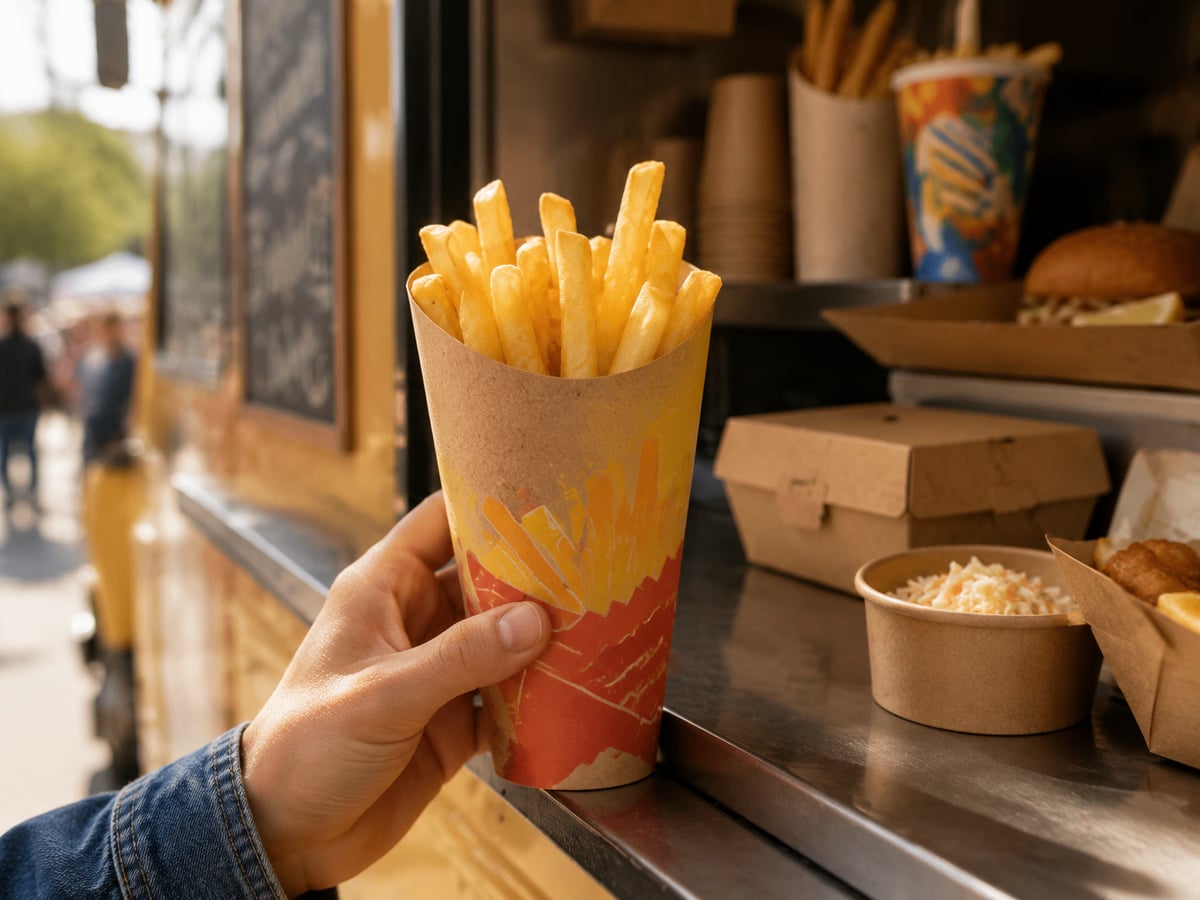
Canada Pricing Guide for 14oz and 16oz Kraft Fries Cups
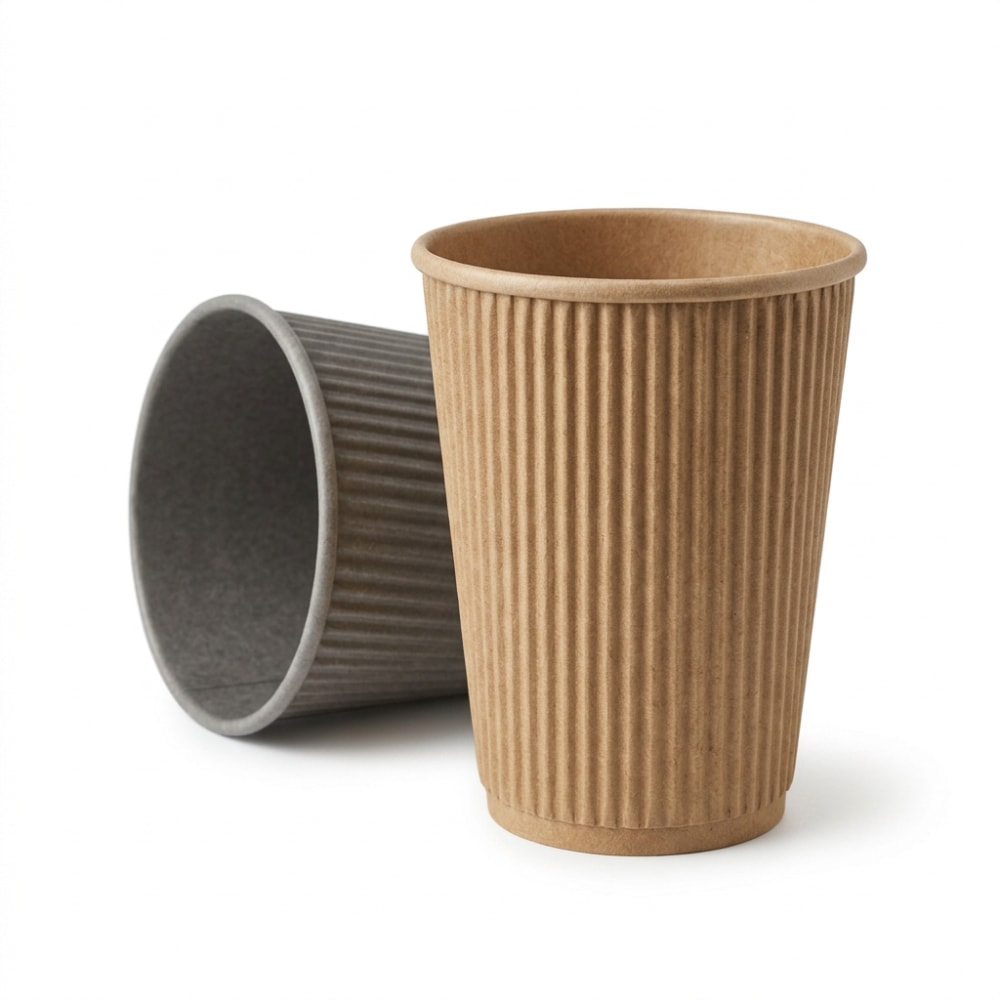
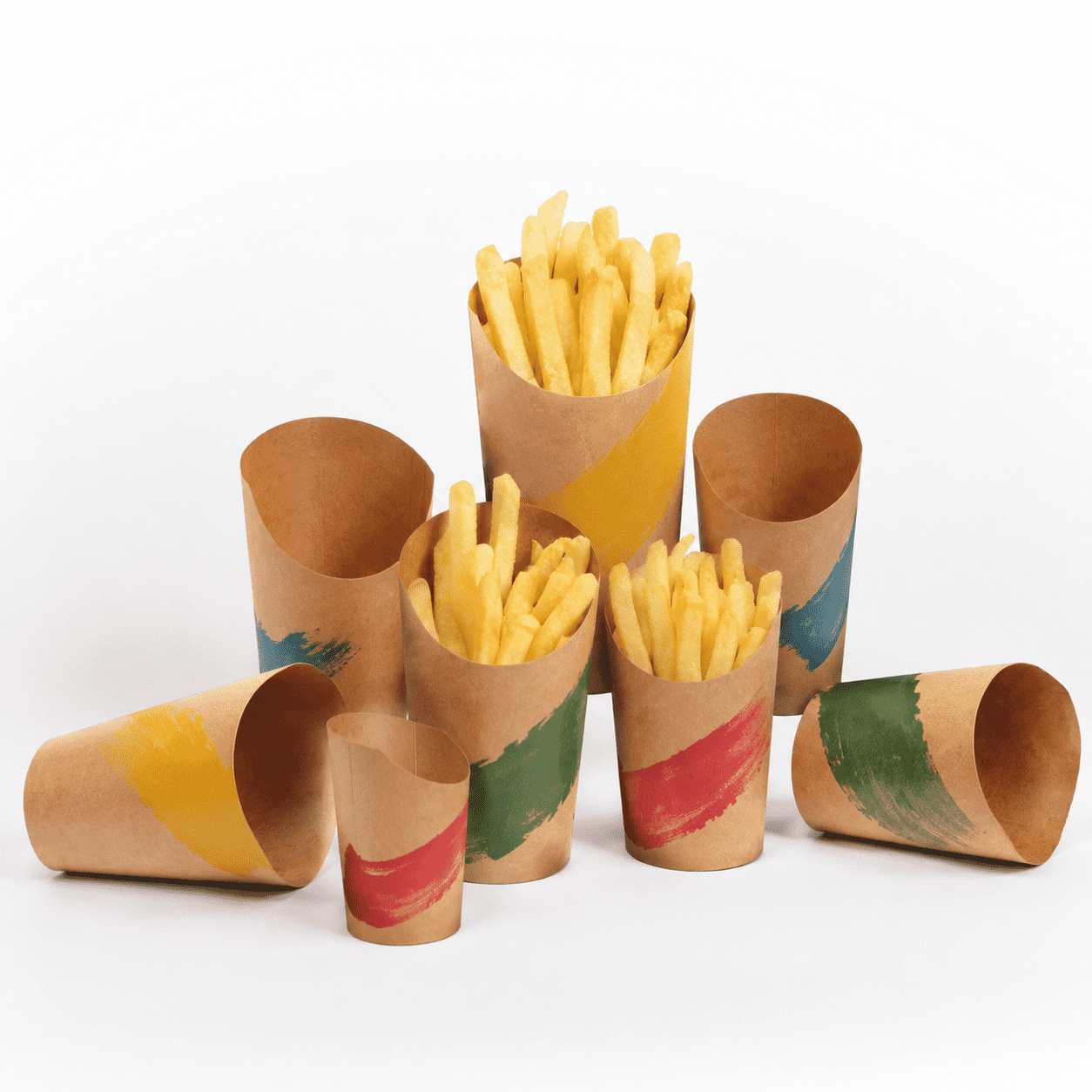
For Canadian food-service buyers, the bulk price of 14oz and 16oz kraft fries cups is not determined by capacity alone. The practical price is shaped by paperboard grade, board weight, grease-resistant or moisture-resistant coating, cup geometry, printing coverage, order volume, packing density, shipment method, and the supplier’s quality-control process. A lower quoted unit price can become more expensive after freight, warehousing, production loss, rejected cartons, oil penetration, poor stacking strength, or brand-print inconsistency are considered.For quick-service restaurants, distributors, stadium vendors, food trucks, cinemas, university cafeterias, and takeaway brands in Canada, the best procurement approach is to compare total delivered cost per usable cup. Confirm a written specification, request samples, measure cup capacity and rigidity, test performance with hot fries, gravy-adjacent foods, poutine toppings, and oil exposure, then approve a retained production sample before mass manufacturing.Typical factory pricing varies substantially by specification and order size. Plain kraft fries cups generally cost less than printed versions, while custom printing, heavier paper, special coatings, unique die cuts, compostability requirements, and small production runs raise the total. Buyers importing into Vancouver, Toronto, Montreal, Halifax, or Calgary should also calculate freight cube and inland transport before choosing between a small fast shipment and a container-oriented replenishment plan.Cost ElementWhat Changes ItImpact on Bulk PriceBuyer CheckPaperboardKraft quality, gsm, fibre sourceHighConfirm gsm and food-contact suitabilityCoatingPE, water-based barrier, PLA optionsMedium to highTest grease and moisture resistanceFormingFlared shape, folded base, side seamMediumCheck rigidity and opening consistencyPrintingInk coverage, colours, Pantone matchingMediumApprove digital and physical proofsMOQProduction quantity per designHighCompare price at multiple volume tiersFreight cubeCarton dimensions and nesting efficiencyHigh for importsRequest carton count, weight, and CBMQuality failure riskOil soak-through, weak seams, misprintsPotentially very highSet measurable acceptance criteriaThe table shows why a quote should be reviewed as a system rather than as a single cents-per-piece number. A cup that costs slightly more but ships efficiently, remains rigid during service, and reduces complaints may produce a lower total operating cost for a Canadian chain or distributor.The base material is often the largest direct input cost. Kraft board may differ in fibre quality, recycled-content profile, surface smoothness, odour control, stiffness, and grease resistance. For fries packaging, the board must balance cost with practical performance. Thin board can lower the initial quote but may soften when loaded with freshly fried potatoes, gravy, cheese curds, seasoning oil, or sauces. Excessively heavy board can add cost and freight weight without improving the customer experience enough to justify the increase.The difference between 14oz and 16oz may appear small, but a larger opening, taller sidewall, or wider base can change material consumption and nesting efficiency. Cup shape also matters. A broad flared fries cup that gives a premium visual presentation can use more board and require more careful forming than a simple straight-sided design. Custom rim profiles, reinforced bases, or special folding details add manufacturing complexity.Canadian buyers should communicate the intended food use. A dry-service cup for lightly salted fries has different needs than packaging for loaded fries in Edmonton, poutine at a Montréal sports venue, or heavily sauced potato wedges delivered in winter conditions in Winnipeg. Food temperature, hold time, ventilation, topping weight, and delivery travel time should guide the material recommendation.Specification VariableEconomy OptionPerformance OptionWhen It Matters MostPaper weightLower gsm kraftHigher gsm kraft boardHeavy portions and long holding timeBarrier treatmentBasic grease resistanceEnhanced oil and moisture barrierPoutine, loaded fries, deliveryBoard finishNatural kraft textureSmoother printable surfaceDetailed branding and colour accuracyForming profileStandard tapered cupCustom die-cut profilePremium presentation or differentiationBase structureStandard folded baseReinforced base designLarger portion weightsPrint coverageUnprinted or one-colour markFull-wrap multi-colour artworkBrand launches and retail displayPackaging formatStandard bulk cartonOptimized inner packsMulti-location distributionBefore comparing suppliers, ask each factory to quote the same measurable format: finished capacity, top diameter, bottom diameter, height, board specification, coating type, artwork coverage, units per sleeve, sleeves per carton, carton dimensions, gross weight, production lead time, and trade term. This avoids comparing a thinner 14oz cup from one supplier with a stronger 16oz cup from another while assuming they are equivalent.Paper weight is commonly specified in grams per square metre, but gsm alone is not a complete performance indicator. Fibre composition, caliper, stiffness, coating distribution, and forming quality all influence real-use strength. Buyers should request the exact board description rather than accepting generic terms such as “high-quality kraft paper.”Grease resistance is especially important for fries cups because heat and oil migrate into paper fibres. Depending on the application and market requirements, suppliers may offer conventional polymer barriers, water-based coatings, or compostability-oriented material choices. The right selection should be based on food-contact requirements, disposal goals, and actual performance testing—not only marketing claims.Forming complexity can affect both cost and consistency. A precision die cut, accurately aligned side seam, tight base fold, and stable nesting profile improve usability for employees handling high volumes at counters. In a busy Toronto quick-service location, even a small proportion of cups that open poorly or collapse during filling can create service delays and wasted product.var ctx1 = document.getElementById('marketGrowthChart').getContext('2d');new Chart(ctx1, {type: 'line',data: {labels: ['2022', '2023', '2024', '2025', '2026 Forecast', '2027 Forecast'],datasets: [{label: 'Indexed Canadian Demand for Paper Fries Cups',data: [100, 106, 113, 121, 129, 137],borderColor: 'rgb(99, 70, 45)',backgroundColor: 'rgba(99, 70, 45, 0.12)',fill: false,tension: 0.3,borderWidth: 3}]},options: {responsive: true, maintainAspectRatio: false}});The chart is an indexed planning illustration rather than a market-size claim. It reflects the expected direction of demand for convenient, branded, fibre-based food packaging as takeaway service, delivery, sporting events, and quick-service dining continue to influence Canadian packaging purchases. Individual results will vary by province, restaurant category, and food-service seasonality.Plain kraft fries cups are generally the fastest route to a lower initial cost and shorter design approval cycle. They suit wholesalers, independent restaurants, temporary events, and buyers who need flexible inventory. A plain cup can also be paired with a label, stamp, sleeve, or sticker for short-run promotions.Custom-printed fries cups increase brand visibility and can help a chain maintain a consistent presentation across provinces. However, printing introduces artwork preparation, plate or setup charges where applicable, colour-control requirements, waste allowances, and minimum run quantities. The unit-price premium often falls as volume rises because fixed setup costs are spread across more units.For Canadian brands, custom printing should be evaluated beyond the factory quote. Consider bilingual requirements where applicable, legal statements, QR codes, franchise design standards, and the risk of outdated promotional artwork. A good purchasing strategy may use a standard evergreen design for most of the year and reserve limited printing variations for major campaigns.OptionUpfront CostUnit Cost at Low MOQUnit Cost at High MOQBrand FlexibilityPlain natural kraftLowestLowestLowestHighOne-colour logoLow to mediumModerateLow premiumHighTwo-colour printMediumModerate to highModerate premiumGoodFull-wrap CMYK designMedium to highHighCompetitive at scaleModeratePantone colour matchingHighHighModerate premiumBest for strict brand systemsSeasonal artworkHigh per designHighModerate at high volumeLimited inventory flexibilityPrinted cup plus labelMediumModerateCan remain moderateVery highThe most economical branded solution is not always the least printed solution. For a large chain, high-volume custom printing can be financially sensible because it eliminates separate labeling labour and improves brand recognition. For a regional distributor serving many small operators, plain inventory may be safer because it reduces obsolescence and storage complexity.Minimum order quantity affects nearly every part of the quotation. Material purchasing, printing setup, machine preparation, labour allocation, inspection, and carton packing are more efficient when production runs are longer. A small custom order must absorb a disproportionate share of fixed costs, which is why the lowest quantity is often not the best buying point.Buyers should ask for a price ladder rather than one figure. For example, compare the quoted cost at sample quantity, one pallet, a partial container allocation, and a planned annual call-off volume. The best commercial choice depends on inventory space, cash flow, forecast reliability, product shelf-life considerations, and freight strategy.For importers bringing goods through the Port of Vancouver or Port of Montréal, combining fries cups with complementary categories can improve container utilization. A distributor may consolidate kraft food boat trays, fries cups, bowls, and takeaway boxes in one shipment. This can spread freight and documentation costs across more saleable packaging categories.var ctx2 = document.getElementById('industryDemandChart').getContext('2d');new Chart(ctx2, {type: 'bar',data: {labels: ['QSR Chains', 'Independent Restaurants', 'Food Trucks', 'Sports Venues', 'Distributors', 'Campus Dining'],datasets: [{label: 'Relative Demand Index for Fries Cups',data: [92, 74, 58, 81, 88, 63],backgroundColor: ['rgba(115, 78, 45, 0.85)','rgba(156, 112, 65, 0.85)','rgba(194, 149, 91, 0.85)','rgba(92, 127, 75, 0.85)','rgba(70, 103, 139, 0.85)','rgba(153, 92, 126, 0.85)']}]},options: {responsive: true, maintainAspectRatio: false}});This demand comparison helps procurement teams identify where volume planning is most likely to support improved pricing. Quick-service chains and distributors usually have the strongest ability to benefit from repeat runs, while event operators and food trucks may place greater value on low inventory commitments and flexible plain-stock options.Freight cube can materially change the landed cost of lightweight paper packaging. Fries cups are inexpensive per piece but occupy significant volume. A quote that appears favourable ex-works may lose its advantage if cartons contain fewer nested cups, use oversized outer cartons, or create inefficient pallet patterns.Request both units per carton and carton dimensions. Calculate cubic metres per 10,000 cups, not just cartons per order. Then compare ocean freight, domestic drayage, warehouse receiving, pallet storage, and outbound distribution. This is especially important for customers supplying restaurants in high-cost logistics areas such as Greater Toronto, Metro Vancouver, or remote Western Canadian markets.Logistics MeasureWhy It MattersPreferred Comparison MethodTypical Risk If IgnoredUnits per sleeveAffects store handlingCompare identical sleeve countsInconsistent replenishmentSleeves per cartonDetermines carton quantityCalculate cups per cartonMisleading carton priceCarton dimensionsDetermines freight cubeCalculate CBM per 10,000 cupsHigher ocean and warehouse costGross carton weightAffects handling and air freightCompare kg per cartonUnexpected freight premiumPallet patternInfluences storage efficiencyAsk for pallet layoutUnderused warehouse positionsCarton strengthProtects cups in transitConfirm export carton specificationCrushed or contaminated stockMixed-container planImproves shipment utilizationReview total container load planPaying freight on empty spaceCarton density should never be improved at the expense of cup shape. Over-compression can distort rims, reduce nesting quality, and make fast dispensing difficult. The goal is efficient packing with adequate protection, verified by transit testing and inspection before shipment.To make an accurate comparison, normalize each supplier quote to a common basis. Confirm whether the price is EXW, FOB, CIF, DDP, or another trade term. For Canadian importers, identify which party pays for export clearance, ocean freight, marine insurance, port charges, customs brokerage, duty or tax handling, inland delivery, and palletization.Also separate one-time expenses from recurring costs. Artwork checking, plates, moulds, samples, testing, certification documentation, and pre-production proofs may be charged once, while printed unit prices, cartons, and shipping are recurring costs. A supplier that appears expensive on the first order may become more competitive for the second and third repeat order after setup costs are absorbed.Quote ItemShould Be Included?One-Time or RecurringWhat to ConfirmFinished cup unit priceYesRecurringCapacity, material, coating, printingPrinting plates or setupYesUsually one-timeOwnership and reuse termsSamplingYesOne-time or refundableCourier method and sample typeExport cartonsYesRecurringStrength, markings, carton dimensionsPre-shipment inspectionPreferablyRecurring or project-basedInspection standard and timingFreightQuote separatelyRecurringPort, transit time, validity periodCustoms and deliveryClarifyRecurringCanadian destination and exclusionsA practical acceptance record should include approved artwork, physical sample photos, dimensional tolerances, capacity tolerance, board and coating description, print reference, carton packing details, acceptable defect level, and test observations. This document protects both buyer and supplier by making “quality” measurable.A first-order budget should include more than the product invoice. Canadian buyers should plan for prototype freight, artwork preparation, possible plate charges, independent inspection, import freight, local handling, and a modest contingency for timing changes. If the project is customized, allow time for artwork revision and physical proof approval before booking the main shipment.For a small initial order, air freight may be appropriate for launch samples or urgent store tests, but it is usually unsuitable for full fries-cup replenishment because paper packaging has a high volume-to-value ratio. Ocean freight is typically more economical for larger replenishment orders, especially when several packaging categories are consolidated.A distributor can reduce risk by starting with plain or lightly branded stock, evaluating sell-through, and then moving to a higher-volume printed program after demand becomes predictable. Restaurant groups can use scheduled releases from a planned annual order to improve price while avoiding excessive local storage.var ctx3 = document.getElementById('trendShiftChart').getContext('2d');new Chart(ctx3, {type: 'line',data: {labels: ['2022', '2023', '2024', '2025', '2026 Forecast', '2027 Forecast'],datasets: [{label: 'Standard Barrier Cup Preference',data: [78, 73, 68, 63, 58, 53],borderColor: 'rgb(125, 92, 60)',backgroundColor: 'rgba(125, 92, 60, 0.25)',fill: true,tension: 0.35},{label: 'Enhanced Fibre-Based and Water-Based Barrier Preference',data: [22, 27, 32, 37, 42, 47],borderColor: 'rgb(61, 128, 88)',backgroundColor: 'rgba(61, 128, 88, 0.20)',fill: true,tension: 0.35}]},options: {responsive: true, maintainAspectRatio: false}});The area chart illustrates a planning trend: more buyers are asking for lower-plastic, recyclable, compostability-oriented, or water-based barrier options. Final suitability depends on provincial requirements, end-of-life infrastructure, food-contact compliance, and actual grease resistance. Sustainability claims should be supported by applicable material documentation and should not replace functional testing.Fude Packaging supports overseas B2B buyers with integrated paper food-packaging production, project support, and export coordination. Its technological capabilities include in-house quality testing, incoming material inspection, production monitoring, final inspection, and batch verification. For fries cups, this supports practical checks for dimensions, forming consistency, print appearance, grease performance, and transport readiness.Its manufacturing capability is supported by more than 20 years of packaging experience, a self-owned 30,000 m² production base in Shandong, and automated output capacity of up to 120,000 units per day. In-house production control allows buyers to coordinate fries cups with related categories, including custom kraft paper fries cups, trays, bowls, boxes, and other food-service formats. This can simplify supplier management for Canadian importers building a broader packaging program.Fude Packaging’s service capabilities include artwork and dieline checking, digital proofs, white samples, printed pre-production proofs, functional samples, scheduled-order support, export packing, and documentation assistance. Buyers can also explore Custom and Wholesale food Paper packaging when they need an OEM or ODM plan rather than a standard-stock quotation. Its broader catalogue includes Custom Paper Food Container products, Custom Paper Bowl products, and Custom Paper Cup products for consolidated purchasing.For Canada-oriented projects, Fude Packaging can help buyers discuss food-contact documentation, FSC material options, quality-management records, production traceability, inspection options, and packaging suitable for long-distance shipment. The company profile and manufacturing background can be reviewed through Fude Packaging’s manufacturing overview.var ctx4 = document.getElementById('supplierComparisonChart').getContext('2d');new Chart(ctx4, {type: 'bar',data: {labels: ['Customization', 'Quality Control', 'Multi-Category Supply', 'Export Packing', 'Sample Support', 'Traceability'],datasets: [{label: 'Integrated Manufacturer Capability Index',data: [90, 88, 92, 87, 91, 85],backgroundColor: 'rgba(77, 112, 151, 0.85)'},{label: 'Typical Trading-Only Quote Model Index',data: [65, 58, 52, 61, 64, 50],backgroundColor: 'rgba(180, 138, 81, 0.80)'}]},options: {responsive: true, maintainAspectRatio: false}});This comparison chart is a procurement framework, not a rating of individual suppliers. It demonstrates why Canadian buyers should assess supplier capability across quality control, custom development, packaging coordination, traceability, and service—not only the quoted unit price.From 2026 onward, buyers are likely to see greater attention to material traceability, fibre sourcing, reduced-plastic barrier technologies, improved recycling compatibility, and more detailed packaging documentation. Canadian brands are also expected to continue seeking packaging that supports delivery performance while presenting a more responsible environmental profile.Technology trends include digital colour management, faster proofing, automated vision inspection, more precise die cutting, and production data that improves batch consistency. For food-service groups operating across Canada, these tools can reduce variation between replenishment orders and help protect franchise or chain branding.Policy and sustainability trends will remain province-specific. Buyers should confirm local rules and waste-system realities before choosing a “compostable,” “recyclable,” or “plastic-free” claim. A cup should be selected for compliant food contact, real-world performance, and credible end-of-life positioning in the intended municipality.1. What is the typical cost structure for 14oz and 16oz kraft fries cups?Cost generally consists of paperboard, barrier coating, converting and forming, printing, cartons, quality inspection, setup charges, and freight. The landed cost for Canada may also include customs brokerage, inland transport, warehouse handling, and local distribution.2. Which specification changes affect price most?Paper weight, coating choice, print coverage, custom structure, carton density, and order quantity have the greatest effect. A heavier board or enhanced grease barrier may be justified when serving poutine, loaded fries, or delivery orders where rigidity matters.3. How does MOQ change the unit price?Higher quantities generally reduce the unit price because fixed preparation costs are spread over more cups. However, buyers should avoid ordering more than they can store or sell before branding, regulations, or menu needs change.4. Which quote items are often excluded?Common exclusions include sample courier charges, printing plates, moulds, inspection fees, freight, insurance, destination port charges, customs clearance, and inland delivery. Ask for a full cost schedule before comparing offers.5. How can buyers reduce cost without weakening performance?Standardize cup dimensions, use an evergreen print design, increase planned run length, consolidate product categories, optimize carton packing, and test the minimum acceptable material specification. Do not reduce board or barrier performance until the cup has passed real food-use trials.6. Should Canadian buyers order 14oz or 16oz fries cups?Choose according to portion size, toppings, food weight, and desired presentation. A 14oz size may suit regular fries, while a 16oz format may better support larger portions, loaded fries, sharing formats, or premium menu positioning. -

Canada Guide to Bulk Kraft Fruit Box Cost Planning
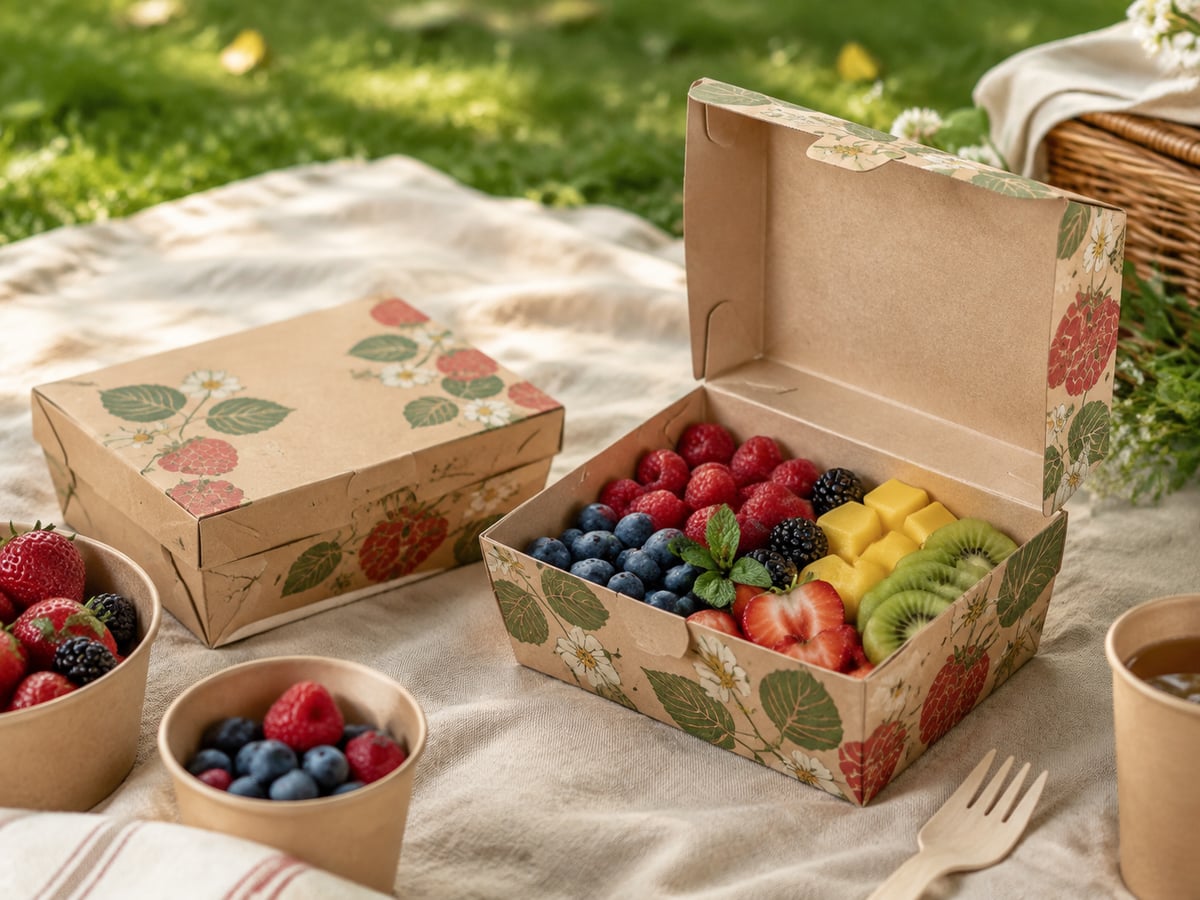
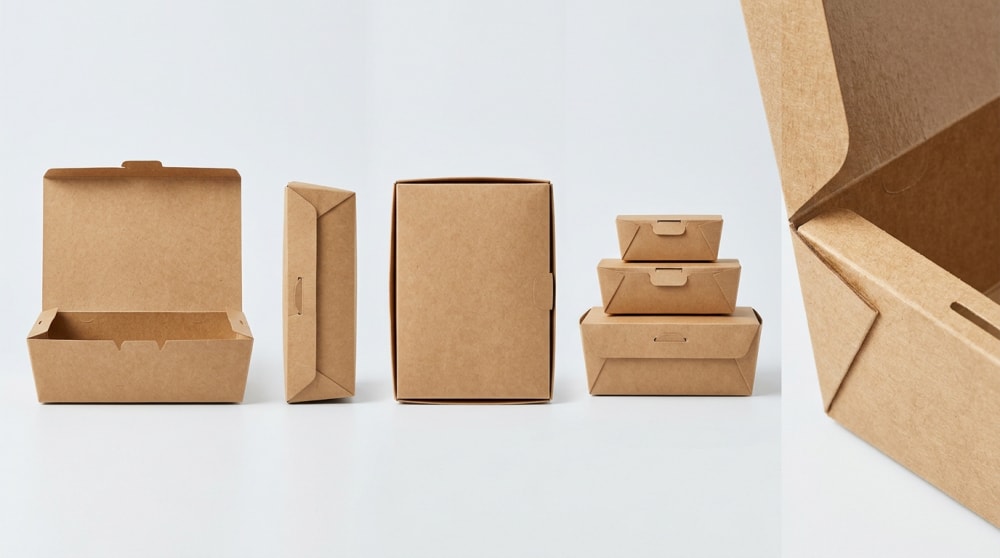
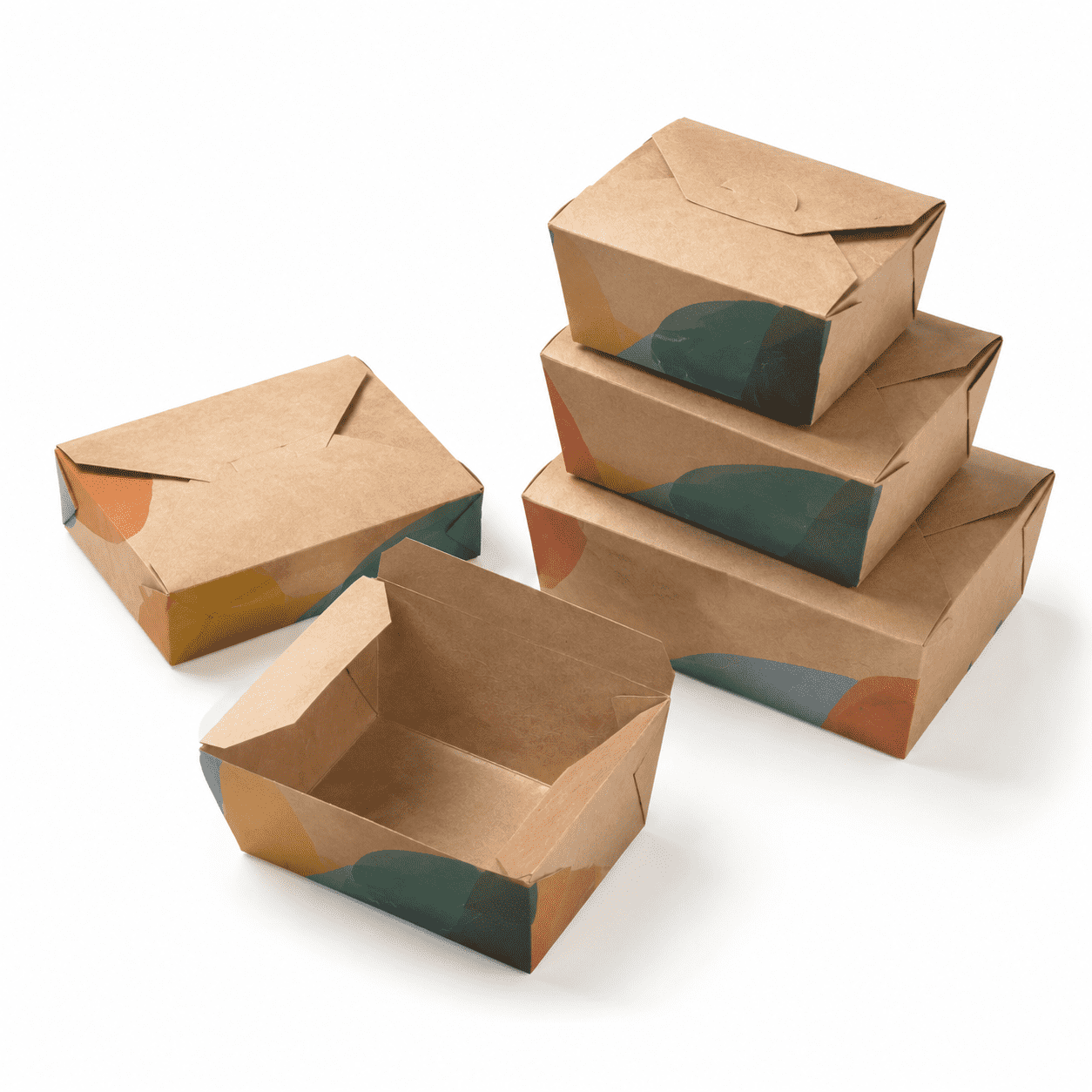
Bulk 500–1500 ml kraft fruit box pricing in Canada depends on far more than the quoted unit cost. Paperboard grade, moisture or grease barrier coating, box dimensions, fold-and-lock complexity, printing coverage, order quantity, carton density, shipping route, and storage requirements all affect the true landed cost. A 500 ml fruit snack box may appear inexpensive, but a weak closure, poor lid fit, excessive carton cube, or juice leakage can create higher operational losses than a more carefully specified box.For Canadian produce distributors, smoothie brands, grocery prepared-food teams, meal-prep companies, cafés, farmers’ markets, and food-delivery businesses, the most reliable approach is to compare like-for-like specifications. Confirm paper weight, board type, coating method, capacity, carton pack, print colours, approved artwork, food-contact documentation, pallet configuration, and performance expectations before comparing quotations.A practical procurement process should separate recurring unit cost from one-time charges such as printing plates, custom molds, samples, testing, artwork adjustments, freight, customs clearance, warehousing, and potential quality-failure costs. Buyers serving Toronto, Vancouver, Montreal, Calgary, Edmonton, Halifax, and regional food-service markets should also assess shipping time, domestic storage needs, and seasonal demand fluctuations.Cost ElementTypical Effect on PriceWhy It Matters for Canadian BuyersPaperboard gradeHighVirgin kraft, recycled board, and food-grade white board have different strength and compliance profiles.Coating or barrierHighFruit juices, dressings, cut melon, berries, and smoothie toppings may require moisture or grease resistance.Box capacityMedium to highLarger 1000–1500 ml boxes consume more board and usually require stronger structural design.Printing coverageMediumOne-colour branding costs less than multi-colour, full-coverage, metallic, or specialty finishes.MOQHighLarger production runs spread setup, plate, and machine-adjustment costs over more units.Freight cubeHighBulky pre-formed boxes can consume significant container, LCL, and warehouse space.Failure ratePotentially very highLeaks, lid release, crushing, and poor print consistency can create product loss and customer complaints.The table shows why the lowest ex-factory quotation is not always the lowest procurement cost. A supplier offering lower board weight or fewer quality checks may appear competitive until the boxes are filled, stacked, transported, refrigerated, or used for delivery.Canadian demand for kraft fruit packaging is supported by convenience food growth, fresh-cut produce, grab-and-go breakfast, smoothie kits, meal-prep services, and retail-ready fruit assortments. Demand is strongest in large metropolitan markets where convenience, food safety, visual presentation, and brand consistency directly affect purchase decisions.In Ontario, businesses supplying Greater Toronto Area grocery, catering, and food-delivery channels often prioritize consistent carton availability and delivery reliability. In British Columbia, companies moving fresh berries, sliced fruit, and premium snack assortments through Vancouver and Richmond may place greater emphasis on moisture resistance and cold-chain performance. Quebec buyers may prioritize bilingual packaging layouts, while Prairie distributors often assess storage efficiency and winter transport durability.var ctx = document.getElementById('lineChart').getContext('2d');var chart = new Chart(ctx, {type: 'line',data: {labels: ['2022', '2023', '2024', '2025', '2026', '2027'],datasets: [{label: 'Indexed Canadian Demand for Kraft Fresh-Food Boxes',data: [100, 108, 117, 126, 136, 147],borderColor: 'rgb(71, 125, 84)',backgroundColor: 'rgba(71, 125, 84, 0.12)',fill: false,tension: 0.25}]},options: {responsive: true,maintainAspectRatio: false,plugins: {legend: {display: true}},scales: {y: {beginAtZero: false}}}});This illustrative market-growth view reflects the expected continued shift toward portable fresh food, branded takeaway packaging, and more structured food-contact documentation. It is not a price forecast; actual box costs remain closely linked to pulp pricing, coating availability, foreign exchange, shipping capacity, and order specifications.The most common purchasing error is comparing two prices that do not represent the same product. One quotation may use 300 gsm board with a water-based coating, while another uses lighter board with no stated barrier. One supplier may include matching lids, while another quotes only the base. A seemingly identical 750 ml kraft fruit box may differ in usable capacity, board stiffness, fold pattern, leak resistance, and stacking strength.Before requesting pricing, prepare a specification sheet that suppliers can quote consistently. This document should define the intended food, fill temperature, expected holding time, delivery conditions, size, closure type, artwork, acceptable tolerances, packaging configuration, destination, and required compliance evidence. If the product will carry cut pineapple, citrus, berries, yogurt, granola, sauces, or chilled fruit salad, state this clearly because moisture exposure changes the recommended material construction.Specification ItemWhat to StateAcceptance MethodNominal capacity500 ml, 750 ml, 1000 ml, 1200 ml, or 1500 mlMeasured fill volume using water or intended food.Internal dimensionsLength, width, height, and fill lineCaliper or dimension check on finished samples.PaperboardKraft grade, GSM, virgin or recycled content, food-contact suitabilityMaterial declaration and sample confirmation.Barrier requirementNo coating, PE, PLA, water-based barrier, grease-resistant treatmentJuice, oil, and holding-time test.Closure systemTuck flap, interlock, separate lid, window lid, tamper-evident optionOpen-close and vibration testing.PrintingPantone references, number of colours, coverage area, finishApproved digital proof and printed pre-production sample.Outer packingUnits per sleeve, sleeves per carton, cartons per palletCarton label, count verification, pallet diagram.The specification should also define the testing environment. For example, a box that performs well with dry grapes for 30 minutes may fail when packed with chilled watermelon for four hours. Procurement teams should record test results, retain an approved sample, and issue a repeatable approval record that production and quality teams can reference later.Paperboard is usually the largest direct cost in a kraft fruit box. The board price is affected by fibre source, thickness, coating, moisture resistance, printing suitability, and food-contact requirements. Structural yield is equally important: a square box, tapered bowl-style box, window box, or multi-panel locking design uses different die-cut layouts and creates different levels of trim waste.A 500 ml snack box with simple tuck tabs can be efficient to die-cut and form. A 1500 ml fruit platter box with reinforced corners, a wide opening, a separate lid, and a clear window may require more board, more forming time, and more careful packing. Complex designs can improve merchandising and consumer convenience, but they must be assessed against production yield and freight cube.For Canada-bound orders, material selection should balance cost with practical transport conditions. Products moving from a warehouse in Mississauga to urban delivery customers may experience different stresses than boxes shipped to remote regions, stored in unheated facilities, or used in high-volume grocery replenishment. A lower GSM board may be suitable for dry fruit snack portions but unsuitable for heavily filled fruit salad bowls.Box FormatCommon CapacityMaterial DemandTypical Strength RequirementSmall tuck-top snack box500 mlLowerLight to medium for dry fruit and snack mixes.Windowed fruit carton500–750 mlMediumMedium; window adhesion and top-panel rigidity matter.Folded salad-style box750–1000 mlMediumMedium to high for juicy fruit portions.Rectangular meal box1000 mlMedium to highHigh for stacking and delivery handling.Deep fruit bowl with lid1200 mlHighHigh, especially around rim and lid engagement.Family sharing box1500 mlHighHigh for heavier fill weights and transport vibration.This comparison explains why capacity alone does not determine cost. Two 1000 ml boxes can require significantly different quantities of board depending on footprint, wall height, closure style, and reinforcement features.Printing is a visible brand investment, but it should be quoted separately from the basic box structure. The cost of print depends on the number of colours, ink coverage, artwork complexity, registration tolerance, finish requirements, and whether a custom plate or cylinder is required. A single dark logo on natural kraft is normally simpler than full-coverage colour graphics with white ink, gradients, metallic effects, or photographic fruit imagery.Canadian retailers and food-service operators often want packaging that communicates freshness, ingredients, recycling instructions, and bilingual information. These elements can increase artwork density and print coverage. To manage cost, brands can reserve high-coverage printing for flagship sizes while using a consistent one- or two-colour system for core 500 ml, 750 ml, and 1000 ml formats.Artwork should be checked for dieline placement, folding areas, barcode readability, nutritional panel placement where applicable, and colour consistency. Buyers should approve a digital proof before sampling, then compare the printed pre-production proof against the approved artwork before mass production begins.var ctx = document.getElementById('barChart').getContext('2d');var chart = new Chart(ctx, {type: 'bar',data: {labels: ['Fresh-cut fruit', 'Smoothie shops', 'Grocery deli', 'Meal prep', 'Catering', 'Farm markets'],datasets: [{label: 'Relative Demand Index for Kraft Fruit Boxes',data: [92, 84, 96, 78, 67, 59],backgroundColor: ['rgb(241, 164, 76)','rgb(104, 169, 210)','rgb(87, 142, 92)','rgb(177, 115, 187)','rgb(220, 123, 92)','rgb(128, 128, 95)']}]},options: {responsive: true,maintainAspectRatio: false,plugins: {legend: {display: true}},scales: {y: {beginAtZero: true, max: 100}}}});The chart illustrates relative purchasing demand by application category. Grocery deli and fresh-cut fruit channels generally require stronger consistency, higher documentation readiness, and more stable replenishment planning than occasional promotional users.Carton density is a frequently underestimated part of kraft fruit box procurement. A box can have an attractive unit price but occupy too much warehouse space or ship inefficiently. Buyers should ask how boxes are packed: flat-packed, nested, bagged, sleeved, or pre-assembled. Flat-packed cartons can reduce freight cube, although they may require additional assembly labour at the destination.For import programs through Vancouver, Prince Rupert, Montreal, Halifax, or Toronto-area distribution facilities, shipment method affects total cost. Full-container loads often produce the best freight cost per unit for high-volume buyers. Less-than-container shipments provide flexibility but can add handling, consolidation, destination charges, and variable transit timing. Air freight is generally most appropriate for samples, urgent launch quantities, or replacement stock rather than routine bulk packaging.Supply FormatFreight EfficiencyDestination LabourBest Use CaseFlat-packed bulk cartonsHighHigher assembly requirementHigh-volume distributors and central kitchens.Flat-packed retail sleevesMedium to highModerateMulti-site food-service operations.Pre-formed boxesLowerLowOperators prioritizing speed of service.Nested bowls with lidsMediumLowFruit bowls, smoothie toppings, and deli counters.Mixed-size container loadMediumDepends on sorting processBuyers consolidating cups, bowls, trays, and boxes.LCL consolidation shipmentLowerLow to moderateTrial orders and smaller initial programs.Domestic warehouse replenishmentHigh after arrivalLow at store levelChains needing scheduled deliveries across Canada.Storage cost should be calculated per usable unit, not only per pallet. Consider carton dimensions, pallet height limits, warehouse rent, handling frequency, seasonal inventory, and the risk of over-ordering slow-moving printed designs. A common cost-control strategy is to use standard kraft structures across multiple products and customize only sleeves, labels, or a limited number of high-volume printed sizes.A lower quotation deserves investigation, not automatic rejection. It may reflect better purchasing, efficient manufacturing, or a simpler design. However, it can also indicate missing assumptions. Common omissions include lower board weight, unconfirmed coating type, no lid inclusion, lower carton counts, fewer print colours, no printing plates, unpriced molds, weaker export cartons, or freight terms that exclude destination charges.Buyers should ask suppliers to clarify whether pricing is EXW, FOB, CIF, DDP, or another agreed Incoterm. A price quoted from China without clearly defined terms may not include inland transportation, export documentation, ocean freight, insurance, port charges, customs brokerage, duties, GST, warehouse delivery, or pallet handling in Canada.Performance omissions are equally important. If a supplier does not define leak resistance, stacking strength, lid security, or print tolerance, the buyer may receive a product that technically matches the dimensions but does not work in service. For fruit delivery, failure can mean spilled juice, soft bottoms, detached lids, damaged branding, and food waste.var ctx = document.getElementById('areaChart').getContext('2d');var chart = new Chart(ctx, {type: 'line',data: {labels: ['2022', '2023', '2024', '2025', '2026', '2027'],datasets: [{label: 'Share of Buyer Requests Including Barrier and Sustainability Requirements (%)',data: [34, 42, 51, 59, 68, 74],borderColor: 'rgb(44, 119, 140)',backgroundColor: 'rgba(44, 119, 140, 0.25)',fill: true,tension: 0.25}]},options: {responsive: true,maintainAspectRatio: false,plugins: {legend: {display: true}},scales: {y: {beginAtZero: true, max: 100}}}});The trend reflects a growing buyer focus on barrier performance, fibre sourcing, coating choices, end-of-life communication, and documentation. Sustainability claims should always match the actual material construction and the local waste-management context rather than relying on generic marketing language.Procurement managers should create a standardized review sheet before selecting a fruit box supplier. The objective is not simply to identify the lowest unit quote, but to identify the offer with the lowest controlled total cost and the strongest supply reliability. Include finance, operations, quality, marketing, and logistics input for larger programs.Review QuestionWhat to VerifyRisk if IgnoredIs capacity verified?Usable volume and fill line under real operating conditions.Underfilled presentation or lids that do not close.Is board construction clear?GSM, food-contact suitability, coating, and fibre source.Softening, leakage, or unsupported sustainability claims.Are samples approved?White sample, printed sample, and functional trial where needed.Unexpected dimensions, colour, or assembly problems.Are tooling costs disclosed?Plates, dies, molds, setup, and artwork corrections.Budget overruns after purchase approval.Are freight terms complete?Incoterm, port, customs documents, destination charges, and delivery point.Unexpected landed-cost increases.Is packing confirmed?Carton count, carton strength, pallet pattern, and labels.Shortages, crushing, and warehouse inefficiency.Is quality control defined?Inspection standard, defect limit, traceability, and claims process.Unclear responsibility for inconsistent production.Buyers can reduce cost without weakening performance by standardizing footprints, grouping volumes into scheduled releases, limiting colour count, using shared structural molds where feasible, forecasting seasonal demand, and selecting a barrier level that matches actual food exposure. Cutting board weight or removing protective coating without testing is usually a false saving.Canadian buyers may source kraft fruit boxes from domestic converters, North American distributors, import agents, or direct overseas manufacturers. Each option has trade-offs. Local suppliers can provide shorter replenishment cycles and easier face-to-face coordination. Overseas factories may offer wider customization, stronger unit economics at scale, and consolidated production across boxes, cups, bowls, trays, and meal containers.var ctx = document.getElementById('comparisonChart').getContext('2d');var chart = new Chart(ctx, {type: 'bar',data: {labels: ['Unit-cost potential', 'Customization range', 'Replenishment speed', 'Container efficiency', 'Documentation control', 'Small-order flexibility'],datasets: [{label: 'Canadian Stock Supplier',data: [58, 52, 91, 64, 78, 85],backgroundColor: 'rgb(102, 144, 190)'},{label: 'Direct Factory Program',data: [88, 90, 61, 89, 86, 55],backgroundColor: 'rgb(89, 151, 94)'}]},options: {responsive: true,maintainAspectRatio: false,plugins: {legend: {display: true}},scales: {y: {beginAtZero: true, max: 100}}}});This comparison is a planning tool rather than a universal ranking. A hybrid strategy can work well: use Canadian stock inventory for urgent replenishment and a direct-factory program for predictable, high-volume, branded packaging. Businesses with nationwide distribution may also benefit from storing imported inventory near Toronto, Vancouver, Montreal, or Calgary for regional release schedules.Fude Packaging supports overseas B2B buyers seeking customized paper food packaging for fruit, fresh food, takeaway, café, retail, and meal-service applications. For buyers evaluating kraft fruit box options, the company can help match capacity, structure, paperboard, barrier treatment, lid format, printing requirements, and packing method to the intended application.From a technology perspective, Fude Packaging operates an in-house laboratory and applies quality controls across incoming materials, printing, die-cutting, forming, packing, and final inspection. Buyers can request support for sample-based evaluation, including white samples, digital proofs, printed pre-production proofs, and functional prototypes. This is especially valuable for fruit boxes that must manage chilled moisture, juice exposure, stacking, and vibration during delivery.From a manufacturing perspective, the company has more than 20 years of packaging experience, a self-owned 30,000 m² production base in Shandong, and automated output capacity of up to 120,000 units per day. Its product range includes paper cups, bowls, food boxes, trays, salad containers, burger boxes, noodle packaging, and multi-compartment meal boxes. This allows some Canadian buyers to consolidate related packaging categories with one manufacturing partner, helping improve artwork consistency and container utilization.From a service perspective, Fude Packaging provides OEM and ODM support for structural development, artwork checking, Pantone matching, sampling, production scheduling, export packing, and shipment coordination. Documentation can be reviewed according to destination-market needs, including food-contact, FSC, ISO 9001, FDA-related, EC 1935/2004, and selected compostability requirements where applicable. Learn more about available custom packaging services or review the company’s manufacturing background before beginning a project.By 2026 and beyond, Canadian buyers are likely to place greater emphasis on packaging that combines convenience with measurable sustainability and product protection. Fibre-based packaging will remain attractive, but brands will increasingly ask detailed questions about coating composition, recyclability guidance, compostability claims, recycled content, renewable fibre sourcing, and compatibility with local waste streams.Technology trends include improved water-based barriers, lighter-weight board engineered for better stiffness, digital proofing, more automated inspection, variable-data printing, and traceability systems that connect batch records with approved specifications. These developments can help reduce material use while maintaining fruit-box performance.Policy and retailer expectations may also increase demand for clearer environmental claims and food-contact documentation. For Canadian market programs, packaging statements should be reviewed for provincial requirements, bilingual needs where relevant, and the actual collection and processing infrastructure available to end users. The most credible sustainability strategy is one that considers material selection, product protection, transport efficiency, waste reduction, and clear consumer instructions together.The total cost normally includes paperboard, coating, die-cutting, forming, printing, packaging, quality control, export packing, freight, and destination handling. One-time costs may include printing plates, custom dies, molds, sampling, and artwork adjustments. The most useful comparison is landed cost per usable box rather than ex-factory unit price alone.Paper grade, board weight, barrier coating, box size, structural complexity, window material, lid system, printing coverage, and MOQ are usually the largest price drivers. A 1500 ml reinforced box with a window and full-colour graphics will generally cost more than a simple 500 ml tuck-top kraft carton.Higher order quantities spread fixed setup costs across more units and often improve material purchasing efficiency. However, buyers should avoid ordering excessive quantities of highly customized packaging if storage space is limited or artwork may change. Scheduled orders with staged deliveries can balance price efficiency and inventory control.Common exclusions include printing plates, tooling, samples, freight, insurance, customs brokerage, taxes, destination-port charges, warehouse delivery, palletization, third-party inspection, and special compliance testing. Request an itemized quotation with Incoterms and confirm all assumptions in writing.Standardize core box dimensions, reduce unnecessary print colours, consolidate related packaging categories, improve demand forecasting, choose flat-packed formats where labour permits, and test the minimum board-and-barrier specification that reliably protects the product. Do not reduce material or coating requirements without testing filled boxes under actual chilled-storage and delivery conditions.For a Canada-focused quotation, sample plan, or specification review for 500–1500 ml kraft fruit boxes, buyers can contact Fude Packaging with capacity, food type, artwork, estimated annual volume, destination city, preferred shipping method, and required delivery date. -

Canada Guide to 500–1300 ml Square Salad Box Selection
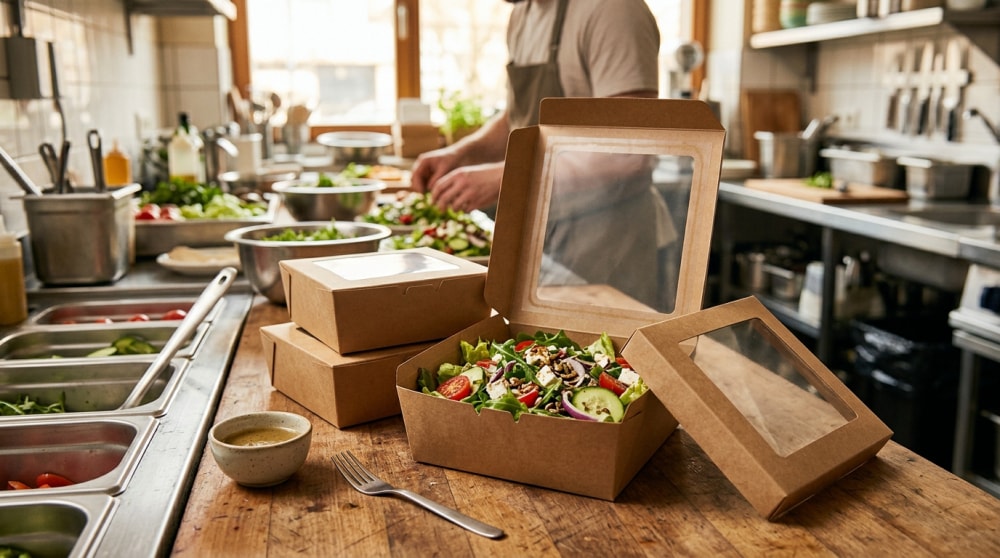
The best 500–1300 ml square salad box for a Canadian food-service or retail program is not always the lowest-cost option. The correct specification depends on the temperature of the food, dressing moisture, portion weight, delivery distance, merchandising requirements, warehouse capacity and desired brand presentation. A 500 ml container can work efficiently for side salads and snack bowls, while a 1,000–1,300 ml format is generally more appropriate for substantial grain bowls, protein salads and deli meal kits.For cold salads sold quickly in cafés, university food courts and quick-service restaurants, a clear-lid paperboard or kraft square container often balances appearance, speed and cost. For prepared meals held for longer periods in refrigerated retail displays, buyers should prioritize lid retention, moisture resistance, grease resistance and stable corner construction. For food delivery in Toronto, Vancouver, Montréal, Calgary and other high-density markets, a stronger rim and secure lid system can reduce leak claims, remakes and delivery-platform refunds.A fair purchasing decision should compare options using weighted criteria rather than unit price alone. Test actual salads, grain bowls and deli meals under real operating conditions. Confirm dimensions, usable fill volume, lid fit, stack strength, condensation control, print quality and packing efficiency through approved samples and a documented acceptance record.Buying FactorWhy It MattersRecommended CheckHigher-Risk SituationFood temperatureHeat and condensation affect board stiffness and coatings.Fill containers at actual service temperature.Warm grains packed with cold vegetables.Food moistureDressing, sauces and cut produce can soften paperboard.Hold a filled sample for the intended shelf life.Wet slaws and marinated salads.Portion weightHeavy proteins and grains create base and corner stress.Weigh the heaviest menu build.Chicken, rice, quinoa and sauce combinations.Service speedFast assembly requires intuitive lid closure.Run timed packing trials with staff.Lunch rush at urban quick-service locations.Display clarityVisible ingredients can improve retail conversion.Review clarity under store lighting.Refrigerated grab-and-go displays.LogisticsNested containers and lids affect cube utilization.Calculate cartons per pallet and pallet height.Long-distance replenishment across Canada.The table shows why a container that appears economical can become expensive if it creates spills, limits attractive product display or consumes excessive warehouse space. Buyers should use the same test protocol for every proposed square salad packaging option.Square salad containers generally differ by material structure, wall rigidity, coating, lid type and capacity. The most common formats for Canadian buyers include kraft paperboard containers with clear PET or PP lids, white paperboard containers for high-impact printing, compostability-oriented fibre solutions, and heavier-duty coated paperboard formats for wet or greasy meals. The correct choice should match the operational use case.Smaller 500–650 ml boxes suit individual salads, fruit bowls, side dishes and lighter lunch portions. Mid-size 750–900 ml formats are versatile for composed salads and moderate grain bowls. Larger 1,000–1,300 ml containers are better for premium meal bowls, protein-forward salads, family-size deli portions and meal-prep programs. However, nominal capacity is not the same as practical filling capacity. The headspace required for a lid, toppings and visual presentation should be included in the product specification.Nominal CapacityTypical Food UsePractical Portion ProfileSuggested Lid Style500 mlSide salad or fruit bowl150–280 gLow clear lid650 mlSnack salad or soup-and-salad add-on220–350 gFlat or lightly domed lid750 mlStandard salad300–450 gClear fitted lid900 mlGrain bowl or premium salad400–600 gMedium dome lid1,000 mlProtein meal bowl500–700 gSecure dome lid1,300 mlLarge deli meal or meal-prep bowl650–900 gHigh-clearance locking lidCapacity selection should also consider ingredient movement. A visually attractive salad may look underfilled in a large container, while a packed grain bowl can compress toppings in a small one. During product development, use the actual recipe and target selling weight rather than relying on a generic millilitre rating.Construction affects both customer experience and operating loss. Paperboard grade, coating weight, fold geometry and rim design influence resistance to moisture, grease and compression. For cold and dry salads, a standard food-contact paperboard structure may be sufficient. For dressed salads, oily proteins, saucy grains or refrigerated storage, a stronger moisture-and-grease-resistant barrier should be evaluated.Clear lids provide visibility and can support premium merchandising, but the material must retain shape at relevant temperatures and fit consistently across production batches. A lid that closes easily at the packing station but loosens after refrigeration is unsuitable for retail distribution. The same applies to containers with folded corners: attractive square geometry must remain stable when the bowl is lifted from one side or stacked in delivery bags.Construction OptionKey StrengthPrimary LimitationBest-Fit ApplicationKraft paperboard with clear lidNatural appearance and ingredient visibilityNeeds appropriate barrier for wet foodsFresh salads and café bowlsWhite paperboard with printStrong colour reproduction and brandingMay show scuffs more easilyRetail meal brands and chainsEnhanced moisture barrier boardImproved hold time with wet ingredientsCan increase specification costDressed salads and deli mealsGrease-resistant boardBetter performance with oils and proteinsRequires food-specific validationChicken, salmon and grain bowlsFibre-focused compostability optionSupports selected sustainability programsLocal disposal acceptance variesInstitutional and eco-led conceptsHeavy-gauge square bowlImproved stacking and corner durabilityHigher material useDelivery and refrigerated retailFor Canadian importers, material documentation should be matched with the intended market and customer requirements. Food-contact documentation, FSC material options, ISO 9001 quality controls and applicable compostability claims should be reviewed before an environmental statement is printed on packaging. Municipal composting acceptance differs by province and municipality, so a claim suitable in one program may not be appropriate nationally.Application fit should start with the food rather than the container. Leafy salads need volume and visual height. Grain bowls need base strength. Deli meals need moisture resistance and a dependable lid. Meal-prep programs need repeatable portioning and efficient stacking. Retail refrigerated programs need transparent presentation, label area and consistent shape on shelves.Food ApplicationRecommended CapacityRecommended ConstructionImportant Validation PointCaesar salad750–900 mlKraft or printed board with clear lidKeep croutons and dressing from softening board.Greek salad750–1,000 mlMoisture-resistant boardTest brine, tomatoes and dressing hold time.Quinoa grain bowl900–1,300 mlHeavy-gauge grease-resistant boardTest base deflection at maximum weight.Chicken protein bowl1,000–1,300 mlSecure-rim coated boardTest warm protein and sauce interaction.Deli pasta salad650–900 mlMoisture-resistant board with clear lidCheck oily dressing and refrigeration effects.Fruit and yogurt bowl500–650 mlClear-lid paperboard formatCheck condensation and fruit juice resistance.Canadian operators serving lunch traffic near downtown offices, transit stations and campuses should especially test service speed. A lid that requires repeated alignment can add seconds per order and cause staff frustration. In contrast, retail deli counters should focus on clean lid fit, stackability and label placement because product presentation influences perceived freshness.The most common performance failures in square salad packaging are corner opening, rim deformation, loose lids, condensation, oil penetration and reduced product visibility. These risks rise when food is heavier, wetter or held longer than the container was designed to manage. A successful supplier approval process measures failure under realistic conditions rather than relying only on a dry sample inspection.Corner stress is particularly relevant in square bowls because the folded geometry concentrates force at the corners. A container can appear rigid when empty but weaken when a 700 g bowl is carried one-handed or placed in a tightly packed courier bag. Lid fit must be checked after filling, after refrigeration and after stack loading. Display clarity should be evaluated under the lighting used in supermarkets, airport food counters and refrigerated meal displays.var ctx=document.getElementById('lineChart').getContext('2d');new Chart(ctx,{type:'line',data:{labels:['2022','2023','2024','2025','2026','2027'],datasets:[{label:'Indexed Canadian demand for prepared salad packaging',data:[100,108,117,126,136,147],borderColor:'rgb(44,121,173)',backgroundColor:'rgba(44,121,173,0.12)',fill:false,tension:0.25}]},options:{responsive:false,maintainAspectRatio:false,scales:{y:{beginAtZero:false,title:{display:true,text:'Demand index'}}}}});This market-growth chart is an indicative planning model rather than a sales forecast. It illustrates why buyers should plan scalable packaging specifications: demand for convenient prepared foods and refrigerated meal solutions is expected to keep favouring reliable salad and bowl packaging formats through 2026 and beyond.Customization can create a stronger brand experience, but it affects minimum order quantities, lead times, artwork control and inventory exposure. Plain kraft or white containers usually offer the easiest route for pilots, seasonal launches and regional tests. Printed containers can provide higher impact for established chains and retail brands, especially when the design includes nutritional labels, QR codes, disposal guidance or bilingual communication appropriate for the Canadian market.Custom printing should be approved through a disciplined process: artwork review, dieline confirmation, digital proof, white sample, printed pre-production proof and signed production approval. Pantone colour targets, print placement, seam clearance and barcode readability should be agreed before mass production. A label panel should not cross folds, corners or lid-contact areas.Customization LevelTypical MOQ ImpactBest UseApproval RequirementStock kraft containerLowestTrials and distributorsFunctional sample checkStock white containerLowLabel-driven retail programsDimension and lid confirmationSingle-colour logo printModerateRegional food-service chainsDigital artwork proofMulti-colour exterior printModerate to highNational brand presentationPrinted pre-production proofCustom size or structureHigherUnique menu or automation needPrototype and functional testingFull matched packaging rangeProgram-basedLarge chains and distributorsBatch and replenishment planFude Packaging can support digital proofs, unprinted white samples and printed pre-production samples for customized projects. This staged method helps buyers avoid colour, dimension and performance errors before committing to larger quantities. It is particularly useful where one brand needs coordinated salad boxes, cups, bowls, trays and multi-compartment meal packaging.Freight and storage costs are often underestimated. Square containers can use shelf and carton space efficiently, but the final result depends on nesting depth, lid packing method, carton dimensions and protection against crushing. Buyers importing through Vancouver, Prince Rupert, Montréal or Halifax should compare landed cost per usable unit, not just ex-factory unit cost.A low-priced container with inefficient nesting can raise ocean freight, domestic trucking and warehouse labour costs. Similarly, a lid packed in a separate high-volume carton may create handling complexity in multi-location distribution. Evaluate container and lid quantities per master carton, cartons per pallet, pallet height, total cube, loading pattern and damage allowance.var ctx=document.getElementById('barChart').getContext('2d');new Chart(ctx,{type:'bar',data:{labels:['Quick-service salads','Retail grab-and-go','Meal-prep brands','University dining','Corporate catering','Deli counters'],datasets:[{label:'Relative demand index',data:[88,94,81,68,61,75],backgroundColor:['#3978a8','#4c96b7','#62b6a1','#d6a34d','#ba6f55','#7d8aa5']}]},options:{responsive:false,maintainAspectRatio:false,scales:{y:{beginAtZero:true,max:100,title:{display:true,text:'Index'}}}}});The industry-demand comparison highlights the importance of matching packaging programs to the sales channel. Retail grab-and-go buyers often assign more weight to clarity and shelf stability, while catering programs may value volume efficiency and stacking performance more heavily.Different buyers should assign different weights to cost, speed, customization and risk. A small café may begin with a stock 750 ml kraft container and clear lid. A meal-prep brand may need a heavier 1,000 ml or 1,300 ml structure with a verified delivery test. A grocery supplier may require printed boxes, barcode zones and extended refrigerated-display trials. Distributors need flexible carton quantities, dependable batch consistency and forecast-based replenishment.var ctx=document.getElementById('areaChart').getContext('2d');new Chart(ctx,{type:'line',data:{labels:['2022','2023','2024','2025','2026','2027'],datasets:[{label:'Share of buyers prioritizing barrier and sustainability features (%)',data:[36,42,48,55,62,68],borderColor:'rgb(57,139,105)',backgroundColor:'rgba(57,139,105,0.28)',fill:true,tension:0.25}]},options:{responsive:false,maintainAspectRatio:false,scales:{y:{beginAtZero:true,max:80,title:{display:true,text:'Buyer priority share (%)'}}}}});The trend-shift chart illustrates the increasing importance of measured barrier performance and sustainability decisions. By 2026, buyers are expected to place more emphasis on packaging that is fit for food use, transparent in its material claims and compatible with realistic local waste-management conditions.Buyer TypeRecommended Starting FormatTop PriorityNext StepIndependent café650–750 ml stock kraft boxFast service and low inventoryTest one menu cycle.Quick-service chain750–900 ml standardized formatLid speed and consistencyRun multi-store trial.Meal-prep company1,000–1,300 ml heavy-duty boxDelivery strengthConduct courier-drop test.Grocery meal brandPrinted 750–1,000 ml boxDisplay and label areaPerform shelf-life validation.Food distributorMultiple stock capacitiesCarton efficiency and availabilityPlan replenishment schedule.Institutional dining operator900 ml practical bowl formatValue and sustainability fitConfirm disposal pathway.Fude Packaging provides overseas B2B buyers with a practical route to source food containers, including square salad boxes, through an integrated manufacturing and export-support model. Canadian customers can review the wider range of food container solutions when building a coordinated program for salads, bowls, deli meals and takeaway foods.Fude Packaging uses in-house quality and performance testing to support decisions on material selection, print quality, dimensions, food-contact suitability, moisture resistance, grease resistance, leak prevention and lid compatibility. For a salad-box project, the technical review should identify the food type, fill temperature, hold time, sauce level, expected product weight and delivery method. This helps match paperboard, barrier and lid structure to actual performance requirements rather than a generic product description.For custom branding, the team can assist with dieline review, artwork checks, Pantone colour matching and sample development. Buyers can use functional prototypes to assess whether a specific 500–1300 ml format supports real menu presentation and operational handling.With more than 20 years of packaging experience, a self-owned 30,000 m² production base and automated capacity of up to 120,000 units per day, Fude Packaging is positioned to support both recurring programs and scale-up requirements. Production control extends across material selection, printing, die-cutting, forming, inspection, packing and shipment preparation. Full-batch traceability and documented quality procedures help improve consistency for importers, restaurant groups and retail meal suppliers.The factory produces a broad packaging range, allowing customers to consolidate salad boxes with cups, bowls, trays and compartment meal boxes under one supply partner. Learn more about the company’s manufacturing background through Fude Packaging’s company profile.For Canada-bound projects, Fude Packaging supports OEM and ODM development, sample approval, scheduled orders and export-ready documentation. Standard production timing can be approximately 7–15 days depending on the product specification and order volume. The team can coordinate sea freight, air freight, full-container loads, less-than-container shipments and express samples, with practical assistance for commercial documents and shipment preparation.Buyers can request a project review through the company’s custom packaging service and use a defined approval sequence before mass production. This is valuable for customers supplying multiple regions, from British Columbia’s Pacific logistics corridor to Ontario and Québec retail networks.var ctx=document.getElementById('comparisonChart').getContext('2d');new Chart(ctx,{type:'bar',data:{labels:['Customization support','Production scale','Quality traceability','Sampling options','Export coordination','Range consolidation'],datasets:[{label:'Integrated supplier capability score',data:[92,95,90,94,88,93],backgroundColor:'rgb(121,91,175)'}]},options:{responsive:false,maintainAspectRatio:false,scales:{y:{beginAtZero:true,max:100,title:{display:true,text:'Capability score'}}}}});This supplier-comparison model shows the capabilities that should be assessed when selecting an overseas packaging partner. Buyers should verify each proposed supplier’s actual sample process, quality controls, documentation availability, communication response and shipment capability before placing a program order.Through 2026, square salad packaging will increasingly be shaped by convenience retail, digital ordering, material transparency, automation and waste-policy developments. Brands will seek containers that protect fresh ingredients while providing a clean visual presentation for online menus and refrigerated displays. QR-enabled packaging, clearer disposal instructions and designs that use less secondary labelling may become more common.Sustainability decisions will move beyond broad claims toward more specific questions: What is the container made from? Is the coating suitable for the intended food? Is there a local collection or processing route? Can the container’s environmental message be supported by available documentation? Canadian buyers should keep packaging communications accurate and avoid assuming that all fibre-based products are accepted by every municipal system.Technology will also improve buyer control. Digital artwork approval, traceable batch records, structured sample testing and forecast-linked ordering can reduce risk for multi-site food brands. As labour pressures continue, containers that close quickly, stack consistently and reduce remakes will have a measurable operational advantage.For standard leafy salads, 750–900 ml square containers are usually a practical starting point. For grain bowls and protein meals, 900–1,300 ml formats with stronger base and moisture resistance are often more suitable. For deli meals, prioritize the expected hold time, sauce content and lid retention.The lowest real operating cost is the option with the lowest total cost of ownership. Include container price, lid price, freight cube, warehouse handling, filling speed, damage, leakage, refunds and brand presentation. A slightly stronger box may cost less overall if it prevents failures during delivery.Compare nesting efficiency, lid-carton volume, cartons per pallet and container protection. Square formats can offer strong space efficiency, but actual savings depend on the exact dimensions and packing configuration. Request carton specifications before comparing landed cost.White paperboard generally supports vivid printing, while kraft board offers a natural appearance. Clear lids showcase ingredients. The strongest branding solution combines the correct print surface, a clean label area, consistent colour control and a container size that presents the food generously.Select at least two candidate specifications. Fill each with the heaviest, wettest and most typical menu items. Test closure speed, refrigeration, stacking, one-handed carrying, delivery-bag packing, display lighting and customer handling. Record pass/fail results, photographs, fill weights and comments before approving production.For a sample plan, custom quotation or technical discussion about square salad boxes for Canada, contact Fude Packaging’s international packaging team with your target capacity, food type, expected order quantity, artwork needs and destination port. -

Paper Cup Factory Supply Guide for United States Brands
For beverage brands, restaurant groups, importers, and distributors in the United States, buying from a reliable paper cups factory can reduce landed cost, improve print consistency, shorten approval cycles, and create stronger supply visibility than buying through multiple trading layers. This guide explains current and 2026 demand outlook, factory scale, production systems, compliance, customization, and supplier evaluation points for buyers serving cities such as Los Angeles, Chicago, Houston, New York, Miami, Seattle, Atlanta, and Dallas.If you need the short version, here it is: a qualified paper cup manufacturer is usually the better choice when your business needs custom branding, stable quality, repeatable lead times, and documented food-contact compliance. In the United States market, demand continues to be driven by coffee chains, cold beverage shops, quick-service restaurants, convenience stores, catering operators, food delivery platforms, and wholesale packaging distributors. The best factory partners offer hot and cold cup formats, low migration inks, stable rim curling, leak resistance, matching lids, and scalable OEM production.For American buyers comparing direct factory supply with traders, the biggest differences are visibility and control. A real manufacturing partner can show production equipment, quality procedures, coating choices, cup forming lines, warehouse handling, and certification records. That matters when containers may travel through major ports such as Los Angeles/Long Beach, New York/New Jersey, Savannah, Houston, or Seattle-Tacoma before reaching regional warehouses in the Midwest or East Coast.Shandong Fude Packaging Co., Ltd. is one example of a factory-oriented supplier with more than two decades of experience in food-grade packaging. Instead of operating as a simple reseller, the company combines development, automated manufacturing, custom printing, quality inspection, and export service in one system. Buyers looking for a broader packaging range can also review its food packaging product lineup when building a multi-item purchasing plan that includes cups, bowls, boxes, and lids. Quick Comparison for United States Import Buyers Buying Option Best For Price Visibility Customization Depth Quality Traceability Typical Risk Direct factory Brands, chains, distributors High High Strong Needs clear specs Trader Mixed small sourcing Medium Medium Variable Less production control Domestic stock wholesaler Urgent replenishment High Low Medium Limited branding options Online marketplace seller Test orders Medium Low Low to medium Inconsistent spec details Packaging broker Multi-source projects Medium Medium Medium Extra margin layer Hybrid model Large regional buyers High High Strong Needs demand planning The table shows why direct sourcing becomes more valuable as order frequency, annual volume, and brand complexity increase. The more you care about print color, cup wall structure, lid fit, and repeat performance, the more useful factory-level access becomes.The United States paper cup market is being shaped by three simultaneous forces: continuing away-from-home beverage consumption, stricter sustainability expectations, and a broader shift toward branded takeaway and delivery packaging. Hot coffee remains a major base volume driver, but growth in iced coffee, smoothies, bubble tea, juice, and dessert beverages is increasing demand for larger cold cup formats and stronger print differentiation.By 2026, buyers should expect stronger demand from urban and suburban food-service clusters, especially in New York City, Southern California, the Dallas-Fort Worth corridor, South Florida, the greater Chicago area, and Atlanta. These regions combine high density, delivery penetration, and large concentrations of chain and independent beverage operators. Demand is also spreading through university towns and secondary logistics markets where local distributors serve restaurants, office catering, stadium concessions, and convenience channels.Policy and consumer pressure are also changing specification requests. More buyers now ask about responsibly sourced paper, compostable options where applicable, and reduction of excess packaging weight. At the same time, procurement teams still need practical performance: leak resistance, stackability, heat insulation, machine compatibility, and reliable case packing.var ctx1 = document.getElementById('lineChartMarket').getContext('2d');var chart1 = new Chart(ctx1, { type: 'line', data: { labels: ['2022', '2023', '2024', '2025', '2026'], datasets: [{ label: 'Estimated U.S. Demand Index for Paper Cups', data: [100, 107, 115, 123, 132], borderColor: 'rgb(54, 162, 235)', backgroundColor: 'rgba(54, 162, 235, 0.15)', fill: false, tension: 0.3 }] }, options: { responsive: true, maintainAspectRatio: false }}); United States Paper Cup Demand Drivers Through 2026 Demand Driver Impact Level Main End Users Effect on Cup Type 2026 Outlook Buyer Response Specialty coffee growth High Cafes, chains, kiosks Hot single and double wall Positive Secure print capacity early Iced beverage expansion High Tea, juice, dessert shops Cold cups, larger sizes Strong Check coating and lid fit Delivery and takeaway habits High QSR, food delivery brands Leak-resistant cups Strong Review transit testing Sustainability claims Medium to high Corporate buyers FSC, PLA, lightweight designs Growing Ask for certificate validity Private label retail packs Medium Retailers, clubs, e-commerce Mixed sizes and printed cartons Growing Plan packaging artwork well Event and institutional demand Medium Schools, offices, venues Standard white or kraft cups Stable Balance stock and custom SKUs The demand picture is not only about total volume. It is also about mix. In 2026, buyers should expect more requests for 12oz, 16oz, and 22oz formats; better print registration for social-media-friendly branding; and cups designed to pair smoothly with sleeves, sip lids, dome lids, or straw slots depending on channel.var ctx2 = document.getElementById('barChartIndustry').getContext('2d');var chart2 = new Chart(ctx2, { type: 'bar', data: { labels: ['Coffee Shops', 'QSR Chains', 'Bubble Tea', 'Juice Bars', 'Catering', 'Convenience Stores', 'Distributors'], datasets: [{ label: 'Estimated 2026 Demand Share Index', data: [92, 84, 71, 65, 44, 58, 76], backgroundColor: 'rgb(255, 159, 64)' }] }, options: { responsive: true, maintainAspectRatio: false }});Many United States buyers begin with traders because they are easy to find and often respond quickly. However, there is an important difference between a trader who sources from multiple unknown plants and a manufacturer that owns equipment, runs process control, and takes responsibility for output. That difference affects pricing, lead time reliability, and the ability to resolve problems.A factory can usually provide direct information on paper grammage, PE or PLA lining, printing method, die-cut tolerances, cup body sealing, bottom knurling, and final packing configuration. A trader may give some of this information, but often has to request it from another party. That extra step can slow sampling, introduce translation errors, or obscure the root cause when defects appear.For example, if cups arrive at a New Jersey warehouse with lid mismatch issues, a factory with traceable lot records can review tooling, rim curl settings, or cup diameter tolerance much faster than a middleman without plant access. Direct factories also tend to support better long-term optimization, such as reducing basis weight without compromising performance or adjusting carton count for U.S. pallet patterns. Factory Versus Trader: What Changes for the Buyer Factor Factory Trader Why It Matters in the United States Best Choice Notes Unit cost transparency Higher Lower Helps margin planning Factory Fewer hidden layers Custom print control Strong Variable Critical for chains and campaigns Factory Better proofing coordination Lead time visibility Strong Medium Useful during seasonal peaks Factory Direct schedule access Multi-item consolidation Medium High Useful for small mixed orders Trader Depends on product mix Complaint resolution speed Fast Medium to slow Reduces warehouse disruption Factory Plant can inspect records Process improvement support High Low to medium Important for recurring programs Factory Better for long-term sourcing The practical lesson is simple: traders can be useful for spot-buying, but a real factory is usually the better partner for repeat U.S. programs where consistent quality and brand control matter.Capacity should never be judged by one number alone. A supplier may state daily output, but buyers should also ask about number of production lines, line redundancy, shift schedules, maintenance discipline, warehouse conditions, and the percentage of capacity already booked by existing clients. These details matter during peak beverage seasons and holiday promotions in the United States.Shandong Fude Packaging’s manufacturing footprint includes a modern 30,000 square meter facility, automated production systems, controlled warehousing, and integrated processes that support both standard and customized disposable food packaging. For paper cup programs specifically, the operation is designed to handle printing, die-cutting, forming, and inspection in a structured workflow, with reported capacity reaching about 120,000 paper cups per day. That scale is meaningful for regional distributors, restaurant chains, and fast-growing beverage brands that need predictable replenishment rather than occasional spot production.Factory scale also affects resilience. A larger plant is more likely to maintain backup tooling, separate workstations, and inventory staging that can protect delivery plans when one line needs maintenance. For U.S. buyers bringing goods into California, Texas, Georgia, or New Jersey distribution networks, this consistency can be more valuable than chasing the lowest quoted price. Capacity Questions Buyers Should Ask Before Ordering Question Area What to Confirm Why It Matters Risk if Ignored Good Sign Buyer Tip Daily cup output Real average, not peak only Prevents overselling Shipment delays Range with evidence Ask by cup size Line count How many forming lines run Shows production depth No backup capacity Multiple active lines Request photos or video Printing capability Flexo setup and color control Affects branding quality Off-color cups Stable sample approval process Match Pantone expectation Warehouse conditions Clean and climate-aware storage Protects paper integrity Warping or contamination Organized stock zones Ask how finished goods are stored Peak season plan Booked capacity vs open slots Improves forecasting Rush surcharges Forward planning calendar Reserve seasonal runs early Lead time range Normal and urgent production Supports inventory control Stockouts Clear 7 to 15 day windows Confirm after artwork approval Capacity should always be read together with service ability. A supplier may produce a lot, but if it cannot manage artwork approvals, carton marking, and export documentation accurately, the program still suffers.Understanding the production process helps buyers write better specifications. A standard paper cups factory workflow begins with material selection: base paper type, coating choice, and print layout. For branded cups, artwork is prepared for production with color separation and print positioning. The material then moves through flexographic printing, die-cutting into cup fans and bottom rolls, forming, sealing, rim curling, inspection, and packing.Each stage can affect performance. In printing, poor alignment may distort logos. In die-cutting, inaccurate cuts can create seam variation. During forming, weak side sealing or bottom sealing may increase leakage risk. Improper rim curling can affect lid fit. Packing errors can mix lots or damage cups during long sea transit to the United States.Fude’s technological capability is relevant here because the company integrates automated lines with in-house process steps such as flexo printing, die-cutting, cup forming, testing, and warehousing. For buyers, this means one coordinated system rather than disconnected subcontractors. Those wanting to understand its broader manufacturing approach can review the company background at the Fude company page. Main Stages in Paper Cup Manufacturing Production Stage Main Task Quality Check Typical Defect to Watch Impact on End Use Buyer Question Paper selection Choose board weight and coating Material verification Wrong stiffness Cup collapse or poor insulation What paper grades are available? Printing Apply brand graphics Color and registration check Smearing or color shift Brand inconsistency How is print approved? Die-cutting Cut cup fan and bottom pieces Dimension control Mis-cut edges Sealing issues How are tools maintained? Forming Shape body and attach bottom Seam integrity Leak points Product failure in use Do you run leak tests by lot? Rim curling Create drinking edge and lid fit Diameter and curl check Poor lid seal Spills and customer complaints Which lids are matched? Packing Bag, carton, label, palletize Count and cleanliness review Crushing or mixed sizes Warehouse handling problems What export pack options exist? By 2026, technology improvements will likely include better in-line vision inspection, smarter defect recording, and more efficient material usage. These upgrades will matter as labor costs and sustainability expectations both rise. U.S. buyers should ask suppliers how they plan to reduce waste, improve lot traceability, and support data-driven quality reports.var ctx3 = document.getElementById('areaChartTrend').getContext('2d');var chart3 = new Chart(ctx3, { type: 'line', data: { labels: ['2022', '2023', '2024', '2025', '2026'], datasets: [{ label: 'Shift Toward Sustainable and Custom Cup Demand', data: [28, 35, 43, 51, 61], fill: true, backgroundColor: 'rgba(75, 192, 192, 0.25)', borderColor: 'rgb(75, 192, 192)', tension: 0.3 }] }, options: { responsive: true, maintainAspectRatio: false }});Consider a growing U.S. beverage brand expanding from 8 locations in Texas to 26 locations across Texas, Arizona, and Nevada. At first, it buys generic stock cups locally and uses stickers. That works for a while, but as volumes increase, the brand faces three problems: inconsistent appearance, higher per-unit cost, and poor fit between cups and lids. Customer photos on social media show different looks in different stores, weakening recognition.After switching to a structured factory-direct model, the brand develops custom 12oz hot cups, 16oz cold cups, and a seasonal promotional series. Artwork is standardized, carton labels are designed for easy warehouse picking, and reorder points are aligned with launch schedules. Because the factory controls printing and forming, the buyer can approve samples before mass production and avoid surprise substitutions. The brand’s packaging becomes part of its visual identity instead of an afterthought.This type of growth story is common because custom paper cups are not just containers. In the U.S. market, they are mobile advertising used in offices, transit corridors, downtown districts, and suburban drive-thru traffic. Factory sourcing helps when a brand needs consistency across multiple states and sales channels. Illustrative Growth Impact From Factory-Direct Supply Business Metric Before Factory Program After Factory Program Operational Effect Brand Effect Comment Store count 8 26 Needs scalable supply Wider visibility Custom packaging supports rollout Cup types used Mixed stock items Standardized custom SKUs Simpler replenishment Consistent look Fewer substitutions Print presentation Sticker-based Direct flexo print Lower handling time More professional Better shelf and counter impact Lid fit complaints Frequent Reduced Fewer spills Improved customer trust Match cup and lid tooling Unit cost stability Volatile More predictable Improved budgeting Supports promotion planning Factory pricing is clearer Reorder control Reactive Planned Lower stockout risk Maintains launch timing Forecast-based scheduling helps The lesson is not that every buyer needs huge volume immediately. It is that even mid-sized brands in the United States can gain operational and marketing value when their paper cup supply is treated as a managed program.Food safety compliance is a core requirement, not a marketing extra. U.S. importers should ask for document validity, scope, and product relevance instead of only looking for logos on a brochure. For paper cups, the important issues include food-contact suitability, controlled raw materials, traceability, clean production environments, and documented quality management.Common benchmarks include ISO 9001 for quality management, FSC for responsible paper sourcing, and applicable food-contact compliance such as FDA-related standards or EU food-contact frameworks where relevant to export programs. Compostability claims also need careful handling. If a supplier offers BPI or OK Compost aligned options, buyers should confirm that the exact cup structure, coating, and use case match the claim, especially because end-of-life infrastructure differs by U.S. state and municipality.Fude states adherence to food-grade requirements and internationally recognized standards, including ISO 9001, FSC, and food-contact compliance frameworks. The company also offers material options such as food-grade PE coatings and compostable PLA choices, giving U.S. buyers flexibility based on performance needs, local regulations, and brand positioning. Compliance Areas Buyers Should Verify Compliance Area What It Covers Why U.S. Buyers Care Documents to Request Common Mistake Best Practice ISO 9001 Quality management system Shows process discipline Valid certificate and scope Assuming all products are covered equally Check site and expiration date FSC Responsible paper sourcing Supports sustainability claims Chain-of-custody evidence Using logo without proof Verify claim type FDA-related compliance Food-contact suitability Essential for import confidence Test reports or declarations Accepting vague statements Match report to product structure EU EC 1935/2004 Food-contact framework Useful for multinational buyers Declaration of conformity Assuming EU data replaces all U.S. needs Use as supporting evidence Compostability claim End-of-life performance Important for eco-focused programs Relevant certification proof Ignoring local disposal reality Align claims with region Migration and ink safety Print and material safety Protects consumers and brand Material specs and testing Checking only paper, not print system Review full cup construction In 2026, compliance will likely expand beyond paperwork. More U.S. buyers will want digital traceability, sustainability metrics, and evidence that suppliers control rejected material, storage hygiene, and lot separation.OEM and private label programs are now central to the U.S. beverage and food-service market. Operators want packaging that carries their logo, color system, tone of voice, and sometimes even QR-based campaign messages. A capable paper cup factory should be able to customize size, wall structure, print, coating, paper style, carton marking, and matching accessory combinations.Common formats include 4oz tasting cups, 8oz and 12oz hot beverage cups, 16oz coffee cups, 20oz and 22oz cold drink cups, ripple wall cups for hand comfort, and double wall cups for premium service. Some buyers prefer kraft aesthetics for a natural look, while others want bright bleached white surfaces for crisp brand colors. The best choice depends on beverage temperature, brand image, and how the cup will be used in-store, on delivery routes, or at events.Service capability matters as much as production capability. Fude supports packaging selection, artwork preparation, sampling, order confirmation, production coordination, and delivery support in a structured process. That helps reduce the confusion that often slows down custom orders. Buyers seeking help with custom development or lead time planning can review the company’s packaging services as part of supplier evaluation. Popular Paper Cup Customization Options for the United States Customization Item Typical Options Best For Benefits Trade-Off Buyer Advice Size 4oz to 32oz Coffee, tea, soda, dessert Fits menu mix More SKUs to manage Focus on core sellers first Wall structure Single, double, ripple Hot drink service Improves handling comfort Cost varies Match to beverage temperature Paper style Kraft or white Natural or premium branding Shapes visual identity Print appearance differs Request physical samples Coating PE or PLA Standard or eco-positioned programs Supports performance goals End-of-life claims differ Confirm local disposal context Printing Custom logo and graphics Brand-led operators Better market recognition Needs approval time Standardize color references Pack configuration Sleeve count and carton count Distributors and chains Easier warehouse control May affect carton size Design for pallet efficiency For U.S. distributors, private label is also a margin tool. A distributor that offers its own branded cup line can create differentiation in local markets such as Phoenix, Charlotte, Denver, or Minneapolis where many restaurant accounts still buy through regional packaging partners rather than national contracts alone.var ctx4 = document.getElementById('comparisonChartSupplier').getContext('2d');var chart4 = new Chart(ctx4, { type: 'bar', data: { labels: ['Customization', 'Traceability', 'Lead Time Control', 'Cost Visibility', 'Compliance Access', 'Scale Support'], datasets: [{ label: 'Direct Factory Advantage Score', data: [92, 90, 86, 88, 91, 87], backgroundColor: 'rgb(153, 102, 255)' }, { label: 'Trader Model Score', data: [66, 58, 61, 63, 60, 69], backgroundColor: 'rgb(201, 203, 207)' }] }, options: { responsive: true, maintainAspectRatio: false }});Shandong Fude Packaging Co., Ltd. serves international food-service and takeaway markets with a manufacturer-centered approach built over more than 20 years. For United States buyers, the main advantage is not just product availability but the combination of technological, manufacturing, and service capabilities under one organization.On the technology side, the company uses automated production systems, flexographic printing, die-cutting, forming processes, and internal quality lab controls to support consistency for food-grade packaging. On the manufacturing side, its 30,000 square meter modern facility, organized production flow, and structured warehousing help support stable output and cleaner inventory management. On the service side, the team supports product selection, artwork readiness, sampling, customization, production scheduling, and delivery coordination for import buyers, restaurant groups, wholesalers, and private label programs.Its broader catalog includes not only paper cups but also paper bowls, lunch boxes, trays, deli boxes, dessert packaging, fries cups, fruit boxes, and compartment meal solutions. That can be useful for U.S. customers who prefer to simplify sourcing across multiple takeaway categories. If you want to discuss a program directly, shipping plan, or custom cup requirement, you can reach the team through the contact page.What matters most is fit. Not every buyer needs the same structure. Small cafes may want low-MOQ trial designs, while distributors may need repeat production windows and consistent outer carton specifications. Chain buyers may focus on exact brand standards and annual forecast alignment. A factory with experience across these use cases is generally easier to scale with over time.1. What is the best way for a United States buyer to compare paper cup suppliers?Start with five areas: compliance, production control, customization ability, lead time reliability, and landed cost. Ask for sample photos, certificates, cup specifications, and a clear quotation structure. Then compare not only unit price, but also carton count, print consistency, and expected shipment performance.2. Should I buy from a domestic distributor or overseas factory?If you need immediate stock, domestic distribution is useful. If you need long-term cost control, custom branding, and recurring volume, a direct factory often provides better value. Many larger U.S. buyers use both: domestic safety stock plus planned import orders.3. What cup sizes are most common in the United States?For hot drinks, 8oz, 12oz, and 16oz are widely used. For cold beverages, 16oz, 20oz, and 22oz are common. The ideal range depends on your menu, price points, and lid strategy.4. How important are ISO and FSC for paper cup sourcing?They are important indicators of process management and responsible sourcing, but they should not replace product-specific verification. Always confirm that the actual cup you are buying matches the supporting documentation.5. What lead time should I expect?For many custom programs, lead time can fall in the 7 to 15 day production range after design confirmation, though total delivery timing depends on order size, queue position, and ocean freight planning to the United States.6. What should I include in a request for quotation?Include cup size, hot or cold use, wall structure, print colors, annual quantity, per-order quantity, coating type, lid requirements, carton configuration, target delivery port, and whether the project is OEM or stock.7. Are sustainable paper cups always compostable?No. Some cups are responsibly sourced but still use conventional PE lining. Others use PLA or other alternative materials. Sustainability claims should match the exact material structure and the disposal options in your target U.S. region.8. Which U.S. industries use paper cups the most?Coffee chains, quick-service restaurants, offices, universities, hospitals, convenience stores, food delivery operators, event venues, and beverage specialty stores are all strong users.9. Can a paper cups factory help with brand design?Most strong suppliers can support artwork preparation for production, print layout adaptation, and sample proofing. Final brand design strategy is usually led by the buyer or agency, but factory feedback is valuable for print feasibility.10. What is the biggest mistake buyers make?Focusing only on headline price. A lower quote can become expensive if cup performance, lid compatibility, print quality, or delivery reliability are weak. The total program outcome matters more than the first number on the quote.In summary, the best paper cups factory for the United States market is one that combines dependable manufacturing, practical service, documented food safety, and customization that matches your actual route to market. As 2026 approaches, buyers will need suppliers that are not only cost-competitive, but also responsive to sustainability pressure, branding demands, and supply-chain resilience. For growing beverage and food-service businesses, direct factory sourcing is increasingly a strategic decision rather than a simple procurement task. -
Custom Paper Boat Trays Wholesale in the United States
For U.S. restaurants, food trucks, stadium vendors, caterers, wholesalers, and distributors, custom paper boat trays wholesale is no longer a niche packaging category. It has become a practical, brand-building format for fries, tacos, sliders, chicken tenders, seafood baskets, desserts, and festival snacks. Buyers across New York, Los Angeles, Chicago, Houston, Miami, Atlanta, Seattle, and Dallas increasingly want paper food boats that are lightweight, stackable, grease-resistant, easy to print, and suitable for both dine-in and takeout environments.In the United States, demand is being shaped by three converging forces: growing grab-and-go food sales, stronger sustainability expectations, and the need for visual branding in crowded delivery and event markets. Whether you are sourcing for a regional concession operator near the Port of Los Angeles, a distributor serving Midwestern ballparks, or a private-label packaging line entering East Coast wholesale channels through New York and Savannah, the right custom paper boat trays wholesale partner can reduce cost, improve speed to market, and strengthen shelf and counter presence.This guide explains how to evaluate custom paper food boat suppliers, choose between OEM and ODM development, manage design and printing, protect intellectual property, estimate MOQ and landed cost, and plan a successful launch timeline for the U.S. market. It also shows how buyers can work with a factory-direct partner such as Shandong Fude Packaging to support consistent quality, scalable production, and flexible service for growing food brands.Custom paper boat trays wholesale in the United States is a strong opportunity for snack brands, quick-service restaurants, food trucks, stadium concessions, and packaging distributors because it combines low unit cost, high branding value, and broad menu versatility. The best buying strategy is to define tray size, board weight, grease resistance, coating type, print method, shipping plan, and compliance requirements before requesting quotes. Buyers that need a proprietary size or structure often choose OEM, while buyers that want faster market entry and lower tooling complexity often choose ODM based on an existing tray platform.For most U.S. importers and food service buyers, the smartest path is to compare suppliers on six points: food-contact compliance, print accuracy, structural consistency, lead time, MOQ flexibility, and export coordination. A dependable supplier should be able to support custom dimensions, kraft or white paperboard options, PE or PLA lining where needed, logo printing, pre-production samples, and documentation aligned with FDA and customer-specific requirements. It should also understand U.S. use cases such as state fair snacks, convenience store hot foods, baseball park servings, boardwalk fries, seafood samplers, and dessert boats for cafes.In practical terms, custom paper boat trays wholesale works best when the packaging is chosen for a specific menu application rather than as a generic tray. Fries and churros need different grease behavior than mini donuts. Tacos need different sidewall strength than fried pickles. Lobster bites and sauced wings need more moisture and oil control than dry popcorn chicken. The most successful U.S. buyers match tray structure to food weight, hold time, and customer handling conditions.Buying FactorWhat U.S. Buyers Should CheckWhy It MattersFood safetyFDA-compliant food-contact materials and traceable production batchesSupports retail, chain, and distributor requirementsMaterial choiceKraft, white board, coated or compostable optionsAffects appearance, grease control, and eco positioningTray structureBase width, sidewall angle, fold stability, nestingImproves handling speed and product presentationPrintingFlexo color consistency, logo placement, ink suitabilityProtects brand image in high-volume serviceMOQTrial order minimums and repeat order flexibilityImportant for regional launches and seasonal demandLogisticsCarton packing, palletization, ocean lead time, customs filesReduces delays into U.S. ports and inland warehousesSamplingPlain samples, printed samples, fit tests with menu itemsPrevents costly errors before mass productionThe table above shows why custom paper boat trays wholesale should be treated as a performance purchase, not only a price purchase. Even a low-cost tray can become expensive if it leaks, crushes, or prints inconsistently. Conversely, a slightly higher unit price often creates better total value when it lowers complaint rates, improves stacking efficiency, and supports stronger branding.The U.S. market outlook for 2026 is favorable because snack consumption remains robust across food trucks, convenience stores, college campuses, entertainment venues, and fast casual chains. Paper boats are especially attractive in categories where operators need open-top service, rapid loading, visible food presentation, and easy disposal. This includes fries, nachos, onion rings, corn dogs, mozzarella sticks, chicken bites, funnel cake fries, sushi snacks, mini sandwiches, and shareable appetizer assortments.By 2026, several trends are likely to accelerate demand. First, cities and states are tightening scrutiny around unnecessary plastic use, even where outright bans are not uniform. Second, food brands want packaging that photographs well for delivery apps and social media. Third, more distributors want a simple path to custom private-label foodservice packaging without the complexity of rigid containers. Fourth, buyers increasingly want options that balance sustainability claims with real operational performance.In major trade corridors such as Los Angeles/Long Beach, New York/New Jersey, Savannah, Houston, Oakland, and Seattle-Tacoma, importers are also becoming more strategic about container utilization and packaging density. Paper boat trays ship efficiently in nested stacks, which helps compared with bulkier packaging formats. That matters for importers managing freight volatility and warehouse space near logistics hubs like Inland Empire, New Jersey distribution parks, Memphis, and Dallas-Fort Worth.var ctx1 = document.getElementById('lineChartMarket').getContext('2d');var chart1 = new Chart(ctx1, {type: 'line',data: {labels: ['2022', '2023', '2024', '2025', '2026', '2027'],datasets: [{label: 'Estimated U.S. Demand Index',data: [68, 74, 82, 91, 103, 112],borderColor: 'rgb(75, 192, 192)',backgroundColor: 'rgba(75, 192, 192, 0.15)',fill: false,tension: 0.25}]},options: {responsive: true,maintainAspectRatio: false,plugins: { legend: { display: true } },scales: { y: { beginAtZero: true } }}});The line chart indicates a realistic growth pattern for U.S. demand as custom paper boat trays move from commodity packaging into a branded, specification-driven category. The demand index rises steadily because more operators are replacing plain stock boats with custom-printed versions and because menu diversification is increasing the need for multiple tray sizes.2026 Growth DriverImpact on DemandTypical U.S. Buyer ResponseFood truck growthHigher need for lightweight handheld packagingOrder compact branded boats in mixed sizesStadium and event concessionsNeed for fast service and easy stackingChoose grease-resistant high-volume traysDelivery and pickup brandingMore value placed on visible logo printingUpgrade from blank stock trays to custom printEco expectationsPreference for paper-based formats over some plasticsRequest FSC, compostable, or lower-impact materialsRegional chain expansionStandardization across locationsDevelop OEM specifications with repeatable qualityPrivate-label wholesaleDistributors want own-brand packaging linesUse ODM bases with custom printingRetail hot food countersConvenience stores add fried and baked snacksSeek leak control and compact carton packingLooking ahead, policy and technology will shape the 2026 market. Water-based barrier research, improved compostable coatings, and smarter print registration are making paper food boats more versatile. At the same time, buyers are asking harder questions about whether a sustainability claim fits actual disposal infrastructure in the United States. A good supplier should discuss the difference between recyclable, compostable, and food-soiled real-world outcomes instead of making vague environmental promises.Another major market factor is menu localization. Southern seafood shacks, California taco counters, Chicago fair vendors, and New England fry houses do not use the same tray profiles. That is why custom paper boat trays wholesale is moving toward more segmented specifications rather than a one-size-fits-all approach.One of the first decisions a U.S. buyer must make is whether to use OEM or ODM development. In packaging, OEM generally means the tray is produced according to your own design, dimensions, material targets, and branding specifications. ODM usually means the manufacturer offers an existing tray design that can be adjusted or branded for your business. Both models can work well, but they fit different business goals.OEM is best for companies that want a unique footprint, a proprietary food presentation angle, or a tray that solves a particular operational issue. For example, a chain with a signature loaded fries program may need a deeper boat with stronger corner support and a wider base for toppings. A seafood concept may need a specific ratio between tray length and sidewall height to reduce spill risk while showing off the product. OEM usually involves more development work, more approvals, and sometimes tooling or die costs, but it creates stronger differentiation.ODM is often ideal for distributors, startups, seasonal operators, and regional chains that want speed. If a supplier already has proven paper boat tray models for fries, finger foods, desserts, and sampler portions, the buyer can focus on board type, print, and packing instead of reinventing the structure. This reduces launch time and may lower minimums.Comparison PointOEMODMDesign ownershipBuyer-led specificationSupplier-led base designTime to marketModerate to longerFasterCustomization depthHighMediumDevelopment costCan include die/sample costUsually lowerBest forChains, brands, unique menusDistributors, new launches, seasonal programsMOQ patternMay be higher by SKUOften more flexible on existing formatsRisk levelHigher if specification is untestedLower due to proven tray structuresThe table makes clear that the better choice depends on your sales model. If you serve many independent restaurants across the United States and need quick replenishment, ODM may be the commercially smarter option. If you are building a recognized food brand and want strong packaging identity, OEM is usually worth the extra effort.Many buyers use a hybrid method. They begin with an ODM tray for pilot market testing in places like Phoenix, Orlando, or Denver, then shift to OEM after proving unit economics and customer acceptance. This approach lowers risk while still creating a roadmap toward proprietary packaging.A capable factory should support either route. On the service page, buyers can understand how requirement review, artwork confirmation, sampling, and production planning can be streamlined. For U.S. importers, this matters because launch windows are often tied to sports seasons, holiday events, school calendars, or franchise rollout schedules.The design phase is where good packaging becomes commercially useful packaging. A paper boat tray may seem simple, but the wrong dimensions or paper weight can create real service issues. In the United States, where portion sizes vary widely and food is often served with sauces, toppings, or liners, design should start with menu reality rather than only visual preference.A typical development flow begins with a buyer sketch, reference photo, or an existing tray sample. The supplier then converts the concept into a dieline, confirms dimensions, suggests suitable material thickness, and produces either a plain sample or a printed prototype. That sample should be tested with actual food under normal service conditions. For instance, fries should sit in the tray for the realistic hold time before being handed to customers. Tacos should be checked for collapse at the fold lines. Sauced tenders should be tested for grease migration and base softening.Important design decisions include opening width, bottom panel size, sidewall height, fold lock strength, stackability, and packing count per carton. A tray used at a state fair in Texas may need a deeper profile for piled toppings, while a movie theater snack boat in California may prioritize easy one-hand carrying. For wholesalers, carton dimensions also matter because pallet efficiency affects warehouse cost from New Jersey to Southern California.Design StepWhat HappensCommon U.S. Buyer CheckpointRequirement briefSize, use case, coating, branding, compliance needs definedConfirm menu item weight and service temperatureDieline draftingSupplier prepares structure layoutReview dimensions against portion sizeMaterial selectionBoard grade and barrier option proposedTest grease and moisture resistancePlain samplePhysical sample made without printAssess stacking and food fitArtwork layoutLogo, colors, and print areas setCheck visibility from customer-facing sidePrinted samplePrototype with final graphicsVerify brand color and registrationProduction approvalFinal sign-off before mass runApprove tolerance, carton labeling, and shipment planThe table above shows why “sketch to sample” should not be rushed. Sampling is where performance problems are cheapest to fix. A supplier with in-house forming, die-cutting, and printing is usually more efficient during this stage because artwork and structure feedback can be adjusted without long communication gaps.From a technology standpoint, this is also where supplier capability matters. Shandong Fude Packaging has built its technical strength around integrated development processes including flexo printing support, die-cutting precision, forming control, and quality lab verification. That combination helps when U.S. buyers need predictable tray forming, stable print placement, and material recommendations matched to oily, dry, or mixed snack applications.Consider a realistic case: a U.S. distributor based near Chicago wants to launch a private-label line of custom paper boat trays wholesale for regional food trucks, college concessions, and sports venues across Illinois, Indiana, and Ohio. The distributor needs three sizes: a small fries boat, a medium snack tray, and a larger loaded food boat for tenders and nachos. The goal is to launch before the spring event season.Week 1 begins with specification collection. The distributor shares tray dimensions, target board appearance, logo files, expected annual volume, carton labeling preferences, and preferred arrival window. Week 2 is dedicated to dielines and plain samples. The buyer tests them with real food, including hot fries, fried cheese curds, and sauced chicken bites. Week 3 adds printed sample review, confirming color strength and checking logo visibility under concession lighting. Week 4 finalizes compliance documents, carton pack, and purchase order details.Weeks 5 to 7 cover mass production, quality inspection, and export preparation. Weeks 8 to 11 account for ocean transit and customs clearance depending on route, port congestion, and inland trucking schedules. By week 12, the goods arrive at the distributor’s warehouse and are allocated to customers before event demand peaks.var ctx2 = document.getElementById('areaChartTimeline').getContext('2d');var chart2 = new Chart(ctx2, {type: 'line',data: {labels: ['Week 1', 'Week 2', 'Week 3', 'Week 4', 'Week 6', 'Week 8', 'Week 10', 'Week 12'],datasets: [{label: 'Launch Completion Progress',data: [8, 18, 30, 42, 65, 82, 93, 100],borderColor: 'rgb(54, 162, 235)',backgroundColor: 'rgba(54, 162, 235, 0.25)',fill: true,tension: 0.3}]},options: {responsive: true,maintainAspectRatio: false,plugins: { legend: { display: true } },scales: { y: { beginAtZero: true, max: 100 } }}});The area chart highlights an important reality: the launch does not progress evenly. Most of the risk sits in the early approval stage. Once the sample, print, and carton details are confirmed, execution becomes much more predictable.Timeline StageEstimated DurationMain RiskHow to Reduce RiskRequirement review2 to 4 daysMissing dimensions or unclear use caseUse a detailed product briefDieline and plain sample5 to 7 daysPoor fit for food portionTest with real menu itemsArtwork and printed sample4 to 7 daysColor mismatch or crowded designApprove print-ready files carefullyMass production7 to 15 daysLate approval delaying run slotLock specifications earlyInspection and packing2 to 4 daysCarton count mistakesPre-approve packing standardOcean shipping20 to 35 daysPort congestion or customs delayBuild buffer time around seasonalityInland delivery3 to 7 daysWarehouse appointment constraintsCoordinate drayage and trucking in advanceThis type of launch schedule is realistic for U.S. buyers importing through Long Beach, Oakland, New York/New Jersey, or Savannah. Seasonal operators should add more buffer ahead of summer festivals, back-to-school campus demand, and major sports calendars.Printing is one of the strongest reasons to choose custom paper boat trays wholesale instead of plain stock packaging. In the United States, packaging often functions as a low-cost media surface. Customers post food photos, carry trays through public venues, and recognize colors from a distance at fairs and stadiums. A well-printed paper boat becomes part of the customer experience.Branding decisions should begin with usage context. If the tray is used for fries at a high-speed concession stand, bold colors and a short logo message often work better than detailed artwork. If the tray is intended for boutique desserts or premium seafood samplers, cleaner layouts with more white space may improve perceived value. For food trucks and regional chains, repeating logo patterns can create visibility even when only part of the tray is visible.Flexographic printing is a common and efficient method for paper packaging, especially where repeat orders and volume consistency matter. Buyers should check line sharpness, color stability, and whether print placement stays accurate after forming. They should also confirm how much printable area is available on each panel, because the tray folds can distort crowded artwork.var ctx3 = document.getElementById('barChartIndustry').getContext('2d');var chart3 = new Chart(ctx3, {type: 'bar',data: {labels: ['Food Trucks', 'Stadiums', 'QSR', 'Cafes', 'Catering', 'Convenience Stores', 'Seafood Shacks'],datasets: [{label: 'Estimated U.S. Demand for Printed Boats (%)',data: [78, 84, 72, 51, 63, 58, 69],backgroundColor: 'rgb(255, 159, 64)'}]},options: {responsive: true,maintainAspectRatio: false,plugins: { legend: { display: true } },scales: { y: { beginAtZero: true, max: 100 } }}});The bar chart shows where custom-printed boat trays are especially valuable. Stadiums, food trucks, and quick-service operations have some of the highest need because packaging is visible, high-turnover, and often linked to impulse purchases.Branding ElementBest PracticeWhy It HelpsLogo placementPut core logo on outward-facing sidewallImproves visibility during service and photosColor useLimit to strong brand colors with contrastPrevents muddy print on kraft backgroundsText contentKeep messaging short and readableWorks better in fast-moving food environmentsPattern designUse repeat motifs for partial visibilityMaintains recognition when tray is folded or stackedMaterial matchChoose white board for vivid color, kraft for natural lookAligns print effect with brand styleGrease exposure planningKeep critical text above likely oil zonesPreserves legibility in useCarton markingPrint SKU, count, and customer code clearlySpeeds warehouse handling and replenishmentFor buyers building a private label program, consistency matters more than artistic complexity. That is where technical and manufacturing integration adds value. Fude’s production system combines automated lines, printing capability, and quality checks that help maintain repeatable branding results across large orders. You can review broader product categories through the product catalog if you want to build a coordinated packaging line beyond paper boats, such as bowls, deli boxes, fries cups, and meal containers.Intellectual property and quality agreements are essential in custom packaging, especially when a U.S. buyer has developed a unique tray shape, a branded artwork system, or exclusive carton labeling for retail and distribution programs. Too many buyers focus on unit price and ignore commercial safeguards until a problem appears. A better approach is to put product ownership, artwork usage, confidentiality, and inspection standards in writing before production begins.For IP protection, buyers should clarify who owns the tray design, who may use the artwork, and whether similar structures can be sold to competitors. If the tray uses a standard ODM format, exclusivity may only apply to the printed design, not the structure. If it is a true OEM development with custom dielines, the agreement should define how those files are stored and who can authorize future production.Quality agreements should specify dimensions, paper weight tolerance, coating expectations, print quality requirements, carton count, acceptable defect rates, and document retention. U.S. distributors and chains may also require lot traceability and pre-shipment inspection records. For food-contact products, confirm compliance documents and test expectations before the first order, not after the vessel has sailed.From a manufacturing standpoint, a supplier with stable capacity is less likely to compromise quality under deadline pressure. Shandong Fude Packaging’s manufacturing strength comes from a large modern factory, automated production systems, die-cutting and forming resources, climate-conscious storage conditions, and a production model designed to support both repeat orders and custom runs. That matters when buyers need consistent tray nesting, board integrity, and large-volume output for nationwide customers.Agreement TopicWhat to IncludeBusiness BenefitArtwork ownershipCustomer retains logo and print rightsPrevents unauthorized reuseDieline controlClarify ownership of custom tooling and filesProtects unique tray structureConfidentialityNon-disclosure of product plans and volumesReduces competitive exposureQuality specificationDefine dimensions, weight, coating, print toleranceAligns expectations before productionInspection methodPre-shipment checks and defect thresholdsMinimizes receiving disputesTraceabilityLot coding and production record retentionSupports problem investigation if neededCorrective actionComplaint handling and replacement termsImproves accountability and continuityThe quality side should never be treated as paperwork only. Real quality in custom paper boat trays wholesale means the tray opens properly, holds shape under heat and oil exposure, prints consistently, and arrives packed accurately. For U.S. buyers serving chain accounts or institutional customers, one failed load can hurt future contracts. That is why supplier audits, sample approvals, and repeat-order consistency are more important than chasing the lowest quoted cent value.Minimum order quantity and landed cost are usually the biggest concerns for U.S. buyers, especially smaller brands or distributors testing a private-label packaging line. The good news is that custom paper boat trays wholesale can be relatively accessible compared with highly engineered food containers, but cost varies meaningfully depending on size, material, print complexity, packing format, and shipping mode.Typical MOQ logic is driven by printing setup, board procurement, and production efficiency. Plain or lightly customized trays often support lower minimums than fully printed OEM designs. A buyer requesting three tray sizes in four-color print with separate carton labels should expect a different MOQ structure than a buyer choosing one standard tray with one-color branding.Unit cost should be evaluated in layers: ex-factory price, sample cost, packaging cost, ocean freight, customs, drayage, warehousing, and inland delivery. In the United States, buyers near coastal import hubs may have lower domestic transport cost than buyers shipping inland to Kansas City, Minneapolis, or Salt Lake City. On the other hand, inland distributors may gain efficiency by combining several SKUs into one container and serving a broader customer base from a central warehouse.var ctx4 = document.getElementById('comparisonChartSupplier').getContext('2d');var chart4 = new Chart(ctx4, {type: 'bar',data: {labels: ['MOQ Flexibility', 'Print Quality', 'Lead Time', 'Custom Design', 'Export Support', 'Compliance'],datasets: [{label: 'Factory-Direct Supplier Score',data: [82, 91, 86, 89, 88, 93],backgroundColor: 'rgb(153, 102, 255)'},{label: 'Generic Trading Source Score',data: [65, 72, 61, 54, 63, 70],backgroundColor: 'rgb(201, 203, 207)'}]},options: {responsive: true,maintainAspectRatio: false,plugins: { legend: { display: true } },scales: { y: { beginAtZero: true, max: 100 } }}});The comparison chart illustrates why total supplier value matters. A slightly lower quoted price from a non-specialized source can be outweighed by weaker print control, slower issue resolution, and less compliance support. In wholesale packaging, total cost of ownership often tells the real story.Cost DriverLow Impact ScenarioHigh Impact ScenarioTray sizeSmall fries boatLarge loaded food boatBoard typeStandard kraft boardHeavier specialty board or compostable materialPrinting1-color simple logoMulti-color full coverage brandingCoating/barrierLight grease resistanceEnhanced oil/moisture barrier requirementMOQStandard ODM repeat orderNew custom OEM run with multiple SKUsFreight modePlanned ocean shipmentUrgent split shipment or air supportWarehouse handlingSingle destination distributionMulti-location carton relabeling and allocationAs a rule, buyers should ask for price breaks by quantity and by print complexity, then compare those against forecast accuracy. If your demand is uncertain, a slightly higher unit cost with a manageable MOQ may be better than overbuying a huge run that ties up cash and warehouse space. For repeat business, most importers eventually optimize cost through carton standardization, fewer artwork variations, and consolidated freight planning.Buyers that need a quote or specification discussion can use the contact page to compare options based on size, board style, and annual volume. The most useful quote requests include dimensions, use case, target market, print needs, and estimated order frequency.Shandong Fude Packaging serves the global food service market as a factory-focused packaging partner with more than two decades of experience in disposable food-grade paper and plastic packaging. For U.S. buyers looking for custom paper boat trays wholesale, the company’s value is not just in making trays; it is in combining product development, production discipline, and export service in a way that supports real commercial use.On the technology side, Fude has invested in integrated capabilities that matter to custom paper boat development: flexographic printing, die-cutting accuracy, forming consistency, quality testing, and production planning that supports repeatable outcomes. These technical resources are especially relevant when a U.S. customer needs multiple tray sizes, specific grease-resistant behavior, or precise logo placement across recurring orders.On the manufacturing side, the company operates from a large modern facility in Shandong with automated lines and organized warehousing conditions designed to support scale. That production foundation helps with order stability, batch consistency, and responsiveness for both test orders and larger wholesale programs. For buyers serving chains, distributors, or food delivery channels, this capability becomes important when reorders must match approved samples rather than merely resemble them.On the service side, Fude supports requirement review, artwork preparation, sample development, production follow-up, and delivery coordination. This end-to-end approach is useful for U.S. importers because custom packaging decisions usually involve several stakeholders at once: purchasing, operations, marketing, and logistics. A supplier that can guide all the way from concept to shipment reduces friction and shortens the path to launch.The company also has broad product coverage beyond paper boats, which is valuable for customers wanting a unified takeout packaging range. That includes food containers, bowls, cups, deli boxes, fries cups, noodle packaging, meal boxes, and other solutions that can be aligned under one branding system. Buyers who want a fuller view of the manufacturer can visit the company overview and explore how its factory-direct model supports global customers.For the United States market, the core advantage is practical balance: custom packaging capability, food-service manufacturing experience, and flexible service suitable for both trial-stage and mature wholesale programs. That makes the company relevant not only to importers, but also to restaurant groups, regional chains, concession suppliers, deli wholesalers, and private-label distributors.What sizes are most common for custom paper boat trays wholesale in the United States?Common sizes range from small boats for fries, nuggets, or churros to larger trays for nachos, tenders, tacos, seafood bites, and sampler servings. The best size depends on portion weight, toppings, and whether the food is eaten while walking, seated, or in transit.Can I order kraft and white versions of the same tray?Yes. Many buyers use kraft for a natural or rustic brand image and white board for brighter print color. The right choice depends on your visual identity, grease performance needs, and target customer segment.Is OEM always better than ODM?No. OEM is better when you need unique dimensions or a proprietary structure. ODM is often better when speed, lower development complexity, and proven tray performance matter more than exclusive structure.How long does production usually take?For many custom paper boat tray orders, production can fall in the 7 to 15 day range after final sample and artwork approval, though total project timing also depends on sampling, order volume, and shipping arrangements.What information should I send for an accurate quote?Send tray dimensions, food application, estimated quantity, board preference, coating requirement, print artwork, target delivery timing, and destination port or warehouse. The more complete the brief, the more accurate the costing and lead-time estimate.Are these trays suitable for greasy foods?Yes, if the right paperboard and barrier treatment are selected. Fries, fried seafood, chicken bites, and other oily snacks often need stronger grease resistance than dry bakery items or popcorn-style foods.Can custom paper boat trays be compostable?They can be, depending on material structure and coating selection. However, U.S. buyers should align compostable claims with actual local disposal systems and verify certifications rather than assuming all paper boats perform the same way in composting environments.What is the usual MOQ for custom orders?MOQ varies by size, print design, and whether the project uses an existing model or a new custom structure. ODM programs often allow more flexible minimums than fully custom OEM developments.How can I reduce landed cost into the United States?Standardize tray sizes where possible, avoid unnecessary print complexity, plan ocean shipments early, optimize carton counts, and consolidate related packaging items in the same container. Buyers near major ports can also reduce domestic freight cost.What industries use custom paper boat trays wholesale most often?Food trucks, stadiums, amusement venues, concessionaires, cafes, quick-service restaurants, seafood shops, school vendors, cinema snack counters, and wholesale foodservice distributors all use them widely.Can a supplier help with artwork and production files?Yes. A capable supplier should help convert artwork into print-ready layouts, identify safe print areas, and check how the tray folds affect logo visibility and design integrity.How do I start a project?Begin with your food application, approximate dimensions, target annual volume, and branding concept. Then request a sample and discuss OEM or ODM options with a qualified factory partner. If you are ready to move forward, you can review custom packaging services and send project details for evaluation.In summary, custom paper boat trays wholesale is a timely packaging category for the United States because it sits at the intersection of convenience, branding, and sustainability-driven menu presentation. Buyers that define the application clearly, compare OEM and ODM logically, and choose a supplier with proven technical, manufacturing, and service capability will be best positioned to win in 2026 and beyond. -

Canada Guide to 14oz and 16oz Kraft Fries Cups
For Canadian quick-service restaurants, caterers, food trucks, distributors, stadium vendors, and takeaway brands, 14oz and 16oz kraft fries cups should be selected based on the actual food portion rather than nominal volume alone. Fries, chips, nuggets, onion rings, poutine-style sides without excess gravy, fried chicken bites, and finger foods all behave differently inside a paper cup. The correct pack must manage food weight, serving temperature, grease migration, steam, customer carrying habits, delivery time, and stacking pressure during peak service.A 14oz kraft fries cup is usually a practical choice for regular fries, smaller snack portions, children’s meals, and sides paired with burgers or wraps. A 16oz kraft fries cup generally offers more headspace and can better suit loaded fries with dry toppings, larger sharing portions, chicken nuggets, mixed fried snacks, or premium menu combinations. However, the larger cup is not automatically stronger. Board grade, coating choice, seam quality, cup shape, rim construction, and packing method should be validated before a wholesale order is released.The most dependable specification process is simple: request samples, define measurable acceptance criteria, test them under real restaurant conditions, record results, approve a production sample, and retain the approval record for repeat orders. This method reduces complaints such as oily hands, softened bottoms, collapsed cups, inconsistent print, difficult handling, or food portions that appear undersized.Food-Service Factor14oz Kraft Fries Cup16oz Kraft Fries CupWhat to ConfirmTypical menu roleRegular side or snackLarge side or premium snackMatch cup to menu portion standardRecommended food weightApproximately 90–150 gApproximately 130–200 gVerify with actual cooked food densityHeat exposureFreshly fried foodsFreshly fried foods with more headspaceTest immediately after fryingGrease loadModerate grease applicationsModerate to higher food volumeEvaluate oil staining and base strengthDelivery suitabilityShort local delivery routesBetter for larger takeaway portionsTest 20–45 minute holding cyclesCustomer handlingSingle-hand eatingHandheld sharing and fuller servingsCheck grip, rim comfort, and stabilityThis comparison is a starting point, not a substitute for testing. A thin-cut fry portion can fill a cup differently from thick-cut fries, waffle fries, chips, nuggets, or battered vegetables. Restaurants in Toronto, Vancouver, Calgary, Montréal, Ottawa, and Halifax may also face different delivery patterns, winter temperatures, humidity conditions, and menu expectations. For example, delivery drivers in downtown Toronto may carry several hot orders in insulated bags, while seasonal operators near Whistler or Banff may need to consider cold-weather transport and prolonged customer carry time.Rather than buying individual cups as isolated items, Canadian buyers should create a packaging system around their menu. The system should identify which foods go into 14oz cups, which foods go into 16oz cups, what secondary packs are used, how the products are stored, and how staff are trained to fill them consistently. A packaging system helps purchasing teams control cost while protecting product presentation across multiple outlets.Start with the menu mix. List every fried side, snack, appetizer, and finger food. Record portion weight, food temperature at filling, seasoning or sauce level, expected holding time, and whether the item travels in a courier bag. Then assign a primary cup size and a secondary backup format, such as a paper boat tray for open presentation or a larger food box for shareable orders. Browse compatible kraft paper boat trays when fries, nachos, fried snacks, or festival foods require wider access and more visible presentation.A practical Canadian system may use 14oz cups for regular fries and kids’ menu items, 16oz cups for large fries and chicken bites, trays for dine-in loaded snack applications, and lidded containers for moist side dishes. This keeps staff decisions simple during lunch rushes and reduces overfilling.Menu ItemSuggested FormatPrimary RiskUseful Test ConditionRegular salted fries14oz kraft fries cupOil staining30-minute hold after fryingLarge fries16oz kraft fries cupOverfill and rim deformationRepeated pickup testChicken nuggets16oz kraft fries cupSteam softeningCovered delivery-bag trialOnion rings14oz or 16oz cupLoss of crispness20-minute delivery simulationLoaded dry fries16oz cup or trayFood weight and leakageFull serving plus topping testFestival finger foodsBoat tray or larger cupCustomer handlingStanding and walking trialThe table shows why food type matters. A 16oz cup may fit a heavier food portion, but a boat tray may provide a better eating experience when toppings, forks, sauces, or shareable presentation are involved. The objective is not to force every menu item into one cup; it is to control the total packaging range without compromising function.Choosing between 14oz and 16oz kraft fries cups begins with portion control. Measure the food after cooking and draining, not only before frying. A portion of fries can vary in volume depending on cut, moisture, crispness, seasoning, and how tightly staff fill the cup. For purchasing teams, it is useful to conduct fill tests with at least three employees because one employee may pack fries more tightly than another.Use a defined visual fill line or a scoop standard. If the food reaches above the rim during normal service, customers may spill product and perceive the cup as poorly designed. If the cup appears half empty, the portion may seem poor value even when the menu weight is correct. In Canadian QSR environments, consistency is especially important for franchise operators and distributors supplying multiple provinces.var ctx = document.getElementById('marketGrowthChart').getContext('2d');new Chart(ctx, { type: 'line', data: { labels: ['2022', '2023', '2024', '2025', '2026', '2027'], datasets: [{ label: 'Indexed Canadian demand for paper fry-serving formats', data: [100, 106, 113, 121, 130, 140], borderColor: 'rgb(104, 78, 48)', backgroundColor: 'rgba(104, 78, 48, 0.12)', borderWidth: 3, fill: false, tension: 0.25 }] }, options: { responsive: true, maintainAspectRatio: false, scales: { y: { beginAtZero: false } } }});The line chart presents an indexed planning view rather than a guarantee of market performance. Demand for paper-based food-service packaging is supported by takeaway growth, restaurant convenience formats, event catering, and changing expectations around fibre-based packaging. Buyers should still forecast according to their own sales history, promotions, regional seasonality, and distribution strategy.Fries cups are often open-top packs, but they still need to work within a wider order. For takeaway and delivery, the cup may sit inside a paper bag, meal box, tray, or multi-compartment pack. The goal is to prevent crushing, minimize grease transfer to other foods, and preserve crispness. Fully sealing hot fries can trap steam, so a lid should only be selected after evaluating whether it reduces quality.For dry fried foods, ventilation may be more important than a tight closure. A paper insert, folded top, bag divider, or upright secondary tray can provide better stability without trapping moisture. Where sauces are included, use separate sauce cups or a suitable compartmented pack rather than allowing wet sauces to soak fries during transport.Canadian delivery platforms commonly carry multiple food items in insulated bags. Test whether a filled 16oz kraft fries cup remains upright when placed beside beverages, burger boxes, and bowls. For larger combinations, consider Custom Paper Food Container products that can help organize a full meal without relying on one fries cup to solve every packing challenge.Secondary-Pack ComponentFunctionBest UseValidation PointPaper bagOrder carryingTakeaway counter serviceCheck grease transfer to bag baseVentilated outer packSteam managementHot fries and onion ringsCompare crispness after 20 minutesDrink carrierOrder stabilityMeal bundles with beveragesEnsure cups do not tip beside drinksPaper boat trayOpen eating accessLoaded fries and shared snacksCheck food weight and rigiditySauce cup insertSauce separationNuggets and finger foodsConfirm no cross-contaminationMeal box dividerItem separationDelivery and combo mealsCheck compression during stackingThe best secondary pack is determined by the customer journey. A walk-up fries order at a Vancouver food truck may only need a strong open cup. A multi-item courier order leaving a Mississauga ghost kitchen may require an engineered bagging process, venting logic, and stacking instructions for drivers.Standardization makes quality management easier. When related fries cups, snack cups, trays, bowls, and food boxes use compatible paper grades, coatings, print standards, and carton labels, buyers can simplify training and reduce procurement complexity. Kraft paper offers a natural appearance that fits many Canadian restaurant concepts, from independent burger shops to health-oriented cafés and national fast-casual chains.However, kraft appearance should not be confused with performance. Ask for paperboard specifications, food-contact documentation, grease-resistance options, coating information, storage guidance, and batch traceability. The suitable barrier system depends on food temperature, oil level, moisture, local environmental objectives, and disposal expectations. A buyer may choose conventional performance-oriented barriers for demanding fried foods or explore fibre-forward and compostability-oriented options where the full disposal system supports them.Related menu categories can also use Custom Paper Bowl products for soups, grain bowls, salads, or sauced dishes, while drinks and desserts may align with Custom Paper Cup products. Consolidating these categories with compatible materials and print standards can improve brand consistency and container utilization for importers bringing goods through the Port of Vancouver, Port of Montréal, or Halifax logistics networks.Peak-service handling tests reveal issues that a desk review will miss. Run the trial at a busy service period, not only in a quiet kitchen. Have staff fill cups at normal speed, season fries as usual, place portions in bags, stack orders, hand them to customers, and simulate driver pickup. Include both new and experienced staff because the system must work reliably without perfect handling.Testing should include hot fill, 10-minute, 20-minute, 30-minute, and 45-minute evaluations. Record grease marks, bottom softening, seam opening, rim shape, cup collapse, food temperature, perceived crispness, and visible print quality. If the cups are printed, inspect whether dark ink areas show scuffing or whether the design remains legible after condensation and customer handling.var ctx = document.getElementById('industryDemandChart').getContext('2d');new Chart(ctx, { type: 'bar', data: { labels: ['QSR', 'Food Trucks', 'Catering', 'Sports Venues', 'Convenience Retail', 'Distributors'], datasets: [{ label: 'Relative demand for fry and finger-food cups', data: [92, 78, 64, 72, 69, 85], backgroundColor: ['#8A633C', '#A97B4E', '#C49A6C', '#6F8A62', '#87966B', '#5C7355'] }] }, options: { responsive: true, maintainAspectRatio: false, scales: { y: { beginAtZero: true, max: 100 } } }});The bar chart illustrates relative planning demand across user types. QSR chains and distributors typically need the highest degree of repeatability because a small performance difference can affect many locations. Food trucks may prioritize quick storage access and one-hand serving, while caterers and event operators often focus on appearance, high-volume packing speed, and guest mobility.Trial StepMethodAcceptance ExampleWhy It MattersHot-fill testFill directly after fryingNo immediate deformationMeasures initial heat responseGrease testHold filled cups on white paperNo unacceptable stainingChecks barrier performanceCarry testWalk with filled cup for 5 minutesComfortable grip and stable baseReplicates customer useBagging testPlace cup in a typical order bagNo crushing or major grease transferValidates takeaway processDelivery testSimulate 20–45 minutes in transitAcceptable structure and food qualityReplicates courier handlingStacking testStack packed orders under normal loadNo collapsed rims or spillsTests peak-service pressureThe acceptance examples should be customized. A premium restaurant may reject even light oil shadowing, while a high-volume chip stand may accept minor staining if the cup stays strong and food quality remains high. The key is to define “acceptable” before evaluating samples.Branding should be added after the structure, paper grade, coating, and filling method are proven. A strong design cannot compensate for a cup that softens during delivery or feels too small for the advertised portion. Once performance is confirmed, buyers can develop a visual system with logo placement, brand colours, simple product icons, QR codes, recycling or disposal guidance, and seasonal campaigns.Kraft substrates work particularly well with restrained designs, darker inks, and natural colour palettes. For more complex branding, request digital artwork checks, white samples, printed samples, and printed pre-production proofs. Confirm Pantone references where colour consistency is important across fry cups, burger boxes, bowls, and beverage cups.For custom development, buyers can use Custom and Wholesale food Paper packaging support to review artwork, product requirements, material recommendations, prototypes, and export-ready packing. This is especially useful for Canadian distributors supplying several restaurant brands that each require different print artwork but consistent underlying specifications.The purchase price of a cup is only one element of cost. A lower-priced cup can create higher total cost if it causes food waste, duplicate bagging, customer complaints, rework, brand damage, or operational slowdowns. After launch, review usage rates, portion variance, complaint categories, damage rates, storage losses, and freight efficiency. Compare actual results with the original approval record.Track complaints by location and menu item. A recurring complaint from one location may indicate staff overfilling, different fryer settings, longer delivery routes, or unsuitable bagging practice rather than a manufacturing defect. A repeated complaint across locations may signal that board strength, barrier level, or cup dimensions should be reviewed.var ctx = document.getElementById('trendShiftChart').getContext('2d');new Chart(ctx, { type: 'line', data: { labels: ['2022', '2023', '2024', '2025', '2026', '2027'], datasets: [{ label: 'Basic untested purchasing', data: [62, 55, 47, 39, 33, 28], borderColor: '#9B5E4A', backgroundColor: 'rgba(155, 94, 74, 0.18)', fill: true, tension: 0.25 }, { label: 'Tested, documented packaging programs', data: [38, 45, 53, 61, 67, 72], borderColor: '#58764D', backgroundColor: 'rgba(88, 118, 77, 0.18)', fill: true, tension: 0.25 }] }, options: { responsive: true, maintainAspectRatio: false, scales: { y: { beginAtZero: true, max: 100 } } }});The area chart highlights a clear procurement direction: buyers increasingly prefer documented testing and repeatable specifications over informal sample approval. This shift is driven by higher delivery volumes, sustainability scrutiny, multi-location consistency requirements, and tighter control of food-service operating costs.Fude Packaging supports overseas B2B customers with a production approach designed around measurable quality, scalable manufacturing, and export coordination. For Canadian buyers evaluating 14oz and 16oz kraft fries cups, the objective is to provide practical packaging options that can be sampled, tested, approved, and reproduced for future orders.Technological capabilities: Fude Packaging operates an in-house laboratory and uses structured inspection processes to assess material quality, forming consistency, grease resistance, dimensions, print appearance, and finished-product performance. Documentation options can support food-contact and quality-management requirements relevant to international buyers, including FSC, ISO 9001, LFGB, FDA-related documentation, and other requested records depending on the destination market and product specification. Full-batch traceability helps customers connect shipment records with approved samples and production controls.Manufacturing capabilities: With more than 20 years of packaging experience, a self-owned 30,000 m² production base, automated output capacity of up to 120,000 units per day, and in-house production across cups, bowls, boxes, trays, and meal packaging, Fude Packaging can support consolidated purchasing programs. This helps distributors and restaurant groups reduce fragmented sourcing when they need fries cups alongside other paper food-service formats.Service capabilities: Customers can request digital proofs, white samples, printed samples, and printed pre-production proofs before mass production. The team supports OEM and ODM discussions, artwork review, structural recommendations, export packing, scheduled orders, and production planning. This can be valuable when shipments are planned for Canadian trade hubs such as Vancouver, Toronto-area logistics centres, Montréal, Calgary, and Halifax.Supplier Evaluation AreaWhat Canadian Buyers Should RequestFude Packaging SupportApproval EvidenceProduct fitSamples for actual menu foodWhite and functional sample optionsCompleted test reportMaterial controlPaper and barrier informationMaterial recommendation supportApproved specification sheetPrint qualityArtwork and colour confirmationDigital proof and printed proof optionsSigned print approvalProduction consistencyBatch controls and inspectionIn-house production monitoringInspection and batch recordsCompliance readinessRequested food-contact documentsDocumentation coordinationDocument checklistDelivery planningCarton dimensions and schedulesExport-ready packing supportConfirmed shipping planThe table explains how a supplier discussion should move from quotation to controlled approval. A buyer should not rely solely on product photos or a nominal ounce size. Samples, documented criteria, and a signed production reference make repeat purchasing more reliable.Yes. Both sizes can suit fries, chips, nuggets, onion rings, fried vegetables, and other finger foods when the paper grade and barrier system match the food. The 14oz size is often used for regular portions and snacks, while the 16oz size is more suitable for larger servings, heavier portions, or items that benefit from extra headspace. Always conduct a real-service trial with the actual food, seasoning, bagging process, and expected hold time.Test the cup immediately after hot filling, then at 10, 20, 30, and 45 minutes. For delivery-focused operations, include the longest realistic route time. Record cup stiffness, base condition, grease marks, food crispness, and customer-handling comfort. In winter markets such as Edmonton, Winnipeg, Ottawa, or Québec City, include a cold-weather carrying simulation if customers often walk outdoors with orders.Fill the cup with the intended food at its normal serving temperature, place it on clean white absorbent paper, and inspect the exterior after each hold interval. Check the bottom seam, side seam, rim, and base. Then place the filled cup in the normal takeaway bag to confirm whether grease transfers to the bag or adjacent products. Define an acceptance threshold before testing so the decision is objective.The best size depends on food weight and presentation. A narrower cup can create a generous visual fill for fries but may be less suitable for wider items such as onion rings or loaded snacks. A wider format can improve access and topping distribution but may need stronger board support. Test at least one 14oz and one 16oz sample with the intended portion and ask staff and customers for handling feedback.A complete trial should include food preparation, hot filling, seasoning, counter service, bagging, stacking, delivery simulation, customer carry testing, and post-hold inspection. Include regular and peak-service staff. Record food weight, filling time, hold time, grease results, cup deformation, complaints, and operational observations. Retain the approved sample, photographs, and specification sheet as the repeat-order benchmark.In 2026, Canadian food-service buyers are expected to continue balancing performance, cost control, fibre-based packaging goals, municipal waste-system realities, and evolving policy expectations. Sustainability claims should be carefully matched to the material construction, local collection infrastructure, and the customer’s intended disposal pathway. Buyers should avoid broad claims unless they can be supported by relevant product documentation and destination-market requirements.Technology is also improving the procurement process. Digital artwork approvals, QR-based batch records, production-image checks, structured sample feedback, and specification databases make it easier for multi-location operators to maintain consistency. For distributors, this reduces the risk of accidentally mixing older and newer cup specifications. For restaurants, it helps ensure that the cup delivered to a location in Surrey, Brampton, Laval, or Saskatoon matches the tested product.var ctx = document.getElementById('comparisonChart').getContext('2d');new Chart(ctx, { type: 'bar', data: { labels: ['Sample Control', 'Production Traceability', 'Customization', 'Export Coordination', 'Multi-SKU Capability', 'Testing Support'], datasets: [{ label: 'Structured packaging program', data: [92, 88, 90, 86, 94, 89], backgroundColor: '#6B8757' }, { label: 'Basic spot-buy approach', data: [48, 42, 50, 45, 38, 35], backgroundColor: '#B78658' }] }, options: { responsive: true, maintainAspectRatio: false, scales: { y: { beginAtZero: true, max: 100 } } }});The comparison chart demonstrates why a structured packaging program typically provides more control than spot buying. The values are illustrative planning scores, but the principle is operationally important: documented samples, traceability, customization control, and coordinated logistics reduce avoidable risk.For local supply planning, Canadian buyers should evaluate warehouse availability, inland freight, port routing, carton storage conditions, and seasonal demand. Importers using Vancouver may serve Western Canada efficiently, while Montréal and Halifax can support eastern freight routes. Greater Toronto Area distribution remains important for Ontario-based restaurant chains, wholesalers, and e-commerce fulfillment. Regardless of entry point, cartons should be stored dry, elevated from floors, protected from odours, and rotated using a clear inventory system.14oz and 16oz kraft fries cups are simple products only when they are viewed in isolation. In real service, they are part of a food-quality, cost-control, branding, and logistics system. By selecting cup size from actual menu portions, coordinating secondary packaging, validating grease and heat resistance, approving printed samples, and reviewing post-launch feedback, Canadian buyers can build a dependable program for fries, chips, nuggets, and finger foods. -
Bulk Paper Catering Trays Supplier in the United States
For buyers in the United States, the best bulk paper catering trays supplier is one that can deliver food-safe performance, stable bulk pricing, dependable lead times, and customization for banquet, deli, grocery, and event service. In practical terms, that means choosing a manufacturer or factory-direct partner that offers multiple tray sizes, kraft and white board options, grease and leak resistance, PE or PLA lining choices, documented compliance, and shipping support into U.S. trade gateways such as Los Angeles, Long Beach, New York, Savannah, Houston, and Seattle. If your business serves corporate lunches, hotel banquets, stadium concessions, supermarket prepared foods, or large off-premise catering programs, bulk paper catering trays are one of the most efficient packaging categories to standardize because they combine stackability, presentation quality, and cost control.In the United States, demand is strongest among caterers, quick-service restaurants, ghost kitchens, event venues, college dining programs, airline and rail food service, and wholesale food distributors. Buyers usually compare not just unit price, but also tray rigidity, oil resistance, sustainability claims, carton count, print options, storage efficiency, and how well trays perform under transport. That is why this guide focuses on actual purchasing needs: market demand, size and material selection, lining differences, bulk production, cost-saving strategies, certifications, minimum order quantities, and supplier evaluation.Whether you are sourcing for Chicago banquet routes, New York deli chains, Florida resort catering, Texas barbecue delivery, or California prepared meal distribution, the right supplier decision can reduce waste, improve food presentation, and protect margins. You can also review product categories for food packaging and compare tray formats against your menu mix before moving into sampling and volume planning.If you need a quick recommendation, a reliable bulk paper catering trays supplier for the United States should offer the following:Food-grade paperboard in kraft and white finishes Common U.S. catering tray sizes for sandwiches, pastries, fried foods, appetizers, meal sets, and platter service PE-lined options for moisture and grease resistance PLA-lined options for compostability goals where suitable Stable carton packing and palletization for warehouse handling Flexible MOQ for trials and lower per-unit pricing at volume Support for private label printing and custom dimensions Documents aligned with FDA and other food-contact requirements For most U.S. buyers, kraft trays with PE lining remain the mainstream choice because they balance cost, oil resistance, and durability. PLA-lined trays are growing in demand where municipal sustainability mandates, campus procurement standards, and eco-positioned brands influence packaging selection. If your menu includes hot fried items, sauced foods, or chilled deli assortments, request application-specific samples rather than relying only on a data sheet.A good supplier should also understand the realities of the U.S. market: freight volatility, seasonal demand spikes around Thanksgiving and December events, and the need for consistent packaging performance across multiple states. Operators in Atlanta, Dallas, Las Vegas, Orlando, and Phoenix often prioritize stackability and warehouse efficiency because regional distribution to event sites is as important as the tray itself.Buyer TypeTypical NeedPreferred Tray StyleCommon LiningPriorityBuying PatternBanquet catererLarge meal serviceDeep rectangular traysPELeak resistanceSeasonal bulk ordersDeli chainCold prepared foodsShallow display traysPEPresentationMonthly reorderStadium vendorFast handheld foodsBoat traysPESpeed and stackabilityHigh-volume weeklyEco-focused café groupLight meals and snacksKraft catering traysPLABrand sustainabilityForecast-basedSupermarket commissaryPrepared food packagingLidded platter traysPEShelf stabilityContract volumeFood distributorMixed customer resaleMultiple sizesPE and PLARange coverageContainer-level purchasingThe table above shows why there is no single best tray for every buyer. The most suitable bulk paper catering trays supplier will match tray construction to end use instead of pushing one standard SKU to every account.The U.S. market for paper food packaging continues to expand because of three overlapping shifts: growth in off-premise dining, stricter attention to sustainability, and the need for better presentation in delivery and catering formats. Bulk paper catering trays are benefiting from all three. Compared with foam and some rigid plastic formats, paper trays offer stronger branding opportunities, easier perception of sustainability, and broad acceptance across foodservice channels.Demand in the United States is particularly concentrated in metro regions with dense event, office, hospitality, and prepared-food traffic. New York City, Los Angeles, Chicago, Miami, Las Vegas, Washington D.C., San Francisco, Boston, and Houston show strong pull for banquet trays and deli-ready paper platters. Secondary logistics markets such as Columbus, Memphis, Kansas City, and Inland Empire distribution corridors matter as well, because packaging often moves through national foodservice distribution networks before reaching the end operator.Corporate catering has recovered into a more hybrid model, where office meetings, training events, school functions, healthcare service, and airport concessions all contribute to stable tray demand. Another important driver is grocery prepared foods. Large supermarket groups increasingly use paper-based serving trays for sushi assortments, bakery packs, sandwich platters, cut fruit, and hot bar takeaway. That creates demand not only for classic buffet trays, but also for compartment styles, window-lid formats, and stronger moisture-resistant constructions.Cost sensitivity remains high. Buyers are not just asking if paper trays are sustainable; they are asking whether the tray can reduce total cost per serving. A tray that nests efficiently, resists collapse, and minimizes leakage may lower labor complaints, replacement costs, and refund rates. This operational thinking is shaping the supplier landscape across the United States.var ctx1 = document.getElementById('lineChartMarket').getContext('2d');var chart1 = new Chart(ctx1, {type: 'line',data: {labels: ['2021', '2022', '2023', '2024', '2025', '2026'],datasets: [{label: 'Estimated U.S. demand index for paper catering trays',data: [82, 89, 97, 108, 118, 129],borderColor: 'rgb(54, 162, 235)',backgroundColor: 'rgba(54, 162, 235, 0.15)',fill: false,tension: 0.3}]},options: {responsive: true,maintainAspectRatio: false}});The line chart illustrates a realistic growth path based on market behavior in foodservice packaging, especially for catering, prepared meals, and large-format takeaway. Growth into 2026 is likely to be supported by procurement policies, franchise standardization, and wider adoption of molded paper and lined paperboard alternatives.U.S. Demand SegmentShare of Tray DemandMain Use CaseGrowth OutlookKey Buying DriverRegional HotspotsCorporate catering18%Meetings and office lunchesStrongPresentation and speedNew York, Chicago, BostonHotels and banquets16%Events and room serviceStable to strongConsistencyLas Vegas, Orlando, MiamiSupermarket prepared foods21%Deli and chilled plattersVery strongShelf appealLos Angeles, Dallas, AtlantaQuick-service restaurants14%Combos and snack serviceStrongCost per unitHouston, Phoenix, CharlotteStadium and entertainment11%High-traffic event foodsSeasonal strongHandling speedSeattle, Denver, PhiladelphiaDistributors and wholesalers20%Multi-channel resaleVery strongSKU breadthMemphis, Savannah, Inland EmpireThis table shows that supermarket prepared foods and wholesale distribution are especially important in current market development. For suppliers, that means broader SKU planning and stronger logistics coordination.var ctx2 = document.getElementById('barChartIndustry').getContext('2d');var chart2 = new Chart(ctx2, {type: 'bar',data: {labels: ['Corporate', 'Hotels', 'Supermarkets', 'QSR', 'Stadiums', 'Distributors'],datasets: [{label: 'Estimated annual demand score',data: [72, 68, 84, 66, 51, 79],backgroundColor: ['#4e79a7','#f28e2b','#59a14f','#e15759','#76b7b2','#edc948']}]},options: {responsive: true,maintainAspectRatio: false}});One practical takeaway from U.S. market data is that a supplier should not rely on a single vertical. Buyers want a packaging partner able to serve hot foods, cold foods, premium display, and transport-heavy delivery channels across multiple end markets.Choosing the right size and material is usually where costs are won or lost. A tray that is too small leads to overpacking, product damage, and customer complaints. A tray that is too large increases board consumption, carton volume, and freight cost. Most U.S. buyers standardize around a small group of sizes to simplify inventory across lunch service, appetizer service, family meals, and event platters.Common materials include natural kraft board, white paperboard, heavier duplex board, and specialty laminated structures. Kraft is often preferred when brands want a natural, eco-oriented appearance. White board is favored when print quality and cleaner premium presentation matter more. Heavier board grades are useful for loaded foods such as sliders, fried chicken assortments, pasta portions, and mixed platters with sauces.The right tray depth is just as important as the length and width. Shallow trays work for cookies, sandwiches, wraps, and bakery assortments. Medium trays suit combo meals and finger foods. Deep trays are best for full meal catering, sauced dishes, and buffet handling. If lids are involved, tray geometry must align with closure performance and stacking behavior during transport.Tray Size CategoryTypical DimensionsBest ForRecommended Board WeightCommon FinishBuyer NoteMini snack tray5 x 3 inPastries, tasting samples250-300 gsmKraft or whiteIdeal for events and concessionsStandard boat tray6 x 4 inFries, nuggets, sides280-320 gsmKraftHigh-volume QSR useMedium serving tray7 x 5 inWraps, sandwiches, combo meals300-350 gsmKraft or whiteBalanced all-purpose optionLarge entrée tray9 x 6 inMeal service, fried assortments320-380 gsmKraftGood for catering routesPlatter tray12 x 8 inDeli platters, bakery assortments350-400 gsmWhite or kraftOften paired with lidDeep banquet tray14 x 10 inLarge event portions380-450 gsmKraftNeeds stronger corner structureThe size table above is a general buying guide for U.S. applications. Exact dimensions vary by supplier, but these ranges are common enough to support procurement planning and carton optimization.Material selection should also reflect menu temperature and dwell time. Hot foods held for transport can soften lightweight board quickly, especially when steam accumulates. Chilled foods may require stronger moisture resistance rather than heat stability. Fried foods benefit from grease barriers that limit oil migration and preserve handling quality. Some operators also request freezer-safe or microwave-tolerant constructions, particularly for meal-prep and institutional channels.Another useful question is whether your tray needs branding. Custom printing can strengthen brand visibility for catered events, chain restaurants, and premium grocery programs. White board generally provides sharper color reproduction, while kraft gives a more natural visual identity. If you need help narrowing specifications, a supplier with design and application support can advise on prototypes and carton efficiency; this is where production guidance and packaging consultation become valuable parts of the buying process, not just add-ons. Many buyers begin that process by reviewing custom packaging services before approving a pilot run.The PE versus PLA decision is one of the most common questions in U.S. sourcing. Both are used to improve moisture and grease resistance, but they differ in cost structure, compostability positioning, heat behavior, and local acceptance. Choosing between them should be based on end use, sustainability goals, and disposal realities in the target market.PE, or polyethylene, is still the dominant lining for many bulk paper catering trays supplier programs because it is economical, dependable, and widely compatible with greasy and moist foods. PE-lined trays tend to offer strong leak resistance and stable performance in mainstream foodservice conditions. They are often the best option for buyers focused on price discipline and broad menu compatibility.PLA, or polylactic acid, is favored by operators pursuing compostable packaging programs or seeking alignment with sustainability messaging. PLA-lined trays may support municipal or institutional purchasing standards in some U.S. regions, especially where foodservice operators promote lower fossil-based plastic use. However, PLA usually comes with a higher unit cost and should be assessed carefully for heat, storage, and disposal conditions.FactorPE LiningPLA LiningBest FitCost ImpactBuyer CautionGrease resistanceVery goodGoodFried foodsLowerCheck thickness for heavy oilsMoisture barrierVery goodGood to very goodSauced mealsLowerTest long hold timesCompostability positioningLimitedStrongerEco-focused brandsHigherNeeds local waste stream fitHeat toleranceStable for many usesApplication dependentGeneral cateringModerateRequest real-use testingPrint program compatibilityStrongStrongPrivate labelNeutralConfirm ink and coating matchAvailabilityBroadGrowingMixed portfoliosPE usually easierLead time may varyThe table shows why PE remains common for U.S. volume buying, while PLA is increasingly important in niche and regulated sustainability programs. A smart sourcing strategy is not to treat one as universally superior. Instead, match lining type to sales channel. For example, a distributor may stock PE-lined trays for broad market demand while offering PLA-lined trays for universities, eco-cafés, and West Coast municipalities with stronger compostable packaging preferences.var ctx3 = document.getElementById('areaChartTrend').getContext('2d');var chart3 = new Chart(ctx3, {type: 'line',data: {labels: ['2021', '2022', '2023', '2024', '2025', '2026'],datasets: [{label: 'PE-lined share',data: [74, 72, 69, 66, 63, 60],borderColor: 'rgb(255, 159, 64)',backgroundColor: 'rgba(255, 159, 64, 0.25)',fill: true,tension: 0.3},{label: 'PLA-lined share',data: [12, 14, 17, 20, 23, 27],borderColor: 'rgb(75, 192, 192)',backgroundColor: 'rgba(75, 192, 192, 0.22)',fill: true,tension: 0.3}]},options: {responsive: true,maintainAspectRatio: false}});The area chart reflects a likely shift through 2026: PE remains dominant, but PLA adoption rises as procurement policy, sustainability reporting, and consumer expectations continue to influence purchasing. Still, disposal infrastructure in the United States remains uneven, so claims should be made carefully and supported by actual certification and local end-of-life conditions.Understanding production helps buyers evaluate consistency, lead time, and quality risk. A professional bulk paper catering trays supplier normally follows a structured sequence: raw material selection, board coating or lamination, printing where needed, die-cutting, forming, inspection, packing, and palletization. Every step affects final performance.The process starts with food-grade base paper or paperboard. The supplier selects board thickness based on target tray strength, lining requirements, and forming behavior. If the tray requires barrier properties, PE or PLA coating is applied or sourced as pre-coated board. Custom branding is added through flexographic or similar printing methods when required. After printing, sheets move into die-cutting, where the tray blank is cut with precise creases and locking points. The blank then moves into forming equipment that shapes corners, walls, and base structure.Mass production quality depends heavily on tooling precision and process stability. Weak corners, uneven folds, or coating inconsistency can lead to tray failure under load. That is why serious buyers should ask about in-line inspection, burst or compression testing, grease resistance checks, and warehouse storage controls. Packaging held in humid conditions can behave differently from packaging stored in climate-controlled environments.For U.S. import buyers, production scale also matters because delays at the factory level create downstream problems in ocean bookings, customs clearance, and distributor replenishment schedules. Suppliers serving large catering or distributor programs need enough automation and planning discipline to maintain repeatability across lots.When evaluating a supplier, pay attention to three capability layers:Technological capabilities: printing control, die-cut precision, coating expertise, lab testing, and new product development Manufacturing capabilities: line speed, daily output, tooling consistency, labor training, and warehouse management Service capabilities: sampling, artwork confirmation, lead time communication, logistics support, and after-sales response These three layers often separate strategic suppliers from simple traders. For example, a factory with integrated printing, forming, quality testing, and warehousing can usually provide better consistency than a fragmented outsourcing chain.In case studies across the U.S. market, distributors serving Midwest and East Coast foodservice customers often prefer suppliers that can hold carton standardization across repeated purchase orders. Small differences in nesting height or tray opening angle can affect packing lines, shelf-facing, and resale consistency.The most obvious reason to order in bulk is lower unit cost, but real savings go beyond price per tray. Freight efficiency, carton utilization, reduced reorder frequency, lower stockout risk, and better operational standardization all influence total landed cost. A supplier with strong case-pack planning can save buyers money even if the nominal unit price is not the lowest quote.Here are the most important cost levers in U.S. purchasing:Standardizing sizes across multiple menu items Choosing the right board weight instead of overengineering Combining custom print orders by SKU family Aligning pallet counts with warehouse receiving systems Planning seasonal orders in advance of peak freight periods Using supplier samples to reduce costly SKU mistakes For import programs, landed cost must include production lead time, port handling, inland delivery, and inventory carrying cost. A tray that saves one cent per unit but increases damage or takes too much warehouse space may cost more overall. This is particularly relevant for operators using third-party logistics in New Jersey, Southern California, or Georgia, where storage and handling costs can be significant.Order VolumeTypical UseEstimated Unit Cost TrendFreight EfficiencyCustomization OptionBest Buyer Type10,000-30,000 pcsTrial launchHighestLowLimitedSmall chains30,000-80,000 pcsRegional rolloutModerateImprovingBasic print possibleLocal distributors80,000-150,000 pcsSteady commercial useLowerGoodStrongRestaurant groups150,000-300,000 pcsMulti-state programsLowVery goodHighWholesalers300,000-500,000 pcsNational accountsVery lowExcellentFull OEMLarge foodservice networks500,000+ pcsAnnual contract sourcingBestExcellentDedicated toolingMajor distributorsThe table highlights why MOQ and total volume matter so much. Once buyers move past test quantities into stable commercial demand, cost reductions usually become meaningful. This is where a factory-direct model can be especially valuable.Another overlooked saving comes from defect prevention. A sturdy tray that holds shape during transport can reduce remakes, customer complaints, and negative delivery reviews. For catering operations in cities with dense traffic such as Los Angeles and Manhattan, packaging reliability during movement is part of margin protection.Certification is central to supplier credibility in the United States. Food-contact packaging buyers typically expect documentation that confirms material safety, production control, and where relevant, sustainability claims. A professional bulk paper catering trays supplier should be able to explain not only what certifications it holds, but how those certifications apply to the exact tray construction you plan to buy.For U.S. foodservice importers and distributors, FDA alignment is foundational. Buyers may also look for ISO 9001 as evidence of quality management, FSC for responsibly sourced paper, and compostability-related certifications such as BPI or OK Compost when a product is marketed as compostable. For multinational buyers or those distributing to customers with international procurement standards, EU food-contact compliance may also be relevant.Documentation should be current and product-specific when needed. A general certificate is not enough if the tray uses a particular board weight, coating, or print system that differs from other SKUs. Buyers should request migration-related statements, material data, and testing summaries where applicable.Certification or StandardWhy It MattersCommon U.S. RelevanceApplies ToBuyer BenefitCheck Before PurchaseFDA food-contact complianceConfirms suitability for food useEssentialPaper, coating, ink systemRisk reductionProduct scope and dateISO 9001Quality management systemHighly valuedFactory operationsConsistencyCertificate validityFSCResponsible paper sourcingImportant for sustainabilityPaper materialBrand supportChain of custody statusBPICompostability claim supportImportant for compostable linesSpecific productsMarket accessExact SKU matchOK CompostThird-party compostable recognitionUseful for global buyersSpecific materialsStronger claim backingScope limitationsEU EC 1935/2004Additional food-contact frameworkUseful in mixed marketsFood-contact materialsBroader compliance profileLatest version availableThe value of certification is practical, not decorative. It helps importers, distributors, and food brands move faster through vendor approval and procurement review. For institutional buyers such as universities, hospitals, and airport foodservice groups, proper documentation can be the difference between approval and rejection.As 2026 approaches, certification expectations are likely to become more specific. Buyers will ask not just whether a tray is eco-friendly, but whether the fiber source, barrier material, recyclability or compostability pathway, and claims language are all aligned. That means suppliers need stronger technical transparency and cleaner document control.MOQ varies by supplier, tray complexity, printing requirement, and whether the order uses standard or custom tooling. Generic stock-style trays can have relatively low minimums. Fully customized printed trays with unique dimensions or structural features usually require higher order volumes to make production economical.For the United States market, many buyers start with a pilot order to test tray performance and customer acceptance, then move into larger repeat volumes once the SKU is approved. The best pricing normally appears when the buyer can commit to forecasted repeat orders, not just one-time spot buys. Suppliers can then plan raw materials, coating runs, and carton packing more efficiently.Lead time is part of MOQ planning. If your banquet business peaks during graduation season, holiday corporate events, or sports schedules, place orders early enough to avoid air freight or emergency substitutions. Import buyers serving East Coast and Gulf Coast distribution should also build extra time around customs and domestic drayage.Product TypeStock or CustomTypical MOQLead TimePricing LevelBest UsePlain kraft snack trayStock10,000 pcs7-10 daysEntryFast test ordersPlain white meal trayStock10,000-20,000 pcs7-12 daysEntry to moderateGeneral cateringCustom printed trayCustom30,000-50,000 pcs10-15 daysModerateBrand programsDeep banquet trayCustom or semi-custom50,000 pcs12-18 daysModerate to low at scaleLarge event servicePLA-lined eco trayCustom30,000-80,000 pcs12-20 daysHigherCompostable rangesOEM private label assortmentCustom100,000+ pcs mixed15-25 daysBest at program scaleWholesalers and importersThese figures are representative and depend on supplier capacity, season, and material availability. Still, they give U.S. buyers a practical framework for RFQs and annual sourcing plans.var ctx4 = document.getElementById('comparisonChartSupplier').getContext('2d');var chart4 = new Chart(ctx4, {type: 'bar',data: {labels: ['Unit cost', 'Customization', 'Lead time stability', 'Certification depth', 'Production scale', 'Service support'],datasets: [{label: 'Factory-direct supplier score',data: [90, 92, 85, 88, 94, 89],backgroundColor: 'rgba(153, 102, 255, 0.8)'},{label: 'Small reseller score',data: [68, 55, 61, 58, 42, 63],backgroundColor: 'rgba(201, 203, 207, 0.8)'}]},options: {responsive: true,maintainAspectRatio: false}});The comparison chart shows why many U.S. buyers eventually move toward factory-direct or strongly integrated suppliers once their packaging program scales. The benefits are most visible in customization, production depth, and long-term unit economics.For U.S. importers, distributors, and foodservice brands looking for a dependable manufacturing partner, our company combines scale, customization, and export experience in food-grade paper packaging. Shandong Fude Packaging Co., Ltd. has been operating since 2004 and serves global catering and foodservice customers with a broad range of disposable paper-based packaging products.In terms of technological capabilities, the company operates with integrated design and production support that includes printing control, die-cutting, forming systems, and internal quality processes built for repeatable food packaging output. This matters for buyers who need consistent dimensions, reliable grease resistance, and clear artwork on custom tray programs. Buyers can learn more about the manufacturer through the company overview page.In manufacturing capabilities, the factory base covers a large modern production footprint with automated lines, structured workflow, and warehousing that supports stable export operations. Beyond paper catering trays, the company produces lunch boxes, paper bowls, deli boxes, fries cups, noodle boxes, compartment meal boxes, and paper cups, which is useful for U.S. buyers seeking supplier consolidation. The ability to support both standardized products and OEM development makes the factory relevant for wholesalers, restaurant groups, and private label distributors.In service capabilities, the company supports packaging selection, artwork preparation, pre-production sampling, customization review, and delivery coordination. Typical lead times are structured to help both test orders and volume wholesale programs. That service model is especially valuable for U.S. buyers that need quick specification confirmation before container planning or seasonal rollouts. If you want to discuss an RFQ, tray sample, or custom program, you can use the contact page for direct inquiry.Our company position in the market is simple: provide food-safe, brand-ready, and scalable packaging solutions that help buyers balance cost, sustainability, and operational practicality. That is why the business works well with restaurants, chains, takeaway platforms, wholesalers, distributors, caterers, and emerging food brands across multiple regions.For U.S. customers specifically, the value is in factory-direct communication, broad product compatibility, and the ability to move from small trial runs to larger purchase programs without changing supplier structure. Those factors are increasingly important as operators prepare for 2026 trends in sustainable packaging, documentation transparency, and SKU optimization.The largest buyers include banquet caterers, grocery prepared-food programs, deli chains, quick-service restaurants, food distributors, concession operators, schools, hospitals, hotels, and corporate meal providers. Demand is strongest where presentation and transport performance matter at the same time.Applications include sandwich platters, pastry trays, hot combo meals, fried food service, deli assortments, bakery displays, event catering, airline snacks, stadium foods, and family meal takeaway. Tray depth and coating should be chosen based on food moisture and holding time.A local supplier may offer faster domestic replenishment and lower complexity for small orders. An overseas manufacturer or factory-direct export partner often offers better pricing, deeper customization, and stronger capacity for ongoing high-volume programs. Many U.S. buyers use both: local inventory for urgent needs and direct import for planned volume.Los Angeles and Long Beach are major Pacific gateways, while New York-New Jersey and Savannah are important on the East Coast. Houston is relevant for Gulf access. Inland distribution hubs such as Chicago, Dallas, Atlanta, and the Inland Empire are important for final foodservice delivery.Review product range, certifications, coating options, print quality, sample response time, lead time stability, carton packing, MOQ flexibility, and communication quality. Ask for samples with your actual food items, not just empty trays.Not always. Compostable trays can support sustainability goals, but only if the product performance, local disposal system, and cost structure make sense. In some U.S. markets, PE-lined trays still provide the best operational value for greasy or high-moisture foods.Standardize sizes, avoid excessive board weights, consolidate custom print runs, forecast repeat orders, and work with a supplier that understands pallet efficiency and damage prevention. Total landed cost matters more than headline unit price alone.Expect stronger demand for traceable paper sourcing, more detailed compliance documentation, wider adoption of compostable or lower-plastic barrier solutions, cleaner private label graphics, and increasing pressure from city and state procurement standards. Buyers may also see more automation in converting lines and more development of high-performance coatings that improve oil resistance while reducing environmental impact.Yes, and this can be a major advantage. Suppliers that make trays, bowls, meal boxes, cups, and deli packaging can simplify procurement, align print identity across SKUs, and reduce vendor management effort. U.S. distributors often prefer that model when building private label foodservice packaging lines.Start with a short list of sizes, run food-specific samples, confirm carton counts and lead times, validate compliance paperwork, and then place a pilot order. Once performance is proven, move into forecast-based purchasing for better pricing and supply continuity.In summary, the right bulk paper catering trays supplier for the United States market is not just a source of disposable trays. It is a packaging partner that understands food applications, compliance, logistics, sustainability direction, and commercial scale. Buyers who evaluate trays through that broader lens usually achieve better margins, fewer quality issues, and stronger long-term supply stability. -
Custom Kraft Deli Box Wholesale Guide for the USA
For restaurants, delis, grocers, meal-prep brands, and food distributors in the United States, custom kraft deli boxes wholesale is no longer just a packaging purchase. It is a business decision tied to food safety, delivery performance, brand visibility, compliance, and margin control. Whether you operate in New York, Los Angeles, Chicago, Houston, Atlanta, Seattle, or Miami, buyers are increasingly looking for deli packaging that is practical, grease-resistant, stackable, and sustainable without sacrificing print quality.In the U.S. market, kraft deli boxes are widely used for sandwiches, salads, pastries, wraps, noodles, rice meals, baked goods, fruit cups, grab-and-go chilled meals, and premium takeaway. The strongest wholesale demand comes from urban food service hubs, convenience retail, college dining programs, airport concessions, stadium food operators, ghost kitchens, and regional distributors supplying independent stores. Compared with generic packaging, customized kraft deli packaging helps businesses improve shelf impact, support repeat ordering, and align with consumer expectations around eco-aware materials.This guide explains the market opportunity for 2026, the difference between OEM and ODM production, how a custom kraft deli box moves from sketch to approved sample, printing and branding options, quality and IP safeguards, cost and MOQ planning, and what to expect from a reliable manufacturing partner. It is written for U.S. buyers who need clear, practical information before placing wholesale orders.If you need a direct answer, custom kraft deli boxes wholesale is a strong opportunity for U.S. food brands because it combines functional takeaway packaging with visible branding and growing sustainability appeal. The best wholesale option depends on your sales channel and order volume. Small chains and new food brands often start with standard sizes plus custom logo printing. Regional distributors and large restaurant groups usually benefit from fully customized structures, coatings, and artwork.In the United States, the ideal kraft deli box should meet six basic criteria: food-grade compliance, leak and grease resistance, stackability, print clarity, shipping efficiency, and suitable MOQ. For chilled deli foods, salads, bakery items, and display-ready meals, window-lid or PET-window kraft boxes are especially effective. For hot foods and sauced items, PE-lined or other barrier-enhanced structures are often preferred. If a buyer expects microwave use or compostability claims, those specifications must be confirmed before sampling and mass production.For most U.S. importers and wholesalers, a smart purchasing path looks like this:Choose the target food application first. Select box size, paper weight, and barrier type. Confirm whether standard sizing or full structural customization is needed. Review logo placement and print method. Request samples before mass production. Check lead time, port routing, and carton efficiency. Companies sourcing from experienced factories often gain lower unit cost, broader customization, and better consistency than buying from mixed traders. Buyers looking for a broader packaging range can review product options at food packaging product categories to compare deli boxes with bowls, trays, and related takeaway formats.The U.S. market opportunity for custom kraft deli boxes wholesale in 2026 is being driven by three overlapping changes: growth in takeaway and delivery, stronger retailer demand for shelf-ready grab-and-go packaging, and policy pressure favoring recyclable or lower-plastic packaging formats. In metro areas such as New York City, Boston, San Francisco, Dallas, and Washington, D.C., deli operators and fresh-food retailers are under pressure to improve food presentation while reducing packaging waste perceptions.Kraft deli packaging performs well because it sits at the intersection of function and branding. Consumers see kraft tones as natural and premium, while food service operators value the material’s flexibility across hot and cold applications. By 2026, buyers are expected to prioritize packaging that can support QR codes, short-run branded designs, multi-location consistency, and stronger supply chain predictability.Another key factor is channel expansion. Kraft deli boxes are not limited to sandwich shops. They are now used by prepared-food counters in supermarkets, airport kiosks, hotel grab-and-go programs, campus dining services, healthy meal subscription brands, and catering operations. As inflation pressure continues to affect menu pricing, operators want packaging that protects food quality while controlling total landed cost.Ports and trade hubs also matter. Import activity linked to Los Angeles/Long Beach, New York/New Jersey, Savannah, Houston, and Seattle/Tacoma shapes lead time and warehousing strategy for U.S. packaging buyers. Many distributors now split inventory between East Coast and West Coast hubs to reduce domestic transit time and improve service to restaurant groups.The table below shows realistic drivers behind U.S. demand growth for wholesale kraft deli boxes through 2026.Market DriverU.S. Impact in 2026Main Buyer GroupPackaging ImplicationTypical Box FeatureBusiness ResultGrab-and-go meal growthHigher shelf-ready packaging demandSupermarkets, convenience storesBetter display and visibilityWindow lid, clean foldsImproved impulse salesDelivery and takeout volumeMore durable transport packagingRestaurants, ghost kitchensLeak and crush resistancePE lining, reinforced structureFewer complaint refundsEco-conscious consumer behaviorPreference for kraft-based formatsHealthy brands, cafésNatural material appearanceBrown kraft boardStronger brand trustPrivate-label food expansionMore custom print programsRegional distributors, retailersBrand-ready packagingFlexo printed logosShelf differentiationLocal regulation pressureMaterial scrutiny in some statesChains, institutionsNeed for compliance reviewFood-grade certified materialsLower legal riskMulti-unit food service growthStandardized packaging needsFranchises, chainsRepeatable quality at scaleConsistent dimensionsOperational efficiencyThis market outlook shows why 2026 is not just about buying cheap boxes. U.S. operators increasingly judge suppliers based on consistency, documentation, branding support, and responsiveness to changing menu formats.var ctx1 = document.getElementById('marketGrowthChart').getContext('2d');var marketGrowthChart = new Chart(ctx1, { type: 'line', data: { labels: ['2022', '2023', '2024', '2025', '2026'], datasets: [{ label: 'Estimated U.S. Demand Index for Kraft Deli Boxes', data: [78, 86, 95, 107, 121], borderColor: 'rgb(75, 192, 192)', backgroundColor: 'rgba(75, 192, 192, 0.15)', fill: false, tension: 0.3 }] }, options: { responsive: true, maintainAspectRatio: false }});Looking ahead, the most important 2026 trends include improved compostable barrier options, better digital-to-flexo artwork workflows, data-based SKU planning for distributors, and increased demand for packaging that can balance sustainability claims with real transport durability. U.S. buyers should expect continued attention to material traceability and supplier transparency.One of the first decisions in any wholesale project is whether to use OEM or ODM. In packaging, OEM usually means you provide your own design direction, branding, dimensions, and structure requirements, and the factory manufactures to your specification. ODM means the supplier offers existing box models or refined house designs that you customize with your logo, print, and selected details.For many U.S. food businesses, ODM is the faster and lower-risk entry point. A deli chain in Philadelphia or a café group in Austin may choose a proven standard deli box shape and simply customize the print and size label. That reduces development time and usually lowers tooling complexity. OEM makes more sense when the packaging must match a unique product layout, unusual shelf footprint, or premium brand identity.The right choice depends on your budget, launch speed, and internal design resources. If you are a distributor serving many small clients, ODM can help you build inventory faster. If you are launching a national meal-prep line into grocery retail, OEM may create better shelf differentiation and easier pallet planning.FactorOEM ApproachODM ApproachBest for U.S. Buyer TypeSpeedCost PatternStructural designFully customBased on existing modelsNational brands vs smaller operatorsOEM slowerOEM higher upfrontBranding flexibilityMaximumHigh but not unlimitedPrivate label, chain storesODM fasterODM lower setupTooling needsOften requiredMinimal or noneCustom structure projectsODM easierOEM more development costSample revisionsUsually more roundsUsually fewer roundsPremium launchesODM shorter cycleOEM may rise with changesMarket differentiationStrongestModerate to strongCompetitive urban retailDepends on artworkLong-term ROI can favor OEMMOQ efficiencyBetter at larger volumeSuitable for trial runsImporters, distributorsODM flexibleODM lower barrierFrom a U.S. wholesale perspective, buyers should ask three questions before selecting OEM or ODM:Do we need a unique structure or is a standard box enough? How quickly do we need the packaging in market? Will the packaging be used across one concept or many SKUs? In practical terms, many successful projects begin as ODM for market testing, then shift to OEM after demand stabilizes. That path works well for regional food brands expanding from local farmers markets into supermarket prepared-food sections.The design process is where many packaging projects either gain speed or lose time. U.S. buyers often assume a simple box can move directly to production, but the best outcomes come from a structured workflow. For custom kraft deli boxes wholesale, a reliable sketch-to-sample process reduces errors in fit, print registration, stackability, and shipping configuration.It usually begins with application data: what food goes inside, serving temperature, holding time, moisture and oil exposure, and whether the box needs a window, tuck top, lock corner, vent, or tamper-ready feature. A sandwich sold in a Boston commuter station does not need the same structure as a sauced rice meal shipped by a delivery kitchen in Phoenix.Next comes size planning. U.S. buyers should provide product dimensions, filling weight, and packing style. This helps determine internal volume, paper thickness, and barrier treatment. Artwork then follows dieline approval. Even for simple custom logo orders, panel hierarchy matters: top panel for logo, side panel for compliance or QR code, front edge for flavor or SKU name.The sample phase is where the supplier proves structural understanding. Physical samples should be checked for fold accuracy, lid closure, leak resistance, grease resistance, print contrast, and real food performance. A good sample review includes transport simulation, stacking, and refrigeration or short heat-holding tests if relevant.StepBuyer Input NeededFactory ActionKey CheckpointRisk if SkippedTypical TimingRequirement briefFood type, size, quantityFeasibility reviewApplication matchWrong structure1 to 2 daysBox specificationDimensions and barrier needsMaterial proposalBoard and coating selectionLeak or crush issues1 to 3 daysDieline draftBrand layout directionEngineering drawingFold and panel accuracyArtwork mismatch2 to 4 daysArtwork setupLogo files, colorsPrint prepressColor legibilityWeak branding2 to 3 daysSample productionApproval of draftPrototype makingReal product testingMass-production defects3 to 7 daysFinal confirmationRevision notesProduction releaseSigned sampleDisputes later1 to 2 daysFor U.S. brands, sketch-to-sample discipline matters even more when products are sold through multiple channels. A box used in a deli case in Chicago may also appear in a delivery bag and in social media photos. That means structure and appearance both affect sales.Buyers wanting support with design review, sampling, and production coordination can explore custom packaging services to understand how a structured development process reduces lead-time surprises.To show how a real launch works, consider a realistic U.S. case. A regional prepared-food brand with distribution in New Jersey, Pennsylvania, and Maryland wanted to replace plain clamshell packaging with branded kraft deli boxes for chilled wraps, sandwiches, and fruit-and-cheese snack packs. Their goals were stronger shelf appeal, less plastic-heavy appearance, and more consistent packaging across stores.The brand initially considered sourcing from a local distributor but found that the available sizes did not match their portioning standards. Instead, they chose a wholesale custom program based on an existing structural model with modified artwork and a clear display window. Because they planned to supply multiple grocery chains, they needed reliable carton counts, UPC-friendly side panels, and consistent dimensions for shelf facings.The project timeline below reflects what many U.S. buyers can expect.WeekProject StageMain ActionsDecision PointOutputResultWeek 1Requirement collectionSKU review, food testing briefChoose standard vs custom structureSpecification sheetClear launch scopeWeek 2Dieline and artwork draftPanel mapping, logo placementConfirm branding directionDigital proofFast alignmentWeek 3Physical samplingStructure and print mock-upCheck fit and displaySample setDetected lid revision needWeek 4Sample revisionClosure adjustmentRetest in refrigerationApproved sampleProduction-ready designWeek 5-6Mass productionPrinting, die-cutting, formingQC reviewBulk order completedStable outputWeek 7-8Export and delivery planningCarton loading, shipmentPort schedulingIn-transit orderWarehouse intake prepThe brand launched the new packaging in 42 retail points and reported stronger shelf visibility and easier SKU recognition. Because the box had a window and clean kraft surface, consumers could see the product while still associating the packaging with freshness and a more natural presentation.This type of rollout is common across U.S. regional brands. The most important lesson is that launch speed depends less on box complexity than on buyer preparation. Clear food specs, timely artwork files, and quick sample approval save the most time.Branding is one of the strongest reasons food businesses move from plain stock boxes to custom kraft deli boxes wholesale. In the United States, packaging often functions as both transport protection and retail advertising. A well-branded deli box can improve recognition on crowded shelves, in office catering spreads, on delivery drop-offs, and across social media photos.Kraft boxes support several branding approaches. Minimal branding uses one- or two-color printing for a clean artisan look. Mid-market brands often choose stronger color blocks and repeated logos. Retail-focused businesses may combine logo printing with product callouts, ingredient icons, handling instructions, QR codes, and nutrition placement areas. The right approach depends on channel. For example, a deli counter in Brooklyn may want understated premium design, while a high-turnover airport operator in Orlando may prioritize bold visual recognition.Print planning should account for the natural tone of kraft paper. Dark ink colors generally hold well. Fine lines and pale shades may require testing for readability. Window placement can be used as a branding feature if it aligns with the product’s strongest visual cue, such as layered sandwiches or colorful salad ingredients.The table below compares common branding choices.Branding OptionVisual StyleBest Use CaseAdvantagesLimitationsRecommended for U.S. BuyersSingle-color logo printClean and simpleSmall cafés, bakeriesLow cost, fast setupLess shelf impactTrial orders and local shopsTwo-color printBalanced brandingDeli chains, sandwich barsBetter contrastModerate design rangeMost common wholesale choiceFull-surface flexo printStrong branded presenceRetail-ready food linesHigh visibilityHigher setup attentionRegional packaged food brandsWindow plus logo designProduct-forwardGrab-and-go chilled foodsBoosts trust and appealNeeds careful positioningSupermarkets and convenience storesQR code integrationInteractiveStorytelling brandsTraceability and engagementRequires clean print areaPremium and health-focused brandsPrivate-label multi-SKU systemStructured and scalableDistributors, grocery programsEasy SKU identificationArtwork management neededLarge-volume buyersU.S. buyers should also think beyond appearance. Good print design improves operations. Clear side labels help warehouse staff sort SKUs. Flavor bands support retail replenishment. Box coding improves traceability. For national or multi-state programs, consistent print reproduction is just as important as attractive artwork.When requesting quotes, ask whether color matching on kraft stock has known limits, whether the print method suits your artwork density, and whether the carton packing layout protects printed surfaces during transport. These details affect the final shelf result.var ctx2 = document.getElementById('industryDemandChart').getContext('2d');var industryDemandChart = new Chart(ctx2, { type: 'bar', data: { labels: ['Delis', 'Cafés', 'Supermarkets', 'Meal Prep Brands', 'Caterers', 'Food Trucks'], datasets: [{ label: 'Estimated U.S. Demand by Industry Segment', data: [74, 59, 92, 81, 53, 47], backgroundColor: 'rgb(255, 99, 132)' }] }, options: { responsive: true, maintainAspectRatio: false }});The chart highlights that supermarkets, prepared-food programs, and meal-prep brands are likely to account for some of the fastest growth in branded kraft deli packaging demand in 2026.When sourcing packaging internationally for the U.S. market, buyers should treat intellectual property and quality agreements as core purchasing tools, not optional paperwork. A custom deli box may look simple, but it can include proprietary artwork, private-label information, sizing strategy, and structural choices that should remain exclusive to your brand or your customer channel.At the quotation stage, buyers should confirm what documents are available: food-contact compliance records, factory quality procedures, sustainable material certifications where applicable, and sample approval references. It is also wise to define artwork ownership, mold or die ownership if custom tooling is used, and acceptable production tolerance.For quality control, U.S. importers commonly evaluate board thickness, print registration, fold accuracy, closure performance, oil resistance, odor neutrality, moisture behavior, and master-carton consistency. For food retailers and distributors, random carton checks upon arrival in warehouses near Chicago, Newark, or Los Angeles can prevent downstream complaints.Agreement AreaWhat to ConfirmWhy It MattersCommon RiskRecommended Buyer ActionBest TimingArtwork ownershipUse restrictions and confidentialityProtects brand assetsUnauthorized reuseWritten IP clauseBefore proofingCustom tooling rightsWho owns dies or moldsSecures design investmentTransfer disputesContract noteBefore sample approvalFood-contact complianceFDA and related documentationSupports U.S. safety expectationsImport and customer issuesRequest records in advanceQuotation stageQuality toleranceColor, size, and sealing rangeReduces conflictSubjective acceptance debatesApprove standards in writingPre-productionInspection methodSampling level and checkpointsImproves consistencyHidden batch variationDefine AQL or inspection planBefore mass productionClaim handlingRework, credit, or replacement rulesProtects landed costDelayed resolutionSet response processContract finalizationQuality also includes operational quality. A box that prints well but fails in stacking is not a good box. A box that looks premium but arrives crushed because of weak master-carton packing is not a good wholesale solution. U.S. buyers should review both the individual box specification and the export packing plan.In 2026, one important trend is the stronger overlap between quality control and sustainability claims. Buyers will increasingly ask suppliers not only whether a box is recyclable, compostable, or responsibly sourced, but also whether those materials still meet the performance needed for hot foods, oily foods, and delivery handling.Cost planning is one of the biggest questions in custom kraft deli boxes wholesale. The lowest unit price is not always the best deal for U.S. buyers because landed cost includes sampling, printing setup, production efficiency, carton utilization, freight, customs handling, and domestic warehousing. A buyer in Atlanta may pay less per box on paper but more overall if shipment density is poor or if too many damaged cartons arrive.MOQ, or minimum order quantity, varies based on box size, print complexity, material, and whether the project uses standard or custom tooling. Standard-size boxes with simple printing generally allow more flexible MOQs. Fully custom structures with multi-SKU print runs usually require higher quantities to keep the project efficient.For U.S. market planning, buyers should separate packaging costs into five parts: unit cost, pre-production cost, shipping cost, warehousing cost, and quality-risk cost. This gives a more accurate picture than focusing only on ex-factory pricing.Cost ElementWhat Affects ItHigher Cost TriggerHow to Control ItImpact on U.S. BuyerPriority LevelMaterial costPaper grade, coating, window filmHeavier board or specialty barrierMatch spec to actual useChanges unit price directlyHighPrinting costNumber of colors, artwork coverageComplex graphicsSimplify panel designAffects setup and repeat ordersHighTooling or setupCustom structure needsUnique dielineStart with modified standard modelRaises first-order expenseMediumFreight costCarton density, route, seasonBulky inefficient packingOptimize master cartonsAffects landed cost stronglyHighMOQ pressureProduction line efficiencyToo many low-volume SKUsConsolidate sizesImpacts cash flowHighInventory carrying costStorage time and warehouse spaceOver-orderingStage orders where possibleImportant for U.S. distributorsMediumAs a rule, U.S. buyers can lower costs in three practical ways: choose a proven box format, reduce unnecessary size variation, and design artwork that works across multiple SKUs with only minor panel changes. Buyers importing through major gateways like Long Beach or Savannah should also compare the cost difference between one large order and staggered shipments.The chart below shows how demand is shifting from generic packaging toward more branded and sustainability-focused deli box programs.var ctx3 = document.getElementById('trendShiftChart').getContext('2d');var trendShiftChart = new Chart(ctx3, { type: 'line', data: { labels: ['2022', '2023', '2024', '2025', '2026'], datasets: [ { label: 'Generic Stock Box Share', data: [62, 57, 50, 44, 38], fill: true, backgroundColor: 'rgba(201, 203, 207, 0.25)', borderColor: 'rgb(201, 203, 207)', tension: 0.3 }, { label: 'Custom Branded Kraft Box Share', data: [38, 43, 50, 56, 62], fill: true, backgroundColor: 'rgba(54, 162, 235, 0.20)', borderColor: 'rgb(54, 162, 235)', tension: 0.3 } ] }, options: { responsive: true, maintainAspectRatio: false }});That trend matters because custom packaging is becoming less of a premium extra and more of a standard competitive requirement in many U.S. food segments.For businesses comparing suppliers, a detailed quote request should include size, material preference, coating type, print colors, annual volume, destination port, and target use. This improves quote accuracy and helps avoid later pricing revisions.Choosing a supplier for custom kraft deli boxes wholesale is not just about factory capacity. U.S. buyers need a partner that can combine packaging engineering, reliable manufacturing, and responsive service. Shandong Fude Packaging Co., Ltd. serves global food service clients with a factory-direct model focused on disposable food-grade packaging for takeaway, delivery, and retail-ready applications.From a technological capabilities perspective, the company supports packaging development with flexographic printing, die-cutting, forming systems, quality laboratories, and production workflows designed for repeatability. That matters for U.S. customers who need consistent logo reproduction, stable dimensions, and dependable food-contact performance. Technical support is especially important when a buyer needs to compare kraft board options, PE-lined formats, compostable alternatives, or window structures for different deli foods. Learn more about the company background at our packaging company profile.From a manufacturing capabilities perspective, the operation is built around a modern 30,000 square meter facility in Shandong with more than two decades of sector experience. Its production environment supports large-scale output, process control, and climate-managed warehousing, which helps preserve packaging quality before export. For U.S. wholesale buyers, this translates into stronger batch consistency, better scheduling for repeat orders, and a supplier able to support both trial programs and larger distributor demand. The factory serves a broad customer base across six continents, which also means familiarity with different market specifications and documentation expectations.From a service capabilities perspective, the value goes beyond manufacturing. The team supports requirement review, packaging selection guidance, artwork preparation, sample confirmation, production follow-up, and delivery coordination. This is particularly useful for U.S. importers, food brands, and wholesalers managing multiple SKUs or launching packaging under time pressure. Flexible MOQ planning and typical lead times in the range of 7 to 15 days for many standard programs can help buyers balance trial orders and expansion orders more efficiently. Businesses ready to discuss specifications or request a quotation can use the contact page for packaging inquiries.For U.S. buyers, the appeal of a supplier like Fude is the one-stop packaging approach. In addition to kraft deli boxes, the product range includes bowls, trays, lunch boxes, cups, dessert packaging, fries cups, fruit boxes, and compartment meal containers. That helps restaurant groups and distributors consolidate sourcing under one experienced partner rather than managing multiple packaging vendors.The comparison below summarizes what many buyers evaluate when reviewing supplier options.Supplier FactorFactory-Direct SpecialistGeneral TraderLocal ResellerU.S. Buyer BenefitBest Use CaseCustomization depthHighVariableUsually limitedBetter fit to brand needsOEM and private labelPrice transparencyUsually strongerMixedHigher markup likelyClearer cost controlVolume purchasingLead-time controlMore directDependent on third partiesFast if stock existsBetter project planningRepeat ordersTechnical supportPackaging-specificOften basicLimited engineering inputFewer design errorsNew product developmentProduct rangeBroad within categoryPotentially broadStock-focusedSource consolidationMulti-SKU food service buyersQuality traceabilityStronger process visibilityCan be unclearDepends on upstream sourceLower riskImporters and chainsvar ctx4 = document.getElementById('supplierComparisonChart').getContext('2d');var supplierComparisonChart = new Chart(ctx4, { type: 'bar', data: { labels: ['Customization', 'Cost Control', 'Lead-Time Visibility', 'Technical Support', 'Range', 'Traceability'], datasets: [{ label: 'Factory-Direct Packaging Supplier Score', data: [92, 88, 84, 90, 87, 91], backgroundColor: 'rgb(153, 102, 255)' },{ label: 'General Trading Supplier Score', data: [68, 61, 57, 54, 73, 58], backgroundColor: 'rgb(255, 159, 64)' }] }, options: { responsive: true, maintainAspectRatio: false }});For U.S. companies seeking packaging guidance across deli boxes and other food-service formats, a useful starting point is the custom development and order support page, where the sourcing process is outlined more clearly.What foods are best suited to kraft deli boxes?Kraft deli boxes are commonly used for sandwiches, wraps, pastries, salads, rice meals, noodles, snacks, cut fruit, and deli counter items. The right box depends on whether the food is hot, cold, oily, wet, or display-oriented.Can I order custom kraft deli boxes with my logo only?Yes. Many U.S. buyers begin with standard box sizes and custom logo printing. This is usually the simplest route for new brands or test markets.What is better for a startup in the United States, OEM or ODM?ODM is often better for startups because it uses existing structures, reduces development time, and usually lowers early costs. OEM is better once your volume and packaging requirements become more specialized.How do I choose the right coating or lining?Choose based on food contact conditions. Dry bakery items may need less barrier protection than oily sandwiches or sauced meals. Ask for recommendations based on grease resistance, moisture resistance, and any sustainability goals.Are kraft deli boxes suitable for retail display?Yes. Window designs and clean print layouts make them highly suitable for grab-and-go shelves in supermarkets, convenience stores, cafés, and airport food programs.What certifications should U.S. buyers request?At minimum, request documentation relevant to food-contact safety. Depending on your project, you may also ask about ISO quality systems, FSC sourcing, and compostability-related certifications where applicable.What MOQs are typical?MOQ depends on size, print, and customization level. Standard-size boxes with simpler printing generally allow more flexible order quantities than fully custom structures.How long does production usually take?For many standard or semi-custom projects, lead times often range from about 7 to 15 days after final approval, though shipping time and seasonal demand must also be considered.How can I reduce landed cost for the U.S. market?Standardize sizes, limit unnecessary print variations, optimize carton density, and align reorder planning with your inbound route through ports like Los Angeles, New York/New Jersey, Houston, or Savannah.What are the biggest mistakes when buying wholesale kraft deli boxes?The most common mistakes are choosing by price alone, skipping real food testing, ignoring carton packing efficiency, overcomplicating artwork, and failing to define quality tolerance in writing.Are local U.S. suppliers always better?Not always. Local suppliers may be useful for urgent stock purchases or small replenishment needs, but factory-direct wholesale sourcing often offers better customization, broader format options, and stronger long-term cost efficiency.What 2026 trends should buyers prepare for?Expect continued growth in sustainable packaging claims, more retailer demand for shelf-ready presentation, stronger interest in compostable or lower-plastic options, and increased importance of documentation and traceability.In summary, custom kraft deli boxes wholesale is a high-potential packaging category for the United States because it answers current needs in branding, food protection, and sustainability positioning. Buyers who plan carefully around application, print, MOQ, and supplier capability will be in the best position to build efficient and attractive packaging programs for 2026 and beyond. -
United States Guide to Kraft Takeout Box Factories
The United States food packaging market is changing fast. Restaurants, ghost kitchens, deli chains, meal-prep brands, supermarket food counters, and delivery platforms now need takeout packaging that is strong, grease-resistant, brandable, and increasingly sustainable. For buyers sourcing at scale, a reliable kraft takeout container factory can offer much more than low prices. It can improve product consistency, protect food safety, shorten lead times, and help brands meet rising customer expectations around eco-friendly packaging.In the United States, demand is strongest in high-volume food hubs such as Los Angeles, Chicago, New York City, Houston, Atlanta, Seattle, Miami, and Dallas. Import flows through ports like Los Angeles/Long Beach, New York/New Jersey, Savannah, and Houston continue to shape sourcing decisions for distributors and food service brands. As buyers compare domestic converters, import traders, and factory-direct manufacturers, the key question is no longer just where to buy. It is how to buy the right structure, coating, printing, and certification package for the exact food application.This guide explains what U.S. buyers should know about working with a kraft takeout container factory, what 2026 demand may look like, how production lines operate, which certifications matter, and how OEM or private label programs can support faster brand growth.If you need dependable packaging for salads, rice bowls, noodles, fried foods, deli meals, or grab-and-go retail items, the best choice is usually a factory-direct kraft takeout container manufacturer with proven food-contact compliance, stable printing quality, flexible customization, and export experience to the United States. Compared with traders, a real factory typically gives you better control over paper weight, coating type, lid fit, leak resistance, carton packing, and repeat order consistency.For U.S. buyers, the best factory partner should offer:Food-grade raw materials suitable for U.S. food service use Strong grease and leak resistance for hot and cold applications OEM and private label capability for logos, sizes, and structures Clear documentation such as ISO, FSC, and food-contact testing Stable production capacity for seasonal demand spikes Shipping support aligned with U.S. ports and inland distribution schedules Kraft takeout boxes are now used by burger shops in Denver, poke brands in San Diego, salad chains in Boston, meal-prep companies in Phoenix, and convenience retail counters across the Midwest. A good factory partner helps these businesses reduce damage rates, improve shelf appearance, and control landed cost.The table below summarizes what most U.S. buyers prioritize when selecting a supplier.Buyer PriorityWhy It Matters in the United StatesBest Factory ResponseLeak resistanceDelivery and pickup orders involve longer hold times and transportUse PE or PLA lining with structure testing for sauces and oilsGrease barrierFried chicken, wings, fries, and barbecue create staining riskSelect kraft board with tested oil resistancePrint qualityBranding is important for chain stores and social media visibilityOffer flexo printing with consistent color controlFit with lidsRetail and delivery demand secure closure during transportPrecision die-cutting and forming for dependable lid matchingCompliance documentsImporters and chains require audit-ready recordsProvide FDA-related food-contact support, ISO, FSC, and testing filesLead time stabilityPromotions and seasonal peaks can disrupt inventoryPlan production windows and maintain finished goods disciplineMOQ flexibilityNew brands often test smaller SKUs firstAllow trial orders before larger container programsThis table shows that packaging selection in the United States is operational, not only cosmetic. Buyers usually start with food application, then certification, then freight and cost.Looking toward 2026, demand for kraft takeout packaging in the United States is expected to stay strong due to three drivers: the continued size of off-premise dining, retailer expansion of ready-to-eat food, and state-level pressure for more sustainable packaging formats. Food delivery growth may not be as explosive as in earlier years, but it remains a stable volume engine in metro regions such as New York City, Los Angeles, San Francisco, Austin, and Washington, D.C.Another important shift is consumer preference. More U.S. customers now look for packaging that feels natural, recyclable where possible, and less plastic-heavy in appearance. Even when a food box uses a functional lining, the exterior kraft look still communicates environmental responsibility better than many conventional alternatives. For this reason, deli operators, salad brands, sandwich chains, and upscale casual restaurants increasingly use kraft containers for both practical and branding reasons.By 2026, buying patterns are likely to reflect the following trends:Higher demand for medium-size meal boxes and bowl-lid combinations Growth in window-lid packaging for grab-and-go retail displays More requests for compostable material options in select states and cities Greater standardization among multi-unit food chains Increased use of custom printing for delivery-first brands Broader sourcing diversification to manage freight and geopolitical risk The United States market also varies by region. West Coast buyers often focus more heavily on sustainability claims and port efficiency through Los Angeles and Oakland. East Coast distributors serving New York, Philadelphia, and Boston often prioritize quick replenishment and mixed-container flexibility. Southern markets such as Atlanta, Dallas, and Miami tend to value durable heat-tolerant formats for delivery and high-volume takeout.The table below gives a realistic 2026 view of estimated demand direction by segment.U.S. Segment2024 Demand Index2026 Demand IndexMain DriverQuick-service restaurants100116Steady pickup and delivery trafficCasual dining takeout100110Higher off-premise shareMeal-prep brands100123Subscription and fitness food growthSupermarket deli100119Expansion of ready-to-eat foodCatering and events100108Portable meal service demandFood trucks100114Compact, stackable packaging needsCampus and hospital dining100112Convenience-led packaged mealsThis table indicates that meal-prep, supermarket deli, and quick-service categories are likely to provide the strongest growth opportunities for a kraft takeout container factory serving the United States.var ctxLine = document.getElementById('lineChart').getContext('2d');var lineChart = new Chart(ctxLine, {type: 'line',data: {labels: ['2022', '2023', '2024', '2025', '2026'],datasets: [{label: 'U.S. Kraft Takeout Packaging Demand Index',data: [86, 93, 100, 108, 116],borderColor: 'rgb(75, 192, 192)',backgroundColor: 'rgba(75, 192, 192, 0.15)',fill: false,tension: 0.3}]},options: {responsive: true,maintainAspectRatio: false}});var ctxBar = document.getElementById('barChart').getContext('2d');var barChart = new Chart(ctxBar, {type: 'bar',data: {labels: ['QSR', 'Supermarket Deli', 'Meal Prep', 'Food Trucks', 'Catering', 'Campus Dining'],datasets: [{label: 'Estimated 2026 Demand Share',data: [28, 20, 17, 11, 9, 15],backgroundColor: ['#8d6e63', '#a1887f', '#6d4c41', '#bcaaa4', '#5d4037', '#d7ccc8']}]},options: {responsive: true,maintainAspectRatio: false}});For U.S. buyers building a 2026 sourcing plan, the takeaway is simple: demand is broad-based, but the highest-value opportunities are in branded food service and retail-ready applications, not plain commodity packaging alone.Many importers first enter the market through traders because traders can be fast, multilingual, and flexible with mixed orders. However, a trader and a real kraft takeout container factory are not the same. This difference becomes very important once order volumes rise, branding becomes more complex, or chains require documented consistency.A trader may source from multiple workshops, each with different paper stock, die tolerances, printing settings, and quality systems. That can work for generic products, but it often causes inconsistency in lid tightness, carton pack counts, shade variation, and board stiffness. In contrast, a factory with its own converting lines manages raw material input, process control, inspection routines, and packing standards in one system.For U.S. distributors supplying restaurant chains in cities like Chicago or Atlanta, this difference affects returns, complaint rates, and warehouse handling efficiency. For a private label meal-prep brand shipping from a New Jersey fulfillment center, it affects product presentation and customer reviews.FactorFactory-Direct SupplierTrader ModelControl over raw materialsUsually high and documentedOften depends on third-party sourcingPrinting consistencyStable across repeat runsMay vary by source factoryStructural customizationCan develop new molds or sizesOften limited to existing catalog itemsQuality traceabilityBatch and line-level traceability possibleHarder to track across suppliersLead time predictabilityBetter with production planningDepends on upstream bookingTechnical communicationDirect with engineers or production staffFiltered through sales intermediariesCost transparencyLess margin layeringAdditional trading margin includedThis comparison does not mean traders are always unsuitable. They can help with mixed sourcing, fast sampling, or low-volume market entry. But if your U.S. business needs branded packaging with repeatable performance, factory-direct sourcing usually creates better long-term results.var ctxComp = document.getElementById('comparisonChart').getContext('2d');var comparisonChart = new Chart(ctxComp, {type: 'bar',data: {labels: ['Price Stability', 'Quality Control', 'Customization', 'Traceability', 'Lead Time Control', 'Technical Support'],datasets: [{label: 'Factory-Direct Score',data: [88, 95, 93, 94, 89, 91],backgroundColor: 'rgba(63, 81, 181, 0.75)'},{label: 'Trader Score',data: [72, 64, 58, 55, 67, 70],backgroundColor: 'rgba(255, 152, 0, 0.75)'}]},options: {responsive: true,maintainAspectRatio: false}});When evaluating suppliers, U.S. buyers should ask direct questions about who owns the equipment, who controls paper purchasing, where printing happens, and how inspections are recorded. A true manufacturer can usually answer with confidence and detail. This is also the stage where visiting a supplier’s company background and factory profile can help confirm whether it is truly production-based.Factory scale matters because takeout packaging is not just a product category; it is a supply chain commitment. A small order for one deli SKU may be manageable almost anywhere, but a program serving U.S. wholesalers, multi-state restaurant groups, or regional distributors needs broader capacity planning. That includes paper conversion, printing throughput, die-cutting accuracy, forming speed, packing discipline, and warehouse control.In practical terms, U.S. buyers should evaluate capacity through four lenses: daily output, SKU complexity, peak season handling, and export readiness. Daily output shows whether the supplier can support ongoing replenishment. SKU complexity matters because a factory may produce standard lunch boxes well but struggle with multi-compartment structures or PET window lids. Peak season handling becomes critical around summer promotions, holiday catering, and back-to-school or sports event surges. Export readiness affects carton labeling, pallet condition, moisture control, and container loading efficiency.For example, a distributor serving Texas and Florida may need several container sizes plus fries cups and noodle boxes in one coordinated shipment. That requires production scheduling and warehouse organization, not only machine speed.Capacity IndicatorWhy It MattersPreferred Standard for U.S. BuyersDaily cup or container outputShows production strengthEnough to support repeat monthly programsNumber of forming linesImproves redundancy during maintenanceMultiple lines for stable supplyPrinting capabilitySupports branding and retail displayReliable flexo or equivalent color consistencyDie-cutting precisionAffects folding and lid fitControlled tolerances and sample verificationWarehouse conditionPrevents moisture damage during storageClean, organized, climate-aware storageQC lab testingValidates leakage, stiffness, and adhesionDocumented in-house inspection workflowExport carton managementProtects goods in long transitClear labeling and strong outer casesA capable manufacturer should be able to explain not just how much it produces, but how it maintains consistency over time. This includes material incoming checks, in-process inspection, and final packing review.For buyers researching scale, it helps to review the supplier’s product range and see whether the same factory can support lunch boxes, trays, bowls, cups, and matching lids without relying heavily on outside sourcing. That reduces risk for U.S. importers who want tighter supplier consolidation.Understanding the production line helps U.S. buyers make better purchasing decisions. Even basic kraft takeout containers are performance products. Their resistance to leakage, steam, grease, compression, and folding fatigue depends on production discipline.A standard production flow usually begins with food-grade paperboard selection. The base paper may be kraft brown or bleached white depending on brand positioning and application. The board then receives the required functional layer, such as PE for barrier performance or PLA for compostable-oriented programs where suitable. After that, the material is printed if custom branding is required.Next comes die-cutting, where the board is cut to the precise blank shape. This stage is crucial because poor die accuracy leads to folding issues, weak corners, or lid mismatch. The blanks then move into forming lines, where heat, pressure, and mechanical folding create the final box structure. For some products, windows or special lids are added in separate steps. After forming, products go through inspection, count packing, master carton packing, and warehouse staging.The quality-critical checkpoints typically include:Board thickness and moisture balance Coating adhesion and barrier integrity Print registration and color consistency Die-cut edge quality Corner sealing strength Lid fit and stackability Drop and compression behavior in packed cartons The following table links production stages to buyer outcomes.Production StageMain Control PointImpact on U.S. End UserPaper sourcingFood-grade quality and fiber consistencySafer contact and stronger structureCoating processEven barrier layer applicationBetter leak and grease resistancePrintingInk control and registrationCleaner branding and shelf appealDie-cuttingDimensional precisionSmoother folding and fewer defectsFormingSealing pressure and heat balanceImproved corner strength in delivery useInspectionLeak, fit, and appearance checksLower complaint and return ratePacking and warehousingCount accuracy and moisture protectionBetter import handling and inventory controlThis workflow is especially important for high-turn items used by delivery-heavy restaurants in major U.S. metros. For example, noodle shops in Seattle or ramen chains in New York need barrier integrity. BBQ outlets in Kansas City need grease performance. Supermarket prepared-food counters in Minneapolis need clean stacking and visible presentation.Future production trends for 2026 will likely include more automation, digital tracking of defects, reduced waste during die-cutting, and wider adoption of material systems designed to balance sustainability claims with real-world performance. Buyers can often review these production-related service steps in a supplier’s manufacturing and support services page before beginning development.A useful way to understand factory-direct sourcing is through a practical growth example. Consider a mid-sized U.S. meal brand expanding across California, Arizona, and Nevada. Initially, it purchased generic brown takeout boxes from a domestic distributor. The packaging was available quickly, but the lids popped open during delivery, branding was inconsistent, and cost rose as order volume expanded.The company then moved to a dedicated kraft takeout container factory program. First, it standardized three key sizes: one lunch box, one salad bowl, and one three-compartment meal box. Second, it switched from generic stock to custom-printed packaging with simple one-color branding. Third, it adjusted the board grade and closure structure to reduce transit failures.Within two ordering cycles, the brand saw several improvements. Warehouse receiving became easier because pack counts were standardized. Social media presentation improved because the packaging looked more consistent. Customer complaints about leakage dropped. Most importantly, the company could forecast packaging cost more accurately across its regional kitchen network.The impact of factory-direct sourcing can be summarized in the table below.Business MetricBefore Factory ProgramAfter Factory ProgramPackaging SKUs9 mixed generic items5 standardized branded itemsAverage damage complaintsHigh during delivery peaksReduced after structure revisionBrand visibilityLow, generic appearanceHigh, custom printed lookForecasting accuracyUnstable due to ad hoc buysImproved with planned purchase cyclesWarehouse handlingMixed carton sizesMore consistent pallet planningCost per served mealHigher over timeLower after volume-based factory sourcingMenu expansion supportLimited format choiceNew compartment designs possibleThis case is typical of what happens when a growing U.S. food brand stops treating packaging as a last-minute purchase and starts managing it as a core operating asset. Whether the buyer is in Portland, Charlotte, or New Jersey, a structured supplier relationship can create measurable gains.var ctxArea = document.getElementById('areaChart').getContext('2d');var areaChart = new Chart(ctxArea, {type: 'line',data: {labels: ['2022', '2023', '2024', '2025', '2026'],datasets: [{label: 'Share of Standard Generic Orders',data: [68, 61, 55, 49, 42],fill: true,backgroundColor: 'rgba(255, 193, 7, 0.25)',borderColor: 'rgba(255, 193, 7, 1)',tension: 0.3},{label: 'Share of Custom Factory Programs',data: [32, 39, 45, 51, 58],fill: true,backgroundColor: 'rgba(76, 175, 80, 0.25)',borderColor: 'rgba(76, 175, 80, 1)',tension: 0.3}]},options: {responsive: true,maintainAspectRatio: false}});The area chart highlights a broader market shift: U.S. buyers are gradually moving away from plain stock packaging toward more custom, performance-led factory programs.Certifications are often the dividing line between a suitable supplier and a risky one. In the United States, importers, chain operators, and distributors increasingly ask for documented management systems and sustainable sourcing evidence. For kraft takeout packaging, the most common requirements relate to quality management, responsible fiber sourcing, and food-contact compliance.ISO 9001 matters because it indicates a formal quality management system. It does not guarantee perfect products, but it does show that the manufacturer has process discipline, record keeping, and corrective action methods. FSC is important for buyers who want paper from responsibly managed sources. In many U.S. bids, especially for regional chains and environmentally focused retailers, FSC can strengthen the supplier’s position.Food safety documentation is equally important. Buyers should confirm that materials are appropriate for food contact and that any coatings, inks, and adhesives used in the structure are suitable for the intended application. If the box will hold hot oily foods, the test focus should differ from that of a cold salad box with a PET lid.Certification or StandardPurposeRelevance for U.S. BuyersISO 9001Quality management systemSupports consistency and audit readinessFSCResponsible paper sourcingUseful for sustainability claims and chain tendersFDA-related food-contact compliance supportMaterial suitability for food useImportant for import documentation and customer assuranceEU EC 1935/2004Food-contact framework complianceAdditional credibility for global programsBPICompostability verification for eligible itemsRelevant in selected U.S. waste-management environmentsOK CompostCompostability standardHelpful for sustainability-focused product linesIn-house migration or barrier testsApplication-specific technical controlImportant for hot, oily, or long-hold foodsThis table shows that certifications should be matched to the real sales channel. A simple deli box for refrigerated use may need one compliance path, while a hot food delivery container may need stronger barrier validation and structural testing.By 2026, policy and sustainability pressures will likely become more complex in parts of the United States. Cities and states may continue to revise packaging rules around recyclability claims, compostability language, and single-use materials. Buyers should therefore ask suppliers not only what certifications they hold today, but how they update materials to match future policy changes.OEM and private label programs are one of the biggest reasons U.S. brands work directly with a kraft takeout container factory. Generic boxes can solve a short-term operational need, but branded packaging creates stronger recognition, better shelf presentation, and more control over portioning and menu design.A good OEM program should cover more than printing. It should include size development, board selection, structure adjustment, coating choice, lid compatibility, carton labeling, and sample validation. This is especially helpful for chains introducing new bowls, rice boxes, combo meal packs, or windowed bakery and deli items.Private label is also growing among U.S. wholesalers and food service distributors. Instead of selling anonymous stock containers, many now create their own house-brand packaging lines for independent restaurants and local operators. In markets like Chicago, Philadelphia, and Dallas, this can improve margin and customer loyalty.OEM ElementCustomization OptionsBusiness ValueLogo printingSingle-color or multi-color layoutsBuilds recognition and professional appearanceSize customizationVolume, width, depth, height adjustmentsFits menu items more preciselyMaterial choiceKraft, white board, PE, PLA, window optionsBalances branding, function, and sustainabilityStructure designClamshell, tray, box, compartment formatsImproves user experience and food separationLid systemPaper lid, PET lid, secure closure designsSupports transport and retail displayOuter carton brandingSKU coding and pallet labelsImproves warehouse and distributor managementSample developmentPre-production prototypesReduces launch risk before full ordersWhen setting up an OEM program for the United States, buyers should provide six things early: product dimensions, food type, fill temperature, hold time, lid preference, and branding requirements. This shortens development time and improves sample accuracy.It is also wise to plan by channel. A fast-casual brand in Los Angeles may want eye-catching printing for delivery photos. A grocery deli supplier in Ohio may prefer low-ink designs with clear labeling space. A wholesaler serving independent takeout stores in New Jersey may focus on cost-optimized private label packs.For new projects, U.S. buyers can often start with a consultation through a supplier’s contact channel to discuss quantity, artwork, and shipping needs before moving to samples.Shandong Fude Packaging Co., Ltd. serves food service and packaging buyers looking for a practical factory partner rather than a simple trading source. For the United States market, the company’s value is best understood in three areas: technological capability, manufacturing capability, and service capability.Technological capabilities: the company has built its operation around food-grade paper packaging development, including flexographic printing, die-cutting, forming, and application-focused design for takeout, deli, noodle, bowl, and cup formats. This technical base allows product matching by end use, such as leak-resistant meal boxes, grease-resistant fries containers, stackable bowls, and window-lid retail packs. It also supports customization of size, coating, structure, and print design for brands that need packaging aligned with real menu use rather than generic catalog choices.Manufacturing capabilities: founded in 2004, the company operates a modern production site of roughly 30,000 square meters in Shandong and has more than two decades of experience in disposable food-grade paper and plastic packaging. Automated lines, quality inspection routines, and organized warehousing support large-scale output and repeat-order consistency. The factory serves buyers across more than 35 countries and works with restaurants, chains, takeaway platforms, wholesalers, distributors, and emerging food brands. That export experience is relevant for U.S. importers who care about shipping discipline, carton condition, and predictable production schedules.Service capabilities: for U.S. customers, support goes beyond production. The company assists with packaging selection, artwork preparation, sample review, order confirmation, delivery coordination, and customized development. Flexible MOQ arrangements and lead times often suited to both trial orders and repeat wholesale programs make it easier for brands to move from testing to scale. This consultative approach is particularly useful for importers and restaurant groups balancing cost, compliance, and market presentation.For buyers comparing partners, it may help to review the company’s factory overview and explore its broader service capabilities in relation to your U.S. product plan.1. What is the best kraft takeout container for oily foods?For burgers, fries, fried chicken, and barbecue, buyers usually need stronger grease-resistant board with tested barrier performance and secure fold structure. Ask for application-specific samples before ordering.2. Are kraft takeout containers suitable for hot meals?Yes, many are designed for hot foods, but performance depends on board weight, lining, fold design, and hold time. A rice bowl or curry meal may need different specifications from a cold deli salad.3. How do I know if I am dealing with a real factory?Ask about forming lines, printing equipment, die-cutting capability, quality inspection procedures, and warehouse conditions. A real factory can usually provide detailed production information and sample development support.4. What certifications should U.S. buyers ask for?Common requests include ISO 9001, FSC, food-contact compliance documentation, and where relevant, compostability-related certifications such as BPI or OK Compost for eligible products.5. What is a normal lead time for custom kraft takeout boxes?Lead times vary by order size and print complexity, but factory programs often run within a practical window after artwork and sample approval. Buyers should build extra time for freight and customs planning through ports such as Los Angeles, Long Beach, Savannah, or New York/New Jersey.6. Can a factory help with private label packaging for U.S. distributors?Yes. Many factories support house-brand programs for distributors by offering logo printing, carton coding, and standardized SKUs for restaurant resale.7. What are the main 2026 trends in this market?Expect more demand for sustainable-looking packaging, more scrutiny of environmental claims, greater use of retail-display windows and lids, and more automation in factory quality control.8. Is factory-direct sourcing always cheaper?Not always on the first small order, but it often becomes more cost-effective over repeat cycles because of better consistency, less margin layering, and more efficient customization.9. Which U.S. industries use kraft takeout containers most?Quick-service restaurants, supermarket delis, meal-prep services, campus dining, food trucks, caterers, coffee shops, and convenience retail food counters are all active users.10. What should I prepare before requesting a quote?Prepare product dimensions, intended food application, estimated order volume, print artwork, target delivery schedule, required certifications, and destination port or warehouse location.For U.S. buyers seeking a dependable kraft takeout container factory, the smartest sourcing approach is to evaluate the supplier as a long-term operating partner. Look at technical fit, not just unit price. Check capacity, not just catalogs. Verify certifications, not just marketing claims. And build your packaging program around the realities of your food, your brand, and your distribution network.