Disposable Paper Bowl Wholesale in the United States
Disposable Paper Bowls Wholesale for U.S. Foodservice Buyers
For foodservice operators in the United States, disposable paper bowls wholesale is one of the most practical ways to secure scalable, food-safe, brand-ready packaging for dine-in, takeout, and delivery. Whether you run a restaurant group in Chicago, a commissary kitchen in Los Angeles, a salad concept in Austin, or a distributor serving New York and Miami, bulk paper bowl purchasing helps control packaging costs, standardize quality, and support menu expansion.
Paper bowls are now widely used for soups, grain bowls, poke, salads, noodles, desserts, frozen treats, and hot sides. Buyers are no longer choosing bowls based on size alone. They compare lining materials, leak resistance, lid compatibility, rim strength, print quality, carton efficiency, and food-contact documentation. In the U.S. market, this is especially important because operators must balance sustainability expectations, delivery performance, and increasingly tight labor and storage constraints.
Factory-direct sourcing can offer meaningful advantages when it is managed correctly. Buyers working with experienced manufacturers often gain better pricing visibility, more customization options, and stronger control over materials and production schedules. Companies looking for reliable packaging partners often review suppliers with established export experience, traceable compliance systems, and flexible customization support. For example, buyers exploring a broad packaging portfolio can review food packaging product options to compare bowl styles, coatings, and related takeaway formats.
Quick Answer: Disposable paper bowls wholesale gives foodservice buyers scalable, food-safe packaging

The short answer is yes: wholesale paper bowls are a strong fit for U.S. foodservice buyers that need dependable packaging at scale. They help restaurants, chains, delivery brands, caterers, wholesalers, and importers purchase standardized bowl formats in volume while keeping unit costs more predictable.
The main wholesale advantages include:
- Consistent supply for multi-location operations
- Food-safe materials suitable for hot and cold menu items
- Access to matching lids for transport and delivery
- Custom printing and private label programs for branding
- Better cost efficiency than repeated small-lot purchases
- More flexibility in choosing kraft, white, compostable, or specialty lined bowls
In the United States, demand is strongest in dense metro areas and logistics corridors such as New Jersey distribution hubs, the Port of Los Angeles and Long Beach, Houston, Savannah, and inland warehouse networks around Dallas and Atlanta. Buyers in these regions often prioritize fast replenishment, high pallet efficiency, and reliable import coordination.
At a practical level, wholesale disposable paper bowls are not just packaging. They are part of operations planning. The right bowl affects food temperature retention, customer presentation, spill prevention, delivery ratings, and packing speed during rush periods.
Top disposable paper bowl sizes and lid systems buyers compare

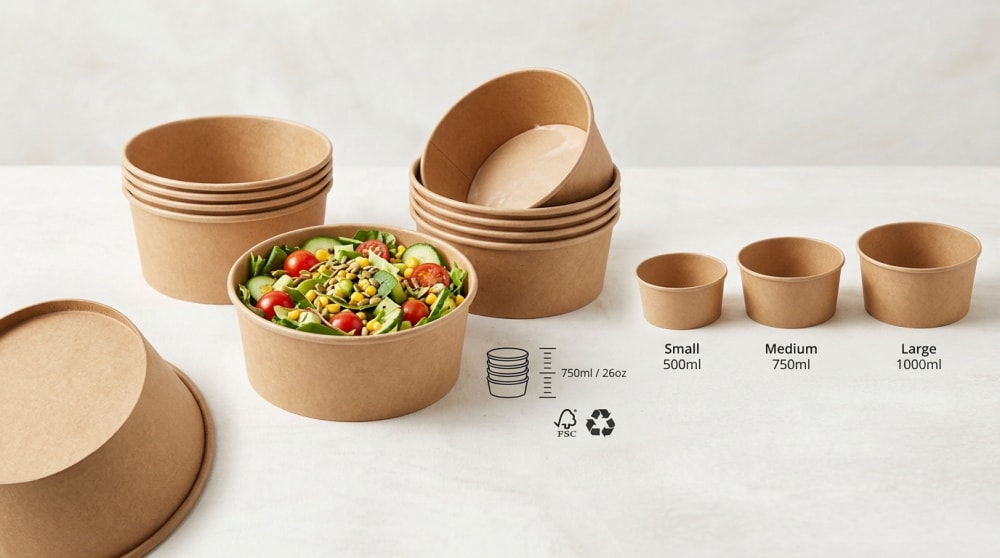
Size selection depends on menu type, portion strategy, and whether the bowl is used in-store or for off-premise service. U.S. buyers usually compare ounce capacity, top diameter, bottom diameter, nesting depth, and lid interchangeability. A bowl that looks similar on a sample table can perform very differently in stacking, transport, and sealing.
| Bowl Size | Typical U.S. Use | Best For | Common Lid Type | Hot/Cold Suitability | Buyer Notes |
|---|---|---|---|---|---|
| 8 oz | Side dishes | Rice, sauces, samples | Paper lid or PP lid | Hot or cold | Compact and cost-efficient |
| 12 oz | Soup and desserts | Chili, oatmeal, ice cream | PET or PP lid | Hot or cold | Popular for cafes |
| 16 oz | General takeaway | Soup, salad, noodles | PET, PP, paper lid | Hot or cold | One of the most versatile sizes |
| 26 oz | Meal bowls | Poke, pasta, grain bowls | Clear PET dome lid | Mainly cold or warm | Good for premium presentation |
| 32 oz | Large entrees | Salads, ramen, family sides | PET or PP snap lid | Hot or cold | Often used in delivery |
| 36 oz+ | Shared portions | Catering and combo meals | Heavy-duty lid systems | Hot or cold | Storage space should be checked |
This comparison matters because lid fit directly affects leakage risk and consumer experience. Salad concepts often prefer clear PET lids to show ingredients and toppings. Soup and noodle operators may need vented PP lids for heat. Some buyers request paper lids for a more fiber-forward appearance, especially in environmentally positioned brands.
When comparing bowl systems, ask for production specs covering:
- Inner and outer diameter tolerances
- Lid sealing force
- Stack height per sleeve and per carton
- Microwave suitability where relevant
- Compression resistance during transport
- Compatibility across multiple bowl sizes
The chart above reflects how bowl demand tends to concentrate in segments where takeaway, delivery, and one-bowl meals are central to the business model. Asian takeout, fast casual, and salad chains continue to drive volume in many U.S. metro markets.
Kraft, white, and compostable paper bowl options for different menus

Material appearance plays a large role in product positioning. Kraft bowls are often chosen for organic, natural, or rustic branding. White bowls are common in polished chain environments where bright print colors and a clean look are important. Compostable options appeal to brands serving campuses, health-focused communities, and environmentally conscious urban markets.
| Material Style | Appearance | Common Menu Fit | Brand Positioning | Strength Profile | Typical Buyer Concern |
|---|---|---|---|---|---|
| Kraft | Natural brown | Salads, grain bowls, deli items | Eco-oriented, artisanal | Strong everyday use | Print color visibility |
| White paper | Clean bright finish | Soups, noodles, premium takeaway | Mainstream, polished | Highly versatile | May look less “natural” |
| Double-sided kraft look | Rustic exterior/interior | Cafe and bakery programs | Craft-focused | Good visual consistency | Coating specs must be verified |
| Compostable PLA-lined | Natural or white | Cold foods, selected warm foods | Sustainability-led | Depends on application | Heat limitations |
| Plant-fiber enhanced | Natural matte finish | Specialty foodservice | Innovative green packaging | Varies by structure | Pricing and availability |
| Custom printed bowls | Branded surface | Chains and promotional launches | High recognition | Based on base paper/lining | MOQ and lead time |
For U.S. foodservice menus, kraft bowls often work best for salads, grain bowls, wraps cut into sections, and room-temperature prepared foods. White bowls are preferred for soup programs, noodle bars, and national chains that want crisp graphics. Compostable constructions are increasingly requested by university foodservice, natural grocers, and businesses operating in municipalities with stricter packaging policies.
That said, the most suitable bowl is not always the “greenest-looking” one. It must match real menu conditions: heat, oil, moisture, delivery duration, and storage environment. A salad bowl in San Diego and a pho bowl in Seattle do not require the same barrier performance.
PE vs PLA vs plant-based linings for hot and cold foods
One of the most important wholesale decisions is the bowl lining. The lining creates the moisture and grease barrier that helps prevent sogginess and leakage. In the U.S. market, the most commonly discussed options are PE, PLA, and newer plant-based barrier systems.
| Lining Type | Best Use | Heat Tolerance | Cold Use | Compostability | Buyer Takeaway |
|---|---|---|---|---|---|
| PE lining | General hot and cold foods | Strong for hot fill | Excellent | Usually not compostable | Most widely used and cost-effective |
| Double PE | Heavier soups and oily dishes | Very good | Excellent | Usually not compostable | Extra barrier for demanding menus |
| PLA lining | Cold foods and selected warm items | Moderate | Very good | Industrial composting potential | Must be matched carefully to use case |
| Water-based barrier | Emerging applications | Varies by formula | Good | Often improved sustainability profile | Needs thorough testing |
| Plant-based coating blends | Specialized eco programs | Varies | Good | Depends on certification | Ask for verified compliance data |
| Custom barrier structure | High-performance OEM projects | Designed to spec | Designed to spec | Depends on design | Best for large buyers with precise needs |
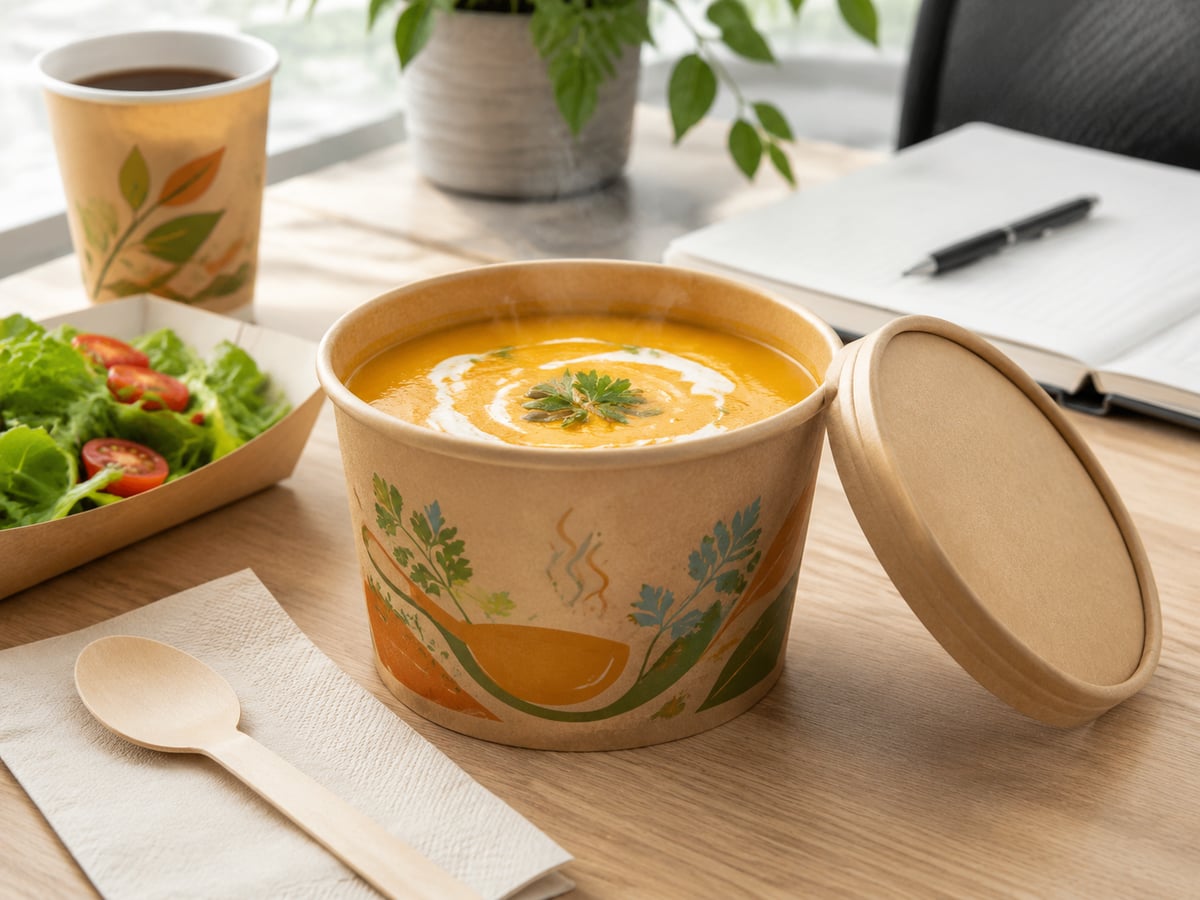
For hot soups, stews, ramen, and greasy foods, PE remains a common choice because of reliable barrier performance and lower cost. For cold salads, fruit bowls, poke, and chilled desserts, PLA and other alternative linings may work well if buyers also confirm end-of-life claims and local disposal realities. Since composting infrastructure varies widely across the United States, especially outside major urban centers, buyers should avoid marketing assumptions and instead verify local waste-stream compatibility.
A sensible sourcing approach is to test at least three conditions:
- Hot holding for 30 to 60 minutes
- Cold condensation after refrigeration
- Delivery vibration and tilt tests with lids attached
By 2026, more U.S. buyers are expected to evaluate advanced barrier coatings that reduce conventional plastic content while preserving bowl performance. However, large-scale adoption will still depend on price stability, municipal policy, and whether the alternative barrier can maintain leak resistance at high production volume.
How to evaluate disposable paper bowl wholesale suppliers and factories
Choosing the right supplier is about more than catalog variety. U.S. importers and foodservice buyers should review the factory’s quality systems, production control, export experience, and communication discipline. This is particularly important when shipping to major receiving points such as Los Angeles, Oakland, Seattle, New York/New Jersey, or Savannah.
A practical supplier evaluation framework includes product, factory, documentation, and service checks. Ask suppliers for recent production photos, machine lists, quality-control steps, carton specs, and testing methods. Also ask how they manage raw material traceability and lot identification.
| Evaluation Point | What to Request | Why It Matters | Risk if Missing | Best for U.S. Buyers | Priority Level |
|---|---|---|---|---|---|
| Food-contact compliance | FDA and related reports | Supports legal and buyer review | Import and customer issues | Mandatory | High |
| Factory capability | Machine and capacity details | Confirms scale | Late or inconsistent supply | Important for chains | High |
| Quality control | Inspection SOPs | Reduces defect rates | Leaks, lid mismatch, print problems | Critical | High |
| Customization support | Artwork and sample process | Ensures brand accuracy | Delayed launch | Useful for private label | Medium |
| Export experience | Shipment history and markets | Improves communication and paperwork | Freight and customs errors | Very helpful | High |
| Warehouse and storage | Packing and storage conditions | Protects product quality | Moisture damage or deformation | Recommended | Medium |
Suppliers with established technical and production systems are easier to assess. Buyers who want to learn more about manufacturer background and export orientation can review company information and factory experience before requesting samples or quotations.
Technological capabilities are especially relevant in custom paper bowl projects. A capable producer should be able to explain coating options, forming tolerances, flexographic print controls, die-cutting precision, and lab-based quality checks. Manufacturing capabilities matter just as much: stable production lines, organized warehousing, clear carton labeling, and repeatable batch control all reduce risk. Service capabilities then tie the project together through responsive communication, sampling, artwork verification, and shipment coordination.
This comparison chart illustrates why many U.S. buyers prefer direct factory relationships when purchasing in volume. Not every project requires a factory-direct model, but it often provides stronger visibility into quality, materials, and production timing.
MOQ, custom printing, and private label programs explained
MOQ, or minimum order quantity, often determines whether a packaging project is practical for a buyer’s current scale. Stock bowls typically have lower MOQs and shorter lead times. Custom printed and private label bowls usually require higher order quantities because of printing plate setup, raw material planning, and production scheduling.
For independent operators in cities like Denver, Nashville, or Portland, a stock-size bowl with a standard lid may be the best starting point. For chain stores, distributors, and regional foodservice groups, custom print can justify itself through stronger brand recognition and consistent customer presentation.
Typical wholesale custom options include:
- Exterior logo printing
- Custom sizes and capacities
- Kraft or white paper selection
- PE, PLA, or alternative lining choice
- Special rim structures for premium feel
- Private label carton and barcode labeling
Buyers should also understand how artwork approval affects timing. A smooth project usually follows three stages: requirement review, sample and design confirmation, then mass production and delivery. Packaging suppliers with established support systems can guide customers through dielines, color review, and production-ready artwork files. Buyers needing assistance with order coordination or sampling can review packaging service support to understand how OEM and private label workflows are typically handled.
Private label programs are especially relevant for U.S. distributors selling to regional restaurants or cash-and-carry customers. These programs can include neutral master cartons, distributor branding, barcode systems, or multi-SKU packaging families that create a more cohesive catalog.
What drives disposable paper bowl wholesale pricing at volume?
Wholesale pricing is shaped by several cost layers rather than one headline number. U.S. buyers comparing quotes should break down raw material, printing, coating type, size, wall thickness, carton quantity, shipping method, and destination port. A 16 oz white bowl with a simple PE lining is priced differently from a 32 oz kraft bowl with custom print and matching PET lid.
| Pricing Driver | Impact on Cost | Why It Changes Price | High-Cost Scenario | Cost-Control Tip | Buyer Relevance |
|---|---|---|---|---|---|
| Paper weight | Medium to high | More material used | Heavy bowls for hot foods | Match GSM to actual use | Very high |
| Lining type | Medium | Barrier material differs | Special eco coatings | Test alternatives first | High |
| Printing complexity | Medium | More colors and setup | Full-wrap custom graphics | Simplify artwork where possible | Medium |
| Size and capacity | High | Larger bowls use more material | 32 oz to 36 oz bowls | Standardize top-selling sizes | High |
| Lid system | Medium to high | Material and fit vary | Custom dome lids | Use shared lid diameters | High |
| Order volume | Lower unit cost at scale | Production efficiency improves | Small trial orders | Combine SKUs when possible | Very high |
Freight is another major factor. Ocean shipping to West Coast ports may differ significantly from East Coast routing depending on season, container availability, and inland delivery. Buyers shipping to warehouses near Chicago, Memphis, or Pennsylvania should evaluate landed cost rather than just ex-factory pricing.
The line chart shows a realistic upward trend in U.S. demand, driven by continued growth in delivery, convenience dining, meal prep, and sustainability-oriented packaging transitions.
Why leak resistance, stackability, and rim strength matter
Operational performance is where good packaging proves its value. Leak resistance protects food quality and customer satisfaction. Stackability improves storage, shelf use, and packing speed. Rim strength affects lid fit, structural stability, and the consumer’s hand feel when carrying hot food.
For soup shops and noodle brands, leakage can damage not only the order but also the entire customer experience. For central kitchens and distributors, poor stackability can reduce warehouse efficiency and raise damage rates. For quick-service environments, weak rims can slow assembly lines because staff need extra time to secure lids properly.
Ask suppliers about:
- Leak test methods using oil, broth, and acidic foods
- Drop or tilt testing with filled bowls and lids
- Compression performance in stacked cartons
- Rim curling consistency for smooth lid sealing
- Carton packing density and sleeve protection
- Performance after temperature cycling
Manufacturing discipline strongly influences these results. Factories with automated forming lines, in-process inspections, and controlled storage conditions are generally better positioned to maintain shape consistency across large runs. This is where manufacturing capabilities matter beyond headline capacity. Large output alone is not enough; repeatability is what wholesale buyers actually need.
Lead times, Incoterms, and food-contact compliance documents to request
Lead time planning is essential for U.S. importers and large-scale buyers. Stock products may move faster, while custom print and private label orders usually take longer. Buyers should confirm production time, port scheduling, and documentation readiness before issuing purchase orders.
Common Incoterms include EXW, FOB, CIF, and DDP, though the best choice depends on the buyer’s logistics setup. Experienced importers often use FOB with their own freight forwarders. Smaller buyers may prefer broader shipping support if available.
| Document or Term | What It Covers | Why U.S. Buyers Request It | When to Ask | Typical Importance | Notes |
|---|---|---|---|---|---|
| FDA-related food-contact reports | Material safety | Supports compliance review | Before order confirmation | Critical | Match report to actual SKU |
| EU EC 1935/2004 data | Additional food-contact benchmark | Useful for broader assurance | Early qualification stage | High | Common with export factories |
| FSC certificate | Responsible paper sourcing | Supports sustainability claims | During supplier review | Medium to high | Check validity dates |
| ISO 9001 evidence | Quality management system | Indicates process discipline | Supplier selection stage | High | Not a substitute for product testing |
| BPI or OK Compost documentation | Compostability claims | Important for eco lines | Before marketing approval | High | Verify market relevance |
| Incoterm confirmation | Delivery responsibility | Prevents cost confusion | At quotation stage | Critical | State port and destination clearly |
Typical lead times for established factories may fall into the 7 to 15 day production range for certain standard or well-organized projects, though shipping time is additional and varies by destination and season. Buyers should also ask whether the supplier can support sample dispatch before mass production and whether climate-controlled storage is used for finished goods awaiting export.
If you are building a U.S. sourcing plan and need direct communication on specifications, documentation, or shipment timing, it is useful to contact the packaging team before finalizing your purchasing calendar.
The area chart reflects an ongoing trend: more U.S. buyers are adding compostable or lower-plastic-content options to their packaging mix. By 2026, this shift is likely to accelerate further in markets influenced by state policy, institutional procurement standards, and consumer pressure.
FAQ: disposable paper bowls wholesale for foodservice buyers
What bowl size is most commonly used in U.S. foodservice?
16 oz and 32 oz are among the most versatile sizes, but the right choice depends on your menu and portion size. Soup concepts may also rely heavily on 12 oz and 16 oz formats.
Are kraft bowls always compostable?
No. The outer paper appearance does not determine compostability. The lining and total structure matter. Always request certification for any compostability claim.
Is PE or PLA better?
PE is often better for hot, greasy, or high-moisture foods because of its dependable barrier performance. PLA is more often considered for cold applications or eco-focused programs, but it must be matched carefully to actual conditions.
What MOQ should I expect?
Stock products usually have lower MOQs. Custom printed and private label orders typically require higher MOQs due to production setup and material planning.
What documents should I request first?
Start with food-contact compliance reports, certification records, product specifications, and Incoterm-based quotation details. For eco claims, request FSC and compostability documentation where relevant.
How do I compare wholesale quotes fairly?
Compare the same bowl size, paper weight, lining type, print scope, lid type, carton quantity, Incoterm, and destination. Landed cost matters more than unit price alone.
Can paper bowls be customized for my brand?
Yes. Common customizations include logo printing, color designs, bowl size changes, paper finish options, lining selection, and private label cartons.
What makes a supplier reliable for U.S. buyers?
Clear compliance documents, repeatable quality control, stable capacity, export experience, responsive communication, and sample support are all important signals.
Market outlook, industries, applications, and supplier strategy in the United States
The U.S. paper bowl market continues to benefit from broad foodservice shifts: more off-premise dining, expanded delivery platforms, higher demand for one-bowl meals, and rising pressure to improve sustainability performance. Demand is particularly strong across quick-service restaurants, Asian takeaway, salad chains, prepared meal retailers, stadium concessions, universities, and healthcare dining.
Applications continue to diversify. What started as a soup-and-noodle format now includes protein bowls, burrito bowls, hot breakfast, fruit cups, frozen desserts, deli salads, meal prep kits, and premium takeaway sides. This diversity means buyers increasingly need a packaging partner that can support multiple bowl sizes, lid families, and material options instead of a one-SKU purchase.
Local U.S. sourcing can work well for urgent replenishment or low-volume regional needs, but many large buyers still rely on overseas factory production for better scale, customization, and cost structure. The best approach is often hybrid: hold safety stock domestically while using factory-direct production for core volume planning.
As for supplier strategy, U.S. buyers should segment vendors into three groups: emergency domestic backup suppliers, regional stocking partners, and primary manufacturing sources. This gives more resilience during freight disruptions, seasonal spikes, or product transitions.
Our company approach for U.S. wholesale paper bowl buyers
For businesses seeking a one-stop packaging partner, Shandong Fude Packaging Co., Ltd. brings a mix of technological capabilities, manufacturing capabilities, and service capabilities that align well with wholesale paper bowl sourcing. Rather than focusing only on volume, the company’s approach is centered on food-safe, brand-supportive, and operationally practical packaging for global foodservice buyers.
Technological capabilities: Fude’s production system supports flexographic printing, die-cutting accuracy, bowl forming, and quality lab checks that help buyers evaluate barrier performance, print consistency, and structural fit. This is particularly relevant for custom bowl programs, matching lid systems, and multi-SKU packaging lines.
Manufacturing capabilities: With a modern factory footprint in Shandong, automated lines, organized warehousing, and experience serving clients across multiple continents, the company is positioned to support both trial projects and recurring wholesale demand. Its packaging portfolio covers paper bowls, takeaway boxes, trays, cups, and related foodservice formats, making it easier for buyers to consolidate sourcing.
Service capabilities: The company supports packaging selection, artwork preparation, sample confirmation, customization development, and delivery coordination. That matters for U.S. buyers who need clear communication on MOQ, production planning, private label details, and export timelines. This consultative service structure can be especially useful for distributors, restaurant groups, and emerging brands launching new menu concepts.
For U.S. buyers comparing options for kraft bowls, white bowls, compostable programs, or custom printed takeaway packaging, a supplier’s ability to combine product engineering with responsive service is often what turns a quote into a long-term partnership.
In 2026 and beyond, the strongest wholesale paper bowl suppliers will likely be those that can do four things well: document compliance clearly, support sustainable material transitions honestly, maintain repeatable quality at scale, and help customers simplify procurement across multiple packaging categories.

About the Author
Fude Packaging is a professional flexible packaging manufacturer serving global food brands, wholesalers, and distributors. Our team shares practical insights on custom packaging, printing technology, food-safe materials, and industry trends to help businesses build better packaging solutions.
Share
Product Category
Start Your Project With Fude Today
Related Post
-

Global Market Guide to Low-MOQ Custom Food Box Planning
For Global market buyers, low-MOQ custom food boxes should be planned around total landed cost, not the lowest quoted unit price. A low initial order can carry disproportionately high artwork, plate, die-cutting, packing, inspection, freight, customs, and inventory costs. The practical question is not “Which supplier has the cheapest box?” but “Which approved packaging program delivers the lowest risk-adjusted cost per usable box at the destination warehouse?”Enterprise procurement teams should request quotations against one controlled specification: box dimensions, board grade, coating, print colors, finish, food-contact requirements, packing method, carton size, destination, Incoterm, inspection level, and requested delivery date. Without this discipline, a supplier quoting thinner paperboard, fewer colors, loose packing, or FOB Qingdao cannot be compared fairly with a supplier quoting stronger material, export cartons, and delivered freight to Rotterdam, Los Angeles, Dubai, Singapore, or Sydney.For custom food packaging at low volumes, the best commercial strategy usually combines a limited number of structural sizes with flexible print designs, realistic safety stock, and a pre-approved reorder process. A restaurant group opening ten stores, a distributor testing a new takeaway range, or a food brand launching seasonal menus should protect service continuity before pursuing marginal unit-price savings.Cost ElementWhy It Matters at Low MOQBuyer ControlPaperboard and coatingMaterial can account for a large share of box cost and performance.Specify GSM, food-contact coating, grease resistance, and fiber source.Printing and platesFixed costs are spread over fewer units on small custom runs.Limit colors, reuse artwork, and approve Pantone references.Die-cutting and formingNew structures may require tooling, setup, and trial time.Use existing dies where possible or amortize tooling over annual demand.Export packingWeak cartons increase damage and raise warehouse handling cost.Confirm pieces per carton, carton dimensions, gross weight, and pallet plan.Freight and destination feesCarton cube can outweigh product price for lightweight paper packaging.Compare freight on the same Incoterm and destination port or warehouse.Quality and complianceFailed inspections or missing documents can delay market entry.Define AQL, testing requirements, certificates, and claim procedures.The table shows why a unit-price comparison is incomplete. A box that costs US$0.01 less ex-works may cost more after poor container utilization, rework, damaged cartons, stockouts, or rejected shipments. Buyers should calculate landed cost by SKU, then add a risk reserve for volatile freight lanes, regulatory testing, promotional demand, and product obsolescence.Demand for branded foodservice packaging remains supported by takeaway, delivery kitchens, convenience retail, meal preparation, cafés, airline catering, event foodservice, and franchise expansion. Markets around London, Hamburg, Rotterdam, Dubai, Jeddah, Johannesburg, New York, Toronto, São Paulo, Melbourne, Singapore, and Tokyo increasingly require packaging buyers to balance cost control with recycling, compostability, fiber sourcing, and food-contact documentation. The strongest programs are built around repeatable specifications rather than one-off purchasing events.var ctx=document.getElementById('lineChart').getContext('2d');new Chart(ctx,{type:'line',data:{labels:['2022','2023','2024','2025','2026','2027'],datasets:[{label:'Indexed global demand for custom food boxes',data:[100,107,115,124,134,145],borderColor:'rgb(28,120,145)',backgroundColor:'rgba(28,120,145,0.12)',borderWidth:3,fill:false,tension:0.3}]},options:{responsive:false,maintainAspectRatio:false,scales:{y:{beginAtZero:false,title:{display:true,text:'Demand index'}}}}});This planning illustration uses 2022 as an index of 100 and reflects steady expansion in branded delivery, convenience food, and sustainable paper-based packaging. Actual demand should be forecast by destination, food category, and customer channel rather than applying one growth rate across all SKUs.MOQ is not one number for an entire packaging program. It should be calculated at the intersection of structural size, board material, coating, print method, artwork version, and packing configuration. A plain kraft lunch box may be practical at a much lower quantity than a full-color, double-sided, embossed burger box with a unique dieline. Likewise, two boxes with the same dimensions but different artwork are separate production requirements when print plates, color approvals, or changeover time differ.For purchasing purposes, define each sellable configuration as an SKU: 500 ml white salad box with one-color logo; 750 ml kraft noodle box with black print; two-compartment meal box with four-color artwork; or plain stock burger carton. This approach prevents a supplier from aggregating quantities that cannot genuinely run together. It also helps sales, marketing, and operations understand the cost of excessive design variation.Box ProgramTypical MOQ LogicLow-MOQ RecommendationPlain stock kraft boxBased mainly on forming and carton packing.Use for demand testing and emergency replenishment.One-color logo on existing sizeDepends on print setup plus one production batch.Choose for new brands needing basic recognition.Two to four color printEach color and print change adds setup complexity.Reserve for stable, repeatable demand.Custom dieline boxRequires die approval, trial run, and tooling control.Apply only where product fit creates measurable value.Special finish or embossingRequires additional process stages and quality checks.Use selectively for premium retail or gifting programs.Multi-SKU family orderShared board and freight can improve overall economics.Consolidate compatible sizes under one production window.MOQ should also reflect shelf-life and commercial risk. Paper food boxes do not expire in the same manner as food, but artwork, legal statements, recycling marks, promotional campaigns, and menu sizes can become obsolete. A buyer that saves 8% by ordering twelve months of stock may lose more if branding changes after four months. For this reason, calculate both production MOQ and economic order quantity, then choose the lower-risk option.Low-volume customization is most effective for product families that share materials and handling requirements. Common applications include burger boxes, clamshell takeaway cartons, fry trays, cake boxes, kraft lunch boxes, salad containers, noodle boxes, meal trays, bakery packaging, sushi cartons, snack trays, and compartment meal boxes. Buyers sourcing meal-preparation or corporate catering programs can review custom printed two-compartment takeaway boxes when portion separation and branded presentation are both important. For bento, school meal, and delivery applications, four-compartment bento lunch boxes can help standardize different food components in one pack.Tooling and setup costs are often misunderstood because they may appear as separate line items or be embedded in unit price. Buyers should ask for a transparent quotation showing dieline development, die-cutting tool cost, print plate or digital setup cost, color matching, sampling, machine changeover, and any special forming fixture. This information allows procurement teams to distinguish one-time costs from recurring production costs.Technology should be selected according to run length and visual requirements. Digital printing can reduce setup barriers for short runs, while conventional offset or flexographic methods can become more economical once annual volume rises. The correct choice depends on board type, image coverage, color consistency, production speed, and the buyer’s tolerance for variation. A short-run promotional box does not always need the same process as a high-volume national restaurant chain pack.Setup ItemCommercial EffectPlanning ActionExisting dieline reviewCan eliminate new die cost and shorten development time.Check available structural sizes before designing a new box.New cutting dieCreates an upfront project cost and approval milestone.Assign ownership, storage terms, and replacement responsibility.Print platesMay be required for repeat color production.Confirm number of colors, plate life, and reuse policy.Pantone matchingImproves brand consistency but needs controlled proofs.Approve physical or digital color standards before production.Digital artwork preparationReduces waste caused by incorrect bleed, fonts, or barcodes.Submit editable artwork and approve final production files.Machine changeoverRaises cost when many small designs are scheduled separately.Group compatible SKUs in a coordinated production run.The buyer should retain approved dielines, print files, color references, and revision records. A controlled artwork library is especially valuable when purchasing teams operate across multiple regions. It reduces the chance that a distributor in Europe, a franchise operator in the Middle East, and a co-packer in North America order visually inconsistent packaging under the same brand.Fude Packaging supports low-MOQ food box development through in-house artwork and dieline checking, material recommendations, prototype preparation, printing coordination, forming, and quality testing. Its Shandong operation uses automated production lines and an internal laboratory to evaluate practical performance such as compression strength, grease resistance, heat behavior, leak prevention, print accuracy, and box formation. These controls matter when a buyer is deciding whether a low-volume launch box can become a repeat national SKU.An annual volume plan converts an uncertain low-MOQ project into a manageable supply program. Buyers should forecast monthly demand by SKU, then identify launches, seasonal peaks, promotional campaigns, restaurant openings, and expected customer wins. The plan should include base demand, upside demand, safety stock, and an obsolescence limit. Rather than promising a supplier an unrealistic annual figure, provide a range and a schedule of planned release orders.For example, a distributor supplying cafés in Berlin and Amsterdam may order a conservative starter quantity of two printed cup-and-box SKUs, followed by quarterly releases once sell-through is proven. A meal-prep operator in Dubai may require higher stock before Ramadan and year-end events. A retail bakery chain in Melbourne may need more cake and pastry cartons before school holidays. Demand seasonality should be reflected in both production slots and ocean freight bookings.var ctx=document.getElementById('barChart').getContext('2d');new Chart(ctx,{type:'bar',data:{labels:['Quick-service restaurants','Delivery kitchens','Cafés and bakeries','Meal preparation','Retail food','Catering'],datasets:[{label:'Illustrative custom box demand index',data:[92,88,76,69,63,58],backgroundColor:['#1f7a8c','#2a9d8f','#52b788','#e9c46a','#f4a261','#e76f51']}]},options:{responsive:false,maintainAspectRatio:false,scales:{y:{beginAtZero:true,title:{display:true,text:'Demand index'}}}}});The comparison indicates why quick-service restaurants and delivery kitchens often justify earlier investment in standardized packaging. Their recurring throughput can spread setup costs over more units, while lower-volume catering or retail programs may benefit from shared structures, simpler print, or stock packaging with labels.Planning HorizonBuyer DecisionSuggested Control0–30 daysConfirm launch date and first shipment route.Use approved samples and reserve production capacity.31–90 daysAssess sales conversion and customer feedback.Measure consumption against the original demand forecast.3–6 monthsPrepare reorder quantities and seasonal adjustments.Review artwork, carton cube, and freight options.6–9 monthsNegotiate annual pricing and capacity allocation.Consolidate compatible SKU production runs.9–12 monthsEvaluate design changes and compliance updates.Set an obsolescence ceiling before placing large orders.12+ monthsDecide whether to scale, simplify, or redesign.Use quality, service, and landed-cost data in supplier review.A sample order should answer commercial and technical questions before mass production. Buyers should not treat samples as decorative proofs only. A useful sample program verifies dimensions, folding quality, lid closure, nesting, stackability, grease resistance, heat resistance, leak risk, print placement, barcode readability, and real food performance. Test with the intended menu: sauced noodles, fried foods, salads with dressing, hot rice meals, pastries, or chilled desserts.Start with a white sample when structural fit is uncertain. Move to a printed sample after the dieline and material are approved. For high-risk applications, request a functional prototype and conduct a documented test with actual filling temperature, transit time, and delivery handling. A food box that looks correct on a desk may fail after thirty minutes in a delivery rider’s insulated bag.A regional takeaway brand planning a Global market launch used three steps: first, white samples to validate a folding meal box; second, printed samples for color and logo placement; third, a limited commercial run for five pilot locations. After measuring leakage complaints, carton damage, and weekly consumption, the buyer consolidated two underperforming sizes into one standard box. The result was fewer purchase orders, better carton utilization, and a lower total cost despite a slightly higher unit price for the upgraded board.var ctx=document.getElementById('areaChart').getContext('2d');new Chart(ctx,{type:'line',data:{labels:['Pilot','Month 2','Month 3','Month 4','Month 5','Month 6'],datasets:[{label:'Share of standardized SKUs (%)',data:[35,42,51,59,66,72],borderColor:'rgb(67,160,71)',backgroundColor:'rgba(67,160,71,0.28)',fill:true,tension:0.35,borderWidth:3}]},options:{responsive:false,maintainAspectRatio:false,scales:{y:{beginAtZero:true,max:100,title:{display:true,text:'Percentage'}}}}});This trend illustrates a common operational improvement: as a pilot proves demand, buyers usually shift toward a smaller number of standardized, repeatable SKUs. Standardization lowers artwork errors, reduces changeovers, supports faster replenishment, and gives suppliers more predictable production planning.SKU consolidation is one of the most effective ways to improve low-MOQ economics. It does not mean eliminating all brand differentiation. It means separating what customers see from what the factory must manufacture. A buyer may use different sleeve labels, stickers, menu inserts, or stamps while keeping a common food box structure, board grade, and carton format.Start with a SKU map showing size, food type, customer group, artwork, annual consumption, gross margin, storage location, and replacement option. Identify low-volume designs that can share a base box. In many programs, four lunch-box sizes can become two sizes, and several campaign designs can become one core design plus labels. This approach is valuable for distributors serving independent restaurants that want a branded appearance but cannot justify a full printed production run.Consolidation LeverOperational BenefitPossible Trade-OffOne shared box footprintSimplifies die-cutting, packing, and warehouse slots.May not perfectly fit every menu item.Common board gradeImproves material purchasing and quality consistency.Some premium items may need stronger board.Single core artworkReduces print setup and obsolete stock exposure.Less campaign-specific visual impact.Labels for local brandingAllows short-run differentiation after manufacture.Adds an application step at warehouse or restaurant level.Shared export cartonImproves container planning and handling efficiency.May require revised inner-pack quantities.Coordinated release ordersSupports better production scheduling and freight consolidation.Requires accurate cross-team forecasting.Buyers can explore a broader range of structures through the food container packaging range and identify designs that can be standardized across delivery, dine-in takeaway, catering, and retail channels.A reorder point should be based on average demand during replenishment lead time plus safety stock. For imported food boxes, lead time includes artwork confirmation, production scheduling, manufacturing, final inspection, port delivery, export documentation, sea or air transit, customs clearance, inland delivery, and receiving. A buyer using FOB Qingdao must manage the freight and destination stages directly; a buyer using DDP or delivered terms should still understand the full timeline and responsibility split.A practical formula is: reorder point = average weekly consumption × total lead time in weeks + safety stock. Safety stock should reflect demand volatility and service expectations. A high-volume restaurant chain with no acceptable substitute may require six to ten weeks of protection. A low-volume promotional SKU with a short campaign window may need only limited stock because obsolescence is a greater risk than shortage.Global market importers should build timing assumptions around actual logistics lanes. Qingdao and Shanghai are major Chinese export gateways for paper packaging. Destination routing may pass through Rotterdam or Hamburg for Europe, Long Beach or New York for North America, Jebel Ali for the Gulf, Singapore for Southeast Asia, or Melbourne and Sydney for Oceania. Congestion, customs examinations, transshipment, and peak-season bookings can alter lead times. Maintain a documented alternative: approved local stock, a second freight forwarder, a substitute plain box, or a production slot reserved with the primary manufacturer.var ctx=document.getElementById('comparisonChart').getContext('2d');new Chart(ctx,{type:'bar',data:{labels:['Specification control','Low-MOQ flexibility','Multi-category consolidation','Export documentation','Inspection support','Reorder coordination'],datasets:[{label:'Structured manufacturing program',data:[90,82,88,92,85,87],backgroundColor:'rgba(73,80,87,0.78)'},{label:'Unmanaged spot buying',data:[52,68,38,45,41,50],backgroundColor:'rgba(231,111,81,0.72)'}]},options:{responsive:false,maintainAspectRatio:false,scales:{y:{beginAtZero:true,max:100,title:{display:true,text:'Planning capability score'}}}}});The comparison is an operational model, not a universal supplier ranking. It emphasizes that strong supplier selection includes specification control, documentation, inspection, and replenishment support, not only a low quotation.Effective negotiation begins with reliable data. Give the supplier a clear product brief, expected annual volume range, target launch date, destination, desired Incoterm, quality requirements, and future SKU potential. Ask for price breaks at realistic quantity levels rather than demanding an unsustainable low MOQ. A manufacturer is more likely to support flexibility when it can see a credible path from pilot order to repeat business.Compare suppliers on the same basis. For example, request FOB Qingdao pricing for all candidates, then separately model freight to the same destination. Where a delivered quote is preferred, specify the exact warehouse postal code, unloading assumptions, customs responsibility, and whether duties are included. EXW, FOB, CIF, DAP, and DDP each assign cost and risk differently; they should never be mixed in a simple unit-price spreadsheet.Negotiation TopicQuestion to AskDesired OutcomeIncotermWhich named place, freight scope, and risk transfer apply?Comparable landed-cost quotations.MOQWhat is the MOQ by size, material, artwork, and print method?Realistic order quantity by SKU.ToolingWho owns the die and how long is it retained?Protected future production capability.Quality planWhich defects are critical, major, and minor?Clear inspection and claim standard.Payment termsWhat deposit, balance, and document process is required?Cash-flow visibility and controlled release.Capacity reservationCan production space be tentatively held for reorders?Reduced launch and peak-season delay risk.Fude Packaging supports overseas B2B buyers seeking a practical balance of customization, supply continuity, and cost control. With more than 20 years of packaging experience and a self-owned 30,000 m² factory in Shandong, the company manufactures foodservice packaging directly rather than relying solely on fragmented trading arrangements. This helps buyers coordinate multiple categories, including paper cups, bowls, burger boxes, kraft lunch boxes, salad containers, noodle boxes, trays, and compartment meal boxes through one manufacturing partner.Automated production lines with capacity of up to 120,000 units per day support repeat orders as programs grow beyond pilot stage. Material selection, printing, die-cutting, forming, inspection, packing, and shipment preparation are managed within the production system. For low-MOQ buyers, this creates an advantage when common structures and compatible materials can be scheduled together. Production timing is typically around 7–15 days for standard orders, subject to product complexity, approval status, and order volume.Fude Packaging provides OEM and ODM support from product selection and structural development to artwork review, Pantone matching, samples, export packing, documents, and shipment coordination. Buyers can request white samples, printed samples, functional prototypes, and third-party inspection support before shipment. The international service team can assist with food type, serving temperature, capacity, target market requirements, delivery deadlines, freight choices, and documentation needs. Food-contact, FSC, ISO 9001, EC 1935/2004, FDA-related, BPI, and OK Compost options can be discussed according to the destination market and material objective.Include material, coating, print setup, tooling, forming, packing, inspection, freight, insurance, customs, inland delivery, storage, quality risk, and likely obsolescence. Compare the final landed cost per usable box, not only the factory unit price.Calculate MOQ separately for each structural size, material, coating, print design, color count, and packing format. Artwork changes usually create a separate production requirement even when the box size is identical.FOB at the same named Chinese port, such as Qingdao, is often useful for comparing factory offers because freight can be sourced separately. For delivered quotes, use the same destination warehouse and clearly define duty, customs, and unloading responsibilities.There is no universal quantity. Hold enough inventory to cover demand during total replenishment lead time plus a buffer for demand and logistics variability. High-volume operational SKUs generally require more protection than seasonal or promotional artwork.Review on-time-in-full delivery, production lead time, transit lead time, container utilization, carton damage rate, customs delay frequency, inventory days, stockout incidents, forecast accuracy, nonconformance rate, and total landed cost per usable unit. These KPIs reveal whether the packaging program is genuinely improving as volume grows. -

Canada Noodle Box Buying Guide for Food Service 2026
For buyers in Canada, choosing the right noodle box is no longer only about cost. Restaurants, ghost kitchens, mall food courts, catering operators, wholesalers, and regional distributors now evaluate noodle boxes by leak resistance, heat retention, branding quality, stackability, sustainability, and import reliability. In cities such as Toronto, Vancouver, Richmond, Calgary, Montreal, Mississauga, Markham, and Burnaby, Asian food service is expanding through dine-in, takeout, and delivery. That means the noodle box has become both a functional food container and a visible part of the customer experience.Whether you are serving chow mein, pad thai, ramen side portions, stir-fried rice noodles, dumplings, or hot soup noodles, the ideal format depends on food temperature, holding time, oil content, delivery distance, and brand positioning. Canadian buyers also need to consider cold-weather transport, warehousing conditions, bilingual labeling needs in some channels, and compliance expectations for food-contact packaging. Importing from China remains a practical route when the supplier offers stable quality, clear specifications, and export-ready packing.This guide focuses specifically on noodle boxes for the Canada market. It explains design formats, lid structures, heat resistance, coating options, size selection, branding possibilities, export quality control, and supplier evaluation. It also includes data views, product comparison tables, and practical advice for importers supplying restaurants and food service chains across provinces from British Columbia to Ontario and Quebec.If you need a fast buying decision for Canada, the best noodle box choice for most Asian food service operators is a food-grade paper box with strong board, reliable inner coating, secure closure, and custom print support. For dry noodles, fried rice, and stir-fry dishes, standard fold-top noodle boxes remain cost-effective and stack well. For soup noodles, curry dishes, and higher-liquid meals, a reinforced paper bowl or noodle box with improved sealing and heat-resistant lining is usually the safer option.Canadian importers should prioritize six points:Paperboard strength suitable for hot and oily foods PE or compostable lining chosen by actual application Heat resistance for short-hold and delivery conditions Size consistency for portion control and delivery platforms Custom printing clarity for brand identity Export-grade packing and inspection before shipment Buyers comparing cartons for takeout can also review Custom Paper Food Container products when selecting boxes beyond classic noodle formats. If your menu includes soup-heavy items, side bowls, or combo meals, it is also smart to compare Custom Paper Bowl products for stronger liquid performance.In practice, the Canada market is moving toward packaging that balances operational efficiency and sustainability messaging. Independent restaurants often want low minimum order quantities and fast design support. Multi-location chains want repeatable dimensions, tighter color management, and pallet-friendly export packaging. Distributors servicing Toronto, Vancouver, Edmonton, and Winnipeg often prefer a standardized size mix that can serve Chinese, Thai, Korean, Japanese, and pan-Asian takeaway menus with only minor variation.Buying NeedRecommended Noodle Box TypeBest UseKey BenefitRisk if Wrong ChoiceCanada Buyer TipDry noodlesTraditional fold-top boxChow mein, lo meinEfficient filling and stackingSteam softening if board is weakChoose heavier board for delivery ordersStir-fry with sauceModern coated noodle boxPad thai, yakisobaBetter oil and moisture resistanceSauce seepageRequest leakage test dataHot soup noodlesReinforced soup-capable containerRamen, pho add-onsImproved heat and liquid controlBottom softening or side leaksConsider paper bowls instead of classic boxesPremium brandingCustom printed white board boxBranded chain takeawaySharper print qualityHigher cost with weak design planningStandardize artwork across sizesEco-focused menuKraft or compostable formatNatural brand imageStronger sustainability appealPerformance mismatch if wrong liningConfirm actual disposal route in CanadaHigh-volume wholesaleStandardized export carton packDistributorsLower handling costWarehouse inefficiencyMatch master carton size to pallet planThe table above shows that the best noodle box is application-driven. A restaurant in downtown Vancouver serving quick lunch stir-fries has a different packaging need from a suburban Toronto delivery kitchen serving hot noodle soup in winter. The right purchase decision starts from menu behavior, not from appearance alone.var ctxLine = document.getElementById('lineChartCanada').getContext('2d');var chartLine = new Chart(ctxLine, {type: 'line',data: {labels: ['2021', '2022', '2023', '2024', '2025', '2026'],datasets: [{label: 'Estimated Canada demand growth for noodle takeout packaging (%)',data: [6.5, 8.1, 9.4, 11.2, 12.6, 14.1],borderColor: 'rgb(75, 192, 192)',backgroundColor: 'rgba(75, 192, 192, 0.15)',fill: false,tension: 0.3}]},options: {responsive: true,maintainAspectRatio: false}});The line chart highlights a realistic growth pattern tied to food delivery, Asian cuisine expansion, and stronger demand for branded takeout packaging. For importers, this means more pressure to secure reliable suppliers before peak periods such as Lunar New Year promotions, back-to-school catering, and winter delivery surges.Traditional noodle boxes are still widely recognized in North America. They typically feature a folded paperboard body with interlocking top flaps and a tapered square shape. This structure remains popular because it is familiar, fast to pack, visually linked to Asian takeaway, and generally efficient to ship in flat form. For classic stir-fried noodles, rice, and dry dishes, it continues to perform well.Modern noodle box designs, however, have expanded far beyond the iconic fold-top profile. Buyers in Canada increasingly request rounded-corner boxes, wider-mouth boxes for easier eating, vented lids, window options, and hybrid formats that visually resemble bowls while maintaining box-like handling. Modern designs also focus on delivery realities. Better lid retention, reduced condensation, improved grease barriers, and more stable stacking matter to delivery apps and ghost kitchens in dense urban markets like Toronto and Montreal.Traditional designs are ideal when labor speed, recognition, and low unit cost matter most. They fit many Chinese takeaway concepts and are easy for customers to carry. Modern designs are stronger when the restaurant wants premium presentation, cleaner branding surfaces, or better performance for mixed sauces and longer holding times. For example, a mall counter in Richmond might prioritize speed and compact storage, while a premium noodle bar in downtown Toronto may prefer custom-printed modern packs that support a higher-end identity.Design also affects customer use. Some traditional boxes can be unfolded to create a plate-like surface, which is convenient in office lunches and campus dining. Modern versions often prioritize easier lidding and better bowl-style access, helping with ramen toppings, wide noodles, or fusion dishes.Design TypeStructureBest Menu FitBrand ImageOperational AdvantageLimitationClassic fold-topTapered paper box with flapsDry noodles, fried riceRecognizable takeaway styleLow storage footprintLess ideal for soupWide-mouth noodle boxBroader openingLoaded noodles, toppingsModern casual diningEasier fillingSlightly higher board useWindow noodle boxPaper body with clear panelRetail display mealsPremium and visualProduct visibilityNot always ideal for very hot steamBowl-style boxRounder or semi-round profileSaucy noodlesContemporaryBetter spoon accessMay reduce stacking efficiencyHinged-lid paper packIntegrated top coverPrepared mealsClean branded lookSimple close-and-goCan cost more than standard boxKraft natural finishBrown board aestheticEco-positioned menusArtisan or sustainableStrong natural lookDark base may affect print brightnessThe table shows that “traditional versus modern” is not about one being better than the other. It is about which structure best supports the menu, service model, and brand positioning. Operators serving mainly dine-out lunches may still prefer traditional fold-top boxes, while those scaling on delivery platforms may increasingly invest in modern constructions with stronger closure performance.For businesses carrying multiple packaging categories, it can be practical to coordinate noodles, soup bowls, and drinks through one product family. Buyers often combine noodle packaging with Custom Paper Cup products to create a consistent takeaway identity across hot drinks, bubble tea add-ons, and combo meals.Heat resistance is one of the most misunderstood aspects of noodle box purchasing. Many buyers assume that if a paper container can hold warm food, it can also safely handle very hot soup or broth. In reality, heat performance depends on the paper weight, coating type, seam quality, structural geometry, and fill duration. A hot noodle soup container used for five minutes in-store faces a different stress level from one traveling 35 minutes through winter delivery conditions in Ottawa or Calgary.For hot noodle soup products, the buyer should assess four practical factors: serving temperature, hold time, liquid ratio, and customer handling. Broth-heavy dishes challenge the container more than dry or lightly sauced noodles. Steam can soften the top structure, liquid can stress the bottom seam, and repeated movement in transit can expose weak points.In Canada, winter introduces another variable. Sudden temperature differences between hot filling and cold external air can create condensation and affect lid fit. This is why many operators now separate highly liquid ramen or pho applications into dedicated paper bowls with matching lids instead of using generic noodle boxes.Heat resistance should be verified through production testing rather than only by material description. Ask suppliers about hot water holding tests, seam integrity checks, drop tests after filling, and grease migration observations. Also consider whether the item is intended for microwave reheating, although actual performance depends on coating type and use conditions.ApplicationTypical Fill TemperatureHold TimeRecommended ConstructionKey TestBuyer NoteDry stir-fry noodles60-80°C15-30 minStandard coated noodle boxGrease resistanceFocus on sidewall stiffnessSaucy noodle dishes70-85°C20-40 minHeavier board with stronger barrierLeak testCheck corner seals carefullyHot broth side dish80-90°C15-25 minSoup-ready bowl or reinforced boxBottom seam testStandard box may be riskyRamen takeaway80-95°C30-45 minPremium bowl with secure lidLid retention testUse venting strategy if neededPho or noodle soup delivery85-95°C30-50 minHigh-performance soup containerTransport simulationOften better with separated brothMicrowave reheat menuVariesConsumer reheatingMicrowave-appropriate gradeHeat deformation testConfirm actual usage instructionsThis table demonstrates that soup-oriented applications require much more than a decorative noodle box. As menu liquid level rises, the packaging needs stronger barriers and more reliable lid systems. That is why menu mapping is essential before placing a large import order.var ctxBar = document.getElementById('barChartDemand').getContext('2d');var chartBar = new Chart(ctxBar, {type: 'bar',data: {labels: ['Chinese Takeout', 'Japanese Casual', 'Thai Restaurants', 'Korean Street Food', 'Delivery Kitchens', 'Campus Food Service'],datasets: [{label: 'Estimated packaging demand index in Canada',data: [88, 74, 69, 56, 91, 48],backgroundColor: ['rgb(255, 99, 132)','rgb(54, 162, 235)','rgb(255, 206, 86)','rgb(75, 192, 192)','rgb(153, 102, 255)','rgb(255, 159, 64)']}]},options: {responsive: true,maintainAspectRatio: false}});The bar chart suggests where noodle box demand is strongest. Delivery kitchens and classic Chinese takeout remain major volume users. Importers serving these sectors should keep hot-fill performance, speed of packing, and size standardization at the center of product planning.Fold-top and hinged lid constructions each solve a different operational problem. Fold-top boxes are usually cheaper, easy to ship flat, and familiar to kitchen staff. They are a strong fit for fast-service counters, high-volume takeaway, and dry noodle meals. Hinged lid constructions are more modern and can improve convenience because the lid remains attached, reducing component handling and helping staff close the pack more quickly in some operations.Functionality should be judged through the full workflow: storage, opening, filling, closing, stacking, transport, customer carrying, and eating. In a busy food court in Mississauga, fold-top boxes may still win because they are intuitive and fast. In a branded chain with a set assembly line, hinged lids can support consistency and a tidier visual presentation.One key difference is closure behavior under steam. Fold-top boxes rely on flap geometry, while hinged versions rely on cover retention and board memory. If the food is very hot and moist, both systems need testing because steam can reduce closure firmness. Another difference is branding surface. Hinged lids often offer a cleaner front panel for logos and campaign printing.From a distributor perspective, fold-top boxes are easier to standardize across many customer profiles. Hinged lids may support product differentiation but can require more careful dimension planning. Buyers should ask not just for unit pricing but also for flat-pack efficiency, carton count, and loading optimization per 20GP or 40HQ container.FeatureFold-Top BoxHinged Lid BoxBest forMain BenefitMain ConcernStorage efficiencyVery goodGoodWholesalersLower warehouse spaceNeed correct folding skillPacking speedFastFast to moderateQuick-service kitchensSimple workflowVaries by staff routineClosure convenienceManual flap lockAttached coverDelivery brandsNo separate lid managementSteam can affect fitBranding surfaceClassic panelsCleaner top/front areaPremium brandingBetter visual continuityMay cost moreMenu flexibilityDry and semi-saucy dishesSaucy and presentation-driven dishesMixed menusBroader premium useNot always needed for basic takeoutImport cost controlUsually betterDepends on designVolume purchasingLower unit economicsLess differentiated appearanceThe explanation behind this comparison is simple: fold-top boxes tend to maximize efficiency, while hinged lid formats tend to maximize convenience and presentation. A buyer supplying independent restaurants across Ontario may favor fold-top consistency. A brand opening multiple polished urban locations may invest in hinged lid designs for stronger customer perception.Custom printing is no longer optional for many Canadian food businesses. The noodle box is seen in customer photos, delivery handoffs, office lunch meetings, and social media posts. A plain box can work for low-cost operations, but a branded box can communicate hygiene, professionalism, and cuisine identity. For Asian restaurants, custom print can also express regional style, whether minimalist Japanese, traditional Chinese, modern Korean street-food, or bright pan-Asian fusion.Good custom printing begins with understanding the substrate. White board usually gives sharper color reproduction and better contrast for detailed logos. Kraft board creates a natural, eco-oriented look but often softens bright colors. Flexo printing is common for efficient large runs, while artwork planning should account for fold lines, seam areas, and food-contact restrictions.Canadian buyers should also think about bilingual or multi-location needs. National chains may need a print strategy that works in English-first regions and in channels where French labeling is considered. Seasonal campaigns around Lunar New Year, campus recruitment, summer festivals, and sports events can also be built into print planning.Beyond logos, strong custom printing can include QR codes, reheating guidance, ingredient messaging, social handles, and sustainability statements. The key is clarity. Overcrowded artwork can reduce print quality and weaken brand recognition. Import buyers should ask for dielines, digital mockups, and pre-production samples before approval.Companies sourcing multiple SKUs often coordinate noodle boxes with cups and bowls for a full branded set. A supplier capable of integrated projects through Custom and Wholesale food Paper packaging can reduce approval time and help unify dimensions, print colors, and ordering cycles.var ctxArea = document.getElementById('areaTrendShift').getContext('2d');var chartArea = new Chart(ctxArea, {type: 'line',data: {labels: ['2021', '2022', '2023', '2024', '2025', '2026'],datasets: [{label: 'Shift toward branded custom noodle boxes in Canada (%)',data: [32, 38, 45, 53, 61, 68],borderColor: 'rgb(75, 192, 192)',backgroundColor: 'rgba(75, 192, 192, 0.25)',fill: true,tension: 0.3}]},options: {responsive: true,maintainAspectRatio: false}});The area chart shows a clear shift from generic takeaway packs to branded packaging solutions. This reflects stronger competition in delivery apps and growing customer expectations for memorable packaging. In 2026, more buyers are expected to standardize printed packs even for small chains and regional franchise groups.Printing ElementPurposeBest Board ChoiceIdeal Use CaseBuyer TipCommon MistakeLogo printingBrand recognitionWhite or kraftAll restaurant formatsKeep clear safe marginsPlacing logo on fold zonesFull-color graphicsVisual impactWhite boardPremium chainsTest print color on final substrateIgnoring ink density limitsMinimal one-color printCost controlKraft boardEco casual conceptsUse bold shapesToo-small textQR codeEngagement and menu accessWhite board preferredDelivery and loyalty programsCheck scan after productionDistortion near foldsSeasonal campaign panelLimited promotionsWhite boardHoliday launchesStandardize placement across sizesToo many versions increase SKU complexitySustainability messageTrust and positioningKraft or whiteEco-focused brandsUse accurate claims onlyVague or unverified statementsThis printing table explains why artwork planning must match material and business objective. A beautifully designed box can fail commercially if text is unreadable, colors shift, or too many print versions make inventory management difficult.Material selection is the core of noodle box performance. The outer appearance may look similar from one supplier to another, but material grade often determines whether the pack stays rigid, resists grease, prints cleanly, and survives transport. Canadian buyers should look beyond “paper box” as a generic term and request details on board weight, virgin fiber or mixed composition, coating type, and intended food use.Common options include kraft paperboard, white paperboard, and food-grade coated board. Kraft offers a natural look and often communicates sustainability. White board supports stronger visual branding. Coatings typically include PE for moisture and grease resistance, while some buyers explore PLA or other alternative barrier solutions for compostability-oriented programs. However, packaging claims should always align with actual disposal conditions and local collection realities.Material grade must match menu use. For oily stir-fries, grease resistance is critical. For saucy or soup-adjacent meals, stronger moisture protection is needed. For premium presentation, smoothness and printability matter more. The wrong material can lead to sidewall softening, bottom distortion, or poor print appearance. The right material improves customer confidence and reduces complaint rates.In 2026, sustainability pressure is expected to increase. More food service buyers in Canada will request FSC-sourced paper, reduced plastic content where practical, and clearer end-of-life communication. But sustainability must not weaken performance. A leaking “eco” box damages both brand trust and food safety perception.When reviewing manufacturing capability, look for suppliers with stable forming quality, controlled coating application, and in-house checks on board thickness and seal performance. That is where technological capability matters. A factory with automated lines, printing control, die-cutting precision, and quality lab support is better positioned to maintain consistency across repeat orders.Material OptionAppearanceBarrier PerformancePrinting QualityBest ApplicationBuyer ConsiderationKraft paperboardNatural brownGood with proper coatingModerate to goodEco-style takeawayColor vibrancy is lowerWhite paperboardClean whiteGood with coatingExcellentCustom brandingUsually preferred for detailed graphicsPE-lined boardDepends on outer layerStrong moisture resistanceGoodHot and oily foodsMost common practical choicePLA-coated boardVariesApplication-dependentGoodSelected eco programsConfirm temperature suitabilityHeavier gsm boardMore rigidBetter structural supportGoodPremium or larger sizesHigher cost but lower collapse riskLightweight boardEconomy feelLimited for demanding foodsAdequateSimple dry itemsCan underperform in deliveryThis material comparison shows that board and coating decisions should be tied directly to product use, not trend alone. A sustainable claim only works when the box still handles hot noodles, sauces, and travel pressure successfully.Size planning is one of the easiest ways to reduce packaging waste and improve order efficiency. Many buyers in Canada make the mistake of ordering too many sizes. While variety can help menu fit, too many dimensions complicate forecasting, warehouse space, and print management. The better approach is to build a rational size ladder from small to extra large based on actual portioning.Small sizes work for side noodles, kids’ portions, or combo meals. Medium sizes are often the daily standard for lunch portions. Large sizes fit main-course takeout orders, while extra large boxes support family sharing, catering, and mixed dishes. The correct fill line matters as much as nominal capacity. A box that looks full creates value perception; a box that appears underfilled can trigger customer dissatisfaction even when the weight is correct.Distributors often prefer a limited core range that serves different cuisines. For example, one medium and one large size may cover most stir-fry noodle applications across Chinese, Thai, and fusion operators. Soup-dominant applications may shift into bowls, allowing the noodle box range to remain simpler.For import orders, size choice also affects shipping efficiency. Small dimension differences can significantly change carton count, pallet patterns, and container loading. Buyers shipping to Vancouver or rail-linked inland hubs should compare not just unit cost but full landed cost per usable meal served.Size CategoryTypical UsePortion StyleBest Customer TypeOperational BenefitOrder AdviceSmallSides or snacksSingle light portionFood courts, combo mealsReduces overpackingOrder only if menu truly needs itMediumStandard lunch noodleMain individual mealIndependent restaurantsMost versatile sizeUsually the highest-volume SKULargeDinner takeawayFull main portionDelivery kitchensBetter value perceptionUse stronger board for saucy dishesExtra largeSharing or cateringMulti-person servingCaterers and family mealsSupports high ticket ordersCheck load-bearing strengthTall formatLayered noodlesVertical presentationSpecialty brandsDistinctive lookMay be less stable in transitWide formatWide noodles and toppingsOpen visual surfacePremium dine-out conceptsEasier eating experienceReview carton efficiency firstThe explanation here is practical: fewer well-chosen sizes usually outperform an overly broad range. They simplify inventory control, reduce ordering errors, and improve repeat purchasing across chain locations.Importing noodle boxes into Canada requires more than finding a competitive factory price. Export quality standards determine whether the shipment arrives clean, dry, consistent, and ready for distribution. For food-contact paper packaging, buyers should confirm documentation, product specifications, inner packing method, master carton strength, moisture protection, and inspection routines before shipment.Export-ready packing matters especially for ocean freight moving through ports such as Vancouver, Prince Rupert, Montreal, and Halifax. Transit time, container humidity, and warehouse transfer can all affect paper products. Without proper carton sealing, bagging, and pallet planning, even good boxes can arrive distorted or dusty. This is a major issue for distributors who need shelf-ready packaging immediately after customs clearance.Quality standards should cover dimensions, print accuracy, adhesive or forming consistency, cleanliness, odor control, and food-grade compliance. Buyers should also ask about batch traceability. If a problem appears after import, traceable production data makes corrective action much easier.From a manufacturing capability angle, reliable suppliers usually have controlled production flow, quality checkpoints, and organized warehousing. From a service capability angle, they should be able to support sampling, artwork confirmation, lead time planning, and shipment coordination. For importers managing mixed products, working with a supplier that offers coordinated production across containers, bowls, and cups can reduce operational friction.var ctxComp = document.getElementById('comparisonChartSupplier').getContext('2d');var chartComp = new Chart(ctxComp, {type: 'bar',data: {labels: ['Material Stability', 'Print Consistency', 'Lead Time Reliability', 'Export Packing', 'Customization Support', 'QC Transparency'],datasets: [{label: 'Preferred supplier score benchmark',data: [90, 87, 85, 92, 88, 86],backgroundColor: 'rgb(153, 102, 255)'},{label: 'Basic supplier score benchmark',data: [68, 61, 57, 64, 52, 49],backgroundColor: 'rgb(201, 203, 207)'}]},options: {responsive: true,maintainAspectRatio: false}});The comparison chart shows why supplier selection is about more than unit cost. In export-oriented packaging, strong performance in packing, documentation, quality control, and customization support often saves more money than a small initial price discount.Export Control PointWhy It MattersWhat to CheckCommon IssueImpact in CanadaPrevention MethodCarton strengthProtects flat-packed boxesBoard grade and compressionCrushed cartonsWarehouse lossUse export-grade master cartonsMoisture protectionPaper is humidity-sensitiveInner bagging and seal qualitySoftened productReduced usabilityAdd protective poly bag and dry packingPrint inspectionBrand consistencyColor and registrationLogo shiftBrand complaintsApprove pre-production sampleDimension controlFilling and stackabilityRandom measurement checksPoor fit or closureKitchen inefficiencySet tolerance limitsCleanliness controlFood contact reputationDust and odor checksStorage contaminationCustomer concernControlled warehouse handlingDocumentationImport confidenceCompliance and packing listMissing paperworkCustoms delaysVerify files before shipment releaseThis table explains why export packaging should be treated as part of product quality, not a separate logistics detail. Good noodle boxes can still fail commercially if they are poorly packed for shipment.Case studies from the market often show the same pattern. A Toronto wholesaler may save on purchase price but lose margin when cartons arrive compressed and require sorting. A Vancouver restaurant group may overorder too many customized sizes and create dead inventory. An Alberta delivery brand may discover that the correct bowl for broth dishes reduces refund rates more than any promotional campaign. The lesson is consistent: specification discipline matters.When evaluating local supplier alternatives in Canada, buyers should compare landed cost, stock availability, minimum order quantity, customization flexibility, and repeat consistency. Local stockists can help with urgent replenishment, but direct factory sourcing can deliver better customization and stronger long-term price control. Many buyers eventually use a hybrid model: import core customized SKUs directly and buy emergency plain stock locally.Shandong Fude Packaging Co., Ltd. supports food service buyers seeking practical, brand-ready, and export-capable paper packaging solutions for international markets including Canada. Rather than positioning itself only as a commodity manufacturer, the company focuses on packaging that must perform in real catering environments, from takeaway counters to large distribution channels.On technological capabilities, the company operates with integrated production support that includes flexo printing, die-cutting, forming processes, quality inspection routines, and organized warehousing conditions. This helps maintain cleaner print output, more stable forming quality, and better consistency across repeat orders. For buyers who need noodle boxes aligned with broader menu packaging, the same technical environment also supports cups, bowls, lunch boxes, and related disposable food-contact formats.On manufacturing capabilities, the operation is backed by a modern factory base in Shandong with large-scale production infrastructure developed over more than two decades in the sector. This allows the company to handle both trial runs and volume orders while keeping attention on board selection, coating suitability, product forming accuracy, and export packing. The business serves clients across multiple regions globally, which is important for importers who want a supplier familiar with documentation, shipping schedules, and the realities of long-distance logistics.On service capabilities, the company works through a structured process that starts with requirement review, moves to design and sample confirmation, and then proceeds to production and delivery coordination. This is useful for Canadian distributors, restaurant groups, and emerging brands that may require help with artwork preparation, packaging selection, or OEM customization. Lead times are typically planned to suit both smaller market tests and larger wholesale programs.The wider product range can be useful for buyers who want one supplier for several categories, including paper bowls, food containers, and cups. More information is available through the company profile page at about Fude. Buyers looking to build a broader packaging program can also review Custom Paper Food Container products, Custom Paper Bowl products, and Custom Paper Cup products depending on their menu mix.Looking ahead to 2026, the strongest supplier relationships will likely be those that combine three things: dependable manufacturing, flexible customization, and credible sustainability progress. As policy and buyer expectations continue to evolve, packaging partners need to provide not only products, but also specification guidance and practical problem solving.1. What is the best noodle box type for most restaurants in Canada?For most dry or semi-saucy noodle dishes, a standard coated fold-top paper noodle box is the most practical. For broth-heavy dishes, use a soup-capable bowl or reinforced liquid-friendly format instead of a generic box.2. Are traditional noodle boxes still popular in 2026?Yes. Traditional fold-top boxes remain highly popular because they are cost-effective, recognizable, and efficient for takeaway. However, modern formats are gaining share in premium delivery and chain restaurant settings.3. Can noodle boxes hold very hot soup?Some can, but many standard noodle boxes are better suited for dry or lightly sauced foods. Hot soup applications need stronger heat and leak performance, so testing is essential before ordering at scale.4. What coating is most common for noodle boxes?Food-grade PE lining remains a common practical choice because it helps resist moisture and oil. Alternative coatings may suit sustainability-focused programs, but they must be matched carefully to food temperature and use conditions.5. Which material is better for printing, kraft or white board?White board generally gives cleaner and brighter printing, especially for detailed branding. Kraft board supports a natural and eco-style appearance but can mute color intensity.6. How many sizes should a restaurant usually order?Most operators do best with a simple range, often one or two core sizes for dry noodle dishes and separate soup containers for liquid-heavy items. Too many sizes increase storage and inventory complexity.7. What should Canadian importers check before shipment?Check product dimensions, board grade, coating type, print approval, packing method, carton strength, moisture protection, and food-contact documentation. Pre-shipment inspection is strongly recommended.8. Is custom printing worth the extra cost?Usually yes, especially for delivery businesses and growing restaurant brands. Branded noodle boxes improve recognition, support repeat orders, and make the packaging part of the overall customer experience.9. How do I choose between fold-top and hinged lid noodle boxes?Choose fold-top for efficiency, standardization, and lower cost. Choose hinged lid for cleaner presentation, attached closure convenience, and more premium brand positioning.10. What trends will shape noodle box sourcing in 2026?Three trends stand out: stronger sustainability requirements, higher demand for custom branding, and more technical specification for delivery performance. Buyers will increasingly ask for FSC-based sourcing, lower-impact materials where practical, and packaging designed around real transport conditions.11. Should I buy from a local distributor in Canada or import directly from China?It depends on your priorities. Local distributors offer speed and lower ordering complexity. Direct import offers better customization, larger cost advantages over time, and broader product control. Many buyers combine both strategies.12. What related products should I source together with noodle boxes?Many food service buyers also source bowls for soup items, cups for beverages, and meal containers for side dishes or combos. Coordinated sourcing often improves branding consistency and order efficiency.For Canadian buyers, the best noodle box program is built on realistic menu testing, clear specifications, and dependable export execution. If the product is chosen correctly, the noodle box protects food, supports brand identity, improves customer satisfaction, and helps restaurants scale efficiently across dine-in, takeaway, and delivery channels. -
Canada Buyer Guide to Paper Food Packaging Costs
Paper food packaging pricing is not determined by unit price alone. For Canadian importers, restaurant groups, distributors, caterers, retailers and food brands, the final procurement cost is shaped by paper grade, basis weight, coating type, size, structural complexity, printing coverage, order quantity, carton density, freight cube, customs documentation, storage and failure risk.A low quotation can become expensive if cups leak during a winter delivery route in Toronto, a burger box loses stiffness with hot food in Vancouver, a salad bowl lid does not fit consistently in Montreal, or the supplier cannot provide the required food-contact and traceability documents. A practical buying process separates recurring product cost from one-time costs such as plates, molds, artwork preparation, samples, laboratory testing and pre-production approval.For Canada, buyers should assess performance under real operating conditions: hot beverages, sauces, grease, freezer storage, delivery transport, condensation, stacking, bilingual brand artwork where required, and the packaging expectations of provincial and municipal waste programs. The strongest decision is usually the option with the lowest total cost per served meal, not the lowest price per piece.Cost ElementWhat It CoversImpact on Buyer CostHow to Control ItPaperboardVirgin, kraft, recycled or specialty food-grade paperHighMatch basis weight to actual food loadCoatingPE, water-based, PLA or grease-resistant treatmentHighSpecify heat, liquid and grease requirementsFormingCutting, creasing, gluing, curling and assemblyMedium to highUse established structures where possiblePrintingColours, coverage, varnish and registration toleranceMediumLimit unnecessary coverage and colour changesMOQMinimum efficient production quantityHigh at low volumesCombine SKUs or schedule repeat releasesFreight cubeCarton dimensions, palletization and container utilizationHigh for bulky productsCompare landed cost by carton and cubic metreQuality failure riskLeakage, print errors, crush damage and missed deliveriesPotentially very highUse samples and measurable acceptance criteriaThis table shows why equivalent-looking food packaging can have materially different costs. A buyer comparing only a single unit price cannot see the cost of rejected stock, repacking, emergency local purchasing or lost sales caused by a packaging failure.A useful quotation for paper food packaging should state more than a price per thousand pieces. Canadian buyers should request a clear specification record that identifies product dimensions, capacity, paper grade, paper weight, coating, print standard, packing method, carton size, MOQ, production lead time, trade terms and validity period. If a quote is missing these details, it may not be directly comparable with another supplier’s offer.For shipments to Halifax, Montreal, Vancouver or Prince Rupert, freight can differ substantially according to carton cube and whether the order moves as a full container load, less-than-container load or air shipment. A shallow food tray may have a lower manufacturing price but occupy more shipment volume than a nested bowl. The correct comparison is landed cost per usable piece, with a reasonable allowance for warehousing and damage.Quote FieldWhat Canadian Buyers Should ConfirmCommon Risk if OmittedProduct descriptionExact style, capacity, dimensions and lid compatibilityDifferent product quoted under the same nameMaterial specificationPaper type, GSM, coating and food-contact suitabilityInsufficient rigidity or liquid resistancePrinting detailsNumber of colours, Pantone references and print areaUnexpected plate or colour adjustment costsPackaging methodPieces per sleeve, sleeves per carton and carton dimensionsFreight cube and handling costs underestimatedTrade termEXW, FOB, CIF, DDP or another agreed IncotermUnclear responsibility for freight and insuranceTooling costsPlate, die, mold and setup chargesOne-time costs hidden outside the unit priceQuality standardLeak, compression, dimension and print acceptance limitsDisputes after production or arrivalAsk suppliers to present recurring and non-recurring costs separately. This makes it easier for procurement and finance teams to amortize tooling across the expected annual demand. It also prevents a common problem: selecting a supplier with a low first quote that later excludes the essential costs needed to make the product production-ready.Product cost covers the materials and production activities required for each sellable piece. Plates, molds, cutting dies, prototypes and samples are project-enablement costs. They should be shown separately because they are not equally relevant to every repeat order.Printed paper cups and branded bowls typically need printing plates or related artwork setup. A new structural design, unusual compartment meal box or custom locking tray may need a cutting die, forming tooling or mold adjustment. In some cases, a buyer can avoid new tooling by selecting a standard format from an existing supplier range and customizing only the artwork.Samples should not be treated as a minor formality. White samples verify dimensions, stacking and lid fit. Printed samples verify artwork placement, colour balance and legibility. Functional samples confirm heat resistance, grease resistance, leak prevention, compression strength and performance during actual food service.One-Time ItemTypical PurposeWhen It Is NeededApproval MethodArtwork reviewChecks dielines, bleed, barcode area and legal marksAll printed projectsDigital proof approvalPrinting platesTransfers repeat colour artwork to packagingCustom printed cups, bowls and boxesColour proof and signed artworkCutting dieCreates box and tray outlinesNew sizes or custom structuresWhite sample approvalForming moldSupports specialized shapes or compartmentsComplex meal packagingFunctional prototype reviewPre-production sampleConfirms production material and print resultHigh-value or branded ordersSigned production standardLaboratory testingChecks relevant performance characteristicsHigh-temperature, liquid or grease applicationsTest report and acceptance limitsThird-party inspectionVerifies quantity, appearance and packingLarge import ordersInspection report before shipmentThe approval record should identify the signed sample, revision date, artwork version, material configuration and inspection criteria. This creates a repeatable reference for future purchase orders and makes supplier performance easier to measure.Two kraft lunch boxes may look almost identical in an online image while having different paper weights, coatings, glue systems, compression resistance, fold precision and food-contact documentation. The visual appearance is only one part of the specification.For example, a 900 ml salad bowl may require a heavier board and more robust rim construction than a dry-snack bowl of the same apparent size. A soup cup for 85°C service needs different liquid resistance from a cold dessert cup. A multi-compartment meal box may require accurate folds and stronger load-bearing panels to prevent compartment collapse during delivery.Printing also changes the economics. One-colour logo printing normally uses less ink, fewer setup requirements and less inspection time than full coverage artwork with several spot colours. Dark background coverage can increase the sensitivity of scuffing and registration variations. Metallic effects, special varnishes and tightly controlled Pantone matches may add cost because they demand more process control.var ctx=document.getElementById('lineChart').getContext('2d');new Chart(ctx,{type:'line',data:{labels:['2022','2023','2024','2025','2026 Forecast','2027 Forecast'],datasets:[{label:'Canadian demand index for paper food packaging',data:[100,106,113,120,128,136],borderColor:'rgb(38,120,91)',backgroundColor:'rgba(38,120,91,0.12)',fill:false,tension:0.25}]},options:{responsive:false,maintainAspectRatio:false,plugins:{title:{display:true,text:'Estimated Growth in Canadian Foodservice Paper Packaging Demand'}}}});The chart illustrates an index-based planning view rather than a fixed market forecast. Demand is supported by takeaway meals, coffee service, grocery prepared foods, delivery platforms and the broader transition away from some single-use plastic formats. Buyers should secure capacity early for seasonal promotions and national chain rollouts.MOQ matters because printing setup, machine adjustment, material preparation, inspection and packing administration are spread across the order quantity. The price reduction from 50,000 to 100,000 pieces can be meaningful when the run crosses an efficient production threshold. However, ordering too much creates warehouse expense, cash tied up in inventory and risk of artwork obsolescence.Canadian buyers with multiple locations can often obtain better economics by consolidating compatible orders: one cup size across several regions, a shared unprinted food box, or a standard bowl using different labels rather than unique printed cartons for every location. Scheduled releases are especially useful when demand is steady but warehouse space in Calgary, Mississauga or Burnaby is limited.Order VolumeProduction EconomicsUnit Cost DirectionBuyer Consideration10,000–30,000Setup is spread over few piecesHighestBest for testing a market or seasonal launch50,000–100,000More stable material and printing runsModerateSuitable for regional foodservice operators100,000–300,000Better use of equipment and labourLowerAllows stronger negotiation on repeat SKUs300,000–500,000Efficient batch production and packingLowerNeeds forecast confidence and storage planning500,000–1,000,000Tooling and setup broadly amortizedCompetitiveAppropriate for distributors and chain programsOver 1,000,000Long-run scheduling and material purchasing improvePotentially lowestUse staged delivery and locked specificationsVolume breaks should be tied to annual consumption, not only a single purchase order. A supplier may support a forecast agreement with phased production or scheduled shipment, helping the buyer access more favourable economics without taking all inventory at once.Negotiation is productive when it is based on the actual cost drivers. It becomes risky when a buyer asks only for a lower unit price without protecting functional requirements. The supplier may respond by reducing paper weight, changing coating performance, simplifying reinforcement, using a less suitable ink system or reducing inspection intensity.The consequence may appear after delivery: hot drinks soften the cup wall, oily food stains through a box, lids fit inconsistently, printed branding rubs off, cartons crush in transit or the product cannot be approved by a customer’s quality team. The resulting cost includes product replacement, expedited freight, restaurant disruption, customer complaints and damaged brand reputation.For a food delivery business in Greater Toronto, even a small leak rate can multiply quickly across thousands of orders. For a national coffee chain, a minor cup seam issue can become a major operational event. The procurement objective should be to remove avoidable cost while preserving measurable performance.Cost per meal is a better financial measure than unit price alone. It combines packaging cost with expected spoilage, leakage, handling time, freight allocation and customer-service impact. A container that costs two cents more but prevents a sauce leak, retains heat better or stacks more efficiently may reduce total serving cost.Consider a meal kit or takeaway operator shipping prepared foods across Ottawa, Edmonton or Winnipeg. The packaging must survive handling, temperature shifts and stacking in courier bags. If a slightly stronger meal box reduces failure from 1.5% to 0.3%, the avoided food, labour, refund and delivery costs may exceed the higher packaging price.MeasurementLow Unit Price OptionPerformance-Focused OptionDecision InsightPackaging unit costLowerSlightly higherOnly one component of total costLeak resistanceVariableValidated for food applicationReduces refund and remake riskCarton densityMay be inefficientOptimized nesting and packingCan reduce freight per pieceStack strengthLower toleranceDefined compression standardReduces warehouse damageBrand print consistencyBasic controlApproved colour standardProtects chain presentationInventory flexibilityLarge one-time commitmentScheduled release optionReduces storage and obsolescenceCost per meal servedCan rise after failuresMore predictableMost useful procurement comparisonFinance teams can calculate cost per meal by dividing the total packaging-related expense by successfully served meals. Include landed packaging cost, warehouse handling, estimated failure losses and emergency replenishment. This approach makes a packaging decision easier to explain across purchasing, operations and quality departments.There are several ways to lower paper food packaging cost without weakening performance. Standardizing dimensions, simplifying print coverage, increasing order predictability, improving carton utilization and using a proven stock structure can reduce expense while protecting food safety and usability.Buyers should avoid arbitrary reductions in GSM, coating thickness or structural strength. Instead, test whether the pack is over-specified for the actual application. A dry bakery product may not need the same barrier solution as a saucy rice bowl. A cold beverage cup may use a different coating requirement than a hot soup container. The correct specification depends on food type, serving temperature, holding time and delivery conditions.var ctx=document.getElementById('barChart').getContext('2d');new Chart(ctx,{type:'bar',data:{labels:['Coffee shops','Quick-service restaurants','Grocery prepared foods','Catering','Meal delivery','Institutions'],datasets:[{label:'Relative Canadian packaging demand index',data:[92,88,76,58,71,64],backgroundColor:['#7a4f2c','#d28b36','#4d8f67','#7a79b8','#d65c5c','#4b88b9']}]},options:{responsive:false,maintainAspectRatio:false,plugins:{title:{display:true,text:'Relative Demand by Foodservice Segment'}}}});The demand pattern above helps buyers prioritize products by sector. Coffee shops require cups, lids and sleeves; quick-service restaurants need burger boxes, fry trays and meal boxes; grocery prepared-food departments often require bowls, salad containers and tamper-aware closing structures; institutions may prioritize stackability and consistent bulk packing.Fude Packaging supports overseas B2B customers with integrated paper packaging manufacturing rather than fragmented sourcing. Its 30,000 m² self-owned production base in Shandong combines material handling, printing, die-cutting, forming, inspection, packing and export preparation. Automated capacity of up to 120,000 units per day supports repeat programs for distributors, restaurant groups and multi-location foodservice operations.From a technology perspective, Fude Packaging uses in-house laboratory capability and controlled production processes to support evaluations of dimensions, strength, lid compatibility, leak prevention, grease resistance and print quality. Buyers can request digital proofs, white samples and printed pre-production samples so that the approved packaging specification is documented before mass production. This is valuable for Canadian programs where a product must perform consistently across several stores, provinces or delivery conditions.From a manufacturing perspective, the company produces cups, bowls, food boxes, trays, kraft lunch boxes, salad containers, noodle boxes, burger packaging and multi-compartment meal packs in-house. Consolidating these categories with one manufacturing partner can help reduce supplier-management workload and improve brand consistency. Explore the available paper food packaging product range when planning a multi-SKU procurement program.From a service perspective, Fude Packaging offers OEM and ODM support, including material recommendations, custom sizing, artwork checking, Pantone matching, prototype development, functional testing, export packing and scheduling support. Customers can also discuss shipment options and documentation needs through the company’s international packaging services. For buyers seeking a long-term manufacturing relationship, the company’s factory and quality-management background provides further context.Supplier Comparison FactorLocal Stock SupplierTrading CompanyIntegrated ManufacturerCustom print controlOften limited to available inventoryDepends on factory networkDirect coordination with productionProduct range consolidationMay be narrowCan vary by sourceMultiple in-house paper packaging categoriesTooling visibilityMay be included in resale priceCan be unclearCan be quoted as a separate itemProduction sample accessUsually stock samplesDepends on supplierWhite, printed and functional optionsBatch traceabilityVaries by distributorVaries by factoryManaged through production controlsFreight flexibilityFast local deliveryDepends on logistics partnerContainer, LCL and sample-shipment supportBest fitUrgent replenishmentSimple sourcing needsRepeat custom and scalable B2B programsLocal Canadian suppliers can be useful for immediate stock replenishment, especially for standard products. Direct manufacturing is often more suitable for custom branding, long-term volume programs, multi-product consolidation and planned container shipments. The best sourcing model may combine local emergency inventory with direct import for forecasted demand.By 2026 and beyond, Canadian buyers will face greater attention to sustainability claims, material traceability, reduction of unnecessary packaging, fibre-based alternatives and responsible end-of-life communication. Procurement teams should avoid treating “eco-friendly” as a generic claim. They should identify the paper source, coating construction, disposal pathway, food-contact suitability and applicable documentation before making environmental statements.Technology will also improve packaging selection. Digital artwork workflows reduce proofing errors, barcode verification improves traceability, automated inspection can identify print and forming defects earlier, and data-based production planning can support scheduled replenishment. Restaurants and distributors increasingly want packaging data connected to SKU forecasts, seasonal promotions and regional warehouse requirements.var ctx=document.getElementById('areaChart').getContext('2d');new Chart(ctx,{type:'line',data:{labels:['2022','2023','2024','2025','2026 Forecast','2027 Forecast'],datasets:[{label:'Share of buyer briefs requesting fibre-forward or lower-plastic solutions (%)',data:[34,41,49,57,65,71],borderColor:'rgb(45,130,150)',backgroundColor:'rgba(45,130,150,0.25)',fill:true,tension:0.3}]},options:{responsive:false,maintainAspectRatio:false,plugins:{title:{display:true,text:'Trend Shift Toward Fibre-Forward Packaging Requests'}}}});The trend does not mean every application can use the same material construction. Hot liquids, oily foods, frozen products and extended delivery time may require different barriers. Sustainable packaging decisions should be evidence-led and matched to real use conditions rather than selected only for visual appearance.1. What is the typical cost structure for paper food packaging?The largest components are usually paperboard, coating, converting and forming, printing, packing, quality control and freight. Custom plates, dies, molds, samples and testing should be quoted separately from the recurring unit price.2. Which specification changes affect price most?Paper grade, basis weight, coating, capacity, structural complexity, print coverage, special finishes, carton density and MOQ normally have the greatest effect. A small dimension change can also affect nesting, material yield and container freight cost.3. How does MOQ change the unit price?MOQ spreads setup, labour, plate preparation, machine adjustment and inspection across more pieces. Higher volumes usually lower the unit price, but buyers should balance this against storage cost, cash flow and the risk of outdated branded artwork.4. Which quote items are often excluded?Common exclusions include printing plates, cutting dies, molds, sample freight, pre-production samples, laboratory testing, third-party inspection, inland trucking, customs costs, duties, cargo insurance and destination handling. Confirm every item before comparing quotes.5. How can buyers reduce cost without weakening performance?Use standard structures, consolidate compatible SKUs, simplify print coverage, optimize carton packing, use forecast orders, schedule delivery releases and validate the minimum performance requirement through food trials. Do not reduce paper weight or coating without testing.var ctx=document.getElementById('comparisonChart').getContext('2d');new Chart(ctx,{type:'bar',data:{labels:['Unit price visibility','Customization','Quality verification','Freight optimization','Traceability','Repeat-order control'],datasets:[{label:'Price-only sourcing approach',data:[85,35,40,38,42,48],backgroundColor:'rgba(214,92,92,0.75)'},{label:'Total-cost sourcing approach',data:[74,88,91,82,86,90],backgroundColor:'rgba(38,120,91,0.75)'}]},options:{responsive:false,maintainAspectRatio:false,plugins:{title:{display:true,text:'Comparison of Price-Only and Total-Cost Procurement Approaches'}},scales:{x:{stacked:false},y:{beginAtZero:true,max:100}}}});A total-cost procurement approach improves visibility beyond the initial quotation. It gives Canadian buyers a stronger basis for negotiating specifications, approving samples, planning freight, controlling inventory and preventing avoidable quality failures.For a custom quotation covering cups, bowls, trays, boxes or multi-compartment meal packaging, Canadian buyers can contact Fude Packaging for a specification review. Provide food type, serving temperature, capacity, annual volume, print artwork, delivery city, target launch date and preferred shipping method to receive a more comparable proposal.