-
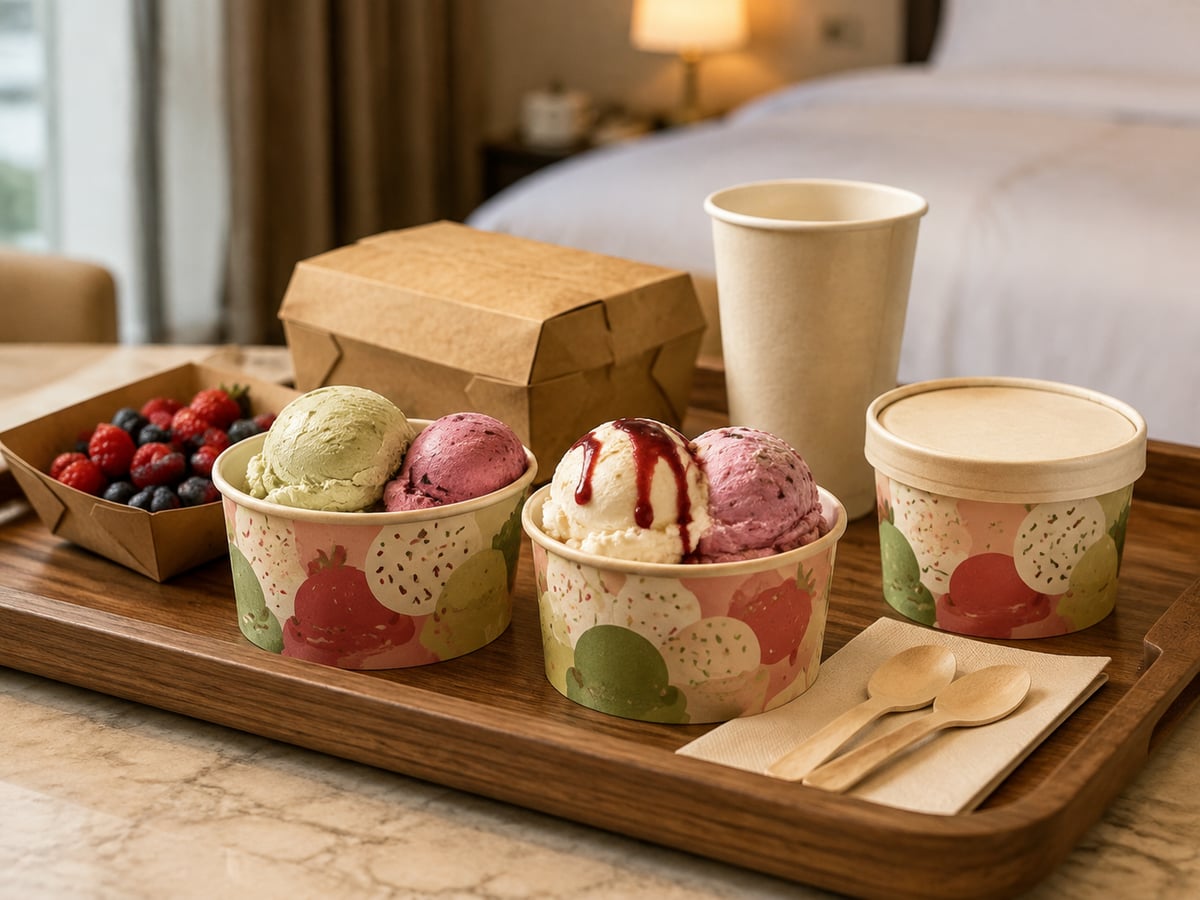
Canada Ice Cream Bowl Quality Standards for Reliable Service
For Canadian ice cream, gelato, frozen yogurt, bakery and dessert brands, quality for 100–1200cc paper dessert bowls should be specified through measurable, repeatable criteria rather than visual impressions alone. A bowl that looks acceptable in a dry warehouse may soften, leak, lose lid retention or distort after it is filled with frozen dessert, warm sauce, fruit toppings or melting ice cream during delivery.A practical quality standard should define bowl dimensions, usable capacity, paper weight, coating type and coverage, rim strength, bottom sealing, lid compatibility, print alignment, carton packing and actual food-use performance. Before bulk production begins, the buyer and factory should approve a white sample or printed pre-production sample, record the results and agree on an inspection plan and failure remedy.For Canada, testing should reflect real operating conditions in cities such as Toronto, Vancouver, Montréal, Calgary and Halifax, where summer delivery demand, refrigerated storage, long-distance logistics and temperature changes can expose weak food packaging. A bowl used for a dine-in scoop shop may perform differently from one carried in a delivery bag for 35 minutes.Quality ItemRecommended Acceptance MethodTypical Control PointWhy It MattersNominal capacityMeasure filled volume in millilitres100cc to 1200cc size rangePrevents under-serving or product overflowTop diameterDigital caliper measurementMatch approved lid diameterEnsures lid fit and stackabilityPaper weightMaterial specification and batch verificationSpecified GSM rangeSupports sidewall rigidity and handling strengthCoating consistencyVisual, weight and soak testingInside food-contact surfaceReduces moisture absorption and leakage riskBottom sealWater hold and compression checkSide seam and base curlProtects against drips during servicePrint toleranceCompare against approved artworkColour, placement and registrationMaintains brand appearance across locationsLid retentionFit test with approved lid SKURim diameter and curl profilePrevents loose lids in chilled deliveryThe table above provides a starting framework. The exact numerical tolerances should be confirmed according to bowl size, filling weight, lid design, coating system, dessert format and distribution method. A 120cc tasting bowl does not need the same compression resistance as a 1000cc family-size sundae container, but both require stable food-contact surfaces and consistent forming.Paper dessert bowls commonly fail because the product specification is too general. A purchase order may state “paper bowl with lid” without identifying the required paperboard, coating performance, rim dimensions, bottom-seal integrity, lid supplier or real-use test conditions. This leaves room for material substitution, inconsistent forming and different interpretations of what is acceptable.In Canadian food-service operations, failure often appears after the bowl has left the store: melting ice cream increases moisture exposure, sauces collect near the bottom seam, condensation forms under the lid, and delivery drivers stack orders in insulated bags. A bowl can then soften at the base, develop a small leak, lose its lid or transfer moisture to the outer carton.Other common failure patterns include bowls sticking together in humid storage, graphics rubbing off from poor print curing, uneven rims that prevent snap-on lids from seating, and capacity variation that disrupts portion control. Problems are more costly when a chain operates across Ontario, British Columbia, Alberta and Quebec because a single weak batch may affect hundreds of stores.var ctx = document.getElementById('lineChart').getContext('2d');new Chart(ctx, {type: 'line',data: {labels: ['2021', '2022', '2023', '2024', '2025', '2026 Forecast'],datasets: [{label: 'Canadian frozen-dessert bowl demand index',data: [100, 107, 115, 124, 133, 143],borderColor: 'rgb(42, 109, 171)',backgroundColor: 'rgba(42, 109, 171, 0.12)',borderWidth: 3,fill: false,tension: 0.25}]},options: {responsive: true, maintainAspectRatio: false}});The market-growth chart illustrates why consistent bowl specifications are increasingly important. As branded frozen dessert, takeout and app-based delivery expand, packaging reliability becomes part of customer retention rather than a simple purchasing detail. Growth does not automatically mean higher quality; it increases the need for documented approval and lot-level traceability.Moisture softening is one of the most frequent service failures for paper bowls used with ice cream, gelato, smoothie bowls, fruit cups and chilled desserts. Frozen desserts often generate condensation as they warm. Toppings such as berries, syrup, whipped cream, chocolate sauce and fruit purée can add liquid exposure. If the inner barrier coating is inconsistent, too thin or damaged during forming, the paperboard can absorb moisture and lose stiffness.The risk increases when a large-format dessert bowl is carried from a freezer display to a customer vehicle or delivery courier. A bowl may be stored at low temperature, then exposed to warm indoor air, then placed into an insulated bag. Repeated temperature changes can create condensation around the rim, sidewall and base.Lid mismatch is closely connected. Even when the bowl itself is structurally sound, a lid with a slightly different inside diameter, locking groove or stiffness can create gaps. Gaps allow melted product to move along the rim, reduce stack stability and increase spill risk. Buyers should never approve a bowl and lid separately when they will be used together in service.Service ConditionLikely FailurePrimary CauseRecommended TestIce cream held for 30 minutesSoft sidewallWeak moisture barrierFrozen dessert hold testWarm chocolate sauce addedBottom seepageSeal weakness or coating gapHot topping and hold testCourier deliveryLid loosensRim and lid mismatchShake and transport simulationStacked cups in freezer roomBowls stick togetherHumidity or coating variationCold storage stack testLarge sundae portionRim distortionInsufficient board stiffnessFilled compression testFruit topping exposureSidewall stainingCoating non-uniformityAcidic food-contact testSealed lid storageCondensation poolingInadequate lid ventilation designChilled closed-lid testThe key lesson is that the bowl, lid, food and delivery process should be tested as one system. A Canadian buyer should provide the intended dessert type, filling temperature, target holding time, lid design and distribution scenario before selecting board grade and coating construction.Paper and coating variation can change the performance of apparently identical 100–1200cc dessert bowls. Board stiffness may vary between paper batches. Coating application may be inconsistent across a roll. Recycled-content formulations, fibre composition, moisture content and converting conditions can also influence forming quality and resistance to liquid penetration.For ice cream bowls, the supplier should identify the food-contact material structure clearly. This may include PE-coated paperboard, water-based barrier paper, PLA-coated paperboard or another suitable system selected for the destination market and intended use. Environmental claims should be supported by the relevant material documentation and should not replace functional testing.Canadian buyers may also require alignment with food-contact expectations and customer sustainability policies. Where documentation is required, the factory should provide applicable declarations, material information and traceability records relevant to the order. Claims involving compostability, recyclable design or FSC-certified paper should be verified according to the selected material and project requirements.var ctx = document.getElementById('barChart').getContext('2d');new Chart(ctx, {type: 'bar',data: {labels: ['Ice Cream Shops', 'Gelato Bars', 'Delivery Desserts', 'Supermarkets', 'Catering', 'Food Courts'],datasets: [{label: 'Estimated packaging demand score',data: [88, 69, 92, 76, 55, 72],backgroundColor: ['#2f80ed', '#56ccf2', '#6fcf97', '#f2c94c', '#eb5757', '#9b51e0']}]},options: {responsive: true, maintainAspectRatio: false}});The industry-demand comparison shows why delivery dessert operations deserve special attention. Their bowls are more likely to encounter movement, lid pressure, longer hold times and moisture accumulation. Retail freezer applications may emphasize stacking and storage stability, while scoop shops may prioritize speed of service and lid fit.Bowl SizeTypical Canadian ApplicationPreferred Performance FocusCommon Lid Requirement100–150ccTasters, samples and mini dessertsAccurate portion size and rim uniformitySmall flat or dome lid180–250ccSingle gelato servingMoisture resistance and print qualitySecure snap lid300–400ccIce cream, frozen yogurt and parfaitsSidewall stiffness and leak resistanceDome lid or flat lid500–650ccLarge dessert bowls and smoothie bowlsBottom strength and transport stabilityDeep dome lid700–900ccSharing desserts and bakery takeoutLoad-bearing rim and seal reliabilityReinforced clear lid1000–1200ccFamily packs and catering dessertsCompression strength and stackingLarge secure-fitting lidThis size guide helps buyers avoid applying a single material specification to every format. Larger bowls typically require more attention to board stiffness, bottom forming and carton protection because their filled weight is significantly higher.Even high-quality paperboard can fail if forming conditions are poorly controlled. The side seam may be incomplete, the bottom curl may be uneven, the rim may be oval rather than round, or the flange may not match the lid’s locking profile. These defects are sometimes difficult to notice in a quick visual inspection, especially when only a few bowls are checked.Critical forming controls include seam overlap, adhesive or heat-seal condition where applicable, bottom knurling, rim curl geometry, bowl height, top diameter and roundness. For printed bowls, artwork position must also remain within an agreed tolerance so that logos, patterns and regulatory text are not visibly shifted.A practical specification should state that the approved lid SKU is used in production verification. If the buyer sources lids separately, both parties should exchange samples and confirm compatibility before the bowl order is released. For chains operating from Toronto to Vancouver, this avoids a situation where bowls from one production run fit a lid while another run does not.Inspection PointExample Acceptance CriterionInspection ToolFailure Risk if IgnoredTop diameterWithin agreed tolerance from approved sampleDigital caliperLid leakage or loose fitBowl heightWithin agreed toleranceHeight gaugeIncorrect capacity or stacking issueRoundnessNo visible oval deformationGauge ring and visual checkLid does not seat evenlyBottom seamNo open channels or wrinklesVisual and water hold testSlow leakage at baseSide seamContinuous, clean overlapVisual inspectionSidewall seepageRim curlUniform profile around circumferenceVisual and lid fit testLid release during transportPrint registrationMatch approved proof toleranceArtwork comparison guideInconsistent brand presentationThe criteria above should be documented on an inspection sheet. This does not require complicated laboratory language. It requires the buyer and supplier to define what is measured, how it is measured, how many samples are checked and what action is taken if results fail.A simple kitchen test can identify many weak batches before a full distribution rollout. The test should use the actual dessert, toppings, lid and service method rather than plain water alone. Water testing is useful, but it does not fully replicate melting fat, sugar, acidity, condensation and lid pressure.For a standard 300–500cc ice cream bowl, fill the bowl to the normal serving level with frozen dessert. Add the heaviest typical topping combination, such as fruit sauce, chocolate sauce and whipped cream. Apply the approved lid, hold the bowl at room temperature for 30 minutes, then place it in a delivery bag or comparable insulated container for another 20 minutes. Check for softening, seepage, lid movement, print damage and base deformation.For larger 700–1200cc bowls, repeat the test with the maximum intended fill weight. Stack filled bowls where relevant, apply light compression similar to carton or delivery-bag loading, and inspect the bottom seam and rim. Record photographs and observations against the approved sample.var ctx = document.getElementById('areaChart').getContext('2d');new Chart(ctx, {type: 'line',data: {labels: ['2022', '2023', '2024', '2025', '2026 Forecast', '2027 Forecast'],datasets: [{label: 'Share of buyers requesting documented functional testing (%)',data: [34, 42, 51, 61, 69, 76],borderColor: 'rgb(39, 174, 96)',backgroundColor: 'rgba(39, 174, 96, 0.24)',fill: true,borderWidth: 3,tension: 0.25}]},options: {responsive: true, maintainAspectRatio: false}});The area chart reflects a broader procurement shift: buyers increasingly request proof of performance, not only material descriptions. By 2026, brands are expected to place more emphasis on written test records, lot traceability, sustainable-material verification and delivery-use validation.When a bowl batch fails, the factory should not simply replace visible defects without identifying the underlying cause. The first step is containment: isolate the affected production lot, preserve samples, confirm carton and pallet codes, and prevent unverified stock from shipping. The second step is root-cause analysis involving materials, machine settings, lid compatibility, packaging conditions and inspection records.If moisture softening occurs, the factory should verify paperboard grade, coating coverage, coating adhesion and storage moisture. If lids are loose, the factory should measure bowl rims and compare them directly with the approved lid. If leakage appears at the base, the forming machine’s bottom-seal parameters, pressure, heat settings and tooling condition should be reviewed.Corrective action should be specific. Examples include adjusting forming pressure, increasing control frequency for top diameter, replacing a worn tool, separating lid-compatible bowl inventory, changing carton packing protection or requalifying the paperboard supplier. A revised sample should then pass the same food-use test before the next bulk run is accepted.Observed FailureImmediate ContainmentLikely Corrective ActionRequired VerificationBase leakageStop shipment from affected lotAdjust bottom-seal forming parametersWater hold and food-fill testSoft sidewallQuarantine material and finished goodsReview board and coating batchCondensation exposure testLoose lidSeparate bowl and lid inventoryCorrect rim diameter or lid pairingFit, inversion and shake testOff-centre printHold printed inventoryRecalibrate printing registrationApproved artwork comparisonCrushed bowls in cartonsInspect palletized stockImprove carton strength or packing countTransit compression simulationMixed sizes in cartonBlock affected warehouse releaseImprove line segregation and labellingCarton audit and count checkA failed batch remedy should be agreed before ordering. Depending on the confirmed issue, the remedy may include replacement production, credit, refund, sorting support, rework where safe and practical, or compensation for verified non-conforming quantities. The agreement should define claim timing, evidence requirements, retained samples and how both parties confirm the final resolution.A written quality standard turns experience into a repeatable purchasing system. It should be attached to the purchase order or signed as part of the product specification. The document should identify the bowl code, artwork revision, material construction, approved sample date, lid code, packaging configuration, inspection level, critical defects, major defects and remedy process.For Canadian importers receiving shipments through Vancouver, Prince Rupert, Montréal or Halifax, the document should also define carton markings, pallet requirements, moisture protection, container loading expectations and shipment documentation. Clear markings make it easier to identify affected stock if a problem is discovered after goods arrive at a regional warehouse.Buyers should keep a repeatable approval record containing photographs, drawings, test results and a physical reference sample where possible. This is especially useful when purchasing teams change, new store locations open or seasonal dessert promotions require reorders months later.var ctx = document.getElementById('comparisonChart').getContext('2d');new Chart(ctx, {type: 'bar',data: {labels: ['Material Traceability', 'Lid Fit Testing', 'Pre-Production Proof', 'Batch Inspection', 'Food-Use Testing', 'Claim Process'],datasets: [{label: 'Basic supplier control score',data: [45, 52, 48, 50, 38, 42],backgroundColor: 'rgba(235, 87, 87, 0.75)'},{label: 'Documented quality-system score',data: [91, 94, 96, 92, 89, 88],backgroundColor: 'rgba(47, 128, 237, 0.75)'}]},options: {responsive: true, maintainAspectRatio: false}});The supplier comparison chart demonstrates the value of a documented quality system. The strongest supplier is not necessarily the one offering the lowest unit price. It is the supplier that can connect material, tooling, samples, inspection records and corrective actions to the same production order.Fude Packaging supports overseas B2B buyers with customized paper bowls, cups, boxes, trays and meal packaging. For Canadian dessert operators, the advantage is the ability to coordinate packaging performance, custom printing, capacity requirements and export preparation through one manufacturing partner rather than several disconnected suppliers.From a technological capability perspective, Fude Packaging uses in-house testing and production monitoring to evaluate material selection, forming quality, leak resistance, lid compatibility, print accuracy and functional performance. Digital proofs, white samples and printed pre-production proofs can be used to confirm design and construction before full-scale output. This gives buyers an opportunity to approve the actual bowl format instead of relying only on a digital image.From a manufacturing capability perspective, Fude Packaging has more than 20 years of packaging experience, a self-owned 30,000 m² production base and automated output capacity of up to 120,000 units per day. Control over printing, die-cutting, forming, inspection, packing and shipment preparation supports more consistent quality across repeated orders. Full-batch traceability can help identify relevant material and production records when a quality issue is investigated.From a service capability perspective, the team supports OEM and ODM projects, artwork and dieline checking, Pantone matching, sampling, scheduled orders and export documentation. Canadian buyers can discuss destination requirements, food type, serving temperature, order timing and shipment preference before production. Learn more about available custom paper bowl options or review Fude Packaging’s broader custom packaging services.For brands supplying dessert stores in Toronto, Vancouver, Edmonton, Ottawa or Montréal, scheduled production can reduce the risk of seasonal stock shortages. Buyers can also review the company background through Fude Packaging’s manufacturing profile and request project-specific samples through the contact team.1. Which defects are critical for 100–1200cc dessert bowls?Critical defects are those that can cause leakage, food-contact concerns, lid detachment, structural collapse, incorrect product size, severe contamination or major carton mixing. Open bottom seams, damaged food-contact coating, severe rim deformation and bowls that cannot retain the approved lid should normally be treated as critical or major non-conformities.2. How many cartons should be inspected?The inspection quantity should be agreed before production and should reflect order volume, product risk and past performance. A practical approach is to inspect cartons across the beginning, middle and end of production, rather than taking all samples from one pallet. For larger orders, buyers may use an agreed sampling standard or appoint an independent inspection company before shipment.3. Which real-food tests should be used?Use the actual ice cream, gelato, frozen yogurt, fruit sauce, syrup, whipped cream or other topping expected in service. Test normal and maximum fill levels, room-temperature holding, chilled delivery, lid fit, stacking and transport movement. Water holds are useful for seam checks, but actual food testing is better for identifying condensation and coating weaknesses.4. How is the approved sample linked to production?Assign the approved sample a product code, artwork revision, material description, lid code and approval date. The same details should appear on the purchase order, production sheet and final inspection report. Keep photographs, measurements and test results with the order record so future reorders can be matched to the approved standard.5. What remedy should apply to a failed batch?The remedy should be written into the commercial agreement. Depending on the verified cause and affected quantity, it may include replacement goods, credit, refund, sorting, rework where appropriate or another mutually agreed solution. Claims should include carton codes, photographs, retained samples and clear evidence of the defect.6. What trends should Canadian dessert brands prepare for in 2026?Key trends include stronger demand for documented food-contact compliance, lower-plastic packaging strategies, verified sustainable material claims, digital artwork approval, batch traceability and packaging designed for delivery platforms. Brands will increasingly compare suppliers based on practical testing, consistency and risk control rather than unit cost alone. -

Canada Guide to 3-Compartment Meal Box Quality Control
For Canadian institutional caterers, restaurants, meal-prep brands, ghost kitchens and delivery operators, a reliable 750–1300 ml three-compartment meal box must be approved against measurable requirements rather than visual impressions alone. The specification should cover formed dimensions, compartment capacity, board weight, coating coverage, seam integrity, lid fit, print tolerance, carton packing and real-food performance for one main dish plus two side dishes.A practical approval process begins with a signed reference sample, a dimensional drawing, a material declaration, an inspection plan and a defined remedy when a batch fails. For example, a Toronto meal-delivery operator serving rice bowls, grilled chicken and sauce-based vegetables may need a different barrier level from a Vancouver salad-chain operator packing cold meals. The box should be tested with the food, fill weight, holding time and transport conditions that match the actual Canadian application.The most important question is not simply whether the meal box “looks good.” It is whether the box protects food quality during filling, stacking, delivery and disposal. A 1000 ml container that leaks after 20 minutes of hot gravy exposure, transfers sauce between compartments, loses rigidity in a delivery bag or has an unstable lid is not fit for the intended purpose, even if its print is attractive.Quality PointRecommended Measurable RequirementInspection MethodTypical Failure RiskOverall dimensionsWithin agreed drawing tolerance, commonly ±2 mm unless otherwise specifiedCaliper, ruler and formed-sample comparisonLid mismatch, stacking instabilityCompartment capacityMinimum declared volume at practical fill lineWater-fill test in each compartmentUnderfilling or food overflowPaperboard basis weightWithin approved material specificationGSM test from retained sheet sampleSoft walls and reduced compression strengthCoating continuityNo visible pinholes, skips or uncoated food-contact areasVisual inspection and grease testGrease bleed and liquid absorptionSeam and corner formingNo open seam, split corner or incomplete bondVisual check and liquid-hold testLeaks at folds and cornersPrint registrationWithin approved artwork tolerance, commonly ±1 mm to ±1.5 mmApproved proof comparisonBranding errors and unreadable textLid engagementSecure fit without excessive force or unintentional releaseManual opening and shake testSpills during deliveryThe table above should be converted into a purchase specification that both buyer and factory can sign. It gives the inspection team a common language and avoids disputes based on subjective terms such as “strong,” “good coating” or “acceptable printing.”Three-compartment meal packaging is structurally more demanding than a single-compartment lunch box. Internal dividers create additional fold lines, compression points and potential paths for liquid migration. The main compartment commonly carries the highest food weight, while the side compartments may contain vegetables, sauces, fries, pasta, fruit, gravy or dressings. Every compartment must remain functional under the expected service temperature.Canadian buyers should identify the food-service scenario before selecting material. A 750 ml box may suit a lighter school lunch or airline-style meal, while 1000 ml and 1300 ml formats are commonly used for restaurant entrees, corporate catering, hospital meal services and delivery combinations. If hot, oily or acidic food is included, the barrier coating and board stiffness become more important than for dry bakery products.Box SizeTypical Food ConfigurationCommon Canadian ApplicationPriority Performance Requirement750 mlLight entrée with two small sidesSchool catering, cafés, meal-prep programsCompact stacking and portion control850 mlRice or pasta main with vegetables and sauceQuick-service restaurantsDivider integrity and grease resistance1000 mlStandard lunch or dinner combinationCorporate caterers in Toronto and OttawaLeak resistance and lid security1100 mlProtein-heavy meal with two sidesFitness meal-prep providersCompression strength and capacity accuracy1200 mlLarge hot meal with gravy or curryRestaurant takeaway and deliveryHeat tolerance and sauce containment1300 mlFamily-size individual meal or premium comboInstitutional catering and food hallsRigid walls and secure closureWhen comparing product types, buyers should request formed samples rather than reviewing only flat die-cut blanks. The forming process affects wall height, compartment shape, corner bonding and lid compatibility. A flat sample cannot prove whether a divider will remain stable under a portion of hot rice, braised meat and wet vegetables.Canada’s foodservice packaging market is shaped by long delivery distances, winter weather, bilingual labelling needs in some sales channels, municipal waste policies and increasing demand for fibre-based alternatives to rigid plastic. In major markets such as Toronto, Montréal, Vancouver, Calgary and Halifax, food operators are balancing cost control with customer expectations for cleaner, more sustainable packaging.For imports entering through Vancouver, Prince Rupert, Montréal or Halifax, packaging buyers should also allow for sea-freight lead time, inland transport and warehouse storage conditions. Cartons must protect formed boxes from humidity, crushing and contamination during shipment. If orders are distributed nationally from Ontario or British Columbia, pallet configuration and carton dimensions should be reviewed before production.var ctx = document.getElementById('canadaMealBoxGrowth').getContext('2d');var chart = new Chart(ctx, {type: 'line',data: {labels: ['2022', '2023', '2024', '2025', '2026 Forecast', '2027 Forecast'],datasets: [{label: 'Indexed demand for compartment meal boxes in Canada',data: [100, 108, 117, 126, 136, 147],borderColor: 'rgb(34, 115, 78)',backgroundColor: 'rgba(34, 115, 78, 0.12)',fill: false,tension: 0.25,borderWidth: 3}]},options: {responsive: true,maintainAspectRatio: false,plugins: { legend: { display: true } },scales: { y: { beginAtZero: false, title: { display: true, text: 'Demand Index' } } }}});This indexed chart illustrates a practical purchasing assumption: demand for compartmented fibre meal packaging is expected to continue rising as delivery, prepared meals and institutional catering expand. Actual purchasing volumes should be based on each operator’s menu cycle, location count and seasonal demand rather than market estimates alone.Sauce migration is one of the most frequent quality complaints with three-compartment meal boxes. It can occur when internal divider height is insufficient, corners are not fully formed, the box is tilted in delivery, the paperboard absorbs liquid or the main compartment is overfilled. Instead of writing “no sauce mixing,” define a repeatable test condition.For example, the buyer may specify that 100 ml of 70°C coloured test sauce is placed in the main compartment, while the two side compartments remain dry. The closed box is held at a 15-degree tilt for 10 minutes, returned upright and inspected. No visible liquid should enter the side compartments, no external leak should appear, and the divider should not deform beyond the agreed tolerance. The exact volume, temperature, duration and angle should be adapted to the real menu.Test ElementSuggested Starting ConditionAcceptance CriterionReason for TestSauce typeWater-based coloured sauce or menu-equivalent gravyNo cross-compartment transferShows divider containment performanceFill volume80–100% of normal service portionNo overflow at normal handling angleReplicates actual filling practiceFood temperature60°C to 80°C for hot mealsNo softening that causes loss of shapeChecks heat and moisture exposureHold time30, 45 or 60 minutes as agreedNo external leak or divider collapseReflects delivery and waiting timeTilt test15 degrees for 10 minutesNo visible migration into adjacent sectionsReplicates courier handlingShake testFive controlled hand movements after closingLid remains engaged; contents retainedChecks delivery-bag movementPost-test inspectionOpen box after test completionNo coating delamination or fibre exposureConfirms functional barrier continuityThe purpose of this table is to create a shared test protocol. It is particularly useful for Canadian delivery operators because a box may travel from a restaurant kitchen to a downtown office, suburban home or campus residence under changing outdoor temperatures. Buyers should document any menu-specific challenge, such as butter chicken, poutine gravy, kimchi liquid, curry, salsa or sesame dressing.Quality begins before forming. Paperboard, barrier coating, ink, adhesive and packaging materials should be checked against the approved bill of materials. Incoming inspection reduces the risk that production is started with the wrong board grade, incorrect coating, unapproved ink colour or damaged raw material.For food-contact packaging supplied to Canada, buyers should request documentation appropriate to the product, material and destination requirements. Documentation review should be part of the approval file, together with applicable food-contact declarations, material traceability and any sustainability claim support. Claims such as compostable, recyclable or FSC-certified should only be used where the product, certification scope and local waste-stream conditions support them.Fude Packaging operates a self-owned 30,000 m² production base in Shandong with more than 20 years of paper-packaging experience. Its automated lines are designed for scalable production, with stated capacity of up to 120,000 units per day depending on product configuration. Direct control over material selection, printing, die-cutting, forming, inspection, packing and shipment supports a more consistent approval process for overseas B2B buyers.For custom compartment meal boxes, a factory should maintain records for raw-material lot number, machine settings, forming tool, production date, inspector, packaging lot and shipment reference. This is especially important where one Canadian customer has several artwork versions, box sizes or coating options in circulation.var ctx = document.getElementById('industryDemandChart').getContext('2d');var chart = new Chart(ctx, {type: 'bar',data: {labels: ['Restaurant Delivery', 'Corporate Catering', 'Meal Prep', 'Healthcare', 'Education', 'Retail Ready Meals'],datasets: [{label: 'Relative demand score for 3-compartment meal boxes',data: [92, 78, 86, 69, 74, 81],backgroundColor: ['rgb(54, 111, 160)','rgb(75, 151, 99)','rgb(231, 161, 60)','rgb(171, 91, 91)','rgb(121, 104, 177)','rgb(65, 151, 154)']}]},options: {responsive: true,maintainAspectRatio: false,plugins: { legend: { display: true } },scales: { y: { beginAtZero: true, max: 100, title: { display: true, text: 'Relative Demand Score' } } }}});The chart identifies sectors where compartment separation creates practical value. Delivery and meal-prep services place the highest emphasis on leak prevention, stacking and presentation. Healthcare and education buyers may place greater emphasis on portion consistency, traceability and routine inspection records.Laboratory-style testing should be supported by real-food validation. A meal box can pass a short water test yet fail with oily noodles, hot roasted vegetables or acidic tomato sauce. The most useful protocol combines controlled tests with a menu simulation that reflects normal filling, lid closure, bagging, stacking and delivery time.Performance TestSuggested ProcedureAcceptance StandardOperational ImportanceStatic leak testFill compartments with test liquid and hold for 30 minutesNo visible external leakageIdentifies seam and corner failuresGrease resistance testPlace oily food or oil medium in main compartmentNo oil stain through exterior surfaceProtects bags, hands and customer perceptionHot-food testFill with food at agreed serving temperatureNo collapse, coating lift or severe distortionValidates suitability for hot mealsCompression testStack filled closed boxes under agreed loadNo crushing that opens lid or spills foodSupports catering and delivery stackingDrop simulationControlled short drop in packed delivery configurationNo lid release or structural breakReplicates courier handling incidentsCold-hold testStore filled sample under chilled conditionsNo soggy base or loss of closure functionRelevant to meal-prep and retail foodMicrowave suitability testOnly when material and intended use are approvedNo unsafe deformation under stated conditionsSupports clearly defined consumer use claimsThese procedures are starting points, not universal legal standards. The buyer should define the test temperature, duration, fill weight and failure threshold based on the food application. A box used for 15-minute counter service in Calgary does not require the identical protocol as a box used for 60-minute third-party delivery in Greater Toronto.By 2026, Canadian buyers are likely to ask more detailed questions about material efficiency, source traceability, barrier technologies and end-of-life options. The market is moving beyond generic “eco-friendly” language toward more specific questions: Is the fibre responsibly sourced? Is the coating suitable for the intended food? Can the pack enter a local recycling or organics stream? Does the claim match the province and municipality where the box is used?Technology trends include lighter-weight boards designed to retain stiffness, water-based coatings, improved moulding and forming precision, digital proofing, camera-assisted print inspection and batch-level production records. For operators serving Montréal, Toronto, Edmonton or Vancouver, the most responsible approach is to match packaging claims to the local collection infrastructure rather than rely on a single sustainability message across all regions.var ctx = document.getElementById('sustainabilityTrendChart').getContext('2d');var chart = new Chart(ctx, {type: 'line',data: {labels: ['2023', '2024', '2025', '2026 Forecast', '2027 Forecast', '2028 Forecast'],datasets: [{label: 'Demand for documented fibre-based packaging solutions',data: [38, 47, 58, 68, 76, 83],borderColor: 'rgb(47, 128, 110)',backgroundColor: 'rgba(47, 128, 110, 0.25)',fill: true,tension: 0.3,borderWidth: 3}]},options: {responsive: true,maintainAspectRatio: false,plugins: { legend: { display: true } },scales: { y: { beginAtZero: true, max: 100, title: { display: true, text: 'Buyer Priority Index' } } }}});The area chart shows the expected shift toward documentation-backed packaging decisions. Buyers can prepare by retaining approved material specifications, food-contact records, batch numbers, artwork approvals and performance-test reports for each recurring meal box program.A pre-shipment inspection plan should identify the lot size, cartons selected, samples drawn, tests performed and acceptance number for each defect class. Random selection should cover different production times, pallet locations and carton positions. Sampling only from the top of one pallet does not provide meaningful assurance.Many buyers use an AQL-based inspection framework, but the final plan should be agreed in the purchase order. Critical defects should generally have a zero-acceptance approach. Major and minor defect limits should reflect the commercial risk, product price and end-use environment. Institutional catering programs may require stricter controls than a low-risk dry-food application.Lot Size ExampleSuggested Cartons to SelectSample FocusCritical Defect RuleUp to 10,000 units5 cartons from different locationsDimensions, forming, print, packingAccept zero critical defects10,001–35,000 units8 cartons from at least 2 palletsAdd leak and lid testingStop and investigate on any critical defect35,001–75,000 units10 cartons from multiple pallet layersAdd carton count and compression checksAccept zero critical defects75,001–150,000 units13 cartons from broad pallet coverageInclude production-lot traceability reviewHold affected lot for review150,001–300,000 units20 cartons across production periodsInclude repeat functional testingRequire documented root-cause actionOver 300,000 unitsCustom statistically agreed planUse shift and machine-based stratificationZero critical defects unless contract states otherwiseThis sampling guide helps buyers make inspections repeatable. If a Canadian importer uses a third-party inspection agency, the agency should receive the approved sample, artwork file, specification sheet, carton marking instructions and test protocol before arriving at the factory.Defect classification allows the buyer and supplier to decide quickly whether a lot may ship, needs sorting or requires remanufacture. A defect report should include photographs, sample number, carton number, pallet number, defect type, severity, quantity found and the action taken. Vague descriptions such as “poor quality” do not support corrective action.SeverityExamplesCustomer RiskTypical DispositionCriticalFood-contact contamination, wrong material, major leak, unsafe sharp edgeFood safety or immediate product failureReject or hold entire affected batchCriticalIncorrect product size that cannot close with approved lidHigh spill and operational riskStop shipment and investigateMajorOpen corner seam, divider collapse, serious print misregistrationLikely customer complaint or unusable packSort, rework or reject based on rateMajorGrease bleed after agreed food simulationDelivery bag contamination and poor presentationHold lot and repeat testingMinorSmall non-food-contact print markLimited effect on use or appearanceAccept within agreed limitMinorSlight carton scuff with no product damageLow operational riskRecord and monitor trendObservationVariation still within toleranceNo immediate failureTrack for process improvementA defect log should be retained with the batch file. Over time, trend analysis may reveal that failures are linked to a specific machine, tool, shift, board lot or artwork version. This evidence helps prevent repeated disputes and supports more efficient supplier management.When an inspection fails, the remedy should be defined in advance. Depending on the defect and urgency, available actions can include containment, 100% sorting, rework, replacement production, credit, partial shipment approval or rejection. A buyer should not accept a vague promise to “improve next time” without documentation of what failed, why it failed and how recurrence will be prevented.A corrective action report should identify the affected quantity, root cause, immediate containment action, corrective action, preventive action, responsible person and verification date. For a compartment meal box, the report may show that a forming temperature setting caused weak corner bonds, or that a coating lot did not meet the approved barrier specification.Fude Packaging supports overseas B2B projects with digital proofs, white samples, printed pre-production proofs and functional prototypes. This gives Canadian purchasers an opportunity to verify compartment layout, volume, lid fit, print placement, board feel and actual food performance before committing to bulk production. Customers can also review packaging options for food containers through the food container range when comparing meal boxes with bowls, trays and related formats.For buyers managing seasonal promotions, restaurant rollouts or distributor replenishment, Fude Packaging can support scheduled orders, export packing documentation and coordinated shipment planning. Project discussions can begin through the company’s custom packaging services, where food type, target capacity, coating needs, branding, expected order quantity and delivery route can be clarified.var ctx = document.getElementById('supplierComparisonChart').getContext('2d');var chart = new Chart(ctx, {type: 'bar',data: {labels: ['Sample Options', 'Batch Traceability', 'Custom Printing', 'Functional Testing', 'Export Support', 'Production Scale'],datasets: [{label: 'Integrated manufacturer model',data: [92, 95, 94, 89, 88, 91],backgroundColor: 'rgb(48, 104, 166)'},{label: 'Basic trading-only sourcing model',data: [62, 55, 68, 51, 64, 58],backgroundColor: 'rgb(173, 173, 173)'}]},options: {responsive: true,maintainAspectRatio: false,plugins: { legend: { display: true } },scales: { y: { beginAtZero: true, max: 100, title: { display: true, text: 'Relative Capability Score' } } }}});This comparison chart is an illustrative procurement tool rather than an independent ranking. Canadian buyers should compare suppliers using documented evidence: approved samples, factory audit information, test records, production capacity, communication speed, export experience and response procedures for non-conforming goods.Local Canadian converters may offer shorter domestic transport times and easier access to small replenishment quantities. Overseas manufacturers may offer broader customization, scalable production and consolidated sourcing for multiple paper packaging categories. The best sourcing model depends on order volume, forecast stability, artwork complexity, warehouse capacity and delivery deadline.For a buyer importing into Vancouver or Montréal, it is useful to compare landed cost rather than unit price alone. Include freight, customs handling, inland delivery, warehousing, inspection, damage allowance, inventory carrying cost and the risk of stock-outs. For fast-moving programs in Toronto, Mississauga, Brampton, Surrey or Calgary, a scheduled order program can balance ocean-freight economics with local inventory availability.Buyers interested in reviewing Fude Packaging’s manufacturing background and international project experience can visit about Fude Packaging. For a project-specific quality checklist, sample request or quotation, contact the team through the Canadian buyer enquiry channel.Fude Packaging combines manufacturing, quality control and export support for paper food packaging programs. The company serves international customers with products including paper cups, bowls, boxes, trays, burger boxes, kraft lunch boxes, salad containers, noodle boxes and multi-compartment meal packaging. This wider product range can help Canadian distributors consolidate related packaging purchases under one supplier.Its in-house laboratory and production-control process support incoming material checks, in-process monitoring, final inspection and batch verification. For a 750–1300 ml three-compartment meal box project, the most effective workflow is: confirm the menu and use conditions; select board and barrier structure; approve the dieline; issue a digital proof; inspect a white sample; approve a printed pre-production sample; conduct food simulation; and retain the approved reference against which bulk production is inspected.Fude Packaging can also coordinate third-party inspection where requested. This may be useful for Canadian importers that require an independent pre-shipment report before containers leave China. Documentation should be reviewed according to the product’s intended use and destination requirements, including applicable food-contact, material-source and sustainability documentation.Critical defects normally include food-contact contamination, wrong approved material, major leakage, sharp unsafe edges, incorrect box configuration, inability to close with the approved lid and defects that allow hot food or sauce to escape during normal use. Critical defects should generally result in a shipment hold and immediate investigation.The number depends on total lot size, pallet count and agreed sampling plan. For smaller lots, five cartons from different locations may be a practical starting point. Larger orders should include more cartons selected from different pallets, layers and production periods. The plan should be confirmed in the purchase order before production begins.Use food that represents the actual menu: hot gravy, curry, oily noodles, rice, roasted vegetables, fried foods, acidic sauces or chilled salad dressing. Test normal fill weight, serving temperature, holding time, lid closure, delivery-bag stacking and controlled tilt. A real-food test is more meaningful when it duplicates the restaurant’s actual operating conditions.The approved sample should receive a reference number and be linked to the final artwork, dieline, dimensions, board specification, coating type, print standard and testing protocol. The factory should retain a controlled reference sample, and the buyer should retain a matching signed or dated sample. Final inspection should compare production units against this record.The remedy depends on defect severity and quantity affected. Options include shipment hold, re-inspection, sorting, rework, replacement production, credit or rejection. The supplier should issue a documented corrective action report that identifies the affected batch, root cause, corrective measure and verification result before the next shipment is approved.Include product name, size, compartment layout, material, coating, colour, artwork revision, print tolerance, packing quantity, carton marking, pallet requirement, inspection method, defect limits, food-test conditions, documentation requirements, delivery terms and remedy procedure. Clear purchase-order language protects both buyer and supplier.No. End-of-life performance depends on the board, coating, inks, adhesives, food contamination and the collection systems available in the intended Canadian municipality. Buyers should verify claims with appropriate documentation and avoid broad environmental statements that cannot be supported for the specific product and local waste stream.For Canadian food-service operators, the strongest quality program is built on a realistic meal simulation, measurable acceptance criteria, retained approval samples, pre-shipment inspection and full batch traceability. This approach helps reduce leakage claims, branding errors, delivery failures and costly supply interruptions while creating a repeatable specification for every future order. -

Global Market Guide to Wholesale Food Packaging Suppliers
When selecting a food packaging wholesale supplier for distributors, buyers should verify more than catalog pricing or attractive product photos. The supplier must demonstrate that it can repeatedly manufacture the exact cup, bowl, box, tray, or container required, using suitable materials, controlled processes, food-contact documentation, traceable lots, and an established corrective-action system.For Global market distributors, the most reliable qualification method combines document review, factory capability verification, product-specific sample testing, pre-shipment inspection, and measurable acceptance criteria. A supplier may produce standard kraft food boxes successfully but lack the coating equipment, forming controls, leak testing, or lid-matching capability needed for hot soup bowls, cold beverage cups, grease-resistant burger boxes, or custom-printed takeaway containers.Buyers should begin with a written product brief that defines food type, serving temperature, capacity, material preference, coating requirement, print design, destination market, expected annual demand, order frequency, carton configuration, and quality limits. This brief becomes the basis for comparing suppliers fairly and preventing misunderstandings after an order is placed.Qualification AreaWhat the Distributor Should RequestPractical Verification MethodProduct fitDrawings, dimensions, material specifications, application photosTest samples with the actual food, lid, and filling processFood-contact safetyRelevant declarations, test reports, raw-material informationConfirm documents match the product, material, and destinationEquipmentMachine list, production photos, maintenance recordsReview forming, printing, die-cutting, inspection, and packing stagesTraceabilityLot coding method, material batch records, inspection reportsAsk the factory to trace one finished carton back to incoming materialsCapacityMonthly output data, production schedule, order backlogCompare available machine hours with forecasted peak demandCorrective actionComplaint process, root-cause reports, replacement policyReview how previous quality issues were closed and preventedThis verification approach protects distributors from common wholesale risks: inconsistent print color, weak side seams, lid mismatch, odor, damaged cartons, incomplete declarations, insufficient peak-season capacity, and late corrective action. It also creates a clearer basis for long-term supply agreements with measurable supplier performance targets.Distributor product scope should be built around customer use cases rather than a generic packaging list. Restaurants, convenience stores, coffee chains, caterers, supermarkets, delivery platforms, and meal-preparation companies require different combinations of performance, presentation, price, and compliance documentation. A distributor serving London coffee shops may prioritize branded paper cups and secure lids, while a buyer supplying Dubai delivery kitchens may focus on heat retention, stackability, and grease resistance. In Sydney or Los Angeles, compostability claims and local waste-stream compatibility may be commercially important.Core categories include paper cups, paper bowls, salad containers, noodle boxes, burger boxes, kraft lunch boxes, food trays, multi-compartment meal boxes, and matching lids. Buyers sourcing a broad assortment can simplify replenishment by working with a manufacturer capable of producing multiple categories in-house. For example, distributors can explore food containers for takeaway and meal service when building a versatile catalog for restaurants and retailers.Product CategoryTypical End UseCritical Purchase RequirementPaper cupsHot coffee, tea, cold drinksLeak resistance, rim quality, lid compatibility, print registrationPaper bowlsSoup, noodles, rice, saladsSeam integrity, heat tolerance, nesting performanceBurger boxesFast food and deliveryGrease resistance, folding accuracy, compression strengthKraft lunch boxesBakery, deli, meal preparationClosure security, food-contact suitability, carton efficiencySalad containersCold prepared foodVisibility options, lid fit, moisture resistanceNoodle boxesAsian takeaway and street foodLeak control, heat retention, easy handlingMeal boxesAirline, catering, institutional mealsCompartment definition, stacking, portion consistencyThe table shows why distributors should avoid approving a supplier based on one successful product alone. Each format introduces distinct risks. A paper bowl suitable for cold salad may not be appropriate for oily ramen; a standard cup may not work with a high-speed café lid dispenser. Product specifications must therefore identify the intended application rather than relying only on dimensions or a product name.Global demand for convenient, hygienic, and branded foodservice packaging continues to influence purchasing decisions. The following line chart illustrates a realistic indexed view of distributor demand growth for paper-based food packaging categories from 2022 through projected 2027.var ctxMarketGrowth = document.getElementById('marketGrowthChart').getContext('2d');new Chart(ctxMarketGrowth, { type: 'line', data: { labels: ['2022', '2023', '2024', '2025', '2026 Forecast', '2027 Forecast'], datasets: [{ label: 'Global Distributor Demand Index', data: [100, 108, 117, 126, 136, 147], borderColor: 'rgb(44, 122, 78)', backgroundColor: 'rgba(44, 122, 78, 0.12)', borderWidth: 3, tension: 0.3, fill: false }] }, options: { responsive: false, maintainAspectRatio: false, scales: { y: { beginAtZero: false } } }});Factory equipment should be reviewed against the actual product scope. A reliable food packaging wholesale supplier needs more than general paper-converting machines. Buyers should identify whether the factory has suitable printing equipment, die-cutting lines, paper cup or bowl forming machines, sealing controls, inspection stations, packing equipment, and laboratory tools. Equipment condition matters as much as equipment quantity because worn forming dies, poor temperature control, or inconsistent glue application can create leakage and dimensional variation.For custom packaging, confirm that artwork preparation, color matching, plate management, and print inspection are controlled internally or by qualified partners. For cup and bowl programs, check how the factory controls bottom sealing, sidewall overlap, rim forming, and lid compatibility. For food boxes, examine folding accuracy, crease strength, glue placement, grease barriers, and finished-stack consistency.Fude Packaging operates from a self-owned 30,000 m² manufacturing facility in Shandong, within an established Chinese paper and packaging supply region. Its integrated manufacturing process covers material selection, printing, die-cutting, forming, inspection, packing, and shipment coordination. Automated production lines can produce up to 120,000 units per day, subject to the product format and specification. The company also uses an in-house laboratory to support quality and performance testing.Equipment or Control PointWhy It MattersBuyer Verification QuestionPrinting equipmentControls brand color, registration, and legibilityHow are Pantone targets and print samples approved?Die-cutting equipmentDetermines folding accuracy and structural consistencyHow are cut and crease tolerances monitored?Cup and bowl forming linesInfluence seam strength and finished dimensionsWhat in-process checks detect weak seams?Coating and material handlingAffects barrier performance and food-contact consistencyWhich material lots are used for each production batch?Laboratory testing toolsSupports functional and quality verificationCan the factory test leak resistance, compression, and fit?Automated packing linesReduce packing variation and transport damageHow are pack counts and carton labels verified?Maintenance systemHelps prevent avoidable production defectsCan recent preventive-maintenance records be reviewed?The equipment review should lead to a product-specific factory audit checklist. A distributor importing through Rotterdam, Hamburg, Jebel Ali, Singapore, or Long Beach may face expensive consequences if a container arrives with widespread defects. Reviewing machine suitability before production is generally less costly than rejecting inventory after unloading.Minimum order quantity is not simply a supplier policy; it is usually connected to raw-material purchasing, printing plates, setup time, machine efficiency, packaging configuration, and freight economics. Distributors should compare total landed cost, not only ex-works unit price. A lower product price can be offset by weak cartons, poor pallet utilization, high defect rates, delayed shipment, or the need to hold too many slow-moving stock keeping units.Custom printing usually increases the practical MOQ because production needs sufficient volume to absorb setup and artwork costs. Standard sizes with neutral designs can support smaller replenishment orders, while bespoke dimensions, special coatings, multi-color printing, and exclusive structures generally need larger runs. Buyers should request a price ladder showing the effect of volume, print coverage, material grade, carton quantity, and delivery terms.Price DriverEffect on CostDistributor Buying ActionPaperboard grade and weightHigher strength or specialty board increases material costSpecify required performance rather than over-engineeringBarrier coatingChanges heat, moisture, grease, and recycling characteristicsMatch coating to food temperature and destination needsCustom print colorsMore colors and larger coverage increase setup complexityConsolidate designs and approve color standards earlyTooling and custom sizeNew dies or molds create upfront costsAmortize tooling over forecasted annual volumeOrder quantityLarger runs improve machine efficiencyUse volume tiers and scheduled call-off ordersCarton configurationImpacts labor, warehouse handling, and freight densityOptimize inner packs for customer consumption patternsFreight modeAir freight costs more but shortens transit timeReserve air freight for samples, launches, or urgent shortfallsA practical strategy is to combine high-volume branded items with standard stock formats in one supply program. For example, a distributor may order custom coffee cups for a regional café chain while adding standard bowls and kraft boxes to improve container utilization. This reduces fragmented sourcing and can improve purchasing leverage without forcing every customer into large custom MOQs.Samples should not be treated as decoration or sales material. A product-specific trial should replicate real operating conditions. For a hot beverage cup, test the intended beverage temperature, holding time, lid fit, sleeve compatibility, transport handling, and print appearance after condensation. For a bowl, test the actual soup, sauce, noodles, oil content, filling level, stacking, and delivery period. For a burger box, assess grease migration, closure performance, crush resistance, and food presentation after travel.A thorough approval process normally includes white samples to confirm structure, printed samples to verify artwork and color, and functional prototypes to evaluate use performance. Distributors should keep signed or digitally approved control samples and reference them during future inspections. Acceptance limits should be agreed before mass production rather than debated after a claim arises.Quality AttributeExample Acceptance RequirementInspection MethodDimensionsWithin agreed product drawing toleranceCaliper, ruler, template, or fitted gaugeCapacityMeets stated volume at defined fill levelWater-fill test using calibrated measurementLeak resistanceNo visible leakage during specified test durationHot or cold liquid holding testLid fitLid remains secure during normal handlingManual fit, inversion, and vibration checksPrint qualityNo major color deviation, blur, missing print, or misregistrationApproved artwork comparison and visual inspectionOdor and cleanlinessNo abnormal odor, foreign matter, or visible contaminationSensory and visual examinationCarton packingCorrect count, labels, protection, and carton integrityRandom carton audit before shipmentThe table provides a starting point, but numerical tolerances should reflect the product. A beverage distributor may define a maximum acceptable defect level for rim damage, while a meal-kit distributor may prioritize carton count accuracy and nesting consistency. When products are used in automated filling or dispensing equipment, conduct a line trial before approving the final design.Industry demand varies by end-use sector. The following bar chart provides an illustrative comparison of annual paper-food-packaging demand from distributor customer groups.var ctxIndustryDemand = document.getElementById('industryDemandChart').getContext('2d');new Chart(ctxIndustryDemand, { type: 'bar', data: { labels: ['Quick-Service Restaurants', 'Coffee Shops', 'Delivery Kitchens', 'Retail Food', 'Catering', 'Institutions'], datasets: [{ label: 'Illustrative Annual Demand Index', data: [92, 78, 88, 61, 47, 54], backgroundColor: ['#C46B38', '#A65335', '#D38C45', '#6A9A72', '#537C9A', '#85629B'] }] }, options: { responsive: false, maintainAspectRatio: false, scales: { y: { beginAtZero: true } } }});Compliance documentation must match the specific material, coating, intended food contact, and destination market. Distributors should never assume that a certificate for one product automatically covers every item in a supplier’s catalog. Request current documents for the actual item being imported, including material declarations, applicable food-contact statements, test evidence where required, traceability records, and sustainability documentation for any environmental claim used in marketing.Requirements may differ across the United States, European Union, United Kingdom, Gulf markets, Australia, New Zealand, Southeast Asia, and other destinations. Importers should confirm their local legal requirements with qualified regulatory advisers, particularly where packaging may contact hot, acidic, oily, or frozen foods. Claims such as “compostable,” “recyclable,” “plastic-free,” or “FSC-certified” should be specific, supported, and compatible with the relevant local collection or certification framework.Fude Packaging supports products and manufacturing systems aligned with major international requirements, including FDA-related food-contact expectations, EC 1935/2004, FSC-certified material options, ISO 9001 quality-management practices, and selected compostability options such as BPI and OK Compost. Documentation should always be reviewed against the chosen product and destination market before order confirmation.Document TypePurpose for the DistributorImportant Review PointFood-contact declarationConfirms intended suitability of material for food useCheck product description, material, date, and destination relevanceMaterial specificationDefines paper, coating, ink, and adhesive componentsEnsure it matches the approved sample and purchase orderTest reportProvides evidence for defined performance or migration parametersVerify scope, laboratory, sample identity, and validityFSC documentationSupports responsible-sourcing claims where applicableConfirm chain-of-custody claim rules before using logosCompostability evidenceSupports environmental positioning for eligible productsConfirm the claim applies to the full product constructionBatch inspection reportShows production-lot quality checksMatch lot number to cartons, invoice, and shipping documentsCertificate of originSupports customs and trade documentationConfirm format required by destination customs authoritiesDocumentation should be controlled as part of the distributor’s supplier file. Assign a review owner, expiry date, product applicability, and revision history. This reduces the risk of a sales team using an outdated certificate or making an unsupported sustainability claim to a restaurant chain or retailer.Capacity is real only when it is available at the moment the distributor needs it. A supplier’s theoretical monthly output does not guarantee space during holiday peaks, promotional launches, restaurant rollouts, or seasonal beverage demand. Buyers should ask for production calendars, current order backlog, machine allocation, shift arrangements, raw-material lead times, and contingency plans for equipment failure or port disruption.Standard production orders at Fude Packaging can typically be completed in approximately 7–15 days, depending on specifications and volume. Actual lead time should be confirmed for each order because custom artwork, special materials, seasonal demand, sampling cycles, and shipping method can change the schedule. Distributors using sea freight through Qingdao, Ningbo, Shanghai, or Shenzhen should add realistic port, sailing, customs, and inland-delivery buffers to their replenishment plan.Before a peak season, conduct a capacity reservation review. Confirm forecast quantities by SKU, planned production week, packaging materials on hand, inspection date, cargo-ready date, and vessel booking deadline. A shared rolling forecast of three to six months gives both parties more time to secure paperboard and plan production efficiently.The area chart below illustrates the ongoing shift in distributor sourcing toward packaging solutions that combine food safety, efficient logistics, custom branding, and lower-impact material options.var ctxTrendShift = document.getElementById('trendShiftChart').getContext('2d');new Chart(ctxTrendShift, { type: 'line', data: { labels: ['2022', '2023', '2024', '2025', '2026 Forecast', '2027 Forecast'], datasets: [{ label: 'Demand for Verified Sustainable Paper Packaging (%)', data: [29, 35, 42, 49, 56, 63], borderColor: 'rgb(59, 130, 246)', backgroundColor: 'rgba(59, 130, 246, 0.25)', borderWidth: 3, tension: 0.35, fill: true }] }, options: { responsive: false, maintainAspectRatio: false, scales: { y: { beginAtZero: true, max: 100 } } }});Looking toward 2026 and beyond, distributors should expect more demand for fiber-based designs, better material transparency, reduced unnecessary packaging weight, digital batch traceability, automated visual inspection, and packaging designed around local recovery systems. Policy changes may increasingly restrict certain single-use materials or require clearer environmental claims. Suppliers that invest in flexible equipment, documented materials, and rapid prototype development will be better positioned to support these changes.A supplier scorecard converts supplier approval into an ongoing management system. It should include service, quality, delivery, compliance, and commercial performance. Review results quarterly for stable programs and monthly for new launches, high-volume accounts, or suppliers with corrective-action concerns. The objective is not to create paperwork; it is to identify trends before they affect distributor customers.KPISuggested MeasurementWhy It MattersOn-time deliveryPercentage of orders shipped by confirmed cargo-ready dateProtects customer replenishment and promotional schedulesDefect rateNonconforming units or cartons per inspected quantityMeasures product consistency and inspection effectivenessClaim response timeHours or days to acknowledge and investigate a claimShows supplier accountability after shipmentCorrective-action closurePercentage closed by agreed deadlineConfirms that recurring problems are preventedDocument accuracyCorrect documents issued per shipmentReduces customs, compliance, and customer-service delaysSample-to-production matchInspection conformity against approved sampleProtects product appearance and functional performanceCommunication speedAverage response time for technical and order questionsSupports fast decisions during launches and disruptionsSet realistic thresholds based on risk and product category. For example, a premium printed cup program may require stricter color controls than an unprinted kraft tray, while a soup bowl program may require more intensive leak testing than a dry-food box. Scorecards should also include qualitative feedback from warehouses, restaurant operators, and end customers because they often identify handling problems that factory inspection alone cannot reveal.The following comparison chart presents an illustrative supplier evaluation model. It shows why distributors should balance unit cost with capacity, documentation, quality systems, customization, and service support.var ctxSupplierComparison = document.getElementById('supplierComparisonChart').getContext('2d');new Chart(ctxSupplierComparison, { type: 'bar', data: { labels: ['Equipment Fit', 'Quality Controls', 'Compliance Support', 'Peak Capacity', 'Customization', 'Service Response'], datasets: [ { label: 'Integrated Manufacturer', data: [90, 88, 86, 91, 89, 85], backgroundColor: 'rgba(63, 130, 95, 0.75)' }, { label: 'Trading-Only Source', data: [65, 60, 62, 58, 70, 72], backgroundColor: 'rgba(194, 107, 56, 0.70)' } ] }, options: { responsive: false, maintainAspectRatio: false, scales: { y: { beginAtZero: true, max: 100 } } }});Fude Packaging supports overseas distributors, importers, restaurant groups, food brands, retailers, and takeaway businesses seeking a scalable paper food packaging supply partner. With more than 20 years of industry experience and customers in more than 50 countries across six continents, the company understands that distributors need repeatable quality, practical documentation, flexible order planning, and dependable international communication.From a technological capability perspective, Fude Packaging combines automated production equipment with in-house quality and performance testing. Its team can support material and coating recommendations, artwork review, dieline checking, Pantone color matching, prototype development, and functional sample testing. Buyers can evaluate white samples, printed samples, and functional prototypes before proceeding to mass production. For beverage programs, distributors can review customizable paper cup solutions with attention to capacity, insulation, print quality, and lid compatibility.From a manufacturing capability perspective, the Shandong facility produces key product categories in-house, including paper cups, paper bowls, burger boxes, kraft lunch boxes, salad containers, noodle boxes, food trays, and multi-compartment meal boxes. This enables buyers to consolidate categories under one manufacturer, improve brand consistency, coordinate inspections, and optimize container loading. Distributors developing soup, salad, rice, or noodle ranges can also examine paper bowls for foodservice distribution as part of a broader assortment.From a service capability perspective, Fude Packaging provides multilingual support for product selection, specifications, sample development, production planning, export-ready packing, and shipment documentation. The company supports T/T and L/C payment methods, along with sea freight, air freight, full-container, less-than-container, and express sample delivery. Customers may appoint independent inspection companies or third-party laboratories before shipment. After shipment, confirmed manufacturing or quantity issues are handled through defined quality assurance, replacement, return, and claim procedures.For distributors, the value of an integrated manufacturer is not limited to a quotation. It is the ability to build a controlled supply program that accounts for food application, market regulations, print accuracy, order scheduling, shipment timing, warehouse handling, and customer expectations. This approach can reduce total procurement risk compared with managing multiple uncoordinated suppliers.1. How should buyers verify food packaging wholesale suppliers for distributors?Verify the supplier through a product-specific process: review company and factory information, inspect equipment capability, request food-contact documents, approve functional samples, define quality limits, review capacity data, and conduct pre-shipment inspection. Do not approve a supplier solely on price, online images, or a generic certificate.2. Which factory records prove production capability?Useful records include machine lists, production schedules, maintenance logs, incoming-material inspection records, in-process inspection forms, finished-product reports, lot traceability documents, capacity reports, packing specifications, and corrective-action reports. Ask the factory to demonstrate how a finished carton can be traced to its material batch and production date.3. What should a product-specific sample trial include?The trial should use the actual food or beverage, expected serving temperature, intended filling level, matching lid, realistic holding time, transport conditions, and handling process. Test for leakage, grease resistance, strength, odor, lid fit, print quality, stacking, and user comfort. For custom printed products, approve artwork, colors, dimensions, carton marking, and packing count.4. How is real capacity verified before a peak season?Ask for available production weeks, current backlog, machine allocation, raw-material availability, planned shifts, inspection timing, cargo-ready dates, and booking deadlines. Reserve capacity against a rolling forecast and confirm the schedule in writing. Include contingencies for demand spikes, port congestion, and raw-material changes.5. Which supplier KPIs matter after approval?Track on-time delivery, defect rate, inspection pass rate, document accuracy, response time, claim-resolution speed, corrective-action closure, sample-to-production consistency, and communication quality. Review KPI trends regularly and escalate recurring issues before they affect distributor customers or retail programs.For Global market distributors, a strong supplier relationship is built on evidence, not assumptions. The right food packaging wholesale supplier should provide the equipment fit, quality controls, documentation, capacity visibility, customization support, and service discipline needed to protect your inventory, customer reputation, and long-term growth. -

Canada Guide to 3-Compartment Meal Box Pricing
Wholesale pricing for 750–1300ml 3-compartment meal boxes in Canada is not determined by capacity alone. Paperboard grade, coating type, compartment geometry, wall height, printing coverage, order quantity, packing method, freight volume, and quality-control requirements all affect the delivered cost. A basic unprinted box may appear economical, but its true procurement cost can rise quickly if it has weak partition walls, sauce migration between sections, inconsistent folding, poor stack strength, or oversized cartons that consume warehouse space.For Canadian institutional caterers, meal-prep companies, school food-service operators, hospitals, airline kitchens, restaurants, grocery prepared-food departments, and delivery brands, the best quote is usually the one that meets the required application standard at the lowest total landed cost. Buyers should compare suppliers using a like-for-like specification instead of comparing only a unit price.A practical approval process should include a white sample, printed pre-production sample where branding is required, measurable acceptance criteria, documented food-contact compliance, packing details, and a retained approval record. This protects buyers serving Toronto, Vancouver, Montreal, Calgary, Edmonton, Ottawa, Halifax, and other Canadian food-service markets where delivery performance and packaging consistency directly affect customer satisfaction.Cost DriverWhy It Changes PriceBuyer ImpactPaperboard gradeHigher stiffness and food-contact quality increase material cost.Better crush resistance during transport.Coating systemPE, water-based, PLA, or specialty barriers have different costs.Controls grease resistance and sauce containment.Box capacityLarger 1000ml–1300ml formats consume more board.Supports fuller meal portions and larger entrées.Compartment structureDeep partitions and complex folds require more forming precision.Reduces food mixing and leakage between compartments.Printing coverageMore colours, coverage, varnish, and colour matching add cost.Improves brand presentation on takeaway orders.MOQ and order frequencyShort runs spread setup costs across fewer units.Higher MOQs often reduce unit cost.Carton densityInefficient nesting creates higher freight and storage cost.Influences pallet and container utilization.The table shows why a low price without full specifications is not automatically a low-cost purchasing decision. A quote should clearly state paper weight, coating, dimensions, capacity tolerance, compartment proportions, print specification, pack count, carton dimensions, inspection method, and Incoterm.Canadian buyers commonly source 3-compartment meal boxes in bulk for plated meal kits, cafeteria meals, prepared grocery meals, catering trays, and takeaway combinations. Typical capacities include 750ml for lighter meals, 900ml for balanced lunch portions, 1000ml for standard hot meals, and 1200ml to 1300ml for larger restaurant, family, or protein-heavy meals.Indicative unit pricing varies substantially by specification and purchasing volume. An imported box with a standard structure and simple print may have a lower ex-factory price than a highly customized package, but freight, duty classification, Canadian warehousing, customs clearance, and fulfillment costs must be included before comparing suppliers. For orders entering through the Port of Vancouver, Port of Montreal, Port of Halifax, or inland rail hubs serving Mississauga, Brampton, Surrey, and Calgary, carton efficiency can be as important as the initial unit price.Meal Box TypeTypical CapacityCommon Canadian UsePrimary Price ConsiderationCompact lunch box750mlSchool lunches and light meal kitsHigh-volume standard toolingStandard meal-prep box850ml–900mlFitness meals and corporate cateringPartition strengthRestaurant entrée box1000mlHot meals and delivery combinationsGrease and sauce barrierLarge combo box1100mlRice, protein, and side dish mealsBoard stiffness and folding precisionFamily serving format1200mlGrocery prepared-food countersStacking strengthPremium multi-course box1300mlEvent catering and premium takeawayCustom print and structural complexityThe best capacity is determined by actual menu portions, not only by the nominal millilitre rating. A buyer should test rice, pasta, noodles, sauces, grilled proteins, salads, fries, vegetables, and cold components in the sample. Filled weight, moisture exposure, holding time, delivery vibration, and reheating requirements can reveal risks that are invisible in an empty-box comparison.var ctx = document.getElementById('canadaMarketGrowthChart').getContext('2d');new Chart(ctx, {type: 'line',data: {labels: ['2022', '2023', '2024', '2025', '2026', '2027'],datasets: [{label: 'Indexed Canadian demand for compartment meal packaging',data: [100, 108, 117, 126, 136, 147],borderColor: 'rgb(31, 112, 79)',backgroundColor: 'rgba(31, 112, 79, 0.12)',borderWidth: 3,fill: false,tension: 0.25}]},options: {responsive: true,maintainAspectRatio: false,plugins: { legend: { display: true } },scales: { y: { beginAtZero: false, title: { display: true, text: 'Demand index' } } }}});The line chart illustrates a realistic directional demand pattern rather than a guaranteed market forecast. Growth is supported by meal delivery, workplace catering, prepared-food retailing, convenience formats, and operators moving from multiple loose containers to one portion-controlled package.Before requesting prices, issue one complete purchase specification to every supplier. This prevents one factory from quoting a heavier food-grade board while another quotes a lighter, less durable grade. It also avoids comparing a coated leak-resistant construction with a basic board format that may fail in real delivery conditions.A complete specification for 3-compartment meal boxes should define internal and external dimensions, nominal capacity, compartment ratio, paperboard thickness or grammage, coating type, food-contact requirements, maximum service temperature, expected holding time, print colours, finish, packing, carton mark, acceptable defect rate, and delivery terms.Specification ItemWhat to StateWhy It MattersOverall capacity750ml, 900ml, 1000ml, 1200ml, or 1300mlSets material yield and portion suitability.Compartment allocationEqual, 50/25/25, or custom portionsPrevents food mixing and portion imbalance.PaperboardGrade, gsm, fibre source, and stiffness targetDefines stack strength and forming quality.Barrier coatingPE, PLA, water-based, or other requested systemDetermines grease and moisture resistance.Food applicationHot, cold, oily, acidic, saucy, or frozen foodGuides barrier and structural selection.Print requirementColour count, Pantone reference, coverage, finishEnables accurate quotation and brand consistency.Packing requirementPieces per sleeve, sleeves per carton, carton sizeControls warehouse and freight planning.For Canadian food-service buyers, measurable acceptance criteria are particularly important. Examples include no visible coating cracks after folding, no compartment wall collapse under defined fill weight, no sauce transfer after a stated holding period, acceptable colour deviation against an approved proof, and a specified maximum carton damage rate upon delivery.Fude Packaging supports product-development discussions through its custom packaging service, helping buyers review materials, dimensions, artwork, packing configurations, and intended food applications before production starts.Material is usually the largest component of the manufacturing cost. A three-compartment box requires enough board to form the base, walls, partitions, flaps, and locking features. Deeper compartments, wider top openings, reinforced corners, and taller walls increase blank size and board consumption. The shape of the dieline also affects trim waste.Paper grade matters because meal boxes must retain form under heat, moisture, grease, and handling. Lower-grade board may look acceptable before filling but soften too quickly when used for saucy meals such as butter chicken, poutine, ramen, curries, pasta, or gravy-based comfort foods. A more robust grade can cost more initially while reducing refunds, remakes, packaging complaints, and reputational loss.Coating selection should match the food application. A box used for a dry sandwich meal has different needs from a container used for oily noodles or a hot protein-and-rice combination. Buyers pursuing sustainability objectives should confirm the coating system, disposal pathway, local composting conditions, and applicable documentation rather than making general environmental claims.var ctx = document.getElementById('industryDemandChart').getContext('2d');new Chart(ctx, {type: 'bar',data: {labels: ['Meal prep', 'Restaurant delivery', 'Corporate catering', 'Grocery prepared foods', 'Schools', 'Healthcare'],datasets: [{label: 'Estimated relative demand for 3-compartment boxes',data: [88, 94, 72, 81, 65, 69],backgroundColor: ['#1f704f', '#368d67', '#5baa84', '#7abb9c', '#9dceb6', '#bddfcf']}]},options: {responsive: true,maintainAspectRatio: false,plugins: { legend: { display: true } },scales: { y: { beginAtZero: true, max: 100, title: { display: true, text: 'Relative demand index' } } }}});The bar chart compares typical demand intensity across major purchasing sectors. Delivery and meal-prep operators often prioritize leak resistance and consistent portion separation, while healthcare, education, and corporate catering buyers may emphasize documented compliance, repeatability, case count, and predictable replenishment schedules.Printing can range from an economical one-colour logo to full-coverage brand artwork with multiple spot colours, gradients, varnish, and inside print. Every additional colour, larger coverage area, and tighter colour-control requirement adds preparation, ink, machine time, inspection, and waste considerations. Custom printing also involves artwork review, digital proofing, and potentially printing plates.For restaurant chains and retailers, printing should be evaluated as a commercial asset rather than just an added cost. A well-designed meal box can make a delivery order easier to identify, support allergy or handling messages, reinforce brand recognition, and improve the perceived value of prepared meals. However, the most cost-effective design is often a clean exterior with limited colours and clear branding rather than full photographic coverage.Print OptionCost EffectRecommended UseUnprinted kraft or white boardLowest print costCommodity catering and private-label operations.One-colour logoLow incremental costSmall restaurants and local meal-prep brands.Two-colour brand designModerate cost increaseGrowing regional food-service chains.Three to four spot coloursHigher setup and registration controlRetail-ready or franchise packaging.Full-colour coverageHigh ink coverage and process complexityPromotional campaigns and premium brands.Varnish or specialty finishAdditional material and processing costPremium visual presentation where justified.Before mass production, request a digital proof and assess whether a white sample or printed pre-production proof is needed. Fude Packaging can provide these approval stages so purchasers can confirm layout, dieline alignment, colour positioning, legal marks, and visible branding before the full order is produced.Meal boxes are lightweight but volumetric. A buyer importing containers to Canada may pay more for shipping air than paper if cartons are poorly designed. The number of boxes per carton, carton dimensions, nesting efficiency, pallet layout, container loading pattern, and warehouse stacking limitation should be reviewed before confirming an order.For example, a slightly less expensive box that requires 25% more storage volume can become costly for a distributor operating in Greater Toronto Area warehouse space. The same concern applies to Vancouver delivery operators with limited back-of-house storage and to Montreal catering businesses holding multiple branded packaging SKUs.Logistics ElementWhat Buyers Should CheckCost Risk if IgnoredPieces per cartonConfirm inner pack and master carton quantity.Incorrect inventory planning.Carton dimensionsCompare cubic metres, not only carton count.Higher ocean and domestic freight costs.Carton strengthCheck stacking and moisture resistance.Damaged boxes during transport.Pallet patternVerify layers, pallets, and maximum stack height.Lost warehouse efficiency.Container utilizationEstimate units per 20-foot and 40-foot container.Higher landed cost per unit.Storage durationPlan warehouse stock against consumption rate.Cash tied up in excess packaging inventory.Scheduled ordering can reduce the trade-off between volume pricing and excessive storage. Fude Packaging supports planned production and replenishment arrangements for customers who need continuity without taking all inventory at one time. Buyers can review available formats across the food container range when consolidating related packaging purchases.var ctx = document.getElementById('trendShiftChart').getContext('2d');new Chart(ctx, {type: 'line',data: {labels: ['2022', '2023', '2024', '2025', '2026', '2027'],datasets: [{label: 'Standard commodity formats',data: [72, 68, 64, 60, 56, 52],borderColor: '#9b6b2f',backgroundColor: 'rgba(155, 107, 47, 0.20)',fill: true,tension: 0.25},{label: 'Performance and sustainability-led formats',data: [28, 32, 36, 40, 44, 48],borderColor: '#1f704f',backgroundColor: 'rgba(31, 112, 79, 0.22)',fill: true,tension: 0.25}]},options: {responsive: true,maintainAspectRatio: false,plugins: { legend: { display: true } },scales: { y: { beginAtZero: true, max: 80, title: { display: true, text: 'Relative purchasing share' } } }}});The area chart shows the expected shift toward better-specified packaging. Canadian buyers increasingly assess barrier performance, traceability, fibre sourcing, waste reduction, food-contact documentation, and operational efficiency alongside basic price.A lower quote can be legitimate when a supplier has efficient production, standard tooling, good material access, or better carton density. However, it can also indicate that specifications are incomplete. The buyer should not assume coating, board weight, print coverage, packing, inspection, sample charges, mould ownership, or freight terms are included unless they are stated in writing.Common warning signs include a quoted capacity without internal dimensions, no stated board grammage, vague “food grade” language without documentation, no reference to coating type, unclear carton count, no tolerances, and an unusually low price for custom artwork without proofing or plate discussion. These gaps can lead to substitutions after purchase order confirmation.The cost of failure is often higher than the cost difference between two otherwise similar quotations. A leak in a meal-delivery bag can damage food, receipts, napkins, other containers, customer confidence, and a restaurant’s online rating. For institutional users, insufficient partition height may create dietary-separation issues or unacceptable food mixing.Procurement teams should use a controlled quote review process. Assign an owner for technical approval, commercial review, compliance verification, and logistics validation. Retain the approved sample and documented specification so future reorder batches can be checked against the same baseline.Review QuestionApproval EvidenceResponsible TeamIs capacity verified with intended food?Filled product trial and recorded resultOperationsDoes the box resist sauce migration?Leak and holding-time testQuality assuranceIs food-contact documentation available?Current supplier documentsComplianceIs print approved?Signed digital or physical proofMarketingAre carton dimensions confirmed?Packing specification and load planLogisticsAre all costs disclosed?Quote with tooling, samples, freight terms, and payment termsProcurementIs repeat production controlled?Approved master sample and batch recordQuality assuranceBuyers can reduce cost without weakening performance by choosing existing moulds where suitable, simplifying print colours, standardizing capacities across locations, ordering predictable volumes, improving carton utilization, and avoiding unnecessary premium finishes. They should not reduce board weight or barrier performance without testing the actual menu.Fude Packaging combines technological, manufacturing, and service capabilities for overseas B2B buyers seeking dependable meal packaging. Its technical capability includes in-house testing, material selection guidance, coating recommendations, structural review, dieline checking, Pantone-oriented colour matching, functional sample development, and inspection procedures intended to verify consistency before shipment.From a manufacturing perspective, Fude Packaging operates a self-owned 30,000 m² production base in Shandong with automated capacity of up to 120,000 units per day. More than 20 years of packaging experience supports production across cups, bowls, boxes, trays, and multi-compartment food packaging. In-house production helps maintain control from paper selection and printing through die-cutting, forming, inspection, packing, and export preparation.Service capability is equally important for Canadian importers. Fude Packaging provides white samples, digital proofs, printed pre-production proofs, scheduled-order support, full-batch traceability, export documentation assistance, and coordination for sea freight, air freight, full-container, less-than-container, and sample shipments. Its quality-management support includes BRC, FSC, ISO 9001, LFGB, and FDA-related documentation options according to product and market requirements.For buyers evaluating an international supply partner, learn more about Fude Packaging and its experience serving more than 500 business customers. The goal is to provide a total-cost solution rather than simply the lowest quoted unit price.var ctx = document.getElementById('supplierComparisonChart').getContext('2d');new Chart(ctx, {type: 'bar',data: {labels: ['Specification clarity', 'Sample support', 'Traceability', 'Custom printing', 'Production scale', 'Export support'],datasets: [{label: 'Fude Packaging capability score',data: [92, 90, 91, 88, 94, 90],backgroundColor: '#1f704f'},{label: 'Typical basic quote-only supplier',data: [58, 45, 50, 55, 62, 48],backgroundColor: '#a8b6af'}]},options: {responsive: true,maintainAspectRatio: false,plugins: { legend: { display: true } },scales: { y: { beginAtZero: true, max: 100, title: { display: true, text: 'Relative capability score' } } }}});This comparison chart is a procurement framework, not an independent ranking. It highlights why buyers should compare suppliers across quality systems, proofing, capacity, logistics readiness, and after-sales support instead of relying only on the lowest unit price.By 2026 and beyond, the Canadian market is expected to place greater emphasis on packaging that balances performance, cost, waste reduction, and compliance readiness. Food-service operators will continue to seek fibre-based packaging with suitable barrier performance for hot and greasy meals. At the same time, procurement teams will request clearer information about material composition, recyclability or compostability claims, and the local end-of-life pathway.Technology trends include more accurate digital proofing, automated vision inspection, batch-level traceability, improved water-based barrier development, lighter-weight structures engineered for strength, and data-led packing optimization. As food delivery expands, packaging development will increasingly focus on heat retention, condensation management, rigid compartment walls, tamper-evident options, and stackability in delivery bags.Policy developments may differ by province and municipality. Buyers should verify current requirements in their destination market, particularly where single-use packaging rules, extended producer responsibility systems, fibre sourcing expectations, bilingual labelling needs, or compostability claims could affect purchasing decisions. A suitable format for Ontario may need a different waste-stream assessment from one used in British Columbia, Quebec, or Alberta.1. What is the typical cost structure for 750–1300ml 3-compartment meal boxes?Material, coating, converting, printing, tooling, packing, quality inspection, freight, storage, and potential failure costs make up the overall cost structure. Paperboard and barrier requirements normally represent the largest manufacturing variables.2. Which specification changes affect price most?Board grade, coating type, box size, wall height, partition structure, print coverage, custom tooling, and MOQ generally have the largest effect. Larger boxes and deeper compartments typically use more material and require more demanding forming control.3. How does MOQ change the unit price?Higher volumes spread fixed costs such as printing plates, setup, sampling, and production preparation across more units. However, the buyer should balance unit savings against warehouse capacity, cash flow, and stock rotation.4. Which quote items are often excluded?Buyers should ask specifically about printing plates, mould charges, sampling fees, freight, insurance, customs-related expenses, pallets, inspection charges, design revisions, and destination handling. Every quote should identify the Incoterm and validity period.5. How can buyers reduce cost without weakening performance?Use existing box sizes where possible, consolidate volumes, standardize designs, reduce unnecessary print colours, optimize carton density, and test materials against the real menu before changing board or coating specifications.6. How should a Canadian buyer start a custom project?Provide target capacity, food type, serving temperature, compartments, artwork, annual volume, preferred delivery port or city, certification needs, and required delivery date. Contact Fude Packaging’s export team to request a specification review, sample plan, and quotation. -
Global Market Guide to Vetting Paper Food Packaging Makers
When selecting a disposable paper food packaging supplier for the Global market, buyers should verify the supplier’s ability to manufacture the exact item required rather than approving a factory based only on a catalog, certificate list, or low quotation. A supplier that makes standard paper cups may not have the coating, forming, lid-fit, grease-resistance, printing, or inspection capability needed for custom soup bowls, compartment meal boxes, burger cartons, or high-volume takeaway packaging.A practical qualification process should confirm five areas: correct production equipment, documented food-contact material controls, batch traceability, available capacity, and a working corrective-action system. The evidence should be product-specific. For example, if the sourcing project involves hot noodle bowls with lids, the factory should show records for paperboard, coating, forming parameters, leak testing, lid compatibility, packing configuration, and shipment protection for that bowl format.Buyers should request production-flow information, machine lists, recent inspection records, food-contact declarations, sample-trial reports, production schedules, and corrective-action examples. Product-specific samples should then be tested using the actual food application, serving temperature, filling time, transport route, and stacking conditions. For international buyers shipping through Qingdao, Shanghai, Ningbo, Rotterdam, Los Angeles, Dubai, Singapore, or Sydney, export packing and container-loading performance should be included in the evaluation.The most reliable approach is to translate expectations into measurable acceptance criteria before purchase order approval. Define dimensions, paper weight, coating type, print-color tolerance, leakage allowance, odor requirements, compression resistance, packing count, defect limits, lot coding, inspection method, and claim-handling time. This reduces ambiguity between the buyer, factory, freight forwarder, and receiving warehouse.Qualification AreaWhat the Buyer Should VerifyUseful EvidenceTypical Acceptance StandardProduct fitThe factory produces the required cup, bowl, box, tray, or container format.Machine video, drawings, prior production photos, product samples.Sample matches approved structure and intended application.Food-contact controlPaperboard, ink, adhesive, and coating are suitable for the destination market.Material declarations, test reports, supplier specifications.Documents correspond to the actual materials and product.TraceabilityEach shipment can be traced to raw-material and production records.Lot codes, production logs, incoming inspection records.Finished-carton code links to date, line, and material batch.Functional qualityProducts withstand heat, moisture, grease, filling, stacking, and transport.Leak tests, compression tests, application trial reports.No leakage, collapse, odor, or lid-fit failure within agreed use conditions.CapacityDaily output and scheduling can support normal and peak demand.Machine utilization, production plan, shipment history.Confirmed output supports order volume with a realistic buffer.Corrective actionThe supplier investigates defects and prevents repeat issues.Nonconformance reports, root-cause analysis, corrective-action records.Clear owner, due date, verification, and customer response process.This qualification table is intended as a buying framework. It helps procurement teams compare factories consistently and prevents approval decisions from relying on general claims that cannot be verified after goods arrive.Disposable paper food packaging includes a broad range of food-service formats, each with different material, structural, coating, and conversion requirements. Buyers should define their product scope before comparing suppliers because a quotation is meaningful only when the specifications are aligned. A 12 oz cold drink cup, a 32 oz hot soup bowl, and a grease-resistant fried-food box may all be described as “paper packaging,” but they require different performance controls.Common product groups include hot and cold beverage cups, double-wall cups, ripple-wall cups, soup cups, salad bowls, noodle bowls, kraft lunch boxes, burger boxes, snack trays, bakery cartons, takeout containers, compartment meal boxes, and custom promotional packaging. Buyers sourcing multiple categories can simplify freight planning and color consistency by working with one manufacturer that can consolidate paper cups for beverage service, bowls, and food containers within one shipment program.The food type should lead specification development. Dry bakery items may need print quality and crush resistance. French fries and fried chicken require grease management and ventilation. Saucy foods require liquid containment and strong seams. Salad and fresh-fruit applications require presentation, lid fit, and moisture tolerance. Hot coffee requires heat insulation, rim comfort, and lid compatibility. A buyer should state whether food is filled hot, refrigerated, frozen, microwaved, held in delivery bags, or transported over long distances.Packaging TypeTypical Food ApplicationPrimary Performance ConcernBuyer Specification FocusSingle-wall paper cupCold drinks, short-service hot drinksRim quality and sidewall rigidityCapacity, coating, lid diameter, print areaDouble-wall cupCoffee, tea, premium hot beveragesThermal comfort and sleeve bondingHeat insulation, nesting, print alignmentPaper bowlSalads, rice, soup, noodlesLeak resistance and lid fitVolume, rim size, hot-food testingKraft lunch boxRice meals, bakery, takeaway mealsGrease resistance and folding strengthBoard weight, closure, ventilationBurger boxBurgers, sandwiches, fried foodsGrease control and compression resistanceFold accuracy, stackability, print qualityFood traySnacks, fries, street foodRigidity and food presentationDie-cut precision, grease barrier, nestingCompartment meal boxAirline, school, catering, delivery mealsPartition strength and transport stabilityCompartment layout, closure, compression testThe table shows why a product-specific qualification is essential. Buyers can review paper bowl options for hot and cold food service and compare them against the actual food, lid, and distribution conditions planned for the market.The right equipment is not simply a list of machines. It is the ability to control the full conversion process from incoming paperboard to finished export cartons. Buyers should ask how material is stored, printed, cut, formed, inspected, counted, packed, and coded. Where customized packaging is involved, the supplier should also be able to review artwork, verify dielines, match colors, and control print registration before high-volume production begins.For cups and bowls, important equipment may include printing systems, die-cutting machines, cup-forming machines, bowl-forming machines, curling equipment, lid-fit gauges, leak-testing stations, and automatic counting or packing lines. For cartons and meal boxes, buyers should confirm die-cutting accuracy, creasing consistency, gluing or locking methods, folding capacity, and inspection points. A factory may outsource certain processes, but the buyer should understand which steps are in-house and how subcontracted work is controlled.Fude Packaging operates from a self-owned 30,000 m² factory in Shandong, an established paper-manufacturing and packaging region with access to paper materials, skilled operators, and export infrastructure connected to Qingdao Port. Its technological capability includes automated production lines, in-house product development support, printing and dieline review, forming, inspection, and laboratory-based performance checks. For customized projects, this supports earlier identification of risks involving leakage, lid fit, insulation, print registration, or weak structural areas.Equipment or Control PointWhy It MattersBuyer QuestionsEvidence to RequestIncoming material inspectionPrevents unsuitable paperboard or coating from entering production.How are material lots checked and released?Incoming inspection form and material lot records.Printing lineControls brand appearance, registration, and ink consistency.How is color approved and monitored?Artwork approval, color standard, print sample.Die-cutting equipmentDetermines folding accuracy, rim shape, and nesting quality.How are cutting and creasing tolerances checked?First-piece inspection record and machine setup sheet.Cup or bowl forming lineInfluences seam strength, body shape, and leakage risk.Which machine makes this diameter and height?Machine photo, production video, output record.Leak and functional testingConfirms suitability for liquid or hot-food use.What time, temperature, and fill level are tested?Test method, test results, retained samples.Automatic counting and packingReduces short-count and mixed-lot risk.How are inner packs and cartons verified?Packing specification and final-inspection report.Laboratory equipmentSupports repeatable checks for strength and performance.Which tests are performed internally?Equipment list, test records, calibration approach.Equipment verification should include a live remote audit or on-site visit when order risk is high. Buyers should ask the factory to show the exact line used for the proposed product, not a general video of unrelated equipment.Minimum order quantity and unit price are driven by more than the product’s dimensions. Paper grade, barrier coating, print coverage, number of colors, size, custom tooling, packing style, order frequency, raw-material market movement, and destination logistics all influence the final landed cost. A low unit price may create higher total cost if the product has weak performance, excess damage, inaccurate counts, delayed production, or incomplete documentation.MOQ is often connected to material procurement and manufacturing efficiency. Custom printed cups may require a larger quantity than plain stock items because artwork setup, printing plates, paperboard ordering, die-cutting setup, and production-line changeovers must be spread across a workable volume. Buyers can sometimes reduce MOQ pressure by using a standard structure with custom print, combining compatible SKUs, or planning repeat orders under one annual forecast.For Global market sourcing, buyers should calculate cost on a delivered basis: product cost, tooling, export carton, palletization if required, inland transfer, port handling, ocean or air freight, insurance, duty, customs clearance, warehouse labor, and expected defect allowance. Shipments from Shandong commonly move through Qingdao Port, while importers may route goods to Hamburg, Antwerp, Jebel Ali, Singapore, Long Beach, Santos, or Melbourne depending on the final market.Price DriverEffect on CostHow Buyers Can Control ItCommercial Risk if IgnoredPaperboard weightHigher grammage generally increases material cost.Specify the minimum functional strength, not an unnecessary maximum.Weak packaging or excessive cost.Barrier coatingSpecial coatings can raise conversion and material costs.Match coating to food, temperature, and market requirements.Leakage, grease penetration, or compliance mismatch.Custom printingMore colors and coverage add setup and print cost.Use approved artwork and stable color standards.Brand inconsistency or reprint charges.Custom size or toolingNew dies and molds increase first-order cost.Confirm forecast volume and tooling ownership terms.High MOQ or difficult supplier transfer.Order quantityLarger runs improve setup efficiency.Consolidate demand by SKU and plan replenishment.Frequent small orders with unstable pricing.Packing configurationExtra protection and retail-ready packs affect labor and carton volume.Define inner pack, carton count, and pallet requirements early.Damage, short count, or inefficient container loading.Freight seasonalityPeak-season space constraints affect landed cost and timing.Book production and vessel space before major retail peaks.Stockouts and expensive emergency air freight.This cost framework helps buyers negotiate intelligently. The goal is not only the lowest ex-factory price, but a stable specification and predictable landed cost over repeated supply cycles.A sample is a verification tool, not merely a visual approval item. Product-specific sampling should move through three stages: white sample or structural prototype, printed pre-production sample, and functional sample trial. The trial should simulate actual use: beverage temperature, filling level, holding period, sauce or oil exposure, stacking, lid application, delivery vibration, refrigeration, and consumer handling.Buyers should document acceptance criteria before testing begins. For a hot beverage cup, the test may include no leakage after a defined hold time, acceptable rim comfort, no sidewall softening, correct lid fit, stable nesting, and acceptable print appearance. For a food box, criteria may include secure closure, no grease strike-through, no panel collapse under stacking, clean folding, and consistent dimensions. Retained approved samples should be signed, dated, and stored by both parties as the reference standard.Quality limits should be measurable. Rather than saying “good quality,” buyers can define allowable dimensional tolerance, maximum print deviation, number of leakage failures in a sample, carton count accuracy, and acceptable major or critical defect levels. An AQL-style inspection plan may be used where appropriate, but buyers should identify which defects are critical for their application. Leakage in a soup bowl, for example, is often more serious than a minor cosmetic mark on an outer carton.Sample Trial ItemSuggested MethodAcceptance CriterionFailure SignalDimension checkMeasure height, rim, base, and folded panels.Within agreed drawing tolerance.Lid mismatch, poor stacking, filling inconsistency.Leak testFill with relevant liquid at intended temperature.No seam or base leakage during agreed hold time.Wet carton, dripping seam, softened base.Grease testHold fried or oily food under expected conditions.No unacceptable strike-through or structural weakening.Visible oil penetration or carton deformation.Lid-fit testApply intended lid repeatedly across sample units.Secure fit without excessive force or distortion.Lid pops off, leaks, or damages cup rim.Stacking testStack filled or packed products for agreed duration.No collapse, leaning, or product damage.Sidewall buckling, crushed food, lid displacement.Print inspectionCompare against approved artwork and color reference.Legible, aligned, and commercially acceptable appearance.Smudging, registration shift, incorrect color.Pack-count verificationCount inner packs and master cartons.Correct quantity and SKU identification.Short count, mixed sizes, incorrect labels.For higher-risk launches, buyers should conduct a small pilot order before signing an annual volume agreement. Restaurant chains, distributors, and delivery brands can test the pilot in selected cities, collect user feedback, and then lock the production specification for wider rollout.Compliance documents should be reviewed according to the destination market, product construction, food-contact conditions, and environmental claim. A paper package may require different supporting documentation depending on whether it is used with cold drinks, hot beverages, oily foods, frozen foods, direct food contact, or composting programs. Buyers should avoid accepting a generic certificate that does not clearly relate to the supplied material or intended product use.Relevant documentation may include food-contact declarations, raw-material specifications, test reports, traceability information, factory quality-system records, FSC material documentation where requested, and compostability documentation for qualified product constructions. Buyers serving the European market may review suitability against EC 1935/2004-related requirements; buyers serving the United States may assess FDA-related food-contact expectations. Requirements can differ by market and product, so an importer should confirm the final obligation with its own compliance adviser, customer, or local authority.Fude Packaging supports major international documentation needs, including FDA-related food-contact requirements, EC 1935/2004 support, FSC-certified material options, ISO 9001 quality-management practices, and recognized compostability options such as BPI and OK Compost for suitable material systems. The useful purchasing question is not “Do you have certificates?” but “Which documentation applies to this exact paper, coating, ink, product, and destination?”var ctx = document.getElementById('lineChart').getContext('2d');new Chart(ctx, { type: 'line', data: { labels: ['2021', '2022', '2023', '2024', '2025', '2026'], datasets: [{ label: 'Indicative global demand index for paper food packaging', data: [100, 108, 117, 126, 136, 147], borderColor: 'rgb(48, 125, 88)', backgroundColor: 'rgba(48, 125, 88, 0.12)', borderWidth: 3, tension: 0.25, fill: false }] }, options: { responsive: true, maintainAspectRatio: false, scales: { y: { beginAtZero: false } } }});The line chart provides an indicative planning view of continued demand growth across food-service paper packaging. It is not a market forecast; buyers should use their own sales history, promotional calendar, customer contracts, and freight plan to determine order volumes.Real capacity is verified through evidence, not a stated daily output number. Buyers should ask for the production line assigned to the SKU, line speed, machine availability, current order backlog, staffing plan, planned maintenance, material availability, packing capacity, and shipping schedule. A supplier may have high theoretical capacity but limited available capacity during seasonal demand peaks, major holidays, or raw-material shortages.Before a peak season, buyers should request a rolling production-and-shipment plan. This should show order confirmation date, artwork approval deadline, raw-material purchase date, production window, inspection date, container-loading date, vessel booking, estimated departure, and expected arrival. A capacity check is particularly important before Ramadan demand in the Middle East, summer beverage peaks in Europe and North America, Golden Week disruptions in China, holiday retail programs, and national promotional campaigns.Fude Packaging has automated production lines with a stated capability of up to 120,000 units per day, depending on product type and production configuration. Standard production orders can generally be completed in approximately 7–15 days, subject to specification and volume. Its manufacturing capability includes in-house material selection, printing, die-cutting, forming, inspection, packing, and shipment coordination, allowing buyers to manage multiple packaging categories through a single production partner.Capacity CheckpointWhat to MeasureWhy It MattersBuyer ActionAvailable machine timeOpen hours on the relevant line.The right machine may already be fully booked.Request a dated production allocation.Line output ratePractical units per hour for the exact SKU.Theoretical speed may differ from actual output.Review recent run data for comparable products.Material readinessPaperboard, coating, ink, and cartons available.Production cannot start without approved inputs.Confirm material purchase and incoming dates.Artwork approvalFinal files, color standard, and dieline sign-off.Late approvals create avoidable production delays.Set a firm artwork release deadline.Quality releaseInspection timing and rework contingency.Production completion is not shipment readiness.Reserve time for inspection and correction.Container bookingSpace, cutoff date, and port transfer plan.Finished goods can miss vessel departure.Coordinate with forwarder before production ends.Peak-season bufferSafety stock and alternate shipment options.Demand spikes and port congestion are common.Build buffer stock for critical SKUs.Manufacturing capacity should be linked to replenishment strategy. Importers with distribution centers in Rotterdam, Dubai, Singapore, Chicago, Johannesburg, or Sydney may benefit from staggered container releases rather than one large shipment that creates either stockouts or excessive inventory.var ctx = document.getElementById('barChart').getContext('2d');new Chart(ctx, { type: 'bar', data: { labels: ['Coffee Shops', 'Quick Service', 'Delivery Kitchens', 'Retail Food', 'Catering', 'Schools'], datasets: [{ label: 'Indicative packaging demand index', data: [88, 96, 92, 71, 64, 58], backgroundColor: ['#7b4f2c', '#e6903a', '#4d9d74', '#5c87c9', '#a96b9e', '#d1a93b'] }] }, options: { responsive: true, maintainAspectRatio: false, scales: { y: { beginAtZero: true, max: 100 } } }});The bar chart illustrates why restaurant chains, coffee brands, delivery kitchens, retailers, caterers, and institutional food-service operators may require different packaging mixes and capacity reservations.A supplier scorecard converts factory approval into an ongoing management process. It is useful for comparing new suppliers, monitoring approved factories, and making sourcing decisions before expansion into new countries. Scorecards should include both pre-shipment measures, such as document readiness and sample approval, and post-delivery measures, such as defect rate, claim response, fill-rate performance, and repeat quality consistency.Assign weight according to risk. A high-volume beverage chain may give more weight to print consistency, cup-lid compatibility, and on-time delivery. A meal-delivery platform may prioritize leakage prevention, grease resistance, compression strength, and fast corrective action. A distributor handling many stock SKUs may focus on carton marking, count accuracy, mixed-load coordination, and inventory reliability.Scorecard KPIRecommended MeasurementSuggested Review FrequencyDesired DirectionOn-time deliveryOrders shipped by confirmed shipment date.MonthlyHigher is better.Incoming defect rateDefective units or cartons found at receiving inspection.Each shipmentLower is better.Leakage performanceFailures from defined functional test sample.Each critical lotLower is better.Print conformityLots meeting approved artwork and color requirements.Each printed orderHigher is better.Quantity accuracyCorrect inner-pack and carton count.Each shipmentHigher is better.Document readinessRequired documents supplied before shipment.Each shipmentHigher is better.Corrective-action closureClaims closed with verified preventive action by deadline.QuarterlyHigher is better.Use the scorecard with commercial review meetings. A supplier that responds quickly to one complaint but repeats the same defect has not solved the root cause. Buyers should expect clear issue ownership, containment action, root-cause analysis, corrective action, preventive action, and confirmation that the change worked in later production lots.var ctx = document.getElementById('areaChart').getContext('2d');new Chart(ctx, { type: 'line', data: { labels: ['2021', '2022', '2023', '2024', '2025', '2026'], datasets: [{ label: 'Share of buyer requests emphasizing sustainability and traceability', data: [32, 40, 49, 57, 65, 72], borderColor: 'rgb(60, 145, 123)', backgroundColor: 'rgba(60, 145, 123, 0.28)', borderWidth: 3, tension: 0.3, fill: true }] }, options: { responsive: true, maintainAspectRatio: false, scales: { y: { beginAtZero: true, max: 100 } } }});The area chart reflects an important purchasing shift: buyers increasingly evaluate paper packaging not only by price and appearance, but also by traceability, material choices, environmental claims, packaging efficiency, and end-of-life communication.Fude Packaging supports overseas B2B buyers seeking a scalable disposable paper food packaging supplier for the Global market. The company has more than 20 years of industry experience and serves importers, restaurant groups, beverage chains, distributors, retailers, takeaway platforms, and food brands across more than 50 countries. Its product range includes paper cups, paper bowls, burger boxes, kraft lunch boxes, salad containers, noodle boxes, food trays, and multi-compartment meal boxes.Its service capability is designed for buyers who need more than a generic quotation. The multilingual team collects practical project details, including food type, serving temperature, required capacity, order volume, brand requirements, destination regulations, delivery deadlines, and shipping preferences. It then supports product selection, material recommendations, structural development, custom sizing, artwork review, Pantone color matching, rapid sampling, functional testing, export packing, and shipment documentation.Customers can evaluate white samples, printed samples, or functional prototypes before mass production. This enables verification of size, strength, capacity, heat resistance, grease resistance, leak prevention, lid fit, print appearance, and real food-service performance. Buyers may also appoint independent inspection companies or third-party laboratories before shipment, which is especially valuable for first orders, chain-store launches, or high-value custom programs.For logistics, Fude Packaging supports T/T and L/C payment arrangements, sea freight, air freight, full-container loads, less-than-container loads, and express samples. Commercial invoices, packing lists, certificates, inspection documents, and export-related paperwork can be coordinated for international shipments. After shipment, quality assurance, replacement, return, and claim-handling procedures provide a defined route for investigating confirmed manufacturing or quantity issues.var ctx = document.getElementById('comparisonChart').getContext('2d');new Chart(ctx, { type: 'bar', data: { labels: ['In-house Process Control', 'Customization Support', 'Traceability', 'Export Coordination', 'Sample Testing', 'Multi-category Supply'], datasets: [ { label: 'Integrated manufacturing supplier', data: [92, 90, 88, 86, 91, 94], backgroundColor: 'rgb(52, 123, 91)' }, { label: 'Typical trading-only sourcing model', data: [58, 66, 55, 70, 61, 48], backgroundColor: 'rgb(163, 177, 185)' } ] }, options: { responsive: true, maintainAspectRatio: false, scales: { y: { beginAtZero: true, max: 100 } } }});The comparison chart is a practical supplier-evaluation model rather than a universal ranking. It illustrates why buyers should distinguish between an integrated manufacturing partner and a sourcing model that has less direct control over production, inspection, and product changes.Buyers should combine document review, remote or on-site factory verification, product-specific samples, functional trials, and measurable acceptance criteria. Check the exact production line, material controls, food-contact documentation, inspection procedures, capacity records, packaging method, and corrective-action process. Do not approve a supplier only because it can provide attractive photos or broad certification claims.Useful records include machine lists, production schedules, output reports for comparable products, incoming-material inspection logs, first-piece approval records, in-process inspection forms, final-inspection reports, packing specifications, lot-code records, shipment history, and corrective-action reports. For custom projects, also request artwork approvals, dielines, sample sign-offs, and production parameter records.The trial should reflect real use. Test the intended food or drink, expected temperature, fill level, holding time, lid, stacking arrangement, delivery conditions, and customer handling. Check dimensions, leakage, grease resistance, rigidity, closure performance, print quality, odor, nesting, count accuracy, and carton protection. Record the method and result so the approved sample becomes a controlled reference.Request a dated capacity plan showing the assigned line, available hours, expected output rate, current backlog, material readiness, inspection window, packing schedule, and vessel booking. Confirm the supplier’s contingency plan for machine downtime, raw-material delay, port congestion, and urgent replenishment. A supplier should be able to explain available capacity for the exact SKU, not only total factory capacity.Key performance indicators include on-time shipment, incoming defect rate, leakage failures, print conformity, quantity accuracy, document readiness, response time, corrective-action closure, repeat-order consistency, and claim recurrence. The best KPI set reflects the product’s commercial risk. For example, a coffee chain may prioritize cup-lid fit and print consistency, while a food-delivery operator may prioritize leak resistance and compression performance.Looking toward 2026, buyers should expect stronger demand for material traceability, more precise sustainability claims, lower-plastic packaging designs, improved water-based or alternative barrier technologies, digital production monitoring, automated inspection, and better packaging-data integration. Policies affecting food-contact safety, recycling, compostability, waste reduction, and extended producer responsibility may become more detailed across different regions. Suppliers that maintain clear documentation, stable process control, flexible customization, and practical export support will be better positioned to serve Global market buyers reliably. -

Bulk Ice Cream Bowl Supplier Guide for United States
For U.S. brands, distributors, dessert chains, and food-service buyers, choosing the right ice cream paper bowls supplier is no longer only about price. It is about cold-hold performance, leak resistance, food safety, branding quality, logistics reliability, and whether the bowl fits both dine-in and delivery operations. In the United States, buyers from New York, Los Angeles, Chicago, Houston, Miami, Seattle, and Atlanta increasingly want bowls that can handle frozen desserts, toppings, transport, and sustainability expectations at the same time.This guide explains what to look for when sourcing bulk paper bowls for ice cream, frozen yogurt, gelato, acai, shaved ice, and dessert takeaway. It also covers market demand through 2026, size ranges, PE versus PLA lining, large-scale manufacturing, certification requirements, MOQ and pricing structures, and how a dependable factory partner can support American importers and private-label packaging programs.If you need a short answer: the best ice cream paper bowls supplier for bulk orders in the United States is one that can consistently provide food-grade paper bowls in the right ounce sizes, with stable coating options, custom printing, matching lids where needed, U.S.-aligned compliance documents, and lead times that fit seasonal dessert demand.For most American buyers, the right supplier should offer:Common dessert bowl sizes from 3 oz to 16 oz Single-wall paper bowls with PE or PLA lining Good rigidity for frozen and semi-frozen products Custom logo printing for retail and chain branding FDA-related food-contact compliance support FSC, compostable, or other sustainability documentation when required Factory scale suitable for wholesale, chain rollout, and importer replenishment Reasonable MOQ for both trial and recurring container orders In practical terms, a U.S. buyer importing through ports such as Los Angeles/Long Beach, New York/New Jersey, Savannah, Houston, or Seattle/Tacoma should compare suppliers on total landed value, not just ex-factory price. Bowl wall strength, print quality, seal consistency, packaging density, and on-time shipment matter just as much as cents per unit.Many dessert operators in the United States now use paper bowls not only for classic ice cream but also for gelato bars, frozen yogurt shops, smoothie bowl concepts, acai franchises, event catering, food trucks, and grab-and-go supermarket desserts. That is why sourcing decisions should be tied to end use. A 4 oz tasting bowl for a sampling station in Las Vegas is a different product from a 12 oz delivery bowl used by a New York dessert brand on a third-party app.Buying FactorWhy It Matters in the United StatesWhat to Confirm with the SupplierFood safetyNeeded for importer confidence and customer protectionFood-grade paper, migration testing, compliance paperworkCold-use performanceIce cream can cause condensation and softening over timeCoating type, soak resistance, structure testsSize rangeDifferent stores sell single scoop, family, and topping-heavy portionsAvailable ounce sizes and fill-line guidanceBrand printingImportant for chains, franchises, and private-label distributorsFlexo print quality, color count, artwork review processMOQ flexibilityUseful for market testing and SKU expansionMinimum by size, print design, and coatingLead timeCritical during summer peaks and holiday dessert promotionsSample timing, production days, shipping supportLogistics fitAffects landed cost for U.S. ports and inland distributionCarton dimensions, pallet loading, container optimizationThe table above shows why an American importer should evaluate supplier suitability from both commercial and operational angles. A lower quote can become expensive if bowls fail in cold service, arrive late during peak summer, or do not match U.S. retailer expectations.The U.S. market for disposable dessert packaging remains strong because frozen dessert consumption is deeply embedded in retail, convenience, food-service, and delivery channels. Demand is driven by several forces: growth in takeout dessert, expansion of regional ice cream chains, more premium toppings, rising private-label food packaging programs, and stronger sustainability messaging from restaurants and municipalities.By 2026, the outlook for paper dessert bowls in the United States is expected to stay positive, particularly in metropolitan markets with dense food delivery activity such as New York City, Los Angeles, Chicago, Dallas, Miami, Boston, San Francisco, and Washington, D.C. Buyers are also seeing demand growth from secondary cities where local dessert brands are scaling through franchise and wholesale distribution.Several trends support 2026 demand:More off-premise dessert orders through delivery apps Increased preference for visually branded packaging on social media Growth of frozen yogurt, gelato, acai, and smoothie bowl formats Retailers seeking FSC and compostable messaging Food-service operators reducing plastic-heavy packaging where possible Importers broadening product lines to serve distributors across states Demand is also seasonal. Summer remains the strongest period, but all-year dessert traffic is rising because consumers increasingly buy frozen treats as convenience items, not only seasonal indulgences. This creates stable replenishment cycles for wholesalers and chain buyers.var ctxMarket = document.getElementById('lineChartMarket').getContext('2d');var chartMarket = new Chart(ctxMarket, { type: 'line', data: { labels: ['2021', '2022', '2023', '2024', '2025', '2026'], datasets: [{ label: 'Estimated U.S. Demand Index', data: [72, 79, 86, 94, 103, 112], borderColor: 'rgb(54, 162, 235)', backgroundColor: 'rgba(54, 162, 235, 0.15)', fill: false, tension: 0.25 }] }, options: { responsive: true, maintainAspectRatio: false }});The line chart indicates a realistic upward demand trajectory rather than explosive short-term growth. This is common in mature packaging categories where gains come from product substitution, delivery growth, and premiumization.Segment2024 Demand Level2026 OutlookMain DriverIce cream shopsHighHigh growthSeasonal volume and branding needsFrozen yogurt chainsMediumSteady growthSelf-serve and topping-heavy formatsGelato boutiquesMediumPremium growthSmaller bowls with upscale printAcai and smoothie bowl brandsHighVery strong growthHealthy dessert positioningConvenience storesMediumModerate growthGrab-and-go frozen dessertsCaterers and eventsMediumSeasonal growthSampling and portion controlWholesale distributorsHighHigh growthRegional supply to many small operatorsThe table shows where future volume is likely to come from. Acai and smoothie bowl concepts are especially relevant because they often need stronger bowls, larger capacities, and premium custom printing. Traditional ice cream stores still represent the largest base volume, especially in coastal and tourism-heavy regions.var ctxIndustry = document.getElementById('barChartIndustry').getContext('2d');var chartIndustry = new Chart(ctxIndustry, { type: 'bar', data: { labels: ['Ice Cream Shops', 'Frozen Yogurt', 'Gelato', 'Acai Brands', 'Catering', 'Distributors'], datasets: [{ label: '2026 Purchasing Demand Score', data: [92, 71, 64, 88, 57, 95], backgroundColor: [ 'rgba(255, 99, 132, 0.75)', 'rgba(54, 162, 235, 0.75)', 'rgba(255, 206, 86, 0.75)', 'rgba(75, 192, 192, 0.75)', 'rgba(153, 102, 255, 0.75)', 'rgba(255, 159, 64, 0.75)' ] }] }, options: { responsive: true, maintainAspectRatio: false }});The bar chart highlights distributor demand as a major growth engine. In the United States, many independent stores do not import directly, so regional distributors in hubs like Chicago, Atlanta, Dallas, and New Jersey play a crucial role in packaging flow.Policy and sustainability will also shape 2026. Some states and localities are tightening expectations around single-use materials, green claims, and compostability statements. Buyers should avoid vague sustainability language and instead request specific documents. The future market will reward suppliers that provide traceable paper sourcing, compliant coatings, and clear application guidance.A dependable ice cream paper bowls supplier should offer a broad size range because U.S. dessert menus vary widely. Some operations need 3 oz or 4 oz tasting cups for samples, while others need 8 oz, 12 oz, or 16 oz bowls for premium builds with fruit, cookies, syrups, and whipped toppings.Common bowl categories include:Mini sample bowls Single-scoop serving bowls Double-scoop bowls Frozen yogurt self-serve bowls Acai and smoothie bowls Dessert takeaway bowls with lids Seasonal promotional printed bowls In the United States, ounce-based sizing is standard in buyer communication, but experienced suppliers also provide milliliter conversions, top diameter, bottom diameter, and height. Those dimensions matter for lid fit, case pack planning, and stackability in fast-paced stores.Nominal SizeTypical UseCommon U.S. Buyer TypeRecommended Coating3 ozSamples and kid portionsTrade shows, kiosks, tasting countersPE or PLA4 ozSingle scoop or gelato tastingBoutiques, catering, eventsPE or PLA5 ozSmall dessert servingsFrozen yogurt stores, cafésPE8 ozStandard serving with toppingsIce cream shops, chainsPE12 ozLarger portions and deliveryTakeout brands, app-based dessert sellersPE or stronger custom spec16 ozAcai, smoothie, sharing portionHealth bowl concepts, premium dessert barsPE or PLA with structure reviewCustom sizesPrivate-label conceptsImporters and brand ownersProject-basedThe table helps buyers align serving style with the right bowl format. Larger bowls need more than extra capacity; they require stronger sidewall support and more reliable stacking so they do not deform during filling or transport.Beyond size, product range should include:Kraft and white paper options Glossy or matte print presentation Single-color to multi-color custom graphics Compatible PET or paper lids where applicable Rim designs that support cleaner sealing and easier holding Packaging suitable for direct store use or master-carton distribution For U.S. wholesalers, SKU simplification matters. Many prefer a core program of 4 oz, 8 oz, 12 oz, and 16 oz bowls with two or three print patterns, rather than too many niche sizes. That approach reduces inventory complexity in warehouses near inland freight corridors such as Memphis, Kansas City, Columbus, and Dallas-Fort Worth.A supplier with strong customization should also help buyers decide whether to standardize one bowl family across several states or create regional designs. For example, a California dessert chain may emphasize compostable messaging, while a Florida beach-location concept may prioritize vibrant branding and condensation resistance.One of the most important buying decisions is the lining. An ice cream paper bowl typically needs a barrier layer to resist moisture, fats, and temperature-related softening. In most commercial projects, the choice is between PE lining and PLA lining.PE, or polyethylene, is widely used because it delivers reliable leak resistance, cost efficiency, and stable cold-use performance. PLA, or polylactic acid, is often selected when buyers want a compostable-positioned option, subject to local infrastructure, end-use conditions, and certification requirements.FactorPE CoatingPLA CoatingBest FitCold resistanceVery strongGoodBoth for frozen dessertsCost levelUsually lowerUsually higherPE for budget-focused programsCompostable positioningNoYes, when properly certifiedPLA for eco-focused tendersProcessing familiarityVery commonGrowing but more specializedPE for mainstream demandPrint and converting compatibilityExcellentGoodDepends on supplier capabilityU.S. buyer demandHighestIncreasingPE today, PLA growing by 2026Typical applicationChains, wholesalers, high-volume importsPremium brands, green-led programsUse-case dependentThe comparison table shows that PE remains the most common choice in the United States due to price and performance balance. However, PLA demand is growing as brand owners seek stronger sustainability narratives and as procurement teams respond to retailer and municipal expectations.var ctxShift = document.getElementById('areaChartShift').getContext('2d');var chartShift = new Chart(ctxShift, { type: 'line', data: { labels: ['2021', '2022', '2023', '2024', '2025', '2026'], datasets: [{ label: 'PE Share', data: [83, 81, 78, 75, 72, 68], borderColor: 'rgb(99, 132, 255)', backgroundColor: 'rgba(99, 132, 255, 0.25)', fill: true, tension: 0.3 }, { label: 'PLA Share', data: [17, 19, 22, 25, 28, 32], borderColor: 'rgb(75, 192, 192)', backgroundColor: 'rgba(75, 192, 192, 0.25)', fill: true, tension: 0.3 }] }, options: { responsive: true, maintainAspectRatio: false }});The area chart shows a realistic trend shift rather than an abrupt replacement. PE is likely to remain important through 2026, but PLA will continue gaining share in premium and sustainability-focused segments.For American buyers, the right answer depends on channel:High-volume scoop shops often choose PE for consistency and price control. Universities, corporate dining, and some municipalities may prefer PLA when compostable packaging programs exist. Premium natural food concepts may choose PLA for brand positioning, even at a higher cost. Distributors often carry both, because regional demand differs between states and customer categories. Ask suppliers these technical questions before choosing:What paper grammage is paired with each coating? How long can the bowl hold frozen product before noticeable softening? Are there matching lids for the selected bowl design? What exact certification supports compostable claims? Does the coating affect print appearance or color consistency? What are the carton pack counts and storage recommendations? By 2026, coating choice will also be influenced by policy language and consumer scrutiny. Buyers should make only claims that can be supported with documentation and end-of-life context. A trustworthy supplier will guide that conversation honestly instead of overselling green claims.Understanding production helps buyers assess whether a supplier can deliver consistent quality. Large-scale paper bowl manufacturing is not simply about folding paper into a container. It is a controlled process that combines materials engineering, printing accuracy, forming precision, hygiene management, and final inspection.A standard industrial process usually includes:Paper selection and incoming material inspection Coating or sourcing of pre-coated food-grade paper Flexographic printing for custom graphics Die-cutting to precise bowl blank dimensions Side seam and bottom forming Rim curling and structural shaping Leak testing, visual inspection, and packing For U.S. importers, scale matters because seasonal demand spikes can be intense, especially ahead of summer. A serious supplier should be able to prove more than sample-making capability. It should have stable production flow, traceable batch control, and warehousing that protects food-contact packaging from moisture and contamination.Technological capability is a major differentiator. A factory with automated lines, in-house printing, die-cutting, forming equipment, and quality laboratories is usually more reliable than a trader handling outsourced lots from multiple workshops. In practical terms, integrated production means tighter control over color consistency, bowl dimensions, seam strength, and packaging density.Manufacturing capability also includes capacity planning. A supplier serving U.S. distributors needs enough throughput to handle mixed SKU orders, repeat production, and seasonal replenishment without sacrificing consistency. Stable equipment, trained operators, and standardized QC checkpoints reduce the risk of seam leaks or bowl deformation in transit.Production StageMain Quality RiskWhat a Good Supplier ControlsPaper sourcingVariable thickness or weak fiberFood-grade input checks and traceabilityCoating applicationBarrier inconsistencyUniform coating and adhesion reviewPrintingColor shift and smudgingRegistration accuracy and ink safetyDie-cuttingDimensional mismatchPrecision tooling and sample verificationFormingSeam leakage or poor shapeMachine calibration and seam checksPackingCompression damage or contaminationClean packing area and carton standardsStorageMoisture uptakeDry, climate-managed warehousingThe table explains why manufacturing transparency matters. Even a small defect at the blank or forming stage can lead to visible problems when the bowl is filled with cold product in-store.Future production trends through 2026 include more automation, better inline inspection, lower-waste printing, and wider use of eco-focused substrates. Buyers will increasingly ask suppliers not only how bowls are made, but how efficiently they are made. Reduced scrap, better carton optimization, and smarter warehousing can all lower total cost and improve sustainability metrics.This is where a mature factory partner stands out. Shandong Fude Packaging Co., Ltd., for example, supports large-volume packaging programs through a modern 30,000 square meter production base, automated paper cup and bowl lines, flexo printing, die-cutting, forming processes, quality labs, and controlled warehousing. For U.S. buyers, that combination is valuable because it links custom development with scalable execution rather than relying on fragmented outsourcing.A useful way to evaluate a supplier is to examine how it solves real commercial problems. Consider a representative U.S.-focused case: a dessert distributor serving independent ice cream stores and frozen yogurt locations across the East Coast, with customers in New Jersey, Pennsylvania, Maryland, and Florida.The distributor needed a supplier that could replace inconsistent local sourcing and meet three goals:Reduce per-unit packaging cost without lowering quality Standardize bowl sizes across 4 oz, 8 oz, and 12 oz formats Launch branded print for store groups using a private-label program The challenge was not just price. The previous bowls had color inconsistency, occasional rim deformation, and delivery delays before peak summer. The distributor also needed documentation suitable for food-contact packaging review by its retail customers.After sample confirmation, the program shifted to a factory-direct manufacturing model with structured artwork preparation, pre-production approval, and mixed-size production planning. The new bowl range used food-grade paper with stable PE lining, improved print registration, and more efficient carton loading for container shipment to the U.S. East Coast.Results over the first buying cycle included:More consistent appearance across all locations Lower replacement costs due to fewer defective bowls Better inventory planning because sizes were standardized Improved brand visibility from cleaner logo printing Smoother replenishment before summer demand peaks For American buyers, this type of outcome is often more important than headline price reductions. A bowl that performs reliably at store level can reduce hidden costs in complaints, waste, and emergency reordering.var ctxCompare = document.getElementById('comparisonChartSupplier').getContext('2d');var chartCompare = new Chart(ctxCompare, { type: 'bar', data: { labels: ['Price Stability', 'Print Quality', 'Lead Time', 'Customization', 'QC Consistency', 'Documentation'], datasets: [{ label: 'Factory-Direct Supplier Score', data: [88, 93, 86, 91, 94, 89], backgroundColor: 'rgba(153, 102, 255, 0.75)' }, { label: 'Typical Fragmented Supply Score', data: [72, 69, 63, 58, 65, 60], backgroundColor: 'rgba(201, 203, 207, 0.8)' }] }, options: { responsive: true, maintainAspectRatio: false }});The comparison chart illustrates the difference between a structured factory partner and a fragmented supply chain. For U.S. importers, the biggest gains often come from consistency, not from chasing the cheapest one-time quote.Another common success scenario involves regional chains in California and Texas that need custom printed bowls for multiple locations. In such cases, service capability becomes essential. Strong suppliers do more than produce; they help review artwork, align dimensions across SKUs, prepare samples quickly, and coordinate delivery timelines with launch windows. That service support is especially valuable when a buyer is balancing in-store opening schedules, distributor onboarding, and seasonal promotions.Compliance is a core part of supplier selection for the United States. Buyers should never assume that all paper bowls marketed as food-grade are backed by the same documentation. The supplier should provide clear evidence related to food contact, materials, and any environmental claims made in marketing or sales materials.For most U.S. dessert packaging purchases, the key documentation areas include:Food-contact safety support aligned with FDA-related expectations Paper sourcing traceability, including FSC where applicable Factory quality management such as ISO 9001 Compostability documents such as BPI or OK Compost where relevant Migration or other test data when requested by importer or customer Specification sheets covering size, material, and coating Document or StandardWhy U.S. Buyers Ask for ItTypical Use CaseFDA-related food-contact complianceSupports safe use with dessert packagingGeneral U.S. import and resaleFSC certificationShows responsible paper sourcingRetail, chain, and sustainability programsISO 9001Indicates structured quality managementImporter screening and vendor approvalBPI certificationSupports compostable claims in some programsEco-led U.S. packaging tendersOK CompostAdditional compostability credibilityInternational and premium procurementEU EC 1935/2004Useful as added confidence for global buyersMulti-market distributorsProduct specification sheetConfirms exact bowl constructionPurchasing, QC, and retailer reviewThe table above clarifies that not every certificate serves the same purpose. Some confirm quality systems, some support fiber sourcing claims, and others relate to compostability or food-contact expectations. U.S. buyers should match requested documents to the actual sales claim and end market.For compostable-positioned bowls, buyers should also ask practical questions. Is the bowl industrially compostable? Does the local municipality have collection infrastructure? Is the claim printed on-pack, or only used in trade communication? Misaligned claims can create regulatory and reputational risk.A supplier with mature service capability should guide buyers through this documentation process. Shandong Fude Packaging supports food-service importers with product specifications, compliance-oriented documentation, and customization support across paper packaging programs. That is especially useful for U.S. distributors serving multiple customer classes, from local dessert stores to regional restaurant groups.By 2026, certification review is likely to become more detailed, not less. Procurement teams may ask for more evidence around materials, traceability, and environmental claims. Choosing a supplier that treats documentation as part of the product itself will reduce approval delays and commercial risk.MOQ and pricing are among the first topics buyers raise, but they should be evaluated in context. Bowl price depends on size, paper weight, coating type, print complexity, packaging method, order volume, and shipping destination. A plain 4 oz bowl and a custom printed 16 oz acai bowl are completely different commercial items.In general, U.S. buyers can expect lower unit pricing as order volume increases and as designs are standardized. Factory-direct sourcing is particularly effective for wholesalers, importers, chain operators, and private-label packaging companies that can commit to repeat purchase schedules.Order TypeTypical MOQ PatternPrice EffectBest ForStock plain bowlLower MOQLower setup costDistributors testing demandStock printed designMedium MOQModerate pricingGeneral wholesale programsCustom logo single sizeMedium to high MOQBetter with repeat ordersChains and local brandsCustom multi-size setHigher MOQ overallBest value at scaleImporters and large groupsPLA coated bowlUsually higher MOQ or costPremium price rangeEco-positioned buyersMixed container orderProject-basedOptimized landed costBroadline distributorsSample developmentSmall initial quantityHigher per-unit basisNew product approvalThe pricing table shows why MOQ must be discussed alongside order structure. Buyers often get the best value by consolidating a few fast-moving sizes rather than splitting volume across too many low-quantity SKUs.Factors that influence price most strongly include:Paper thickness and rigidity requirements PE versus PLA coating Number of print colors and coverage area Special lids or bundled accessories Carton pack count and export packing format Port routing and shipment mode For a U.S. importer shipping through Los Angeles, Oakland, Houston, Savannah, or New York/New Jersey, landed cost may be improved by better container loading rather than a tiny unit-price reduction. This is why experienced suppliers often discuss carton dimensions and pallet logic early in the quoting stage.Service capability matters here too. A supplier should help with requirement review, artwork preparation, sample approval, and production scheduling. Shandong Fude Packaging works through a streamlined process of specification review, design and sample confirmation, and then mass production with delivery coordination. That structure helps buyers avoid late-stage revisions that can raise cost or delay shipment.Lead times also affect real cost. If a supplier usually produces in about 7 to 15 days for standard projects, that can help U.S. buyers maintain safer inventory flow, especially before summer promotions, chain store openings, or distributor seasonal buys.Shandong Fude Packaging Co., Ltd. serves global food-service and takeaway customers as a factory-focused packaging partner with more than two decades of industry experience. For U.S. buyers looking for an ice cream paper bowls supplier, the company’s value is best understood across three areas: technology, manufacturing, and service.On the technology side, the company operates integrated development and production systems that support food-grade paper packaging with custom print, coating selection, and structural adaptation. Its flexographic printing, die-cutting, forming capabilities, and quality testing processes help buyers maintain more consistent logo appearance, bowl dimensions, and barrier performance. This is particularly important for private-label projects and chain packaging where repeatability matters.On the manufacturing side, the company runs a modern 30,000 square meter factory with automated lines and organized production flow for paper food packaging. That scale helps support both trial orders and recurring high-volume supply. The operation serves customers across more than 35 countries and works with restaurants, chains, wholesalers, distributors, delivery platforms, and emerging food brands. For U.S. companies importing through major trade gateways, stable output and controlled warehousing can help reduce supply disruption risk.On the service side, the company provides end-to-end support from product selection and artwork preparation to sample confirmation, production coordination, and shipment planning. Buyers that need help matching bowl size to application, comparing PE and PLA, or creating a custom printed range can learn more through the company’s packaging service support. Those evaluating broader packaging categories can also review the company’s full product range.The company’s broader background, mission, and manufacturing approach are available on its company profile page. For direct quotes, samples, or discussions about U.S. import programs, buyers can reach out through the contact page.For American customers, the practical advantage is not simply overseas manufacturing. It is having one partner that can combine eco-focused material options, scalable production, print customization, compliance support, and structured order handling in one workflow. That is especially useful for buyers managing multiple channels, such as restaurant distribution, e-commerce packaging, and regional food-service supply.As 2026 approaches, the strongest suppliers will be those that balance cost discipline with sustainability, documentation, and responsiveness. That is where a manufacturing-led company with international export experience can create measurable value for U.S. dessert packaging buyers.Below are common questions from buyers in the United States.8 oz is often the most versatile size because it works for standard servings with toppings. However, many stores also stock 4 oz for smaller portions and 12 oz for premium or delivery orders.Yes. Many paper bowls are used for frozen yogurt, gelato, acai, smoothie bowls, and similar desserts. The right paper weight and coating should be selected based on fill weight, moisture exposure, and holding time.Choose PE if your priority is mainstream performance and lower cost. Choose PLA if your project requires compostable-positioned materials and the supporting certifications fit your market requirements.Yes. Most established suppliers can provide custom branding, often through flexographic printing. Ask about color count, minimum quantities, artwork format, and proofing steps before production.At minimum, request documentation related to food-contact safety and product specifications. Depending on your needs, also request FSC, ISO 9001, BPI, OK Compost, or other relevant records.Common buyers include cafés, caterers, event companies, supermarkets, convenience stores, food trucks, universities, and broadline distributors. Acai and smoothie concepts are also strong users.MOQ varies by size, print design, and coating. Plain stock items often have lower MOQs, while custom printed and PLA-coated items usually require higher volumes to make production efficient.Typical timelines can range from around 7 to 15 days for standard projects after sample or artwork confirmation, though this may vary by season, volume, and customization level.Yes. Many food-service buyers prefer suppliers that also offer cups, containers, lunch boxes, trays, and related packaging, which can simplify procurement and improve shipping efficiency.Confirm size dimensions, paper weight, coating type, print details, carton packing, lead time, documentation, and shipping terms. Also ask for samples that reflect the final production structure, not only a visual mock-up.Question AreaBest Question to AskWhy It Protects the BuyerMaterialWhat paper and coating are used?Confirms durability and claim accuracySizeWhat are the exact dimensions and fill capacity?Prevents lid and portion mismatchesPrintingHow many colors and what proofing process is used?Reduces branding errorsComplianceWhich certifications and test documents are available?Supports importer approvalMOQWhat is the minimum by SKU and by artwork?Helps with inventory planningLead timeHow many days for sample and mass production?Supports launch schedulingShippingHow are cartons configured for export?Improves landed-cost analysisThe final table serves as a buyer checklist. It can be used by U.S. importers, restaurant chains, and distributors when comparing multiple vendors. The supplier that answers these questions clearly is usually the one best prepared for long-term business.In summary, the ideal ice cream paper bowls supplier for the United States is not just a low-cost producer. It is a partner that understands cold dessert applications, offers the right bowl sizes, provides reliable PE and PLA options, backs its claims with documentation, and can scale supply through organized production and export service. As the U.S. market moves toward 2026, buyers that source with this broader view will be better positioned on cost, compliance, and brand performance. -

Canada Dessert Bowl Pricing: A Practical Buyer Guide
For Canadian ice cream, gelato, bakery, café and takeaway buyers, the wholesale price of a 100–1200cc paper dessert bowl is not determined by capacity alone. The main drivers are paperboard grade, coating system, bowl diameter, wall height, rim structure, forming complexity, print coverage, order volume, lid requirements, carton configuration and destination freight cube. Two bowls can look almost identical in a catalogue while differing substantially in rigidity, freezer performance, print quality and delivered cost.A useful quote review separates the product unit price from one-time and indirect costs: printing plates, embossing or forming molds, samples, artwork adjustment, inspection, cartons, palletization, inland delivery, ocean freight, Canadian port and warehouse charges, and storage. Buyers importing through Vancouver, Prince Rupert, Montréal or Halifax should also compare container utilization, because a light but bulky bowl may cost less ex-works while consuming more freight space.For frozen desserts, the lowest bowl price can become expensive if the paper softens from condensation, the seam leaks after holding, the rim becomes distorted, or the lid does not consistently fit. The most reliable buying process is to approve a written specification, request production-representative samples, define measurable acceptance criteria and retain a signed approval record for repeat orders.Cost ElementWhat It CoversHow It Affects Canadian BuyersQuestions to AskPaperboardVirgin fibre, recycled-content board or specialty food-grade paperInfluences stiffness, appearance and food-contact documentationWhat is the GSM, fibre source and food-contact standard?Barrier coatingPE, water-based barrier, PLA or other functional coatingChanges moisture resistance, recycling pathway and costHow long can the bowl hold frozen or wet desserts?FormingDie-cutting, sidewall sealing, bottom curling and rim shapingComplex shapes can raise tooling and reject ratesIs this an existing mold or a new custom structure?PrintingFlexographic, offset or other decoration processesHigher coverage and extra colours increase setup and control needsHow many colours, print zones and Pantone targets apply?Lid systemPET, PP, paper or fibre lid compatibilityPoor fit can create leakage, stacking and delivery failuresWhich lid SKU was tested with the quoted bowl?Freight cubeCarton dimensions, nesting efficiency and pallet heightDirectly affects landed cost to Canadian warehousesHow many bowls fit per carton, pallet and container?The table shows why a quote should be reviewed as a complete supply-chain package. A bowl with a slightly higher factory price may lower total cost if it nests efficiently, reduces breakage, supports a matching lid and avoids customer complaints during summer delivery peaks.Ask suppliers to quote each item on the same commercial basis. “US$ per piece” is not sufficient unless the buyer knows whether the price is EXW, FOB, CIF, DDP or another Incoterms arrangement. For Canadian import programs, FOB is often useful for comparing factory performance, while a landed-cost model provides better decision support for inventory planning in Toronto, Calgary, Edmonton, Montréal or Vancouver.A complete quotation should identify bowl capacity, top diameter, bottom diameter, height, material thickness, coating, colour, printing process, lid status, packing details, MOQ, lead time, payment terms and product tolerances. It should also indicate whether prices include cartons, inner sleeves, export pallets, testing documents and standard quality inspection.Quote LineWhat Good Detail Looks LikeRisk if MissingBuyer ActionCapacityNominal cc volume plus practical fill lineOverfilled portions or inaccurate menu claimsConfirm capacity using the intended product densityPaper specificationBoard type, GSM and coating detailsWeak bowls, moisture absorption or inconsistent feelRequest written material confirmationDimensionsTop diameter, bottom diameter and height tolerancesLid mismatch or poor dispenser compatibilityMeasure samples before approvalPrint scopeColours, finish, print coverage and approved artworkUnexpected plate charges or colour variationApprove a digital proof and printed samplePackingPieces per sleeve, sleeves per carton, carton dimensionsIncorrect freight estimate or warehouse inconvenienceCalculate pallet and container cubeLead timeSampling, production and shipment windows separately statedSeasonal stockouts during peak demandBuild a replenishment calendar with safety stockQuality standardDefect criteria, inspection level and claim processDisputes after deliveryAttach acceptance criteria to the purchase orderCanadian buyers should also clarify the currency, validity period and paper-price adjustment mechanism. Paper and freight markets can change, especially when purchases are scheduled many months before summer promotions. A transparent adjustment formula is usually safer than an unrealistically fixed quote that later requires renegotiation.One-time development expenses should never be hidden inside a unit-price comparison. A standard unprinted 100cc, 240cc, 360cc, 500cc, 750cc or 1000cc dessert bowl may use existing tooling. A custom diameter, unusual profile, embossed logo, proprietary lid fit or special rim often requires new forming components. Printing plates may be needed for custom artwork even when the bowl structure already exists.Samples should be divided into white samples, printed samples and pre-production samples. White samples verify physical dimensions, stackability, bowl feel and lid engagement. Printed samples evaluate colour, registration and artwork placement. A pre-production proof verifies that materials, forming and printing are consistent with the mass-production setup.Cost CategoryUsually One-Time or Recurring?Typical PurposeApproval Evidence to RetainArtwork checkOne-time per artwork revisionChecks dielines, bleeds and print-safe areasApproved artwork PDF and revision codePrinting platesOne-time, replaced when worn or revisedTransfers brand graphics to the bowlPlate ownership and storage agreementForming moldOne-time for a new structureCreates a non-standard bowl geometryDimension drawing and mold reference numberWhite samplePer development cycleChecks fit, capacity and structural feelSigned sample approval sheetPrinted samplePer artwork or process changeChecks brand appearance and registrationColour approval and visual standardPre-production proofPer initial or changed production runConfirms mass-production readinessProduction sample retained by both partiesLaboratory testingAs required by market or applicationValidates food-contact and performance requirementsTest report, lot reference and specification linkFor a multi-location dessert brand, the practical decision is not simply whether to avoid tooling cost. It is whether the custom format will create enough merchandising, portion-control, delivery or operational value to justify its development cost over the projected annual volume. Buyers can amortize plates and molds across forecast quantities, but should keep these costs visible rather than treating them as free.Paper bowls that look alike may perform very differently in freezer cabinets, refrigerated displays and delivery bags. The board may have different fibre quality, stiffness or brightness. The coating may be engineered for moisture resistance, grease resistance, compostability goals or a particular temperature range. Rim curling, bottom sealing and sidewall overlap can affect both strength and production speed.A 500cc bowl with a wide top opening and low wall can use a different amount of paperboard than a tall 500cc bowl. A bowl intended for dry toppings may not need the same barrier protection as one used for melting gelato, fruit compote, whipped cream or sauce-heavy desserts. When comparing offers, require identical dimensions and functional requirements before comparing cents per piece.var ctx = document.getElementById('lineChart').getContext('2d');new Chart(ctx, {type: 'line',data: {labels: ['2021', '2022', '2023', '2024', '2025', '2026 Forecast'],datasets: [{label: 'Canadian demand index for premium dessert bowls',data: [100, 108, 116, 124, 133, 142],borderColor: 'rgb(54, 112, 181)',backgroundColor: 'rgba(54, 112, 181, 0.12)',borderWidth: 3,fill: false,tension: 0.25}]},options: {responsive: true, maintainAspectRatio: false, scales: {y: {beginAtZero: false}}}});The line chart is an illustrative purchasing index rather than a market-size forecast. It reflects the direction of demand commonly associated with premium frozen desserts, delivery services, branded takeaway packaging and seasonal foodservice growth. Actual demand differs by province, chain format, weather conditions and consumer spending patterns.Fude Packaging supports specification development through material recommendations, artwork checking, prototype preparation and in-house quality testing. For bowl projects, practical tests can include dimensional checks, capacity confirmation, visual inspection, seam appearance, lid-fit evaluation and holding trials with the actual dessert. Documentation options include digital proofs, white samples and printed pre-production proofs, helping Canadian buyers establish an auditable approval path before committing to a production order.MOQ matters because production lines must be set up, paper must be allocated, plates must be installed, inks must be matched and cartons must be prepared. At low quantities, setup costs are spread across fewer bowls. At larger volumes, the factory can run longer without changeovers, purchase materials more efficiently and pack fuller shipping units. However, buying beyond practical demand can create storage cost, cash-flow pressure and risk of obsolete branding.The most meaningful volume break is not always the next advertised quantity tier. It may be the point at which a full carton, full pallet, LCL shipment or full container becomes more efficient. A buyer operating distribution centres in Mississauga or Surrey should calculate landed cost per usable bowl, not just price per bowl at the factory gate.Order PatternProduction EconomicsFreight ConsiderationBest Use CaseSample quantityHigh cost per piece; focused on validationExpress shipment may be justifiedNew brand or functional testingSmall pilot runSetup cost remains significantLCL handling can add costRegional launch or menu trialMOQ production runBasic production efficiency achievedCarton density becomes importantIndependent cafés and small distributorsQuarterly replenishmentBetter line scheduling and material planningConsolidated sea freight can reduce riskGrowing regional chainsContainer-oriented orderStrong setup and purchasing efficiencyHigh utilization reduces freight per unitImporters and national distributorsAnnual scheduled programSupports capacity reservation and repeatabilityShipment timing can match warehouse demandMulti-store dessert and foodservice brandsScheduled ordering can be especially valuable for seasonal Canadian demand. Rather than importing one very large quantity before summer, buyers can agree on repeat production windows, safety-stock levels and artwork controls. This lowers the chance of carrying excessive inventory after a promotion ends while protecting availability during peak periods.Product failures can create costs that do not appear on the original invoice. A bowl that softens after condensation may lead to messy handoffs, negative online reviews, remakes and staff time. A lid that is too loose can spill during delivery; a lid that is too tight can slow assembly and cause rim distortion. In a franchise network, even a low defect rate can become costly when multiplied across hundreds of locations.Acceptance criteria should describe practical performance, not general statements such as “good quality.” Define the food type, service temperature, hold time, freezer or refrigerated storage conditions, intended lid, stacking requirement and allowable visual defects. For branded bowls, state acceptable print registration, colour tolerance, readable text and scuff resistance requirements.var ctx = document.getElementById('barChart').getContext('2d');new Chart(ctx, {type: 'bar',data: {labels: ['Ice Cream Shops', 'Gelato Bars', 'Bakeries', 'Quick Service', 'Delivery Kitchens', 'Retail Desserts'],datasets: [{label: 'Indicative bowl demand index',data: [92, 78, 61, 84, 73, 57],backgroundColor: ['#2f80ed', '#56ccf2', '#27ae60', '#f2c94c', '#eb5757', '#9b51e0']}]},options: {responsive: true, maintainAspectRatio: false, scales: {y: {beginAtZero: true, max: 100}}}});The bar chart illustrates how application mix affects bowl requirements. Ice cream shops may prioritize insulation and freezer display performance; bakeries may emphasize branding and portion presentation; delivery kitchens often focus on secure lid fit and stacking. A supplier should be given the real operating context before recommending a material or wall construction.Confirm the bowl capacity at the agreed fill line. Test the intended lid on samples from more than one production stack. Hold a filled bowl under expected serving conditions and inspect the base, seam and rim. Check nesting and denesting speed for staff during a busy service period. Review printed bowls under normal retail lighting for colour consistency and legibility. Inspect carton labels, sleeve counts and traceability codes before shipment. Cost per meal or cost per serving is a more useful commercial measure than bowl unit price alone. The calculation should include the bowl, lid, label if applicable, freight allocation, storage, picking labour, spoilage, defect allowance and operational losses. A one-cent lower bowl price has little value if the bowl causes portion inconsistency, delivery leakage or replacement orders.For a premium gelato brand, packaging also contributes to perceived value. A rigid, well-printed 360cc bowl can support a higher-quality customer experience and protect toppings during takeaway. For value-focused frozen yogurt outlets, a standard 500cc bowl and shared lid system may offer the best balance between cost, availability and simple store operations.Cost per Serving ComponentExample MeasurementWhy It MattersImprovement LeverBowl purchase costPrice per usable bowlDirect packaging spendVolume planning and standardized specificationsLid costMatched lid price per servingControls spill and delivery performanceUse common lid diameters where practicalFreight allocationTransport cost divided by pieces receivedBulky packaging can raise landed costImprove nesting and container utilizationStorage costWarehouse space and handling per unitLarge cartons consume valuable spaceBalance order size with replenishment frequencyDefect allowanceExpected loss from damaged or unusable piecesLow visible price may hide quality lossSet inspection standards and traceabilityService recoveryRefunds, remakes and labourFailures affect margin and reputationValidate moisture and lid performanceBrand valuePresentation and customer perceptionPackaging can support repeat purchaseUse controlled printing and appropriate finishThe correct bowl is the one that delivers the lowest reliable cost per served dessert, not necessarily the lowest quote. This approach helps procurement, operations, marketing and finance teams evaluate the same packaging decision using shared criteria.Effective negotiation focuses on waste reduction and production efficiency rather than reducing material performance below the level required for the application. Buyers can standardize diameters across several capacities, consolidate annual volume, simplify artwork, reduce unnecessary colour changes, accept practical carton counts and schedule repeat orders. These changes can lower cost without increasing the risk of softening, leakage or lid mismatch.Do not reduce paper weight or barrier performance without testing the exact food application. A bowl used for dry cookies may tolerate a lighter construction, while a bowl used for sorbet, melting ice cream, fruit desserts or warm sauces may not. The best negotiation question is: “Which specification element adds cost without improving our actual use case?”var ctx = document.getElementById('areaChart').getContext('2d');new Chart(ctx, {type: 'line',data: {labels: ['2022', '2023', '2024', '2025', '2026 Forecast'],datasets: [{label: 'Share of buyers prioritizing recyclable or lower-plastic formats (%)',data: [31, 38, 46, 54, 63],borderColor: 'rgb(39, 174, 96)',backgroundColor: 'rgba(39, 174, 96, 0.25)',borderWidth: 3,fill: true,tension: 0.3}]},options: {responsive: true, maintainAspectRatio: false, scales: {y: {beginAtZero: true, max: 100}}}});The area chart reflects a directional trend toward packaging decisions that consider material recovery, plastic reduction, fibre sourcing and local policy expectations. In Canada, requirements can differ by province and municipality, so buyers should verify disposal claims, food-contact documentation and local acceptance before making environmental marketing statements.Choose an existing bowl diameter and matching lid platform. Use one artwork design across multiple capacities where feasible. Consolidate cup, bowl, tray and box requirements with one manufacturing partner. Forecast seasonal demand early to secure production scheduling. Select carton quantities that improve pallet stability and warehouse handling. Keep the tested coating and paper grade unchanged for moisture-sensitive desserts. Fude Packaging provides overseas B2B buyers with integrated paper food-packaging manufacturing support, including paper bowls, cups, boxes, trays and multi-compartment meal packaging. With more than 20 years of industry experience, a self-owned 30,000 m² production base in Shandong and automated output capacity of up to 120,000 units per day, the company is positioned to support both standard and customized dessert-bowl programs.In-house production allows closer control over paper selection, printing, die-cutting, forming, inspection, packing and shipment preparation. For buyers importing into Canada, this can reduce the coordination burden created by using separate suppliers for bowls, cups, food boxes and trays. The factory can support custom sizes, printed branding, functional coating recommendations and export-ready packing designed around practical carton and container utilization.Fude Packaging uses an in-house laboratory and structured inspection processes to support incoming-material checks, production monitoring, final inspection and batch verification. Product-development options include digital proofs, white samples and printed pre-production proofs. The company can provide documentation related to BRC, FSC, ISO 9001, LFGB and FDA-related requirements according to the product and destination-market needs. Full-batch traceability supports clearer investigation if quality concerns arise after shipment.For Canadian foodservice buyers, distributors and brand owners, Fude Packaging supports OEM and ODM projects from material selection and artwork review to prototype development, production scheduling and export documentation. Standard production orders may be completed in approximately 7–15 days depending on specifications and volume. Buyers can explore the paper bowl range, review available custom packaging services, learn more about Fude Packaging, or contact the packaging team for a project-specific quotation.Canada’s dessert-bowl market is shaped by regional climate, population concentration, delivery patterns and packaging regulations. Large metropolitan areas such as Toronto, Vancouver, Montréal, Ottawa, Calgary and Edmonton have strong demand for branded takeaway packaging from ice cream parlours, bubble tea shops, cafés, bakeries, quick-service restaurants and grocery dessert counters. Summer events and tourism can produce sharp seasonal demand spikes, while cold-weather delivery conditions can create condensation and stacking challenges.Importers should consider lead times from Asian manufacturing regions to Canadian ports. Vancouver is a common gateway for western distribution, while Montréal and Halifax can serve eastern markets. Freight routing should be planned alongside inventory placement, particularly when bowl cartons are lightweight but high-cube. A supplier’s packing design can influence the number of usable bowls that arrive per pallet position.var ctx = document.getElementById('comparisonChart').getContext('2d');new Chart(ctx, {type: 'bar',data: {labels: ['Unit Price Visibility', 'Tooling Transparency', 'Sample Control', 'Freight Cube Data', 'Traceability', 'Lid-Fit Validation'],datasets: [{label: 'Basic quote process',data: [85, 35, 40, 30, 45, 38],backgroundColor: 'rgba(235, 87, 87, 0.75)'},{label: 'Structured sourcing process',data: [82, 88, 92, 85, 90, 94],backgroundColor: 'rgba(47, 128, 237, 0.75)'}]},options: {responsive: true, maintainAspectRatio: false, scales: {y: {beginAtZero: true, max: 100}}}});The comparison chart demonstrates why a structured sourcing process often delivers more value than a basic unit-price comparison. The figures are illustrative scoring values. Strong tooling transparency, sample control, freight-cube data, traceability and lid-fit validation can reduce expensive surprises after a container arrives at a Canadian warehouse.Supply ModelAdvantagesLimitationsBest FitCanadian local stock supplierFast replenishment and smaller purchasesLimited customization and potentially higher unit costUrgent demand or small operatorsCanadian packaging distributorMultiple product categories and local invoicingLess direct control over manufacturing detailsBuyers needing broad stock rangesDirect overseas factoryCustomization, tooling control and larger-volume economicsRequires forecasting and import coordinationBrands, importers and larger chainsHybrid stock plus import planBalances fast supply with custom-program savingsNeeds disciplined inventory managementGrowing regional businessesMulti-supplier strategyCan provide backup capacityMay create inconsistent bowl and lid specificationsLarge organizations with strong quality systemsSingle integrated manufacturerSupports consolidated quality and visual consistencyRequires careful supplier qualificationMulti-category foodservice packaging programsLocal suppliers can be valuable for emergency replenishment, small test orders and immediate store needs. Direct manufacturing is often more suitable for custom print runs, stable annual volumes and buyers that need tighter control over bowl dimensions, coating, colour and matched-lid compatibility. Many Canadian organizations use a hybrid model: local stock for urgent needs and direct-import programs for predictable core demand.The cost structure usually includes paperboard, barrier coating, forming, printing, packing and quality control. Depending on the project, there may also be one-time charges for artwork preparation, printing plates, molds, samples and testing. For imported goods, add freight, insurance, brokerage, duty or tax treatment where applicable, warehousing and inland transportation. Compare all suppliers on the same Incoterms and packing basis.The largest price influences are material grade, board weight, coating type, bowl dimensions, custom tooling, print coverage, number of colours, lid design, order quantity and carton density. A special bowl profile or proprietary lid diameter may increase cost more than changing nominal capacity alone. For frozen desserts, do not remove barrier performance or structural strength simply to reduce the quoted price.MOQ affects how efficiently setup, printing plates, material handling and production time are spread across an order. Higher volumes often reduce the unit price, but the best purchase quantity depends on storage capacity, cash flow, forecast accuracy and shipping efficiency. A full-container quantity is not always optimal if the buyer will hold inventory too long or change artwork frequently.Common exclusions include printing plates, new molds, sample courier charges, third-party inspections, special testing, export pallets, inland freight, ocean freight, customs brokerage, destination port fees and warehouse unloading. Ask for a clear list of included and excluded items before approving a supplier comparison.Standardize bowl diameters, use existing molds, simplify print coverage, consolidate volumes, schedule repeat orders, optimize carton quantities and select a shared lid platform. Maintain the paper grade and barrier properties proven by application testing. Cost reduction should come from better planning and manufacturing efficiency, not from removing the performance features that protect the dessert, customer experience and brand reputation.In 2026, Canadian dessert-bowl sourcing will increasingly be influenced by traceability expectations, material disclosure, lighter-weight engineering, improved water-based barriers, smarter production planning and packaging formats designed for recycling or compostability pathways where locally supported. Digital proofing, batch records and repeatable approval systems will become more important for brands managing multiple locations. Buyers should evaluate sustainability claims alongside real application performance, local collection infrastructure and documented food-contact compliance. -
U.S. Kraft Salad Bowl Manufacturer Guide for 2026
The U.S. market for paper food packaging is moving quickly, and kraft salad bowls are now a core item for restaurants, delivery brands, salad chains, poke concepts, delis, and supermarket prepared-food counters. Buyers in cities such as Los Angeles, Chicago, New York, Houston, Miami, Seattle, and Atlanta increasingly need bowls that protect food quality, support branding, and align with sustainability goals. For many importers and foodservice operators, working directly with a kraft salad bowl factory instead of a trading middleman offers better pricing visibility, more stable production planning, and stronger control over food safety and customization.This guide explains what U.S. buyers should know in 2026: demand growth, product types, capacity benchmarks, certifications, OEM services, industry applications, and what separates a real manufacturer from a reseller. It also shows how a factory partner can help businesses shipping through major trade routes linked to the Ports of Los Angeles, Long Beach, New York and New Jersey, Savannah, Houston, and Oakland.A kraft salad bowl factory is the best sourcing option for U.S. buyers who need consistent food-grade paper bowls at wholesale scale, especially when they require custom printing, multiple sizes, lid compatibility, and reliable lead times. Direct factory sourcing usually delivers stronger cost control than trading companies because the buyer can evaluate production lines, quality systems, certification status, packaging methods, and actual manufacturing capacity before placing volume orders.For the United States, the most in-demand kraft salad bowls are typically used for salads, grain bowls, noodles, deli meals, fruit, and hot or cold takeaway foods. Buyers generally look for leak resistance, grease resistance, lid fit, stackability, FDA-compliant food-contact materials, and branding options suited to restaurant chains, distributors, and private-label retail programs. A dependable manufacturer should also support artwork review, sampling, flexible order structures, and export coordination.For businesses that want to compare broader product categories beyond salad bowls, the most practical starting point is the factory’s paper food packaging product range, where container formats, bowl styles, lids, and related takeaway packaging can be evaluated together. What U.S. Buyers Usually Expect From a Kraft Salad Bowl Factory Buying Factor Why It Matters Common U.S. Requirement Food safety compliance Protects end users and reduces import risk FDA-aligned food-contact materials Leak resistance Critical for dressings, sauces, grains, and chilled meals No seepage during takeaway or delivery Custom printing Improves shelf impact and brand recall Logo, color matching, multi-size branding Lid compatibility Important for transport and merchandising PET, PP, or paper lid options Supply stability Supports chain expansion and promotions Repeatable lead times and production planning MOQ flexibility Helps small and mid-sized buyers test programs Trial orders before container-scale orders The table shows that a bowl is no longer a simple disposable item in the U.S. market. It is a performance-driven packaging component that must work across kitchen operations, transport, shelf presentation, and brand communication.In 2026, U.S. demand for kraft salad bowls is expected to remain strong due to four overlapping drivers: continued takeaway consumption, growth of healthier fast-casual formats, pressure to replace some plastic-heavy formats, and retailer expansion of ready-to-eat meal programs. Salad and bowl concepts are especially active in coastal metros and high-density suburbs, but demand also continues to rise in college towns, airport foodservice, hospital dining, and corporate cafeterias.Prepared meal formats are becoming more diversified. A “salad bowl” in the U.S. now serves more than leafy greens. It may contain rice bowls, burrito bowls, pasta salads, fruit cups, poke, Mediterranean meals, deli combinations, or hot-and-cold hybrid dishes. That broad usage increases unit demand because operators want one bowl platform that can cover several menu categories.Distributors supplying New Jersey, California, Texas, Florida, Illinois, and Georgia increasingly prefer bowl families with repeatable dimensions, barcode-ready outer cartons, and mixed-size procurement plans. Importers shipping into Long Beach or Savannah also value packaging that stores efficiently in warehouse networks and withstands domestic forwarding. Estimated U.S. Kraft Salad Bowl Demand Indicators for 2026 Market Segment 2024 Baseline 2025 Estimate 2026 Outlook Main Demand Driver Fast-casual salad chains High Higher Very strong Urban lunch and delivery demand Supermarket prepared foods Medium-high High Very strong Grab-and-go meal expansion Independent restaurants Medium Medium-high High Takeout packaging upgrades Food delivery platforms High High High Reliable transit packaging Catering and meal prep Medium Medium-high High Portioned health-focused meals College and institutional foodservice Medium Medium Medium-high Sustainability mandates and convenience The pattern above indicates that demand is not dependent on a single end market. That makes the U.S. kraft bowl segment attractive for manufacturers with broad product compatibility and flexible customization.var ctx1 = document.getElementById('lineMarketGrowth').getContext('2d');var chart1 = new Chart(ctx1, { type: 'line', data: { labels: ['2022', '2023', '2024', '2025', '2026'], datasets: [{ label: 'Estimated U.S. Kraft Salad Bowl Demand Index', data: [68, 75, 84, 93, 104], borderColor: 'rgb(75, 192, 192)', backgroundColor: 'rgba(75, 192, 192, 0.15)', fill: false, tension: 0.25 }] }, options: { responsive: true, maintainAspectRatio: false }});The line chart reflects a realistic upward growth path, driven not just by sustainability positioning but by actual operating convenience. Many U.S. operators prefer a paper bowl that can serve cold salads at lunch and warm rice-based meals at dinner without changing packaging systems.Policy and consumer trends also support the category. More municipalities and corporate buyers are reviewing packaging waste, renewable material sourcing, and store-level disposal communication. In 2026, this does not mean every paper bowl will be treated the same. Buyers are becoming more careful about coatings, fiber sourcing, and real use-case performance. Factories able to offer standard PE-lined options as well as compostable or alternative material routes will be better positioned.For U.S. importers, the difference between a genuine kraft salad bowl factory and a trader can directly affect pricing, quality assurance, lead time accuracy, and customization depth. A trader may be useful for mixed sourcing or low-volume convenience, but when a buyer wants a reliable long-term packaging program, factory-direct sourcing usually offers better transparency.A manufacturer can show how raw paperboard enters production, how printing registration is managed, how forming tolerances are checked, and how packed goods are warehoused before shipment. A trader often cannot provide the same level of process visibility because production is outsourced to one or more third-party suppliers. This can create inconsistency if the order is repeated months later.U.S. buyers serving national chains or regional distributors often ask for carton standardization, barcode labels, print consistency, and shipment documentation that aligns with customs and internal receiving systems. Those needs are easier to manage when the buyer works with the actual production source. Factory vs. Trader Comparison for U.S. Kraft Salad Bowl Buyers Factor Direct Factory Trader Production visibility High, with line and process access Limited or indirect Cost structure Usually clearer and more competitive Includes intermediary margin Customization depth Stronger for size, print, structure Often limited by supplier network Quality control consistency Centralized and repeatable Can vary by subcontractor Lead time accuracy Better linked to actual capacity May depend on external factory scheduling Technical feedback Direct from production teams Filtered through sales intermediary The chart below compares sourcing priorities often evaluated by U.S. packaging buyers.var ctx2 = document.getElementById('comparisonSupplierChart').getContext('2d');var chart2 = new Chart(ctx2, { type: 'bar', data: { labels: ['Price Transparency', 'Custom Printing', 'Lead Time Control', 'QC Consistency', 'Technical Support', 'Volume Flexibility'], datasets: [ { label: 'Direct Factory', data: [92, 95, 90, 94, 91, 88], backgroundColor: 'rgba(54, 162, 235, 0.75)' }, { label: 'Trader', data: [68, 70, 63, 66, 58, 72], backgroundColor: 'rgba(255, 159, 64, 0.75)' } ] }, options: { responsive: true, maintainAspectRatio: false }});For U.S. buyers, the key message is simple: if packaging is strategically important to your margin, service consistency, or brand identity, a direct manufacturer relationship is usually the stronger commercial model.Capacity is one of the most misunderstood factors in international packaging sourcing. U.S. buyers sometimes compare prices without checking whether a supplier has the scale to sustain repeat orders during seasonal peaks. In practice, capacity determines more than output volume. It affects lead time reliability, SKU complexity, order overlap management, and the speed of expansion when a buyer adds new sizes or enters new states.Shandong Fude Packaging Co., Ltd. is an example of a production-oriented supplier with significant factory scale. Founded in 2004, the company operates from Yanzhou District, Jining City, Shandong Province, China, with a modern 30,000 square meter facility focused on food-grade paper and related packaging for global foodservice markets. For U.S. customers, scale matters because it supports stable export planning and the ability to coordinate repeat wholesale orders without relying on fragmented subcontracting.On the manufacturing side, the factory integrates forming, printing, die-cutting, inspection, and organized warehousing. Automated production systems support high daily output, while a structured quality lab and climate-aware storage practices help reduce variation before loading. This is especially relevant for buyers shipping to U.S. hubs with longer domestic distribution legs, such as movement from West Coast ports into Nevada, Arizona, Colorado, or Midwest fulfillment points. Capacity Factors U.S. Buyers Should Verify Before Ordering Capacity Indicator What to Ask Why It Matters in the U.S. Factory size How large is the production campus? Indicates room for scaling and workflow separation Automated lines How many forming and printing lines operate? Supports lead time reliability Daily output What is the realistic daily production volume? Critical for chain and distributor orders Warehouse conditions How are finished goods stored? Protects cartons during export staging QC checkpoints Where is inspection performed? Reduces defects and claims SKU handling Can multiple bowl sizes be produced in one program? Useful for mixed U.S. foodservice channels Capacity should be matched to business model. A local deli distributor in Philadelphia may need one or two standard bowl sizes, while a national fast-casual concept may require multiple capacities, matching lids, custom print runs, and replenishment scheduling across several DCs. A stronger factory can accommodate both scenarios more effectively.Production line design is central to quality. A well-run kraft salad bowl factory does not simply “make bowls.” It controls material conversion from paperboard selection to final packed cartons. Understanding this process helps U.S. buyers assess where quality risks may appear.The workflow generally begins with food-grade paper material selection based on bowl size, rigidity, and end use. Then come flexographic printing, die-cutting, forming, rim curling, sealing, leak testing, visual inspection, counting, and carton packing. Each stage can affect performance. Misalignment in printing can damage shelf appearance, weak forming can affect nesting and strength, and poor sealing can cause leakage with oily grains or sauced protein toppings.In Fude’s technological capability profile, automated lines are paired with production support systems such as flexo printing, die-cutting, forming equipment, and internal quality checks. This matters to U.S. customers who expect branding precision and transport-ready packaging. A supplier with integrated equipment can adjust more quickly when an operator requests a design revision, bowl wall optimization, or improved stackability. Typical Kraft Salad Bowl Production Flow Stage Main Activity Quality Impact Material selection Choose paper weight, coating, and food-contact structure Affects rigidity and safety Printing Apply logo, colors, graphics, or legal marks Determines visual consistency Die-cutting Cut printed sheets into formed component shapes Controls dimensional accuracy Forming Create bowl wall and bottom structure Defines shape and stacking Sealing and curling Secure structure and finish rim Influences leak resistance and lid fit Inspection and packing Check defects, count units, cartonize, store Reduces shipping and receiving issues The explanation above shows why line integration matters. If a U.S. buyer is running delivery-heavy business in cities like Boston or San Francisco, bowl shape stability and lid retention are essential. If the buyer is serving chilled retail salad packs in Dallas or Orlando, print quality and shelf appearance may be equally important.By 2026, production lines are also expected to become smarter. Factories that invest in better registration control, digital defect monitoring, and more data-driven inspection can offer tighter repeatability. That is especially valuable for private label buyers who need one SKU to look identical across multiple purchase cycles.A practical case from the U.S. market involves a regional healthy meal brand expanding from three stores to a multistate delivery and retail model. The company sold chopped salads, grain bowls, and cold deli proteins. Initially, it sourced generic bowls through a domestic intermediary. The bowls were acceptable for store use but inconsistent in stack height, lid fit, and print clarity. This caused warehouse inefficiency and weakened shelf presentation in new retail channels.After switching to a direct factory model, the brand standardized three custom kraft bowl sizes with matching transparent lids and improved logo placement. It also revised carton counts to better match pallet planning in a New Jersey distribution center. The manufacturer created pre-production samples, tested sealing performance, and adjusted print contrast so the branding looked stronger under supermarket lighting.The result was not only a packaging improvement but an operational gain. Bowl nesting became more consistent, staff packing time decreased, and customer perception improved because the product looked more premium without moving into an overly expensive package format. Case Study: Before and After Direct Factory Sourcing Metric Before After Business Effect Supplier model Domestic intermediary Direct factory program Better visibility and planning SKU consistency Variable Standardized Reduced receiving confusion Lid fit Occasional issues Stable performance Fewer complaints Brand presentation Generic look Custom printed Stronger shelf identity Warehouse efficiency Mixed carton handling Optimized carton structure Smoother pallet management Expansion support Limited Multi-size scale-up ready Supported growth into new markets This kind of case reflects a broader trend. In the United States, packaging is often treated as part of brand growth, not just an operating supply. A capable manufacturer can contribute through technical feedback, not merely by quoting a price.Food safety and certification are non-negotiable for serious U.S. buyers. Restaurants, importers, wholesalers, and retailers all need confidence that a kraft salad bowl factory follows recognized systems and uses compliant materials. The most relevant framework is not one certificate alone, but a combination of management systems, sourcing credibility, and product-level food-contact compliance.For paper food packaging sold into the United States, buyers typically review food-grade material declarations, manufacturing controls, and certification records. FSC helps demonstrate responsible paper sourcing. ISO 9001 supports quality management. FDA-aligned food-contact standards are essential for market acceptance. Depending on the product line, buyers may also look at EU compliance data, compostability certifications, or migration-related documentation for cross-market confidence.Fude integrates these expectations into its product and quality positioning. Its packaging portfolio is built around food-grade materials, with certification pathways including ISO 9001, FSC, FDA-related compliance expectations, and additional international standards used by global foodservice customers. For U.S. brands, this can simplify supplier approval processes.var ctx3 = document.getElementById('areaTrendShiftChart').getContext('2d');var chart3 = new Chart(ctx3, { type: 'line', data: { labels: ['2022', '2023', '2024', '2025', '2026'], datasets: [{ label: 'Shift Toward Certified and Sustainable Bowl Programs', data: [34, 42, 51, 63, 76], borderColor: 'rgb(46, 204, 113)', backgroundColor: 'rgba(46, 204, 113, 0.25)', fill: true, tension: 0.3 }] }, options: { responsive: true, maintainAspectRatio: false }});The area chart shows how sourcing priorities are shifting. Certification is no longer just a marketing feature. It now influences retailer onboarding, foodservice procurement policy, and even investor-facing sustainability reporting in larger hospitality groups. Key Certifications and Compliance Items for U.S. Buyers Item Main Purpose Why U.S. Buyers Care ISO 9001 Quality management system Supports process consistency FSC Responsible paper sourcing Useful for sustainability claims FDA-related food-contact compliance Material safety for food use Core requirement for U.S. market entry EU EC 1935/2004 data Additional material assurance Helpful for globally aligned buyers BPI or OK Compost options Compostability route for select products Useful in sustainability-focused channels Internal QC lab records Routine testing and verification Supports claim prevention and traceability When qualifying suppliers, U.S. buyers should ask not only “What certificates do you have?” but also “How do those systems affect daily production?” The strongest answer includes material control, inspection routines, and document support during order execution.OEM and private label programs are major reasons U.S. buyers choose direct factory sourcing. A kraft salad bowl is highly visible in delivery photos, in-store merchandising, and social-media food content. That makes branding valuable even for a simple paper container. A factory with real customization capability can help a buyer refine dimensions, wall structure, print placement, coating choice, and lid pairing.Customization may include logo printing, size changes, white or kraft substrate selection, PE or PLA material route, bowl depth, top diameter, base diameter, and packaging counts per sleeve or carton. Retail-ready labeling and distributor-friendly carton marks are also important. In some cases, U.S. customers require multiple language panels, lot coding support, or warehouse-specific carton labels.Fude’s service capability is particularly relevant here. The company supports packaging consultation, artwork preparation, sampling, order confirmation, production coordination, and delivery planning. For importers or restaurant groups that do not have a large in-house packaging department, this service structure reduces launch friction. Buyers can learn more about its custom packaging and order support services when evaluating project fit. Common OEM and Private Label Options for Kraft Salad Bowls Customization Item Available Direction Benefit for U.S. Buyers Logo printing Single or multicolor branding Stronger customer recognition Material selection Kraft, white, PE-lined, PLA options Aligns with menu and sustainability needs Size range Small to large bowl capacities Supports menu variety Lid type PET, PP, or paper alternatives Fits chilled, visible, or delivery use Carton configuration Custom packing counts and labels Improves warehouse efficiency Structural adjustment Rim, depth, and stiffness tuning Better handling and stackability In 2026, private label growth is expected to continue in supermarkets, meal kits, club-store foodservice, and regional food distributors. As a result, factories that can combine compliance, customization, and repeatability will have a competitive advantage.Shandong Fude Packaging Co., Ltd. serves global foodservice customers with a manufacturer-led approach rather than a reseller model. For U.S. buyers, the company’s value can be understood in three dimensions: technological capability, manufacturing capability, and service capability.Technological capabilities: Fude uses automated production equipment supported by flexographic printing, die-cutting, bowl and cup forming systems, and in-house quality testing. This technical base allows the factory to maintain clearer print registration, stable shaping, and better consistency across repeated orders. For brands launching custom bowls in the United States, that means a stronger chance of achieving uniform appearance from California storefronts to East Coast grocery chains.Manufacturing capabilities: Operating from a modern 30,000 square meter facility, the company has more than 20 years of experience in food-grade paper packaging and serves clients in over 35 countries. Its production environment supports wholesale volumes, organized warehousing, and quality-focused export preparation. This is especially useful for U.S. distributors and restaurant groups that need repeat shipments into trade hubs such as Los Angeles, New York, Savannah, or Houston.Service capabilities: Fude supports customers from requirement review to design confirmation, sample development, production planning, and delivery coordination. Flexible MOQs and lead times often in the 7 to 15 day range help both trial orders and larger-volume programs. For buyers seeking a long-term packaging partner, this service layer can reduce delays during artwork revision, new SKU launches, and replenishment cycles.The company works with restaurants, chains, food delivery platforms, wholesalers, distributors, and emerging food brands that need practical and brand-ready packaging. Those interested in the factory background can review the company overview and manufacturing profile. Businesses ready to discuss specific bowl sizes, print needs, or shipping plans for the U.S. market can also contact the packaging team directly.1. What sizes are most common for the U.S. market?Popular sizes usually support side salads, full meal salads, grain bowls, deli items, and fruit servings. Buyers often build a family of two to four sizes to simplify sourcing and operations.2. Are kraft salad bowls only for cold food?No. Many are designed for both cold and warm applications, depending on the material structure and coating. Buyers should confirm intended use before production.3. What industries use these bowls most?Fast-casual restaurants, salad chains, poke brands, supermarkets, meal prep companies, food trucks, caterers, institutional foodservice, and deli distributors are all major users.4. What is the difference between PE-lined and compostable options?PE-lined bowls are common because they are cost-effective and offer strong moisture resistance. Compostable structures may suit sustainability programs, but buyers should verify local disposal realities in the United States.5. How can buyers reduce import risk?Request samples, review specifications carefully, confirm certifications, check carton details, and verify the supplier’s actual factory capability instead of relying only on a quote sheet.6. Is custom printing worth it for smaller brands?Usually yes, if the bowl is visible to the customer. Custom print can strengthen perceived value and brand recall, especially in delivery, grab-and-go retail, and social-media-driven food categories.7. What lead times should U.S. buyers expect?Lead time depends on volume, print complexity, and season, but factories with organized production planning can often support efficient scheduling for both trial orders and repeat programs.8. What should importers ask about packaging and shipping?Confirm sleeve quantity, master carton dimensions, pallet suitability if required, loading plan, and whether labeling fits your warehouse receiving process in the U.S.9. Which U.S. regions are driving the strongest demand?California, Texas, Florida, New York, New Jersey, Illinois, Washington, and Georgia remain important because of large metro areas, food delivery volume, and active retail prepared-food programs.10. What product types should buyers compare along with kraft salad bowls?It is smart to compare matching takeaway lines such as soup bowls, noodle bowls, lunch boxes, deli boxes, fries cups, trays, and beverage cups so your sourcing strategy is more integrated.var ctx4 = document.getElementById('barIndustryDemand').getContext('2d');var chart4 = new Chart(ctx4, { type: 'bar', data: { labels: ['Salad Chains', 'Supermarkets', 'Meal Prep', 'Delis', 'Food Delivery Kitchens', 'Caterers', 'Colleges'], datasets: [{ label: 'Estimated 2026 U.S. Demand by Industry Segment', data: [95, 89, 76, 72, 83, 61, 54], backgroundColor: 'rgba(153, 102, 255, 0.75)' }] }, options: { responsive: true, maintainAspectRatio: false }});The industry demand chart confirms that usage is broad and expanding. Salad chains remain a natural fit, but supermarkets and off-premise meal providers are now equally important channels for kraft bowl growth.Looking ahead to 2026 and beyond, three trends will shape the market most. First, sustainability claims will become more evidence-based, with buyers asking sharper questions about materials and sourcing. Second, packaging technology will continue to improve in print precision, line automation, and quality inspection. Third, procurement will become more strategic, with U.S. brands favoring fewer but more capable suppliers that can support multiple SKUs across broader product families.For that reason, choosing a kraft salad bowl factory is not simply about buying containers at a low price. It is about selecting a manufacturing partner that can support product performance, protect brand reputation, and scale with market demand across the United States. -
Canada Dessert Bowl Selection Guide for Frozen Treats
For Canadian ice cream shops, gelato counters, dessert cafés, food trucks, stadium vendors and delivery brands, 100–1200cc dessert bowls should be selected according to the actual menu—not capacity alone. Product weight, serving temperature, topping moisture, sauce viscosity, oil content, holding time, lid fit, stacking pressure and customer handling all influence whether a paper dessert bowl performs well in service.A 100cc cup may be suitable for a sample scoop, topping portion or tasting flight, while a 300–500cc bowl often suits a regular ice cream serving with sauces and inclusions. Larger 750–1200cc bowls are typically better for sharable sundaes, family-sized frozen desserts, dessert kits and multi-component takeaway formats. The correct specification should be validated with filled samples, measurable pass/fail criteria and a repeatable approval process before placing a bulk order.For businesses operating in Toronto, Vancouver, Montréal, Calgary, Ottawa or Halifax, testing should reflect local delivery realities. A bowl that works across a counter in five minutes may perform differently after 30 minutes in a chilled courier bag, during a humid summer afternoon, or when transferred from a freezer display to a customer’s vehicle. The most dependable packaging decision comes from realistic service trials rather than visual inspection alone.Typical Bowl CapacityCommon Canadian Menu UseSuggested Fill LevelKey Packaging RiskRecommended Test100–150ccTasting scoops, mini desserts, toppings70–85%Overfill and rim smearingCarry test with small spoon200–300ccSingle scoop gelato, frozen yogurt75–85%Condensation softening20-minute chilled hold350–500ccRegular sundae, two-scoop dessert70–80%Sauce leakage and lid contactShake and delivery bag test550–700ccLoaded dessert bowl, waffle bites65–75%Sidewall compressionStacking and hand-carry test750–900ccSharing sundae, dessert combo60–75%Lid displacement30–45 minute delivery simulation1000–1200ccFamily pack, party dessert kit55–70%Heavy load and meltwater poolingFull-load courier handling testThe capacity guide above is a starting point. Final fill level depends on product density, toppings, air incorporation, lid clearance and whether the customer is expected to add whipped cream, fruit, cookies or sauces after purchase. A bowl with a nominal 500cc capacity should not automatically be filled to 500cc when a secure lid is needed for delivery.Paper dessert bowls from 100cc to 1200cc are practical for cold and frozen foodservice formats that require fast serving, branding flexibility and straightforward takeaway handling. They are widely used for ice cream, gelato, frozen yogurt, sorbet, açaí bowls, fruit-and-cream desserts, pudding, tiramisu portions, cheesecake bites, mini pancakes, churros with dips and layered parfaits.Smaller bowls are useful where portion control matters. They help operators manage food cost for premium gelato, artisan ice cream and sample flights. Medium-size bowls support standard retail servings and are usually the most versatile range for dessert cafés. Larger bowls help increase average order value by supporting add-ons, shareable formats and premium presentation.For Canadian operations with seasonally high demand, standardized bowl sizes can reduce service errors. A Toronto gelato store may use 200cc for a single scoop, 350cc for two scoops, 500cc for a sundae and 750cc for a sharing format. This structure makes training easier, improves ordering speed and creates predictable lid and carton requirements.Menu FormatUseful Capacity RangeSuitable Bowl FeatureRecommended Lid ApproachCommercial BenefitGelato single serving150–250ccCompact round bowlOptional flat lidPortion consistencyFrozen yogurt with toppings300–500ccWide openingHigh-clearance lidSupports customizationIce cream sundae400–600ccStrong sidewallDome or raised lidPremium visual impactAçaí or smoothie bowl500–700ccWide, stable baseSecure delivery lidBetter topping layoutWaffle and ice cream combo650–900ccDeep profileVent-aware raised lidReduces topping crushFamily dessert bundle900–1200ccHeavy-duty bowl structureTight-fit transport lidHigher ticket valueWhen selecting a format, consider whether customers eat immediately, take the dessert home or receive it through third-party delivery. A counter-service bowl can prioritize openness and visual appeal. A delivery bowl needs more headspace, stronger rim construction and a lid that stays secure under movement.Food condition is more important than the word “dessert.” Dry cookies, brownie bites and mochi place different demands on paper bowls than melted ice cream, fruit purée, caramel sauce, nut butter, cream cheese frosting or warm chocolate drizzle. Operators should classify each menu item by moisture, grease, temperature and expected hold time.For dry or low-moisture foods, a standard food-contact paper bowl may be suitable if the structure is strong enough for the portion. For greasy inclusions such as fried churros, buttery waffle pieces, nut toppings or cookie crumbs, grease resistance should be checked at the actual serving temperature. Sauced foods require special attention to coating continuity, bottom seam integrity and rim cleanliness. Liquid or melt-prone desserts require an appropriate barrier material and lid system.Frozen desserts create a particular combination of challenges: the product begins cold, condensation forms outside the bowl, toppings may warm or soften, and melting can gradually increase the liquid load. This is why an ice cream bowl should be evaluated both immediately after filling and after realistic hold periods.Food ConditionExamplesMain Packaging ConcernWhat to InspectTrial DurationDryCookies, mochi, brownie cubesCrushing or poor presentationRim strength and stackability15 minutesGreasyChurros, waffles, nut butterOil migrationBase staining and sidewall softness30 minutesSaucedCaramel, chocolate, berry sauceSeam leakageBottom seam and lid edge30–45 minutesHigh-moistureFruit, whipped cream, puddingCondensation and sogginessExterior feel and rim stability45 minutesFrozenIce cream, gelato, sorbetMeltwater accumulationBarrier performance after thawing45–60 minutesMixed-temperatureWarm brownie with ice creamThermal stress and moistureCoating response and lid fogging30 minutesThese trial durations are operational examples rather than universal limits. A downtown Vancouver dessert brand using bicycle couriers may need a longer movement test than a mall kiosk selling primarily to walk-in customers. Record the result consistently: no visible seepage, no structural collapse, no lid release, no unacceptable softening and no transfer of sauce onto the outside of the pack.Short-hold service and extended delivery require different packaging priorities. For a dessert handed directly to a customer at a counter, the bowl mainly needs to hold its shape and present the product attractively. For delivery through snow, rain, summer heat or high-rise apartment logistics, the bowl and lid system must withstand longer exposure, stacking, lateral movement and changing temperatures.In Canada, delivery distance can vary significantly. A Montréal café serving nearby customers may see a 10–20 minute journey, while an order leaving a suburban commercial area in the Greater Toronto Area may be carried for 35 minutes or more. Operators should test the longest realistic route, not only the average route.var ctx = document.getElementById('lineChart').getContext('2d');var chart = new Chart(ctx, {type: 'line',data: {labels: ['2022', '2023', '2024', '2025', '2026 Forecast', '2027 Forecast'],datasets: [{label: 'Canadian chilled dessert takeaway demand index',data: [100, 108, 117, 126, 136, 146],borderColor: 'rgb(45, 112, 180)',backgroundColor: 'rgba(45, 112, 180, 0.12)',fill: false,tension: 0.3}]},options: {responsive: true, maintainAspectRatio: false}});The line chart shows a planning index for chilled dessert takeaway demand, using 2022 as the baseline of 100. It illustrates why scalable packaging supply, repeatable bowl performance and delivery-ready specifications are becoming more important for Canadian dessert businesses. It should be used as a directional planning tool, not as a substitute for an operator’s own sales data.For short holds, evaluate hand comfort, spoon access, rim cleanliness and immediate visual quality. For extended delivery, add courier bag loading, stack pressure, 10–20 vehicle turns, lid retention and post-delivery opening checks. If products contain whipped cream, tall fruit pieces, wafer sticks or layered toppings, confirm that the lid offers sufficient clearance without allowing excessive movement.Capacity selection should match the commercial role of the product. Single portions need clean visual proportions and controlled food cost. Combos need enough room for components to stay identifiable. Sharing formats require robust structure, a secure lid and a bowl shape that customers can comfortably use from the centre of a table or sofa.Many successful dessert menus use capacity as part of upselling strategy. A 250cc bowl may represent a simple scoop, while a 500cc option provides room for a sauce and two toppings. A 750cc format can become a “shareable” offer with two spoons. A 1200cc bowl can support a family movie-night dessert kit with separated toppings packed alongside.Do not assume the largest bowl automatically creates better value perception. An underfilled 1000cc bowl can look disappointing, while a well-composed 500cc sundae may look more generous and premium. Bowl diameter, depth, colour, print coverage and product height all influence customer perception.Presentation influences whether customers perceive a dessert as basic, indulgent, artisanal or gift-worthy. A low-profile wide bowl can showcase colourful fruit, layered sauces and textured toppings. A deeper bowl can create abundance and protect taller products. A clean white interior often makes dessert colours stand out, while kraft or custom-printed exteriors can reinforce a natural, premium or playful brand identity.For chains and independent dessert concepts alike, custom printing is more than decoration. It can improve brand recognition in delivery photos, support seasonal promotions and help distinguish a premium dessert from an ordinary takeaway item. However, print quality must be assessed on the actual bowl shape and substrate, not only on a flat digital artwork file.Fude Packaging can support digital proofs, plain white samples and printed pre-production samples so buyers can check logo placement, colour interpretation, rim alignment and practical product appearance before mass production. This is particularly valuable when a Canadian brand is preparing a summer launch, franchise rollout or national promotion.var ctx = document.getElementById('barChart').getContext('2d');var chart = new Chart(ctx, {type: 'bar',data: {labels: ['Gelato Shops', 'Frozen Yogurt', 'Bubble Tea Desserts', 'Bakeries', 'Restaurants', 'Grocery Delis'],datasets: [{label: 'Relative demand for dessert bowls',data: [88, 82, 76, 69, 63, 58],backgroundColor: ['#4A90C2', '#6DAEDB', '#8CC2E7', '#A5D2ED', '#5798B9', '#2F6E9B']}]},options: {responsive: true, maintainAspectRatio: false}});The bar chart compares relative bowl demand across common Canadian foodservice segments. Dessert-focused operators generally require more specialized capacity options, while bakeries, restaurants and grocery delis may prioritize multi-purpose bowls that also work for cold side dishes, puddings or prepared foods.Paper dessert bowls are versatile, but they are not the right solution for every food application. They should not be selected without further engineering review for very hot liquids, long-duration hot holding, sharp-edged foods that can puncture the lining, exceptionally oily products, vacuum-sealed applications or products requiring freezer storage for extended periods.A standard dessert bowl should also not be treated as a universal replacement for tamper-evident containers. If a product is sold through unattended retail, requires visible security for delivery, or needs prolonged chilled storage, a dedicated tamper-evident closure or secondary seal may be necessary. Likewise, bowls intended for frozen desserts should not automatically be used for hot soup merely because they appear strong.When the menu includes mixed foods such as hot fried chicken and ice cream, separate packaging may protect quality better than forcing both items into one bowl. In these cases, the goal is not simply to minimize the number of containers; it is to maintain food quality, customer experience and safe handling.ApplicationUse a Dessert Bowl?ReasonBetter AlternativeDecision TriggerSingle-scoop gelatoYesSuitable cold, short-hold useSmall paper cupHigh-volume counter serviceDelivery sundaeYes, with tested lidNeeds headspace and sealingDeep bowl with dome lid30+ minute deliveryHot soupNot without reviewDifferent heat and hold demandsDedicated soup containerHigh serving temperatureDeep-fried oily snacksConditionalGrease and steam may affect bowlGrease-resistant food boxLong holding timeFreezer retail storageConditionalLong-term freezer performance differsFrozen-food retail tubWeeks of storageTamper-sensitive dessertConditionalMay need security featureSealed container or label systemThird-party delivery policyThe table clarifies that suitability is application-specific. Buyers should share the full use case with the packaging supplier, including product temperature at filling, storage temperature, transport duration, reheating expectations and whether the food is sold for immediate consumption or retail distribution.A structured decision table helps purchasing teams convert menu requirements into measurable packaging specifications. This is especially useful for multi-location businesses that need consistent results across Ontario, British Columbia, Alberta, Quebec and Atlantic Canada. It also helps avoid vague approvals based on phrases such as “looks good” or “seems sturdy.”Menu ItemRecommended BowlBarrier RequirementLid RequirementAcceptance StandardTwo-scoop ice cream300–400cc roundCold and moisture resistantOptional for walk-inNo softening after 20 minutesLoaded frozen yogurt450–550cc wide bowlMoisture and sauce resistantRaised lid for deliveryNo topping contact with lidAçaí bowl500–700cc stable bowlHigh-moisture resistantSecure flat or raised lidNo leakage after 30 minutesBrownie sundae550–650cc deep bowlGrease and sauce resistantHigh-clearance lidNo base staining after 30 minutesChurro dessert box bowl700–900cc deep profileGrease-resistant structureVent-balanced coverNo collapse under loaded stackFamily ice cream pack1000–1200cc heavy-duty bowlExtended cold hold barrierTight transport lidNo lid release after delivery trialUse this type of table during product development and supplier approval. Add the exact product weight, target fill line, topping weight, temperature range, lid SKU, carton packing quantity and maximum acceptable delivery time. This creates a practical record that can be repeated for future reorders and new locations.Canadian dessert packaging buyers need to balance presentation, compliance, climate, logistics and sustainability expectations. Demand for delivery-friendly desserts remains strong in major urban centres, while seasonal tourism supports high-volume sales in locations such as Niagara-on-the-Lake, Whistler, Banff, Victoria and Québec City. At the same time, long distances and regional weather conditions can create supply and performance challenges.Import planning matters. Businesses receiving packaging through Vancouver, Prince Rupert, Montréal or Halifax should allow time for ocean freight, customs processing, domestic transfer and warehouse allocation. Buyers supplying the Greater Toronto Area often need reliable replenishment planning due to high consumption volume and commercial storage constraints. Small emergency orders may require air freight or express samples, while larger recurring orders can be planned through full-container or less-than-container shipments.Packaging material selection should also be reviewed against local customer expectations and destination-market requirements. Businesses should request relevant food-contact documentation and discuss coating, recyclability or compostability objectives with a supplier before finalizing a product. Claims should be accurate, market-appropriate and supported by the material and certification pathway selected.var ctx = document.getElementById('areaChart').getContext('2d');var chart = new Chart(ctx, {type: 'line',data: {labels: ['2022', '2023', '2024', '2025', '2026 Forecast', '2027 Forecast'],datasets: [{label: 'Share of buyers prioritizing delivery-ready and lower-impact materials',data: [42, 49, 57, 64, 71, 76],borderColor: 'rgb(61, 139, 104)',backgroundColor: 'rgba(61, 139, 104, 0.28)',fill: true,tension: 0.3}]},options: {responsive: true, maintainAspectRatio: false}});The area chart illustrates a broad shift toward bowls that combine delivery performance with sustainability-oriented purchasing criteria. In 2026 and beyond, Canadian buyers are expected to place more emphasis on material transparency, efficient pack design, reduced transport waste, accurate environmental communication and specifications that work consistently in real service.Fude Packaging supports overseas B2B buyers with dessert bowls, paper cups, food boxes, trays and multi-compartment meal packaging. For buyers who need a broader range beyond dessert bowls, the available paper bowl selection can help compare formats for frozen desserts, salads, snacks and prepared foods.Technical selection begins with the food application. Fude Packaging can recommend bowl capacity, paper construction, coating approach, lid compatibility and print layout based on product temperature, moisture, grease exposure, fill weight and delivery time. An in-house laboratory supports performance checks during development, helping buyers evaluate leak resistance, structure, print quality and functional suitability before production approval.For branded projects, artwork and dielines can be reviewed before printing. Digital proofs, white samples and printed pre-production proofs allow procurement teams to assess the physical result rather than relying on digital visuals alone. This helps protect brand consistency for franchises, distributors and dessert chains that require repeatable presentation across multiple locations.With more than 20 years of packaging experience, a self-owned 30,000 m² production base in Shandong and automated capacity of up to 120,000 units per day, Fude Packaging can support both standard and customized food packaging programs. In-house manufacturing provides control from material selection and printing through forming, inspection, packing and shipment preparation.Quality management includes incoming material inspection, production monitoring, final inspection and batch verification. Documentation support can include food-contact and quality-management materials relevant to BRC, FSC, ISO 9001, LFGB and FDA-related requirements, depending on the selected product and destination market. Full-batch traceability supports buyers who need clearer quality records for internal approval or customer audits.For an overview of manufacturing background, quality approach and export experience, buyers can visit about Fude Packaging. The company has served more than 500 business customers and supports customers seeking consolidated sourcing across bowls, cups, boxes and trays.International packaging orders require coordination, not only manufacturing. Fude Packaging supports OEM and ODM projects with sample development, functional testing, production scheduling, export packing and documentation assistance. Standard production timelines are often approximately 7–15 days after final specification approval, subject to product complexity, order quantity and production scheduling.Canadian importers, distributors and foodservice groups can discuss scheduled orders for seasonal peaks, store openings or promotional programs. Service can include assistance with commercial paperwork, packing lists, certificates, inspection documentation and shipment planning for sea freight, air freight, full-container, less-than-container and express sample deliveries. Learn more about available custom packaging services when developing a bowl program.Supplier Evaluation AreaLocal Stock SupplierCustom Overseas ManufacturerFude Packaging ApproachBuyer QuestionStandard availabilityOften immediateDepends on productionStandard and customized optionsWhat is the backup stock plan?Custom printingUsually limitedUsually availableProof, sample and production supportCan print be approved physically?Capacity rangeMay be narrowCan be broader100–1200cc project optionsWhich sizes share lid systems?Quality verificationVaries by distributorVaries by factoryLaboratory and batch checksHow is performance recorded?Compliance supportDocuments may be limitedDepends on supplierDocumentation discussion availableWhich documents suit Canada?Replenishment planningLocal inventory dependentTransit dependentScheduled-order supportWhat is the lead-time buffer?The comparison table does not mean one supply model suits every buyer. Local Canadian suppliers can be valuable for urgent replenishment and low-volume purchases. Direct manufacturing can be advantageous when a buyer needs custom branding, broader product consolidation, controlled specifications and planned repeat orders. Many established businesses use a hybrid model: approved local emergency stock combined with forecasted direct-import programs.The strongest packaging approval process is simple, measurable and repeatable. Start with samples that represent the intended bowl, lid, print construction and material. Fill the bowl with actual menu items at normal serving weight. Test in the same freezer-to-counter workflow used by staff. Then repeat the test under delivery conditions.A useful trial includes at least six checks: fill line appearance, leakage, exterior condensation, sidewall rigidity, lid fit and customer opening experience. For delivery products, add stacking inside a courier bag, controlled shaking, time-temperature exposure and inspection at the destination. Photograph results and record any failure points.For example, a Calgary frozen yogurt operator may test a 500cc bowl with 280g yogurt, 80g fruit, 40g granola, 25g sauce and a raised lid. The pass criterion may require no visible leakage after 35 minutes, no lid release after bag movement, no topping compression, and a bowl that can be held with one hand without excessive flexing. This becomes an approval record that purchasing, operations and suppliers can use later.var ctx = document.getElementById('comparisonChart').getContext('2d');var chart = new Chart(ctx, {type: 'bar',data: {labels: ['Leak Control', 'Lid Fit', 'Print Consistency', 'Custom Options', 'Traceability', 'Planned Supply'],datasets: [{label: 'Tested custom bowl program',data: [91, 89, 92, 95, 88, 90],backgroundColor: 'rgb(119, 78, 167)'},{label: 'Untested generic purchasing',data: [63, 61, 58, 40, 52, 56],backgroundColor: 'rgb(173, 148, 203)'}]},options: {responsive: true, maintainAspectRatio: false}});This comparison chart demonstrates why a tested, documented bowl program may reduce operational risk versus purchasing based only on nominal capacity or unit price. The scores are illustrative performance-planning indicators. The real decision should be based on a buyer’s own food, route, service conditions and approved samples.In 2026, dessert packaging decisions are increasingly shaped by three connected trends: delivery optimization, material accountability and production data. Operators want bowls that protect product quality during transport while supporting efficient storage, clear branding and responsible material choices. This is leading to greater interest in lid compatibility, lightweight but strong structures, optimized carton dimensions and application-specific barrier solutions.Technology will also improve approval processes. Digital artwork management, traceable production records, QR-linked batch information and more structured sample sign-off procedures can help multi-location brands maintain consistency. For dessert chains, this can reduce the risk of receiving packaging that looks correct but performs differently in service.Policy and sustainability expectations will continue to influence packaging procurement in Canada. Buyers should avoid generalized environmental claims and instead request clear information about the selected material, coating, disposal pathway and relevant documentation. A bowl that is suitable for one municipal collection system may not be treated the same way in another province or city. Accurate communication is better for compliance, customer trust and long-term brand credibility.Fude Packaging can help buyers evaluate practical material options alongside performance needs. The best solution is usually not the thinnest, lowest-cost or most heavily marketed option; it is the specification that matches the actual dessert, supply plan, compliance needs and customer experience.Yes, when the capacity, material construction, coating and lid are selected for the specific product. A small scoop of gelato may need only a 150–250cc bowl, while a loaded frozen yogurt or sharing sundae may require 500–900cc with a higher-clearance lid. For chilled delivery, test the bowl with real toppings, sauces and expected travel time.Test at the actual filling temperature and through the longest realistic customer journey. For many delivery desserts, a 30–45 minute trial is a useful starting point. Include freezer-to-counter transition, time in a courier bag, handling movement and customer opening. If your operation serves remote locations or experiences peak summer heat, extend the test period.Fill the bowl with the real menu item, including sauce and toppings. Inspect the bottom seam, sidewall, exterior surface and lid edge at timed intervals. For greasy products, place the bowl on a clean absorbent sheet during testing and check for staining. For delivery, place filled bowls in the intended bag, simulate movement and inspect again after transport.The best size depends on the intended fill weight, toppings, spoon access and desired visual effect. Narrow deep bowls protect vertical products, while wider bowls showcase fruit, sauces and layered toppings. Leave enough headspace for a lid when the product is delivered. Avoid oversized bowls that make a normal serving look underfilled.A complete trial should include actual food, normal serving tools, normal staff workflow, the correct lid, delivery bag loading, stacking, movement, timed holding and customer-style opening. Record product weight, bowl code, lid code, time, temperature and results. Set clear acceptance criteria before the trial, such as no leakage, no lid release, no visible collapse and acceptable product presentation.For sample requests, custom bowl discussions or a practical review of your Canadian dessert packaging requirements, contact Fude Packaging’s packaging team with your menu details, capacity range, order forecast, artwork requirements and delivery conditions.