-
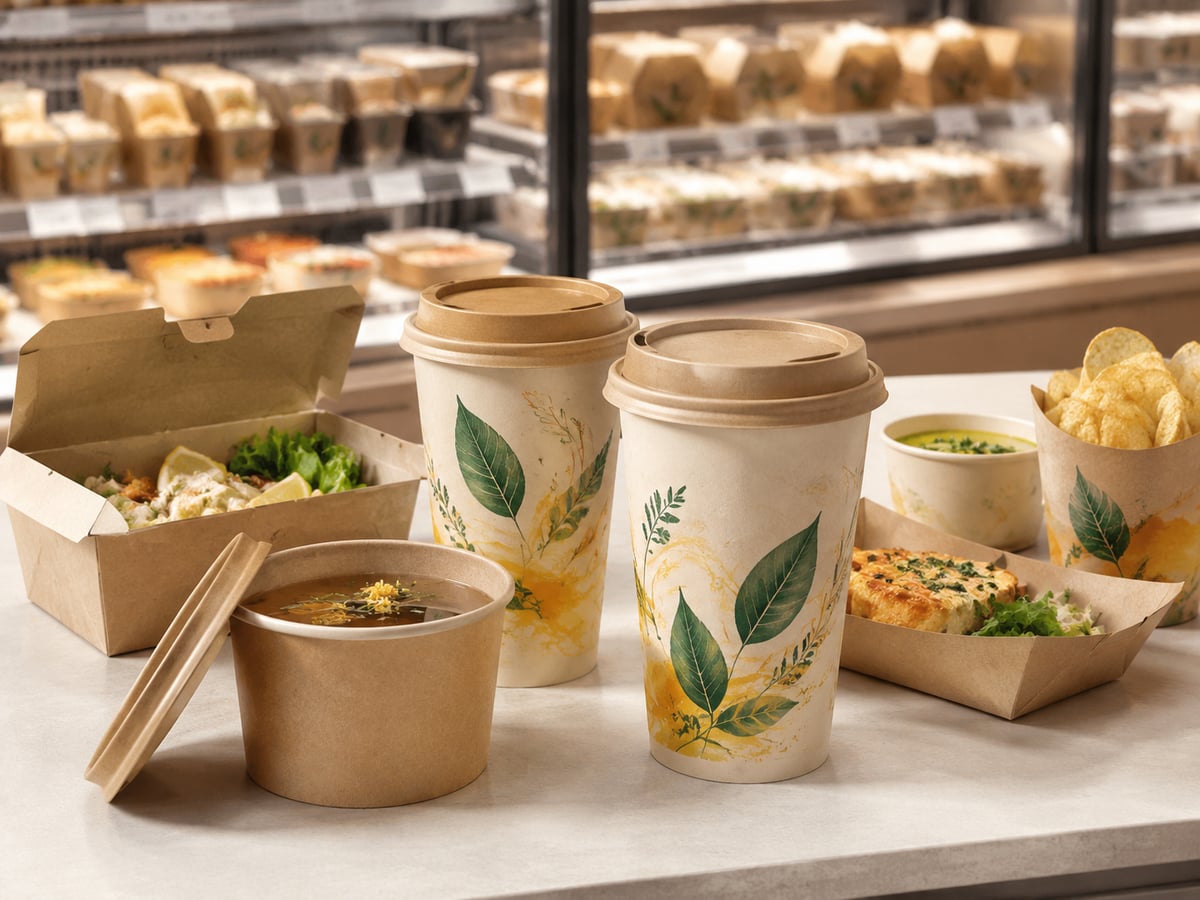
Canada Guide to Consistent Packaging Print Results
Keeping packaging colours consistent across different products requires more than approving a logo on screen. For Canadian food-service brands, retailers, distributors and procurement teams, consistent printing depends on a controlled system: correct dielines, compatible substrates, an appropriate print process, approved ink coverage, measurable tolerances and a signed physical proof.A brand colour printed on a smooth white paper cup will not automatically look identical on a natural kraft lunch box, a coated paper bowl, a folded burger box or a moulded multi-compartment meal tray. Paper shade, coating, absorbency, gloss, print method, drying conditions and product geometry all influence the result. The practical objective is not unrealistic visual sameness; it is controlled, acceptable consistency against an approved master standard.For Canada-bound projects, buyers should approve artwork and production samples under defined lighting, specify Pantone or L*a*b* targets where appropriate, set registration and rub-resistance limits, and retain a documented “golden sample” for repeat orders. This approach reduces disputes, protects brand recognition and makes it easier to compare production batches delivered through Vancouver, Montréal, Toronto or Halifax supply channels.Control PointWhat to ConfirmWhy It MattersDielineBleed, safe area, seams and fold linesPrevents logos from moving into curved or hidden areasSubstratePaper colour, coating and surface textureControls ink absorption and perceived colourInk StandardPantone reference or approved L*a*b* valueCreates an objective colour targetPrint MethodFlexographic, offset or digital suitabilityAligns quality expectations with production volumeProofingDigital proof, white sample and printed proofTests design, structure and real production appearanceReorder RecordApproved sample, material code and press settingsSupports repeatable results between purchase ordersThe table above should become part of the buyer’s packaging specification. It provides a shared production language for marketing, purchasing, quality assurance and the packaging supplier.The most common mistake is treating every product as if it were the same print surface. A takeaway cup, salad bowl, noodle box, burger carton and paper tray may carry the same brand identity, but their print conditions differ. Curved sidewalls can visually compress graphics. Folded panels can interrupt patterns. Natural kraft can mute bright colours. Coatings can change gloss and density.Start with a packaging family map. List every SKU, its substrate, size, finish, print area and intended food application. Then identify which design elements must remain visually stable: the primary logo, signature colour, legal marks, QR code, promotional message and ingredient or disposal icons. Secondary graphics can be adjusted slightly for each format, while core brand elements should use controlled placement and approved colour standards.Canadian brands operating in Toronto, Calgary, Vancouver, Ottawa and Montréal often need bilingual or region-specific information. Reserve safe copy areas early in the dieline process so translations, recycling instructions, product codes and barcodes do not crowd the logo or move close to seams. A well-built dieline prevents last-minute artwork edits that can compromise alignment.Packaging TypeMain Print RiskRecommended Design ControlPaper hot cupCurve distortion and seam overlapKeep logos away from seam and use central safe zonesPaper bowlColour shift on coated stockApprove colour on the final bowl materialBurger boxFold-line crackingAvoid dense solid coverage across sharp creasesKraft lunch boxMuted or warmer ink appearanceUse substrate-specific Pantone expectationsFood trayScuffing during stackingSpecify rub testing and protective varnish where suitableMeal boxRegistration across panelsSet clear tolerances for borders and panel transitionsBefore launch, a buyer should compare all formats together rather than approving each one in isolation. Lay out the cup, bowl, box and tray side by side under consistent lighting. This reveals whether colours, logo scale and overall visual hierarchy truly work as a family.A monitor produces colour with light; packaging reflects colour from its surface. That basic difference explains why a bright screen mock-up cannot serve as final approval for printed food packaging. Device settings, display brightness, browser rendering, room lighting and uncalibrated screens can all create misleading expectations.Physical materials introduce further variation. A bright white coated board reflects light differently from unbleached kraft paper. A PE-, PLA- or water-based coated surface may affect ink holdout and gloss. Even two papers described as “white” can have different undertones. A blue logo may look cleaner on a cool white cup stock and slightly greener or duller on a warmer board.Use digital proofs for copy, layout and approximate visual review. Use white samples to verify structure, capacity, lid fit and folding. Use printed pre-production proofs to approve final colour, registration, ink density and finishing. The printed proof should be dated, signed, stored and linked to the purchase order or artwork revision.var ctx = document.getElementById('lineChart').getContext('2d');new Chart(ctx, { type: 'line', data: { labels: ['2022', '2023', '2024', '2025', '2026', '2027'], datasets: [{ label: 'Indexed demand for custom food packaging in Canada', data: [100, 106, 113, 121, 130, 140], borderColor: 'rgb(36, 119, 181)', backgroundColor: 'rgba(36, 119, 181, 0.12)', fill: false, tension: 0.25 }] }, options: { responsive: false, maintainAspectRatio: false, scales: { y: { beginAtZero: false } } }});This market-growth illustration shows why documented print standards matter. As product ranges expand and repeat ordering increases, visual inconsistency becomes more expensive to correct after goods reach distribution centres or restaurant locations.Registration is the alignment of colours, graphics and die-cut features. It is especially important when a design uses borders, fine lines, reverse type, multiple spot colours or image-to-panel transitions. On folded and curved packaging, technically correct printing can still look visually wrong if the design does not account for structure.Set tolerances in writing before production. A reasonable tolerance depends on product size, artwork complexity, printing method and seam location. For example, a small shift may be acceptable in a full-bleed background, while the same shift may be unacceptable when it creates an uneven white border around a logo. Avoid designing essential elements directly on fold creases, side seams or highly tapered areas.For cups, use the actual wrap template, not a flat rectangle. For clamshell boxes and meal containers, identify folds, tuck areas and glue zones. For food trays, check how graphics appear after stacking. Registration should be judged on formed products, because flat sheets do not reveal all visual issues.Artwork FeatureRisk LevelPractical Acceptance ApproachFull-bleed backgroundLowMinor movement is usually less visibleThin border near edgeHighIncrease border width or move inwardSmall reverse textHighUse adequate type size and avoid foldsLogo on cup seamHighRelocate logo into a defined safe areaLarge central graphicMediumApprove formed sample from multiple viewing anglesPanel-to-panel patternMediumAllow a controlled visual transition at foldsThe goal is to build design tolerance into the artwork rather than expecting any production press to eliminate every possible movement. This is a more reliable and cost-effective approach for high-volume packaging.Large areas of dense ink can look premium, but they require careful planning. Heavy coverage may increase drying time, create scuffing risk during stacking, crack over sharp folds or make colour variation more noticeable. Dark solids, especially black, navy, deep green and rich red, deserve specific production review.Where a box must be folded, consider reducing coverage directly over the crease, using a pattern, adjusting the fold location or selecting a suitable coating and varnish system. The right solution depends on board grade, coating, print method and intended use. Packaging that encounters condensation, hot food, grease or repeated handling needs application-specific testing.For Canadian quick-service restaurants and meal-prep operators, rub resistance is important because packs may travel through delivery networks, cold storage, bags and stacked display environments. A print that looks satisfactory immediately after production may scuff after packing, transport or consumer handling if the ink system and drying conditions are not properly controlled.Substrate-driven variation is predictable when managed early. Paper whiteness, recycled-content appearance, fibre texture, coating weight and moisture condition all influence printed colour. A brand that uses both white and kraft packaging should define whether its colour target is “identical” or “visually coordinated.” In many cases, visual coordination is the more realistic and attractive strategy.For example, the same red may appear vivid on a white cold-drink cup and darker on a kraft sandwich box. Rather than treating this as a production failure, the design team can approve a separate kraft colour target, use a white underprint where feasible, or adapt the brand palette for natural substrates. The important point is that the choice is deliberate and documented.Substrate controls should include approved paper suppliers or material specifications, acceptable shade ranges, coating type, basis weight, food-contact requirements and storage conditions. Humidity can affect paper behaviour, especially during long transit and seasonal warehousing. This is relevant for shipments moving from Asian production ports into Vancouver or Prince Rupert and then across Canada.var ctx = document.getElementById('areaChart').getContext('2d');new Chart(ctx, { type: 'line', data: { labels: ['2022', '2023', '2024', '2025', '2026', '2027'], datasets: [{ label: 'Share of projects requiring recyclable, fibre-based or compostable options (%)', data: [38, 44, 51, 58, 64, 70], borderColor: 'rgb(45, 143, 88)', backgroundColor: 'rgba(45, 143, 88, 0.28)', fill: true, tension: 0.25 }] }, options: { responsive: false, maintainAspectRatio: false, scales: { y: { beginAtZero: true, max: 100 } } }});The trend shift toward fibre-based and lower-impact packaging increases the need for substrate-aware colour approval. Sustainable material choices can alter print appearance, so design standards must evolve together with environmental goals.Visual review remains essential, but measurable criteria reduce subjective disagreements. Buyers can define target Pantone references, approved drawdowns, colour-difference limits, light conditions, rub-test expectations and defect thresholds. The right test plan should reflect the product’s actual journey from factory to end user.For colour-critical programs, a spectrophotometer can help compare production output against an approved target using L*a*b* values and Delta E. A lower Delta E generally indicates a closer match, but the correct allowable range depends on substrate, print method and brand sensitivity. Do not apply one universal number to every material without validation.Rub testing should simulate realistic handling. Consider dry rub, wet rub where relevant, grease exposure, stacking pressure and abrasion from lids or sleeves. Also inspect print after forming, because cracking or stress marks may only appear when a flat blank becomes a box or cup.TestWhat It EvaluatesSuggested Approval RecordVisual colour checkOverall appearance under controlled lightingSigned master sample photographs and dateL*a*b* measurementObjective colour proximityTarget values and accepted rangeDry rub testScuffing from normal handlingPass/fail criteria and test conditionsWet rub testResistance to moisture exposureWater contact method and inspection resultFold-crack inspectionInk durability on creased panelsImages of approved folded sampleRegistration inspectionAlignment of colours and graphicsDefined tolerance by critical artwork areaThese tests create a measurable acceptance framework. They also help a procurement team distinguish between normal material variation and defects that should be rejected before shipment.A successful first order is only the beginning. Reorders are where brand-control systems prove their value. The supplier should retain the approved artwork version, dieline, substrate code, ink reference, proof, press notes, inspection criteria and packing details. Buyers should retain the same records internally and make sure purchasing teams do not submit outdated files.Create a packaging approval record for each SKU. Include product name, dimensions, capacity, material, coating, colour standard, print method, revision number, approved physical sample, acceptable tolerance and photos of critical areas. If a material or print process changes, require written approval before full production continues.For multi-location Canadian restaurant chains, it is useful to forecast promotional spikes, seasonal menu changes and recurring replenishment schedules. This gives the manufacturer time to reserve material, repeat approved settings and coordinate shipment planning. Consistency improves when a reorder is treated as a controlled repeat process rather than a new quotation each time.var ctx = document.getElementById('barChart').getContext('2d');new Chart(ctx, { type: 'bar', data: { labels: ['Coffee Shops', 'QSR', 'Meal Delivery', 'Retail Foods', 'Catering', 'Institutional Dining'], datasets: [{ label: 'Relative demand for branded paper packaging in Canada', data: [82, 95, 76, 68, 58, 54], backgroundColor: [ 'rgb(101, 156, 213)', 'rgb(49, 113, 181)', 'rgb(74, 137, 193)', 'rgb(123, 172, 216)', 'rgb(86, 147, 202)', 'rgb(151, 190, 224)' ] }] }, options: { responsive: false, maintainAspectRatio: false, scales: { y: { beginAtZero: true, max: 100 } } }});This industry-demand comparison highlights why cross-product visual consistency matters. Coffee, quick-service and delivery operators frequently use several packaging formats in a single customer journey.Fude Packaging supports overseas B2B buyers seeking consistent custom food packaging across cups, bowls, boxes, trays and multi-compartment meal packaging. The company’s technological capabilities include artwork and dieline checking, Pantone-oriented colour matching, digital proof review, white samples, printed pre-production proofs and in-house laboratory testing. These controls help translate an approved design into a manufacturable, repeatable packaging program.Its manufacturing capabilities are supported by more than 20 years of packaging experience, a self-owned 30,000 m² production base in Shandong and automated capacity of up to 120,000 units per day. By managing material selection, printing, die-cutting, forming, inspection and export packing in-house, Fude Packaging can help buyers consolidate product categories while maintaining coordinated visual standards.Service capabilities include OEM and ODM support, scheduled-order planning, export documentation assistance, sample shipments and full-batch traceability. For Canadian importers and brands, this can simplify quality management when coordinating multiple packaging types for distribution through major hubs such as Vancouver, Toronto, Montréal and Calgary. Explore available formats through Fude Packaging products, or review customized development support through custom packaging services.Fude Packaging CapabilityBuyer BenefitUse in Colour-Control ProgramsIn-house laboratoryPractical quality verificationSupports rub, material and performance checksArtwork and dieline reviewFewer pre-production errorsProtects logos from seams, folds and trim areasProof optionsClearer approval decisionsCompares digital, white and printed samplesAutomated production linesScalable outputHelps maintain repeat settings for approved runsBatch traceabilityBetter issue investigationLinks inspection findings to production recordsExport supportSmoother international procurementCoordinates packing and documentation requirementsFude Packaging also supports documentation associated with BRC, FSC, ISO 9001, LFGB and FDA-related requirements, subject to product and market needs. Buyers should confirm the documentation required for their intended Canadian application before placing an order.The suitable method depends on order quantity, number of colours, substrate, graphic detail and packaging format. Flexographic printing is commonly used for repeat, higher-volume paper-packaging programs. Offset printing can suit certain carton applications requiring detailed graphics. Digital printing can be useful for shorter runs, prototypes or variable designs. Select the method after reviewing the complete product family rather than one SKU alone.Provide editable vector artwork whenever possible, such as AI, PDF or EPS files with outlined fonts, linked images, specified spot colours and final dielines. Include clear notes for Pantone references, finishes, barcode placement, languages and version control. Your supplier should check the artwork before proofing.Pantone is a useful starting reference, but the final approval should be based on a printed sample on the actual substrate. Confirm whether the target is a coated or uncoated reference, whether white underprint is used, and what variation is acceptable. Retain the approved physical proof as the master reference.Paper shade, coating, texture and absorption affect how ink appears. White coated stock generally produces brighter colour, while kraft stock can make colours warmer, darker or less saturated. This is expected behaviour, not necessarily a defect, provided the result matches the approved substrate-specific proof.Reject defects that exceed documented tolerance or impair brand presentation and functionality. Examples include obvious colour mismatch against the approved proof, severe misregistration, unreadable text, missing graphics, heavy scuffing, ink cracking on critical folds, contamination, incorrect material, structural damage or inconsistent print density across the batch.var ctx = document.getElementById('comparisonChart').getContext('2d');new Chart(ctx, { type: 'bar', data: { labels: ['Proofing Options', 'Batch Traceability', 'Range Consolidation', 'Testing Support', 'Export Readiness', 'Reorder Control'], datasets: [ { label: 'Integrated packaging manufacturer', data: [92, 90, 94, 86, 89, 91], backgroundColor: 'rgb(61, 132, 102)' }, { label: 'Fragmented multi-supplier approach', data: [58, 52, 40, 49, 61, 47], backgroundColor: 'rgb(168, 183, 193)' } ] }, options: { responsive: false, maintainAspectRatio: false, scales: { y: { beginAtZero: true, max: 100 } } }});This comparison illustrates the operational advantage of managing related packaging formats through a coordinated supplier program. Actual performance should always be confirmed through project-specific samples, specifications and inspection requirements.By 2026 and beyond, Canadian packaging buyers will increasingly combine brand-consistency requirements with sustainability, traceability and regulatory readiness. Fibre-based materials, recyclable designs, compostable options where appropriate, water-based systems and reduced-plastic solutions can all affect print appearance. Sustainable packaging should therefore be developed with colour control in mind from the first material trial.Digital workflow improvements will make version control, remote proof approval and production data retention more reliable. Brands will increasingly use digital asset libraries, QR-linked approval records and controlled colour specifications across national store networks. This is particularly valuable for franchises and distributors serving multiple provinces with different product mixes and promotion calendars.Policy expectations around packaging waste, labelling and material transparency will continue to influence design choices. Procurement teams should avoid separating environmental decisions from print decisions. A change in paper, coating or disposal pathway can alter colour, rub resistance and graphic performance. Test the complete finished pack before changing a standard material.For a practical discussion of a multi-product custom packaging program, buyers can learn more about Fude Packaging or contact the packaging team with artwork, product dimensions, estimated order volume, destination city and required delivery schedule. -

Global Market Guide to LFGB Paper Packaging Verification
For Global market buyers sourcing LFGB paper food packaging, supplier verification should begin with the certificate number, certificate scope, issuing organization, manufacturing-site name, applicable product range, issue date, and expiry date. A certificate can support supplier qualification, but it does not automatically prove that every paper cup, burger box, salad bowl, takeaway container, or coated paper product is compliant for every food application.Buyers should request a current certificate copy, independently check the issuing body where possible, compare the factory address with the commercial invoice and production site, and confirm whether the certificate scope includes food-contact paper packaging, printing, coatings, inks, adhesives, and the relevant conversion processes. The buyer should also obtain product-specific migration reports, material declarations, specifications, and performance records for the actual item being ordered.For example, a certificate covering general paper packaging production may not demonstrate suitability for hot soup, oily fried foods, acidic salads, frozen products, microwave use, or prolonged storage. A practical sourcing process combines document verification with sample evaluation, food-contact testing where needed, production inspection, and change-control requirements.Verification ItemWhat Buyers Should CheckWhy It MattersCertificate numberUnique reference number and document versionAllows traceability and authenticity checksIssuing bodyTesting laboratory, certification organization, or auditorConfirms whether the document comes from a credible sourceScopePaper packaging, coatings, printing, food-contact use, production activityPrevents reliance on an unrelated certificateFactory siteLegal company name, address, and production locationEnsures the audited site is the actual manufacturing siteProduct matchSpecific SKU, material structure, coating, ink, and intended food useShows whether the purchased item is actually coveredValidity periodIssue date, expiry date, surveillance dates, and renewal statusReduces the risk of using outdated compliance documentsThe table above should be used as an initial screening tool. For higher-risk applications, such as hot beverages, greasy meals, or printed food containers, a buyer should add independent laboratory review and pre-shipment inspection. Importers supplying restaurant groups in Dubai, Rotterdam, Singapore, Los Angeles, Sydney, or Hamburg often maintain a document-control register so compliance records can be traced by product, factory, batch, and destination market.The scope is the most important section of any LFGB-related document. Buyers should not assume that a broad phrase such as “food packaging” covers every material combination. Paper packaging can contain virgin paperboard, recycled paper, water-based coating, polyethylene coating, PLA coating, aluminum layer, barrier varnish, printing ink, adhesive, and molded or folded construction. Each component can affect food-contact suitability.Ask the supplier to explain the exact scope in writing. It should identify whether the document relates to the management system, factory audit, finished-product testing, raw materials, or a defined range of food-contact items. A product test report is not the same as a factory certification, and a factory certification is not the same as a migration report for a specific finished product.For Global market procurement, buyers should match the certificate scope to the commercial purchase order. A kraft lunch box for fried chicken may require different grease-resistance evidence than a paper cup for coffee, while a salad bowl may require evidence for cold, acidic, and moist foods. Buyers sourcing sustainable kraft paper takeout containers should confirm the grade of paper, barrier treatment, intended food type, temperature range, and storage duration before approving mass production.Packaging CategoryTypical Food Contact ConditionsDocuments Commonly NeededHot paper cupsHot beverages, short contact time, liquid exposureMaterial declaration, migration test, leak test, lid-fit testSoup bowlsHigh temperature, liquids, oils, steamHeat-resistance, coating data, migration and leakage evidenceBurger boxesWarm food, grease, sauces, direct contactGrease resistance, printing control, food-contact declarationSalad bowlsCold, acidic, moist foods, extended displayMigration data, coating specification, closure performanceNoodle boxesHot and moist food, sauces, transport vibrationLeak test, fold strength, heat stability, migration evidenceKraft traysDry snacks, bakery items, fried foodsPaper specification, grease test, ink and adhesive declarationThis comparison shows why buyers should not accept one generic statement for all product types. The compliance package should follow the specific product structure and real end use, particularly when packaging is sold through food-service distributors or used by multi-store restaurant chains.A frequent supplier-document gap occurs when the certificate lists a trading company, an office address, or a parent company rather than the production site. Buyers should compare the factory name and address on the certificate with the production address on quotations, purchase orders, shipping documents, quality records, and audit reports. If subcontracting is involved, the buyer should request disclosure of each facility handling printing, coating, die-cutting, forming, or packing.Site matching is especially important for orders routed through major export hubs such as Qingdao, Shanghai, Ningbo, Shenzhen, Antwerp, Jebel Ali, and Long Beach. The port of export does not prove where a product was manufactured. A transparent supplier should be able to provide factory photos, audit access, production flow information, and batch identification that connects the finished goods to the verified facility.Product matching should go beyond a product-family name. Confirm cup size, board grade, coating weight, paper color, printing specification, adhesive type, lid configuration, and intended food-use conditions. If a supplier changes from PE coating to PLA, changes paper mill source, modifies ink colors, or moves production to another facility, the buyer should require a documented reassessment.var ctx = document.getElementById('lineChart').getContext('2d');new Chart(ctx, { type: 'line', data: { labels: ['2021', '2022', '2023', '2024', '2025', '2026 Forecast'], datasets: [{ label: 'Indexed Global Demand for Verified Paper Food Packaging', data: [100, 109, 121, 135, 149, 165], borderColor: 'rgb(45, 130, 90)', backgroundColor: 'rgba(45, 130, 90, 0.12)', fill: false, tension: 0.3 }] }, options: { responsive: true, maintainAspectRatio: false, scales: { y: { beginAtZero: false } } }});The line chart illustrates an indexed purchasing trend rather than a certification statistic. It reflects the increasing preference among food-service buyers for traceable, documented paper packaging as restaurant delivery, branded takeaway programs, and sustainability requirements expand across international markets.Buyers should identify who issued the document and what that issuer actually assessed. A recognized laboratory may issue a test report for a sample. A certification organization may issue a factory or management-system certificate. An inspection company may issue an audit report. These documents serve different purposes and should not be presented as interchangeable evidence.Check that the issuer’s name, logo, report number, address, signature or approval details, and test methods are visible. When available, confirm the report or certificate directly through the issuer’s verification channel. Be cautious with certificates that have missing pages, altered expiry dates, no product description, unclear test conditions, or an issuer that cannot be identified.Expiry monitoring should be part of supplier management. Many buyers use a calendar alert 90 days before a certificate expires and suspend new orders if renewal evidence is not received in time. For long-running private-label programs, include document renewal obligations in the supply agreement, along with the right to request updated reports after any material or process change.Document TypePrimary PurposeTypical Review FrequencyFactory certificateShows a defined production site or system has been assessedAt issue and before expiryFood-contact test reportShows test results for a defined sample and conditionsPer product change or risk reviewDeclaration of complianceSupplier statement on applicable materials and intended useAnnual review and upon changesRaw material specificationIdentifies paper, coating, ink, adhesive, and technical propertiesPer approved material revisionProduction audit reportReviews hygiene, traceability, controls, and process capabilityAnnual or risk-basedPre-shipment inspection reportConfirms order quantity, appearance, packing, and workmanshipEach critical shipment or selected batchesThe document hierarchy in this table helps buyers distinguish supplier-level qualification from SKU-level evidence. An unexpired factory certificate is valuable, but it does not replace a relevant migration report or functional validation for the final packaging design.Supporting tests should reflect the food, temperature, contact time, and packaging structure. Depending on the destination market and product design, buyers may ask for overall migration testing, sensory assessment, heavy-metal screening, fluorinated-substance review where relevant, grease resistance, heat resistance, leakage testing, compression testing, odor evaluation, print adhesion, and material traceability records.A paper container that performs well with dry pastries may fail with hot noodles or oily curry. Therefore, buyers should define intended use before requesting test reports. Key variables include whether food is hot or cold, acidic or alkaline, dry or fatty, packaged for minutes or hours, transported by delivery riders, stored refrigerated, or reheated by consumers.For leak-resistant kraft paper salad bowls, practical evidence normally includes seam integrity, liquid-holding time, lid compatibility, coating stability, and suitability for cold foods with dressing. For printed cups or boxes, buyers should also confirm that printing is controlled and positioned appropriately for the intended contact configuration.var ctx = document.getElementById('barChart').getContext('2d');new Chart(ctx, { type: 'bar', data: { labels: ['Quick-Service Restaurants', 'Coffee Chains', 'Delivery Kitchens', 'Retail Food', 'Catering', 'Airline Meal Service'], datasets: [{ label: 'Relative Demand for Documented Paper Packaging', data: [92, 88, 95, 74, 69, 63], backgroundColor: ['#2d825a', '#4b9e74', '#66b48c', '#7bc6a0', '#94d3b2', '#afdcc5'] }] }, options: { responsive: true, maintainAspectRatio: false, scales: { y: { beginAtZero: true, max: 100 } } }});The bar chart compares relative procurement demand for well-documented paper food packaging across common buyer sectors. Delivery kitchens and quick-service restaurants tend to require the strongest combination of food-contact documentation, leakage control, reliable printing, and consistent high-volume supply.Document gaps are not always deliberate, but they can create serious import and brand risk. Common issues include expired certificates, missing test conditions, reports for a different product size, paper specifications that do not match the approved sample, unnamed subcontractors, incomplete declarations, and test reports that do not identify the coating or printing system.Another risk is relying on a report that applies only to a raw paperboard sheet rather than the final printed and converted container. Die-cutting, folding, gluing, heat sealing, printing, and post-processing can introduce additional variables. Buyers should clarify whether testing was completed on the finished item or on a representative construction that genuinely matches the ordered product.When gaps exist, request corrective documentation before production. If timing is urgent, buyers may proceed only after assessing the risk, approving samples, and arranging third-party testing or inspection. For high-volume launches, it is prudent to keep retention samples and retain batch records for traceability.Common GapPotential RiskBuyer ActionExpired certificateSupplier status may no longer be currentRequest renewal evidence before order releaseWrong factory addressActual site may not have been assessedVerify site identity and audit the production facilityGeneric product descriptionReport may not apply to the ordered SKUMatch material construction and intended useMissing test conditionsResults may not fit hot, fatty, or acidic food useRequest method, simulant, time, and temperature detailsNo change-control recordMaterials may change without buyer approvalInclude notification requirements in the contractNo batch traceabilityQuality claims are difficult to investigateRequire lot codes, inspection records, and retention samplesThese gaps should be evaluated according to product risk. A simple bakery tray may need a lighter review than a coated soup bowl used by a nationwide delivery brand. The buyer’s quality plan should be proportionate, practical, and documented.Compliance management does not end after initial approval. Buyers should monitor certificate expiry, test-report validity, material changes, production-site changes, new printing designs, coating revisions, and new end-use conditions. A reliable supplier should maintain internal records showing approved materials, supplier changes, production batches, inspection results, and corrective actions.Change control is particularly important in the 2026 market environment. Packaging buyers are increasingly balancing food safety, cost volatility, extended producer responsibility rules, recyclability claims, compostability goals, and restrictions on certain chemical substances. A change from one coating system to another may affect recycling compatibility, food-contact performance, sealing behavior, and local labeling requirements.Buyers can require suppliers to notify them before changes to paper mills, barrier coatings, inks, adhesives, factory locations, product dimensions, packing methods, or manufacturing processes. The agreement should state when new samples, revised specifications, and updated test reports are required. This prevents silent changes that can damage restaurant operations, shelf presentation, or regulatory readiness.var ctx = document.getElementById('areaChart').getContext('2d');new Chart(ctx, { type: 'line', data: { labels: ['2021', '2022', '2023', '2024', '2025', '2026 Forecast'], datasets: [{ label: 'Share of Buyers Requiring Change-Control Documentation (%)', data: [38, 46, 55, 64, 72, 80], borderColor: 'rgb(35, 110, 160)', backgroundColor: 'rgba(35, 110, 160, 0.24)', fill: true, tension: 0.3 }] }, options: { responsive: true, maintainAspectRatio: false, scales: { y: { beginAtZero: true, max: 100 } } }});The area chart illustrates the growing role of change-control documentation in international packaging procurement. As sustainability policies and material requirements evolve, buyers increasingly expect advance notice, updated specifications, and proof that revised products remain fit for their intended use.Before confirming a supplier, buyers should complete a structured review. First, define the product application: food type, serving temperature, storage time, capacity, print design, delivery conditions, and destination country. Second, request supplier-level documents. Third, request product-specific technical and food-contact evidence. Fourth, evaluate samples. Fifth, establish inspection and renewal procedures for ongoing orders.For importers, distributors, and restaurant groups, the checklist should become part of the supplier onboarding process. It is helpful to assign responsibility among purchasing, quality assurance, regulatory, logistics, and product-development teams. This reduces the chance that a commercially attractive product is approved without adequate performance or compliance validation.Buyer StageRequired ActivityDecision OutputApplication definitionConfirm food type, temperature, volume, transport, and brandingClear technical briefSupplier screeningReview company identity, factory site, capacity, and certificate scopeQualified supplier shortlistDocument reviewCheck food-contact reports, declarations, specifications, and expiry datesCompliance review recordSample approvalTest fit, leakage, strength, print, odor, and user experienceApproved reference sampleProduction controlConfirm artwork, material, inspection plan, and batch traceabilityControlled purchase orderOngoing monitoringTrack renewals, complaints, changes, and inspection outcomesUpdated approved supplier statusThis checklist is useful for a wide range of industries, including café chains, takeaway platforms, grocery prepared-food departments, bakery brands, institutional catering, hotel groups, airline caterers, event operators, and restaurant franchises. Each sector may have different priorities, but all need packaging that is safe, functional, consistent, and appropriate for the intended use.Fude Packaging supports overseas B2B buyers seeking practical, documented paper food packaging solutions for Global market distribution. Our product range includes paper cups, paper bowls, burger boxes, kraft lunch boxes, salad containers, noodle boxes, food trays, and compartment meal boxes. Buyers can also explore our broader food container collection when consolidating multiple takeaway packaging categories under one supplier.From a technology perspective, Fude Packaging operates an in-house laboratory for quality and performance evaluation. Product development can include material and coating recommendations, structural review, artwork and dieline checks, Pantone color matching, prototype development, and functional sample testing. We help buyers assess practical factors such as capacity, heat resistance, grease resistance, leakage prevention, lid fit, print accuracy, and transport durability before mass production.From a manufacturing perspective, our self-owned 30,000 m² factory in Shandong has more than 20 years of industry experience and automated lines with capacity of up to 120,000 units per day. We control core conversion stages including material selection, printing, die-cutting, forming, inspection, packing, and shipment preparation. This integrated model helps maintain consistency across large orders and multi-product programs.From a service perspective, Fude Packaging provides OEM and ODM support for importers, distributors, food brands, restaurant groups, and retailers. Our international team assists with samples, specifications, compliance-document coordination, third-party inspection arrangements, export packing, commercial paperwork, sea freight, air freight, and replenishment planning. We have supported customers in more than 50 countries across Southeast Asia, Europe, North America, Central Asia, the Middle East, and Oceania.var ctx = document.getElementById('comparisonChart').getContext('2d');new Chart(ctx, { type: 'bar', data: { labels: ['Document Support', 'Customization', 'Production Control', 'Sample Testing', 'Export Coordination', 'Multi-Category Supply'], datasets: [ { label: 'Integrated Manufacturer Model', data: [92, 90, 94, 88, 89, 93], backgroundColor: 'rgb(45, 130, 90)' }, { label: 'Fragmented Sourcing Model', data: [62, 58, 55, 51, 64, 48], backgroundColor: 'rgb(150, 160, 170)' } ] }, options: { responsive: true, maintainAspectRatio: false, scales: { y: { beginAtZero: true, max: 100 } } }});The comparison chart is a practical illustration of why many international buyers prefer an integrated packaging manufacturer when managing branded food-service programs. Centralized material control, sampling, production coordination, and export support can reduce the administrative burden associated with fragmented sourcing.Buyers should request the complete certificate or report, verify the certificate number, check the issuing organization, confirm the manufacturing-site name and address, review the scope, and confirm the expiry date. They should then compare the document with the exact product, materials, intended food contact, and purchase order. Product-specific testing and sample approval should follow supplier-level verification.It may, but buyers must read the document carefully. A valid document should identify the specific factory site or clearly state the audited production location. If the supplier uses subcontractors for printing, coating, forming, or packing, buyers should ask which sites are involved and whether those activities are controlled under the documented scope.No. Supplier certification or a general factory document does not automatically apply to every SKU. Product design, paper grade, coating, ink, adhesive, size, and intended food-use condition can vary. Buyers should request finished-product evidence or confirm that the existing report covers an equivalent product structure and use condition.The required evidence depends on the product and destination-market requirements. Common supporting records include food-contact migration reports, material declarations, paper and coating specifications, leakage results, grease-resistance results, heat-resistance tests, print-quality records, odor checks, and batch traceability. High-risk or specialized applications may require additional third-party testing.Create a supplier-document register containing certificate numbers, issue dates, expiry dates, product coverage, factory sites, and responsible contacts. Set reminders 90, 60, and 30 days before expiry. Require updated documents before renewal deadlines, and require immediate notification of changes to materials, processes, production locations, or intended product applications. -

United States Kraft Deli Box Factory Market Guide
For buyers in the United States, choosing the right kraft deli box factory is no longer just about price. It is about supply stability, food safety, print quality, sustainability claims, lead time, and whether the supplier can scale with your brand as demand rises in markets like New York, Los Angeles, Chicago, Dallas, Atlanta, and Miami. If you source deli packaging for sandwiches, salads, grab-and-go meals, bakery items, and chilled retail foods, a true factory partner usually gives you better cost control, more consistent quality, and stronger customization than a trader.This guide explains how a factory-based sourcing model works, what demand looks like in 2026, which box formats are selling fastest, how production lines operate, what certifications matter for U.S. importers, and how private label projects can support growth in foodservice, grocery, convenience retail, and delivery channels.A kraft deli box factory produces paper-based food packaging directly through converting, printing, die-cutting, forming, inspection, and packing operations. For U.S. buyers, the biggest advantage is visibility into material selection, structure design, printing standards, and production scheduling. That matters when your products move through busy distribution routes linked to the ports of Los Angeles, Long Beach, New York and New Jersey, Savannah, Houston, and Seattle.In practice, a reliable factory should offer food-grade materials, options such as PE or PLA lining, window lids, multiple sizes from compact 500 ml boxes to larger meal containers, and support for branded artwork. It should also be able to provide sampling, compliance documentation, stable lead times, and packaging advice for real applications such as deli counters, prepared foods, corporate catering, and third-party delivery.For U.S. sourcing teams, the best buying approach is to match the deli box structure to the product journey. A cold pasta salad sold from a supermarket cooler in Boston needs different grease, moisture, and shelf-display performance than a hot chicken wrap sold from a food truck in Austin. A factory that understands these details can reduce leakage claims, collapsing cartons, ink inconsistencies, and inventory risk.Buyer TypeMain NeedRecommended Box StyleTypical Volume PatternTop Decision FactorBest Sourcing ModelIndependent deliAffordable branded packaging500 ml to 750 ml kraft deli boxSmall but recurringLow MOQFactory with flexible productionRestaurant chainConsistency across locationsStandardized leak-resistant boxHigh monthly volumeUniform qualityFactory directSupermarket prepared foodsDisplay and shelf appealWindow-lid deli boxSeasonal peaksVisual presentationFactory with private label supportCatererMultiple portion formatsCompartment meal boxEvent-driven ordersSize varietyFactory with broad toolingDistributorFast replenishmentMixed popular SKUsBulk container loadsStable lead timeLarge-scale factoryFood delivery brandLeak resistance and brandingPE-lined or PLA-lined kraft boxFast growth cyclesOperational performanceFactory with R&D and testingThe table above shows why U.S. buyers often prefer a manufacturing partner over a pure reseller. Different channels have different performance priorities, and a factory can adjust structure, material weight, coating type, and print layout more effectively.If you want to compare available formats first, review the food packaging product catalog to see common deli boxes, bowls, trays, cups, and related takeaway packaging used by American foodservice operators.Demand for kraft deli packaging in the United States is being pushed by four overlapping forces in 2026. First, consumers continue to buy more prepared food from supermarkets, delis, cafés, and convenience chains. Second, operators want packaging that supports both in-store display and delivery transport. Third, municipalities and corporate buyers are under more pressure to reduce plastic-heavy packaging. Fourth, food brands increasingly treat packaging as part of brand identity, not just a container.The U.S. market is especially active in large population and logistics corridors: the Northeast corridor from Boston to Washington, D.C.; Southern growth markets such as Atlanta, Orlando, and Nashville; Texas hubs like Houston and Dallas; Midwest centers including Chicago and Minneapolis; and West Coast consumption zones around Los Angeles, San Diego, San Francisco Bay, Portland, and Seattle. Imports entering through Long Beach, Los Angeles, Oakland, Savannah, and New York/New Jersey then move inland through warehousing and wholesale networks.Kraft deli boxes benefit from this environment because they fit the sweet spot between function and perception. They look natural, photograph well for online ordering, support custom printing, and can be engineered for oil, moisture, and moderate heat. For many operators, they are a practical step between low-cost unbranded packaging and premium rigid food containers.U.S. Demand Segment2026 Demand DirectionMain Use CasePreferred FeatureHigh-Growth CitiesBuyer NoteSupermarket deliStrong growthReady meals and saladsWindow lid, stackabilityNew York, Chicago, AtlantaNeeds retail shelf appealQuick-service restaurantsSteady growthTakeout lunch and sidesLeak resistanceDallas, Phoenix, OrlandoFocus on operating speedFood delivery kitchensVery strong growthDelivery-only menusSecure closureLos Angeles, Miami, HoustonTransport performance is criticalCorporate cateringRecovery and growthBoxed mealsCompartment designWashington, D.C., Boston, SeattlePresentation mattersBakery and caféModerate growthPastries, sandwichesSmall compact formatSan Francisco, Denver, AustinOften values print brandingCollege and hospital foodserviceSteady demandGrab-and-go mealsDurability and pricingPhiladelphia, Columbus, RaleighNeeds contract reliabilityWholesale distributionStrong growthMulti-channel resaleBroad SKU mixSavannah, Newark, MemphisInventory planning is keyThis demand pattern suggests 2026 will favor factories that can serve both standardized and customized orders. A buyer may want plain-stock boxes for urgent replenishment and branded versions for core channels. Factories with multiple converting lines can support both strategies better than smaller intermediaries.var ctxLine = document.getElementById('lineChartMarket').getContext('2d');var lineChartMarket = new Chart(ctxLine, { type: 'line', data: { labels: ['2022', '2023', '2024', '2025', '2026'], datasets: [{ label: 'U.S. Kraft Deli Box Demand Index', data: [100, 112, 126, 141, 158], borderColor: 'rgb(75, 192, 192)', backgroundColor: 'rgba(75, 192, 192, 0.15)', fill: false, tension: 0.25 }] }, options: { responsive: true, maintainAspectRatio: false }});The line chart shows a realistic growth trend based on sustained expansion in prepared foods, delivery services, and sustainable packaging adoption. While growth rates differ by state and sector, the overall direction remains positive.Product TypeCommon Size RangeBest ForMaterial OptionTypical Add-OnU.S. Demand OutlookCompact deli box500 mlCold deli itemsKraft board + PEWindow lidHighStandard deli box750 mlSalads and pastaKraft board + PE/PLACustom printVery highLarge deli box1000 mlMeal portionsKraft board + PESecure flapHighCompartment box2 to 3 sectionsMixed mealsCoated paperboardLeak-resistant foldsGrowing fastWindow display boxVariousRetail grab-and-goKraft board + PET windowHigh-clarity panelVery highSoup and side hybrid boxCustomMoist foodsEnhanced barrier boardLid compatibilityModerate growthProduct types above reflect the most common formats requested by U.S. importers. Window-lid boxes are gaining share in supermarkets and premium café channels, while plain kraft formats remain strong in value-focused takeout operations.var ctxBar = document.getElementById('barChartIndustry').getContext('2d');var barChartIndustry = new Chart(ctxBar, { type: 'bar', data: { labels: ['Supermarkets', 'QSR Chains', 'Delivery Kitchens', 'Catering', 'Cafés', 'Distributors', 'Institutions'], datasets: [{ label: 'Estimated 2026 Demand Share', data: [24, 19, 17, 11, 9, 13, 7], backgroundColor: [ 'rgb(255, 99, 132)', 'rgb(54, 162, 235)', 'rgb(255, 206, 86)', 'rgb(75, 192, 192)', 'rgb(153, 102, 255)', 'rgb(255, 159, 64)', 'rgb(99, 255, 132)' ] }] }, options: { responsive: true, maintainAspectRatio: false }});The bar chart highlights where demand is concentrated. Supermarkets and QSR channels remain core volume drivers, but delivery kitchens and distributors are becoming increasingly influential because of menu expansion and broad geographic reach.Looking ahead, 2026 trends will also be shaped by policy and procurement. More buyers are asking for FSC-certified paper sourcing, better recycling communication, compostable options in selected regions, and cleaner artwork for premium shelf presentation. Technology is also changing production, with tighter color management, digital proofing, automated inspection, and improved warehousing visibility making factory-direct sourcing more dependable.Many U.S. importers have worked with both factories and traders. Traders can be useful for mixed-item sourcing or very small test orders, but they often add an extra communication layer between the buyer and the production floor. That can create issues when you need quick revisions to artwork, urgent checks on material thickness, or clear answers about forming defects.A kraft deli box factory is different because it owns or directly manages the manufacturing workflow. That means your team can ask specific questions about board weight, grease resistance, fold accuracy, print registration, carton packing method, and production slot timing. This is especially valuable when containers are moving under strict retail or chain-restaurant standards.Another major difference is accountability. If there is a problem with lid fit, sidewall delamination, or color variation between batches, a factory can trace it through the line, the lot number, and the raw material record. A trader may not have that depth of information. In U.S. channels where returns, complaints, and compliance reviews can be costly, traceability matters.FactorFactory DirectTrader ModelImpact on U.S. BuyerBest ForRisk LevelPrice visibilityHigher transparencyMarkup addedBetter cost planningVolume contractsLowerQuality controlManaged on-siteIndirect supervisionFewer surprisesBranded packagingLowerTechnical responseFast engineering feedbackSlower relay processQuicker revisionsCustom projectsLowerLead time accuracyProduction-based estimateDepends on supplier networkImproved inventory planningRegular replenishmentMedium to lowSampling controlCloser to final outputMay vary by subcontractorBetter validationRetail launchesLowerMOQ flexibilityDepends on line setupSometimes easier for tiny ordersMixed outcomeEarly testingMediumCustomization depthBroader structural optionsLimited by sourcing networkMore brand freedomPrivate labelLowerTraceabilityLot-based recordsLess directUseful for auditsLarge accountsLowerThe comparison shows why buyers moving from regional resale purchasing to direct import often switch to a genuine factory partner once their monthly volume becomes predictable. For a deli chain with locations in New Jersey, Pennsylvania, and Maryland, even a small unit-price saving and more consistent supply can create meaningful annual benefits.That said, choosing a factory is not enough on its own. Buyers should still ask for production photos, sample approval records, carton packing details, loading plans, and post-production inspection methods. A trustworthy supplier should answer clearly and quickly.var ctxComp = document.getElementById('comparisonChartSupplier').getContext('2d');var comparisonChartSupplier = new Chart(ctxComp, { type: 'bar', data: { labels: ['Cost Efficiency', 'QC Control', 'Traceability', 'Customization', 'Lead Time Clarity', 'Scale Support'], datasets: [{ label: 'Factory Direct Score', data: [90, 95, 93, 92, 88, 94], backgroundColor: 'rgba(153, 102, 255, 0.8)' },{ label: 'Trader Score', data: [72, 68, 60, 70, 66, 74], backgroundColor: 'rgba(255, 159, 64, 0.8)' }] }, options: { responsive: true, maintainAspectRatio: false }});This comparison chart reflects typical sourcing experience rather than a universal rule. Strong traders can still perform well, but factory-direct partnerships usually score higher on control, technical depth, and scalability.Factory scale matters because U.S. demand is uneven. Many buyers experience spikes around back-to-school periods, year-end events, warmer weather food-to-go demand, and regional promotional rollouts. A small workshop may handle prototypes well but struggle with repeat container loads. A larger plant with organized warehousing, multiple forming lines, and quality checkpoints can usually handle these shifts better.For example, a modern food-packaging plant serving global markets may operate from a large production site with separate areas for printing, die-cutting, forming, inspection, and climate-aware storage. This setup helps protect paperboard stability and keeps packed goods ready for export scheduling. It also supports mixed-SKU orders, which are common for U.S. distributors who want cups, bowls, trays, and deli boxes from one source.When evaluating capacity, buyers should look beyond headline numbers. Daily output matters, but so do changeover efficiency, defect rates, labor organization, warehousing, and loading management. If a factory can run several product families and still maintain a 7 to 15 day lead time on standard custom projects, it is generally well organized.A practical sign of scale is whether the supplier can serve both foodservice brands and wholesale distributors in different regions. If they regularly ship to North America, Europe, and other developed markets, they are more likely to understand carton markings, documentation, pallet standards, and packaging consistency expectations.Capacity IndicatorWhat to AskWhy It MattersHealthy BenchmarkBuyer BenefitWarning SignFactory areaTotal operating space?Shows production and storage depthOrganized large-scale siteBetter order handlingCrowded layoutProduction linesHow many forming lines?Supports output and backupMultiple automated linesStable schedulingSingle-line dependencePrinting processWhat print method is used?Affects branding qualityFlexo or better with controlClean artworkInconsistent color answersDie-cuttingIn-house or outsourced?Affects speed and precisionIn-house operationFaster correctionsThird-party delayWarehouse managementHow are finished goods stored?Protects paper from moistureManaged storage environmentLower transit riskNo storage disciplineQC labWhat tests are performed?Confirms food-packaging reliabilityRoutine inspection proceduresHigher consistencyOnly visual checksBuyers should also consider geographic timing. Transit to the United States can differ significantly based on sailing schedules and destination port congestion. A factory with export experience can help buyers align production with shipping windows to Long Beach, Savannah, Newark, or Houston and reduce stockout risk during seasonal demand surges.Understanding the production line helps buyers ask better questions and avoid costly assumptions. A kraft deli box is not just folded paper. Its performance depends on raw material selection, coating compatibility, printing control, cutting accuracy, forming strength, and packing method.The process usually starts with food-grade paperboard selection. The board may be natural kraft or bleached white, and it may include a PE lining for moisture and oil resistance or a PLA layer for certain sustainability programs. The next stage is printing, often with flexographic methods for logos, brand colors, and retail messaging. After printing comes die-cutting, where the flat blank is cut to exact shape and crease lines are formed.The shaped blanks then move to box forming. In this stage, automated equipment folds, glues, locks, or heat-seals structural points depending on design. A good line is calibrated so corners sit flush, lids align properly, and the base maintains strength under filled weight. Boxes then pass through inspection for dimension accuracy, visual defects, and sometimes functional checks such as leak tests or compression review. Finally, units are packed into export cartons, labeled by lot, and stored for shipment.For U.S. retail and chain buyers, print consistency can be as important as the structure. A box with sharp branding performs better in deli coolers, on pickup shelves, and in delivery photos. That is why factories with controlled print and inspection systems often bring more value than those focused only on low cost.From a technology standpoint, the strongest packaging manufacturers combine automated lines with practical quality discipline. In our industry, that means line-based forming systems, flexo printing capability, in-house die-cutting, inspection routines, and organized storage rather than a fragmented workshop process. It also means technical support that can recommend coating, board weight, and structure changes when a U.S. buyer wants better anti-grease or stacking performance.var ctxArea = document.getElementById('areaChartTrend').getContext('2d');var areaChartTrend = new Chart(ctxArea, { type: 'line', data: { labels: ['2022', '2023', '2024', '2025', '2026'], datasets: [{ label: 'Share of Paper-Based Deli Packaging Adoption', data: [38, 44, 51, 59, 67], fill: true, backgroundColor: 'rgba(75, 192, 192, 0.25)', borderColor: 'rgb(75, 192, 192)', tension: 0.25 },{ label: 'Share of Conventional Plastic Preference', data: [62, 56, 49, 41, 33], fill: true, backgroundColor: 'rgba(255, 99, 132, 0.18)', borderColor: 'rgb(255, 99, 132)', tension: 0.25 }] }, options: { responsive: true, maintainAspectRatio: false }});The area chart illustrates the broader shift in packaging preference. It does not mean plastic disappears, but it shows how paper-based deli formats are steadily taking larger share in many U.S. foodservice and retail settings.When reviewing a supplier, ask for a simple process map. A professional manufacturer should be able to explain how artwork becomes a sample, how samples become approved production, and how goods are checked before loading. This is especially important for importers serving demanding local markets such as California, Washington, New York, and Massachusetts, where branding and sustainability claims face more scrutiny.A useful example is the type of growth often seen with a regional prepared-food brand that starts with plain stock packaging and later moves to custom deli boxes. Imagine a U.S. operator with 18 locations across Texas and Florida selling salads, wraps, grain bowls, and refrigerated grab-and-go items. At first, the business buys mixed packaging from local wholesalers. The result is inconsistent box sizing, unstable margins, and weak shelf identity.After switching to a factory partner, the brand standardizes three core box sizes: a 500 ml snack box, a 750 ml salad box, and a 1000 ml meal box with a clean two-color print. It also adds a retail window for cold display items. The factory develops samples, adjusts artwork for production, confirms the board and lining structure, and aligns lead times to the brand’s monthly replenishment cycle.Within two quarters, the brand improves store presentation, reduces packaging complaints, and gains better pallet efficiency because cartons are standardized. Its distribution center in Dallas can forecast more accurately, and its Florida stores receive matching packaging without regional variation. More importantly, customers begin recognizing the product line at first glance, helping the chain compete more effectively in crowded grab-and-go coolers.This kind of result happens because a factory can support more than box production. It can support structured growth. That includes sample development, print adaptation, and repeat manufacturing discipline over time.Growth StagePackaging SituationMain ProblemFactory SolutionBusiness ResultTime FrameLaunch phaseUnbranded stock boxesLow recognitionBasic logo printStronger identity1 to 2 monthsRegional expansionMixed supplier sizesInventory confusionSize standardizationSmoother operations2 to 3 monthsRetail placementPoor display impactWeak shelf visibilityWindow-lid formatBetter merchandising1 seasonDelivery growthLeakage issuesCustomer complaintsImproved lining and foldsLower return rate1 to 2 monthsMulti-state scalingLead time pressureStockout riskProduction planningMore stable supplyQuarterly cycleBrand maturityNeed for premium imageGeneric appearanceRefined printing and structureHigher perceived valueOngoingThe lesson from this table is simple: packaging can either slow down growth or support it. A factory partner becomes especially valuable once a brand moves from local experimentation to regional consistency.U.S. buyers planning similar growth should look for a supplier that can support phased development rather than forcing a one-size-fits-all packaging program. Many brands start with a few core SKUs, then add seasonal prints, retail window versions, and specialized inserts as their customer base expands.Food safety and compliance are central when importing packaging into the United States. A kraft deli box factory should be able to explain not just what certificates it has, but how those standards connect to actual production control. Buyers should ask for up-to-date documentation and confirm whether materials are suitable for the intended food contact application.ISO 9001 indicates a structured quality management system. FSC relates to responsible paper sourcing and is increasingly important for sustainability-focused procurement teams. Food-contact compliance references such as FDA-related suitability and EU food-contact standards often provide additional reassurance, especially for buyers serving multinational clients. For compostable lines, certifications such as BPI or OK Compost may matter depending on the end market and disposal claim.In the U.S. market, compliance is also practical. Retailers, distributors, and restaurant groups may ask for declarations covering food-grade coatings, migration-related suitability, inks, or raw material origin. A supplier that treats certification as a living operating discipline rather than a sales PDF is usually the safer partner.Strong factories also run internal quality checks. That may include visual inspection, dimension verification, coating review, forming strength assessment, and warehouse protection against moisture. These controls are particularly important for kraft deli boxes because structural weakness can lead to panel warping, poor closure, and leakage complaints.From a manufacturing capability perspective, experienced suppliers serving global foodservice markets often combine modern converting equipment with dedicated QC routines and controlled warehousing. That combination helps maintain consistent performance across large export volumes and supports customer satisfaction over repeated orders.Standard or Control AreaWhat It CoversWhy U.S. Buyers CareTypical EvidenceBest Use CaseBuyer CheckpointISO 9001Quality management systemProcess consistencyCertificate and proceduresChain supply programsAsk issue dateFSCResponsible paper sourcingSustainability procurementChain-of-custody recordEco-positioned brandsConfirm claim scopeFDA-related food suitabilityFood-contact complianceConsumer safety assuranceMaterial declarationsGeneral U.S. foodserviceMatch to applicationEU EC 1935/2004Food-contact frameworkAdded compliance confidenceTest or declaration fileGlobal brandsReview relevanceBPI or OK CompostCompostability claimsGreen marketing and policy fitCertification proofSelected municipalitiesCheck claim wordingIn-house QC testingDaily production controlReduces defect riskInspection recordsAll order typesAsk pass/fail methodThe best buying advice here is to align compliance with your actual market. If you sell in California, Seattle, or parts of the Northeast, sustainability claims may get more scrutiny. If you serve institutional foodservice, documentation speed and repeatability may matter even more than premium printing.OEM and private label services are now central to deli packaging in the United States. Restaurants, deli retailers, convenience chains, and grocery brands want packaging that carries logos, menu cues, sustainability language, and recognizable design systems. Even small chains increasingly want packaging that matches their social media and in-store visual identity.Private label development usually starts with requirements: product type, serving size, temperature, grease level, closure style, storage environment, and branding goals. The factory then recommends board, coating, print method, dieline structure, and packing specification. Samples follow before mass production. This process helps avoid a common mistake: approving a visually attractive box that is not operationally strong enough for transport or refrigeration.For U.S. buyers, flexibility matters. A supplier should support logo printing, custom dimensions, alternate board shades, window cutouts, lid structures, compartment designs, and carton labeling adapted for warehouse scanning. Some buyers also need bilingual print for markets serving mixed consumer groups, or promotional artwork for limited-time menu launches.Service capability is where a strong manufacturer stands out. Beyond making the box, the right partner should assist with artwork preparation, sample refinement, order planning, and delivery coordination. That is especially important for buyers importing on tight launch dates or combining deli boxes with bowls, trays, and cups in the same shipment.Customization OptionAvailable VariationBusiness UseBest ForOperational BenefitBuyer TipLogo printing1-color to multi-colorBrand recognitionCafés and chainsStronger shelf identityApprove print proof carefullyCustom size500 ml to 1000 ml and morePortion controlPrepared foodsLess overpackingMatch fill weightCoating choicePE or PLABarrier performanceHot or moist foodsLower leakage riskSpecify food typeWindow designClear display panelRetail merchandisingSupermarketsHigher visual appealCheck fogging behaviorStructure designSingle or compartment boxMenu separationCatering and mealsCleaner presentationTest real servingsCarton and label setupBarcode and shipment marksWarehouse handlingDistributorsFaster receivingConfirm outer carton specsThis table shows that private label is not only about appearance. It affects filling efficiency, stacking, delivery reliability, and retail display performance. U.S. buyers often gain the most when they treat packaging as an operating tool, not a commodity.If your brand is planning a custom launch, explore the supplier’s custom packaging services to understand artwork support, sampling flow, production timing, and delivery coordination before placing a larger order.Shandong Fude Packaging Co., Ltd. serves international foodservice and retail buyers looking for dependable paper food packaging, including deli boxes, bowls, trays, and cups. For U.S. customers, the company’s value comes from combining manufacturing depth with practical export support rather than simply offering catalog items.On the technology side, the company has built its operation around modern converting methods suited to food-grade packaging. Its capabilities include flexographic printing, die-cutting, box forming, inspection routines, and organized storage conditions that help preserve finished goods before export. This matters when buyers need clean print reproduction, reliable folds, and packaging that arrives in stable condition after ocean transit. You can learn about Fude in more detail through its company background and manufacturing overview.On the manufacturing side, the business operates a large modern plant in Shandong with more than two decades of experience serving global markets. Its scale supports both standardized runs and custom development for restaurants, distributors, deli retailers, and takeaway brands. The production system is designed to handle meaningful export volume while maintaining a high level of order consistency, supported by quality checks and warehouse organization that fit international food-packaging supply expectations.On the service side, the company works with buyers through a structured process: requirement review, design and sample confirmation, then production and delivery coordination. This is especially useful for American importers that want help narrowing box styles, adjusting artwork for production, or planning a trial order before moving to larger wholesale shipments. Flexible minimums and practical lead times help make the process workable for both fast-growing brands and established distributors.Fude’s product range includes kraft and white food boxes, meal containers, trays, paper bowls, and paper cups for takeaway and dine-out channels. For deli applications, buyers can source compact food boxes, window-lid formats, leak-resistant meal containers, and brand-ready options for grab-and-go use. The company supports OEM and private label development across size, material, coating, and print requirements, which is useful for U.S. operators trying to balance sustainability positioning with real-world performance.Because U.S. buyers often manage multiple packaging categories at once, one of the biggest advantages of working with an established supplier is consolidation. A buyer may source deli boxes, noodle bowls, cups, and fries containers within one export relationship, reducing vendor complexity. For direct project discussion, sampling, or quote requests, buyers can contact the export team and outline their target size, volume, print requirements, and destination port.1. What is the main advantage of buying from a kraft deli box factory instead of a U.S. distributor?The main advantage is control. A factory can usually offer better unit pricing at scale, deeper customization, clearer quality traceability, and more direct technical support. A U.S. distributor may be faster for emergency stock, but factory-direct sourcing is often better for recurring branded volume.2. What sizes are most common for the United States market?The most common deli box sizes are around 500 ml, 750 ml, and 1000 ml. These cover snacks, salads, sandwiches, pasta portions, and full grab-and-go meals. Window-lid versions are popular in supermarket and café channels.3. Are kraft deli boxes suitable for hot and greasy foods?Yes, when the correct board and lining are chosen. PE-lined formats are widely used for moisture and grease resistance. Buyers should describe the food type clearly so the supplier can recommend the right barrier and structure.4. How can I verify food safety for imported deli boxes?Request material declarations, food-contact compliance information, certification copies, and details about in-house quality control. For many buyers, ISO 9001, FSC, and food-grade material documentation are essential starting points.5. What is a normal lead time for custom deli box orders?Lead time varies by season, print complexity, and volume, but a well-organized factory often completes standard custom orders in roughly 7 to 15 days before shipping. Ocean transit to U.S. ports should be planned separately.6. Can I order private label kraft deli boxes with my logo?Yes. Most established factories support OEM and private label projects including custom print, custom size, coating choice, structural adjustments, and outer carton labeling for warehouse management.7. What should a U.S. buyer include in an inquiry?Include box dimensions or target fill volume, intended food type, whether the item is hot or cold, grease level, quantity, print requirements, preferred coating, and destination port such as Los Angeles, Savannah, Houston, or Newark.8. Are compostable options available?Many factories offer PLA-based or other compostability-oriented options, but claims should be matched to actual certification and the disposal environment in your market. Compostable does not always mean suitable for every city program.9. Is factory-direct sourcing only for large companies?No. While high-volume buyers gain the most pricing advantage, many factories now support flexible minimum orders for sampling, pilot launches, and growing regional brands. The key is to communicate expected volume growth honestly.10. What is the best way to compare suppliers?Compare them on sample quality, technical communication, certification clarity, lead time accuracy, defect handling, carton packing, and customization capability. The cheapest quote is rarely the best long-term packaging decision.In summary, the best kraft deli box factory for the United States market is one that combines real manufacturing scale, reliable documentation, strong customization, and practical export service. As 2026 demand rises across prepared foods, delivery, supermarket deli, and branded takeaway, factory-direct sourcing is becoming a smarter route for buyers that want consistency, cost control, and packaging that supports growth. -

Kraft Packaging Brand Standards for Canada Foodservice
Kraft packaging becomes a valuable brand asset when every format—cups, bowls, lunch boxes, trays and delivery containers—uses the same visual rules. For Canadian food brands, the most reliable system combines a defined kraft substrate, approved ink colours, logo-placement standards, readable compliance copy, finish requirements and documented production tolerances.The key is to approve colour on the actual paper, not only on a screen or white proof. Natural kraft board changes the appearance of ink because its brown base, fibre pattern and coating absorb or influence colour. A dark green may appear warmer, a pale yellow may lose brightness, and fine white type may require an underprint or a larger font size for readability. Brand teams should retain signed printed samples, colour targets, artwork files, dielines and acceptance criteria for every reorder.For Canada, a packaging system should work across quick-service restaurants in Toronto, café chains in Vancouver, meal-prep operators in Calgary, university foodservice in Montréal and delivery-focused brands serving Ottawa, Halifax and Winnipeg. The package needs to look clear on a retail shelf, in a customer’s hand and in a delivery photograph. It must also remain functional under heat, moisture, grease and transport handling.Brand-system elementWhat to defineWhy it mattersKraft substratePaper shade, weight, coating and fibre appearanceCreates a repeatable natural base for all printed formatsLogo hierarchyPrimary logo, secondary mark, minimum size and safe areaProtects recognition on small cups and large meal boxesColour standardPantone target, approved printed sample and variance limitsReduces unexpected shifts on brown kraft paperTypographyApproved fonts, minimum type size and contrast rulesImproves legibility for ingredients, recycling and handling copyFinish specificationMatte, gloss, varnish, embossing or spot treatmentSupports the intended premium, natural or playful impressionReorder recordArtwork revision, proof sign-off, photos and inspection criteriaGives procurement teams a dependable reference for repeat ordersThis table is the foundation of a practical approval record. It translates a visual identity into production instructions that designers, purchasing teams and packaging factories can apply consistently.Customers often form an opinion about food before tasting it. A sturdy kraft bowl with a controlled logo, clean ink coverage and well-fitted lid can communicate care, freshness and operational competence. Conversely, muddy colours, distorted branding or a weak box can make a premium menu feel generic, even when the food quality is high.Kraft packaging naturally signals paper-based simplicity, craft food, environmental awareness and warmth. However, “natural” does not automatically mean premium. Premium perception comes from disciplined spacing, high contrast, an appropriate finish, clean die-cut edges and a coherent system across all sizes. A minimalist coffee brand may use dark brown ink, a centred mark and uncoated texture. A modern salad chain may pair kraft stock with a bold black logo and one saturated accent colour. A family meal brand may use large illustrations and colour-coded compartments without losing recognition.In Canadian urban markets, packaging is frequently photographed before it is opened. Delivery orders moving through downtown Toronto condo lobbies, Vancouver offices or Montréal neighbourhoods are part of the brand experience. The front panel, lid area and hand-held view deserve the same attention as the flat artwork file.var ctx=document.getElementById('kraftGrowthCanada').getContext('2d');new Chart(ctx,{type:'line',data:{labels:['2022','2023','2024','2025','2026','2027'],datasets:[{label:'Indexed demand for branded paper food packaging in Canada',data:[100,108,117,126,136,147],borderColor:'rgb(94,75,48)',backgroundColor:'rgba(94,75,48,0.12)',fill:false,tension:0.3,borderWidth:3}]},options:{responsive:false,maintainAspectRatio:false,plugins:{legend:{display:true}},scales:{y:{beginAtZero:false,title:{display:true,text:'Demand index'}}}}});The line chart illustrates a planning scenario for growing demand for branded paper food packaging. Growth is supported by foodservice delivery, café expansion, takeout convenience and the preference for packaging that communicates a more considered material choice.Every packaging system needs a lead signal. Trying to appear natural, luxury, playful, highly technical and heavily promotional on the same small package usually creates visual noise. Select one primary message and let supporting elements reinforce it.Lead signalRecommended visual approachBest-fit Canadian applicationsNaturalVisible kraft texture, dark ink, restrained graphicsOrganic cafés, bakeries, vegetarian concepts and farm-to-table menusPremiumGenerous whitespace, crisp logo, controlled varnish or embossingCorporate catering, specialty coffee and elevated takeaway diningPlayfulBold icons, friendly illustrations and simple colour blocksIce cream, bubble tea, family meals and student-oriented conceptsFunctionalClear labels, colour coding, directional copy and large product namesMeal prep, ghost kitchens, hospital foodservice and delivery brandsLocal craftNeighbourhood references, limited colours and hand-drawn elementsIndependent restaurants in Halifax, Victoria and Québec CityModern sustainableMinimal graphics, disposal guidance and material transparencyRetail-ready food brands and sustainability-focused chainsThe table shows that the substrate alone does not determine the message. The same kraft lunch box can feel artisanal, premium or playful depending on scale, contrast, layout and finish. A single lead signal helps customers understand the brand quickly.Food packaging often needs more than attractive graphics. Brands may require ingredient information, allergen statements, heating directions, bilingual communication, recycling instructions, QR codes, date labels, lot identification or promotional terms. In Canada, English and French requirements can be especially important for products distributed in Québec or nationwide retail programs. The visual system should reserve practical information zones from the beginning instead of adding them after the design is complete.Use a hierarchy: logo first, product category second, essential customer instruction third, and supporting regulatory copy last. Avoid placing critical small text over highly textured illustrations or dark backgrounds. Maintain adequate contrast, use realistic minimum type sizes and test readability under café lighting and delivery conditions. A QR code should have sufficient clear space and should be tested after printing on the selected kraft surface.Panel areaRecommended contentDesign controlPrimary front panelLogo, product name and lead brand signalKeep uncluttered; use the strongest contrastSide panelTagline, web address or social-media promptUse secondary type and consistent alignmentBase panelLot code, date field or production markReserve a printable, accessible areaLid or top flapOpening cue, tamper message or delivery instructionEnsure copy remains visible after assemblyBack panelIngredients, allergen or disposal guidanceUse legible type and avoid overcrowdingLabel zoneStore label, order ticket or nutrition stickerKeep clear of key logo and mandatory informationThis content map prevents compliance requirements from weakening shelf impact. It also makes the system easier to adapt from a small snack box to a large multi-compartment meal container.A flat artwork proof cannot fully predict how a package performs in real use. Packaging should be reviewed from three perspectives: shelf visibility, hand-held visibility and delivery-photo visibility. A retail shelf requires clear brand blocks from a distance. A hand-held cup or bowl needs a logo that faces naturally toward the customer or camera. Delivery images require a clean top view, a recognisable side panel and a lid that does not hide the identity.For a café cup, place the principal mark within the visible hand zone rather than too close to the base. For a burger box, consider the logo position when the lid is closed and when it is partially opened. For salad bowls, ensure the label zone does not cover the brand mark. For multi-compartment meal packaging, use colour bands or icons that help customers distinguish menu categories without changing the master design.Brand teams can request white samples before final artwork confirmation, then printed pre-production samples for photography and functional review. This step is especially valuable when product launches are planned across several provinces or when packaging will appear in paid delivery-platform advertising.var ctx=document.getElementById('industryDemandCanada').getContext('2d');new Chart(ctx,{type:'bar',data:{labels:['Coffee shops','Quick service','Meal prep','Salad & healthy food','Bakery','Corporate catering'],datasets:[{label:'Estimated relative demand for branded kraft formats',data:[88,94,76,81,69,72],backgroundColor:['#7b5d3b','#9c7347','#b78b57','#6d8a5b','#c69d68','#4d6b78']}]},options:{responsive:false,maintainAspectRatio:false,plugins:{legend:{display:true}},scales:{y:{beginAtZero:true,max:100,title:{display:true,text:'Demand score'}}}}});The bar chart provides a comparative planning view of industries that commonly use branded kraft foodservice packaging. Quick-service restaurants and coffee shops typically need the broadest mix of cups, sleeves, bowls, boxes and delivery formats.Kraft paper is not a neutral white canvas. Its natural brown tone influences transparent or lightly pigmented inks. Large solid areas can also show variation if ink coverage, paper shade or coating changes. To protect the brand, specify the paper base, print method, ink target and approval process together.Where accurate bright colour is essential, consider a white underprint, a white label panel, darker spot colours or a design that uses kraft as an intentional background. Black, deep navy, dark green, burgundy and rich brown often provide stronger contrast on kraft stock than light yellow, pastel pink or pale blue. Fine reversed-out text should be enlarged and carefully tested because fibres and ink spread can soften edges.A realistic quality standard should define acceptable colour variation, registration tolerance, ink coverage, barcode or QR-code readability, scuff resistance and placement accuracy. It should also state how a production batch is sampled and what happens if an issue is identified before shipment.Common issueLikely causePractical controlMuddy accent colourLight ink printed directly on brown stockChoose darker ink, add white underprint or revise the paletteWeak white textSmall reversed type and uneven fibre surfaceIncrease font size, weight and clear area around the textUneven solid ink areaSubstrate variation or insufficient ink controlApprove press sample and define coverage acceptance criteriaLogo appears off-centreArtwork positioning or forming toleranceSet print registration and die-cut alignment tolerancesScuffed graphicsHandling friction during packing and shippingSpecify varnish, packing method and rub-resistance checksUnreadable codeLow contrast or distorted print surfaceTest scanning on final formed packaging before approvalThis table turns common print complaints into preventive checks. It is more cost-effective to solve contrast problems during sampling than after containers have reached a Canadian warehouse or restaurant network.Consistency is earned through documentation. A successful first run is not enough if the next order uses a different board shade, artwork revision or print reference. Each approved format should have a controlled specification file containing the dieline, dimensions, material description, colour references, logo placement, finish, packing configuration and quality criteria.For brands ordering through the Port of Vancouver, Port of Montréal or Toronto-area distribution centres, reorder planning should account for production lead time, ocean transit, customs clearance, warehouse receiving and seasonal demand. A seasonal promotion may require a separate artwork revision, but the master visual system should remain protected.Maintain a physical “golden sample” and signed production proof. Digital photos are useful, but they cannot fully represent paper texture, ink density, gloss level or structural strength. Match the next production run against the signed sample, then retain a batch sample for traceability.var ctx=document.getElementById('trendShiftKraft').getContext('2d');new Chart(ctx,{type:'line',data:{labels:['2022','2023','2024','2025','2026','2027'],datasets:[{label:'Single-use generic designs',data:[62,57,51,45,39,34],borderColor:'rgb(176,102,72)',backgroundColor:'rgba(176,102,72,0.20)',fill:true,tension:0.3},{label:'Documented brand systems',data:[38,43,49,55,61,66],borderColor:'rgb(76,116,83)',backgroundColor:'rgba(76,116,83,0.20)',fill:true,tension:0.3}]},options:{responsive:false,maintainAspectRatio:false,plugins:{legend:{display:true}},scales:{y:{beginAtZero:true,max:70,title:{display:true,text:'Share of purchasing approach (%)'}}}}});The area chart shows a directional shift toward documented brand systems. As foodservice companies operate more locations and more ordering channels, repeatable visual standards become more valuable than one-off packaging artwork.Bulk packaging quality assurance should begin before production and continue through shipment. A clear checklist aligns the brand owner, procurement team and manufacturer. It should cover visual accuracy, structural function, food-contact documentation, packing and batch identification.QA checkpointWhat to verifyApproval evidenceArtwork revisionCorrect logo, bilingual copy, dieline and legal textSigned PDF proof with revision numberMaterial confirmationBoard grade, coating and food-contact suitabilityMaterial specification and applicable documentationPrinted sampleColour, contrast, registration and finish on actual kraftApproved physical pre-production sampleStructure testLid fit, folding, stacking, leak resistance and grease resistanceFunctional test record and customer sign-offProduction inspectionDimensions, print placement and visible defect rateInspection report with batch referenceShipment releaseCarton marks, quantity, packing and loading conditionFinal release record and shipment photographsThis checklist is suitable for restaurant chains, distributors and private-label buyers. Independent inspection companies may also be appointed before shipment where a buyer requires third-party verification.Fude Packaging supports foodservice buyers that need a controlled source for branded paper cups, bowls, boxes, trays and multi-compartment meal packaging. The company’s manufacturing capability includes more than 20 years of packaging experience, a self-owned 30,000 m² production base in Shandong and automated output capacity of up to 120,000 units per day. This scale helps customers consolidate related paper food-packaging categories under one production partner.From a technology perspective, Fude Packaging provides artwork and dieline checking, Pantone-oriented colour matching, prototype development, white samples, digital proofs and printed pre-production proofs. An in-house laboratory supports practical testing for strength, heat resistance, grease resistance, leak prevention, lid compatibility and print performance. These controls are useful for Canadian buyers evaluating packaging for hot beverages, sauced meals, cold salads and takeaway combinations.Its manufacturing controls cover incoming-material inspection, production monitoring, final inspection and batch verification. Customers can request documentation relevant to food-contact and quality-management needs, including FSC, ISO 9001, FDA-related and other destination-market documentation where applicable. Full-batch traceability helps purchasing teams connect approved samples and production records to incoming shipments.Service capability is equally important for overseas projects. Fude Packaging works with more than 500 business clients and supports OEM and ODM development, scheduled orders, export-ready packing and common freight options. For buyers serving Canada, the team can help plan product selection, sample stages, order timing and documentation for delivery through major trade routes and Canadian distribution networks. Explore available food packaging formats, review custom packaging services, learn more about Fude Packaging, or contact the packaging team for a project discussion.var ctx=document.getElementById('supplierComparisonKraft').getContext('2d');new Chart(ctx,{type:'bar',data:{labels:['Product range','Sample options','Batch traceability','Print QA','Scheduled supply','Export support'],datasets:[{label:'Fude Packaging capability score',data:[95,92,90,91,88,93],backgroundColor:'rgba(91,74,129,0.8)'},{label:'Typical fragmented sourcing score',data:[65,52,48,60,55,58],backgroundColor:'rgba(151,151,151,0.65)'}]},options:{responsive:false,maintainAspectRatio:false,plugins:{legend:{display:true}},scales:{y:{beginAtZero:true,max:100,title:{display:true,text:'Comparative capability score'}}}}});The comparison chart is an operational illustration rather than a price quotation. It highlights why buyers often assess suppliers on proofing, inspection, traceability and export coordination—not only unit cost.How can kraft packaging strengthen brand recognition?Use the same logo scale, colours, type hierarchy, illustration style and layout rules across cups, bowls, boxes and trays. Repetition helps customers identify the brand quickly across dine-in, takeaway, retail and delivery moments.Why does colour change on kraft paper?The brown paper base affects how ink appears. Paper shade, fibre texture, coating, ink opacity and print coverage can all influence the final result. Always approve colour on a printed sample made with the intended material.How can several sizes remain visually consistent?Create a master grid with logo safe areas, colour zones, typography rules and panel assignments. Adapt the layout to each dieline instead of simply shrinking the same artwork. Small formats need simplified information and larger formats can carry more supporting content.Which finishes add real value?Matte varnish can support a natural or modern look, while selective gloss, embossing or a controlled metallic detail may add premium impact. The finish should support the brand strategy and remain suitable for the intended foodservice use.What files and standards should be archived?Archive editable artwork, final print PDFs, dielines, material specifications, Pantone references, signed samples, photos, inspection records, carton marks and approved production tolerances. Use version control so every reorder follows the correct standard.What future trends should Canadian brand teams plan for?By 2026 and beyond, more buyers will expect packaging systems to combine sustainable-material choices, clearer disposal communication, data-enabled QR codes, smaller minimum design variations and stronger batch traceability. Policy changes, municipal waste programs and retailer requirements may also influence material selection and labelling. Build flexibility into the design system so it can respond without weakening the core brand. -
Global Market Guide to EU 1935/2004 Food Packaging
For Global market buyers sourcing food-service packaging, an EU 1935/2004 food packaging supplier should be evaluated through a document-and-product verification process rather than by relying on one certificate alone. Buyers should confirm the document number, issuing organization, factory address, covered manufacturing activities, material type, applicable product range, issue date, expiry date, and status of any surveillance or renewal audit.Regulation (EC) No 1935/2004 establishes the general European framework for materials and articles intended to contact food. It requires food-contact materials to be manufactured so that, under normal or foreseeable conditions of use, they do not transfer constituents to food in quantities that could endanger health, unacceptably change food composition, or affect taste and odor. In practice, paper cups, bowls, takeaway boxes, food trays, salad containers, and coated paper products normally need product-specific supporting evidence.A supplier qualification file should therefore combine factory-level quality documentation with a Declaration of Compliance where applicable, material specifications, migration or relevant food-contact test reports, traceability records, production controls, and performance evidence for the intended food application. A document may support confidence in the supplier, but it does not automatically confirm every stock keeping unit, every coating, every ink system, or every temperature condition.Buyer Verification PointWhat to CheckWhy It MattersDocument identificationCertificate or report number, version, issue datePrevents use of outdated or altered documentsIssuing bodyLaboratory, auditor, certification organization, accreditationConfirms the source is credible and traceableFactory siteLegal company name and actual production addressEnsures the evidence relates to the manufacturing locationScopePaper converting, printing, coating, forming, packingShows whether relevant production processes are includedProduct matchMaterial, coating, printing, size and food applicationConfirms the product is within the evidence boundaryValidity controlExpiry date, renewal schedule and change historyReduces the risk of relying on obsolete approvalsThe table provides a practical first-screening method. It should be followed by technical review of the exact packaging construction that will be supplied, including paper grade, barrier coating, adhesives, inks, varnishes, lids, labels, and any recycled-content claim.The scope is the most important part of a supplier document. Buyers should distinguish between a factory management-system certificate, a material test report, an audit report, and a product Declaration of Compliance. These documents have different purposes. A broad factory audit may demonstrate controlled production, while a migration report may apply only to a named paperboard grade and coating combination tested under stated food simulants, contact times, and temperatures.For Global market importers selling into Europe, scope should be checked against the intended product family. A certificate covering “paper packaging manufacture” may not explicitly cover extrusion coating, water-based barrier coating, flexographic printing, heat sealing, or production of multilayer food containers. If a buyer is purchasing hot soup bowls, for example, the file should address hot-liquid contact, seam integrity, coating resistance, and lid compatibility rather than only dry-food packaging.Buyers in Rotterdam, Hamburg, Antwerp, Dubai, Singapore, Los Angeles, Sydney, and other trade hubs often consolidate products from several factories. Each physical production site should have its own traceable documentation. A trading company address, sales office address, or warehouse address is not enough when the goods are produced elsewhere.Document TypeTypical ScopeWhat It Does Not Prove AloneFactory quality certificateQuality-management processes and auditsSpecific food-contact suitability of each itemFood-contact test reportNamed sample under stated test conditionsCoverage of untested materials or changed designsDeclaration of ComplianceSupplier statement for a defined material/articleIndependent validation without supporting recordsMaterial specificationPaper, board, coating, adhesive or ink propertiesFinished-product migration performanceFactory audit reportObserved controls at a specific siteAutomatic compliance for all future productionPerformance test reportLeakage, compression, heat, grease or lid fitRegulatory food-contact compliance by itselfThis distinction helps procurement, quality, and regulatory teams avoid a common mistake: treating “certification” as a single universal approval. A robust supplier file links documents to the product bill of materials, intended use, and controlled manufacturing site.var ctx1 = document.getElementById('marketGrowthChart').getContext('2d');new Chart(ctx1, { type: 'line', data: { labels: ['2022', '2023', '2024', '2025', '2026', '2027'], datasets: [{ label: 'Indexed demand for documented food packaging compliance', data: [100, 108, 118, 130, 144, 159], borderColor: 'rgb(31, 122, 86)', backgroundColor: 'rgba(31, 122, 86, 0.12)', borderWidth: 3, tension: 0.3, fill: false }] }, options: {responsive: true, maintainAspectRatio: false}});The line chart illustrates an indexed planning trend rather than a regulatory forecast. Demand for documented food-contact packaging is expected to rise as restaurant chains, distributors, retailers, and delivery platforms strengthen supplier controls and sustainability reporting.Site matching means confirming that the factory named in the evidence is the factory that makes the ordered packaging. Buyers should request the production-site address, legal entity name, production photos or audit access where appropriate, and batch traceability format. If cups are printed in one location, formed in another location, and packed by a third party, the buyer should understand where each controlled activity occurs.Product matching requires a comparison between the purchase specification and the evidence file. The review should include cup or bowl diameter, board grammage, internal and external coating, color system, printing position, adhesive use, forming method, food type, fill temperature, contact time, and intended disposal route. A test for a white PE-coated cold-drink cup should not automatically be applied to a dark-printed hot beverage cup or a kraft bowl with a different barrier system.For example, a buyer choosing leak-resistant kraft salad bowls should check evidence relevant to aqueous, acidic, oily, or chilled foods as needed. A purchaser of takeaway containers should also validate stacking strength, leak resistance, lid fit, and grease management in addition to food-contact documentation.Product ApplicationKey Material QuestionsKey Performance QuestionsHot coffee cupCoating, printing, hot-contact suitabilityHeat insulation, seam strength, lid fitCold beverage cupCondensation resistance, ink durabilityRigidity, rim quality, leakage preventionSoup bowlHot-liquid and oily-food contact conditionsLeak resistance, compression, lid securitySalad bowlAcidic dressing and chilled food contactMoisture resistance, stackability, seal fitBurger boxGrease resistance and printed surface controlsFold strength, ventilation and closing reliabilityNoodle boxSteam, sauce and high-temperature suitabilityBottom integrity, carry performance, leak controlThe table is a buying guide, not a substitute for laboratory assessment. The correct conditions depend on the food, serving temperature, duration of contact, filling method, storage time, and local customer requirements.Buyers should verify who issued each document and whether that organization is competent for the stated activity. An audit certificate should identify the certification body, standard, audit scope, site, issue date, and expiry date. A laboratory report should identify the laboratory, sample description, test method, test conditions, result, report number, and authorized signatory.Where accreditation is relevant, buyers may review the laboratory or certification body status through official directories or direct confirmation. Fraud prevention is especially important in cross-border transactions involving multiple intermediaries. A short email confirmation to the issuer, cross-checking a public certificate directory, or requesting a digitally verifiable copy can prevent expensive procurement mistakes.Expiry dates should be entered into the buyer’s supplier-management system. A practical control is to request renewals 90 days before expiry, escalate missing records 60 days before expiry, and block shipment approval if a critical document expires without an agreed risk assessment. The process should also cover changes in paper suppliers, barrier technologies, printing inks, factory location, and food-contact formulation.Supporting reports should be proportionate to the packaging design and intended use. For paper food packaging, buyers commonly review documentation related to raw paperboard, coating or polymer layer, inks and adhesives where relevant, finished article suitability, and sensory or performance requirements. The needed report package varies because food-contact risk is not identical for dry bakery goods, hot coffee, oily fried foods, chilled salad, acidic sauce, or frozen ready meals.Tests should be read carefully. Confirm the tested sample was representative, the laboratory described the correct material construction, and the conditions are relevant to actual use. The report date should be current enough to support the present formulation. When suppliers use a material-family approach, buyers should request a reasoned technical statement explaining why the selected worst-case sample covers related products.Performance reports remain essential. A food-contact compliant container that leaks in delivery, loses stiffness with hot food, or fails under stacking pressure can still create commercial, hygiene, and brand risks. Buyers may require sample validation before purchase orders, particularly for custom printing, new dimensions, or new barrier coatings.var ctx2 = document.getElementById('industryDemandChart').getContext('2d');new Chart(ctx2, { type: 'bar', data: { labels: ['Coffee Chains', 'Quick Service', 'Delivery Kitchens', 'Retail Food', 'Catering', 'Distributors'], datasets: [{ label: 'Relative demand for verified packaging documentation', data: [86, 92, 89, 84, 72, 95], backgroundColor: ['#276749', '#2f855a', '#38a169', '#68d391', '#9ae6b4', '#1f7a56'] }] }, options: {responsive: true, maintainAspectRatio: false, scales: {y: {beginAtZero: true, max: 100}}}});The bar chart reflects typical procurement pressure across user industries. Distributors require broad documentation because they sell multiple product types into different markets, while restaurant and delivery operators prioritize stable food-contact and functional performance at scale.Common supplier document gaps include an expired certificate, a missing factory address, a test report without a product photograph or sample description, evidence issued to a different legal entity, or a declaration that does not identify the material and use conditions. Another frequent issue is reliance on generic wording such as “food grade” without technical support.Buyers should treat gaps as questions to resolve, not automatically as proof of non-compliance. A responsible supplier may be able to provide updated reports, material supplier declarations, production records, controlled specifications, or a clear explanation of product-family coverage. However, commercial urgency should not override the need for a documented decision.For high-volume tenders, a structured gap log is useful. It should list the requested document, received version, product reference, responsible person, target completion date, review result, and required corrective action. This creates accountability across sourcing, quality assurance, regulatory affairs, logistics, and supplier management.Document GapProcurement RiskRecommended Buyer ActionExpired certificateCurrent control status is uncertainRequest renewal proof and review before releaseNo site addressFactory cannot be matched to supplierObtain legal entity and physical manufacturing addressGeneric test reportProduct may not match tested constructionRequest product-specific technical comparisonMissing coating detailsBarrier material cannot be evaluatedRequest controlled bill of materials or specificationUnclear food applicationTest conditions may be unsuitableDefine food type, temperature and contact durationNo change notification processFuture production may differ from approvalAdd written change-control terms to the contractThe gap table supports a consistent approval decision. It is especially helpful when comparing factories in different regions or when purchasing through a sourcing office rather than directly from the manufacturer.Renewal management should be active, not reactive. Buyers should maintain a compliance calendar covering audit certificates, laboratory reports, material declarations, FSC chain-of-custody records where relevant, product specifications, artwork approvals, and environmental claims. A supplier should notify customers before changing paper mills, coating types, ink systems, adhesives, forming processes, manufacturing sites, or product dimensions.Change control is vital because even an apparently minor revision can affect compliance or performance. A switch from one water-based barrier formulation to another, a new print coverage level, a lighter board grade, or a revised lid design may require a technical reassessment. For private-label products, approved artwork and color specifications should also be controlled to protect brand consistency.From 2026 onward, buyers can expect greater attention to traceability, digital document management, recycled-content substantiation, PFAS-related restrictions in some markets, packaging waste obligations, and end-of-life claims. Sustainability claims should be supported by applicable evidence and should not distract from food-contact safety requirements.var ctx3 = document.getElementById('trendShiftChart').getContext('2d');new Chart(ctx3, { type: 'line', data: { labels: ['2022', '2023', '2024', '2025', '2026', '2027'], datasets: [{ label: 'Conventional specification-only sourcing', data: [68, 63, 57, 50, 43, 37], borderColor: '#9b2c2c', backgroundColor: 'rgba(155, 44, 44, 0.16)', fill: true, tension: 0.3 }, { label: 'Traceable compliance and sustainability sourcing', data: [32, 37, 43, 50, 57, 63], borderColor: '#276749', backgroundColor: 'rgba(39, 103, 73, 0.20)', fill: true, tension: 0.3 }] }, options: {responsive: true, maintainAspectRatio: false, scales: {y: {beginAtZero: true, max: 100}}}});The area chart shows a directional procurement shift. More buyers are moving from price-led purchasing toward documented, traceable, application-specific packaging selection that considers food safety, operational performance, and sustainability together.Before approving an EU 1935/2004 packaging supplier, buyers should complete a cross-functional checklist. The procurement team should confirm price, capacity, lead time, MOQ, shipment terms, and factory identity. Quality teams should review specifications, inspections, batch controls, and complaint procedures. Regulatory teams should assess the product’s food-contact evidence and market applicability. Operations teams should test filling, storage, transport, stacking, and customer use.For a multi-country rollout, buyers should create one master specification and add market-specific requirements by destination. Packaging delivered through the Port of Rotterdam may require different customer documentation from goods shipped through Jebel Ali, Singapore, Long Beach, or Melbourne. Importers should also confirm labeling, customs, waste-management, and local recycled-content rules independently.Approval StepRequired EvidenceApproval OwnerSupplier identity reviewBusiness registration, factory address, contact detailsProcurementFactory capability reviewCapacity, process flow, quality controls, audit evidenceQuality and procurementFood-contact reviewDeclarations, reports, material specificationsRegulatory or quality teamSample validationFilled-product, leak, heat and transport checksOperations and product teamCommercial approvalQuotation, tooling, lead time, payment and logistics termsProcurement and financeOngoing monitoringRenewals, batch records, inspections and change noticesSupplier managementThis checklist should be retained with the supplier approval file. It also provides a clear audit trail when a retailer, restaurant group, marketplace, or distributor asks how packaging risks were assessed.Fude Packaging supports overseas B2B buyers seeking practical, scalable paper food packaging solutions for Global market distribution. Our technical capabilities include material and coating recommendations, structure development, dieline review, Pantone color matching, prototype preparation, and in-house testing support. We help customers compare packaging options according to food type, temperature, capacity, grease resistance, leakage risk, lid compatibility, print requirements, and target-market documentation needs.Our manufacturing capabilities are based on more than 20 years of industry experience and a self-owned 30,000 m² factory in Shandong. Automated production lines, in-house quality controls, and integrated manufacturing processes support paper cups, paper bowls, burger boxes, kraft lunch boxes, salad containers, noodle boxes, trays, and compartment meal boxes. With production capacity of up to 120,000 units per day, we can support both standard orders and larger customized programs while maintaining batch inspection and traceability discipline.For buyers looking for practical sustainable options, our sustainable kraft paper takeaway containers can be evaluated against food application, barrier needs, branding goals, and disposal expectations. Buyers may also review our wider food container range when consolidating multiple packaging categories under one supplier.Our service capabilities include OEM and ODM support, artwork checking, rapid sampling, export-ready packing, third-party inspection coordination, commercial documentation, and international shipment support by sea, air, LCL, FCL, or express sample service. We have served customers across more than 50 countries and can help buyers organize documentation requests for destination markets without presenting a generic certificate as a substitute for product-specific evidence.var ctx4 = document.getElementById('supplierComparisonChart').getContext('2d');new Chart(ctx4, { type: 'bar', data: { labels: ['Site Traceability', 'Customization', 'Testing Support', 'Capacity Stability', 'Export Service', 'Document Control'], datasets: [{ label: 'Integrated manufacturer model', data: [92, 94, 88, 93, 90, 89], backgroundColor: '#2b6cb0' }, { label: 'Typical fragmented sourcing model', data: [62, 58, 55, 61, 66, 57], backgroundColor: '#a0aec0' }] }, options: {responsive: true, maintainAspectRatio: false, scales: {y: {beginAtZero: true, max: 100}}}});The comparison chart is an illustrative procurement framework. Buyers should score actual suppliers using their own weighted criteria, including document quality, product performance, delivery reliability, sustainability objectives, commercial terms, and responsiveness to corrective actions.1. How can buyers verify an EU 1935/2004 food packaging supplier?Verify the supplier’s legal identity, factory address, document issuer, scope, issue and expiry dates, product references, material construction, and supporting food-contact evidence. Confirm that the documents match the item being ordered and retain an approval record.2. Does the certificate cover the production site?Only if the certificate or audit report clearly identifies the actual manufacturing site. Buyers should not assume that a trading-company address, brand address, or warehouse location represents the production factory.3. Does certification apply to every product?No. Factory certification or a general audit can support supplier qualification, but each product must still be assessed for its material construction and intended use. Different coatings, inks, food types, and temperatures may require separate evidence or a documented technical rationale.4. Which supporting tests are still required?The required package depends on the product and use conditions. Buyers may need material declarations, relevant migration evidence, product specifications, sensory considerations, and performance testing such as leakage, heat resistance, grease resistance, compression strength, and lid compatibility.5. How should expiry and renewals be monitored?Maintain a supplier compliance calendar, request renewals before documents expire, and require advance notice of changes to materials, coatings, inks, production sites, or processes. Critical expired documents should trigger review before new shipments are released. -

United States Guide to Custom Ice Cream Bowl OEM
Private label dessert brands, frozen yogurt chains, gelato shops, delivery kitchens, and food distributors in the United States are increasingly looking for reliable OEM ice cream paper bowls that combine food safety, strong branding, and sustainable materials. The best OEM program is not only about buying a bowl. It is about building a packaging format that protects the product, supports the brand story, works with U.S. foodservice operations, and lands at the right total cost after freight, warehousing, and compliance.For buyers serving markets such as Los Angeles, Chicago, Houston, Miami, New York, Seattle, and Atlanta, the opportunity is strong through 2026. Growth in takeaway desserts, third-party delivery, grab-and-go retail, and premium private label products is increasing demand for printed paper bowls with lids, leak resistance, freezer performance, and better shelf presentation. Businesses importing through Long Beach, Los Angeles, New York/New Jersey, Savannah, Houston, and Oakland also want suppliers that can manage artwork, sampling, quality assurance, and predictable lead times.OEM ice cream paper bowls are customized bowls produced to your brand specification, including size, paperboard weight, lining, lid fit, artwork, finish, and packaging method. For United States buyers, OEM is usually the better choice when you already know your target serving size, channel, and visual identity. It gives stronger brand differentiation than buying plain stock bowls and applying labels later.A strong OEM project for the U.S. market typically includes:Food-grade paperboard and coating suitable for frozen desserts Leak and grease resistance for ice cream, frozen yogurt, acai, and gelato Custom sizes such as 4 oz, 6 oz, 8 oz, 12 oz, and 16 oz Matching lids in paper or plastic depending application needs Flexographic or similar printing for logo, color blocks, and legal information Compliance support for FDA-contact requirements and buyer documentation Shipping plans aligned with U.S. ports, distributors, and seasonal demand peaks If your company sells through retail freezers, mall kiosks, cinema concessions, sports venues, or delivery apps, OEM bowls can improve unit economics and brand visibility at the same time. The most efficient sourcing model is to work with a manufacturer that can handle design review, production samples, production control, and export logistics in one flow. Buyers wanting a broader view of formats can review custom food packaging product options before finalizing bowl specifications.Decision FactorWhy It MattersTypical U.S. Buyer PriorityOEM ImpactRisk if IgnoredRecommended ActionServing SizeControls food cost and customer expectationsHighAllows precise bowl volumeOverfill or poor customer value perceptionMatch bowl size to menu portion planCoating TypeAffects moisture barrier and end-of-life claimsHighSupports PE or PLA choicesLeaks or claim mismatchChoose based on market and disposal realityBrand PrintingImproves shelf and delivery recognitionHighCustom artwork creates private label identityGeneric appearanceApprove print proof carefullyLid CompatibilityImportant for takeaway and deliveryMedium to HighCustom fit reduces spillsCustomer complaints and wasteTest bowl and lid togetherMOQDrives inventory and cash flowHighCan be optimized by standard dimensionsExcess stockStart with core SKUsCompliance DocumentsNeeded for import and retail customersHighBuilds buyer confidenceDelayed approvalRequest documentation before orderThe table above shows why OEM projects succeed when technical choices are made early, not after production starts. U.S. buyers often focus first on appearance, but bowl volume, liner choice, and distribution channel usually matter just as much as color and logo.The market opportunity for OEM ice cream paper bowls in the United States is expanding because dessert consumption is shifting from purely in-store experiences to mixed channels: dine-in, curbside pickup, stadium concessions, retail desserts, meal delivery, and quick-serve impulse sales. The packaging itself now plays three roles: containment, branding, and sustainability signaling.By 2026, several trends are expected to shape buying decisions:More regional and niche dessert brands launching private label packaging Higher demand for compostable-looking or fiber-forward packaging aesthetics Local and state-level scrutiny of single-use plastics and recyclability claims Increased use of digital-first branding designed for social media photos Demand for bowl structures that hold up during longer delivery times More distributors wanting stock-supported customized products with moderate MOQs For U.S. buyers, growth is not limited to traditional ice cream chains. Acai shops in Miami, frozen yogurt concepts in Southern California, dessert franchises in Texas, college-town scoop shops in the Midwest, and convenience-led impulse retailers across the Northeast are all expanding the buyer base. Major foodservice hubs like New York City, Dallas, Orlando, Las Vegas, and Phoenix continue to favor packaging that is easy to stack, easy to brand, and consistent across locations.var ctx1 = document.getElementById('lineChartMarket').getContext('2d');var lineChartMarket = new Chart(ctx1, {type: 'line',data: {labels: ['2022', '2023', '2024', '2025', '2026', '2027'],datasets: [{label: 'U.S. OEM Ice Cream Bowl Demand Index',data: [78, 86, 95, 107, 121, 133],borderColor: 'rgb(75, 192, 192)',backgroundColor: 'rgba(75, 192, 192, 0.15)',fill: false,tension: 0.25}]},options: {responsive: true,maintainAspectRatio: false}});The line chart illustrates a realistic upward demand pattern. The growth comes from both replacement demand and new concept launches. Replacement demand means brands moving from generic stock cups to tailored OEM packaging. New concept demand comes from startups, franchise rollouts, and grocery-adjacent dessert formats.Growth Driver2026 Impact LevelU.S. ExamplePackaging RequirementOEM AdvantageCommercial EffectDelivery DessertsHighUrban ghost kitchensLeak resistance and lid securityCustom fit and structureFewer complaintsPrivate Label RetailHighRegional grocery dessert brandsStrong print qualityBrand differentiationBetter shelf presenceEco-Conscious PositioningMedium to HighWest Coast natural food chainsFSC paper, PLA optionsSupports sustainability messagingHigher brand trustFranchise ExpansionHighSun Belt dessert chainsConsistent multi-location supplyStandardized productionOperational controlSeasonal PromotionsMediumSummer LTO programsFast artwork changesFlexible print planningMore campaigns per yearWholesale DistributionMedium to HighEast Coast foodservice distributorsCase-ready master packingExport and carton optimizationLower landed costIn practical terms, the U.S. market opportunity is strongest for suppliers that can balance customization with manufacturing discipline. Buyers increasingly want a bowl that looks premium but still ships efficiently in container quantities. That is why product engineering, not just printing, will define competitive advantage in 2026.Many buyers use OEM and ODM interchangeably, but they are not the same. OEM means the buyer provides or controls the brand specification. ODM means the manufacturer starts from an existing design platform and adapts it for the buyer. In the United States, OEM is usually preferred by established brands, while ODM often works well for importers, new distributors, and first-time private label sellers that want faster market entry.ModelBest ForCustomization LevelDevelopment TimeCost ImpactMain Trade-OffOEMEstablished brandsHighMediumModerate upfrontMore decisions requiredODMNew market entrantsMediumFastLower tooling riskLess differentiationOEM with Standard BaseDistributorsMedium to HighFast to mediumBalancedLimited structural freedomODM with Custom PrintSeasonal campaignsMediumFastLowerNot unique in shapeFull Custom OEMNational rolloutsVery highLongerHigher startupHigher MOQ often requiredHybrid ProgramMulti-brand portfoliosVariableFlexibleOptimizedNeeds careful SKU managementOEM is usually the right choice if you need a distinct identity, exact bowl capacity, a specific paper weight, a certified material path, or matching accessories. For example, a gelato brand in Boston may want a denser premium bowl with elegant matte print, while a high-volume chain in Phoenix may prioritize stackability and aggressive freight economics.ODM makes sense when speed is the priority. If a distributor in New Jersey wants to launch a dessert packaging line before peak summer season, an existing bowl mold and structure with customized branding may be enough. This approach lowers development complexity and can shorten approval cycles.One effective sourcing strategy is to begin with an ODM-style standard structure and then move toward deeper OEM customization once sales volumes are proven. This reduces launch risk while preserving future brand control.var ctx2 = document.getElementById('comparisonChartOEMODM').getContext('2d');var comparisonChartOEMODM = new Chart(ctx2, {type: 'bar',data: {labels: ['Brand Control', 'Launch Speed', 'Unit Cost Efficiency', 'Design Freedom', 'MOQ Flexibility', 'Retail Impact'],datasets: [{label: 'OEM',data: [95, 72, 84, 96, 68, 93],backgroundColor: 'rgb(153, 102, 255)'},{label: 'ODM',data: [62, 91, 79, 58, 83, 71],backgroundColor: 'rgb(255, 159, 64)'}]},options: {responsive: true,maintainAspectRatio: false}});The comparison chart shows a common buyer reality: OEM wins on brand control and design freedom, while ODM wins on speed and flexibility. A supplier capable of both models can support growth from pilot order to full private label scale.The design journey for OEM ice cream paper bowls should be structured. A bowl is a small packaging item, but a poor specification can lead to serious problems: lids that pop off in transport, logos that print dull, walls that soften after freezer condensation, or bowl diameters that fail to fit existing dispensers and holders.A professional sketch-to-sample process generally follows these stages:Requirement review: size, use case, lid need, brand style, volume target, storage conditions Engineering proposal: paper type, wall construction, rim diameter, bottom size, coating option Artwork preparation: dieline, color separation, bleed area, text placement, barcode area if needed Prototype sampling: plain sample first, then printed sample if required Performance testing: stacking, leakage, print adhesion, freezer or temperature checks Final approval: signed artwork and sample confirmation before mass production In the United States, buyers often need the sample to pass internal tests involving scoop weight, product hold time, condensation handling, and delivery stress. If your brand operates in humid states like Florida or hot inland cities like Las Vegas, this is especially important. Packaging that performs in a mild showroom test may behave differently in summer logistics or delivery-car storage conditions.Design ElementKey OptionsTechnical ConsiderationBrand EffectOperational EffectRecommendationBowl Size4 oz to 16 ozTrue fill vs brimful volumeAligns with menu positioningControls portioningDefine serving weight earlyPaper MaterialKraft, white boardStiffness and print surfaceNatural or premium lookAffects forming stabilityMatch to brand image and useLiningPE, PLABarrier performanceSupports environmental claimsChanges sealing behaviorSelect based on disposal pathwayRim StructureStandard, reinforcedLid fit and comfortPremium hand feelInfluences stackingTest with actual lidsPrint FinishSolid colors, full wrapRegistration and ink holdBrand recognitionAffects costKeep critical elements clearMaster CartonRetail or bulk packTransit protectionSupports channel strategyWarehouse efficiencyDesign based on distributor needsThe table above shows that bowl design is really a balance of marketing, engineering, and logistics. U.S. brands that treat packaging only as a graphic project often face avoidable issues later in rollout.Reliable suppliers can support this stage with technical guidance, artwork review, and production-ready sample development. Businesses that want a supplier with experience in custom development workflows can explore OEM packaging service support as part of the planning process.Consider a realistic U.S. case: a regional frozen yogurt chain operating 24 stores across Texas and Oklahoma decides to replace generic 8 oz and 12 oz bowls with private label printed bowls before summer. The company wants stronger shelf identity, better social media visibility, and improved lid performance for delivery orders.The project timeline could look like this:WeekProject StageMain TasksBuyer ActionSupplier ActionOutcome1DiscoveryDefine sizes, annual volume, artwork goalsShare requirementsPropose structuresSpecification draft2QuotationMOQ, pricing, incoterms, lead timeCompare offersIssue formal quoteCommercial alignment3Artwork SetupDieline and visual proofApprove layoutAdjust print detailsPre-production artwork4Sample MakingPlain and printed sample preparationTest in storesShip samplesPerformance review5RevisionMinor rim and color changesConfirm final editsUpdate sample standardFinal sample approval6-8ProductionPrinting, die-cutting, forming, packingMonitor milestonesMass produce orderFinished goods ready9-12Ocean TransitBooking, customs, port handlingCoordinate broker and warehouseExport documentsArrival in HoustonThis kind of timeline is common for imported private label packaging. If the supplier already has proven standard bowl structures, lead times may tighten. If the project includes multiple sizes, matching lids, and high-detail printing, the launch may require more time. Buyers who miss peak-season planning often end up air-freighting emergency stock, which usually erodes the savings achieved through OEM sourcing.For businesses importing through Gulf or East Coast gateways, timing should also reflect port congestion risk, customs clearance, and inland transportation to distribution centers. A New Jersey importer serving the Northeast will plan differently from a California brand receiving through Long Beach for West Coast distribution.In the U.S. dessert market, the bowl is often photographed before the first spoonful. That makes printing quality a direct commercial issue, not just a packaging detail. Branding on OEM ice cream paper bowls should support legibility, appetite appeal, and quick recognition across store counters, delivery bags, and social media posts.Important printing choices include:Background color strength and consistency across production lots Logo placement for visibility when bowls are stacked Contrast between product imagery and bowl base color Font size for required text and location information Coverage level to balance appearance and cost Print method fit with the chosen substrate and bowl geometry For premium brands, a white-board bowl with clean color separation can communicate a polished retail feel. For natural or eco-positioned brands, kraft-tone bowls with controlled dark printing often create an authentic look. However, kraft backgrounds may alter bright brand colors, so proofing is essential.var ctx3 = document.getElementById('barChartDemand').getContext('2d');var barChartDemand = new Chart(ctx3, {type: 'bar',data: {labels: ['Ice Cream Shops', 'Frozen Yogurt', 'Acai Bowls', 'Cinemas', 'Stadiums', 'Grocery Private Label', 'Food Delivery'],datasets: [{label: 'Estimated U.S. Demand Share for Custom Bowls',data: [88, 72, 64, 49, 55, 77, 83],backgroundColor: 'rgb(255, 99, 132)'}]},options: {responsive: true,maintainAspectRatio: false}});The bar chart suggests where branding intensity matters most. Grocery private label, food delivery, and traditional ice cream shops typically gain the most visible return from customized printing because consumers repeatedly see the package in retail displays, online photos, or repeat takeout orders.Printing also affects inventory strategy. If you run frequent seasonal campaigns in cities like Orlando or Los Angeles, you may prefer a stable core design with a limited area for event-based updates. This helps keep plate and artwork revisions manageable while allowing promotion flexibility.When discussing print readiness with a supplier, ask about color tolerance, registration control, and how proofs are approved. A good manufacturer will review artwork before production rather than simply printing whatever is submitted. That step helps prevent text crowding, edge distortion, and mismatch between flat art and formed bowl appearance.Intellectual property and quality terms are critical in private label packaging, especially when your brand operates across multiple states or sells through retail and franchise channels. The supplier relationship should be protected by clear agreements covering artwork ownership, mold or plate usage, confidentiality, production standards, and corrective action procedures.Key points to include in commercial discussions:Who owns the approved artwork and print files Whether plates, dies, or tooling are exclusive or shared Confidentiality of brand plans and launch schedules Approved material specifications and tolerance levels Sampling approval as the mass production reference Defect handling, replacement terms, and claims window Document package for food-contact and quality review For U.S. buyers, quality is not only about physical defects. It also includes lot consistency, carton labeling accuracy, count accuracy, and traceability. A strong supplier should be able to explain its quality checkpoints from incoming material inspection to printing, forming, finished product inspection, and warehouse control.Agreement AreaWhat to DefineWhy U.S. Buyers CareTypical RiskBest PracticeResultArtwork OwnershipRights to logo and layout filesBrand protectionUnauthorized reuseState ownership in contractClear controlProduction Sample StandardReference sample and tolerancesConsistencyDispute over print or shapeApprove physical sampleObjective quality benchmarkMaterial SpecificationPaper gsm, coating, dimensionsFunctional performanceHidden substitutionsAttach technical sheetReliable performanceInspection MethodAQL or internal standardClaim managementDifferent expectationsDefine acceptance methodFaster resolutionConfidentialityBrand and project secrecyCompetitive advantageEarly market exposureUse NDA termsProtected launch planCorrective ActionReplacement or credit processFinancial controlDelayed dispute settlementWrite response timelineLower supply riskManufacturers with established quality labs, documented workflows, and export experience are generally easier partners for U.S. importers because they understand that packaging approval often involves procurement, quality assurance, operations, and marketing at the same time.MOQ and cost depend on size, print coverage, structure, coating, accessory needs, and shipping mode. In the United States, landed cost matters more than factory price alone. A bowl that is cheaper per thousand units at origin may become more expensive after freight inefficiency, poor carton stacking, or high defect-related waste.Common cost drivers include:Paperboard grade and thickness PE or PLA lining selection Number of print colors and coverage area Bowl size and wall geometry Use of custom lids or standard compatible lids Order volume and repeat forecast Master carton configuration and container loading efficiency MOQs are often lower when the project uses standard diameters and existing tooling. They are usually higher when the structure is highly customized or the print run is split across many SKUs. For U.S. buyers, a smart purchasing plan often starts with one or two core sizes rather than five or six at launch.Cost FactorLow-Cost OptionHigher-Cost OptionEffect on MOQEffect on Lead TimeBuyer AdviceMaterialStandard white boardSpecialty kraft or premium boardLow to mediumShorterUse specialty only if brand needs itLiningPEPLAMediumMay be longerCheck disposal claim fitPrintSimple logo printFull-wrap multi-color designMediumMediumBalance visual effect and costStructureStandard bowl shapeCustom geometryHigher for customLongerStandardize early if possibleLid SystemShared standard lidUnique fit lidHigher if uniqueLongerUse standard if delivery risk is acceptableOrder VolumeTrial orderAnnual programLower for trial, higher costFlexibleForecast repeat demand clearlyAs a rule, the best cost reduction method is not always a lower paper grade. It is often better pallet efficiency, reduced SKU complexity, and stable repeat ordering. Buyers importing to inland hubs such as Chicago or Dallas should also compare the impact of coastal warehousing versus direct inland delivery.var ctx4 = document.getElementById('areaChartTrends').getContext('2d');var areaChartTrends = new Chart(ctx4, {type: 'line',data: {labels: ['2022', '2023', '2024', '2025', '2026', '2027'],datasets: [{label: 'Shift Toward Sustainable and Branded Bowl Programs',data: [32, 39, 48, 57, 69, 78],fill: true,backgroundColor: 'rgba(75, 192, 192, 0.25)',borderColor: 'rgba(75, 192, 192, 1)',tension: 0.25}]},options: {responsive: true,maintainAspectRatio: false}});The area chart reflects how sustainability and brand customization are becoming linked rather than separate decisions. By 2026, buyers are expected to ask not only whether a bowl performs, but whether its material story supports chain positioning and local policy expectations.For United States buyers seeking a factory-direct partner, Shandong Fude Packaging Co., Ltd. offers a practical combination of technical experience, manufacturing scale, and export service support for custom foodservice packaging, including OEM ice cream paper bowls.On the technological side, the company has built capabilities around food-grade paper packaging development, flexographic printing, die-cutting, forming, and structured quality control. This matters for dessert bowl buyers because a successful item depends on consistent shaping, print alignment, coating performance, and controlled production standards. Rather than treating customization as only a graphic task, the company works from material and structure through to production feasibility.On the manufacturing side, the factory operates from a modern 30,000 square meter site in Shandong and serves customers across more than 35 countries. Automated lines, organized forming operations, internal quality labs, and climate-managed warehousing support stable output for large and recurring programs. That gives U.S. importers a better foundation for repeat orders, especially when they need consistent bowl performance across chain locations, distributors, or seasonal promotions. Buyers who want to understand the production background can read more about the packaging manufacturer.On the service side, the company supports requirement review, artwork coordination, sampling, production scheduling, and delivery planning in a straightforward process. This is especially useful for U.S. customers balancing procurement and marketing timelines. Instead of managing separate vendors for technical advice and production, buyers can move from concept to sample to shipment with one partner. Companies ready to discuss a private label project can use the contact page for OEM packaging inquiries.Because the U.S. market is increasingly demanding on sustainability, compliance, and appearance, the most valuable supplier is usually the one that can combine documentation, production consistency, and commercial responsiveness. That is where a one-stop manufacturing model can create real value beyond price alone.1. What bowl sizes are most popular in the United States?The most common sizes are 4 oz, 6 oz, 8 oz, 12 oz, and 16 oz. Ice cream shops often use 4 oz or 6 oz for kids or tasting portions, while frozen yogurt and acai concepts often need 8 oz to 16 oz.2. Is OEM better than buying generic stock bowls?For brands that care about recognition, repeat business, and consistent presentation, yes. OEM helps create a stronger visual identity and allows you to optimize structure, lid fit, and unit economics.3. What material is best for frozen desserts?Food-grade paperboard with a suitable moisture barrier is the standard choice. PE-lined bowls are common for performance and cost balance, while PLA-lined options may be selected when sustainability positioning is important.4. Can I order matching lids?Yes. Many buyers order matching lids for delivery, takeout, and merchandising. Lid choice should be tested with the bowl under real transport conditions before mass production.5. What is a reasonable MOQ for a new brand?It depends on the size and level of customization, but many new brands reduce risk by starting with one core size and a standard structure. This usually improves MOQ flexibility and shortens lead time.6. How long does sampling take?Sampling time varies by complexity, but simple projects can move quickly when the structure is based on an existing format. Printed samples typically take longer than plain structural samples.7. How should U.S. importers plan freight?Plan around seasonality, destination region, and port selection. West Coast importers often use Los Angeles or Long Beach, while East Coast buyers may prefer New York/New Jersey or Savannah. Gulf-focused supply may route through Houston.8. Are custom printed bowls suitable for grocery private label?Yes. In fact, retail private label often benefits more than foodservice from strong printing because packaging has to perform on shelf as well as in use.9. What quality documents should I request?Ask for food-contact compliance details, material specifications, sample approval standards, and any relevant quality certifications or inspection procedures tied to the product.10. What are the biggest mistakes when sourcing OEM ice cream paper bowls?The most common issues are unclear volume specifications, ignoring lid compatibility, overcomplicated multi-SKU launches, skipping sample performance tests, and comparing suppliers only on unit price rather than total landed cost.11. What 2026 trends should buyers watch?Watch for stronger sustainability messaging, more scrutiny of disposal claims, increased demand for premium print effects, tighter regional policy expectations, and greater use of custom bowls in delivery-first dessert concepts.12. How do I choose between a domestic and overseas supplier?Compare not just geography but capability. Evaluate design support, lead time reliability, compliance documentation, production capacity, and landed cost. For many U.S. importers, an experienced overseas manufacturer with organized export service can outperform a less capable local source.In summary, OEM ice cream paper bowls are a high-impact packaging category for United States brands that want to improve product presentation, support growth through 2026, and control packaging performance across dine-in, takeaway, retail, and delivery channels. The strongest sourcing outcomes come from suppliers that can combine market understanding, disciplined manufacturing, brand-ready printing, and clear service support from sketch to shipment. -
Branded Food Packaging Standards for Canada Buyers
Branded food packaging becomes more than a container when structure, colour, logo hierarchy, material, and finish stay consistent across cups, bowls, boxes, trays, and delivery formats. For Canadian restaurant groups, cafés, retailers, meal-prep businesses, and distributors, the strongest packaging programs are built around approved samples, measurable acceptance criteria, and a repeatable production record rather than a logo placed on a generic box.Every customer touchpoint matters. A coffee cup in downtown Toronto, a kraft lunch box delivered in Vancouver, a salad bowl displayed in Montréal, or a takeout tray picked up in Calgary can all influence how consumers judge food quality, safety, price, and environmental responsibility. Packaging that appears inconsistent, faded, greasy, poorly fitted, or visually crowded can weaken a brand even when the food itself is excellent.A practical branded packaging strategy should define the approved substrate, coating, print method, Pantone or target colour values, logo placement, minimum clear space, regulatory-copy position, lid compatibility, performance requirements, carton packing method, and batch inspection process. Before bulk production, teams should verify printed colour on the actual paper stock, not only on a screen or white proof. Kraft, recycled, textured, coated, and uncoated papers all affect ink appearance differently.For buyers managing multiple locations across Canada, the goal is simple: a customer in Mississauga should recognize the same brand system as a customer in Edmonton or Halifax. This requires controlled artwork, standardized dielines, signed samples, and reliable reorder procedures. Explore suitable formats through Fude Packaging’s food packaging range when planning a unified packaging family.Packaging creates a judgement before the first bite. Consumers may associate clean typography and accurate printing with care, food safety, and premium service. A natural kraft texture may signal simplicity and sustainability, while a crisp white cup with restrained metallic detail can support an upscale café identity. Bright colours and illustrated graphics may suit family-oriented quick-service restaurants, dessert shops, or youth-focused beverage brands.In Canada, customer perception is influenced by both aesthetics and practical performance. A bowl that leaks during a winter delivery in Ottawa, a cup that becomes uncomfortable with hot coffee in Winnipeg, or a box that softens under saucy food can create negative online reviews. Functional quality therefore protects the visual promise made by the design.Brand owners should consider packaging as a service product. It is handled by staff, couriers, customers, photographers, recycling or composting systems, and sometimes regulators. A design that works only in a studio mock-up can fail in actual operations. The best branded food packaging supports recognition without interfering with stacking, filling, sealing, opening, eating, or delivery.Packaging signalCustomer interpretationBest-fit business typePractical requirementNatural kraft paperSimple, earthy, responsibleBakery, organic café, farm-to-tableApprove ink colour on kraft stockClean white surfaceModern, hygienic, premiumCoffee chain, salad concept, retail foodProtect against scuffing and stainingBold colour blocksEnergetic, recognizable, playfulBubble tea, burger, dessert brandsControl Pantone targets by batchMinimal black printFunctional, confident, cost-awareMeal prep, delivery kitchen, cateringMaintain sharp legibility on all sizesIllustrated graphicsFriendly, local, memorableFamily dining, seasonal promotionsKeep important art away from foldsSpecial finish accentsPremium, giftable, consideredSpecialty beverage, confectioneryTest rub resistance and food-contact suitabilityThe table shows that visual choices should always be connected to operational requirements. A premium finish that rubs off during transport, for example, does not add real brand value. A natural paper concept that produces poor contrast for mandatory copy may also create avoidable compliance and readability issues.var ctxMarketGrowth = document.getElementById('marketGrowthChart').getContext('2d');new Chart(ctxMarketGrowth, { type: 'line', data: { labels: ['2022', '2023', '2024', '2025', '2026 Forecast', '2027 Forecast'], datasets: [{ label: 'Canadian demand index for branded food packaging', data: [100, 108, 117, 126, 136, 147], borderColor: 'rgb(34, 112, 84)', backgroundColor: 'rgba(34, 112, 84, 0.12)', borderWidth: 3, fill: false, tension: 0.3 }] }, options: { responsive: true, maintainAspectRatio: false, scales: { y: { beginAtZero: false } } }});This illustrative market-growth index reflects the continuing importance of branded takeout, delivery, convenience food, and multi-location restaurant presentation in Canada. Growth is not only driven by volume. Buyers increasingly specify materials, traceability, print consistency, and documented performance instead of purchasing undifferentiated packaging.Most packaging programs benefit from one clear lead signal. Trying to communicate natural, luxurious, playful, technical, traditional, and minimalist qualities at the same time usually produces clutter. The lead signal should guide materials, colours, photography, messaging, and structural selection.A natural brand may use kraft stock, limited colours, softer contrast, and concise sustainability communication. A premium brand may use bright white board, deep colour fields, detailed typography, embossing, or subtle varnish. A playful brand can use illustrated mascots, bold colour combinations, and conversational copy. A functional brand may prioritize large product identification, easy-opening cues, dietary icons, and clear delivery instructions.For Canadian bilingual markets, particularly Québec, the lead signal must leave enough room for required French and English information where applicable. This is one reason why brand teams should establish a design hierarchy early: brand first, product identification second, mandatory information third, and secondary messaging last.Lead signalRecommended materialsColour approachTypical finishNaturalKraft paper, unbleached boardDark green, black, earthy tonesMatte or uncoated appearancePremiumWhite paperboard, smooth coated stockDeep navy, black, metallic accentsSoft-touch or selective gloss where suitablePlayfulWhite or light-coloured coated boardBright, high-contrast palettesGloss accents or vivid full-colour printFunctionalDurable grease-resistant boardLimited colours with clear contrastDurable protective coatingArtisanalKraft or textured paperMuted inks, heritage tonesSimple matte presentationSeasonalStandard approved base materialCampaign-specific accent colourControlled short-run print treatmentThe table can help marketing teams match design intentions to physical materials. It also prevents an expensive mismatch, such as expecting a pale pastel palette to appear identical on brown kraft paper or expecting an uncoated paper surface to provide the same shine as a gloss-coated board.Brand packaging must remain attractive while allowing room for practical and regulatory information. Depending on the product, destination, and food-service application, packaging may need space for ingredient labels, heating instructions, recycling guidance, bilingual messaging, allergen communication, date labels, product codes, or disposal statements. The exact requirements should be confirmed for the intended Canadian market and application.Designers should create protected information zones rather than adding regulatory copy after artwork is complete. Important text should not cross score lines, glued seams, curved cup areas, lid engagement zones, or high-wear corners. Small copy should be tested on physical samples under normal viewing conditions, including lower-light restaurant counters and delivery handoffs.For food-service buyers, a practical method is to establish a master artwork template for every format. Each template should include logo placement, safe zones, barcode or sticker areas, production marks, artwork version number, approved colour references, and any mandatory copy. This makes future promotions easier to manage without weakening the core identity.Artwork elementRecommended placementReasonQA checkMain logoPrimary front panelFast customer recognitionVisible from normal holding angleProduct nameFront or top panelImproves ordering and handlingReadable at one metreMandatory copySide or rear information panelProtects visual hierarchyClear, complete, not distortedDisposal guidanceBase or side panelSupports consumer decision-makingAligned with material claimBatch or date code areaReserved blank zoneSupports traceabilityAccessible for printing or labelsDelivery instructionTop flap or lid-facing panelSupports correct customer useVisible before openingThis table demonstrates why packaging should be designed as an information system, not only as printed decoration. The clearest branded packaging has a defined job for every panel.Food packaging is seen in several ways: stacked on a shelf, carried by hand, held during a meal, photographed for social media, and placed in delivery bags. A package can look attractive when flat but lose impact when folded, filled, or partially hidden by a courier bag. For this reason, artwork should be reviewed on formed samples, not only on dielines.For Canadian food brands, delivery photography is especially important. A visible logo on the top panel of a bowl or box may appear in customer photos, while a logo placed only on a narrow side panel may disappear entirely. Coffee cups should also be evaluated from the angle at which a customer naturally holds them.Design teams can run a simple real-world review: place the filled package on a counter, hold it at arm’s length, put it inside a delivery bag, photograph it under indoor lighting, and inspect it after 20 to 30 minutes of normal use. This reveals weak contrast, awkward panel placement, grease marks, condensation, and hard-to-read copy.Decorative design should never override service reality. A food box may need ventilation, secure closure, grease resistance, stackability, and enough structural strength to withstand transit. A soup bowl needs leak resistance and lid compatibility. A hot beverage cup may require an appropriate sleeve, double-wall construction, or carefully selected paper and coating system.When choosing branded packaging for Canadian operations, consider seasonal conditions. Cold-weather delivery, temperature changes, wet snow, and extended transport can expose weaknesses in board stiffness, lid fit, adhesive strength, and ink durability. Summer festivals, outdoor catering, and high-volume sports events may create different requirements involving speed of assembly, portability, and waste handling.A design review should therefore include food type, portion size, food temperature, holding time, sauce or oil content, delivery route, stacking height, and customer opening experience. Fude Packaging can support artwork and structural discussions through its custom packaging service, helping buyers match branding with usable specifications.Service conditionCommon riskPackaging responseBrand protection benefitHot coffee serviceHeat transfer or sleeve slippingDouble-wall cup or compatible sleeveImproves comfort and perceived qualitySoup deliveryLeakage during transportSecure lid fit and tested bowl structureReduces complaints and refundsFried food takeawaySteam softens packagingVentilation and grease-resistant boardPreserves food presentationSalad deliveryCondensation and lid mismatchAppropriate bowl and clear lid systemMaintains fresh appearanceMeal-prep serviceStacking damageRigid tray and secure compartment layoutSupports reliable repeat ordersFestival or event serviceFast handling and spillsEasy-open, stable, stackable formatsProtects brand in public settingsThe service conditions above show that packaging performance is inseparable from brand experience. A visually strong package that fails in use may cause more reputational damage than an unbranded but functional alternative.Consistency becomes challenging when one brand uses several cup capacities, multiple bowl diameters, burger boxes, lunch boxes, trays, and compartment containers. The logo may appear too small on a large box, too close to the rim on a cup, or distorted by a structural fold. Each size should have a format-specific artwork adaptation while still following the same brand rules.Create a packaging brand standard document containing approved artwork files, fonts converted or packaged correctly, colour targets, material descriptions, finish specifications, dielines, logo sizes, clear-space rules, photography examples, and approved sample photos. The document should also record what variations are permitted, such as different colourways for product categories or seasonal campaigns.For repeat orders, compare new production samples with a signed control sample under neutral lighting. Check colour density, registration, print sharpness, material feel, forming quality, dimensions, and packing. Do not rely only on a digital proof because paper shade, ink absorption, and print equipment can influence the finished result.var ctxTrendShift = document.getElementById('trendShiftChart').getContext('2d');new Chart(ctxTrendShift, { type: 'line', data: { labels: ['2022', '2023', '2024', '2025', '2026 Forecast', '2027 Forecast'], datasets: [{ label: 'Share of buyers prioritizing documented packaging standards (%)', data: [38, 46, 55, 63, 70, 76], borderColor: 'rgb(219, 130, 45)', backgroundColor: 'rgba(219, 130, 45, 0.28)', fill: true, borderWidth: 3, tension: 0.35 }] }, options: { responsive: true, maintainAspectRatio: false, scales: { y: { beginAtZero: true, max: 100 } } }});The trend shift illustrates why controlled standards are becoming more important than one-off printed orders. By 2026 and beyond, buyers are expected to place more emphasis on artwork governance, batch traceability, material verification, and reusable approval records.A brand quality-assurance checklist turns subjective feedback into repeatable inspection points. It helps purchasing, marketing, operations, and suppliers use the same language before production begins. A good checklist should identify what is critical, what is acceptable, how samples are approved, and what happens if a batch does not meet the agreed standard.Before mass production, approve a white sample for structure and size, a digital proof for artwork content, and a printed pre-production sample for actual colour and finish. For complex programs, test the package with real food under expected service conditions. Buyers should archive the signed sample, final artwork version, inspection criteria, carton specification, and approved material declaration.QA itemAcceptance standardInspection stageRecord to retainLogo placementWithin approved tolerance zonePre-production and final inspectionApproved artwork and sample photoColour appearanceMatches signed production samplePress approval and batch inspectionColour target and signed samplePrint registrationNo visible shift or double imageProduction monitoringInspection reportForming qualitySecure seams, correct shape, no damageIn-process and final inspectionProduction checklistFunctional performanceMeets agreed leak, heat, grease or strength testSample validationTest recordCarton packingCorrect count, protection and labellingFinal packing inspectionPacking list and batch numberThis checklist is useful for Canadian importers receiving goods through Vancouver, Prince Rupert, Montréal, Halifax, or Toronto-area distribution facilities. Clear records reduce disputes, speed up replenishment decisions, and make it easier to compare shipments from one production run to the next.var ctxIndustryDemand = document.getElementById('industryDemandChart').getContext('2d');new Chart(ctxIndustryDemand, { type: 'bar', data: { labels: ['Coffee Shops', 'Quick-Service Restaurants', 'Meal Prep', 'Catering', 'Grocery Ready Meals', 'Dessert & Beverage'], datasets: [{ label: 'Estimated branded packaging demand index', data: [92, 96, 78, 64, 73, 84], backgroundColor: ['#4C78A8', '#59A14F', '#F28E2B', '#E15759', '#B07AA1', '#76B7B2'] }] }, options: { responsive: true, maintainAspectRatio: false, scales: { y: { beginAtZero: true, max: 100 } } }});The industry-demand chart highlights the broad use of printed food packaging across Canadian food-service sectors. Coffee, quick-service restaurants, delivery kitchens, and specialty beverage operators often require the strongest visual consistency because their packaging is repeatedly seen in public settings.Fude Packaging supports overseas B2B buyers with integrated manufacturing, technology, and service capabilities. Its self-owned 30,000 m² production base in Shandong combines material handling, printing, die-cutting, forming, inspection, packing, and export preparation. With more than 20 years of packaging experience and automated capacity of up to 120,000 units per day, the company can support structured packaging programs for buyers seeking scalable supply.From a technological perspective, Fude Packaging provides artwork and dieline checking, Pantone colour matching, prototype development, white samples, printed pre-production samples, and functional testing. Its in-house laboratory supports quality and performance evaluation for factors such as fit, strength, heat resistance, grease resistance, and leak prevention. These processes are especially useful when a buyer needs multiple packaging formats to look and perform as one connected brand family.From a manufacturing perspective, the product range includes paper cups, bowls, burger boxes, kraft lunch boxes, salad containers, noodle boxes, trays, and multi-compartment meal packaging. Consolidating these categories through one supplier can simplify visual control, carton planning, and purchasing coordination for restaurant groups and distributors.From a service perspective, Fude Packaging supports OEM and ODM projects, export-ready packing, scheduled orders, sample shipments, inspection coordination, and documentation support. The company works with food-contact and quality-management documentation such as FSC, ISO 9001, FDA-related requirements, LFGB, and other market-relevant records where applicable. Learn more about Fude Packaging’s production approach or contact the team for a packaging review.var ctxSupplierComparison = document.getElementById('supplierComparisonChart').getContext('2d');new Chart(ctxSupplierComparison, { type: 'bar', data: { labels: ['Custom Print Control', 'Multi-Format Supply', 'Sample Options', 'Batch Traceability', 'Export Support', 'Production Capacity'], datasets: [ { label: 'Integrated manufacturing partner', data: [92, 90, 95, 91, 88, 94], backgroundColor: 'rgb(47, 126, 91)' }, { label: 'Typical single-format supplier', data: [65, 48, 60, 57, 52, 61], backgroundColor: 'rgb(145, 160, 176)' } ] }, options: { responsive: true, maintainAspectRatio: false, scales: { y: { beginAtZero: true, max: 100 } } }});This comparison chart illustrates why integrated suppliers can be valuable for branded food packaging programs. The objective is not simply to secure a low unit price, but to reduce risk related to fragmented suppliers, inconsistent printing, incompatible lids, missing documentation, delayed replenishment, and uneven brand presentation.In 2026 and beyond, branded food packaging will increasingly combine visual identity with material transparency, traceability, digital workflow, and waste-management considerations. Canadian buyers are likely to ask more detailed questions about fibre sourcing, coating systems, compostability claims, recyclability guidance, food-contact documentation, and regional disposal realities.Technology will also shape procurement. Digital artwork approval systems, version-controlled specifications, QR-enabled product information, automated inspection records, and production dashboards can help multi-location brands reduce artwork errors and improve reorder control. QR codes may be used for loyalty programs, nutritional information, origin stories, promotional campaigns, and disposal guidance, but they should not replace essential printed information where physical visibility is necessary.Sustainability decisions should remain evidence-based. A packaging claim should match the actual material system, local collection conditions, and the customer’s intended use. The most credible programs balance fibre-based materials, functional performance, responsible sourcing, accurate labelling, and realistic end-of-life communication. Overstated environmental claims can create reputational risk.1. How can branded food packaging strengthen brand recognition?Consistent colours, logo placement, typography, materials, and structural choices create repeated visual cues. When customers see the same system on cups, bowls, boxes, and trays, recognition improves across dine-in, takeaway, delivery, and social media photos.2. Why does colour change on kraft paper?Kraft paper has a brown base colour and can absorb ink differently from white coated paper. Lighter colours may appear darker, muted, or warmer. Always approve colour using a printed sample on the final material.3. How can several sizes remain visually consistent?Use a master brand standard with format-specific artwork. Keep logo proportions, clear space, core colours, and typography consistent, but adjust placement to suit each package’s shape, folds, and visible panels.4. Which finishes add real value?Finishes add value when they support the intended brand signal and survive real handling. Matte surfaces, selective gloss, premium textures, and carefully chosen coatings can be effective, but they should be evaluated for rub resistance, cost, food-service suitability, and delivery performance.5. What files and standards should be archived?Archive final print-ready artwork, dielines, font information, colour references, material specifications, approved samples, photos, test results, carton packing details, inspection criteria, batch records, and supplier approval notes. These records make future orders faster and more consistent. -
Global Market Guide to FDA-Compliant Paper Packaging Buyers
For Global market buyers, selecting an FDA-compliant paper food packaging manufacturer requires more than receiving a certificate file by email. Buyers should verify the document number, issuing organization, covered production site, material scope, product applicability, issue date, expiry date, and any stated exclusions. A supplier document may support qualification, but it does not automatically prove that every paper cup, bowl, tray, burger box, salad container, or takeaway box is suitable for every food-contact application.In practical purchasing, “FDA compliant” normally refers to the use of food-contact materials, coatings, inks, adhesives, and manufacturing controls that are appropriate for intended food contact under applicable United States requirements. The U.S. Food and Drug Administration does not issue a universal approval certificate for every finished paper package. Therefore, responsible procurement teams should request a structured evidence package including material declarations, applicable food-contact statements, test reports, specifications, production-site records, batch traceability information, and confirmation of the intended use conditions.For example, a paper bowl intended for chilled salad may require a different barrier system from a container holding hot curry, oily noodles, soup, acidic sauces, frozen food, or microwave-heated meals. A buyer importing through Los Angeles, Rotterdam, Dubai, Singapore, Sydney, or Hamburg should also align the supplier documentation with the destination market, local customs expectations, customer requirements, and the food-service application.Verification PointWhat the Buyer Should CheckWhy It MattersCertificate numberConfirm the number with the issuer or official verification channel.Helps identify altered, outdated, or unverifiable documents.Issuing bodyReview the organization’s accreditation, reputation, and document format.Not all certificates carry the same evidential value.Factory name and addressMatch the site with the supplier’s contract, audit records, and shipping documents.Prevents reliance on documents belonging to another facility.Scope of coverageCheck whether paper packaging, coatings, printing, conversion, and food contact are included.A broad quality certificate may not cover food-contact production.Product matchCompare the listed products and materials with the exact SKU being purchased.One document may not apply to all package constructions.Validity and renewalRecord issue date, expiry date, surveillance dates, and renewal status.Supports ongoing supplier control rather than one-time approval.The table above is a starting point for supplier qualification. It should be used together with a product-specific review, particularly where packaging will contact hot, greasy, acidic, alcoholic, frozen, or long-storage foods.Certificate scope is the first area buyers should examine. A certificate may cover a management system, a chain-of-custody program, a social audit, a compostability claim, or a specific product test. These documents have different purposes. ISO 9001, for instance, can indicate that a manufacturer operates a documented quality-management system, but it does not by itself establish that a specific coating or ink formulation is appropriate for food contact. Similarly, an FSC claim concerns responsibly sourced forest materials and should not be treated as a food-contact approval.For paper food packaging, the scope should be reviewed against the actual bill of materials. This may include base paperboard, kraft paper, polyethylene coating, water-based coating, PLA coating, aqueous barrier coating, aluminum layer where applicable, printing ink, varnish, adhesive, and any lid or accessory material. Buyers should ask whether the evidence applies to direct contact, indirect contact, dry food contact, aqueous food contact, fatty food contact, hot-fill use, short-duration use, or repeated-use applications.It is also useful to separate supplier-level evidence from product-level evidence. Supplier-level evidence supports confidence that the factory has controlled production processes. Product-level evidence supports the intended use of a particular packaging format. A 12 oz double-wall coffee cup, for example, should be assessed differently from a kraft lunch box, a coated soup bowl, or a multi-compartment meal tray.Document TypePrimary PurposeWhat It Does Not Prove AloneQuality-management certificateShows documented quality procedures and process control.Specific food-contact suitability of each product.Food-contact declarationStates material compliance for stated intended conditions.Mechanical performance under every food-service condition.Migration or material test reportProvides evidence related to tested samples and conditions.Coverage for untested designs or changed materials.FSC chain-of-custody certificateSupports responsible-source claims for eligible materials.Food safety, barrier performance, or leak resistance.Compostability certificateSupports compostability claims under defined conditions.Universal acceptance in all waste-management systems.Factory audit reportReviews site practices, controls, and corrective actions.Automatic compliance of every future production lot.This distinction helps procurement teams avoid a common error: approving a product because a supplier has a recognizable logo on a certificate without checking the specific material construction. The stronger approach is to link every approved SKU to a document matrix listing product code, dimensions, material, coating, print status, intended food type, contact condition, revision number, and effective date.A certificate or test report must relate to the factory that will actually manufacture the order. Global buyers sometimes encounter trading companies, group certificates, subcontracted conversion sites, or documents issued to a parent company. These arrangements are not necessarily unsuitable, but they require transparency. The legal entity, factory address, production line, and relevant manufacturing activity should be confirmed before purchase order release.Site matching is especially important for customized projects. Once a buyer requests custom printing, new cup sizes, modified die-lines, embossed logos, alternative coatings, or specialized lid fitments, the finished package may differ materially from the sample supporting an earlier test report. The buyer should request written confirmation that the customized configuration remains within the approved material and use scope, or request additional testing where the change is significant.Product matching should account for the full package system. For a takeaway soup program, this means evaluating not just the bowl but also the rim, lid fit, venting, seam integrity, stacking performance, outer carton protection, and thermal behavior. For a salad bowl, the buyer should confirm resistance to dressing oils, condensation, cold-chain handling, and the selected lid material. Buyers seeking scalable food containers can review Fude Packaging’s food container range when comparing formats and use requirements.Packaging ApplicationTypical Product RiskEvidence to RequestHot coffee and tea cupsSeam leakage, heat transfer, lid mismatch.Leak test, lid-fit test, heat-resistance specification, material declaration.Soup and noodle bowlsHot liquid penetration and rim deformation.Hot-fill test, soak test, compression test, coating confirmation.Salad bowlsOil exposure, condensation, cold storage.Grease-resistance data, refrigeration performance, lid compatibility record.Burger boxesGrease strike-through and steam softening.Grease test, board strength data, print and odor control confirmation.Kraft lunch boxesFood moisture and closure failure.Load test, closure-cycle evaluation, material and coating declaration.Meal trays with compartmentsStructural collapse and cross-compartment leakage.Load test, forming inspection, dimensional report, application trial.The application matrix above explains why certificate review must be connected to intended use. It gives quality teams a practical way to translate compliance evidence into real restaurant, retail, delivery, and catering conditions.Buyers should identify who issued each document and how it can be verified. A credible certificate normally includes the certificate holder, scope, site address, issue date, expiry date, reference number, signature or authorization details, and issuer contact information. Where available, procurement staff should use the issuing body’s verification system or contact the issuer directly rather than relying only on a supplier-provided PDF.Test reports deserve the same attention. Review the laboratory name, report number, sample description, sample receipt date, test method, results, limits, conditions, and laboratory authorization. A report for unprinted paperboard may not automatically cover a printed and coated finished cup. A test report can also become less relevant after a change in paper supplier, coating grade, ink system, adhesive, production process, or design geometry.Expiry monitoring should be managed as a scheduled procurement activity. Set reminders at 120, 90, 60, and 30 days before document expiry. For high-volume programs distributed through major hubs such as Jebel Ali, Rotterdam, Long Beach, Felixstowe, or Singapore, documentation delays can become a supply-chain problem if customer audits or customs queries arise during transit.var marketGrowthCtx = document.getElementById('marketGrowthChart').getContext('2d');new Chart(marketGrowthCtx, {type: 'line',data: {labels: ['2022', '2023', '2024', '2025', '2026', '2027'],datasets: [{label: 'Illustrative global demand index for paper food packaging',data: [100, 108, 117, 127, 139, 153],borderColor: 'rgb(42, 125, 88)',backgroundColor: 'rgba(42, 125, 88, 0.12)',borderWidth: 3,fill: false,tension: 0.25}]},options: {responsive: true, maintainAspectRatio: false, scales: {y: {beginAtZero: false}}}});The line chart presents an illustrative demand index rather than a forecast or market report. It highlights why buyers should build document renewal and supplier-capacity checks into long-term sourcing plans as food delivery, coffee retail, convenience food, and sustainable packaging programs expand.Supporting tests provide evidence that a package performs as required in its intended application. The exact tests should be determined by the food type, serving temperature, filling method, transport time, and destination market. Buyers should not request documents simply because they appear on a generic checklist; they should request evidence that addresses actual operational risks.For hot drinks, key evaluations may include liquid leakage, seam integrity, lid retention, heat resistance, odor, print rub resistance, and cup nesting. For oily meals, grease resistance and board integrity are central. For takeaway delivery, compression resistance, stacking strength, closure security, and transit performance are often as important as food-contact documentation. Retail food brands may also need barcode quality, color consistency, shelf presentation, and outer-carton drop performance.Independent laboratories can be used when a buyer needs added confidence, a retail customer requires a named laboratory, or a customized construction falls outside existing evidence. Pre-shipment inspection can further confirm that the correct materials, print artwork, dimensions, packing configuration, and quantity were used for the final batch.Test or ReviewBest Suited ForBuyer Decision SupportedFood-contact material reviewAll direct-food-contact products.Whether materials match stated regulatory and application requirements.Hot-liquid soak testCups, soup bowls, noodle containers.Whether seams and barriers tolerate hot food service.Grease-resistance testBurger boxes, fried-food trays, lunch boxes.Whether oils cause strike-through or structural weakness.Leak and seepage testBowls, cups, sauce containers.Whether the package retains liquid under defined conditions.Compression and stacking testDelivery packaging and retail multipacks.Whether products remain stable during transport and storage.Print rub and odor assessmentCustomized printed food-service packaging.Whether branding remains acceptable without unwanted odor transfer.These tests are complementary. A package may pass a food-contact material review while still failing a practical delivery test. Conversely, a strong and leak-resistant package may not have the appropriate evidence for its coating, ink, or intended food-contact condition. Both regulatory readiness and functional validation are necessary.Documentation gaps usually arise from incomplete scope statements, mismatched factory names, old reports, missing sample descriptions, vague material declarations, or failure to control changes. Buyers should treat unclear documentation as a question to resolve, not automatically as proof of misconduct. Professional suppliers should be able to explain the document purpose, provide current versions, identify applicable product codes, and clarify any limitations.A frequent gap is the use of generic statements such as “FDA approved” without a supporting description of the relevant materials and intended use. Another is a report that identifies only “paper cup” without size, coating, print status, or sample construction. A third is an expired certificate included in a sales presentation. These conditions can usually be addressed by requesting a current declaration, a test-plan summary, a controlled specification, or a signed confirmation from the manufacturer.Buyers should also examine sustainability claims carefully. “Biodegradable,” “compostable,” “recyclable,” “plastic-free,” and “PFAS-free” can each have technical, regional, or infrastructure-related limitations. Claims should be supported by relevant documents and should match local waste-management realities in the buyer’s market.var industryDemandCtx = document.getElementById('industryDemandChart').getContext('2d');new Chart(industryDemandCtx, {type: 'bar',data: {labels: ['Coffee Shops', 'Quick Service Restaurants', 'Food Delivery', 'Supermarkets', 'Catering', 'Hotels'],datasets: [{label: 'Illustrative paper packaging demand index',data: [86, 94, 98, 71, 65, 58],backgroundColor: ['#8B5E3C', '#D98C3A', '#4C956C', '#2C6E9F', '#9A6FB0', '#D05A5A']}]},options: {responsive: true, maintainAspectRatio: false, scales: {y: {beginAtZero: true, max: 100}}}});The bar chart illustrates the broad industries that drive demand for paper food packaging. Each industry has different documentation priorities: coffee chains emphasize cup performance and print consistency, food-delivery platforms prioritize leakage prevention and stacking, while supermarkets may emphasize shelf life, barcode control, and standardized packaging specifications.Renewal control is not limited to checking dates. Buyers should maintain a supplier compliance file with document versions, product links, approved factory sites, test-report references, expiry alerts, and contact records. This creates an auditable trail for distributors, restaurant groups, food brands, and retailers.Change control is equally important. Suppliers should notify customers before making changes to paperboard source, coating formulation, ink system, adhesive, dimensions, weight, manufacturing location, packing method, or printing process when the change could affect compliance, performance, or brand presentation. Buyers should specify this requirement in purchase agreements, technical specifications, and quality agreements.In 2026, change control is becoming more significant because packaging technology is evolving quickly. Water-based barriers, dispersion coatings, fiber-based lids, lower-plastic structures, digital print workflows, traceability systems, and automated inspection are creating new opportunities, but they also require disciplined validation. Regulatory expectations related to fluorinated substances, recycled-content claims, packaging waste, labeling, and extended producer responsibility are also becoming more complex across international markets.var trendShiftCtx = document.getElementById('trendShiftChart').getContext('2d');new Chart(trendShiftCtx, {type: 'line',data: {labels: ['2022', '2023', '2024', '2025', '2026', '2027'],datasets: [{label: 'Demand for conventional coated structures',data: [78, 74, 69, 64, 59, 55],fill: true,backgroundColor: 'rgba(194, 92, 70, 0.20)',borderColor: 'rgb(194, 92, 70)',tension: 0.25}, {label: 'Demand for fiber-forward and lower-impact structures',data: [32, 40, 49, 59, 70, 82],fill: true,backgroundColor: 'rgba(55, 135, 94, 0.20)',borderColor: 'rgb(55, 135, 94)',tension: 0.25}]},options: {responsive: true, maintainAspectRatio: false, scales: {y: {beginAtZero: true, max: 100}}}});The area chart is illustrative of the market shift toward fiber-forward packaging systems. Buyers should evaluate sustainability options against actual food-performance requirements, local recovery infrastructure, cost targets, and the evidence supporting the environmental claim.A formal checklist reduces the risk of overlooking essential evidence during supplier onboarding. It should be completed before approving a supplier and reviewed again whenever a new product type, material, factory, or destination market is introduced. Procurement, quality assurance, packaging development, and legal or regulatory personnel should share responsibility for the review.Checklist ItemApproval StandardResponsible FunctionSupplier identity reviewLegal entity and factory address match quotation and contract.ProcurementCertificate validationNumber, issuer, scope, and validity independently checked.Quality assuranceMaterial specification reviewPaper, coating, ink, and adhesive construction clearly defined.Packaging developmentFood-contact evidence reviewDocuments match the intended food and contact conditions.Regulatory or quality teamPerformance sample approvalSamples pass application trials for heat, leakage, grease, and fit.Operations teamRenewal and change processExpiry alerts and prior-change notification requirements documented.Supplier managementThe checklist should be retained with purchase records and revised as requirements change. For major restaurant chains and distributors, it is useful to assign a unique internal approval code to each packaging SKU and maintain a controlled digital folder for related specifications, test reports, artwork approvals, and inspection records.Fude Packaging supports overseas B2B buyers seeking paper food packaging with a practical balance of compliance awareness, customization, production control, and export service. With more than 20 years of industry experience and a self-owned 30,000 m² factory in Shandong, the company produces paper cups, bowls, burger boxes, kraft lunch boxes, salad containers, noodle boxes, food trays, and multi-compartment meal boxes for customers across more than 50 countries.From a technological capability perspective, Fude Packaging operates automated production lines and an in-house laboratory for quality and performance testing. Product development can include material and coating recommendations, structure selection, dieline checking, Pantone color matching, rapid prototypes, white samples, printed samples, and functional trials. Buyers can evaluate capacity, dimensions, heat resistance, grease resistance, leak prevention, lid fit, and print quality before moving to mass production. For food-service operators seeking durable fiber-based options, the company’s sustainable kraft paper takeout containers provide a useful starting point for specification discussions.From a manufacturing capability perspective, Fude Packaging has direct process control from material selection and printing through die-cutting, forming, inspection, packing, and shipment. Its output capacity can reach up to 120,000 units per day, subject to product type and configuration. Incoming material inspection, in-process monitoring, final checks, and batch verification support consistency for repeat orders. Buyers may also appoint independent inspection companies or third-party laboratories before shipment.From a service capability perspective, Fude Packaging helps customers clarify food type, temperature, capacity, destination market, order quantity, branding needs, delivery timing, and shipping method before recommending a suitable packaging solution. Standard production can typically be completed in approximately 7–15 days depending on specification and order volume. The company supports T/T and L/C payment methods, sea freight, air freight, full-container and less-than-container shipments, and express sample delivery. Export documentation support can include invoices, packing lists, certificates, and inspection documents. For chilled food and dressing-heavy menu items, buyers may also compare the company’s leak-resistant kraft paper salad bowls when reviewing application-specific options.var supplierComparisonCtx = document.getElementById('supplierComparisonChart').getContext('2d');new Chart(supplierComparisonCtx, {type: 'bar',data: {labels: ['Document Traceability', 'Customization', 'Production Control', 'Pre-Shipment Support', 'Export Coordination'],datasets: [{label: 'Structured manufacturer sourcing model',data: [92, 90, 94, 88, 91],backgroundColor: 'rgba(54, 104, 170, 0.78)'}, {label: 'Illustrative unverified sourcing model',data: [48, 57, 54, 42, 50],backgroundColor: 'rgba(180, 180, 180, 0.78)'}]},options: {responsive: true, maintainAspectRatio: false, scales: {y: {beginAtZero: true, max: 100}}}});The comparison chart is an illustrative sourcing framework rather than a ranking of individual companies. It shows why buyers should evaluate document traceability, customization control, manufacturing visibility, inspection support, and export coordination alongside quoted unit price.Buyers should verify the supplier’s legal identity, manufacturing address, certificate number, scope, issuing body, expiry date, food-contact declarations, applicable test reports, material specifications, and intended product use. They should also request samples, conduct application trials, and confirm whether the document applies to the exact product configuration being purchased.Only if the certificate explicitly identifies the production site or clearly states that the site is included within its scope. The factory name and address should match the facility producing the order. If production is subcontracted, buyers should request clear disclosure and supporting documentation for the actual manufacturing location.No. A management-system certificate or general supplier document does not automatically cover every paper package. Product-specific factors such as paper grade, coating, ink, adhesive, dimensions, food type, temperature, contact duration, and use conditions must be considered. Customized printed packaging may require an updated review.The required tests depend on the application. Common reviews include food-contact material declarations, hot-liquid soak testing, leakage testing, grease resistance, compression testing, lid-fit evaluation, print rub resistance, odor assessment, and transit simulation. The test plan should reflect actual restaurant, retail, catering, or delivery conditions.Maintain a supplier document register with issue dates, expiry dates, product links, factory scope, and scheduled reminders. Request renewal documents before expiry and require prior written notice of changes to materials, coatings, inks, manufacturing sites, or production processes. This approach helps prevent compliance gaps during repeat ordering and international shipment. -
United States Bulk Paper Salad Bowl Supply Guide
The United States market for disposable salad packaging continues to expand as restaurants, grocery deli counters, meal-prep brands, and delivery platforms look for practical, food-safe, and brand-ready bowl packaging. If you are searching for a bulk paper salad bowls supplier, the best option is usually a factory-backed partner that can provide stable quality, food-grade certification, custom sizes, printed branding, and reliable lead times for ports serving Los Angeles, Long Beach, New York, New Jersey, Savannah, Houston, Seattle, and Chicago distribution networks.If you need a quick answer, a reliable bulk paper salad bowls supplier for the United States should offer food-grade kraft or white paper bowls in the most common capacities such as 500ml, 750ml, 1000ml, 1090ml, 1300ml, and 1500ml, with matching lids in PET, PP, or paper. The right supplier should also provide both PE-lined and PLA-lined options, FDA-compliant materials, stable leak resistance, and flexible OEM branding for restaurant chains, wholesalers, and importers.In practical buying terms, U.S. importers typically compare suppliers based on six points: structural strength, leak resistance, coating choice, print quality, minimum order quantity, and landed cost. A bowl that looks inexpensive at the factory may become costly if it has poor nesting, weak rim strength, or frequent sealing and stacking issues during warehousing in hubs like Dallas, Atlanta, or Inland Empire logistics parks in California.For many foodservice buyers, paper salad bowls are now used for more than salads. They also package poke bowls, grain bowls, fruit cups, pasta salads, cold noodles, deli sides, and premium takeaway meals. Because of that, buyers increasingly prefer suppliers able to support multiple diameters, lid compatibility, and custom print runs across several product lines, instead of sourcing from different vendors for every format.A dependable bulk paper salad bowls supplier should also understand U.S. market seasonality. Demand often rises before spring and summer when salad consumption increases, and again before the holiday catering period when prepared foods and grab-and-go offerings accelerate. Buyers that plan ahead often secure better volume pricing, more flexible production slots, and fewer delays around peak shipping periods. Key Criteria for Choosing a U.S.-Focused Bulk Paper Salad Bowl Supplier Criteria Why It Matters Typical U.S. Buyer Expectation Food Safety Protects end users and supports compliance FDA-ready material documentation Leak Resistance Reduces complaints in delivery and takeaway No seepage with dressings for common hold times Size Range Supports varied menu items 500ml to 1500ml options Lid Compatibility Improves stackability and user convenience PET or PP clear lids with secure fit MOQ Flexibility Helps both distributors and emerging brands Trial and wholesale order options Customization Supports brand visibility Private label printing and structure options Lead Time Supports inventory planning Predictable production and export schedule The table above shows that buyers in the United States rarely choose suppliers on price alone. Performance in transit, certification readiness, and consistency across repeat orders are equally important when products move through wholesale channels or restaurant distribution programs.Demand for paper salad bowls in the United States has been shaped by three overlapping trends: growth in delivery and takeaway, premiumization of cold prepared foods, and stronger interest in fiber-based packaging. Independent restaurants in cities such as New York, Austin, Portland, Denver, and Miami increasingly use paper bowls as a cleaner, more upscale alternative to foam or standard plastic containers. At the same time, large chains and commissary kitchens want packaging that stacks well, prints clearly, and works across omnichannel service models.Wholesale demand is especially strong among salad chains, poke brands, supermarket prepared-food departments, college dining programs, airport concession operators, and regional distributors. Areas with dense office lunch traffic, health-conscious consumers, and strong grocery deli competition tend to generate steady bowl packaging consumption. Metropolitan regions such as Los Angeles, San Francisco Bay Area, Chicago, Boston, and Washington, D.C. remain active demand centers.Another market driver is branding. U.S. consumers increasingly associate plain, sturdy kraft bowls with freshness, sustainability, and premium convenience. For that reason, private-label bowl packaging has become more common. Suppliers that can print logos, menu colors, QR codes, or short brand messages directly on the bowl can help food businesses differentiate in crowded markets.By 2026, the market is expected to continue shifting toward packaging that combines operational performance with environmental positioning. Buyers are asking tougher questions about source fiber, compostable lining options, recyclability messaging, and the total packaging story presented to consumers. State-level packaging rules and local procurement standards may also influence material selection in parts of the United States.var ctx1 = document.getElementById('lineChartMarket').getContext('2d');var chart1 = new Chart(ctx1, { type: 'line', data: { labels: ['2021', '2022', '2023', '2024', '2025', '2026'], datasets: [{ label: 'Estimated U.S. Demand Index', data: [78, 86, 95, 107, 118, 129], borderColor: 'rgb(75, 192, 192)', backgroundColor: 'rgba(75, 192, 192, 0.15)', fill: false, tension: 0.25 }] }, options: { responsive: true, maintainAspectRatio: false }});The line chart shows a realistic demand trend for bulk paper salad bowls supplier activity in the U.S. market. Growth is not purely volume-driven; it also reflects increased use across more menu categories and channels. Estimated Demand Drivers in the United States Market Segment Demand Level Main Reason for Growth Salad Chains Very High Daily recurring demand and dine-in plus delivery use Supermarket Deli High Grab-and-go prepared foods expansion Poke and Grain Bowl Brands High Premium cold meal presentation Catering and Meal Prep Medium to High Portion control and easy stacking Universities and Hospitals Medium Convenience and food safety requirements Food Trucks Medium Portable service and quick disposal Airports and Travel Retail Medium Need for secure packaged meals This table helps buyers understand where volume is coming from. The strongest demand usually comes from businesses with standardized menus and repeated daily packaging use, which is why distributors and chain operators tend to purchase in larger lots.Choosing the right size is one of the most important steps when working with a bulk paper salad bowls supplier. Many U.S. buyers initially focus on bowl diameter or listed capacity, but actual menu fit depends on the ingredient mix, topping height, sauce volume, and lid headspace. A 750ml bowl may work for a side salad in one concept but feel too small for a protein-rich grain bowl in another.Most high-volume foodservice programs use a combination of bowl sizes rather than a single universal format. Smaller capacities serve fruit, side salads, deli portions, or kids’ meals. Mid-range bowls are common for lunch salads and cold noodle dishes. Larger bowls are preferred for meal salads, family-style prepared foods, and premium mixed bowls with proteins, grains, and sauces.Material selection also matters. Kraft paper is popular for its natural, warm appearance and sustainability perception. White paper bowls offer a clean premium look and often highlight colorful custom graphics better. Both can be engineered for leak resistance and paired with clear lids that let consumers view ingredients, which is especially important for supermarkets and grab-and-go shelves. Common Bowl Sizes and Typical Uses Capacity Typical Use Best Buyer Type 500ml Fruit cups, side salads, deli snacks Convenience retail, cafes, schools 750ml Light lunch salads, pasta side dishes Cafes, office lunch providers 850ml Standard entree salads Restaurant takeaway, meal prep 1000ml Large salads, poke, grain bowls Chains, deli counters, delivery kitchens 1090ml High-topping premium bowls Health food brands, gourmet retail 1300ml Family portions or large meal bowls Catering, prepared-food distributors 1500ml Shared salads, buffet takeaway Events, supermarkets, bulk catering The size table above can reduce mismatches between menu requirements and packaging performance. Many U.S. buyers sample two or three adjacent sizes before locking in a final specification. Material Options for Paper Salad Bowls Material Type Appearance Main Advantage Kraft Paper Natural brown Eco-friendly look and strong market acceptance White Paperboard Bright white Better color printing and premium visual appeal Heavy GSM Kraft Natural brown, firmer wall Extra rigidity for larger bowls Double-Layer Paper Structure Structured, robust feel Improved insulation and strength PE-Coated Paper Standard foodservice finish Strong moisture and oil barrier PLA-Coated Paper Similar to PE at first glance Compostable positioning for selected programs Printed OEM Paper Bowl Custom branded Supports restaurant and retail brand identity This material guide shows why bowl selection is both a packaging and merchandising decision. Retail-facing operations often value visual appeal and shelf presence just as much as structural function.When U.S. buyers compare lining choices, the most common question is whether to order PE-lined bowls or PLA-lined bowls. Both options can be food-safe and suitable for salad packaging, but they serve different priorities.PE, or polyethylene lining, remains the standard choice in many foodservice programs because it offers dependable moisture resistance, good sealing performance, and cost efficiency. It is often preferred for high-volume restaurant chains, wholesalers, and distributors focused on practicality, broad application range, and lower unit costs.PLA, or polylactic acid lining, is more often selected when compostable positioning is a selling point or when a buyer wants a packaging story aligned with sustainability messaging. However, PLA can carry a higher cost and may require more specific end-of-life conditions, depending on local disposal systems. U.S. buyers should match the material not just to marketing claims but to actual use, storage, transport, and regional waste infrastructure.In the United States, city and state packaging expectations vary. Buyers serving California, Washington, Oregon, Colorado, and parts of the Northeast may receive more requests for sustainability-forward packaging options, while other regions may still prioritize cost, speed, and dependable inventory over compostability claims. The right supplier should clearly explain the tradeoffs instead of offering a one-size-fits-all answer. PE vs PLA Lining Comparison Factor PE Lining PLA Lining Cost Usually lower Usually higher Leak Resistance Strong and widely proven Good when properly manufactured Market Availability Very common More specialized Brand Sustainability Message Moderate Stronger for compostable programs Best for High-Volume Chains Yes Depends on budget and policy Typical Lead Time Sensitivity Lower Can be higher depending on material supply Use Case Fit General foodservice and wholesale Eco-positioned concepts and regulated markets The comparison above makes the decision simpler. PE usually wins on cost and broad practicality, while PLA is chosen where sustainability positioning is central to the brand or procurement requirement.var ctx2 = document.getElementById('areaChartTrend').getContext('2d');var chart2 = new Chart(ctx2, { type: 'line', data: { labels: ['2021', '2022', '2023', '2024', '2025', '2026'], datasets: [{ label: 'Shift Toward PLA and Eco-Labeled Options', data: [12, 15, 19, 24, 30, 37], borderColor: 'rgb(54, 162, 235)', backgroundColor: 'rgba(54, 162, 235, 0.25)', fill: true, tension: 0.25 }] }, options: { responsive: true, maintainAspectRatio: false }});The area chart illustrates the realistic shift toward sustainability-focused coatings. The transition is meaningful but gradual, with PE still holding a strong position in mainstream bulk purchasing.Understanding how bowls are produced helps buyers judge quality beyond the catalog photo. Bulk paper salad bowls typically begin with food-grade paperboard selected for basis weight, stiffness, and print compatibility. The paper is then coated, printed if needed, die-cut into blanks, formed into bowl structures, rimmed for strength, and inspected before packing.For large-volume orders, automation is essential. Consistent forming pressure, controlled coating application, precise die-cutting, and stable nesting geometry all affect whether bowls perform well at the restaurant and distribution level. If bowl walls are inconsistent or rims are weak, end users may see deformation, poor lid fit, or leakage during transport.Technological capability is therefore a major signal of supplier reliability. A modern manufacturer should use integrated production lines, controlled printing systems such as flexographic printing, forming equipment calibrated for consistency, and in-house quality checks for dimensions, barrier integrity, and visual defects. Buyers ordering for U.S. wholesale channels often prefer factory partners with climate-controlled storage, because humidity swings can affect packaging condition before export.Manufacturing capability also includes scale. A supplier that can handle repeated large orders is better positioned to support restaurant groups, distributors, and seasonal retail surges. Buyers should ask whether the factory can manage both stock-type production and customized OEM runs without sacrificing consistency or timeline.At Shandong Fude Packaging Co., Ltd., production strength comes from more than two decades of packaging experience, a modern 30,000 square meter manufacturing base, automated lines, and integrated processes covering printing, die-cutting, forming, testing, and warehousing. This matters for U.S. buyers because it supports repeatability across orders, especially when the same bowl design is shipped to multiple distribution points. Typical Bulk Production Stages for Paper Salad Bowls Stage What Happens Quality Impact Paper Selection Food-grade board is chosen by weight and strength Affects stiffness and durability Coating Application PE or PLA barrier is added Controls moisture and oil resistance Printing Brand graphics or stock design applied Influences appearance and brand value Die-Cutting Blanks are cut to exact forming shape Affects fit and forming accuracy Forming Bowl body is shaped and sealed Critical for leak resistance Rim Curling Top edge is reinforced Improves lid fit and stackability Inspection and Packing Finished goods are checked and packed Reduces defect risk in export shipments This production table shows why factory process visibility matters. Buyers that understand the sequence are better able to ask the right questions during supplier evaluation.The biggest cost advantage in working with a bulk paper salad bowls supplier is not only the lower unit price from high-volume production. Savings also come from better carton efficiency, fewer stockouts, stronger nested packing, less waste due to bowl failure, and the ability to standardize bowl sizes across multiple menu items.Importers serving the United States should examine total landed cost rather than only ex-factory pricing. Ocean freight, customs handling, inland transport, warehousing, and reorder timing all affect the final economics. For example, a slightly higher-quality bowl that nests tighter and reduces shipping cube may produce a better per-serving cost than a cheaper bowl with poor packing density.Restaurant groups and distributors can often reduce costs by consolidating sizes, aligning lid formats, and placing forecast-based orders before high season. Buyers shipping through Long Beach or Savannah may also save by coordinating container loading across related packaging items such as cups, lunch boxes, or deli containers from the same factory.Another overlooked saving is fewer customer complaints. If a bowl leaks in delivery or collapses when filled, the resulting refund, food loss, and brand damage can exceed the packaging cost difference many times over. That is why sophisticated buyers focus on value engineering, not just low prices.var ctx3 = document.getElementById('barChartDemand').getContext('2d');var chart3 = new Chart(ctx3, { type: 'bar', data: { labels: ['Salad Chains', 'Supermarket Deli', 'Meal Prep', 'Poke Brands', 'Catering', 'Campus Dining'], datasets: [{ label: 'Average Monthly Bowl Demand Index', data: [92, 84, 66, 73, 58, 49], backgroundColor: 'rgb(255, 159, 64)' }] }, options: { responsive: true, maintainAspectRatio: false }});The bar chart above highlights where high-volume usage often concentrates. Businesses with predictable turnover tend to unlock the strongest economies of scale. Typical Ways Buyers Save Money on Bulk Bowl Orders Strategy How It Saves Best For Container-Level Ordering Reduces unit freight cost Importers and major distributors Fewer Size Variants Simplifies inventory and increases buying volume per SKU Restaurant groups Shared Lid Platforms Lowers accessory complexity Chains and commissaries OEM Print Batching Improves print efficiency over repeated runs Private label brands Forecast Ordering Avoids rush production and emergency freight Seasonal high-volume users Factory-Direct Sourcing Removes extra trading layers Wholesalers and importers Multi-Product Consolidation Fills shipping space more efficiently Distributors buying several packaging lines The table clarifies that cost control is a system decision. Buyers who coordinate packaging specifications and purchasing cycles usually achieve better margins than those who reorder ad hoc.Certification is essential for the United States market. Buyers should request documentation covering food contact compliance, material safety, quality management, and when relevant, sustainability or compostability claims. Certification is especially important for distributors selling into chains, institutions, or larger regional grocery groups that audit supplier paperwork carefully.Food-grade certification is not just a checkbox. It helps reduce import risk, supports customer confidence, and can speed vendor approval in commercial foodservice procurement. For bowls used with ready-to-eat foods, documentation should match the actual material specification, coating type, and production process.Shandong Fude Packaging Co., Ltd. supports international foodservice buyers with products manufactured to recognized standards including FDA-related food contact expectations, EU EC 1935/2004, ISO 9001 quality management, FSC sourcing for paper, and selected BPI or OK Compost options depending on the material program. For U.S. buyers, this combination is valuable because it balances food safety, traceability, and sustainability messaging.Service capability is also important here. A strong supplier should not only hold certifications but also help buyers understand which documents are relevant for customs, distributor onboarding, private-label projects, and institutional tenders. Responsive paperwork support can save significant time during product launch. Common Certifications and Compliance Signals for U.S. Buyers Certification or Standard Why Buyers Ask for It Typical Relevance FDA Food Contact Readiness Supports U.S. food packaging acceptance Core requirement for many importers EU EC 1935/2004 Shows broader food-contact compliance discipline Useful for international distributors ISO 9001 Confirms structured quality management Important for repeat-order consistency FSC Supports responsible paper sourcing claims Useful for sustainability-focused buyers BPI Supports compostable claims where applicable Relevant for PLA and compostable programs OK Compost Additional compostability assurance Useful for export or premium eco programs Factory Test Reports Verifies batch performance and dimensions Helpful for private label and chain accounts The table above helps procurement teams sort mandatory compliance documents from value-added credentials. In the U.S. market, the best suppliers present clear, organized documentation rather than vague marketing language.Volume pricing depends on bowl size, paper weight, lining choice, printing complexity, lid type, and shipping configuration. In general, the per-unit cost falls as order volume rises, especially when a buyer commits to standard specifications or repeat orders. Customized graphics, special structures, and low-volume test runs usually cost more on a unit basis.MOQ, or minimum order quantity, varies by product. Generic bowls may carry lower minimums, while custom-printed bowls often require larger runs to make plate setup and production efficient. U.S. buyers launching new brands often start with simpler printing or one standard size, then expand once demand stabilizes.A flexible supplier is useful for both trial orders and scale. Some customers need a modest opening quantity for market testing in one region, such as Southern California or the Mid-Atlantic. Others need a larger monthly program serving multiple warehouses across the United States. A supplier capable of supporting both stages can reduce the need for vendor changes later.Fude’s service model is designed around this kind of progression. The company supports packaging selection, artwork preparation, sampling, confirmation, production, and delivery coordination, with practical lead times that often fall in the 7 to 15 day production window depending on the order type. That structure helps buyers move from evaluation to full commercial supply more efficiently. Buyers can learn more about its packaging range on the product catalog page, review its background on the company profile page, or discuss project scope through the service support page.var ctx4 = document.getElementById('comparisonChartSupplier').getContext('2d');var chart4 = new Chart(ctx4, { type: 'bar', data: { labels: ['MOQ Flexibility', 'Customization', 'Lead Time', 'Cert Support', 'Capacity', 'Export Readiness'], datasets: [{ label: 'Factory-Direct Supply Strength Index', data: [82, 91, 86, 90, 94, 89], backgroundColor: 'rgb(153, 102, 255)' }] }, options: { responsive: true, maintainAspectRatio: false }});This comparison chart summarizes the factors procurement teams often weigh when selecting a supplier for large or repeat programs. Typical MOQ and Pricing Logic by Order Type Order Type MOQ Trend Pricing Effect Plain Stock Bowl Lower Most cost-efficient entry point Single-Color OEM Print Medium Moderate setup cost Full-Color Custom Print Medium to High Higher due to printing complexity PLA-Lined Bowl Medium Higher material cost Mixed Size Container Load Negotiable Can improve freight efficiency Repeat Forecast Program Flexible over time Often better pricing stability Urgent Small Trial Run Higher practical cost Least efficient cost structure The table explains why buyers should align MOQ expectations with their real growth stage. Trying to force ultra-low MOQ on a highly customized bowl often leads to unfavorable pricing.Shandong Fude Packaging Co., Ltd. serves global foodservice buyers as a factory-based packaging partner with long experience in disposable food-grade paper and plastic solutions. For U.S. customers looking for a bulk paper salad bowls supplier, the company’s value lies in the combination of manufacturing scale, customization capability, and export-oriented service.From a technology standpoint, the company operates with integrated production systems that include flexographic printing, die-cutting, forming, in-house quality checks, and warehousing conditions designed to protect packaging integrity. This supports consistent bowl dimensions, clearer branding output, and stronger performance in wholesale distribution.From a manufacturing standpoint, the company runs a modern factory with automated production capacity serving customers across North America, Europe, Southeast Asia, the Middle East, Oceania, and other markets. Its broader product portfolio includes paper bowls, food containers, lunch boxes, trays, paper cups, and specialty takeaway packaging, which is useful for U.S. distributors interested in consolidating related items from one source.From a service standpoint, the company helps buyers through a practical order path: requirement review, design and sample confirmation, then production and delivery coordination. That means a restaurant chain, importer, or wholesaler can move from concept to containerized shipment with one contact flow instead of piecing together multiple vendors. Buyers interested in discussing custom bowl projects or supply planning can reach out through the contact page.The company also fits the needs of different buyer profiles. A new prepared-food brand may need help selecting the correct capacity and lining. A regional wholesaler may need standard kraft bowls with reliable monthly output. A multi-state chain may need printed branding, strict dimensional consistency, and synchronized lead times for several warehouses. A supplier that understands each of these operating models is more valuable than one that only sells generic packaging.For the United States market, this matters because packaging is rarely a one-time purchase. It becomes part of the customer experience, operational flow, and supply chain risk profile. A capable supplier should therefore function as a long-term packaging partner rather than merely a low-price exporter.What size paper salad bowl is most popular in the United States?The most commonly requested sizes are usually 750ml, 850ml, 1000ml, and 1090ml because they work for entree salads, poke bowls, grain bowls, and deli meals.Are kraft bowls better than white bowls?Not universally. Kraft bowls offer a natural eco-forward look, while white bowls often give better print visibility and a more premium branded appearance. The best choice depends on menu positioning and brand style.Should I choose PE or PLA lining?Choose PE if you want broad practicality, lower cost, and proven performance. Choose PLA if compostable positioning is important and you understand the regional disposal context and added cost.Can a bulk paper salad bowls supplier provide custom printing?Yes. Many factory-direct suppliers can print logos, colors, and brand graphics. Custom printing usually affects MOQ and lead time, so buyers should plan artwork and forecasts early.What certifications should U.S. buyers request?At minimum, ask for food-contact compliance documentation relevant to the United States. Many buyers also request ISO 9001, FSC, and compostability certifications when applicable.How long does production usually take?Lead time depends on order complexity, season, and printing requirements. Standard or repeat orders often move faster than new custom jobs. Planning before peak season is strongly recommended.Can I order multiple bowl sizes in one shipment?In most cases, yes. Mixed-size orders are common, especially for wholesalers or distributors filling container space efficiently with related packaging products.Which industries buy in the highest volumes?Salad chains, grocery deli programs, meal-prep brands, catering groups, institutional foodservice, and regional distributors usually generate the largest recurring demand.How do I compare local U.S. suppliers with overseas factories?Local suppliers may offer faster replenishment, but factory-direct sourcing can provide stronger pricing, deeper customization, and broader product integration. Buyers should compare total landed cost, lead time, and quality stability.What trends will shape the market through 2026?The strongest trends are smarter material selection, more demand for certified sustainable sourcing, wider use of compostable-positioned options in certain states, better custom branding, and growing pressure for packaging that balances cost control with environmental credibility.In summary, the best bulk paper salad bowls supplier for the United States is one that can combine product range, technical consistency, food-grade compliance, customization, and responsive service. As the market moves into 2026, buyers who evaluate packaging through the lens of total value, policy readiness, and sustainability positioning will be better prepared to serve modern foodservice channels across the country.